Mathematics (New)
RATES AND VARIATIONS
Reading settings
Text size
Line spacing
Colours
RATES AND VARIATIONS
Rates and Variations is a topic in Mathematics that explains how one quantity changes in relation to another. The topic covers two concepts: (i) Rates and (ii) Variations.
Upon completion of this chapter, you should demonstrate competencies in Rates and variations by: (i) Explaining the meaning of Rates and Variations Clearly (ii) Distinguish between:(a) Direct variation (b) Inverse variation (c) Joint variation (iii) Interpret variation statements mathematically.
The competences developed will help you apply mathematical knowledge and skills to solve real life problems, such as: (i) Speed, distance, and time problems (ii) Work and time problems (iii) Simple interest (iv) Population growth problems (v) Predicting data trends in different fields like Agriculture, Science, Economics and many more.
INTRODUCTION:
In everyday life, many quantities depend on one another. For example, the distance travelled depends on time and speed, the cost of goods depends on quantity purchased, and the time taken to complete a job depends on the number of workers involved. These relationships between quantities can be described using the concepts of rates and variation.A rate compares two quantities measured in different units, such as kilometres per hour or litres per minute. Variation, on the other hand, describes how one quantity changes in relation to another. For instance, one quantity may increase as another increases (direct variation), or decrease as another increases (inverse variation).In this topic, we study different types of variation, including direct, inverse and joint variations, and learn how to apply them in solving real-life problems involving speed, work, and other measurable quantities.
Rates
A rate is the measure of how one quantity changes in relation to another quantity, usually expressed per unit of the second quantity. It is always a ratio of two different quantities, showing how much of one occurs for one unit of another.
For example, a rate of pay consists of the money paid divided by the time worked. If a man receives 1,000 shilling for two hours work, his rate of pay is 1000 ÷ 2 = 500 shillings per hour.
From the above example, we find out that the general formula for finding the rate is Rate (R)=Change in first quantity/Change in second quantity.
The common examples of rates include:
(i) Speed, which is given by Distance/Time
(ii) Wage rate which is given by Money earned/Time
(iii) Flow rate which is given by Volume/Time
(iv) Population growth rate, given by Increase in population/Time
The concepts of rates and solve the related problems.
Understanding Rates
Worked Example: Rate of Pay
Worked Example: Speed
Describe the concepts of rates and variations
Example 1
A man is paid 6,000/= for 8 hours work. (a) What is his rate of pay?(b) At this rate, how much would he receive for 20 hours work?(c) At this rate, how long must he work to receive 30,000 shillings?
Solution:
(a) Rate of pay:
Rate of pay=Total pay/Total time=6,000÷8=750
Therefore, the Rate of pay = 750 shillings per hour
(b) Pay for 20 hours:
Pay=Rate×Time=750×20=15,000
Therefore, he would receive 15,000 shillings.
(c) Time needed to receive 30,000 shillings:
Time=Total pay/Rate=30,000÷750=40
Therefore, he must work for 40 hours.
Example 2
A tap pours 18 litres of water in 6 minutes.(a) What is the rate of flow?(b) How much water will flow in 15 minutes at this rate?(c) How long will it take to fill 60 litres at this rate?
Solution:
(a) The rate of flow
Rate=Volume/Time=18÷6=3
∴The rate of flow is 3 litres per minute.
(b) The amount of water that will flow in 15 minutes
Water=Rate×Time=3×15=45
Therefore, 45 litres of water will flow.
(c) The time taken to fill 60 litres
Time=Volume/Rate=60÷3=20
Therefore, it will take 20 minutes to fill 60 litres.
Example 3
A cyclist travels 36 km in 3 hours.(a) What is his speed?(b) How far will he travel in 5 hours at this speed?(c) How long will it take him to travel 90 km at this speed?
Solution:
(a) Speed:
Speed=Distance/Time=36÷3=12
Therefore, his Speed is 12 km per hour
(b)Distance covered in 5 hours:
Distance=Speed×Time=12×5=60
Therefore, in 5 hours, he will travel 60 km.
(c) Time needed to travel 90 km:
Time=Distance/Speed=90÷12=7.5
Therefore, it will take him 7½ hours to travel 90 km.
Example 4
A town’s population increases by 800 people per year.(a) Find the rate of population growth per year.(b) How many years will it take for the population to increase by 6,400 people?
Solution:
(a) Rate of population growth per year:
The rate is the number of people added per year. Therefore, the rate of population growth is 800 people per year.
(b) Number of years to increase by 6,400 people:
Time=Total increase/Rate=6,400÷800=8
Therefore, it will take 8 years for the population to increase by 6,400 people.
Exercise 1
1.A woman is paid 12,000/= for 8 hours work.(a)What is her rate of pay?(b)At this rate, how much does she earn for 40 hours work?
2.A car is driven at a steady rate so that it uses up to 6 liters of petrol per hour.(a)How much petrol would it use in 20 minutes?(b)How long can it go with 15 litters?
3. Bahati typed a 1,000 words document in 30 minutes. Siola typed a 1,200 words document in 40 minutes. Who was faster?
4.A government taxes income at a rate of Tsh 300 of tax for every Tsh 2,000 of income.(a)What is the tax on an income of Tsh 800,000?(b)If Tsh 2100 is paid, what was the income earned?
5.A worker earns 12,000 shillings for 8 hours of work. (a) Find his rate of pay per hour. (b) How much will he earn in 15 hours of work?
6. A tap fills a tank with 90 litres in 30 minutes. (a) Find the rate of flow of water in litres per minute. (b) How long will it take to fill 150 litres at this rate?
7. A car uses 10 litres of fuel to travel 80 km. (a) Find the fuel consumption per km. (b) How much fuel is needed to travel 300 km at the same rate?
8. A town’s population increases by 250 people every six months. (a) Find the rate of population growth per year. (b) How many years will it take for the population to increase by 3,000 people?
9. A cyclist travels 45 km in 3 hours. (a) Find his speed in km per hour. (b) How far will he travel in 7 hours at this speed?
10. A machine produces 500 items in 5 hours. (a) Find the production rate per hour. (b) How many items will it produce in 12 hours at this rate?
11. A jogger runs 15 km in 2 hours. (a) Find his speed in km per hour. (b) How far will he jog in 5 hours at this speed?
12. A painter paints 3 rooms in 6 hours. (a) Find the rate of painting per hour. (b) How long will it take him to paint 10 rooms at the same rate?
13. A pump fills 200 litres of fuel in 25 minutes. (a) Find the filling rate in litres per minute. (b) How long will it take to fill 500 litres at this rate?
Currency and Rate of Exchange
Different countries have different currencies. Normally money is changed from one currency to another using what is called a Rate of Exchange.
This reduces international investments (business) barriers and also makes trade and travel between countries convenient.
Conversion of money is done by multiplying or dividing by the rate of exchange.For example, if at a certain time there are 1,100 shillings to each UK pound (£), to go from £ to shillings, multiply by 1,100, and to go from shillings to £ divide by 1,100.
Example 5
Suppose that at a certain time, the rate of exchange between the Tanzanian shillings and the Euro is 650 Tsh per Euro.(a) A tourist changed 200 euros to Tshillings. How much did he get?(b)A business woman changed 2,080,000 Tsh to euros. How much did she get?
Solution:
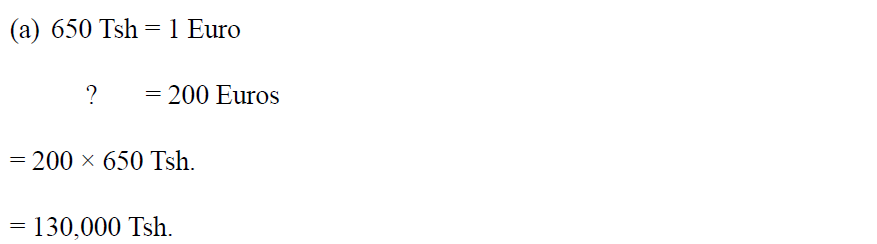
∴ The tourist got 130,000 Tsh.
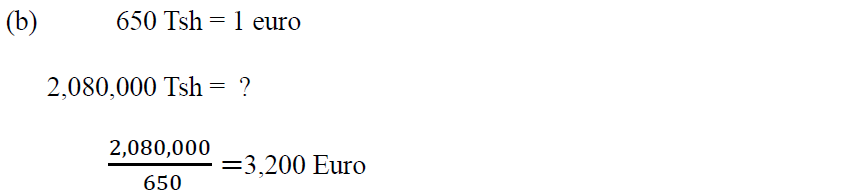
∴ She got 3,200 Euros.
Example 6
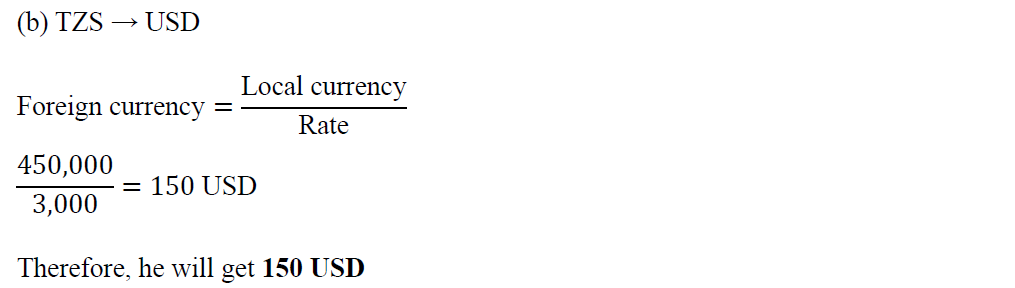
Assuming that the exchange rate is 1 USD = 3,000 TZS. (a) How many Tanzanian shillings will Asha get for 50 USD she has? (b) How many US dollars John will get for 450,000 TZS he has?
Solution:
Example 7
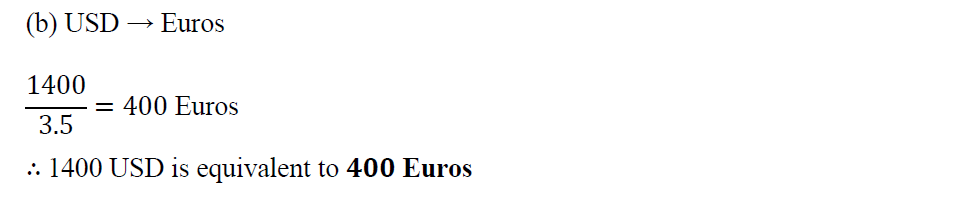
Given that the exchange rate is 1 Euro = 3.5 USD. (a) Convert 100 Euros to USD. (b) Convert 1400 USD to Euros.
Solution:
(a) Euros → USD, this implies 100×3.5=350 USD
∴ 100 Euros is equivalent to 𝟑𝟓𝟎 USD
Example 8
1 USD = 110 Japanese Yen. If a person wants to exchange 5,000 Yen to USD, how much USD will he get?
Solution:
USD=5,000÷110 ≈ 45.45 USD
Therefore, a person will get 45.45 USD
NB: The rate of exchange between two countries varies from time to time.
Exercise 2
1.At a certain time, there were 600 Tsh to one US dollar ($).(a) change $ 720 to Tsh.(b) Change 540,000 to dollars.
2.There are 560 Tsh to 100 Japanese Yen (Ұ).(a) Convert 2,500 Ұ to Tsh.(b) Convert 70,000 Tsh to Japanese Yen (Ұ).
3. A business man in Nigeria exchanges $ 4,500 for 630,000 naira.(a) What is the exchange rate in naira per dollar?(b) At this rate, how many naira could be obtained for $ 6,200?(c) At this rate, how many dollars can be obtained for 700,000 naira?
4. The exchange rate is 1 USD = 2,800 TZS. (a) How many shillings will you get for 75 USD? (b) How many dollars can you get for 140,000 TZS?
5. The exchange rate is 1 Euro = 3,200 TZS. (a) Convert 60 Euros to Tanzanian shillings. (b) Convert 192,000 TZS to Euros.
6. The exchange rate was 1 USD = 2,499 TZS. (a) How many shillings were equal to 120 USD? (b) How many dollars would be obtained from 372,000 TZS?
Stady Table 1.1 carefully, and then answer question 7 up to 12.
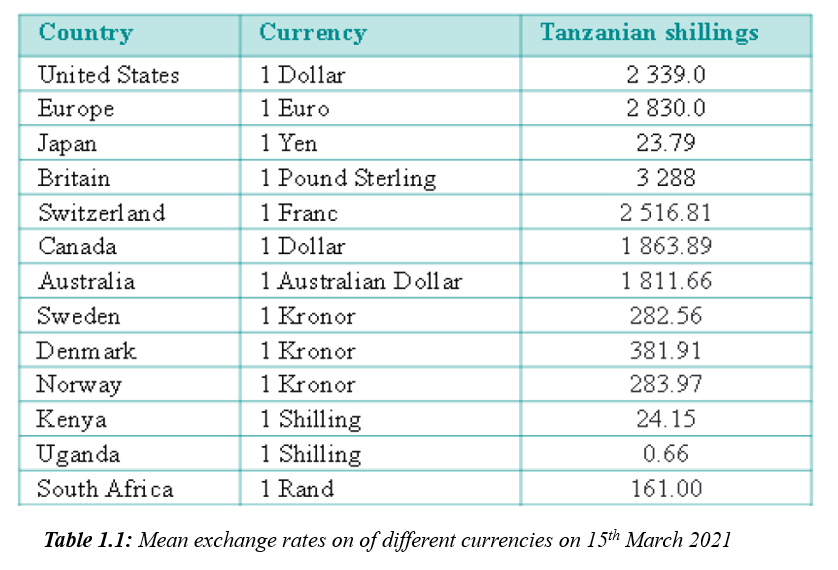
7. From table 1.1, how much was Tsh 300,000 worth in South Africa Rands?
8. How much Tanzanian shillings could be exchanged to get 50,000 Kenyan Shillings?
9. How many Japanese Yen ware equivalent to 200,000 Tanzanian shillings?
10. What was the strongest and weakest currency among the indicated currencies?
11. How much was 1 USD worth in Ugandan shillings?
12. How many were 40 Australian Dollar worth in Switzerland Francs?
Variations
Variation is a Mathematical concept that explains how one quantity changes in relation to another quantity. It describes the relationship between variables and shows how a change in one variable affects another.In variation, quantities are connected by a constant number called the constant of variation.
The concepts of variations and solve the related problems.
Quantities That Depend on Each Other
Direct, Inverse and Joint Variation
Describe the concepts ofvariations and solve therelated problems.
Some quantities are connected in such a way that they increase and decrease together at the same rate. For example, if one quantity is doubled the other quantity is also doubled. Such quantities are said to be varying directly proportional to each other.
Definition:Variation describes how one quantity changes in relation to another quantity, so it shows the relationship between two or more quantities.
Types of Variations
Basically, there are three types of Variations, namely:(i) Direct variations (ii) Inverse variations and (iii) Joint variations.
(1) Direct variations
Direct variation is when one quantity increases or decreases in the same proportion as another quantity.
For example, if a car is driven at a constant speed, the distance it goes is directly proportional to the time taken. Also, the amount of maize you buy is directly proportional to the amount of money you spend.
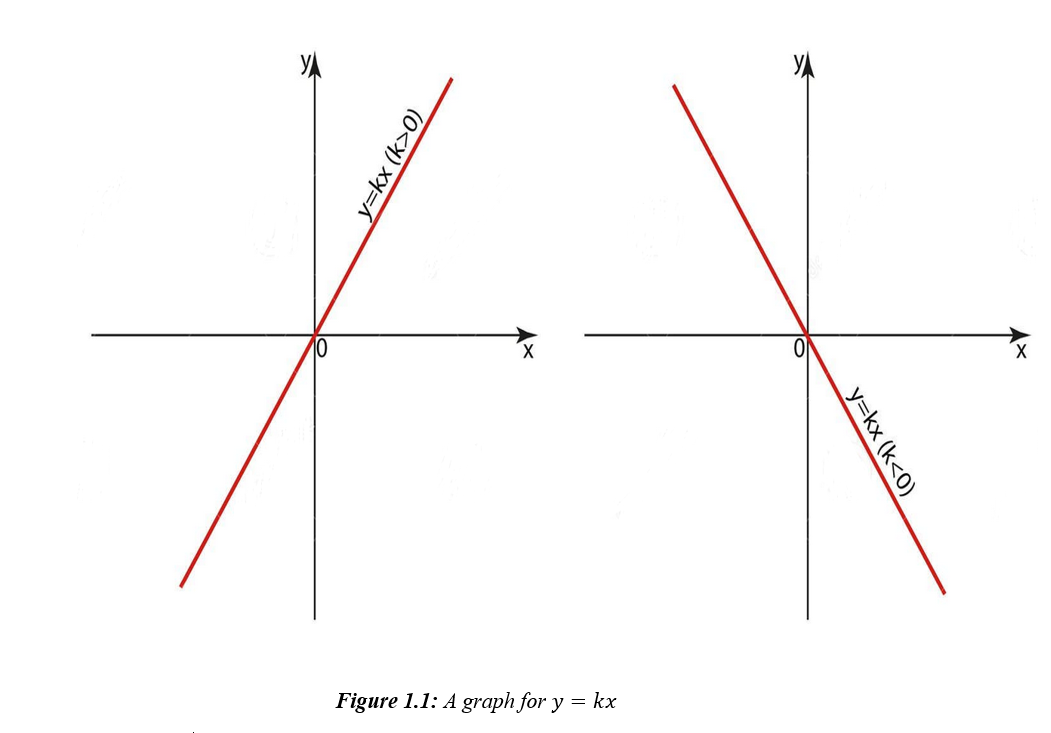
In mathematics, if 𝑥 and 𝑦 are two quantities which are such that 𝑦 varies directly as 𝑥, then we write 𝒚∝𝒙 or 𝒚=𝒌𝒙.
Where ∝ is the symbol for proportionality and k is the proportionality constant.Therefore 𝒚∝𝒙 (read as y is directly proportional to x) is equivalent to 𝒚=𝒌𝒙.The value of k is obtained by (dividing y by x), that is 𝑘=𝑦/𝑥.
Note that 𝑦=𝑘𝑥 is the equation of a straight line passing through the origin as shown in figure 1.1 below.
Example 9
Suppose different weights are hung from a wire. The extension of the wire is proportional to the weight hanging.If a weight of 2kg gives an extension of 5cm, find an equation giving the extension 𝑒 cm in terms of weight w kg and hence find the weight for an extension of 3cm.
Solution:
From the statement above, 𝑒 ∝ w
So, 𝑒 = 𝑘𝑤 or k = 𝑒/𝑤
But e = 5cm when w = 2kg, this means k = 5/2 = 2.5k= 2.5
∴ 𝑒/𝑤 = 2.5 or 𝑒 = 2.5𝑤
Now e = 3cm, w =?
Again e = w x 2.5, this implies 3 = 2.5 x w
W = 3/2.5 = 1.2 kg
∴ A weight of 1.2kg gives an extension of 3cm.
Example 10
Given that y is directly proportional to x such that, when x = 40, y = 5. Find an equation giving y in terms of x and use it to find (a) y when x = 15 (b) x when y = 20.
Solution:
y ∝𝑥 or 𝑦=𝑘𝑥, this gives k= 𝑦/𝑥
But when x = 40, y = 5; so k= 5/40 = 1/8
∴ The equation is y = (𝟏/𝟖)𝒙 or y =𝒙/𝟖
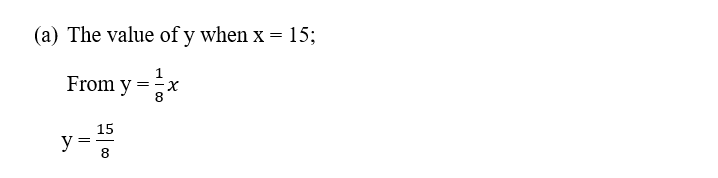
∴ When x = 15, y = 𝟏𝟓/𝟖

∴ When y = 20, 𝑥 =160.
Example 11
The distance 𝑑 traveled by a car is proportional to the time 𝑡 taken and when the time is 4 hours, the distance traveled is 240 km.(a) Find an equation connecting 𝑑 and 𝑡(b) Find the distance traveled in 7 hours.
Solution:
(a) An equation connecting 𝑑 and 𝑡:
Since 𝑑 is proportional to 𝑡, then 𝑑∝𝑡 or 𝑑=𝑘𝑡
but d=240 when t =4, so 240 = k(4) or k=240/4 = 60
Now k=60 implies d=60t
Therefore, the equation connecting 𝑑 and t is 𝐝=𝟔𝟎𝐭.
(b) The distance travelled in 7 hours:
From the equation d=60t, 𝑑=60×7=420
Therefore, the distance traveled in 7 hours is 420 km.
Exercise 3
1. If 𝑦 varies directly as 𝑥 and 𝑦=12 when 𝑥=3, find 𝑦 when 𝑥=7.
2. M varies directly as 𝑁. If 𝑀=15 when 𝑁=5, find the equation connecting M and N and hence the value of N when 𝑀=35.
3.Given that 𝑦 varies directly as 𝑥. If 𝑦=3.6 when 𝑥=0.6, find:(a) The formula connecting the two variables (b) 𝑦 when 𝑥 = 2.
4. The cost of apples varies directly as their mass. If 3 kg costs Tsh 6,000, what is the cost of 5kg ?.
5. The variables m and n are directly proportional to each other such that when m = 3, n = 12.(a) Find an equation giving m in terms of n (b) Find m when n = 18 (c) Find n when m = 15.
6. The mass m kg of a piece of metal is proportional to its volume Vm3. The mass of 0.2m3 is 210 kg. Find:(a) The equation connecting m and v (b) The volume of 14kg of the metal (c) Draw the graph of m against v.
7. The mass 𝑀of a sphere varies directly as the cube of its radius 𝑟. If 𝑀=54kg when 𝑟=3cm, find: (a) The formula connecting M and r (b) The mass when 𝑟 = 5cm.
8. The distance 𝑑 traveled varies directly as time 𝑡. If a car travels 120 km in 2 hours, find:(a) The equation connecting d and t (b) The distance it travels in 5 hours (c) How long will it take to travel 300 km?
(2) Inverse variations
In some cases, one quantity increases at the same rate as another decrease. For example, if the first quantity is doubled, the second quantity is halved. In this case the quantities vary inversely, or they are inversely proportional.
In short, inverse variation is when one quantity increases while the other decreases.
For example, the number of men employed to dig a field is inversely proportional to the time it takes, also, the time to travel a journey is inversely proportional to the speed.
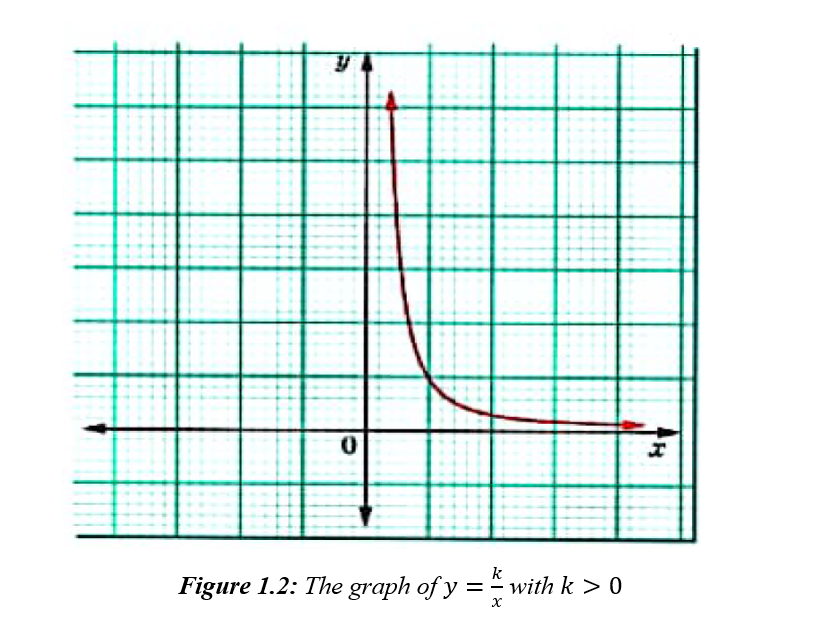
We use the same symbol (∝) for inverse proportionality and write 𝑦 is inversely proportional to 𝑥 as 𝑦∝1/𝑥 or 𝑦=𝑘/𝑥.
Here the value of 𝑘 is given by 𝑥𝑦, that is 𝑘=𝑥𝑦.
Note that the equation representing the inverse variation ( 𝑦=𝑘/𝑥 ) is not a straight line as that of direct variation. The graph of 𝑦=𝑘/𝑥 when the value of k is greater than zero (when k is positive) is shown in figure 1.2.
Example 12
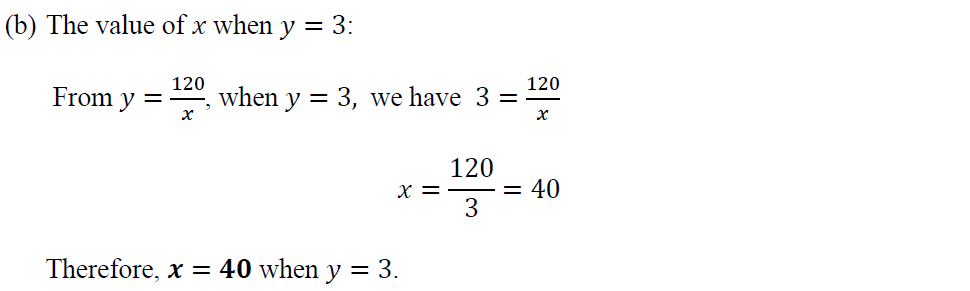
Given that y is inversely proportional to x, such that x = 8 when y = 15. Find the formula connecting x and y by expressing y in terms of x and use it to find:(a) y when x = 10 (b) x when y = 3
Solution:
Since it is stated that 𝑦 is inversely proportional to 𝑥, then we can write 𝑦∝1/𝑥 or 𝑦=𝑘/𝑥
Now from 𝑦=𝑘/𝑥, 𝑘=𝑥𝑦
But 𝑥=8 when 𝑦=15; this implies that 𝑘=15×8=120
Substituting the value of k in 𝑦=𝑘/𝑥 gives 𝑦=120/𝑥,
Therefore, the formula connecting x and y is 𝒚=𝟏𝟐𝟎/𝒙.

Example 13
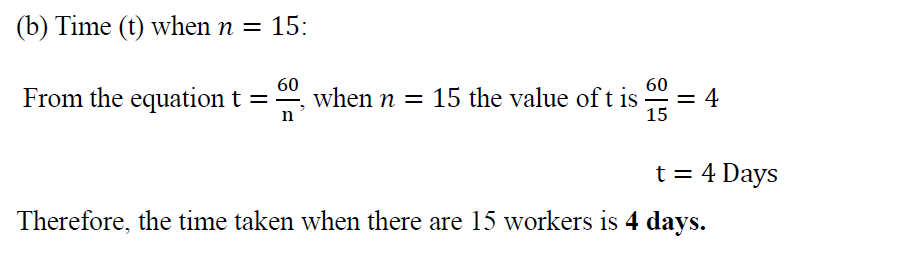
The time 𝑡 taken to complete a job varies inversely as the number of workers 𝑛.When 6 workers take 10 days to complete the job, find:(a) an equation connecting 𝑡 and 𝑛 (b) the time taken when there are 15 workers
Solution:
(a) an equation connecting 𝑡and 𝑛:
Since t varies inversely as n, then t∝1/n or t=k/n
Now, from 𝑡=𝑘/𝑛, 𝑘=𝑡𝑛
But 𝑡=10 days and 𝑛=6, so 𝑘=10×6=60, this gives t=60/n
Therefore, the equation connecting t and n is 𝒕=𝟔𝟎/𝒏.
Example 14
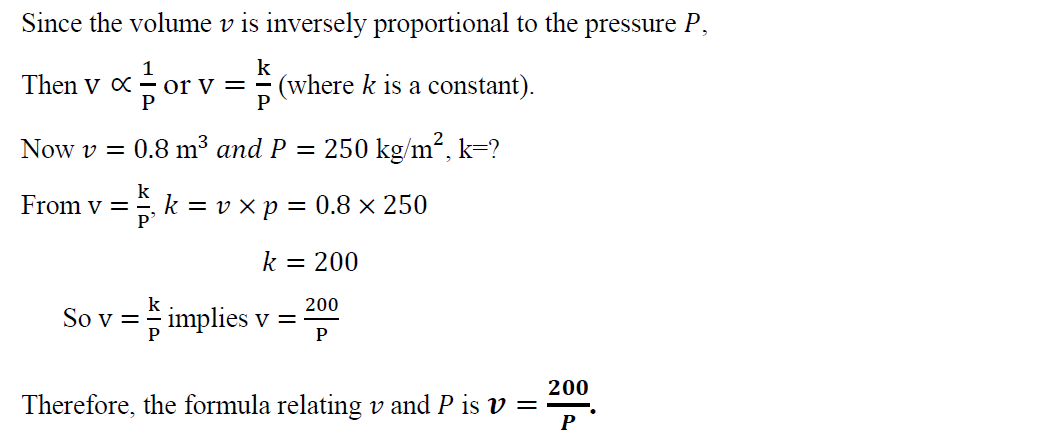
Suppose a mass of a gas is kept at a constant temperature. The volume of the gas is inversely proportional to its pressure. If the volume is 0.8m3 when the pressure is 250kg/m3, find the formula giving the volume Vm3 in terms of the pressure P kg/m2. What is the volume when the pressure is increased to 1,000kg/m2?
Solution:
Finding the volume when 𝑃=1,000 kg/m2:
From v=200P, when 𝑃=1,000 kg/m2, 𝑣=200/1,000=0.2
Therefore, Volume at 1,000 kg/m² pressure is 0.2 m³
Exercise 4
1. The quantities p and q are inversely proportional to each other such that when 𝑝 =1.2, q = 20. Find:
(a) The equation giving p in terms of q (b) q when p = 0.5 (c) p when q = 160
2. Given that y is inversely proportional to x such that when y = 6, x =7. Find the equation connecting x and y by expressing x in terms of y and hence find x when y = 36.
3. Given that 𝑦 varies inversely as 𝑥 and when 𝑥=4, 𝑦=6. Find: (a) 𝑦 when 𝑥=12 (b) 𝑥 when 𝑦=90.
4. It is stated that 𝑝 is inversely proportional to 𝑞 and if 𝑝=10, then 𝑞=3.Find 𝑝 when 𝑞=15.
5. The number of workers needed to repair a road is inversely proportional to the time taken. If 12 workers can finish the repair in 10 days, how long will 30 workers take?
6. The time taken to travel a fixed distance varies inversely as speed. If a car takes 5 hours at 60 km/h, how long will it take at 100 km/h?
7. Given that 𝑦 varies inversely as the square of 𝑥 and that when 𝑥=2, 𝑦=9. (a) Find the equation connecting 𝑦 and 𝑥 (b) Find 𝑦 when 𝑥=6
8.The resistance 𝑅 of a wire varies inversely as the cross-sectional area 𝐴. Two wires 𝑋 and 𝑌are made of the same material. If wire 𝑋 has resistance 12 Ω and area 4 mm², while wire 𝑌 has area 10 mm². Find:(a) The resistance of wire 𝑌(b) The ratio of the resistance of wire 𝑋 to wire 𝑌.
9. The pressure 𝑃of a gas varies inversely as the square of its volume 𝑉. When the volume is 5 m³, the pressure is 72 kPa. (a) Find the equation relating 𝑃and 𝑉 (b) Find the pressure when the volume is 12 m³ (c) Find the volume when the pressure is 8 kPa
(3) Joint variation
Joint variation occurs when a quantity depends on two or more other quantities at the same time, either directly, inversely, or a combination of both.
For example, if y = 3vu2, then y varies jointly with v and u2, also if p = 100𝑞/𝑟, then p varies jointly with q and the inverse of r.
Example 15
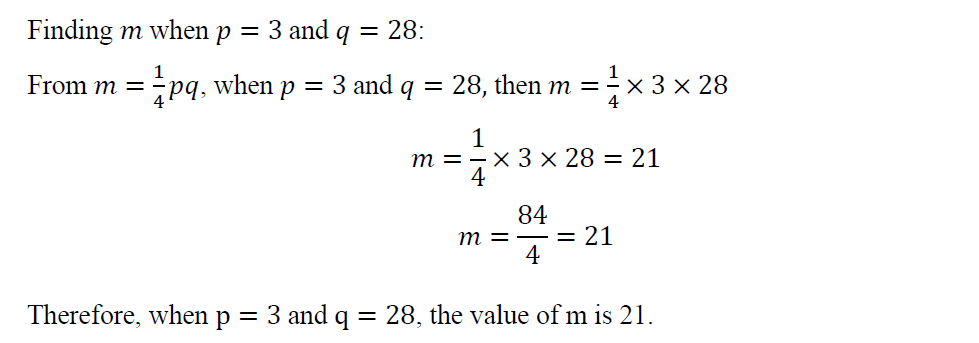
Suppose that m varies jointly with p and q such that when p = 12 and q = 5,then m = 15. Find m in terms of p and q and hence find m when P = 3 and q = 28.
Solution:
m varies jointly with p and 𝑞 means 𝑚∝𝑝×𝑞 or 𝑚=𝑘⋅𝑝⋅𝑞 (where 𝑘 is a constant).
Now 𝑚=15,𝑝=12, 𝑎𝑛𝑑 𝑞=5; so 15=𝑘⋅12⋅5, this implies 15=60𝑘
𝑘=15/60=1/4 and substituting 𝑘=1/4 in 𝑚=𝑘⋅𝑝⋅𝑞 gives 𝑚=(1/4)𝑝𝑞 or 𝑚=𝑝q/4
Therefore, m in terms of p and q is given as 𝒎=𝒑𝒒/𝟒
Example 16
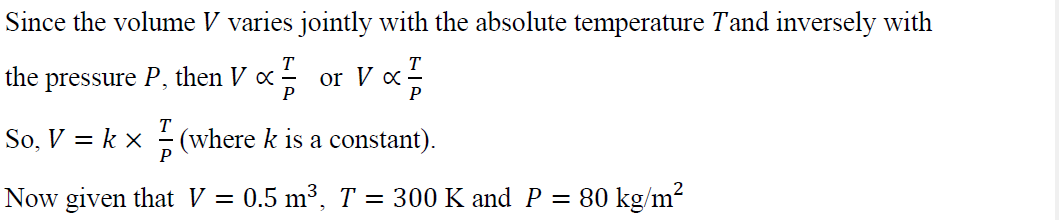
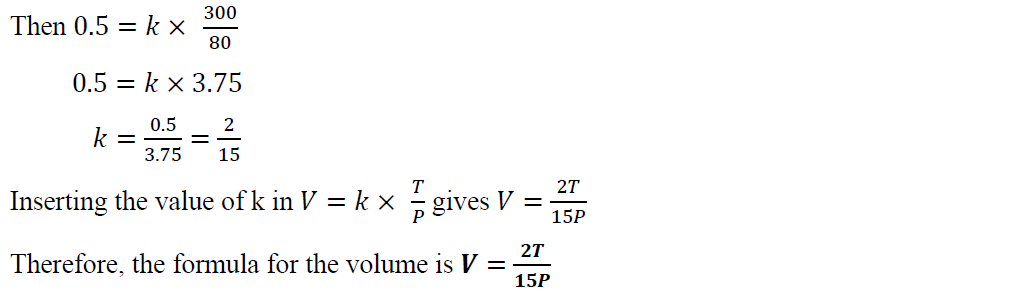
Suppose a mass of a gas with volume Vm3 is under pressure P kg/m2 and has absolute temperature T0. The volume of the gas varies jointly with its absolute temperature and inversely with its pressure. At a temperature of 300 k and pressure of 80kg/m2, the volume is 0.5m3. Find the formula for the volume in terms of T and P.
Solution:
Example 17
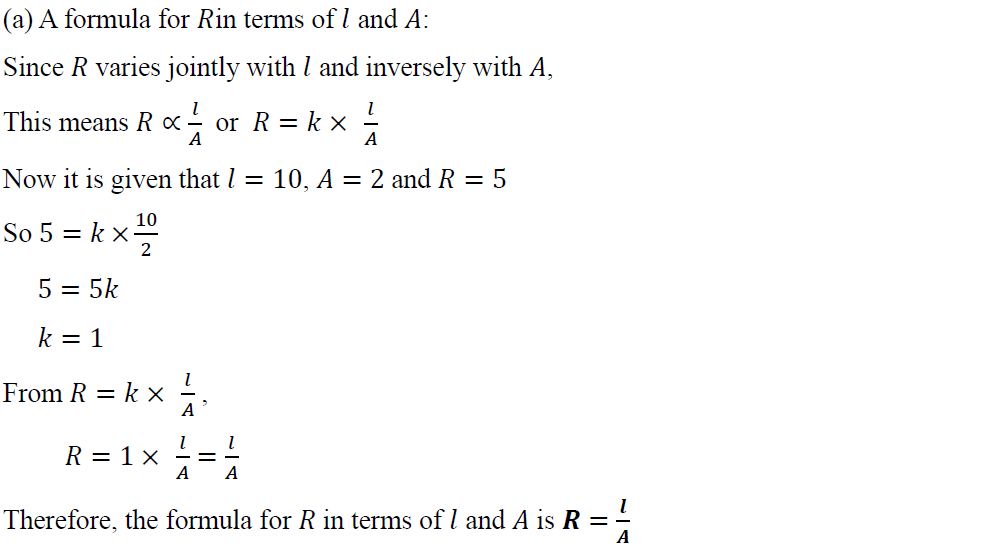
The electrical resistance 𝑅 of a wire varies jointly with its length 𝑙 and inversely with its cross-sectional area 𝐴,when 𝑙=10𝑚 and 𝐴=2𝑚𝑚2, the resistance 𝑅=5Ω.
Find:(a) A formula for 𝑅 in terms of 𝑙 and 𝐴 (b) The resistance when 𝑙=45m and 𝐴=5 mm2
Solution:

Proportion to Powers
Sometimes a quantity is proportional to a power of another quantity. For example, the area A of a circle is proportional to the square of its radius r, so A ∝ r2 or A= kr2.
The constant of the above equation is 𝜋 whose value is 22/7 or 3.142 and hence A= 𝜋r2.
Sometimes a quantity is inversely proportional to a power of another quantity.
For example, Newton’s law of gravity states that the force of attraction (F) between two bodies is inversely proportional to the square of the distance d between them, So F∝1/𝑑2 or F=𝑘×1/𝑑2.
Example 18
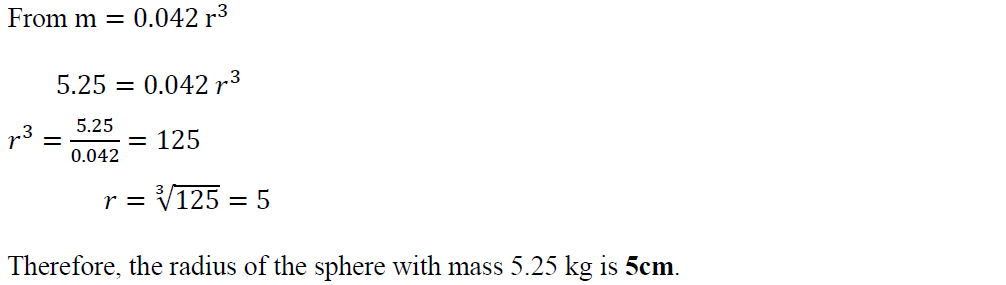
The mass of spheres of a certain metal is proportional to the cube of their radii. A sphere of radius 10cm has mass 42kg. Find the formula giving the mass m kg in terms of radius r cm. Find the radius of the sphere with mass 5.25 kg.
Solution:
Since the mass 𝑚 is proportional to the cube of the radius 𝑟, then 𝑚∝𝑟3 or 𝑚=𝑘𝑟3 (where 𝑘 is a constant).
But 𝑚 =42kg when 𝑟=10cm, so 42=𝑘(10)3 or 42=1000𝑘
This gives 𝑘=42/1000 or 𝑘=0.042
Substituting the value of k in m=kr3, gives m=0.042r3
Therefore, the formula for the mass in terms of radius r is 𝐦=𝟎.𝟎𝟒𝟐𝐫𝟑
Find the radius when the mass is 5.25kg:
Example 19
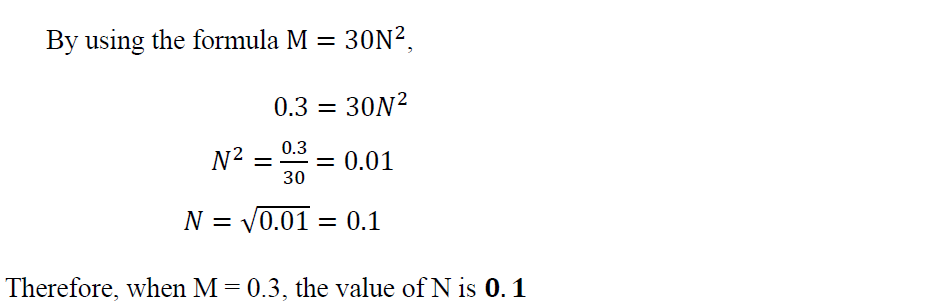
Given that M is proportional to the square of N and when N = 0.3, M = 2.7. Find the equation giving M in terms of N, and hence find the value of:(a) M when N = 1.5 (b) N when M = 0.3
Solution:
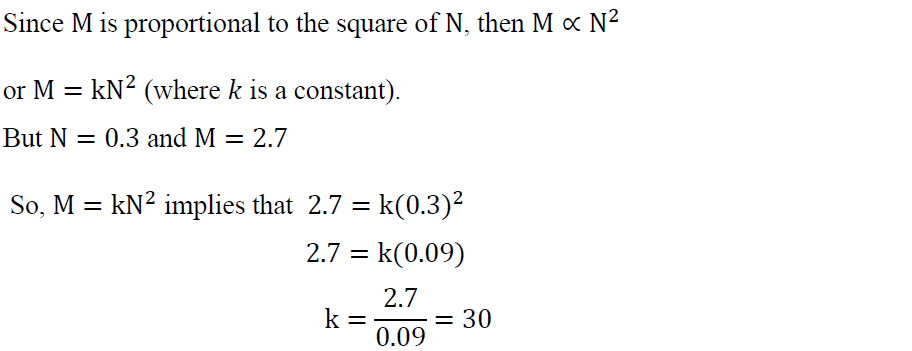
The equation relating M and N:
From M=kN2, M=30N2 (because k=30)
Therefore, the equation giving M in terms of N is 𝐌=𝟑𝟎𝐍𝟐
(a) Finding M when N=1.5:
From M=30N2, 𝑀=30(1.5)2=30(2.25)=67.5
Therefore, when N = 1.5, the value of M is 𝟔𝟕.𝟓.
(b) Finding 𝑁 when 𝑀=0.3:
Exercise 5
1. Given that 𝑦 varies jointly as 𝑥 and 𝑧, and that when 𝑥=4, 𝑧=5, 𝑦=40. Find 𝑦 when 𝑥=10 and 𝑧=6.
2. P varies jointly as Q and R. When Q=2, R=3, P=18.(a) Find the formula connecting 𝑃, 𝑄, and 𝑅.(b) Find 𝑃when 𝑄=6and 𝑅=5.
3. The mass M (kg) of a solid wooden cylinder varies with the height h (m) and with the square of the radius r (m). If v = 0.2 and h = 1.4, then M = 150 Kg. Find M in terms of h and r.
4. Given that B varies jointly with A and the inverse of C. When A = 3 and C = 12 then B =20 Find: (a) B in terms of A and C (b) B when A = 8 and C= 2.
5.The force 𝐹 varies jointly as the mass 𝑚 and the square of velocity 𝑣.When 𝑚=5kg and 𝑣=4m/s, 𝐹=160N. (a) Find the equation connecting 𝐹, 𝑚, and 𝑣 (b) Find 𝐹 when 𝑚=8kg and 𝑣=6m/s
6. The volume 𝑉of a gas varies jointly as the temperature 𝑇and the mass 𝑚, and inversely as the pressure 𝑃. When 𝑇=300K, 𝑚=4kg, 𝑃=200 kPa and 𝑉=6m³. Find the volume when 𝑇=450K, 𝑚=6kg, and 𝑃=300 kPa.
7. The frequency f of a piano wire varies jointly with the square root of the tension T and the inverse of the length L. A wire with a frequency of 260 cps has length 1.2m and tension 700N. What is the formula giving f in terms of T and L?
8. The gravitational force 𝐹 between two bodies varies jointly as the product of their masses 𝑚1 and 𝑚2, and inversely as the square of the distance 𝑟, and directly as the gravitational constant 𝐺. When 𝑚1=4 kg, 𝑚2=10 kg, 𝑟=5 m and 𝐺=6.25, the force is 10 N. Find the force when 𝑚1=8 kg, 𝑚2=12 kg, 𝑟=10 m 𝑎𝑛𝑑 𝐺=6.25.
Listening to this topic