Mathematics (New)
SETS
Reading settings
Text size
Line spacing
Colours
SETS
A set is a well-defined collection of distinct objects, numbers, or items treated as a single group. Usually, we represent sets by capital letters, and the objects in a set (elements or members) are written inside curly brackets { }, for example, A={1,2,3,4} or B={a,e,i,o,u}.
Sets form an important foundation in mathematics and logic because they help organize and analyze information clearly and are widely used in areas such as probability, statistics, algebra, and computer science.
In general, sets help us group objects in a clear and systematic way and study relationships between different collections of items.
CONTENTS:
Under this topic you will cover the following four broad concepts about Sets:
(i) Concept of Sets (ii) Types of Sets (iii) Operations on Sets and (iv) Venn Diagrams
COMPETENCIES:
Upon completion of this chapter, you should develop several important competencies, including:
(a) Understanding the Concept of Sets
Ability to define a set and identify its elements or members.
(b) Representing Sets
Ability to represent sets using different methods such as the roster (listing) and the set-builder methods.
(c) Classifying types of Sets
Identifying different types of sets such as empty sets, finite sets, infinite sets, and equal sets.
(d) Using set Notation and Symbols
Familiarizing with common symbols such as ∈ (element of), ∪ (union) and ∩ (intersection).
(e) Performing Operations on Sets
Finding the union, intersection, and complements of sets.
The competencies developed will enable you to use sets to organize information and solve mathematical and real-life problems.
Concept of a set
Definition:
A set is defined as a collection of objects called elements or members which are clearly specified and do not repeat.
The basic tenets of sets.
What Is a Set?
Sets: Review
Explore the basic tenets of sets.
In mathematics, sets are usually denoted by capital letters, and its members (elements) are listed in a curly bracket { } and separated by commas. For example, if 𝐴={1,2,3}, then 1, 2, and 3 are elements or members of the set 𝐴.
The elements of a set may be listed in any order, but no element is allowed to appear more than once. When alphabetic symbols are used, the elements are written in lowercase letters, for example 𝑆𝑒𝑡 B = {𝑎, 𝑏, 𝑐, 𝑑}.
Membership of elements in a set can be shown using notation such as 1∈𝐴, 2∈B, and so on, which means 1 is an element of set A and 2 is an element(or member) of set B.
Order of Sets:
The order of a set refers to the total number of elements it contains and therefore indicates the size of the set. This order is also called the Cardinality of the set.
Depending on whether a set has a limited or unlimited number of elements, it is described as having finite order or infinite order, respectively.
For example, if 𝑆𝑒𝑡 B = {𝑎, 𝑏, 𝑐, 𝑑, e}, the number of elements in B denoted by n(B) = 5.
Methods of Representing Sets:
Writing and Representing Sets
The common methods used to represent sets include the descriptive (or statement) form, the roster (or listing) form, and the rule-based or set-builder notation.
Descriptive Method:
In this method, a set is described in words and written inside curly brackets. For example, the set of positive even numbers less than or equal to 20 is written as 𝐴={positive even numbers less than or equal to 20}.
Listing (Roster) Method:
In this method, a set is represented by writing its elements inside curly brackets, with commas separating them. For example, the set of all factors of 42 is expressed as 𝐵={1,2,3,6,7,14,21,42 }.
Set Builder Notation:
The set-builder method is a way of representing a set by stating the rule or condition that all its elements must satisfy, rather than listing the elements one by one.
It is written in the form 𝐴={𝑥: condition on 𝑥}, which means “the set of all 𝑥 such that the given condition is true. For example, if C is the set of positive even numbers less than 20, then C can be written as 𝐶={𝑥: 𝑥 = 2n, where n = 1, 2, 3….., 9}.
Example 1
Given that 𝐴 is a set of odd numbers between 1 and 10, describe set A by using:
(a) Listing method (b) By set builder.
Solution:
(a) Listing (Roster) Method: 𝐴={1,3,5,7,9}.
(b) Set-Builder: 𝐴={𝑥:𝑥=2𝑛−1,𝑤ℎ𝑒𝑟𝑒 𝑛=1,2,3…5}.
Example 2
Describe the set of all vowels in the word “EQUATION” by roster method.
Solution:
The word 'EQUATION' has vowels A, E, I, O and U, therefore the set of vowels in the word ‘EQUATION’ is { 𝐴,𝐸,𝐼,𝑂,𝑈 }.
Example 3
Given that D = {2, 4, 6, 8, 10, 12, 14, 16} find the cardinality of set D.
Solution:
The cardinality of set D is the total number of elements in set D, thus |𝐷|=𝑛(𝐷)=8.
Example 4
If A = {x: x is a positive integer less than 15}, then find n(A).
Solution:
Since set A contains integers less than 15, then A = {1, 2, 3, 4, 5, 6, 7, 8, 9, 10, 11, 12, 13, 14}, hence 𝑛(𝐴)=14.
Exercise 1
1. Describe each of the following sets by using roster method.
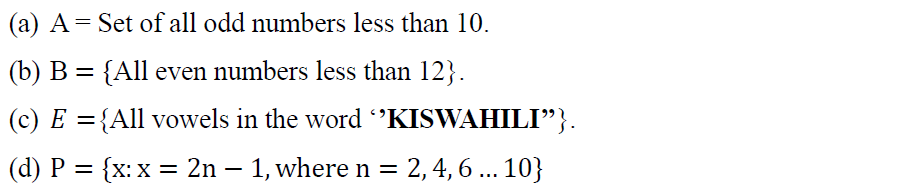
2. Write each of the following sets in statement form:

3. Describe each of the following sets by using Set-Builder Method.
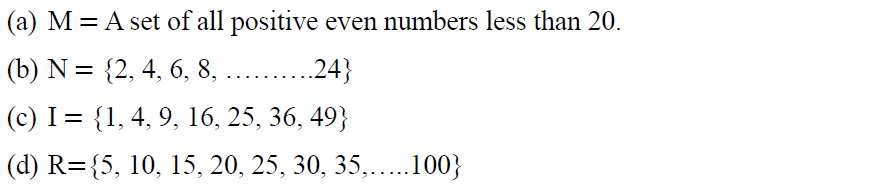
4. How many elements does each of the following sets contain?

Types of Sets
In set theory, sets can be grouped into various categories according to the nature of their elements and how they relate to one another. Below are the common types of sets, each explained clearly with examples.
The different types of sets and their Subsets
Types of Sets
Explore the different types of sets and their Subsets.
(1) Finite Set:
This is a set containing a countable number of elements. For example, if B = {x: x is an integer and 10 < x < 20}, in this case the elements of set B are 11, 12, 13, 14, 15, 16, 17, 18 and 19, thus 𝑛(𝐵)=9 and therefore B is finite set.
(2) Infinite Set:
This is a set containing uncountable number of elements. For example, set C = {1, 2, 3, 4, …}.
(3) Empty (or Null) Set:
This is a set with no elements, and it is denoted by ∅ or { }. For example, a Set of months with 10 days = ∅, because there is no month with only 10 days. The cardinality of the empty set is 0.
NB: It is important to note that 𝐶={ } is different from 𝐶={ 0 }, this is because when 𝐶={ } then 𝑛(𝐶)=0, but when 𝐶={ 0 } then 𝑛(𝐶)=1.
(4) Singleton Set:
This is a set with only one element. For example, set A = { -3 }is a singleton set.
Comparison of Sets
When two or more sets are compared to each other, then they are either equal, equivalent or one is a subset of the other.
(5) Equal Sets:
These are two or more sets that contain exactly the same elements, regardless of the order of their elements. For example, if A = {1, 2, 3} and B = {3, 2, 1}, then A = B.
(6) Equivalent Sets:
These are sets that have the same number of elements, but not necessarily the same elements.
For example, if A = {a, b, c} and B = {1, 2, 3}, then set A is equivalent to set B. In general, if two sets (A and B) are such that n(A) = n(B), then A and B are equivalent sets. We write 𝐴≡𝐵 to mean set A is equivalent to set B.
Example 5
Show that A = {1, 3, 5} and B = {Dog, Goat, Cow} are equivalent sets.
Solution:
Since n(A) = 3 and n(B) = 3, then A and B are equivalent sets.
(7) Subsets:
A subset is a set whose elements are all contained in another set.
Notation: A subset is denoted by a symbol ⊂𝑜𝑟 ⊆. For example, if A = {1, 2} and B = {1, 2, 3}, then A ⊂ B, because all elements in set A are also in set B.
Proper and Improper Subsets
(a) Proper Subsets: A set say A is called a proper subset of set B if all elements of A are in B, and A is not equal to B. A is a proper subset of B is denoted by 𝐴⊂𝐵.
For example, if 𝐴={𝑎,𝑏} and 𝐵={𝑎,𝑏,𝑐}, then every element of A is in B, and 𝐴≠𝐵. Therefore 𝐴⊂𝐵 (A is a proper subset of B).
(b) Improper Subsets
An improper subset is a subset that is exactly equal to the original set. In other words, every set is an improper subset of itself, because all of its elements are contained within it.
Thus, if A and B are two given sets such that A and B have the same elements, then either A is a subset of B or B is a subset of A. We write 𝐴⊆𝐵 to mean A is an improper subset of B. For example, if 𝐴={1,2,3,4,5} and 𝐵={1,2,3,4,5}, then 𝐴=𝐵 and hence 𝐴⊆𝐵.
Example 6
List all subsets of set A, where A = {1, 2}.
Solution:
The subsets of A = {1, 2} are: ∅ (empty set) {1}, {2} and {1, 2}.
Example 7
What are the subsets of set B, where B = {a, b, c}?
Solution:
The subsets of set B are: ∅, {a}, {b}, {c}, {a, b}, {a, c}, {b, c} and {a, b, c}.
Example 8
List all subsets of set C, where C = {1, 2, 3, 4}.
Solution:
The following are the subsets of set C:

Note that from examples 6, 7 and 8, we see that set A has 2 distinct elements, its number of subsets is 4, while set B has 3 distinct elements and its number of subsets is 8, similarly set C has 4 elements and 16 subsets.
Generally, the number of subsets of a set having n-elements is given by 2𝑛.
The following table is a summary of pattern observed in forming a number of subsets for a set having n-countable elements.
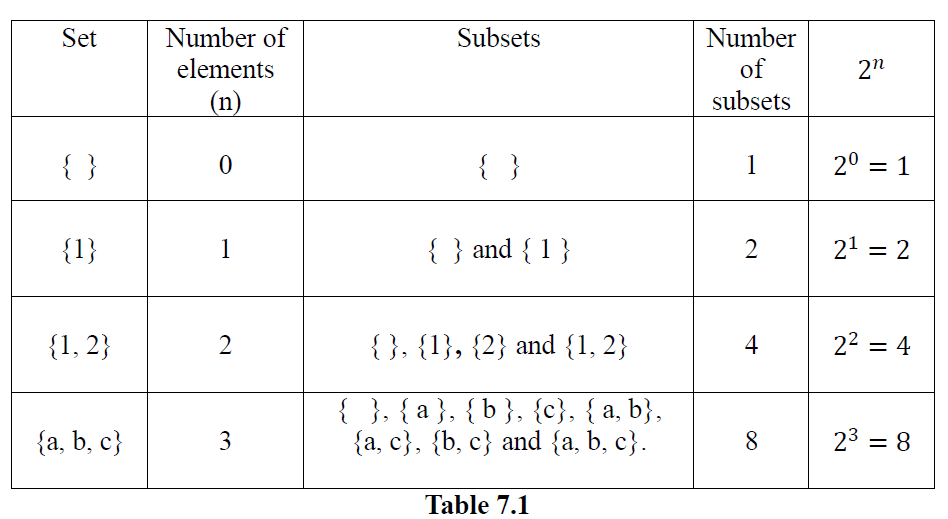
From table 7.1, the formula for number of subsets is 𝟐𝒏 where n is the number of elements of a given set.
Example 9
Given that B = {a, b, c, d, e}. How many subsets does set B have?
Solution:

Number of Proper Subsets
The number of distinct proper subsets of a set containing n elements is given by 2𝑛−1.
Example 10
Given that B = {a, b, c, d, e}. How many proper subsets does set B have?
Solution:
The number of proper subsets is given by 2𝑛−1=25−1=32−1=31;
∴ Set B has 3 proper subsets.
NB: Every Non-Empty Set has exactly ONE Improper Subset and ONE Empty Subset.
(8) Universal Set:
This is a set that contains all the members (elements) under consideration for any given problem. It is a big set which contain all other given sets.
The universal set is denoted by sign μ or sometimes by the symbol 𝜉 or the capital letter U, but any letter can represent the universal set provided that some description is given.
(9) Disjoint Sets:
These are sets that have no common elements. For example, sets 𝐴={1,3,5,7} and 𝐵={2,4,6,8} are disjoint sets because they have no element in common.
(10) Overlapping (Intersecting) Sets:
If two sets are non-disjoint sets, then they are joint sets and they are sometime called Overlapping or Intersecting Sets. The joint sets have a property that they have at least one element in common.
For example, sets 𝐴={−1,0,1,2,3,4,5,6,7} and 𝐵={2,4,6,8,10,12,14,16,18,20,22} are joint sets because they have some elements in common, that is 2, 4 and 6 are their common elements.
Exercise 2
1. For each of the following sets, state whether it represents an empty set or it is a finite set?

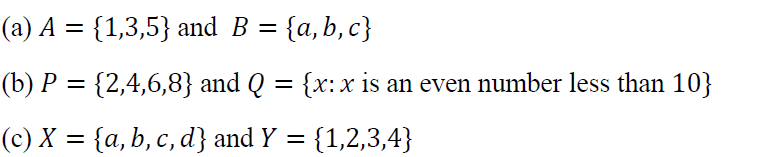
2. Determine whether the given pair of sets are equal (give a reason for your answer).

3. State whether the given pairs of sets are equivalent or equal sets.
Operations on Sets
Set operations are ways to combine or relate two or more sets to form new sets. In this part, the main operations we are going to discuss are Union of sets, Intersection between two or more sets and Complements of sets.
Perform different operations with sets (union, intersection, and complement of a set).
Operations on Sets
Union (∪) of Sets:
The union of two sets contains all elements that are in either set or in both sets.Hence the union between two set (A and B) denoted 𝐴∪𝐵 is defined as follows;
𝐴∪𝐵={𝑥:𝑥∈𝐴 𝑜𝑟 𝑥∈𝐵}, it is a new set whose elements are obtained by combining all elements from set A and B without repetition. For example, if 𝐴={1,2,3} and 𝐵={3,4,5} then 𝐴∪𝐵={1,2,3,4,5}.
Example 11
Given that 𝐴={𝑎,𝑏,𝑐} and 𝐵={𝑎,𝑏,3,4,5}, find 𝐴∪𝐵.
Solution:
𝐴∪𝐵={𝑎,𝑏,𝑐,3,4,5}.
Example 12
Given that 𝐴={−2,−1,0,1,2,3,4,5,6} and 𝐵={2,4,6,8,10,12,14,16}, find 𝑛(𝐴∪𝐵).
Solution:
𝐴∪𝐵={−2,−1,0,1,2,3,4,5,6,8,10,12,14,16}, which has 14 elements;
Therefore 𝑛(𝐴∪𝐵)=14.
Intersection (∩) of Sets:
The intersection of two sets contains only the elements common to both sets. Therefore, the Intersection of two sets (A and B) denoted by 𝐴∩𝐵 is new set formed by combining similar elements from set A and B. Mathematically, 𝐴∩𝐵={𝑥:𝑥∈𝐴 𝑎𝑛𝑑 𝑥∈𝐵}.
Example 13
Given that 𝐴={−2,−1,0,1,2,3,4,5,6} and 𝐵={2,4,6,8,10,12,14,16}, find 𝐴∩𝐵.
Solution:
𝐴∩𝐵 is a new set having elements common to both set A and set B;
Therefore, 𝐴∩𝐵={ 2,4,6}.
Example 14
Let P be a set of letters forming the word “EXAMINATION” and Q be a set of letters forming the word “RESULTS’’. Find 𝑛(𝑃∩𝑄).
Solution:
𝑃={ 𝐴,𝐸,𝐼,𝑀,𝑁,𝑂,𝑇,𝑋} and 𝑄={ 𝐸,𝐿,𝑅,𝑆,𝑇}, so 𝑃∩𝑄={𝐸,𝑇};
Therefore, 𝑛(𝑃∩𝑄)=2.
Complement of a Set:
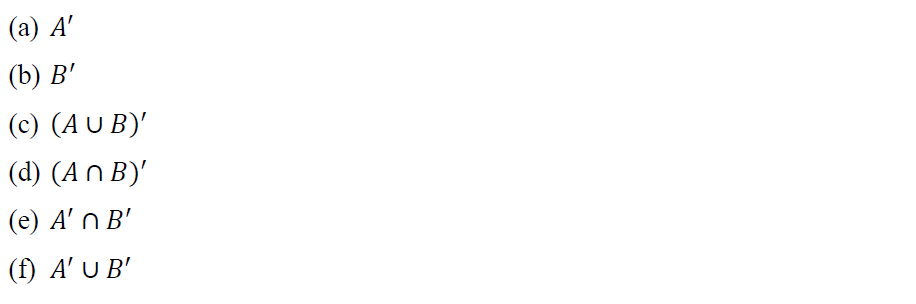
If A is any set, then its complement is defined as new set containing all elements not in 𝐴 but in the universal set 𝑈. The complement of set A is denoted by 𝐴′.
This is Mathematically written as 𝐴′={𝑥:𝑥∈𝑈 and 𝑥∉𝐴}. For example, if U={1,2,3,4,5} and A={2,3}, then A′={1,4,5}.
Example 15
Let 𝜇={ 2, 4, 6, 8, 10, 12, 14, 16, 18, 20, 22, 24, 26, 28, 30} and D={ 𝐴𝑙𝑙 𝑓𝑎𝑐𝑡𝑜𝑟𝑠 𝑜𝑓 24 }, find D′.
Solution:

Example 16
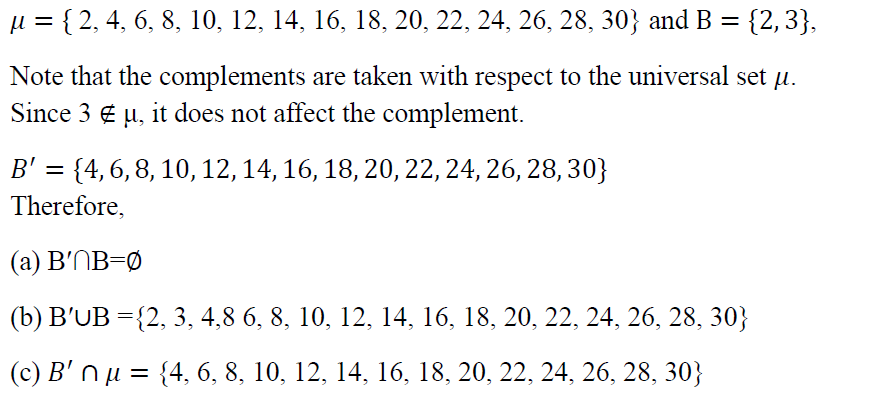
Given that 𝜇={ 2, 4, 6, 8, 10, 12, 14, 16, 18, 20, 22, 24, 26, 28, 30} and B={2,3}, find:

Solution:
Relationship Between Union and Intersection of Sets
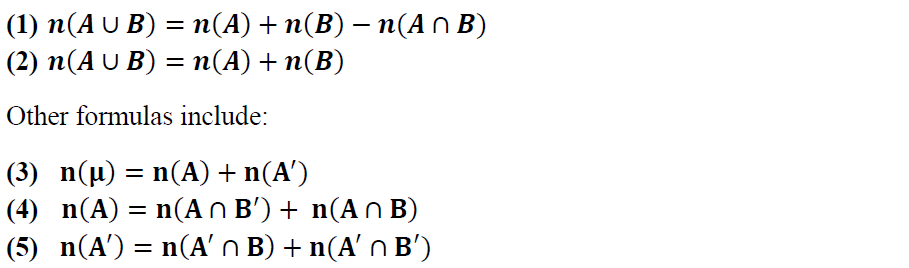
The number of elements of the union between two sets is given by a formula 𝑛(𝐴∪𝐵)=𝑛(𝐴)+𝑛(𝐵)−𝑛(𝐴∩𝐵), the formula applies when A and B are joint sets.
But when A and B are disjoint sets then they have no element in common and hence 𝑛(𝐴∩𝐵)=0, and so 𝑛(𝐴∪𝐵)=𝑛(𝐴)+𝑛(𝐵).
Therefore, the formulas involving number of elements in compound sets are as follows:
Example 17
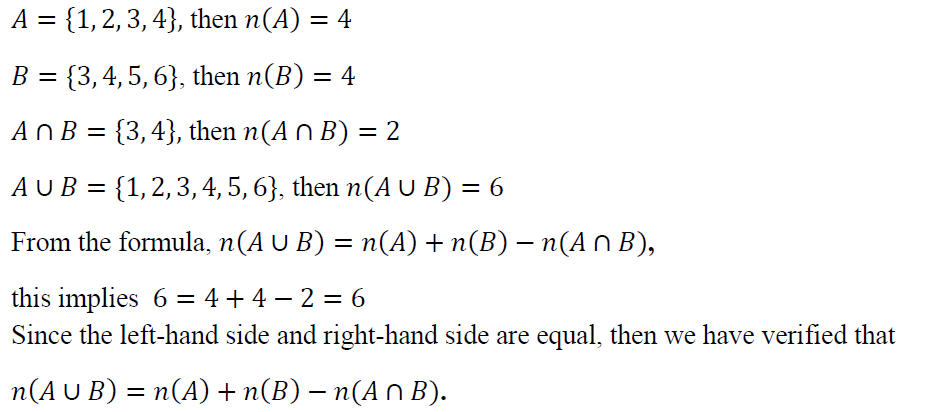
Let 𝐴={1,2,3,4} and 𝐵={3,4,5,6}. verify that 𝑛(𝐴∪𝐵)=𝑛(𝐴)+𝑛(𝐵)−𝑛(𝐴∩𝐵).
Solution:
Example 18
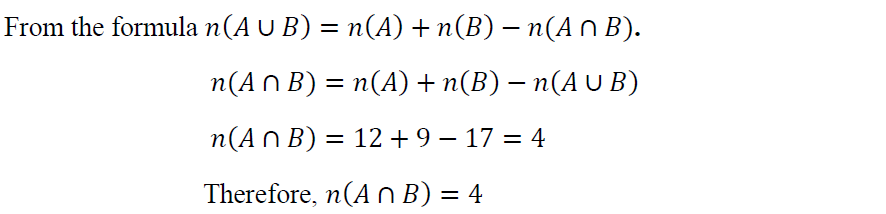
Given that A and B are two joint sets which are such that 𝑛(𝐴)=12, 𝑛(𝐵)=9 and 𝑛(𝐴∪𝐵)=17. Find 𝑛(𝐴∩𝐵).
Solution:
Example 19
In a class of 60 students, 27 like reading Mathematics and 42 like reading Physics, and each person likes reading at least one of the two subjects. How many like reading both Mathematics and Physics?
Solution:
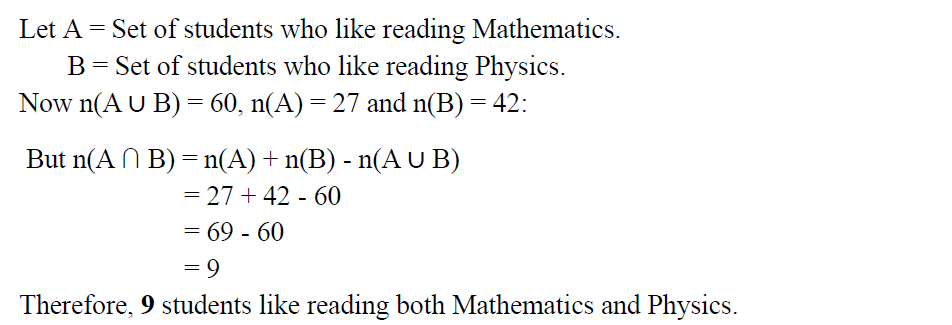
Example 20
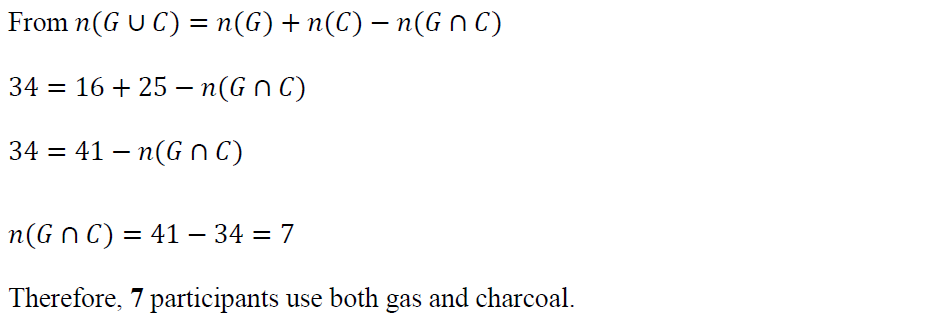
A total of 40 people attending the seminar were asked to describe the source of energy between gas and charcoal they use in cooking. Among them, 16 said they use gas, 25 use charcoal and 6 use neither charcoal nor gas. How many participants use both gas and charcoal?
Solution:
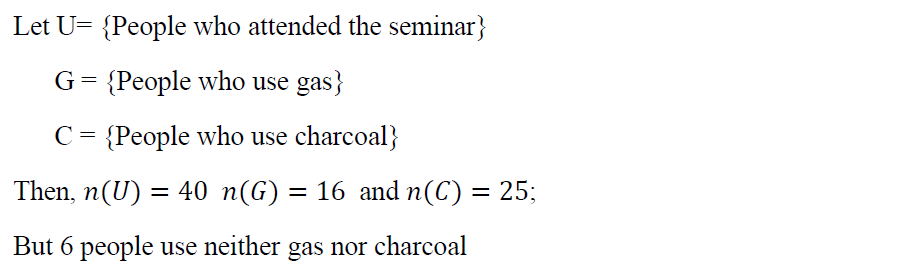
Now, the number of People who use gas or charcoal is given by 𝑛(𝐺∪𝐶)=40−6=34;
Example 21
In Mtakuja village with 500 residents, 300 are in the climate action group and 250 are in poverty alleviation group. If 180 are in both groups, how many residents are in each of the following categories?

Solution:
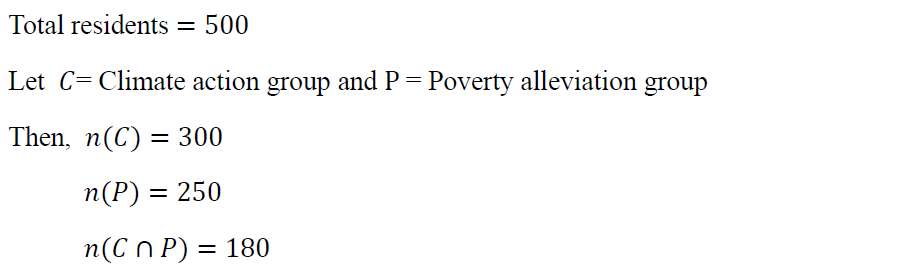
(a) Climate group only:

(b) Poverty alleviation group only:

(c) At least in one group:
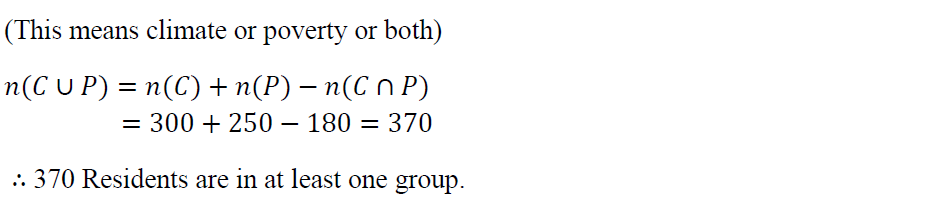
(d) Neither of the two groups:

Example 22
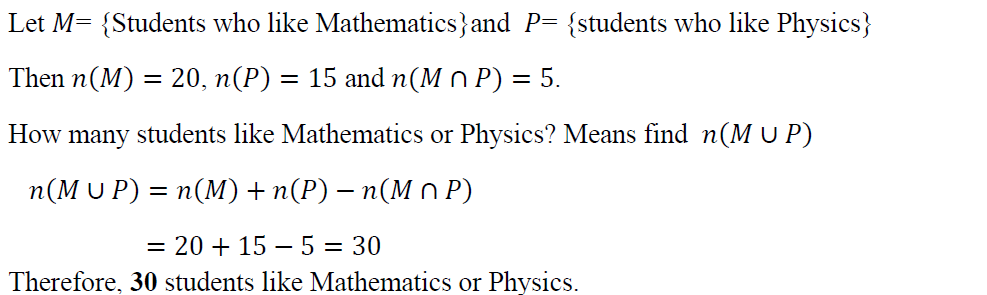
In a certain class 20 students like Mathematics, 15 like Physics and 5 like both subjects. How many students like Mathematics or Physics?
Solution:
Exercise 3
1. Given that A={All multiples of 3 between 20 and 30} and𝐵={All integers greater than 10}, find:

2. Let 𝑃={𝑥:𝑥 is a prime number less than 20} and 𝑄={1,3,5,7}, find:

3. Let 𝑃={𝑥:𝑥 is an even number less than 12} and 𝑄={1,3,5,7…..20}, find:

4. Let 𝜇={ 2, 4, 6, 8, 10, 12, 14, 16, 18, 20, 22, 24, 26, 28, 30}, A={All factors of 24} and 𝐵={3,4,5,6}. Find each of the following:
5. Write all singleton subsets of 𝑀={𝑎,𝑏,𝑐,𝑑,𝑒}.
6. Given that 𝑃={𝑥:𝑥 is a prime number less than 10} and 𝑄={1,3,5,7,9}:

7. Suppose that A and B are two joint sets which are such that 𝑛(𝐴)=8, 𝑛(𝐵)=10 and 𝑛(𝐴∩𝐵)=4, what is 𝑛(𝐴∪𝐵)?
8. Suppose that A and B are two disjoint sets which are such that 𝑛(𝐴)=8, 𝑛(𝐵)=7; Find:

Venn Diagrams
A Venn diagram is a visual tool that represents sets with circles and shows their connections through overlapping regions. They show what elements are in each set, what elements are common to two or more sets, and what elements are outside the sets.
In drawing Venn diagrams, rectangles are used to represent Universal sets, while ovals or circles are used to represents its subsets.
Representation of sets Using a Venn Diagrams
Procedures:
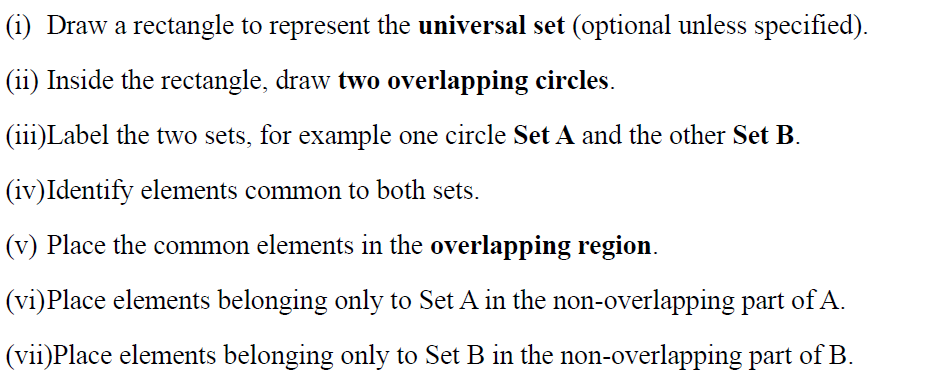
Represent different sets in a Venn diagram
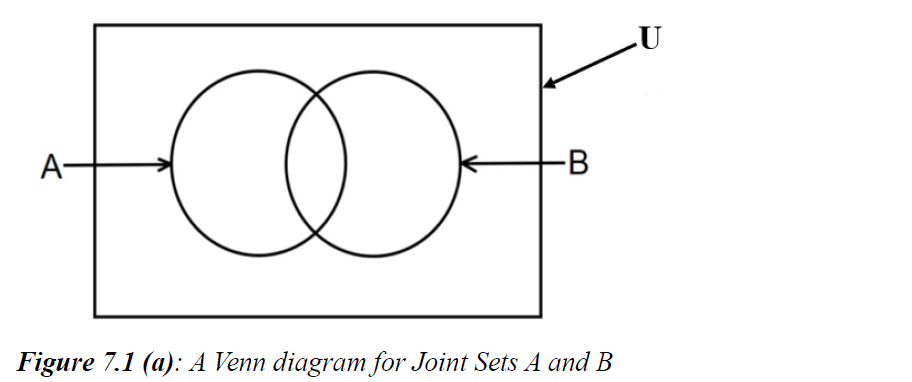
Venn diagram for Joint Sets
When representing joint sets using Venn diagram the common elements are placed in the overlapping region as seen in the figure below;
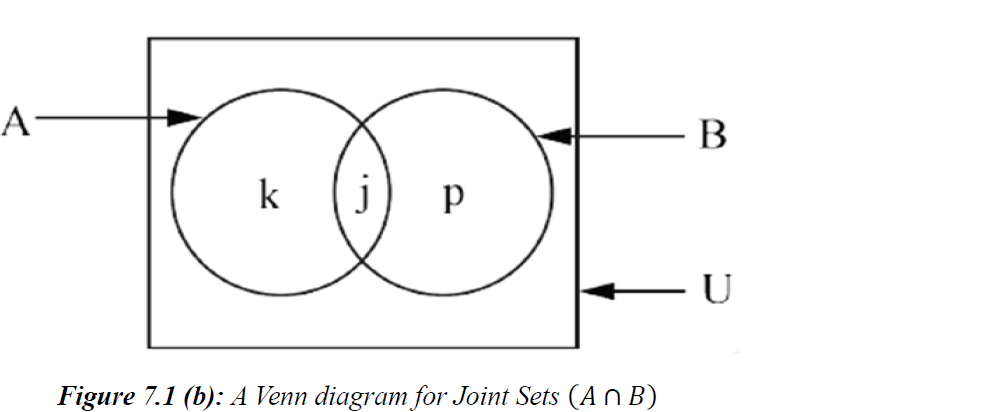
In figure 7.1 (b), the portion labelled j indicates the intersection region of the two sets, it contains elements found in both set A and B.
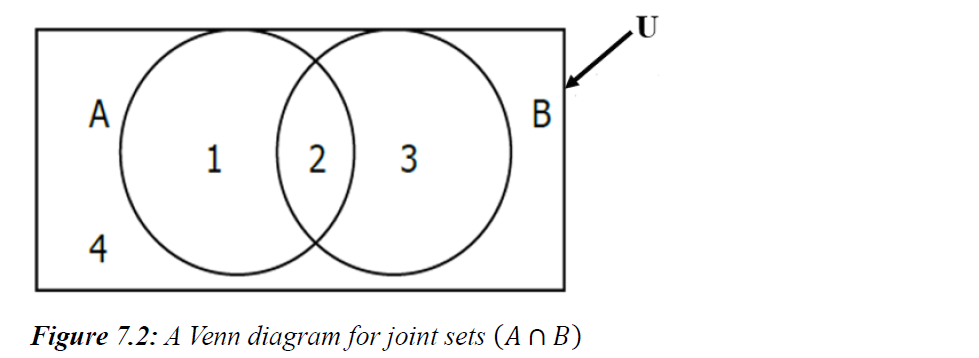
For example, if U={ 1,2,3,4}, 𝐴={1,2} and 𝐵={2,3}, then the Venn diagram representing these sets is as shown in figure 7.2 below:
Venn Diagram for Disjoint Sets
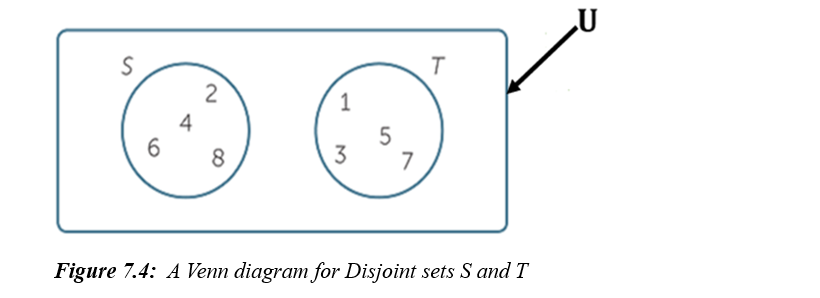
Two sets are said to be disjoint if they have no elements in common, and therefore for two sets A and B to be disjoint, their intersection or A ∩ B = ∅.
In this case there is no overlapping region for their Venn diagram as shown in figure 7.3 below.
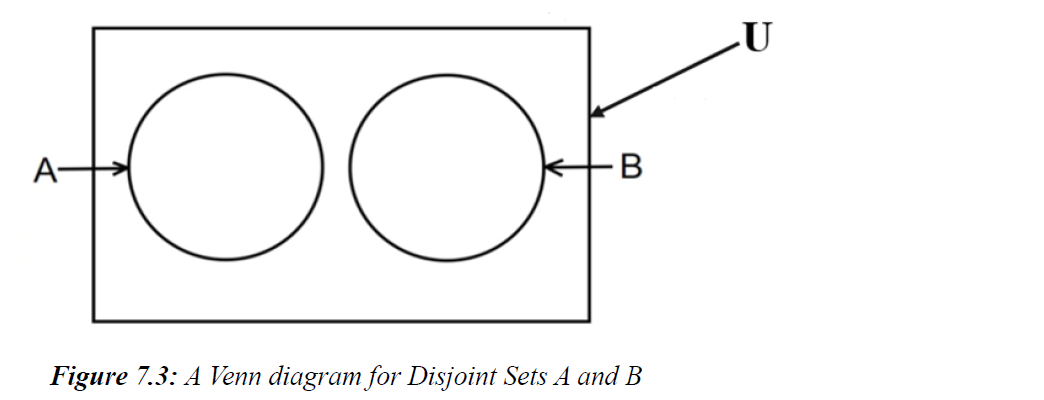
For example, the sets 𝑆={2,4,6,8} and 𝑇={1,3,5,7} are disjoint because they have no elements in common, and they appear in a Venn diagram as follows:
A Venn Diagram Representing Proper Subsets
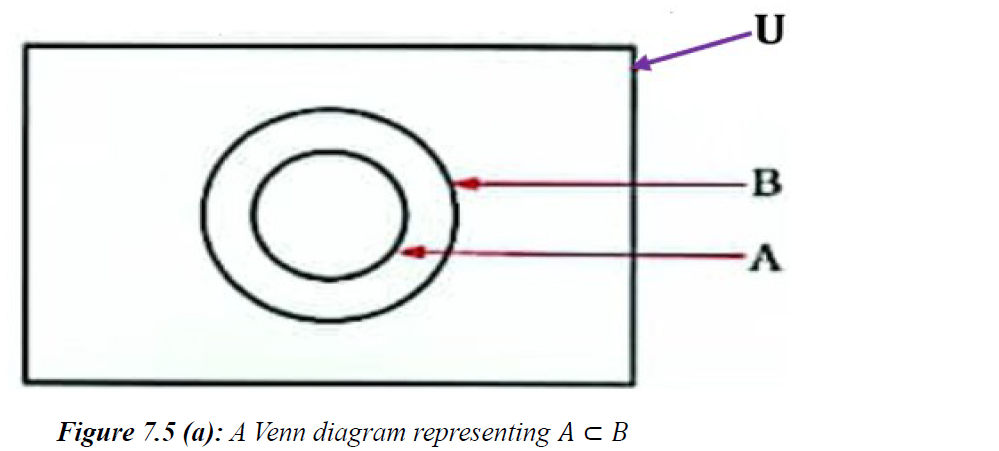
If A is a proper subset of B, that is 𝐴⊂𝐵, then A is completely contained in B as shown in the diagram below:
A Venn Diagram Involving Improper Subsets
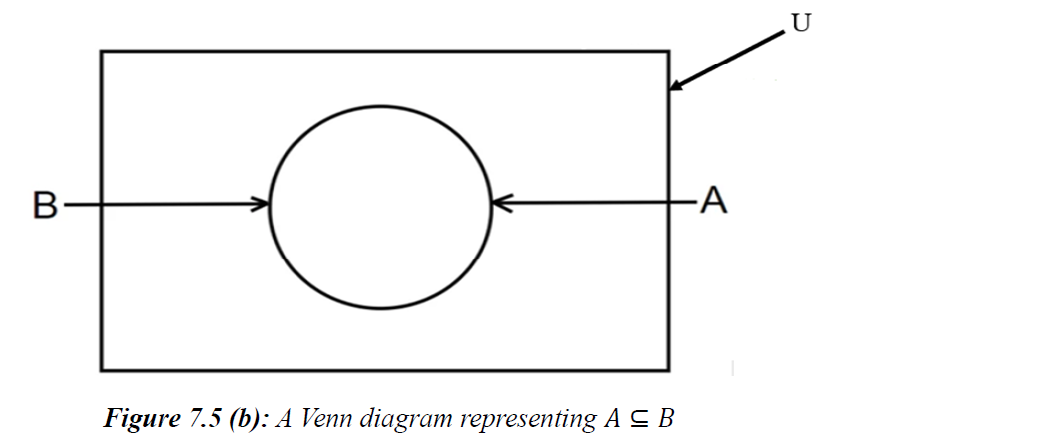
If A is an improper subset of B, that is 𝐴=𝐵, then A and B are subsets of each other as shown in the diagram below:
Shading of Set Regions
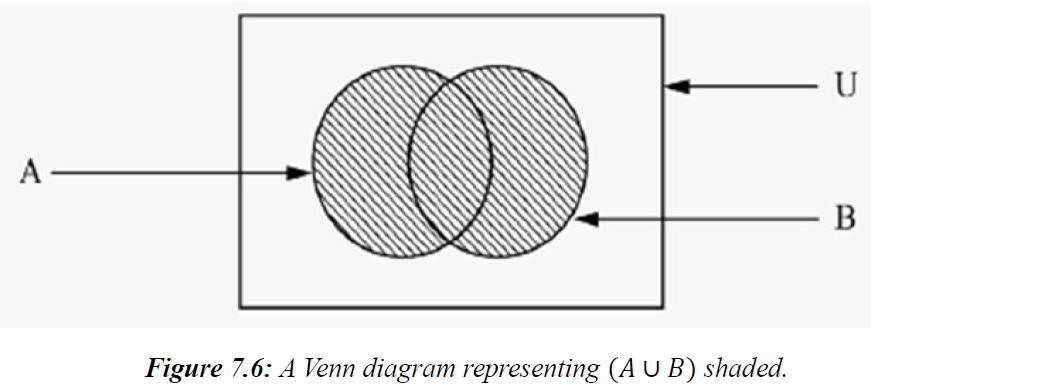
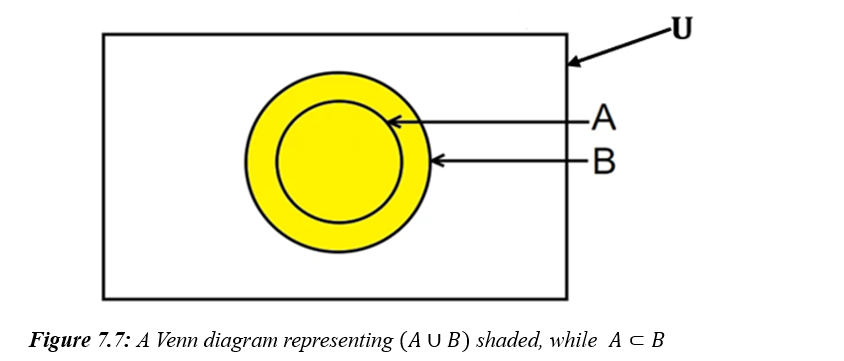
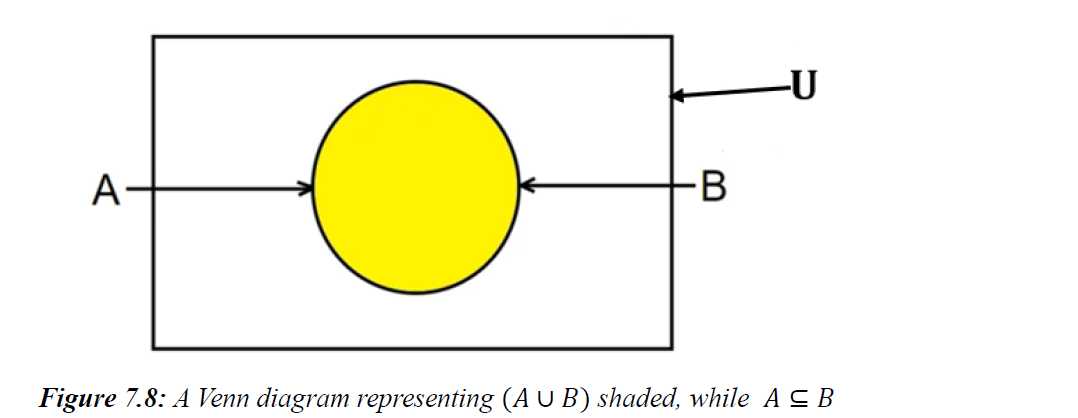
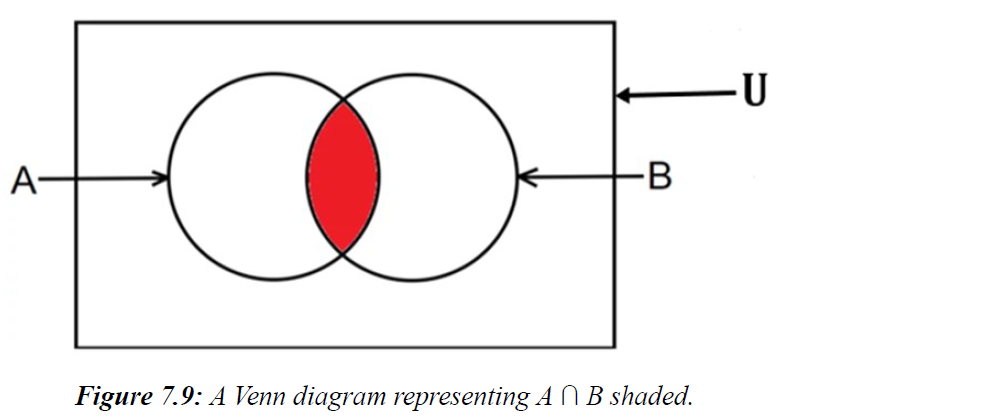
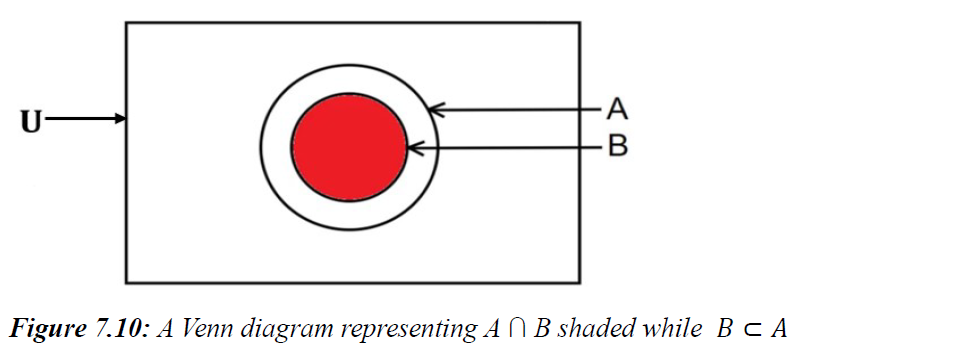
In Venn diagrams, it is common to shade the regions that satisfy the given set. By shading we indicate the areas that represent the required elements especially in compound sets.
Therefore, the following diagrams illustrate different compound sets by shading the required regions:
Union of two sets:
Union of two sets (A and B) such that A⊂B:
Union of two sets (A and B) such that 𝐴⊆𝐵 :
Intersection of two sets:
Shading of A ∩ B .
Shading of A ∩ B when 𝐵⊂𝐴.
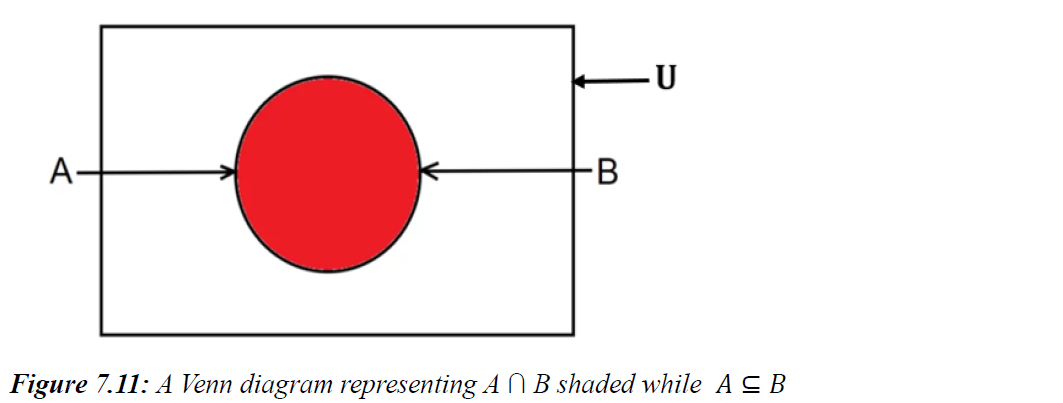
Shading of A ∩ B when 𝐴⊆𝐵.
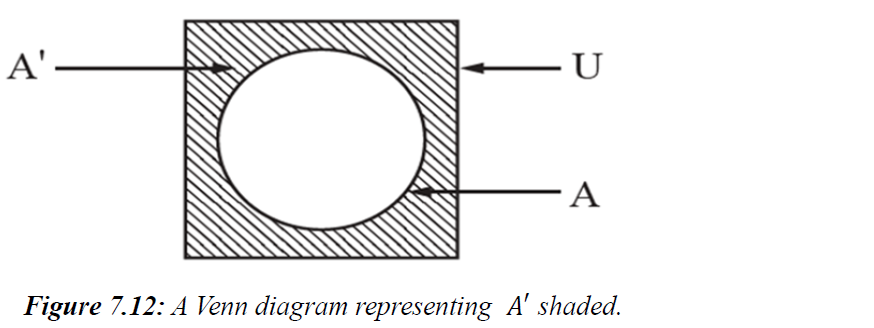
Complement of a set:
Shading of 𝐴′.
Example 23
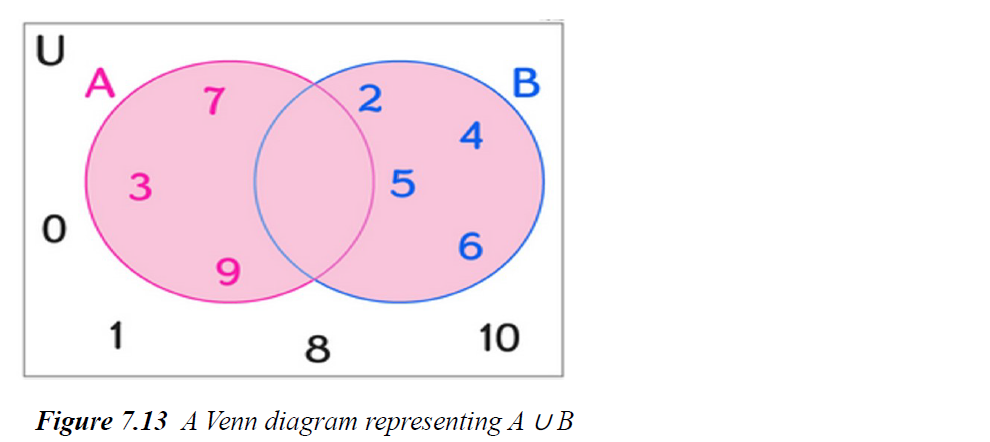
Let U be a universal set containing all non-negative integers less than 11 and sets A and B are two subsets of U such that A = {3, 7, 9} and B = {2, 4, 5, 6}, then find A ∪ B and represent the resulting set in the Venn diagram.
Solution:
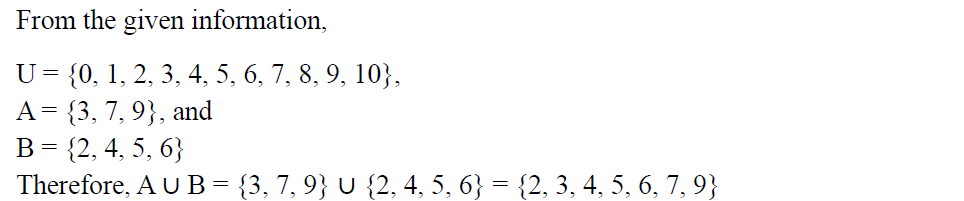
The corresponding Venn diagram of the set A ∪ B is shown in figure 7.13.
Find the number of elements in a set.
A Venn diagram helps in determining the number of elements in sets because it clearly illustrates the relationship between sets, including their overlapping parts (intersections) and the elements that belong to each set separately.
This visual representation makes it easier to count elements accurately and prevents counting the same element more than once.
Example 24
Consider the following Venn diagram and then answer the questions that follow:
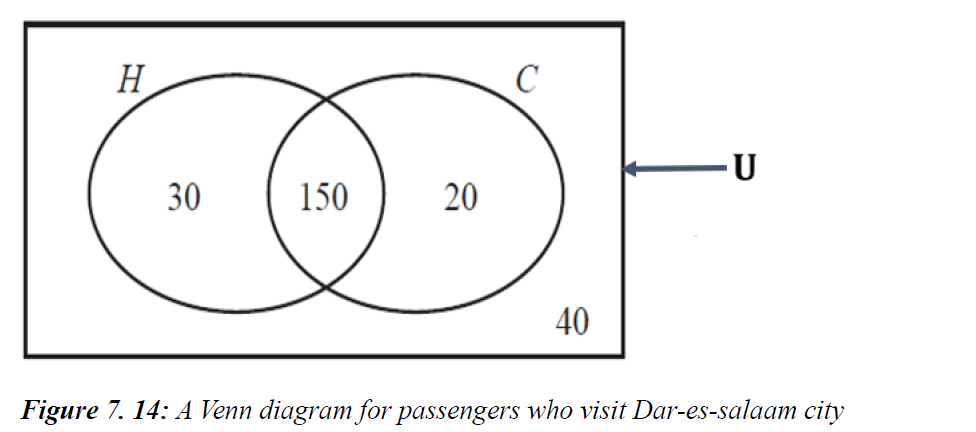
If U={ 240 passengers who arrive on a flight in Dar-es-salaam city},H = {Passengers who are on holiday} and C = {Passengers who hire a Car}, write down the number of passengers who:

Solution:

Example 25
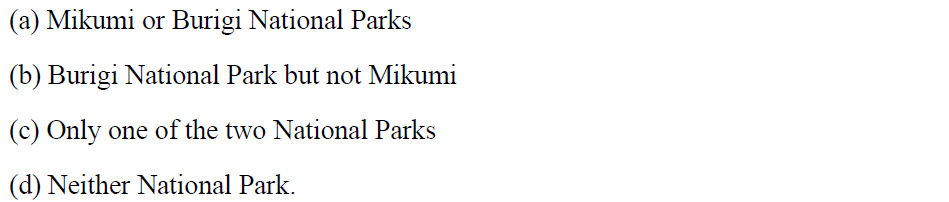
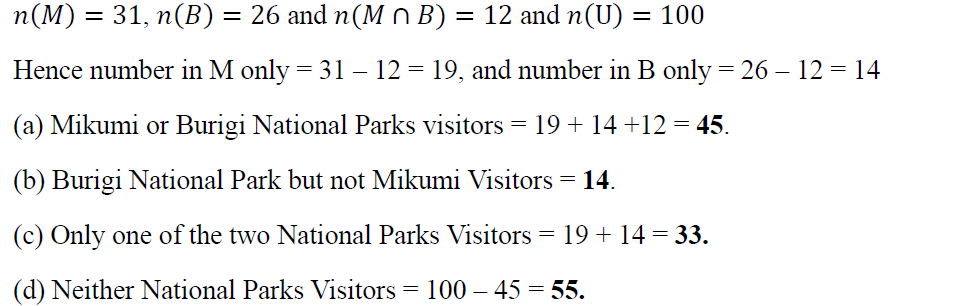
A travel agent surveyed 100 people to find out how many of them had visited the Mikumi and Burigi National Parks of Tanzania. Thirty-one people had visited Mikumi National Park, 26 people had been to Burigi National Park, and 12 people had visited both two National Parks. Draw a Venn diagram to find the number of people who had visited:
Solution:
Let M be the set of people who had visited Mikumi National Park, and let B be the set of people who had visited Burigi National Park. Also let the universal set U be the set of all people surveyed.
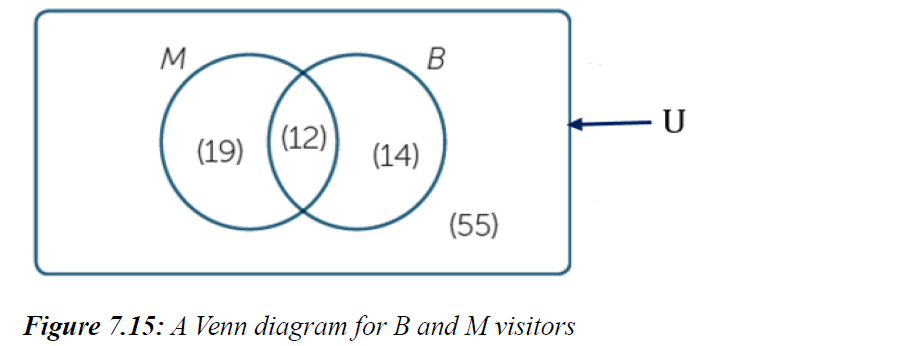
From the above Venn diagram,
Example 26
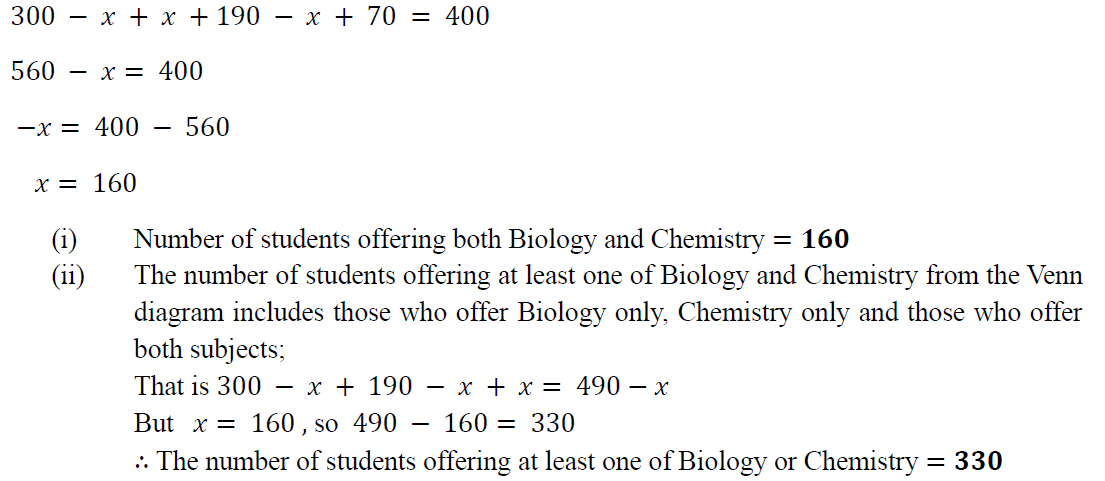
Out of the 400 final year students in a secondary school, 300 are offering Biology and 190 are offering Chemistry. If only 70 students are offering neither Biology nor Chemistry. How many students are offering (i) Both Biology and Chemistry? (ii) At least one of Biology or Chemistry?
Solution:

Consider the following Venn diagram;
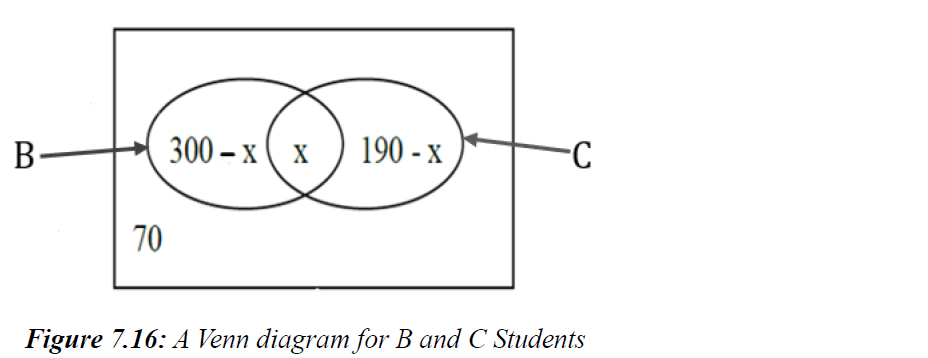
Since the sum of the number of elements in all region is equal to the total number of elements in the universal sets, then:
Example 27
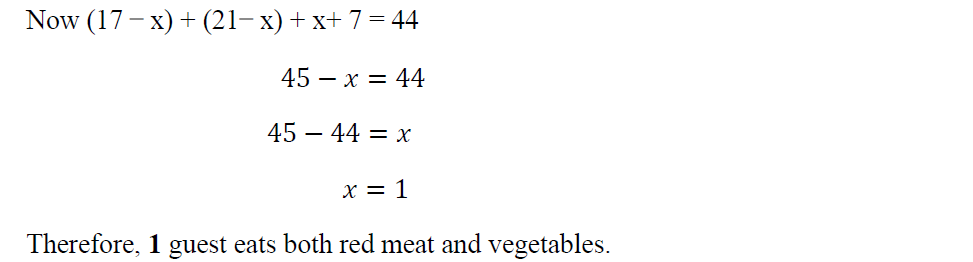
A certain birthday party had a total of 44 guests. Out of these, 21 eat red meat while 17 eat vegetables. How many guests eat red meat and vegetables if 7 guests eat neither red meat nor vegetables?
Solution:
Let R stand for guests who eat red meat and V stand for guests who eat vegetables. The following figure shows the information given with x as the number of elements in the intersection of two sets.
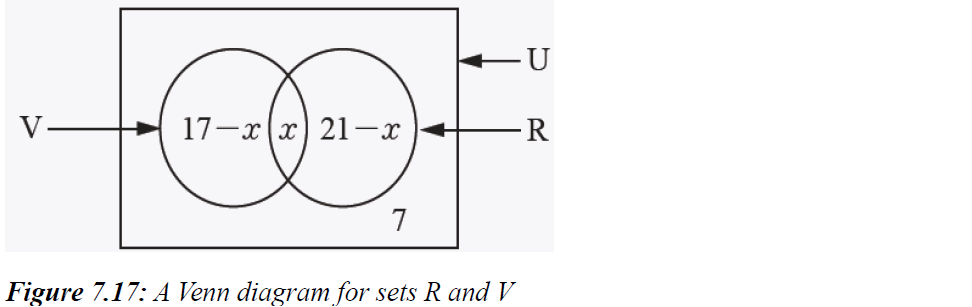
From the Venn diagram above, the total number of guests is given by 𝑛(𝐴∪𝐵)+7;
Example 28
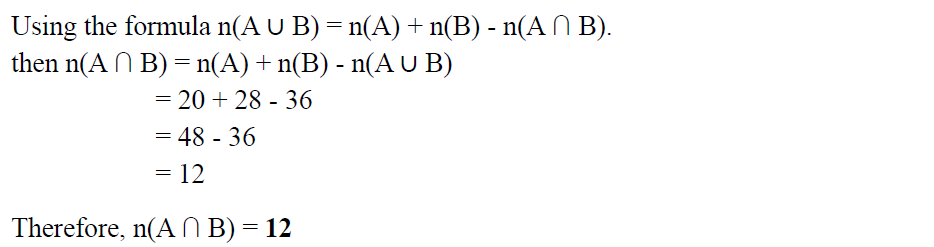
Let A and B be two finite sets such that n(A) = 20, n(B) = 28 and n(A ∪ B) = 36; find n(A ∩ B).
Solution:
Example 29
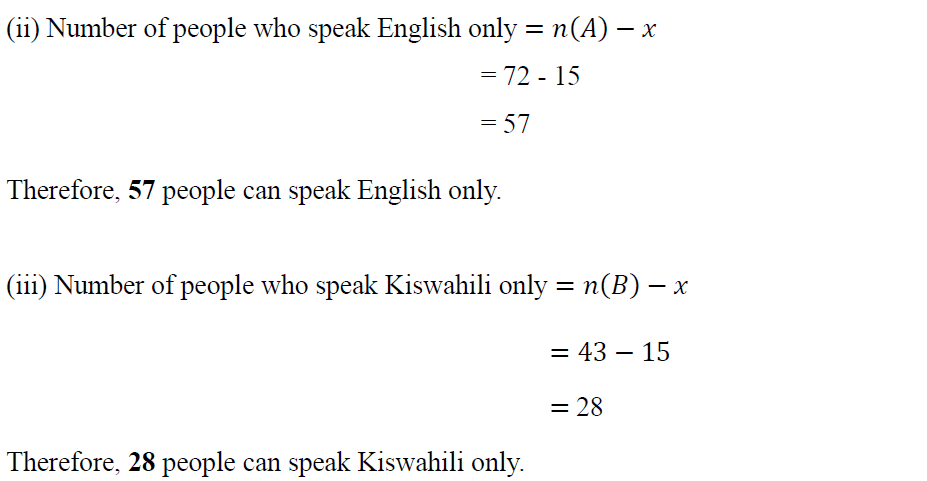
In a group of 100 persons, 72 people can speak English and 43 can speak Kiswahili.

Solution:
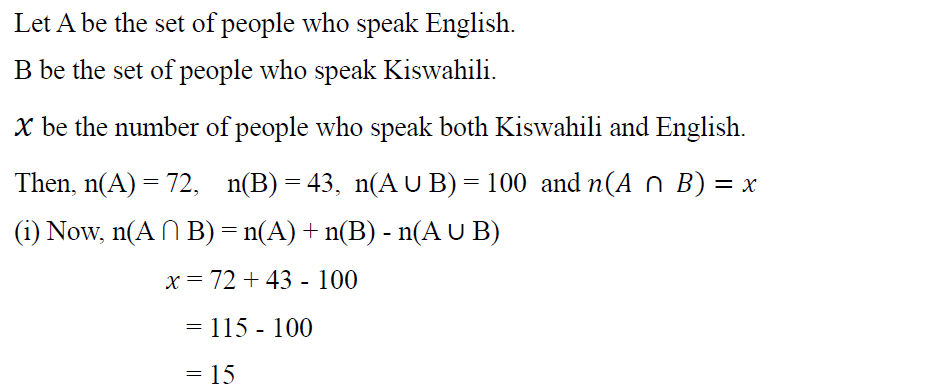
Therefore, 15 people can speak both English and Kiswahili.
Exercise 4
1. Let U={1,2,3,4,5,6,7,8,9,10}, A={2,4,6,8,10} and B={1,2,3,4,5}. Represent the set A∪B using a Venn diagram.
2. Let U={a,b,c,d,e,f,g,h}, P={a,c,e,g} and Q={c,d,e,f }. Represent the compound set P∩Q on a Venn diagram.
3. Let U={1,2,3,4,5,6,7,8} M={1,3,5,7} and N={2,3,4,5}. Represent the compound sets A′ and (M∪N)′ using a Venn diagram.
4. In a class of 40 students, 22 study Mathematics and 18 study Physics. If 10 students study both Mathematics and Physics, find:

5. Out of 60 people in a village, 35 own bicycles and 25 own motorcycles. If 15 people own neither a bicycle nor a motorcycle, find:

6. In a group of 50 students, 28 like rice and 32 like beans. If 20 students like both rice and beans, find:

7. In a certain school of 70 students, 38 play football and 30 play basketball. If 12 students play both football and basketball, find:

8. Out of 55 students in a class, 29 offer History and 26 offer Geography. If 8 students offer neither History nor Geography, find:

9. In a class of 48 students, 28 study Mathematics, 30 study Biology, 15 study both Mathematics and Biology. Let 𝑀 be the set of students who study Mathematics and 𝐵 the set of students who study Biology. Find:

10. In a village of 90 households, 54 households have electricity, 47 households have television, 19 households have neither electricity nor television. Let 𝐸 be the set of households with electricity and 𝑇 the set of households with television. Find:

11. A survey of 65 Tanzanian men showed that 36 like tea, 29 like coffee, 10 like neither tea nor coffee. Let 𝑇 be the set of men who like tea and 𝐶the set of men who like coffee. Find:

Listening to this topic