Mathematics (New)
LOGARITHMS
Reading settings
Text size
Line spacing
Colours
LOGARITHMS
Logarithms are Mathematical concepts that help us determine the exponent to which a base must be raised to produce a given number. In simple terms, a logarithm is the inverse operation of exponents. For example, if 23=8, then log28=3. This means the logarithm tells us what power of 2 gives 8.
Contents:
In this topic you will cover six broad concepts about logarithms:
(i) Standard form of numbers (ii) Concept of Logarithms (iii) Laws of Logarithms (iv) Logarithms of numbers (v) Anti-logarithms and (vi) Application of Logarithms.
Competencies:
Upon completion of this chapter, you should demonstrate competencies in Logarithms by:
1. Expressing a given number in standard form correctly.
2. Defining a logarithm and identify the base, argument, and value of a logarithmic expression correctly and explaining the relationship between logarithmic and exponential forms.
3.Converting expressions from exponential form to logarithmic form and vice versa.
4. Applying the laws of logarithms (product rule, quotient rule, and power rule) of logarithms to simplify expressions.
5. Evaluating logarithmic expressions (calculating the value of logarithms using known powers or tables/calculators) correctly.
6. Solving logarithmic equations correctly.
7. Using common logarithms (working with common logarithms (base 10) in calculations.
These competencies should enable you solve real-life problems such as problems involving growth and decay, earthquakes, spread of diseases and many other scientific calculations.
Standard form of Numbers
Standard form (also called Scientific Notation) is a way of writing very large or very small numbers so that they are shorter, easier to read and easier to calculate with.
Writing a number in standard form involves expressing a number as 𝐴×10𝑛, where 𝐴 is a number between 1 and 10 (that is, 1≤𝐴<10) and 𝑛 is an integer (a whole number that can be positive, negative, or zero).
Why do we need standard form?
Some numbers take a long time to write and are not convenient. For example, writing the diameter of a water molecule (H₂O) which is approximately 0.000000000275 Meter, or the mass of the sun which is about 1,990,000,000,000,000,000,000,000,000,000 Kg.
Handling numbers of this size is challenging and increases the chance of errors. Therefore, we need Standard form because it makes them compact and manageable.
Write numbers in standard form (Scientific notation).
Steps of Writing Numbers in Standard Form
The following are the steps of writing numbers in standard form:
(1) Move the decimal point to make a number between 1 and 10 (identify A).
(2) Count how many places you moved the decimal in order to get the value of 𝑛.
(3) Multiply 10𝑛, where n is positive if moved to the left (for big numbers), negative if you moved to the right (for small numbers) by A.
Example 1
Write 4500 in standard form.
Solution:
The decimal point is moved three places to the left to get a number between 1 and 10. So the number between 1 and 10 (𝐴) is 4.5, and the value of 𝑛 is 3.
Now 𝐴×10𝑛=4.5×10³.
Therefore, 4500 in standard form is written as 𝟒.𝟓×𝟏𝟎𝟑.
Example 2
Write 0.0062 in standard form
Solution:
The decimal point is moved three places to the right to get a number between 1 and 10.
So 𝐴=6.2 and 𝑛=−3, hence 𝐴×10𝑛=6.2×10⁻³
Therefore, 0.0062 =𝟔.𝟐×𝟏𝟎−𝟑
Example 3
Express 720,000 in standard form.
Solution:
From the number 720,000, the decimal point is moved five places to the left to get a number between 1 and 10.
So 𝐴=7.2 and 𝑛=5, hence 𝐴×10𝑛=7.2×10⁵
Therefore, 720,000 =𝟕.𝟐×𝟏𝟎𝟓
Example 4
What is 0.000081 in standard form?
Solution:
In 0.000081, the decimal point is moved five places to the right to get a number between 1 and 10.
So 𝐴=8.1 and 𝑛=−5,hence 𝐴×10𝑛=8.1×10⁻⁵
Therefore, 0.000081=𝟖.𝟏×𝟏𝟎−𝟓
Example 5
Write 299,792,458 in standard form correct to one significant figure.
Solution:
In 299,792,458, the decimal point is moved eight places to the left to get a number between 1 and 10.
So 𝐴=2.99792458≈3.0 and 𝑛=8, hence 𝐴×10𝑛=3.0×10⁸
Therefore, 299,792,458=𝟑.𝟎×𝟏𝟎𝟖
The number is already between 1 and 10, so 𝐴=7 and 𝑛=0.
Therefore, 7 in standard form is written as 𝟕×𝟏𝟎𝟎.
Example 6
Write 7 in standard form.
Solution:
The number is already between 1 and 10, so 𝐴=7 and 𝑛=0, hence 𝐴×10𝑛=7×100.
Therefore, 7 in standard form is written as 𝟕×𝟏𝟎𝟎.
Example 7
Write 3.5 in standard form.
Solution:
The number is already between 1 and 10, so 𝐴=3.5 𝑛=0 and 𝐴×10𝑛=3.5×100.
Therefore, 𝟑.𝟓=𝟑.𝟓×𝟏𝟎𝟎.
Example 8
Express 1.25 in standard form.
Solution:
The number 1.25 is already between 1 and 10, so 𝐴=1.25 and 𝑛=0. Hence 𝐴×10𝑛=1.25×100.
Therefore, 𝟏.𝟐𝟓=𝟏.𝟐𝟓×𝟏𝟎𝟎.
Example 9
The diameter of a water molecule (H₂O) is approximately 0.000000000275 Meter, write it in standard form.
Solution:
From the number 0.000000000275, the decimal point is moved ten places to the right to get a number between 1 and 10.
Now 𝐴=2.75 and 𝑛=−10. So 𝐴×10𝑛=2.75×10⁻¹⁰
Therefore, the diameter of a water molecule (H₂O) which is approximately 0.000000000275 Meter, is written in standard form as 𝟐.𝟕𝟓×𝟏𝟎−𝟏𝟎 𝒎.
Example 10
The mass of the sun is about 1,990,000,000,000,000,000,000,000,000,000 Kg. Write it in standard form.
Solution:
From the number 1,990,000,000,000,000,000,000,000,000,000; the decimal point is moved thirty places to the left to get a number between 1 and 10. So 𝐴=1.99 and 𝑛=30.
Now 𝐴×10𝑛=1.99×1030;
Therefore, the mass of the sun which is about 1,990,000,000,000,000,000,000,000,000,000 Kg, in standard form is written as 𝟏.𝟗𝟗×𝟏𝟎𝟑𝟎 𝐊𝐠.
The key note on standard form:
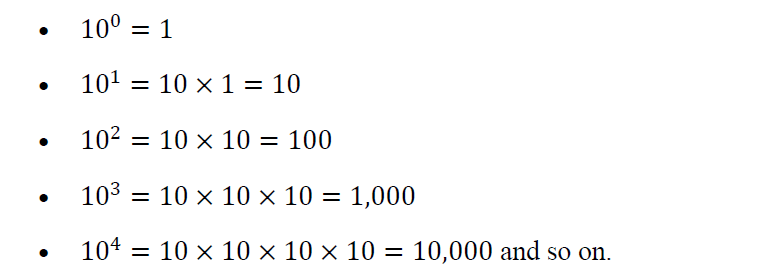
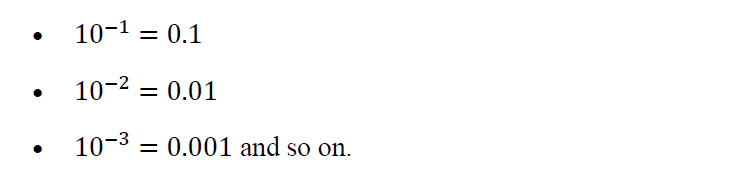
The standard form or scientific notation is based on powers of 10.
For example,
Similarly,
Example 11
Convert 2.5×10³ to an ordinary number.
Solution:
2.5×103=2.5×1000=2500.
Therefore, 2.5×103=𝟐𝟓𝟎𝟎.
Example 12
Write 6.2×10⁻³ as an ordinary number.
Solution:
6.2×10−3=6.2×0.001=0.0062,
Therefore, 6.2×10−3=𝟎.𝟎𝟎𝟔𝟐.
Example 13
Write 7.8×10⁵ as an ordinary numeral.
Solution:
7.8×105=7.8×100000=780,000,
Therefore, 7.8×105=𝟕𝟖𝟎,𝟎𝟎𝟎.
Example 14
Write 9.12×10⁻⁵ as an ordinary numeral.
Solution:
9.12×10−5=9.12×0.00001=0.0000912,
Therefore, 9.12×10−5=𝟎.𝟎𝟎𝟎𝟎𝟗𝟏𝟐.
Example 15
Simplify (3×104)×(2×103).
Solution:
Multiply the numbers representing A as the number are in the standard form, and then add the values representing n in the powers of 10:
That is 3×2=6 and 104×103=104+3=107.
Then (3×104)×(2×103)=6×107=6×10,000,000=60,000,000.
Therefore, (3×104)×(2×103)=𝟔𝟎,𝟎𝟎𝟎,𝟎𝟎𝟎.
Example 16

Solution:
Divide the numbers representing A and subtract the powers of 10:
That is 8÷2=4 and 106÷103=106−3=103.

Example 17
Simplify 5×10⁴+3×10⁴.
Solution:
The powers of 10 are the same (104), so add the numbers representing A:
That is 5+3=8, So 5×10⁴+3×104=8×10⁴,
But 8×104=8×10,000=80,000,
Therefore, 5×10⁴+3×104=𝟖𝟎,𝟎𝟎𝟎.
Example 18
Evaluate 7×10⁵−2×10⁵;
Solution:
The powers of 10 are the same (105), so subtract the numbers representing A and multiply the results by 105.
Now 7−2=5, so 7×10⁵−2×105=5×10⁵,
But 5×105=5×100,000=500,000
Therefore, 7×10⁵−2×105=𝟓𝟎𝟎,𝟎𝟎𝟎.
Exercise 1
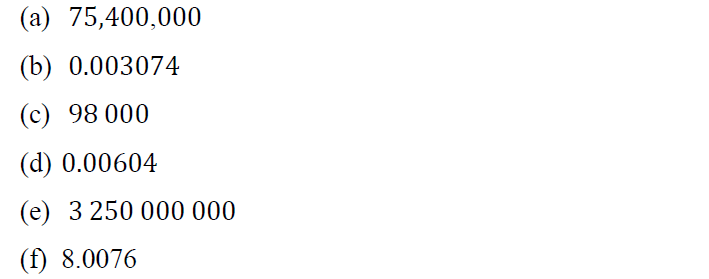
1. Write each of the following numbers in Standard form;
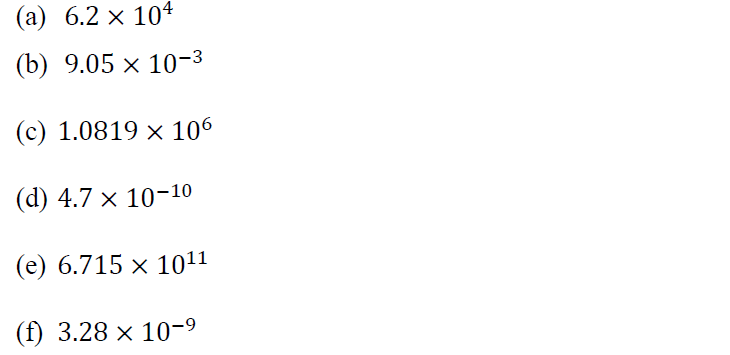
2. Write each of the following numbers as Ordinary Numerals;
3. Evaluate each of the following and give your answer in standard form:
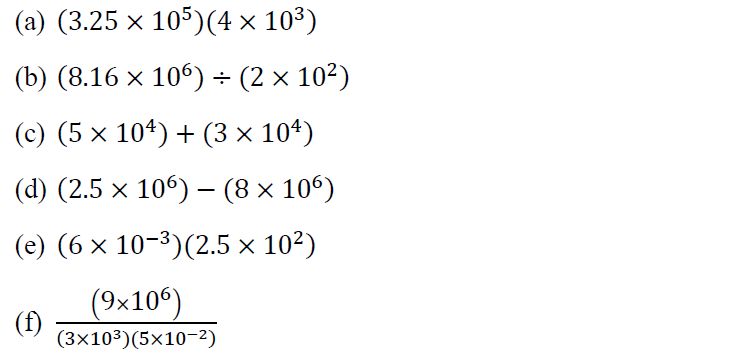
4. The distance from Town A to Town B is 3.6×10⁵m. If a bus travels this distance 4 times in one day, what is the total distance traveled in standard form?
5. The mass of one grain of rice is 2.5×10⁻⁵kg. Find the mass of 2,000 grains in standard form.
6. Light travels at a speed of 3×10⁸ m/s. How long does it take light to travel a distance of 6×10⁴ m? Give your answer in standard form (seconds).
7. A factory produces 4.5×10³ bottles per hour. How many bottles are produced in 2×10² hours? (Your answer should be in normal numerals).
8. A bacterium has a mass of 4×10⁻¹² kg. Find the total mass of 2.5×10⁶ bacteria, giving your answer in ordinary numerals.
Concept of Logarithms
Starting with the knowledge on powers (indices) you have, you already understand numbers like102=100, 103=1000, 100=1, 10−1=0.1 and so on.
Now, having a base (like 10), how many times do I multiply it by itself to get another number?For example, 103=1000, therefore I multiplied 10 by itself 3 times to get 1000.
The Concept of Logarithms
Logarithm
Explain the Concept of Logarithms
Definition:
A logarithm is simply the power (or exponent) to which a number (called the base) must be raised to produce another number.
Recall that 103=1000, so the logarithm of 1000 under base 10 is 3. This is in short written asLog101000=3. Similarly, 24=16 so Log216=4.
In short, a logarithm of a number is the index (power) to which the base must be raised to obtain that number, it is is just the inverse of an exponent.
Therefore, if 𝐚𝐱=𝐛, then 𝐥𝐨𝐠𝐚𝐛=𝒙.
Important Logarithmic results (Special logarithms)
If a > 0, then each of the following statements is true:

Base 10 Logarithms (Common Logarithms).
The Base 10 logarithms also called Common logarithms, are logarithms of numbers under base 10, written in form of 𝐥𝐨𝐠𝟏𝟎𝒙, where 𝑥 is any number greater than 0.
In most cases the common logarithms are written without indicating their base (10), for example, instead of writing log10𝑥, we simply write log𝑥.
Therefore, log10=1 (because 101=10), log100=2 (because 102=100) and log1000=3 and so on.
Example 19
Express each of the following in exponential form;

Solution:
(a) In exponential form, log10𝑥=8 is equivalent to 𝒙=𝟏𝟎𝟖
(b) In exponential form, log5𝑥=−3 is equivalent to 𝒙=𝟓−𝟑
(c) In exponential form, log𝑦𝑥=𝑧 is equivalent to 𝒙=𝒚𝒛
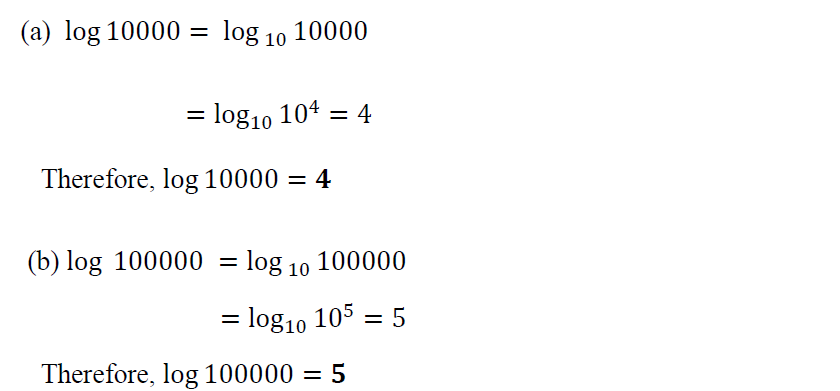
Example 20
Evaluate each of the following logarithms:

Solution:
Example 21
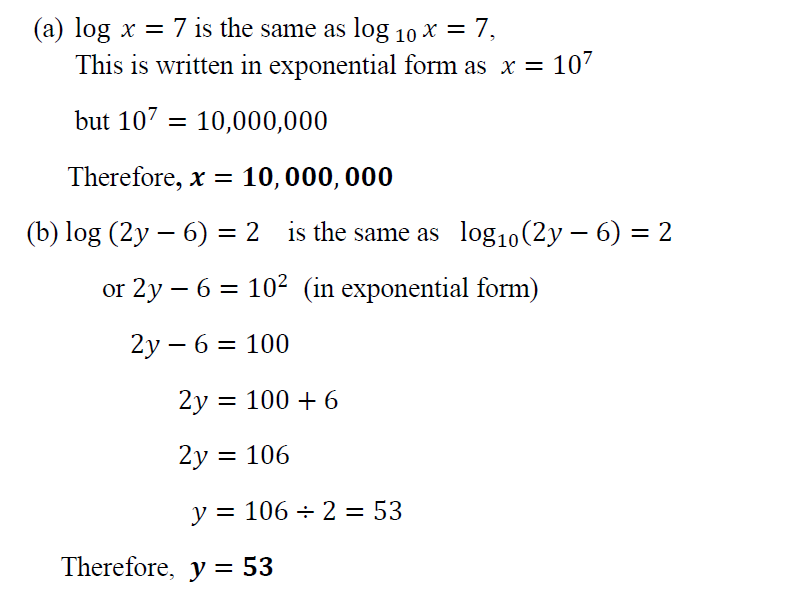
Solve the following equations:

Solution:
Common Logarithms of numbers less than 1.
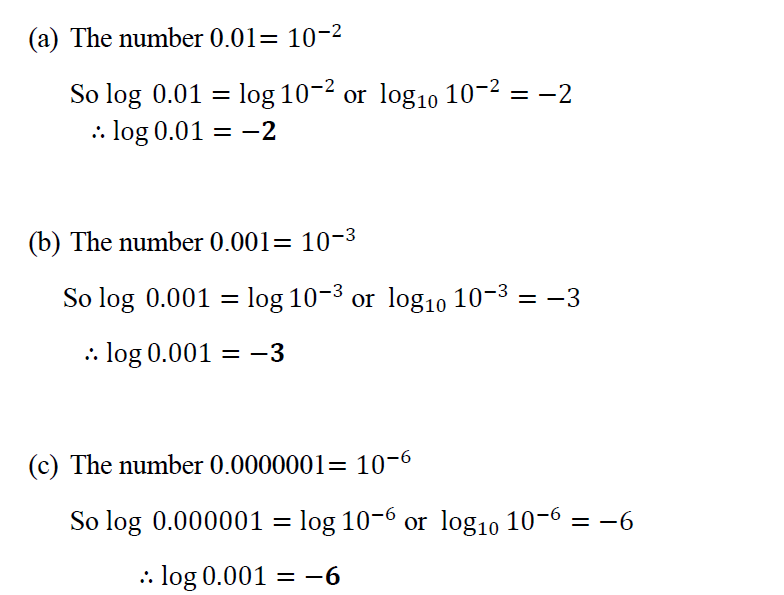
These are logarithms of numbers lying between zero (0) and one (1). Their values are always negative numbers.
Example 22
Find the common logarithms of each of the following numbers.

Solution:
Logarithms of numbers to any base 𝒂
These are logarithms of numbers under the base “a” which is positive but not 10. These logarithms take the form of log𝑎𝑏, where b is any positive number.
Example 23
Evaluate each of the following:

Solution:
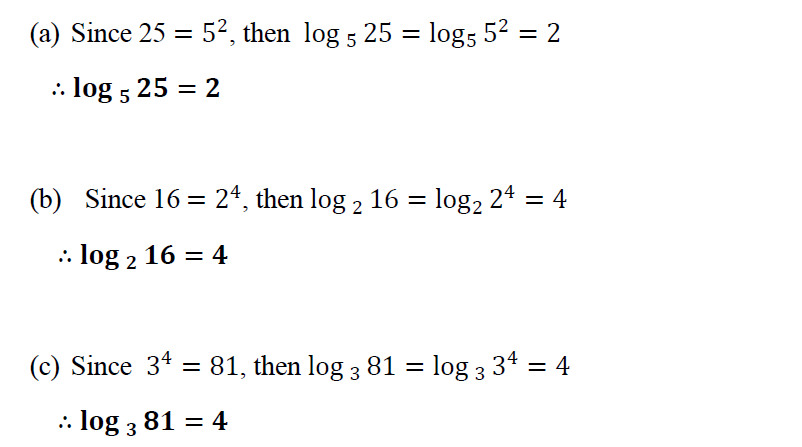
Solution cont....
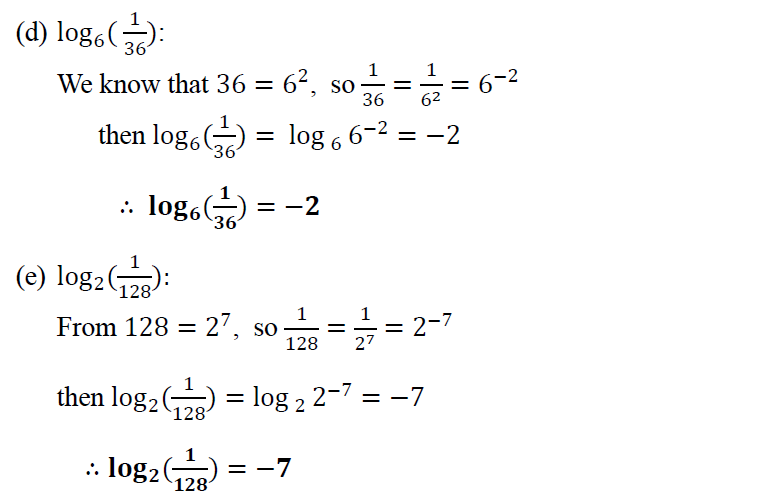
Example 24
Solve for x in each of the following equations:

Solution:
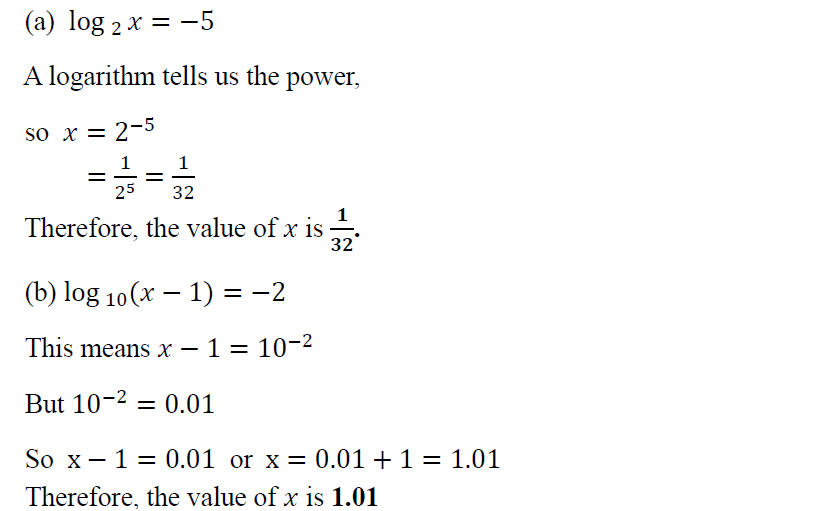
Exercise 2
1. Rewrite each of the following exponential statements in logarithmic form.
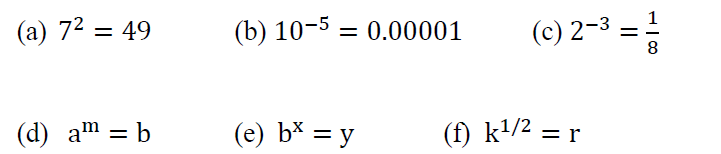
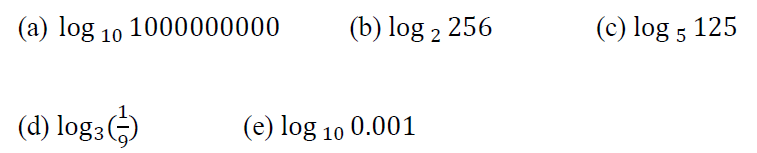
2. Evaluate each of the following:
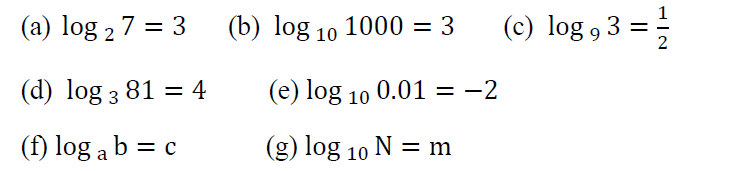
3. Rewrite each of the following logarithmic expressions in exponential (index) form.
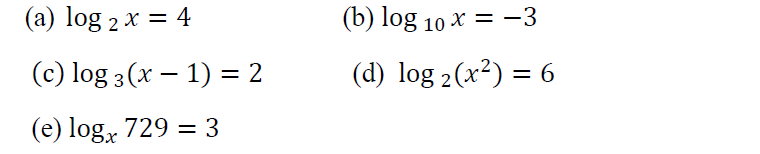
4. Solve for 𝑥 in each of the following equations:
Laws of Logarithms
The laws of logarithms are rules used to simplify and manipulate logarithmic expressions. These laws are derived based on the properties of exponents.
The main laws (product, quotient, and power laws) describe how logarithms behave when numbers are multiplied, divided, or raised to powers.
There are also special results such as log𝑎1=0 and log𝑎𝑎=1, as well as the change of base law.
These laws are very important because they help in simplifying logarithmic expressions, solving logarithmic equations, and performing scientific calculations.
The Laws of Logarithms AND use the laws of logarithms to solve problems.
Explore the Laws of Logarithms and use the laws of logarithms to solve problems.
1. Product Law
Formula: 𝐥𝐨𝐠𝒃(𝒙𝒚)=𝐥𝐨𝐠𝒃𝒙+𝐥𝐨𝐠𝒃𝒚
Interpretation: The logarithm of a product is the sum of the logarithms of the factors.
Derivation:
Statement to derive: 𝐥𝐨𝐠𝒃(𝒙𝒚)=𝐥𝐨𝐠𝒃𝒙+𝐥𝐨𝐠𝒃𝒚
Assume there are numbers b, x and y such that (𝑏>0 but 𝑏≠1), 𝑥> 0 and 𝑦 > 0.
Step 1:

Step 2:

Step 3:

Step 4:

Step 5:

Step 6:

Therefore, 𝐥𝐨𝐠𝒃(𝒙𝒚)=𝐥𝐨𝐠𝒃𝒙+𝐥𝐨𝐠𝒃𝒚 (Derivation completed)
Example 25
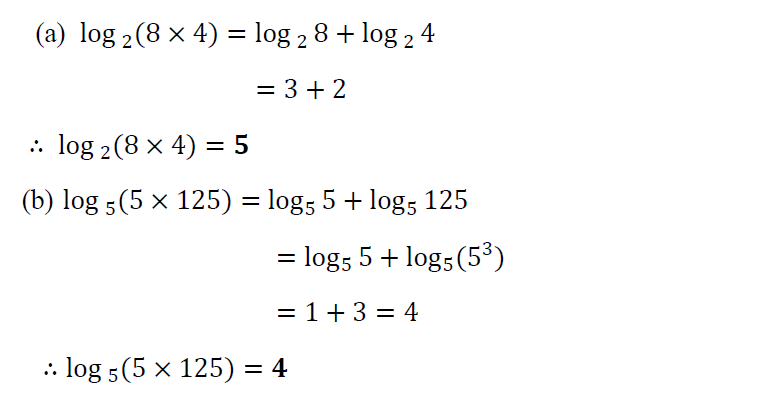
Evaluate each of the following:

Solution:
Example 26
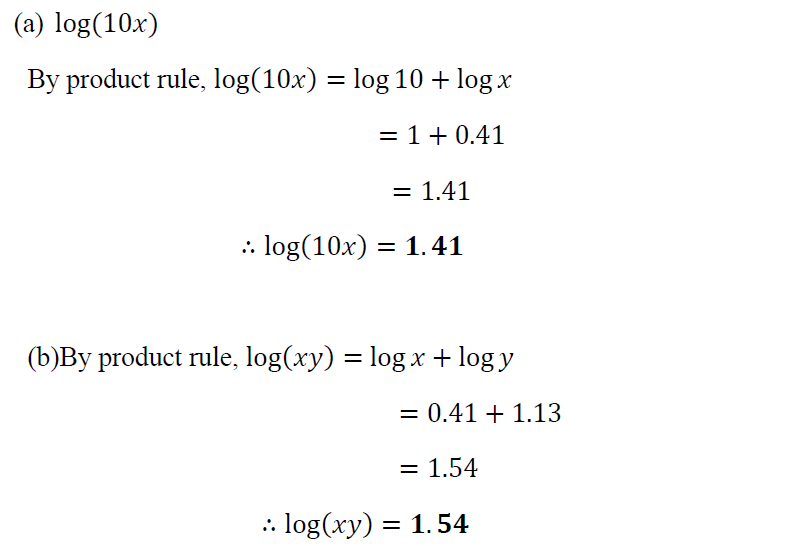
Given that log𝑥=0.41 and log𝑦=1.13, find:

Solution:
Example 27
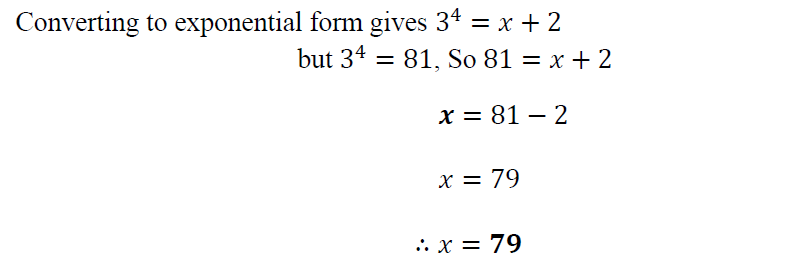
Given that log3(𝑥+2)=4, find the value of x.
Solution:
Example 28
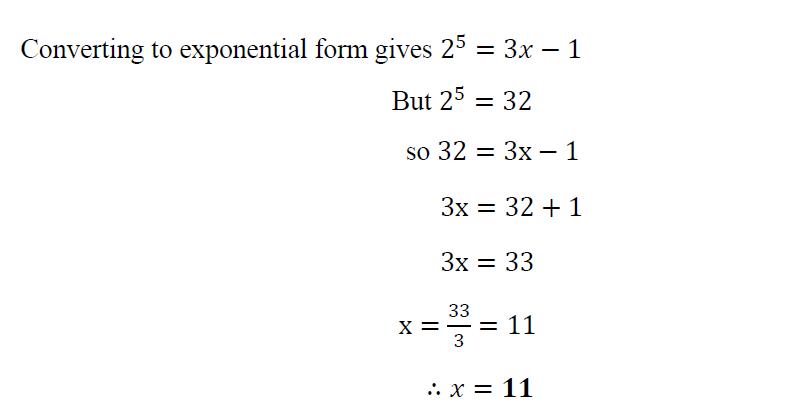
Solve for 𝑥 in log2(3𝑥−1)=5.
Solution:
2. Quotient Law

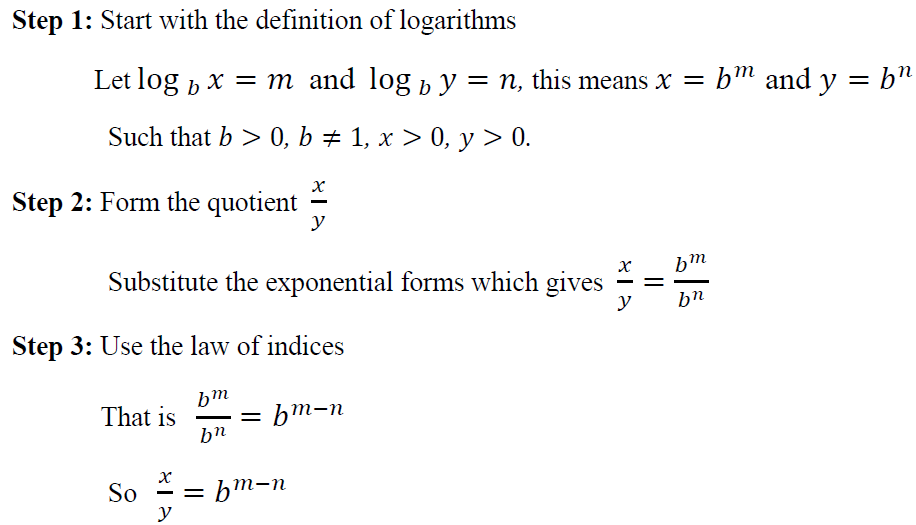
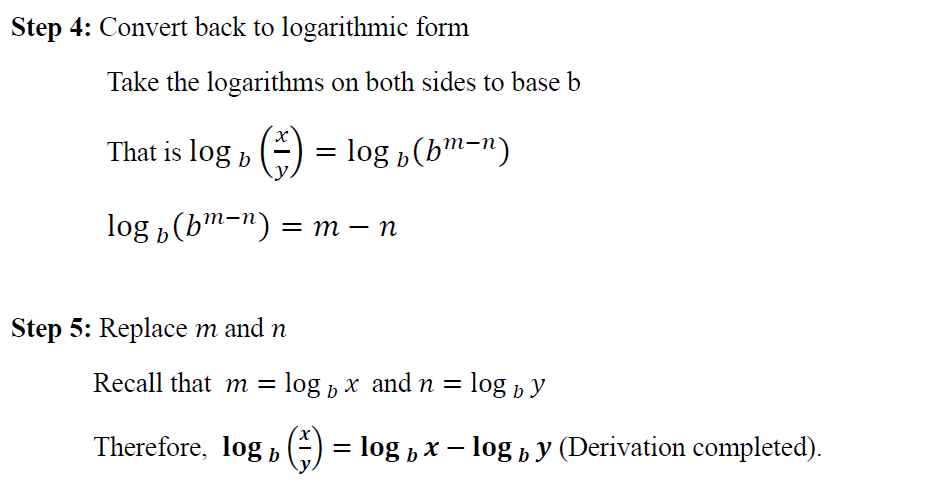
Interpretation: The logarithm of a quotient is the difference between the logarithm of the dividend and the logarithm of the divisor.
Derivation of the Law:
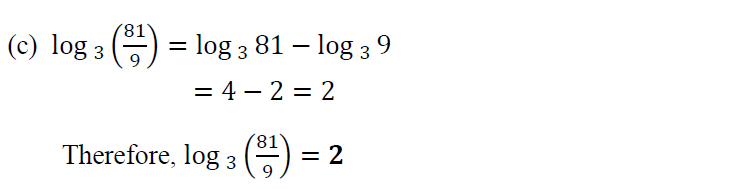
Example 29
Simplify each of the following:

Solution:

By quotient rule, the logarithm is written as log216−log24
Writing each number as a power of 2 gives log2(24)−log2(22)=4−2=2


Applying the quotient rule gives log5125−log525
Writing each number as powers of 5 gives log5125−log525=log5(53)−log5(52)
So log5(53)−log5(52) =3−2=1

3. Power Law

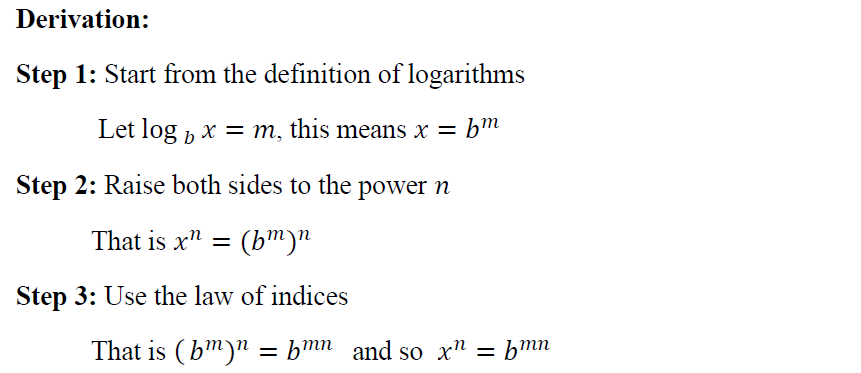
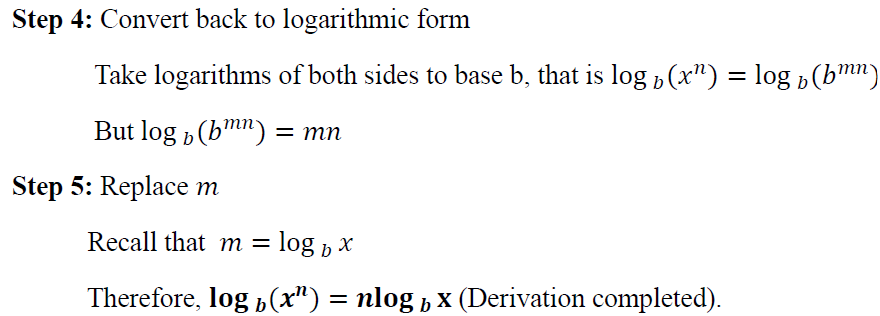
Interpretation: The exponent can be moved in front as a multiplier.
Example 30
Write each of the following in a simplest form:

Solution:
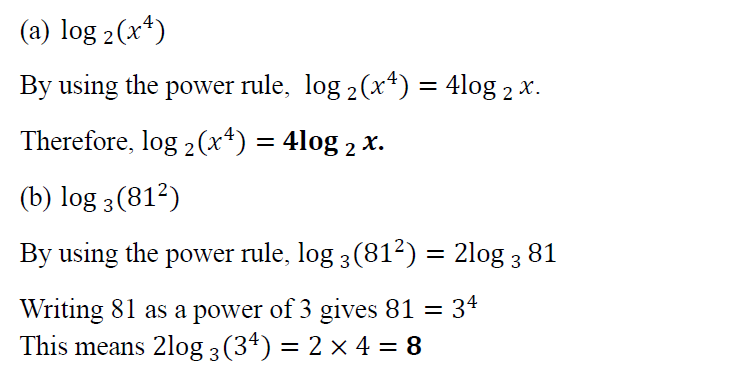
Therefore, log3(812)=𝟖.
(c) log2(83):
By power rule, log2(83)=3log28 =3×3=9
Therefore, log3(83)=𝟗.
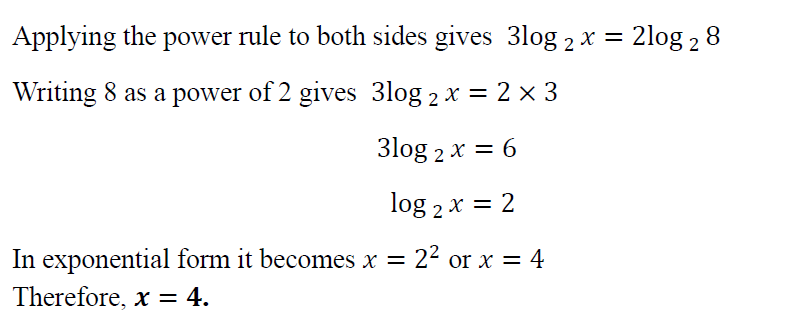
Example 31
Solve for x in the equation log2(𝑥3)=log2(82).
Solution:
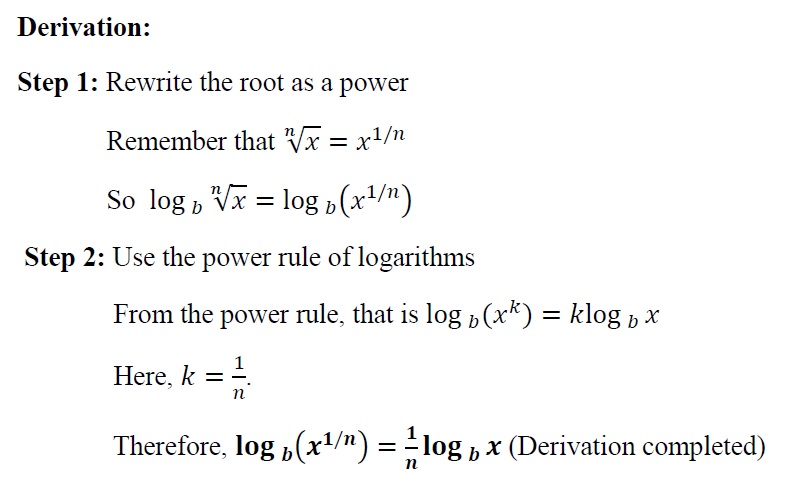
4. The roots law
The roots law is just a special case of the power rule.

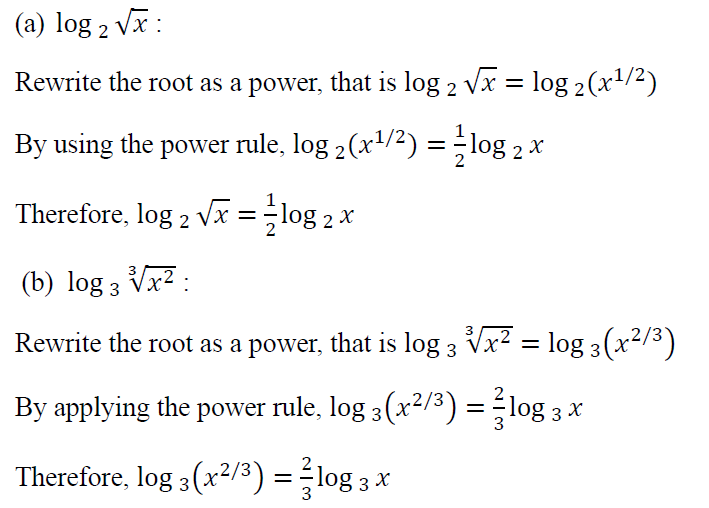
Example 32
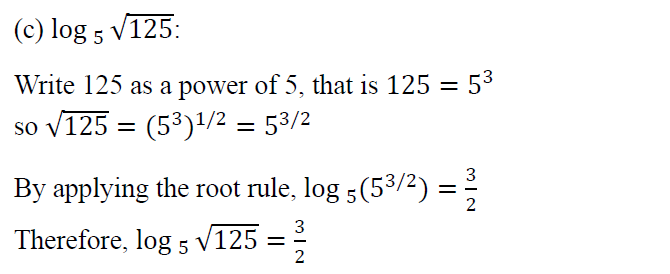
Rewrite each of the following expressions in a simple form:

Solution:
Example 33
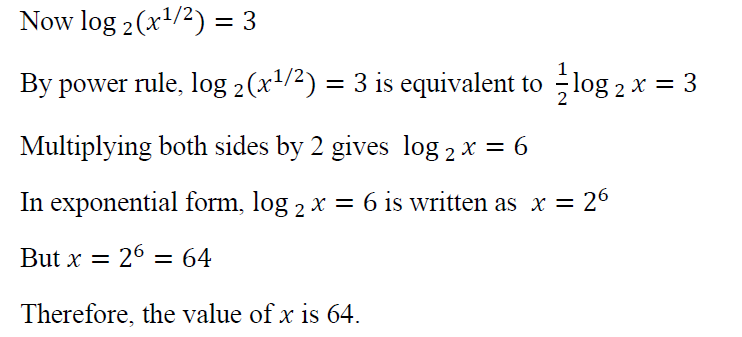
Solve the equation log2√𝑥=3.
Solution:
Rewrite the root as a power, that is log2√x=log2(𝑥1/2)
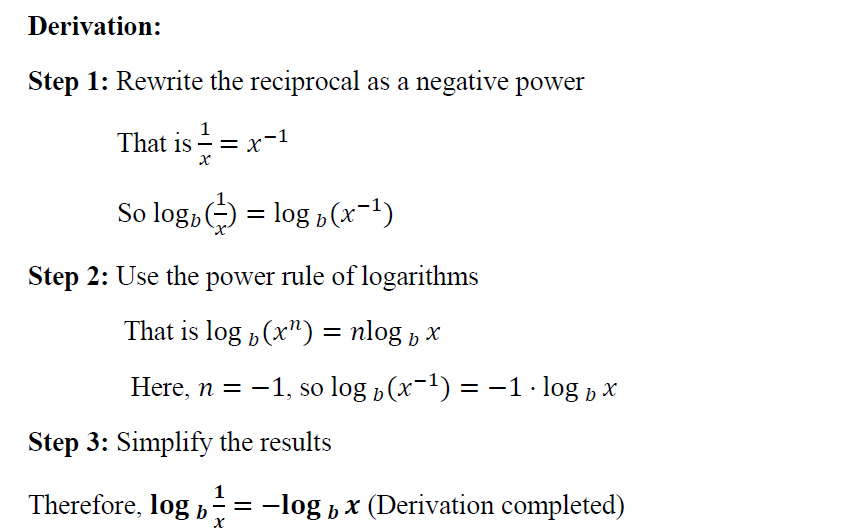
5. Reciprocal Law

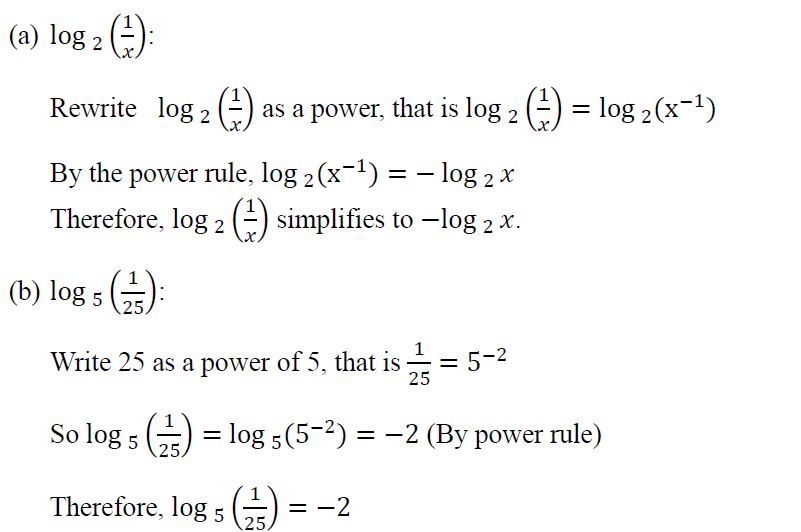
Example 34
Express each of the following in their simplest form:

Solution:
Example 35





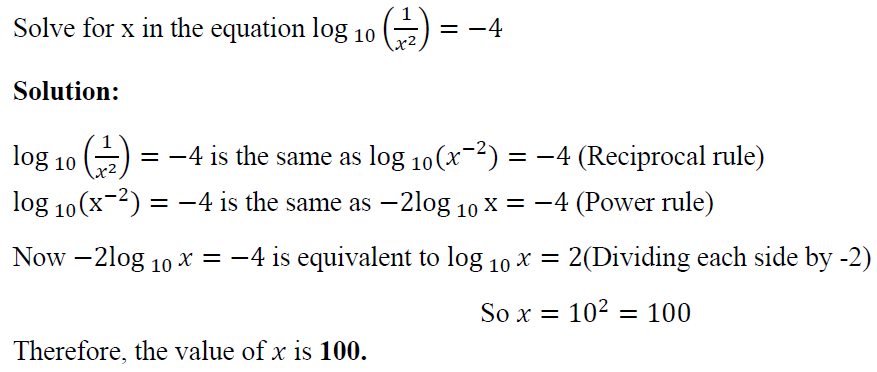
Solution:
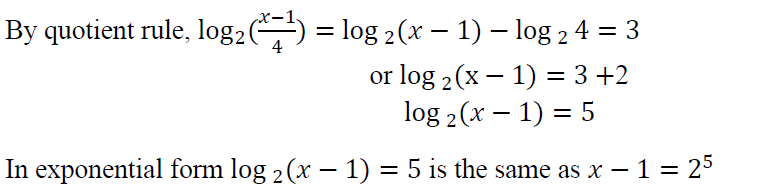
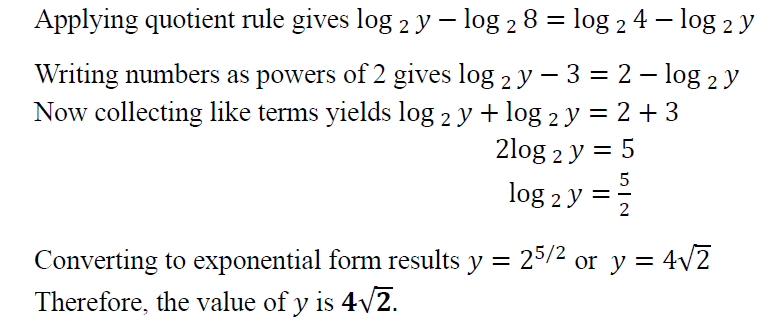
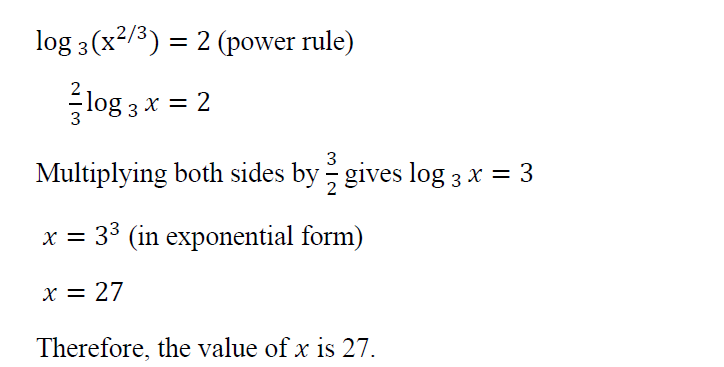
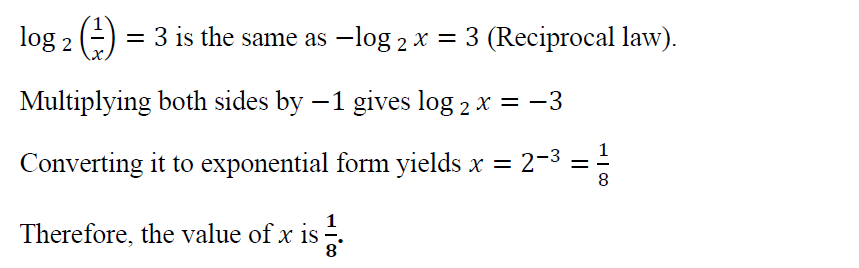
Applying the quotient rule on both sides gives log5𝑥−log525=log5125−log55,
This means 𝑥−1=32 or x=32+1=33,
log5𝑥−2=3−1 or log5𝑥=4
Therefore, the value of 𝑥 is 33.
From log5𝑥=4, 𝑥=54=625,
Therefore, the value of 𝑥 is 𝟔𝟐𝟓.
6. Change of Base Formula
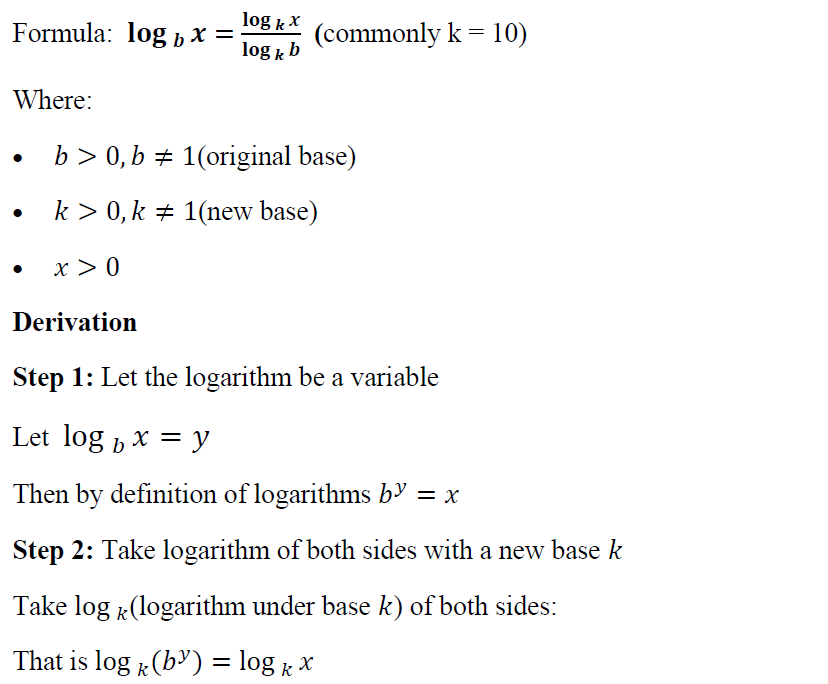
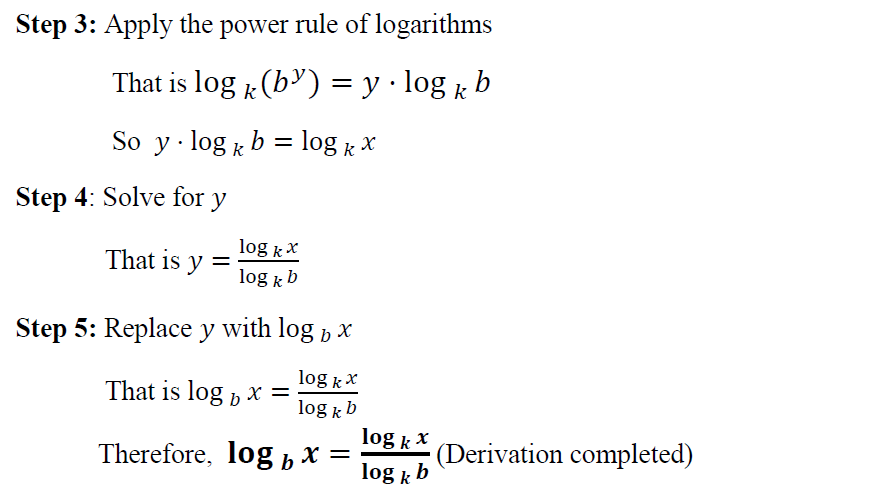
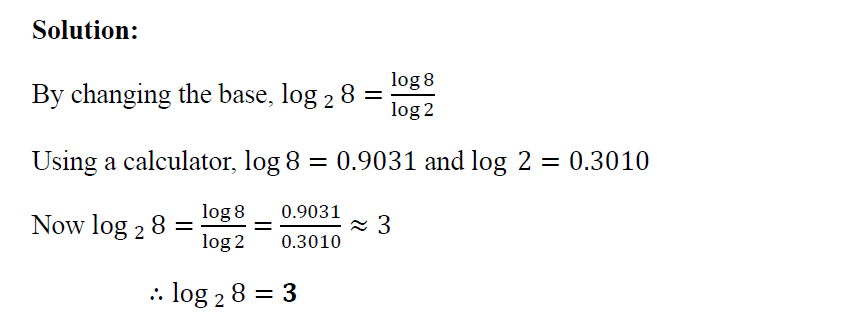
Example 36
Evaluate log28 using base 10.
Example 37
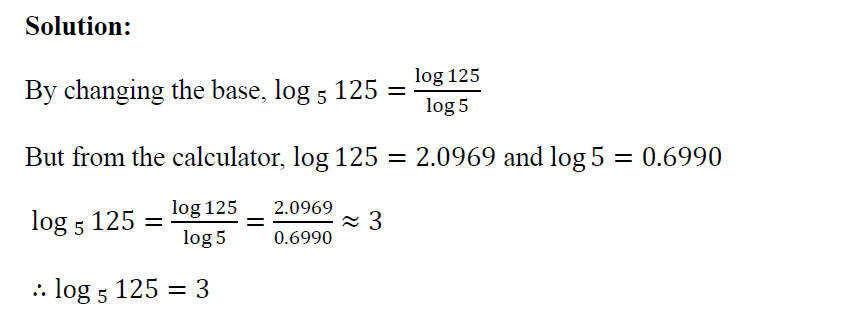
Find the value of log5125 using common logarithms.
Example 38
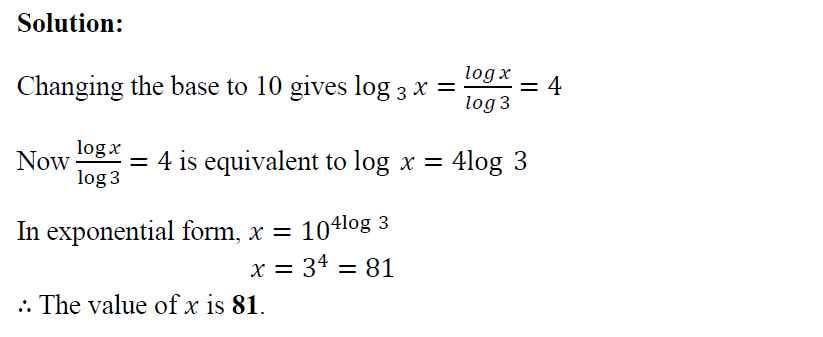
By using change of base approach, find the value 𝑥 in the equation log3𝑥=4.
Example 39
What is the value of x in the equation log2𝑥=log525?
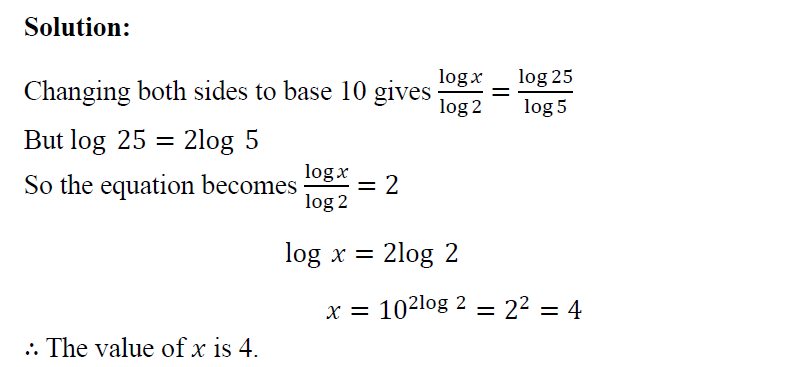
NB: You should note that 𝟏𝟎𝒍𝒐𝒈𝒌=𝒌
Exercise 3
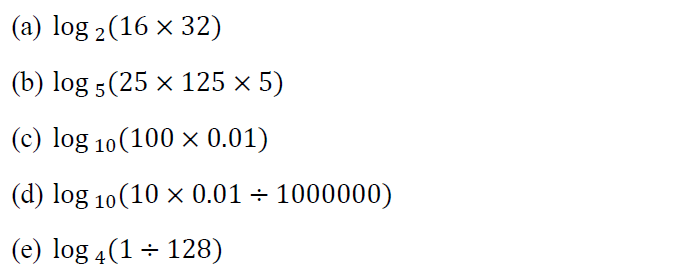
1. Evaluate each of the following:
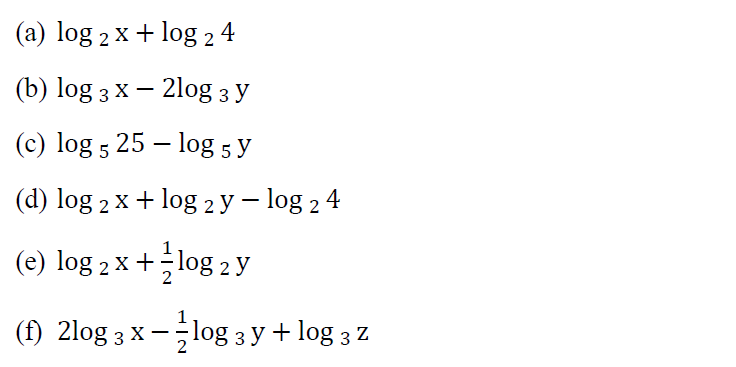
2. Write each of the following using a single logarithm:
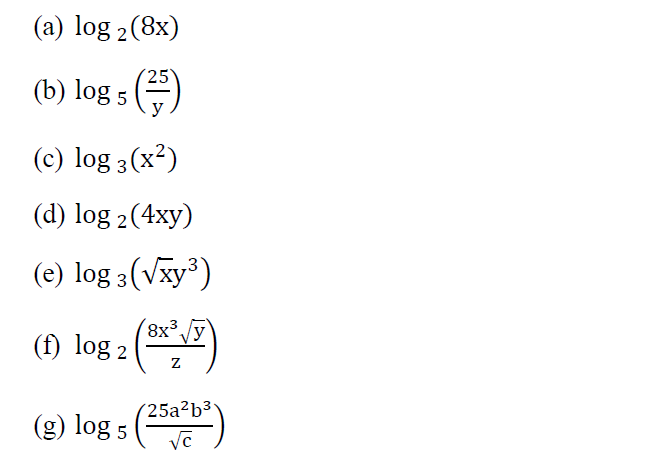
3. Express the following logarithms in expanded form:
4. Given that log a=0.4 and log b=0.6, find the values of each the following:


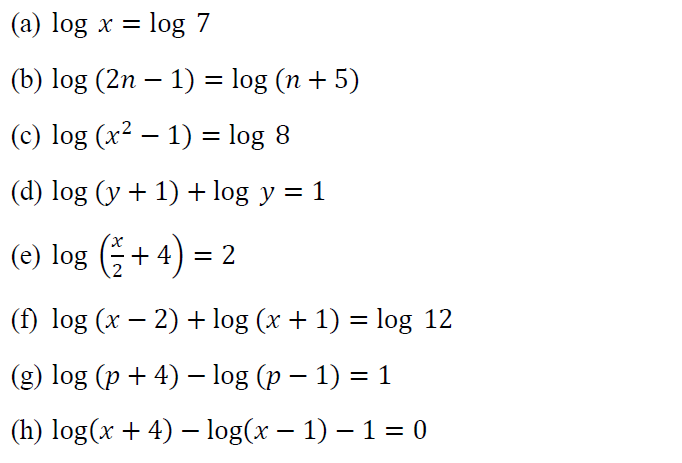
7. Solve each of the following equations:
8. Given that log2=0.3010, log3=0.4771, log5=0.6990 and log7=0.8451. Without using any calculating device, find the value of each of the following:

Logarithms of numbers
Logarithms of Numbers (using Calculators)
Before calculators existed, calculating logarithms was done manually and could take a lot of time.
Mathematicians and scientists depended on logarithm tables, which usually offered values accurate to only 4 or 5 significant figures, limiting both speed and precision.
In fields that require exact calculations, such as science and technology, calculators have become essential. Modern scientific calculators can quickly and accurately perform logarithmic and other complex calculations.
Unlike the older tables or slide rules, calculators have both speed and accuracy, making them essential tools for students, researchers, and professionals. They effectively connect mathematical theory with practical computation.
The basic tenets of Logarithms of numbers and solve the related problems.
Explore the basic tenets of Logarithms of numbers and solve the related problems.
Steps to follow in finding Common logarithms (Logarithms to base 10) of numbers by using a scientific calculator.
A calculator does not look up values in tables. Instead, it uses numerical algorithms (repeated calculations) stored in its memory. So when a calculator finds log N, it is really finding the value 𝑥 such that 10𝑥=𝑁.
Therefore, finding a logarithm of a given number by using a calculator involves the following steps:
1. Switch ON the calculator.
2. Press the log key (this means log base 10).
3. Enter the NUMBER whose logarithm you want to find.
4. Press equals sign (=) to get the result.
5. Read the answer shown on the screen.
NB: When you press log on a scientific calculator, it automatically uses base 10.
Example 40
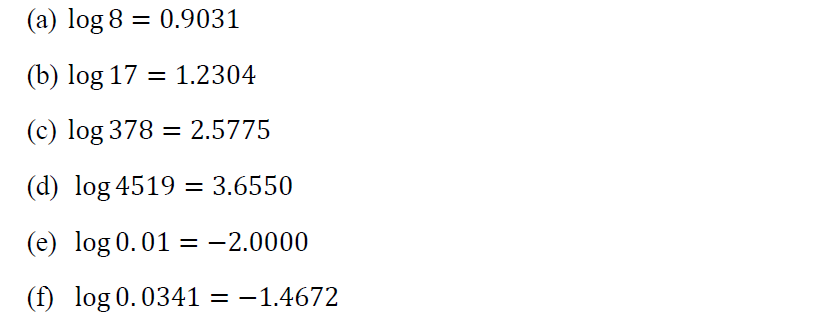
By using a scientific calculator, find the value of each of the following, giving your answer correct to 4 decimal places:

Answers:
Example 41
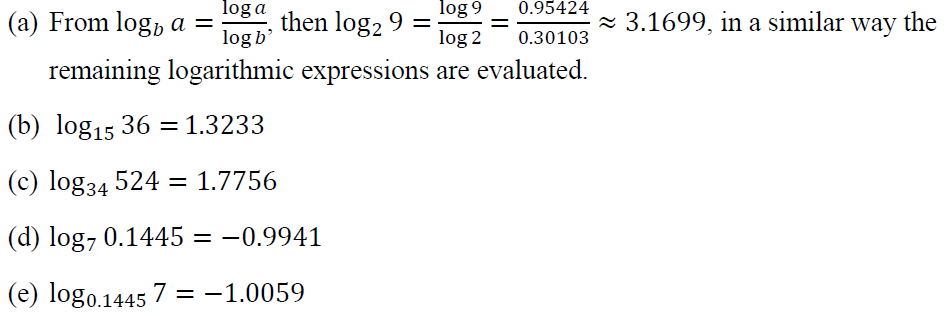
Use a scientific calculator to evaluate each of the following (give your answer correct to 4 decimal places):

Solution:
Here logarithms of numbers can be found by changing the base, because they are not common logarithms.
Example 42
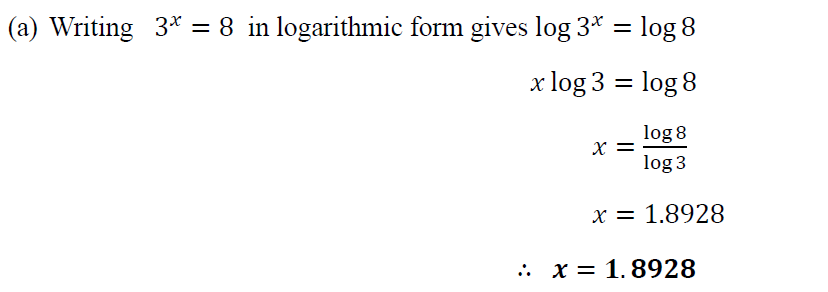
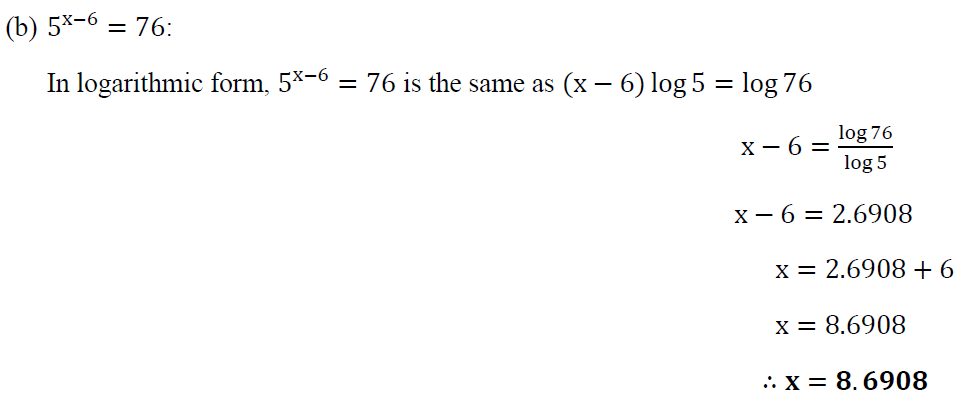
Solve for 𝑥 in each of the following equations:

Solution:
Exercise 4
1. By using a scientific calculator, find the value of each of the following, giving your answer correct to 4 decimal places:

2. By using a scientific calculator, find the value of each of the following, giving your answer correct to 4 decimal places:

3. Find the value of 𝑥 in each of the following equations:

Anti-Logarithms
An antilogarithm is the inverse of a logarithm. If the logarithm of a number is known, the antilogarithm gives back the original number.
Therefore, the antilogarithm is the process of finding the original number when its logarithm is known.
The basic ideas behind the Anti- Logarithms and solve the related problems
Explore the basic ideas behind the Anti- Logarithms and solve the related problems.
Finding the antilogarithm (base 10) by using a Scientific calculator.
To find a number whose logarithm under base 10 is given, just follow the following steps:
1. Switch ON the calculator.
2. Press SHIFT then log (this key usually shows 𝟏𝟎𝒙 above log).
3. Enter the given number (the logarithm value).
4. Press equals sign (=) to get the result.
5. Read the answer on the screen.
Example 43
With a help of a calculator, find a number whose logarithm to base 10 is:


Example 44
Use a calculator to find the ant-logarithm of each of the following;

Answers:
(a) 0.000001 (b) 0.6969 (c) 0.09897 (d) 0.000005825
Example 45
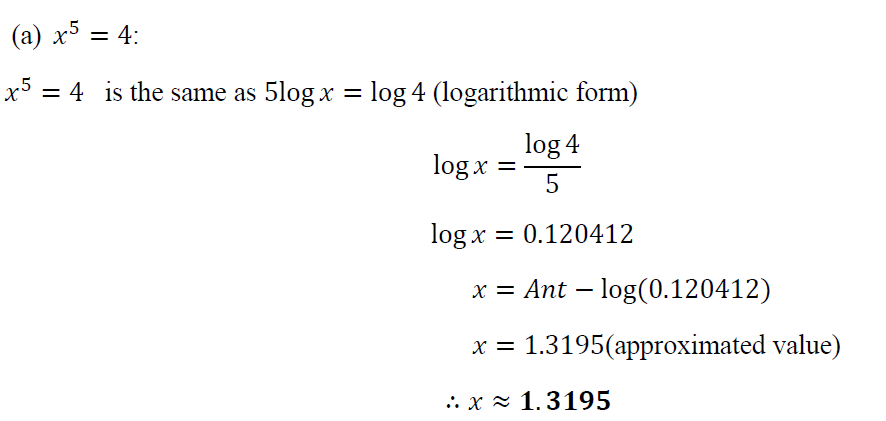
Find the value of 𝑥 each of the following equations:

Solution:
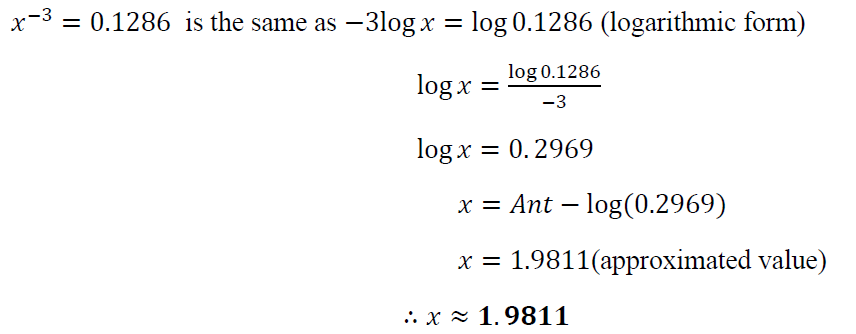
(b) 𝑥−3=0.1286:
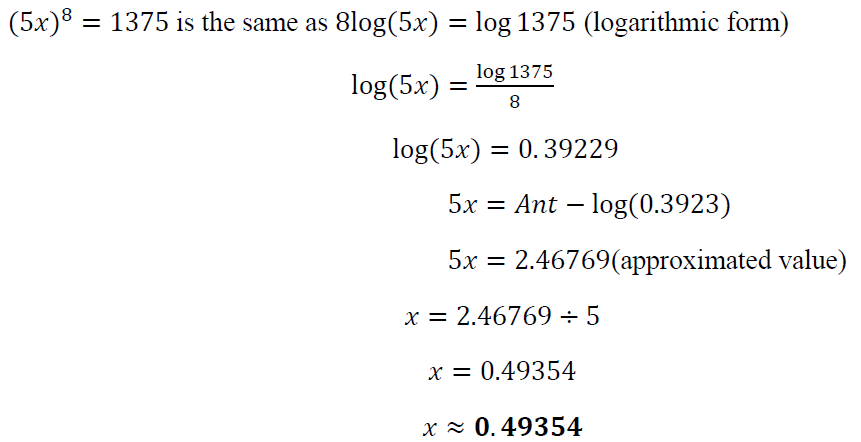
(c) (5𝑥)8=1375:
Exercise 5
1. Use a calculator to find a number whose logarithm is:

2. Use a calculator to find the ant-logarithm of each of the following;

3. Find the value of 𝑥 each of the following equations:

Application of Logarithms
Logarithms are used in many real-life and scientific situations, especially where numbers are very large or very small.
We use logarithms in simplifying calculations, scientific measurements, growth and decay problems, finance, computer science, and many other fields where large or small numbers occur.
Apply the concept and laws of logarithms to solve different related mathematical problems.
Example 46
A population of bacteria growth is given 𝑃=500×2𝑡, where 𝑡 is time in hours. After how many hours will the population reach 4,000?
Solution:
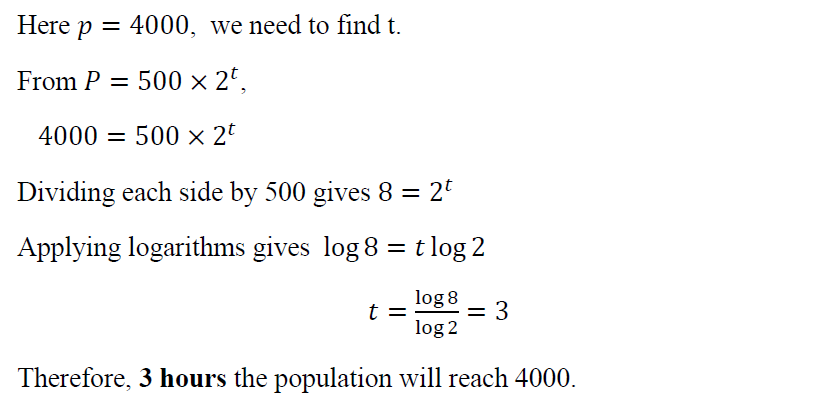
Example 47
The hydrogen ion concentration of a solution is [𝐻+]=3.2×10⁻⁵ mol/L. Find the pH of the solution.
Solution:
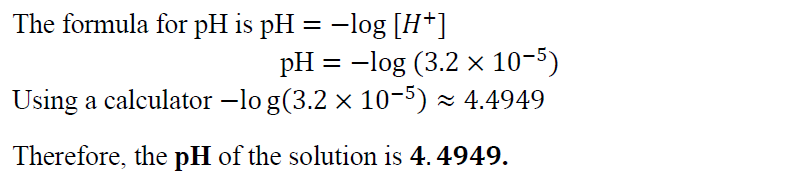
Example 48
The Richter scale measures the magnitude of earthquakes using a logarithmic scale. If Earthquake A has a magnitude of 7 and Earthquake B has a magnitude of 5, how many times more powerful is Earthquake A compared to Earthquake B?
Solution:
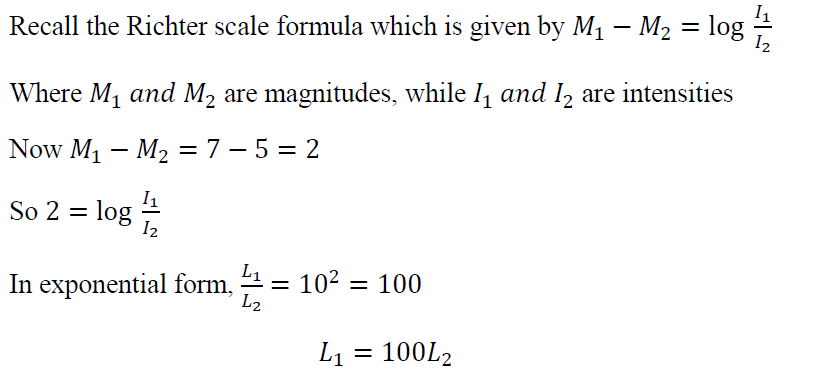
Therefore, Earthquake A is 100 times more powerful than Earthquake B.
Example 49
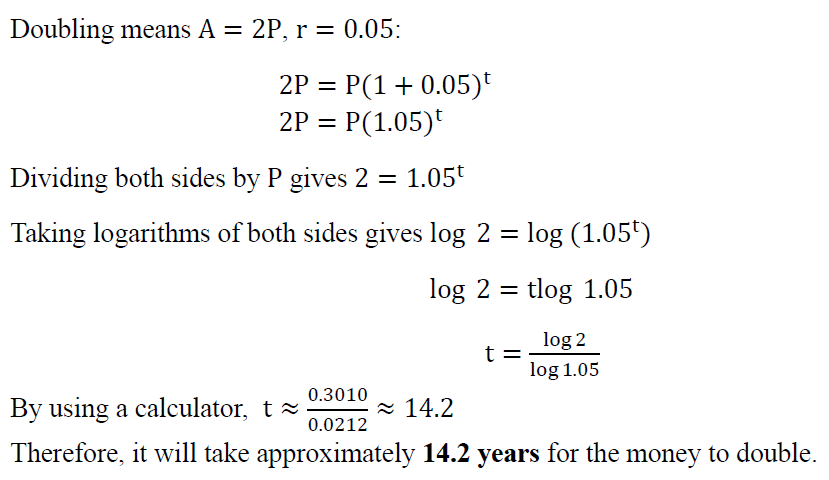
A sum of money is invested at 5% per year, compounded annually. How long will it take for the money to double?
The formula for compound interest is 𝐴=𝑃(1+𝑟)𝑡, where: 𝐴= final amount, 𝑃= principal, 𝑟= interest rate and 𝑡= time (years)
Solution:
Exercise 6
1. A radioactive substance decays according to 𝑁=𝑁0𝑒−𝑘𝑡. If 𝑘=0.2 per year, find the time taken for the substance to reduce to one-quarter of its original amount.
2. A radioactive substance has an initial mass of 80 g. Its decay constant is 0.1 per second.Find the mass remaining after 10 seconds.
3. A radioactive substance has a decay constant of 0.2 per day. How long will it take for the substance to decay to one-quarter of its original amount?
4. An earthquake has a magnitude of 6.5 on the Richter scale, while another has magnitude 4.5. Find how many times more intense the first earthquake is than the second.
5. A sum of TZS 2,000,000 is invested at an interest rate of 5% per annum, compounded annually, for 4 years. Find the final amount (Use the formula 𝐴=𝑃(1+𝑟)𝑡).
6. A sum of money is invested at 8% per annum, compounded annually. How long will it take for the money to double?
7. The hydrogen ion concentration of a solution is [𝐻+]=1.0×10⁻³ mol/L. Find the pH of the solution and state whether it is acidic, neutral, or alkaline(Acidic when the pH < 7 and alkaline when pH > 7, otherwise neutral).
8. A solution has a pH of 5. Find the hydrogen ion concentration [𝑯+].
9. A town has an initial population of 50,000 people. The population grows at a rate of 3% per year. Find the population after 10 years.
10. A country has a population of 2 million people. If the population grows at a rate of 4% per year, how long will it take for the population to double?
Listening to this topic