Mathematics (New)
EXPONENTS AND RADICALS
Reading settings
Text size
Line spacing
Colours
EXPONENTS AND RADICALS
Exponents and radicals are fundamental concepts in algebra that deal with powers and roots of numbers and algebraic expressions. They simplify repeated multiplication and help us solve equations involving large or small quantities easily. These concepts are widely used in areas like mathematics, science, technology, engineering and economics.
Contents
The following concepts are covered under topic: (i) Exponents (ii) Laws of Exponents (iii) Exponential Equations (iv) Fractional Exponents (v) Radicals (vi) Rationalization of Denominators and (vii) Finding roots of Numbers by Calculators.
Competencies
After studying this chapter, you should demonstrate competencies in Exponents and Radicals by:
(1) Defining exponents and identifying the base and the power correctly (2) Use the rules of exponents to simplify numerical and algebraic expressions (3) Simplify expressions involving positive, negative, zero, and fractional exponents (4) Define radicals and identify square roots, cube roots and higher roots (5) Simplify radicals by factoring and expressing them in simplest form (6) Performing operations with radicals (add, subtract, multiply, and divide radical expressions) (7) Solve algebraic equations containing powers and roots (8) Use exponents and radicals in practical contexts such as scientific notation, Rates of spread of diseases and Population growth problems.
Introduction
Exponents and radicals are key concepts in algebra that help us work with powers and roots of numbers. An exponent tells us how many times a number is multiplied by itself. For example, 32 means 3×3. A radical shows the root of a number, such as a square root or cube root. For example, √9=3.
These two ideas are connected because radicals can also be written using fractional exponents. Understanding this connection makes it easier to simplify expressions and solve mathematical equations more easily.
The concepts of Exponents and Radicals are useful in many real-life situations, including science, technology, geometry, finance, and economics. Also mastering this topic builds a strong foundation for higher mathematics learning.
Exponents
Exponents (also called indices or powers) tell us how many times a number is multiplied by itself.
For example, 24=2×2×2×2=16 (2 is multiplied by itself 4 times)
53=5×5×5=125 ( 5 is multiplied by itself 3 times) and 104=10×10×10×10=10,000 (10 is multiplied by itself 4 times)

Therefore, instead of writing long multiplications (repeated multiplication of the same number), exponents give a short and neat way.
The basic concepts of exponents
Exponent
Math Exponential Form
Exponent
Explore the basic concepts of exponents.
Definitions:
Numbers written as 24, 53, 76 or in general 𝑎𝑛 are called Powers.
The base of a power is the number or variable that is raised to an exponent. For example, 2 and 5 are the bases of powers 24 and 53 respectively.
An exponent is a small number (part of the power) written above and to the right of another number. It tells you how many times to multiply the base by itself. For example, 4 and 3 are the exponents of powers 24 and 53 respectively.
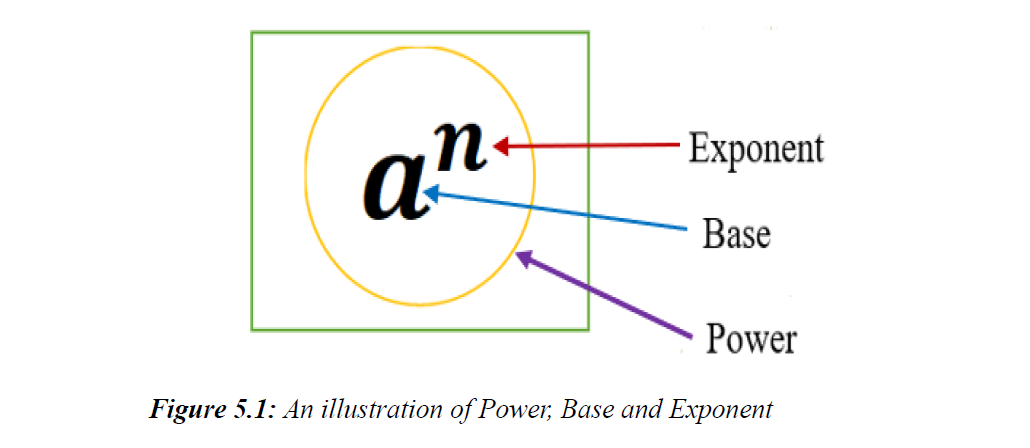
In general, if a number is written in exponential form as 𝑎𝑛, then 𝒂𝒏 is the power, 𝒂 is the base and 𝒏 is the exponent.
The following figure illustrates the concept.
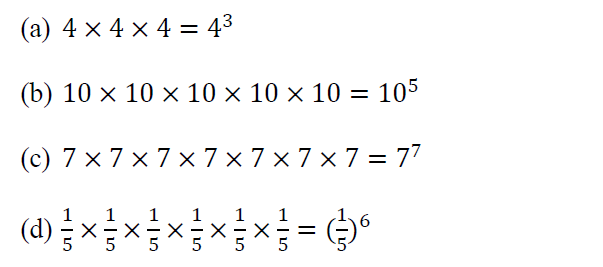
Example 1
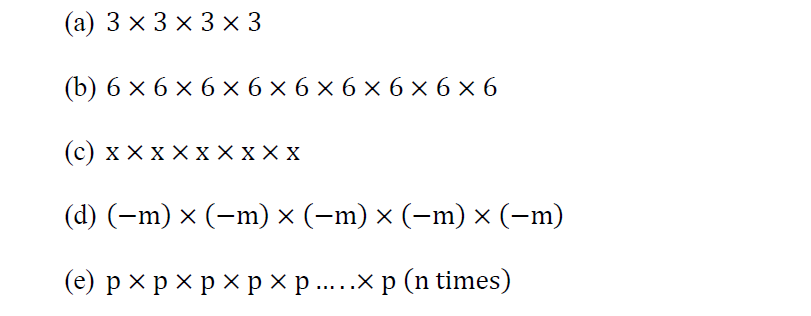
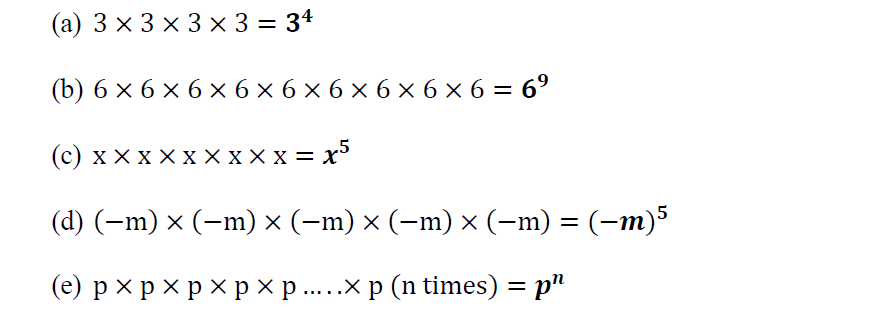
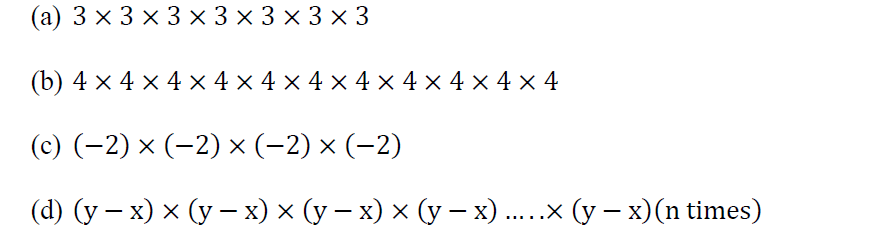
Write the following expressions in exponential form:
Solution:
Example 2
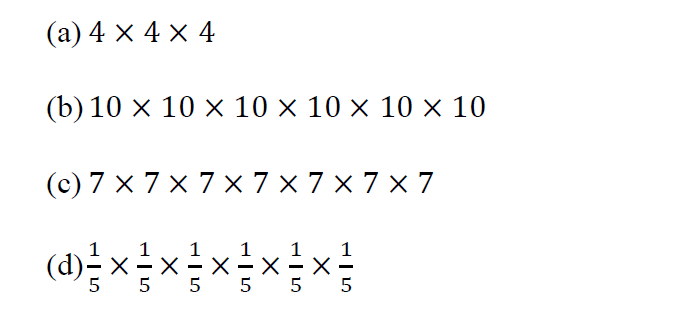
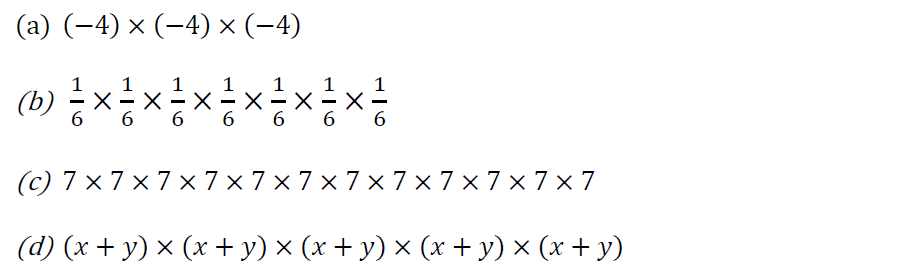
Write the following in power form:
Solution:
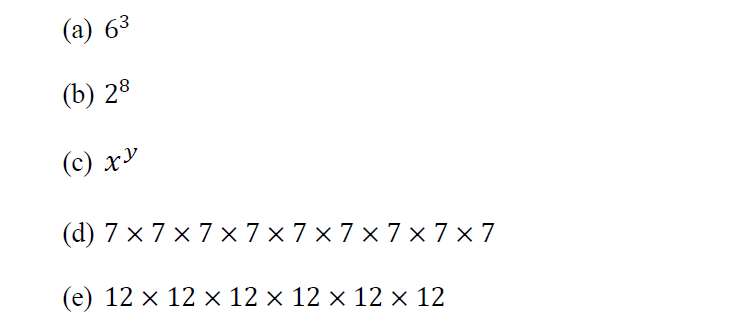
Example 3
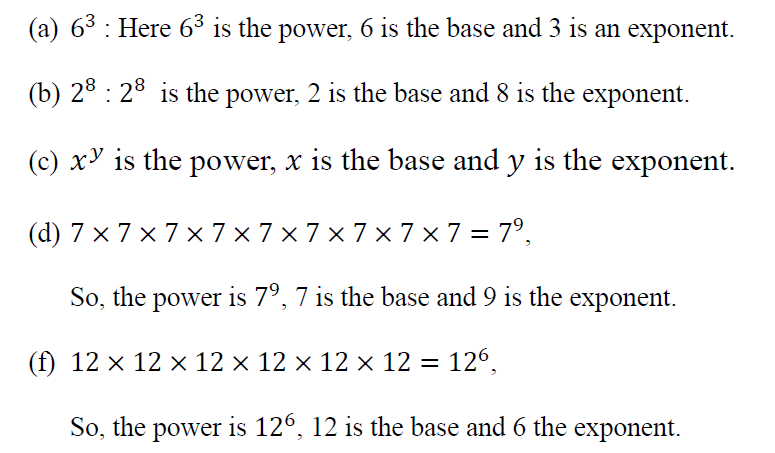
Identify the power, base and exponent for each of the following numbers:
Solution:
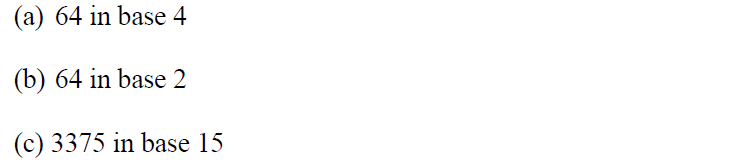
Example 4
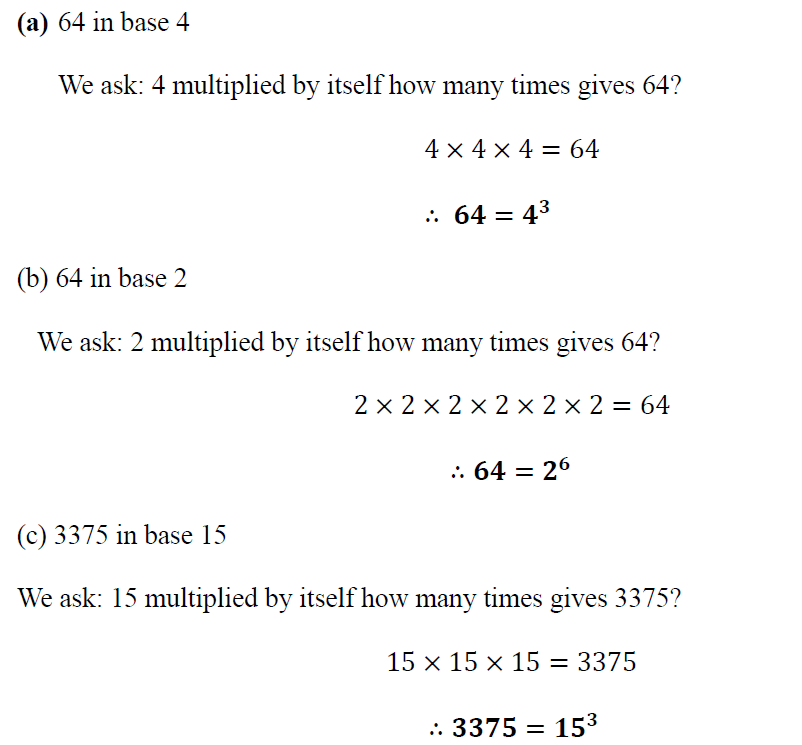
Express each of the following numbers in exponential form:
Solution:
Example 5
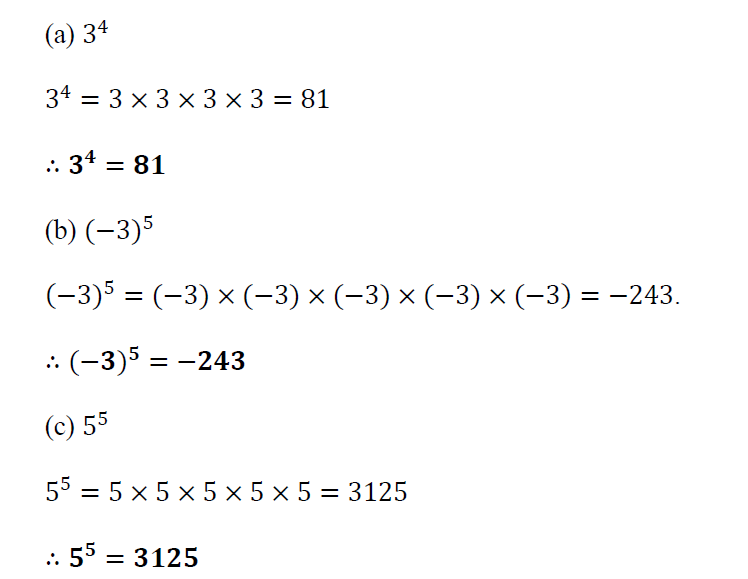
Find the value of each of the following:

Solution:
Exercise 1
1. Write the following expressions in exponential form:
2. Write the following in power form:
3. Identify the power, base and exponent for each of the following numbers:
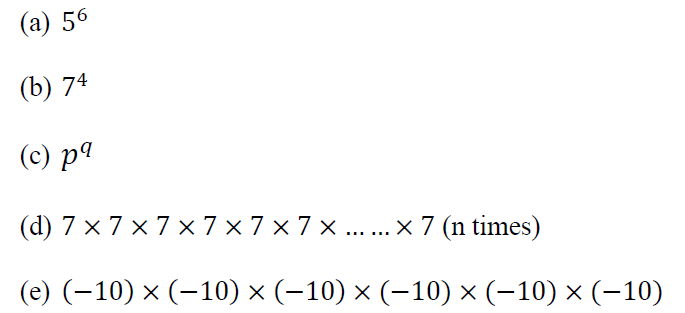
4. Write each of the following numbers in exponential form:
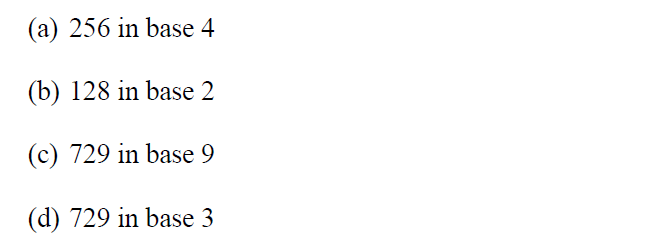
5. Find the value of each of the following:
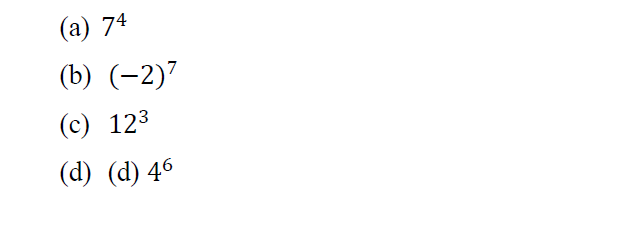
Laws of Exponents
The laws of exponents help us simplify expressions involving powers. Therefore, under this section, the following laws are discussed:
(1) Product Law (Multiplying Powers with the Same Base) (2) Quotient Law (3) Power of a Power Law (4) Power of a Product law (5) Power of a Quotient Law 6) Zero Exponent Law and (7) Negative Exponent Law.
Identify and use laws of exponents involving positive, negative, and zero exponents AND use the laws to solve the related problems.
(1) Product Law (Multiplying Powers with the Same Base)
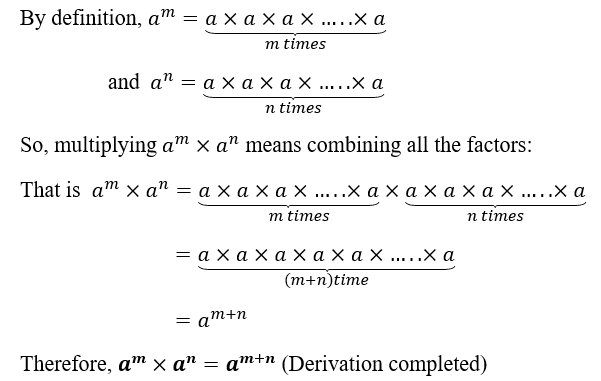
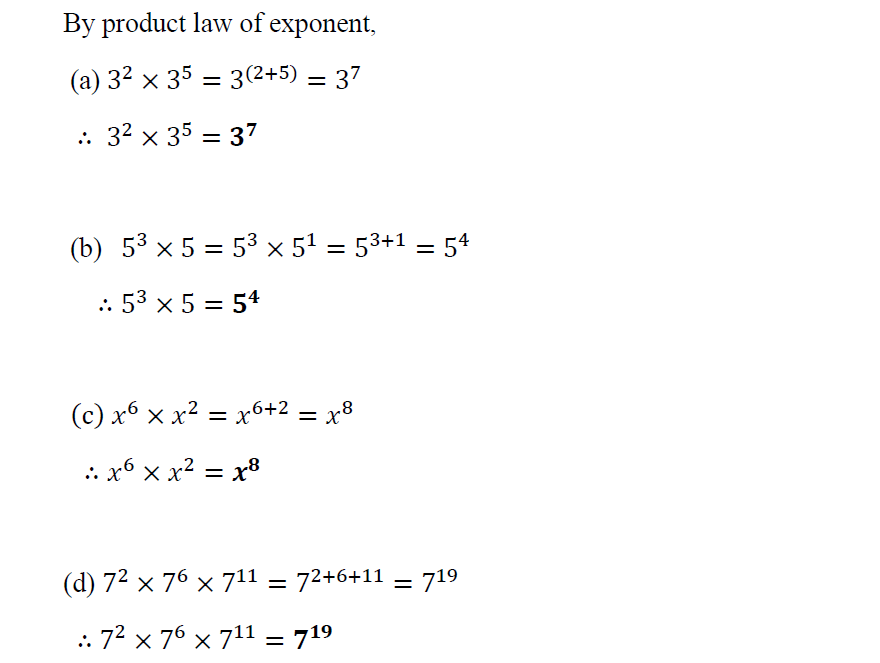
The product law of exponents states that “When multiplying powers that have the same base, add the exponents”.
That is 𝒂𝒎×𝒂𝒏=𝒂𝒎+𝒏
Derivation:
Let the base be 𝑎 (where 𝑎≠0).
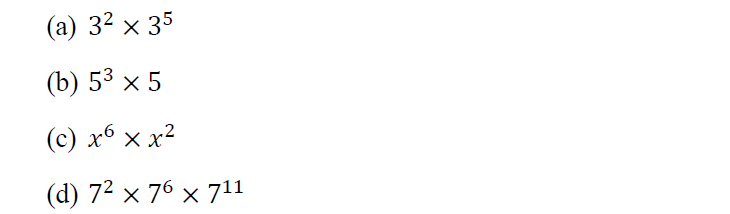
Example 6
Simplify each of the following expression, giving your answer in exponential form:
Solution:
(2) Quotient Law
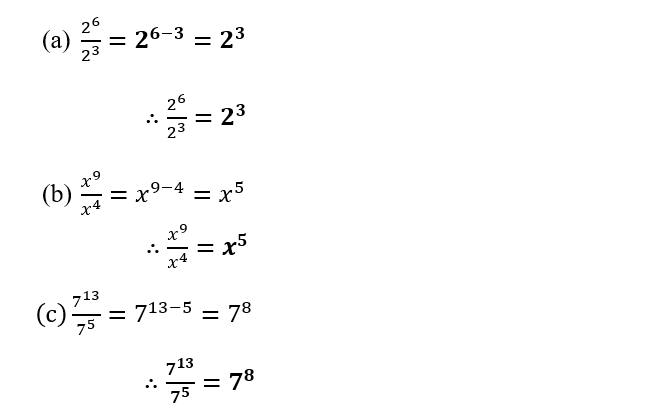
The quotient law of exponents states that “When dividing powers that have the same base, subtract the exponents”.
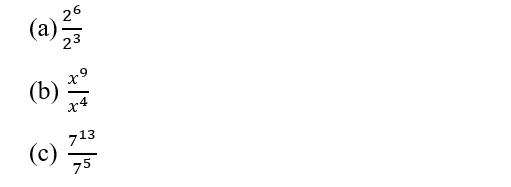
Example 7
Simplify each of the following (leaving your answer in exponential form):
Solution:
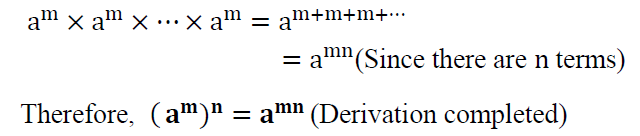
(3) Power of a Power Law
The law states that “When raising a power to another power, keep the base and multiply the exponents’’.

By product law,
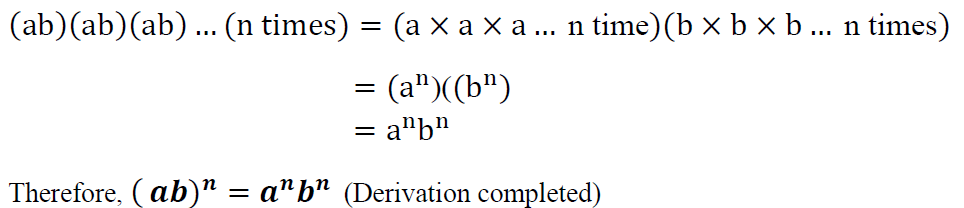
(4) Power of a Product law
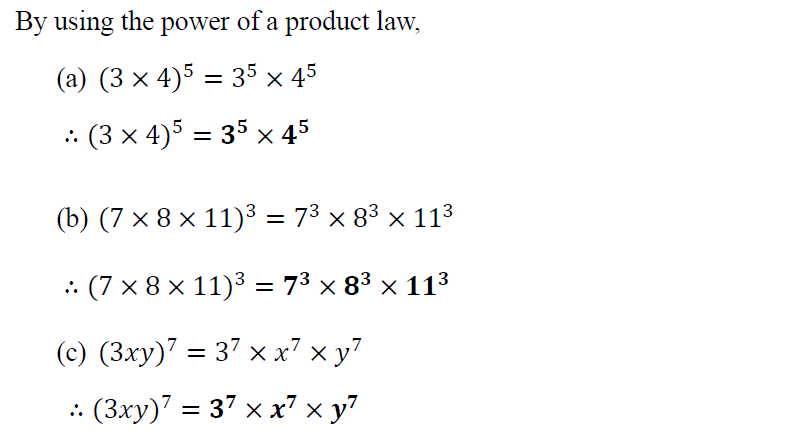
The law states that “When raising a product to a power, raise each factor to that power’’.

By commutative property, we rewrite it as follows:
Example 8
Expand each of the following (giving your answer as a product of powers with different bases):

Solution:
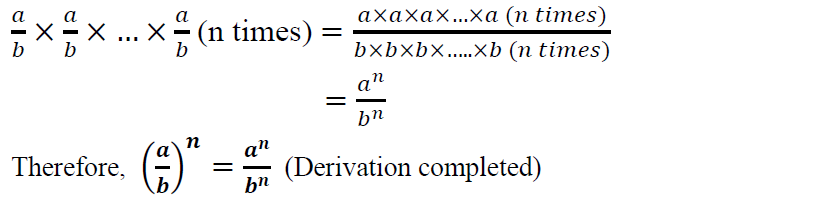
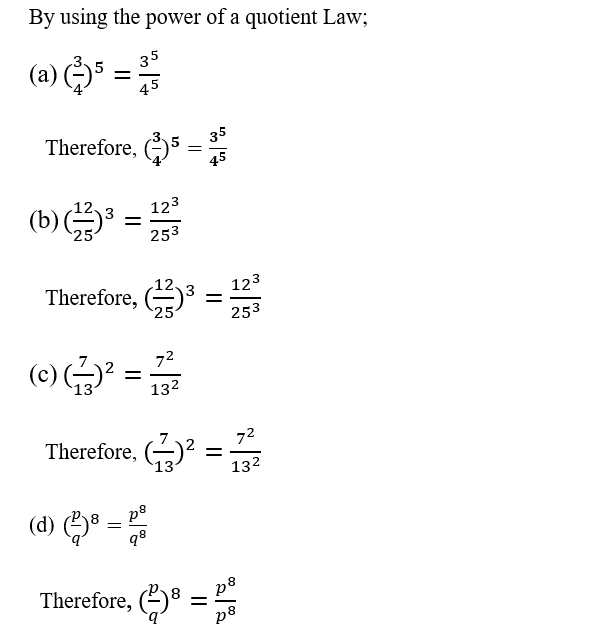
(5) Power of a Quotient Law
The law states that “When raising a quotient to a power, raise both the numerator and the denominator to that power”.

Multiplying numerators and denominators separately gives
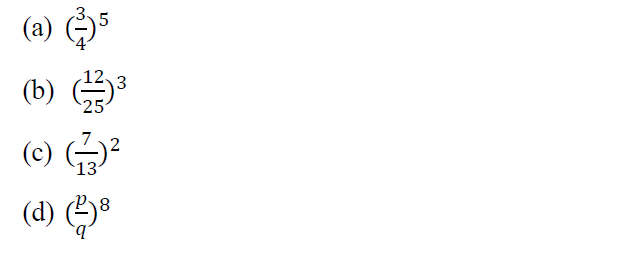
Example 9
Expand each of the following (giving your answer as a quotient of powers with different bases):
Solution:
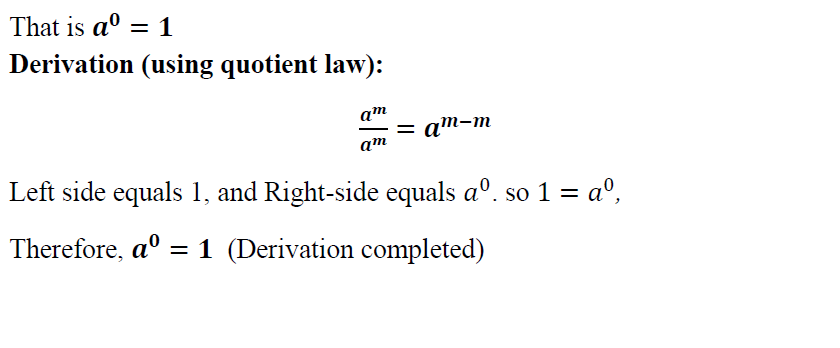
(6) Zero Exponent Law
The law states that ‘Any non-zero number raised to the power zero equals one’.
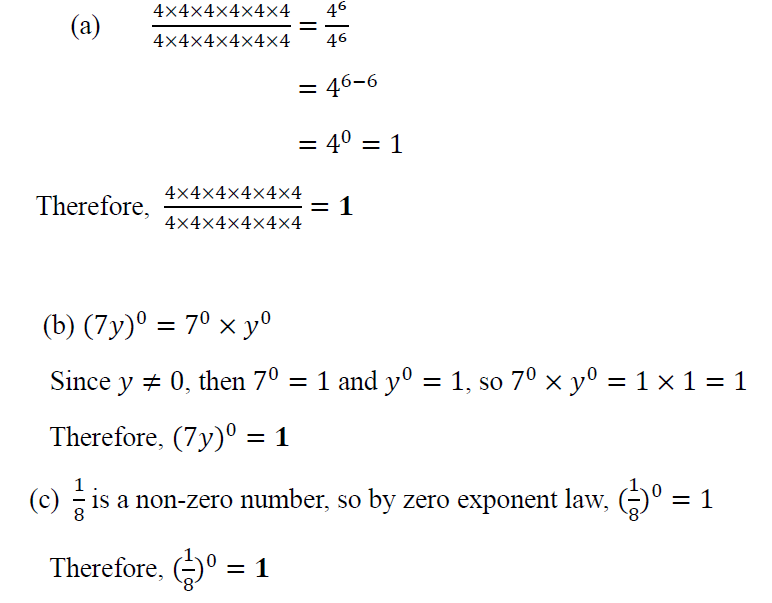
Example 10
Simplify each of the following expressions:

Solution:
(7) Negative Exponent Law
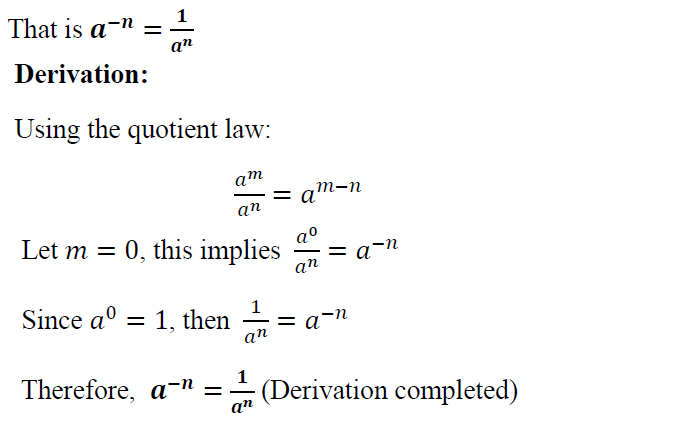
A negative exponent means taking the reciprocal of the base and make the exponent positive.
Example 11
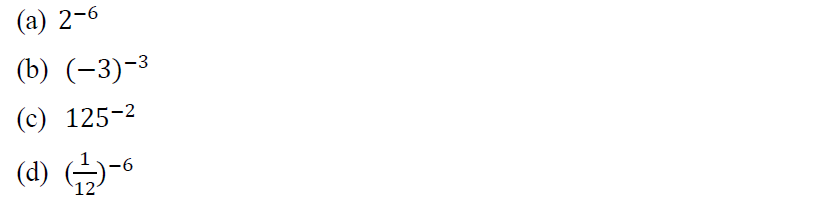
Express the following as powers with positive exponents:
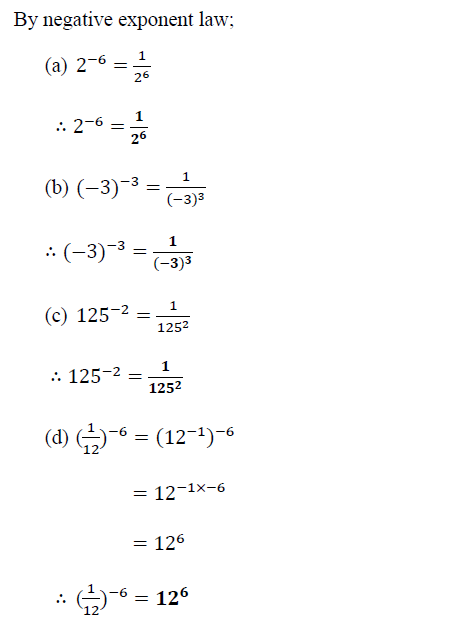
Solution:
Example 12
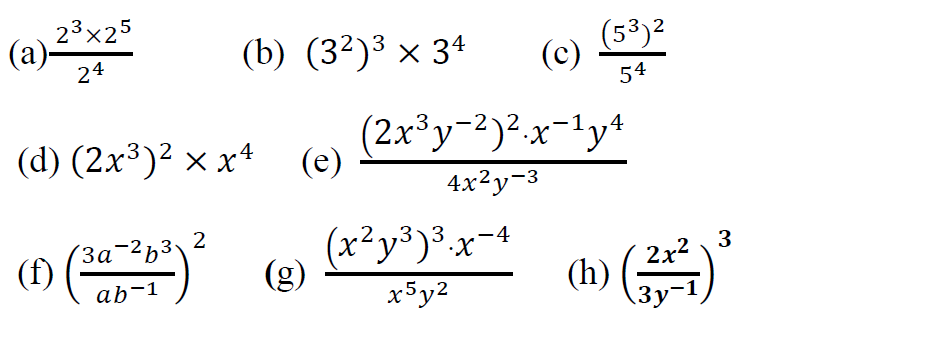
Simplify each of the following:
Solution:
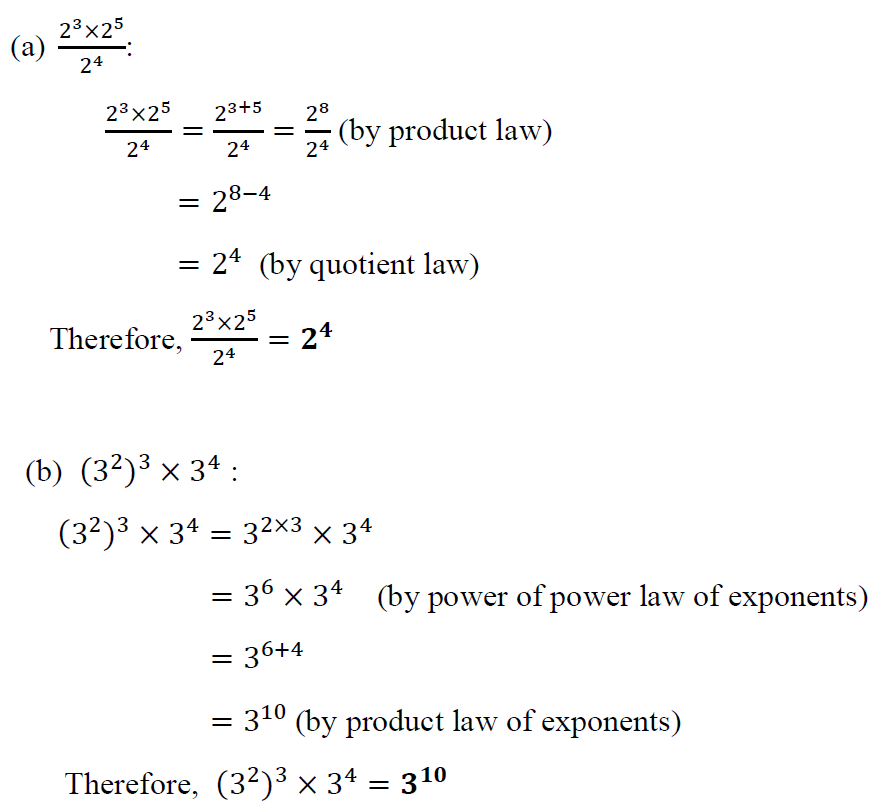
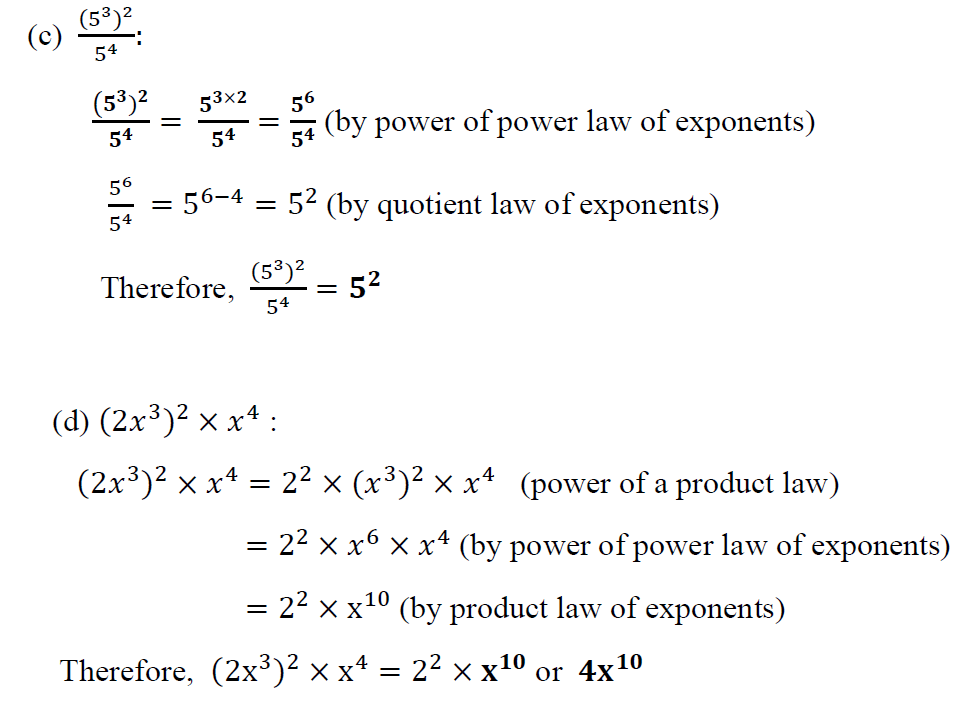
Solution Cont......
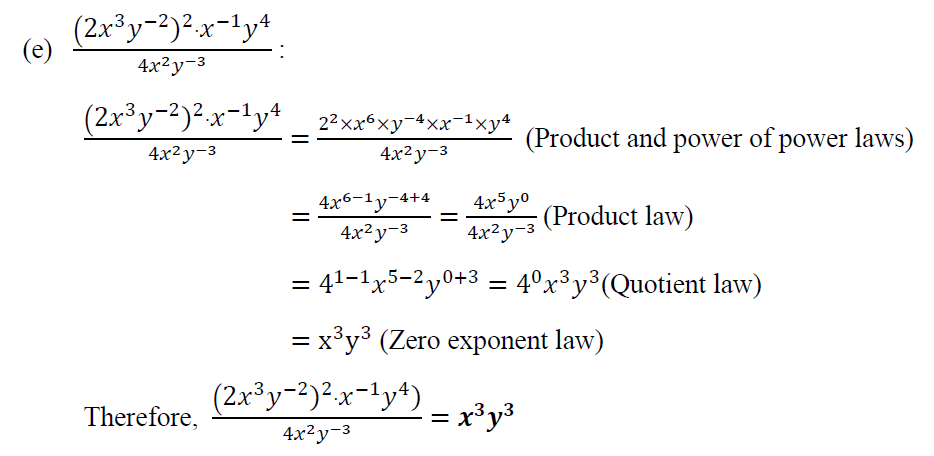
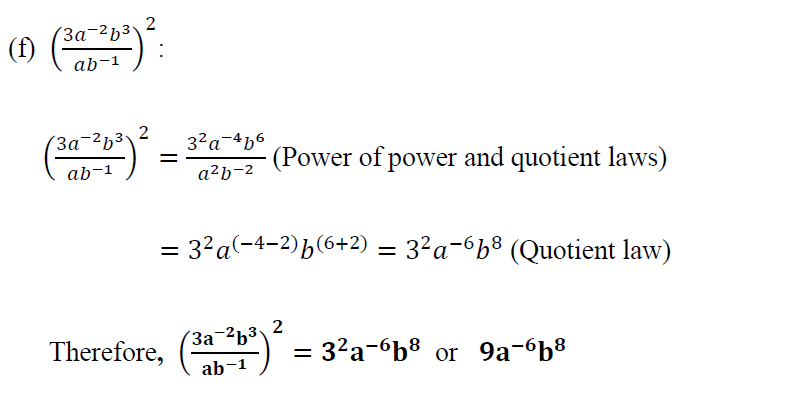
Exercise 2
Answer the following questions according to the given instructions:
1. Simplify each of the following (leave your answer with terms in power form):

2. Simplify each of the following (leave your answer with terms in power form):

3. Write each of the following expressions in a simple way (leave your answer with terms in power form):

4. Expand each of the following (leave your answer with terms in power form):

5. Expand each of the following (leave your answer with terms in power form):

6. Simplify each of the following;

7. Simplify each of the following (leave your answer with terms in power form having negative exponents):

8. Simplify each of the following expressions:

Exponential Equations
Definition:
An exponential equation is any equation involving exponents where by the variable appears in the exponent or the base. The base of the exponent is usually a positive number (not 1), and the goal is to solve for the unknown variable.
For example, 2𝑥=8 or 𝑦3=27 are exponential equations, and the variables to solve for are 𝑥 and 𝑦.
Identify exponential equations and use appropriate methods to solve them.
Rules for Solving Exponential Equations
When solving exponential equations, we use laws of exponents and some key strategies.
(1) Same Base Rule
If the bases are the same, that is if 𝑎𝑚=𝑎𝑛, then the exponents must be equal (𝑚=𝑛).
(2) Same Exponent Rule
If the exponents are the same, that is if 𝑎𝑚=𝑏𝑚, then the bases must be equal (𝑎=𝑏).
Example 13
Find the value of 𝑥 in each of the following equations:

Solution:
(a) 2𝑥=64:
From 2𝑥=64, we write 64 as a power in base 2, that is 64=26
Now 2x=64 implies 2𝑥=26
So 𝑥=6 (since the base are the same, then the exponents should also be the same)
∴ The value of 𝑥 is 6.
(b) 3𝑥−5 = 81:
3𝑥−5=(81=34) which means 3𝑥−5=34
Since the base are the same, then the exponents should also be the same, that is 𝑥−5=4,or 𝑥=4+5=9
∴ The value of 𝑥 is 9.
Example 14
Solve the following equations:

Solution:
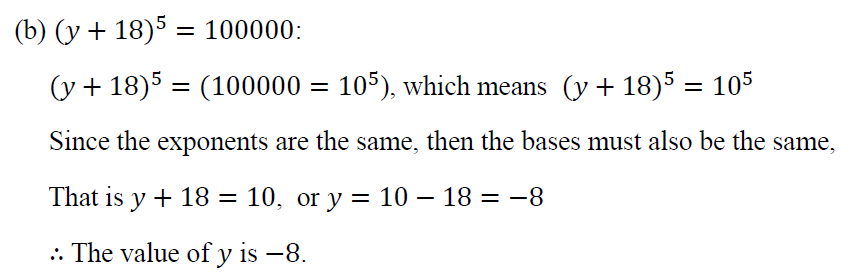
(a) 𝑥3=27:
𝑥3=(27=33) which means 𝑥3=33
Since the exponents are the same, then the bases must also be the same, that is 𝑥=3,
∴ The value of 𝑥 is 3.
Example 15
Solve for 𝑥 and 𝑦 in the equations 4𝑥=2𝑦 and 3𝑥=9𝑦−1
Solution:
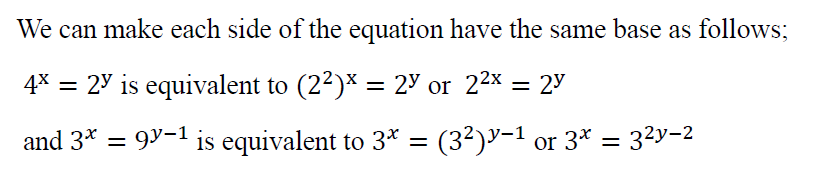
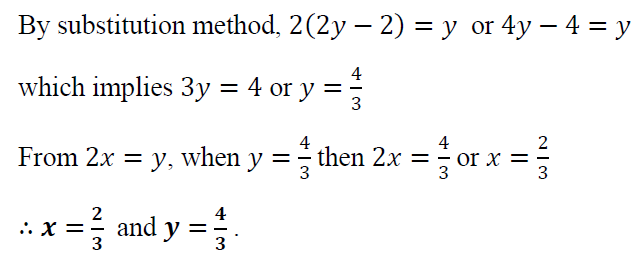
Now, since the bases are the same, then the exponents must also be the same, this results into two linear simultaneous equations, 2𝑥=𝑦 and 𝑥=2𝑦−2
Example 16


Solution:
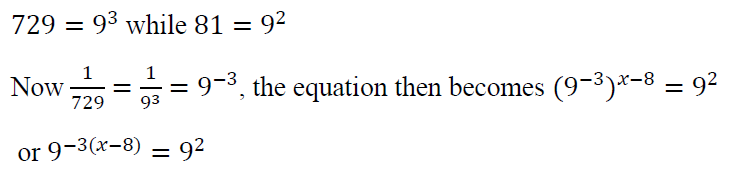
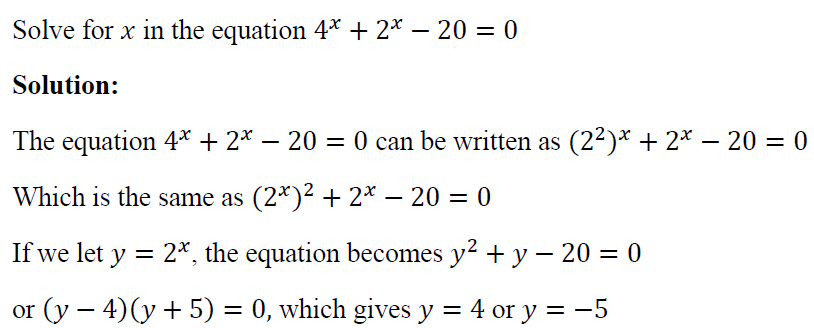
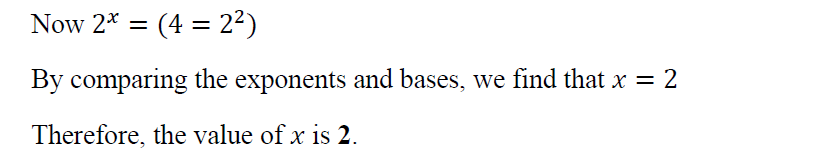
But 𝑦=2𝑥 can’t be negative, so the only possible value of y is 4.
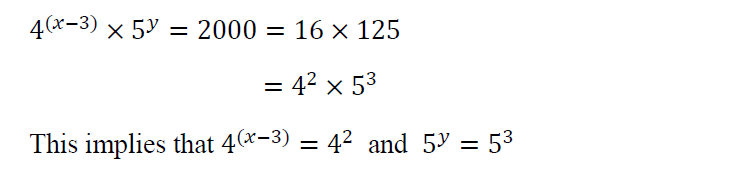
Now, comparing the exponents in both equations suggests that 𝑥−3=2 and 𝑦=3.

Since the bases are the same, then the exponents must also be the same, that is −3(𝑥−8)=2 or 24−3𝑥=2
22=3𝑥, solving for x gives 𝑥=22/3

Exercise 3
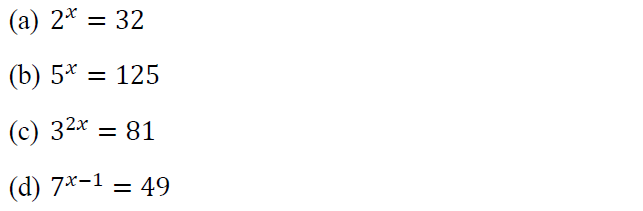
1. Solve for 𝑥 in each of the following equations:
2. Solve the following equations:
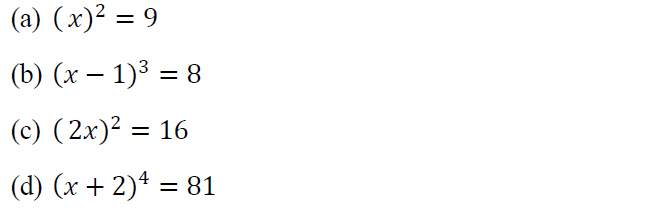
3. Find the value of 𝑥 in each of the following equations:
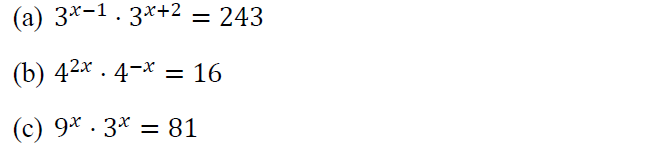

5. Solve for 𝑥 and 𝑦 in each of the following equations:

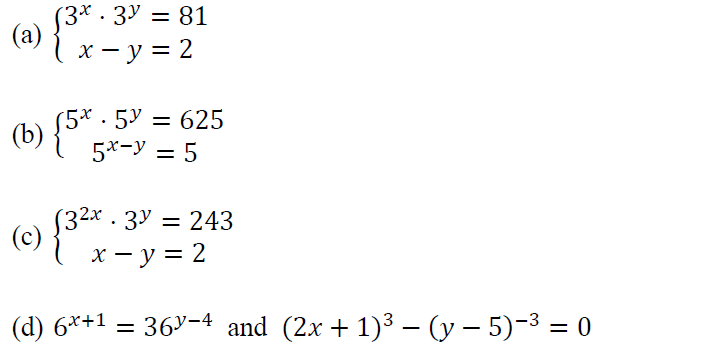
6. Find the value of 𝑥 and 𝑦 in each of the following pairs of equations:
Fractional Exponents
A fractional (or rational) Exponent is an exponent written as a fraction. It represents a combination of a power and a root.
For example, 61/2 and 363/2 are powers with exponents 1/2 and 3/2 respectively.
Generally, a number in exponential form such as 𝒙𝒎/𝒏 represents a power in base 𝒙 having the exponent 𝒎/𝒏.
Note that in simplifying numbers with fractional exponents, the rules used in numbers with integral exponents apply.

Explore fractional exponents and solve the related problems.
Example 17
Evaluate each of the following expressions:

Solution:
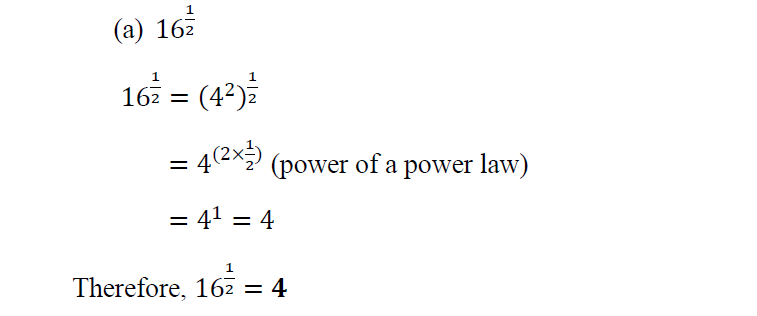
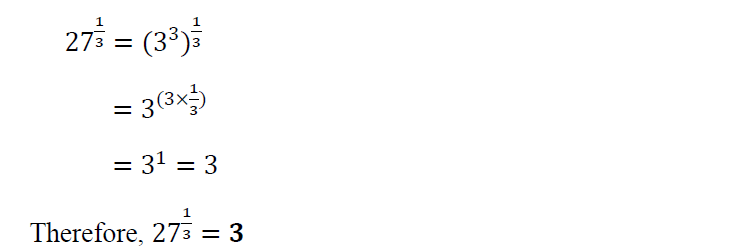
(b) 271/3
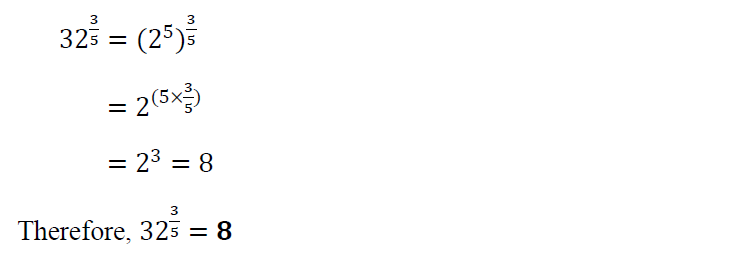
(c) 323/5
Example 18
Find the value of:

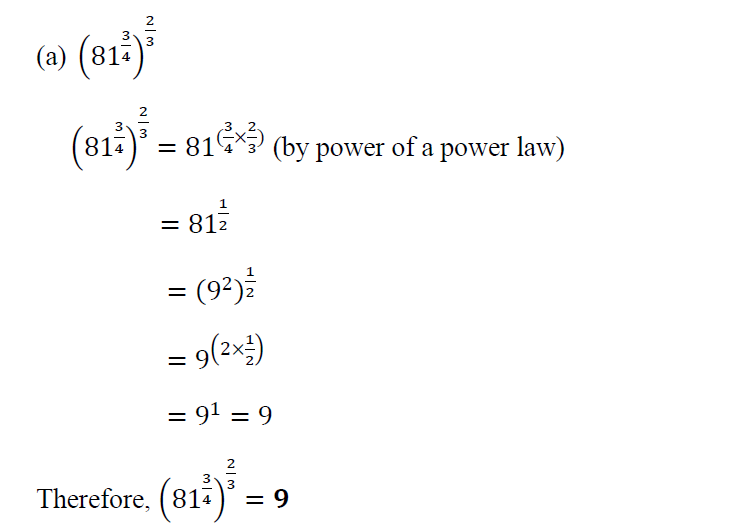
Solution:
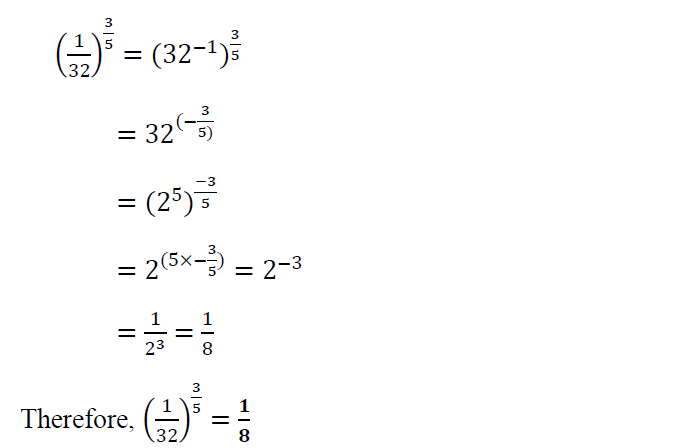
(b) (1/32)3/5
Example 19
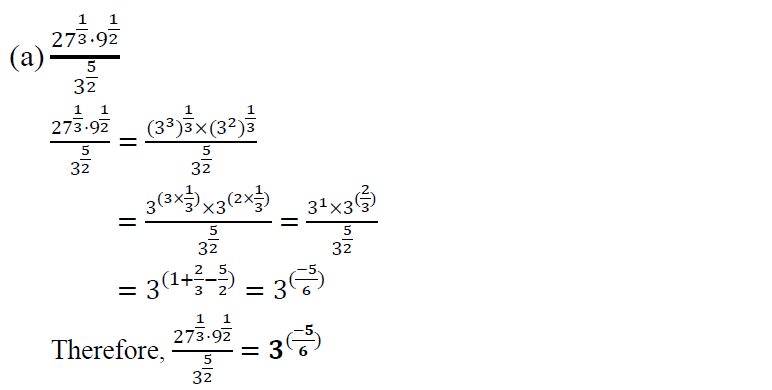
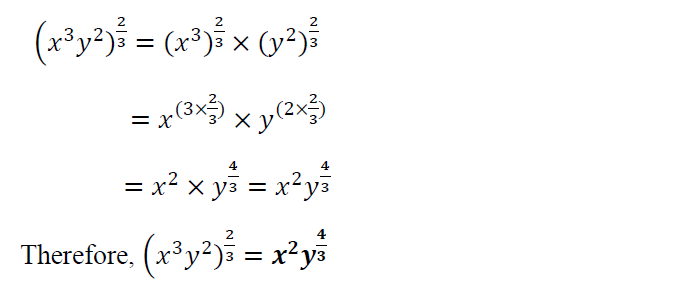
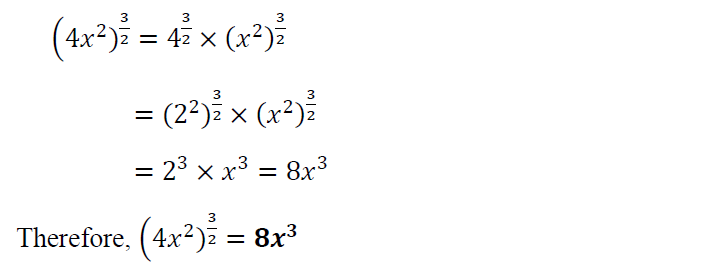
Simplify each of the following expressions:

Solution:
(b) (𝑥3𝑦2)2/3
(c) (4𝑥2)3/2
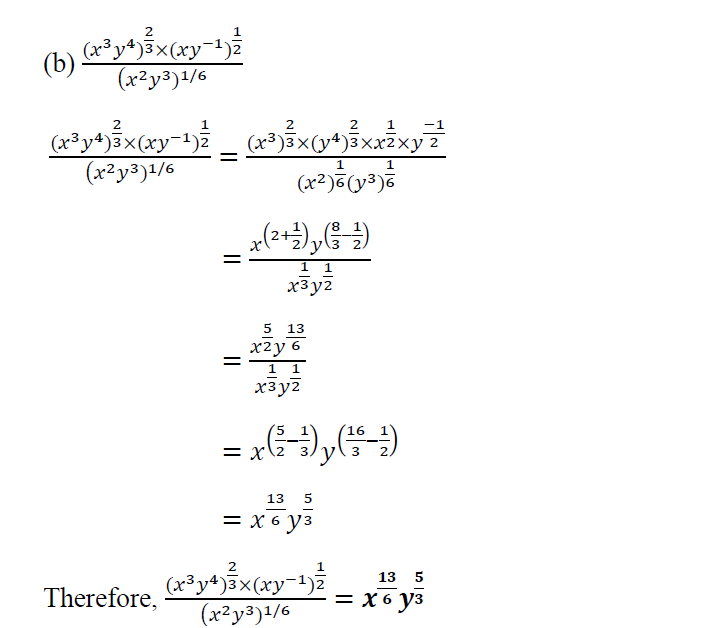
Example 20
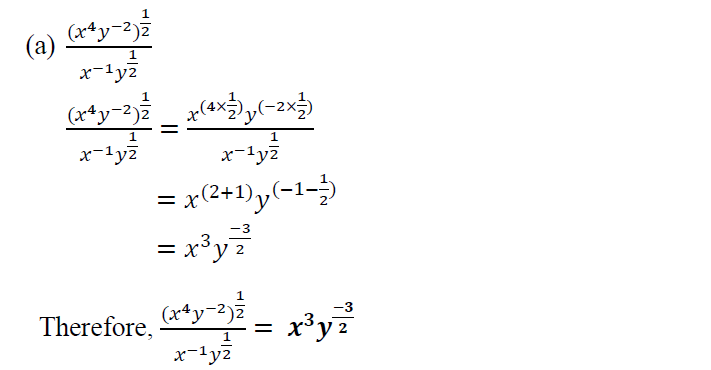
Write the following in their simplest form:

Solution:
Exercise 4
1. Simplify each of the following expressions:

2. Find the value of each of the following expressions:

3. Evaluate each of the following expressions:

4. Write each of the following expressions in simple form:
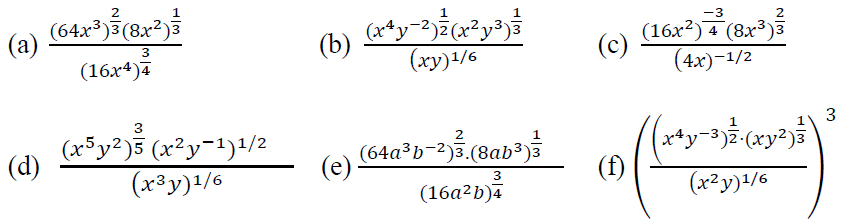
5. Solve the following equations:

Radicals
A radical is a mathematical expression that represents a root of a number.
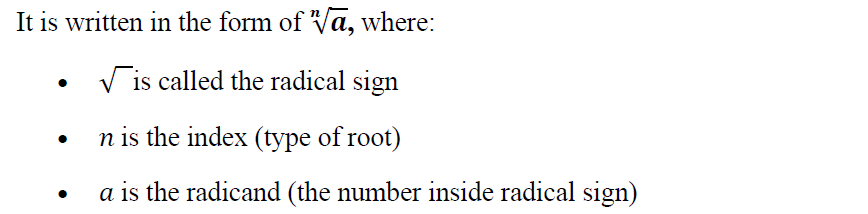
The concept of Radicals and workout the related problems.
Describe the concept of Radicals and workout the related problems.
We can think of Radicals as another way of writing fractional exponents, for example √a=a1/2.

Therefore, radicals can be treated as exponents and this being the case, all expressions involving radicals obey the laws of exponents.


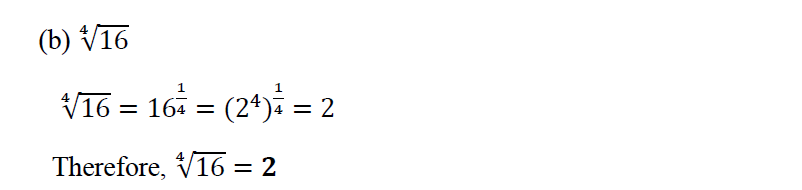
Example 21
Find the value of:

Solution:
(a) √16
√16=161/2=(42)1/2=4
Therefore, √16=𝟒
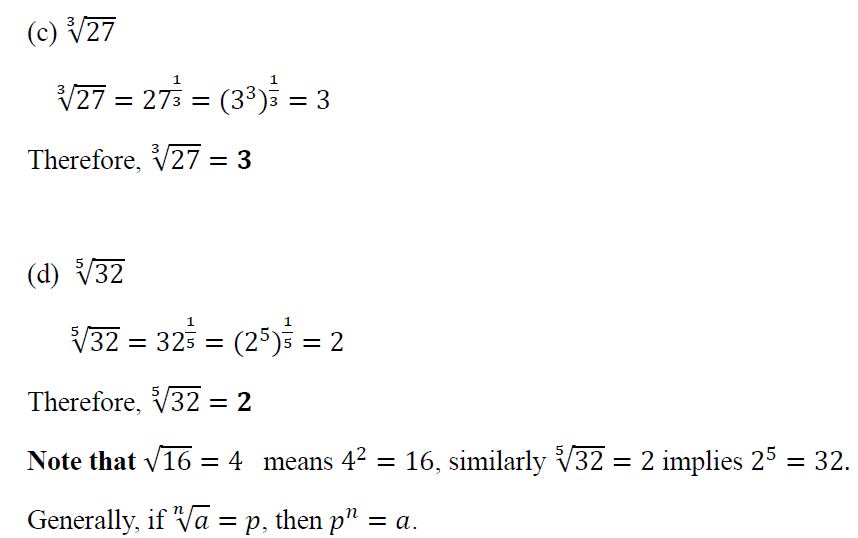
Example 22
Simplify each of the following expressions:

Solution:
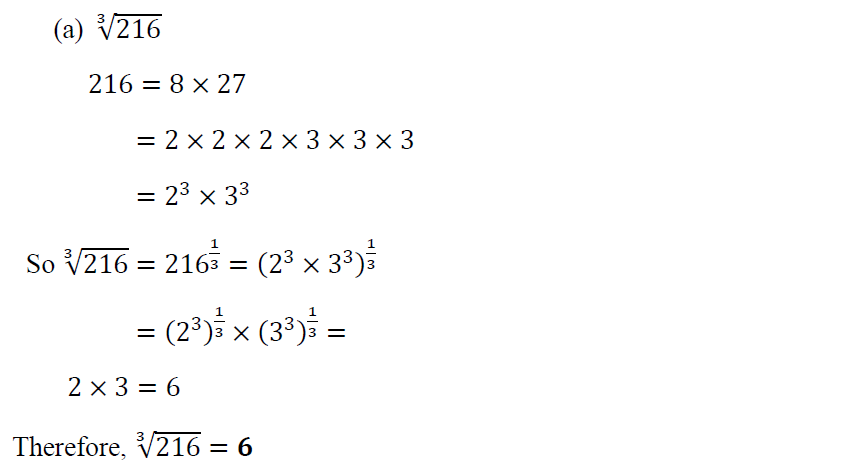
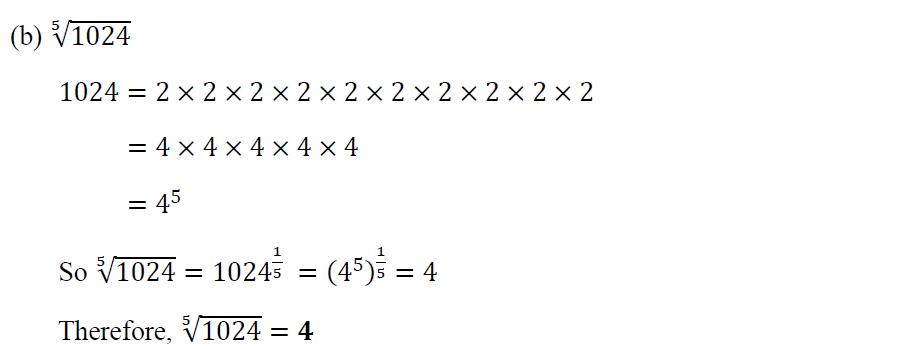
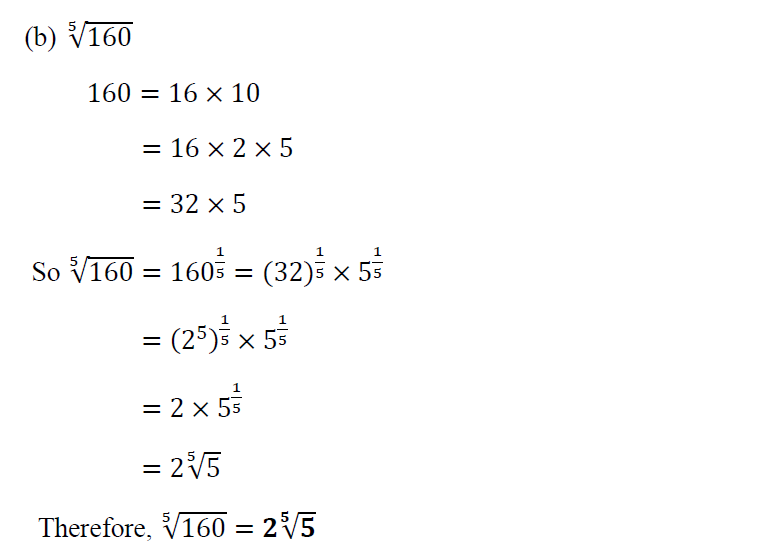
Example 23
Write each of the following expressions in their simplest form:

Solution:
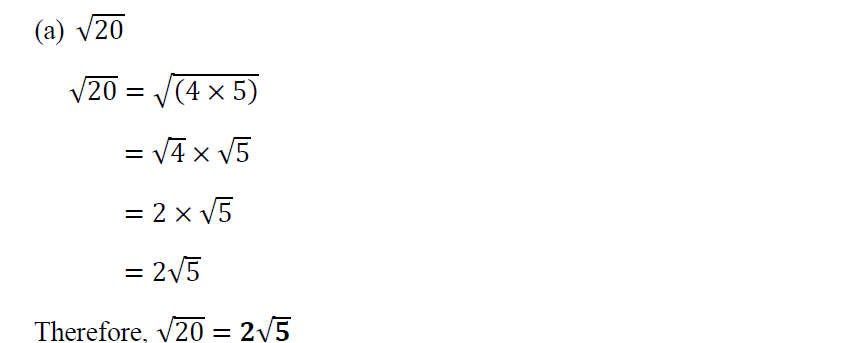
Example 24
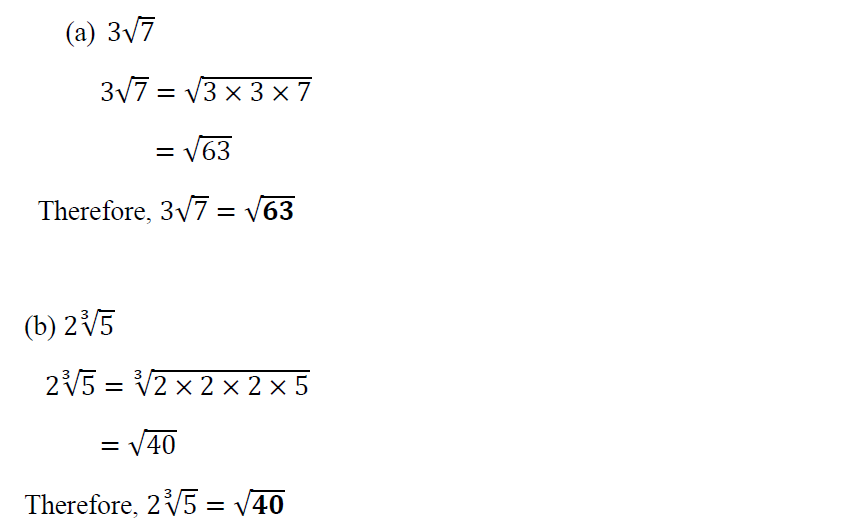
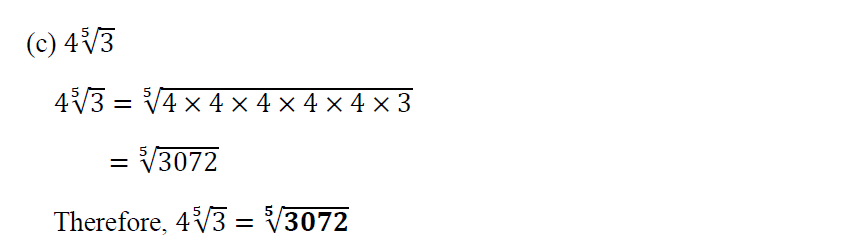
Express each of the following under a single radical sign:

Solution:
Exercise 5
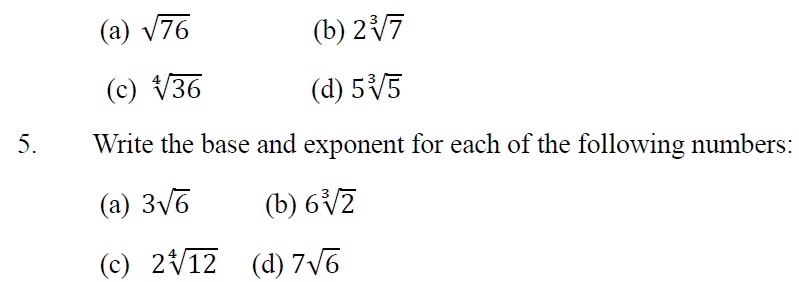
1. Simplify the following radicals:

2. Express the following expressions in simplified form:

3. Write each of the following in their simplest form:

4. Write each of the following in simple form and without a radical sign:
Perform operations on radicals.
Addition and Subtraction of Radicals
The Rule: You can only add or subtract radicals that are alike (similar radicals).
Similar radicals:
• Have the same index (e.g., both square roots)
• Have the same number inside the root.
Example 25
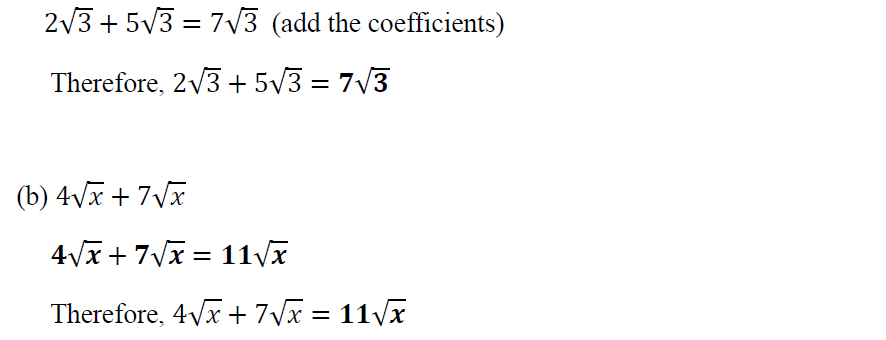
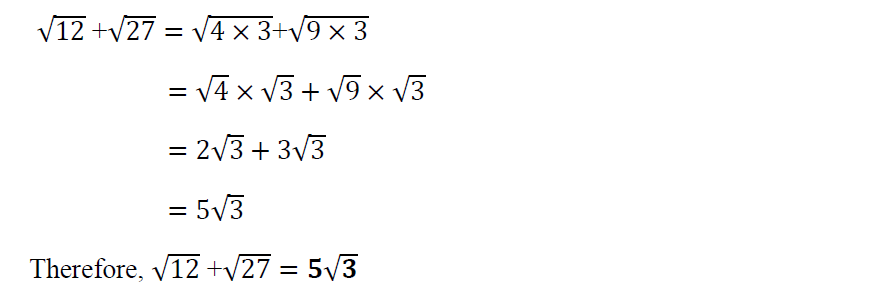
Simplify each of the following expressions:

Solution:
(a) 2√3+5√3
(c) √12 +√27
Example 26
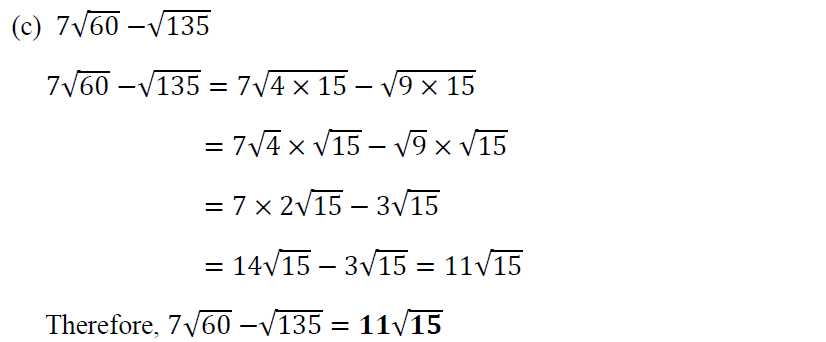
Express each of the following expressions in their simplest form:

Solution:
(a) 8√3−5√3

(b) 14√𝑦−9√𝑦

Example 27
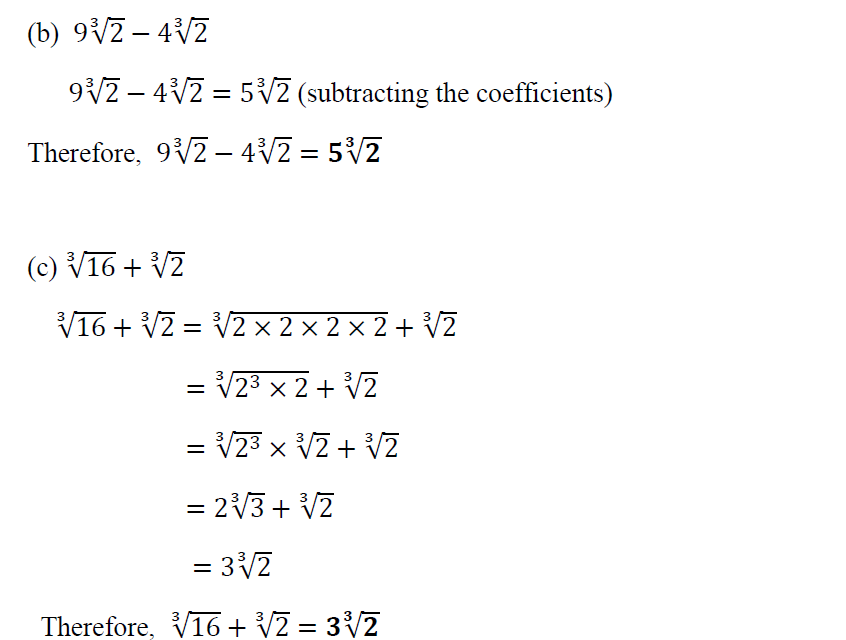
Simplify each of the following:

Solution:

Example 28
Write the following expressions in simplified form:

Solution:
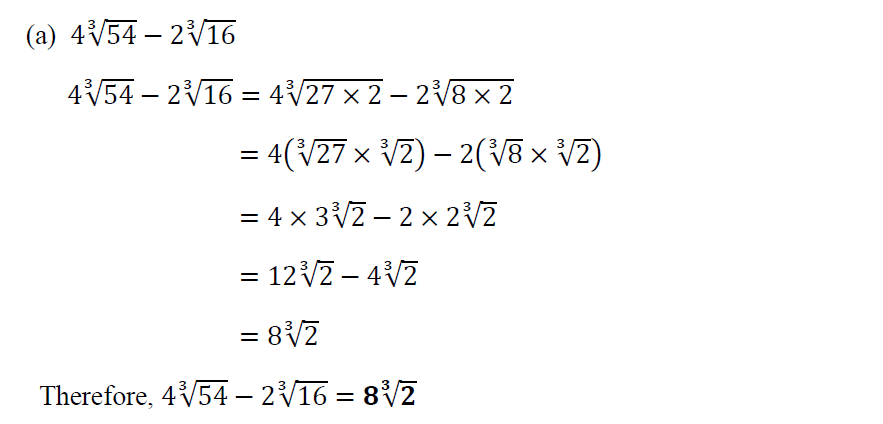
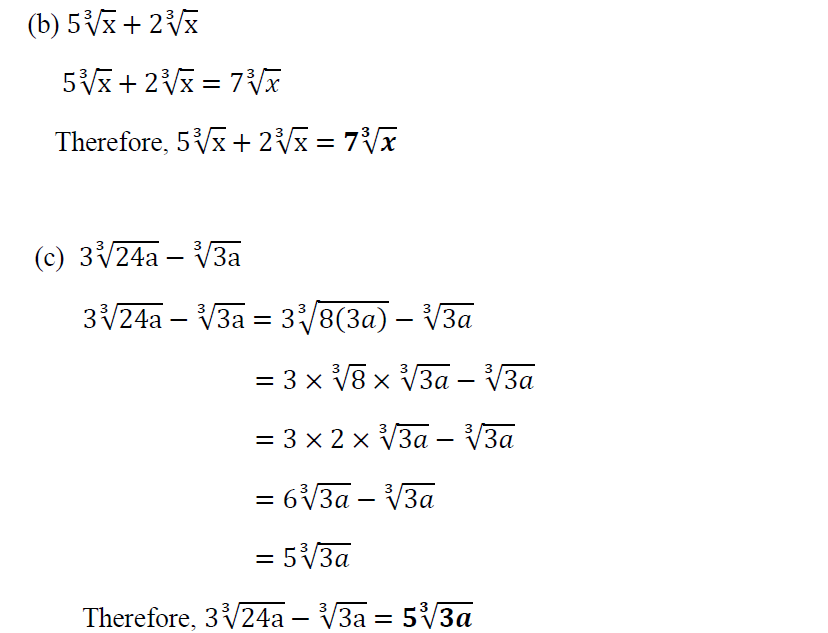
Example 29
Express the following expressions in simplified form:

Solution:
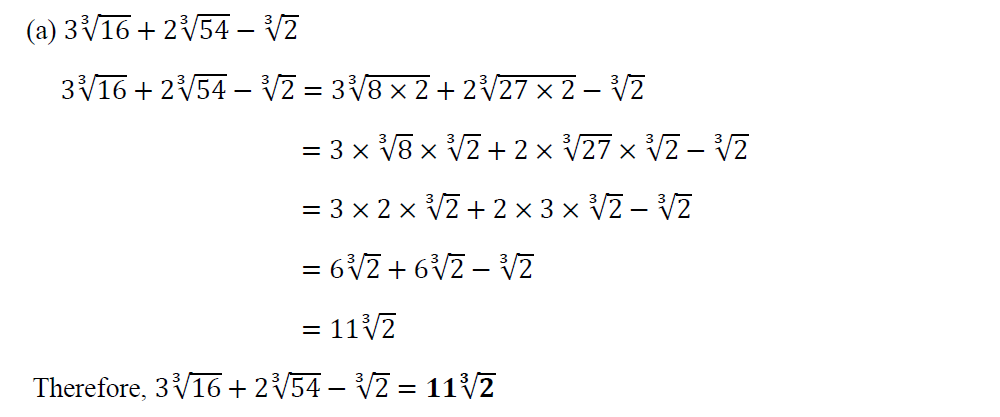
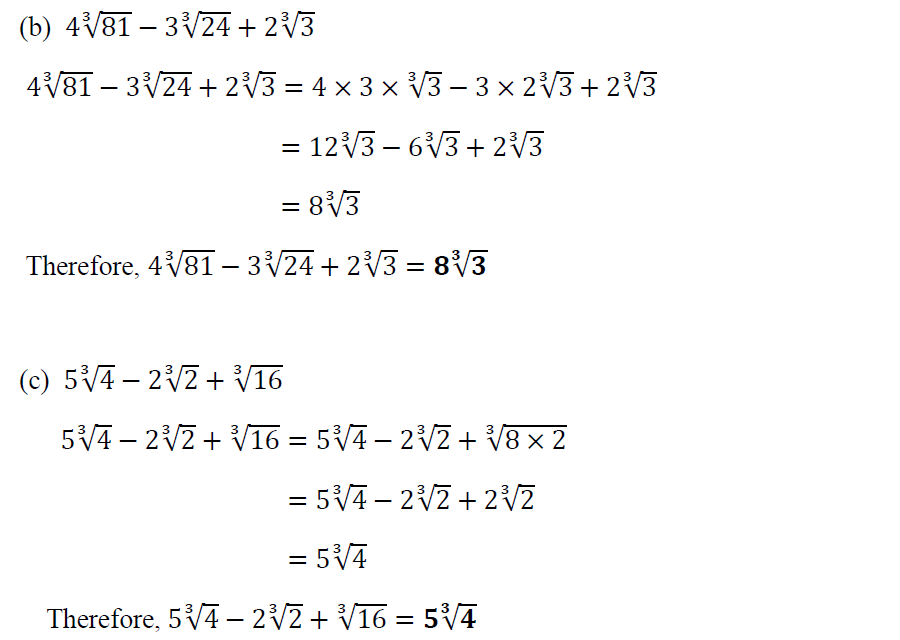
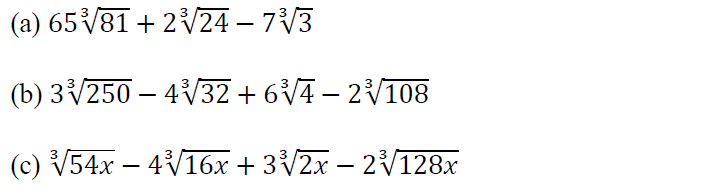
Exercise 6
1. Simplify the following expressions:

2. Express each of the following in their simplest form:
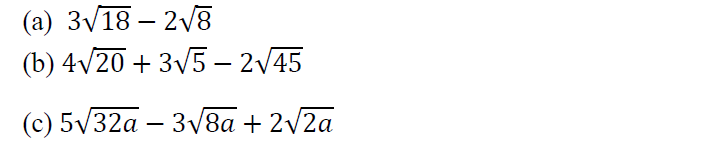
3. Simplify each of the following:
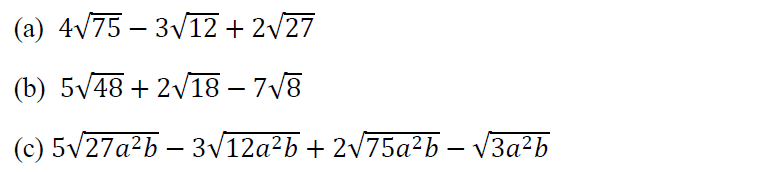
4. Write each of the following expressions under a single radical sign:
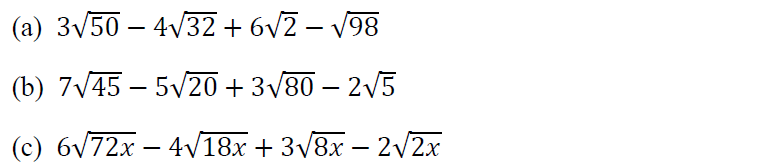
5. Express each of the following in their simplest form:
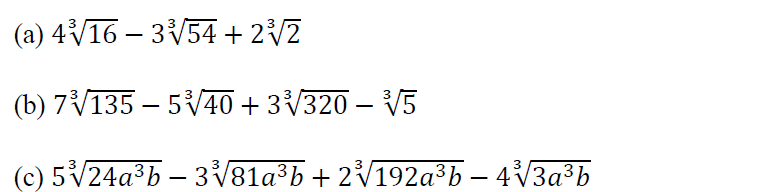
6. Write each of the following expressions under a single radical sign:
Multiplication and Division of radicals
Multiplication Rule:
If the radicals have the same index, then multiply the numbers inside the single radical and simplify where possible.

Division Rule:
If the radicals have the same index, then divide the numbers inside the single radical and simplify where possible.

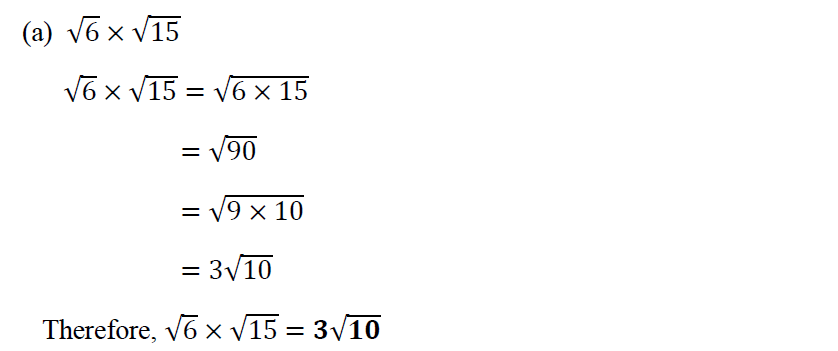
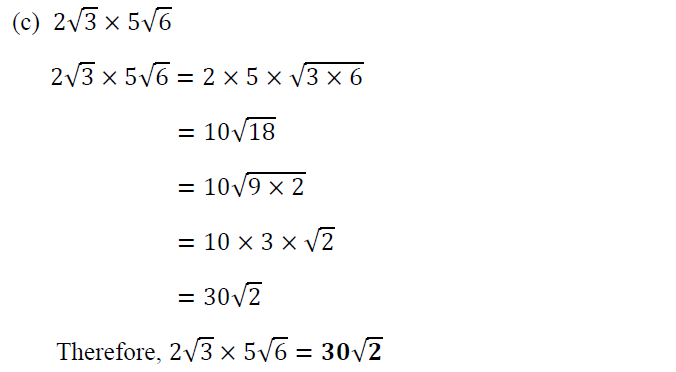
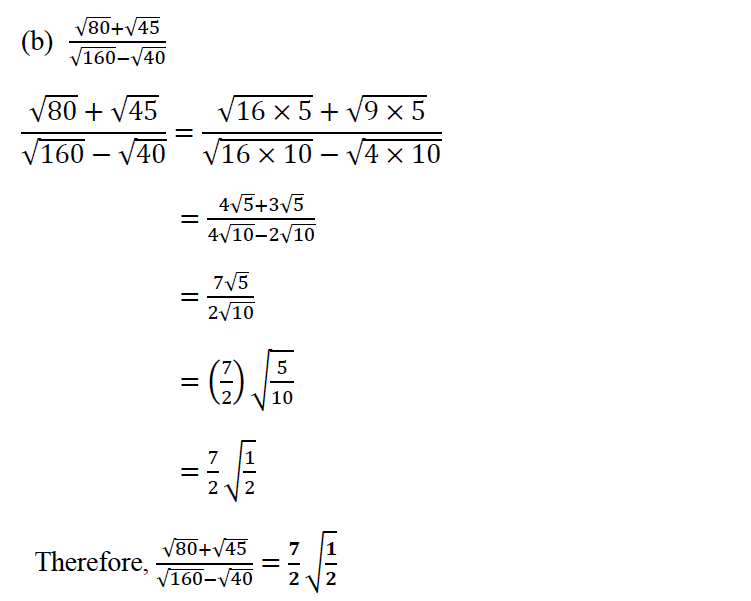
Example 30
Rewrite the following expressions in simplified form:

Solution:
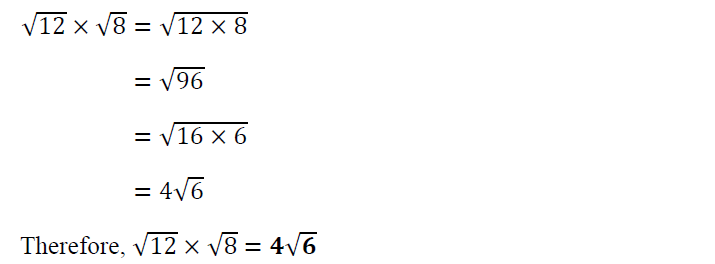
(b) √12×√8
Example 31
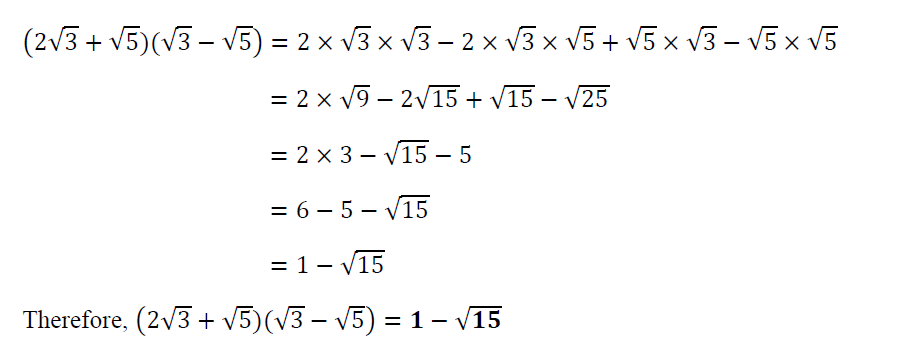
Simplify (2√3+√5)(√3−√5)
Solution:
Example 32
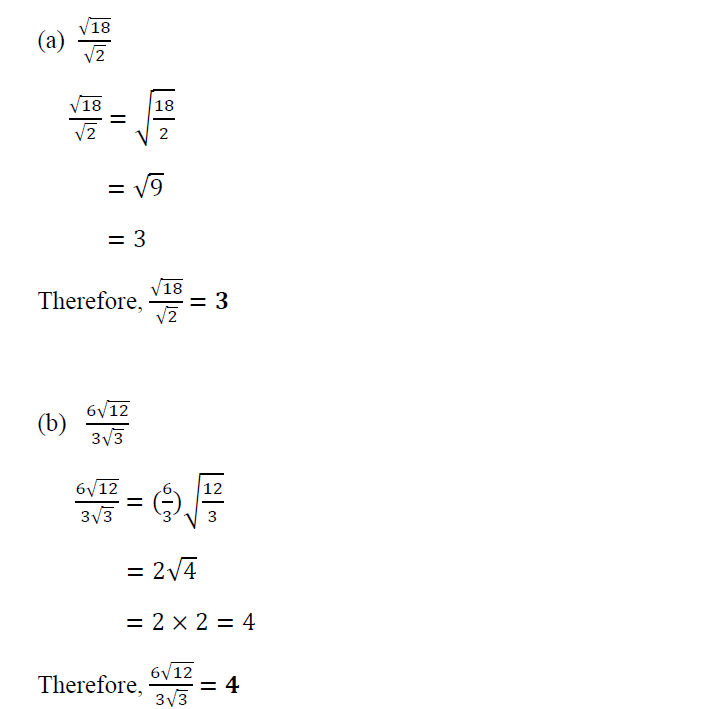
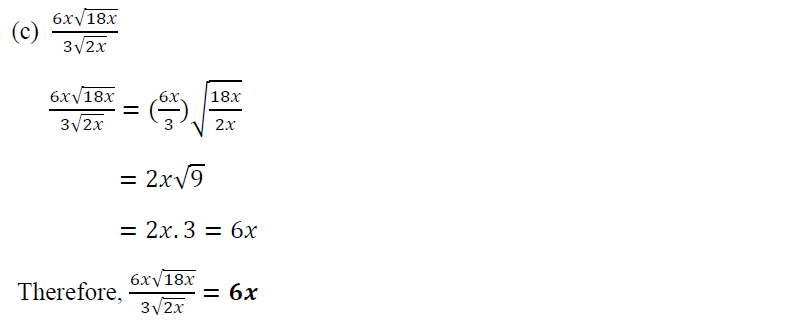
Express each of the following in their simplest form:

Solution:
Example 33
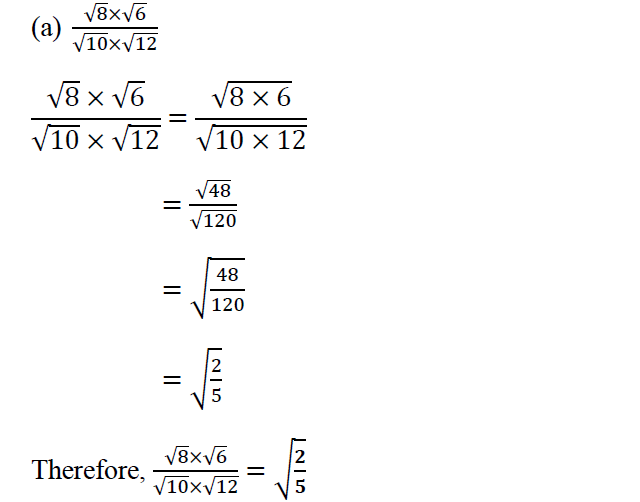
Express each of the following expressions in a simplified form:

Solution:
Exercise 7
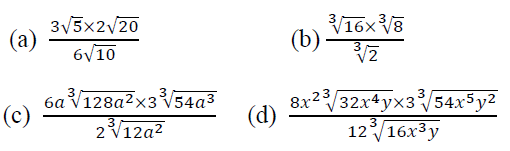
1. Simplify each of the following:

2. Write the following expressions using a single radical sign:

3. Express each of the following expressions in their simplest form:

4. Expand and simplify each of the following:

5. Simplify the following expressions:

6. Simplify the following expressions:
Rationalization of Denominators
Rationalizing the denominator means removing any radical (√, ³√ or higher) from the denominator of a fraction. This process enables us to rewrite a fraction so that there is no root in the bottom.
The concept of Rationalization of Denominators and solve the related problems
Explore the concept of Rationalization of Denominators and solve the related problems
Rules:
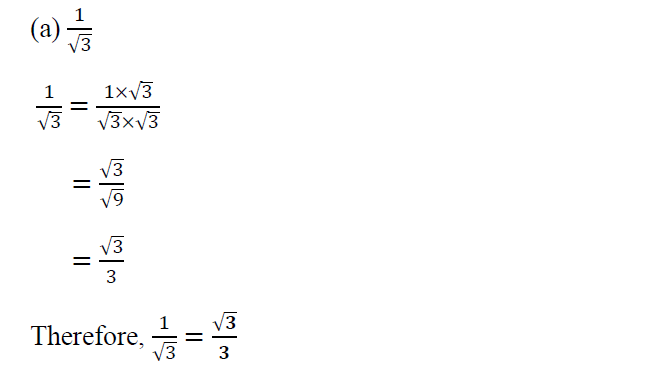
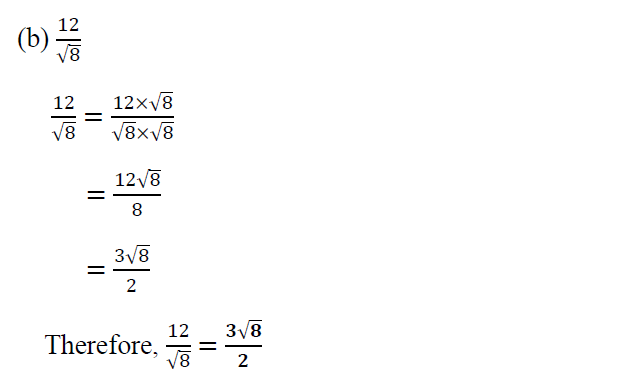
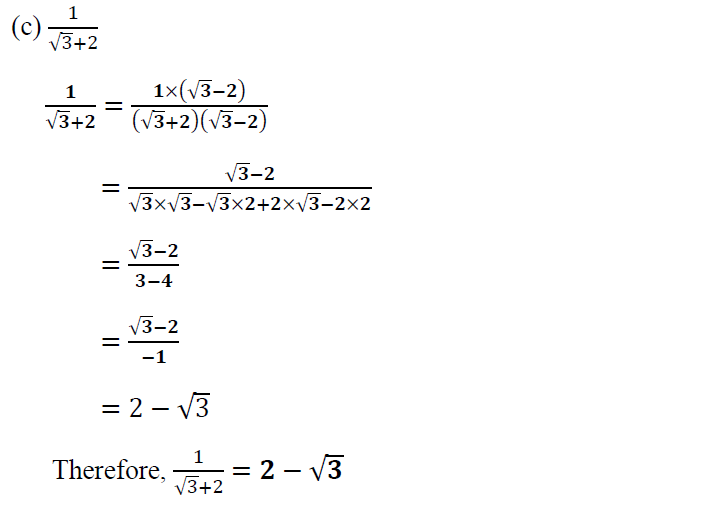
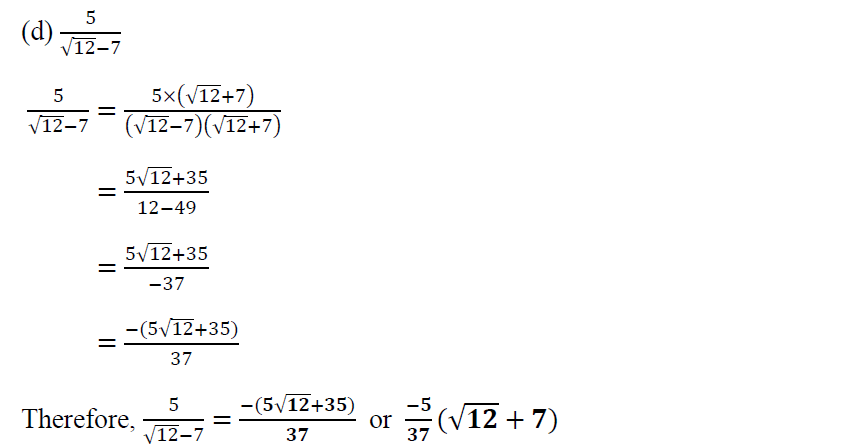
(1) If the denominator has a single root, for example √a, the denominator is rationalized by multiplying the top and bottom by √a.
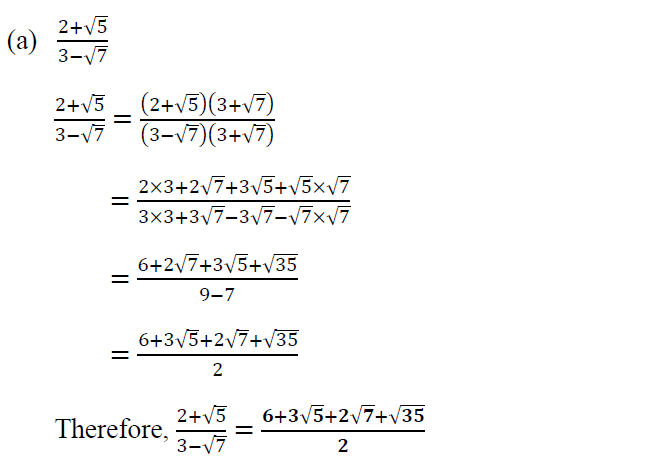
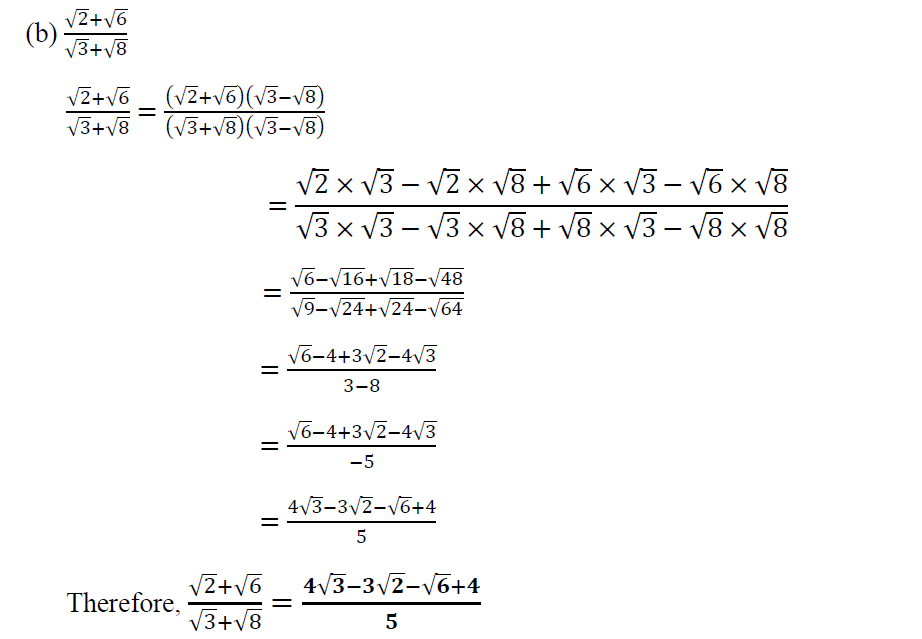
(2) If the denominator takes the form of (a+√b ) or (√a+√b), then the denominator is rationalized by multiplying the top and bottom by their conjugates, that is (a−√b) or (√a−√b) respectively.
Note that the conjugate of (a+√b) is (a−√b) and the conjugate of (a−√b) is( a+√b).
Example 34
Rationalize the denominator in each of the following expressions:

Solution:
Solution Cont....
Example 35
Write each of the following expressions with no radical term in the denominator:

Solution:
Solution Cont....
Exercise 8
1. Rationalize the denominator in each of the following expressions:

2. Write each of the following expressions with no radical term in the denominator:

3. Rationalize the denominator in each of the following expressions:

4. Express each of the following expressions with no radical term in the denominator:

Finding roots of Numbers by Calculators
Finding roots using a calculator depends on the type of root and the calculator you are using.
Finding Square Roots (√)
If you are using a scientific calculator, you can obtain the square root of any number by following the steps below:
1. Press √ button
2. Type your number
3. Press = button
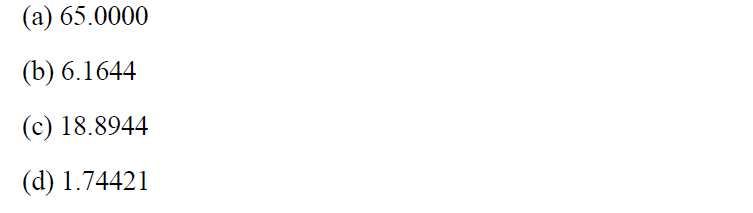
Example 36
Use a calculator to find the square roots of the following numbers (write your answers correct to 4 decimal points):

Answers:
Finding Cube Roots (³√)
If you are using a scientific calculator, you can obtain the cube root of any number by following the steps below:
1. Press ³√ button
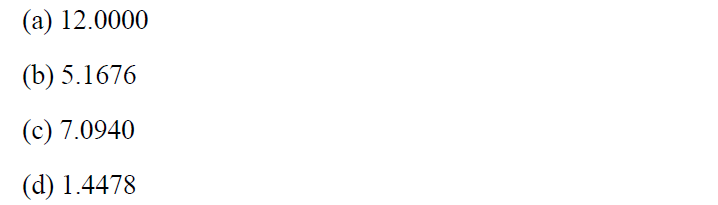
Example 37
By using a calculator, find the cube roots of the following numbers (give your answers correct to 4 decimal places):

Answers:
Finding the 𝒏𝒕𝒉 Root Using the Power Key (Universal Method)

1. Type your number
2.Press ^ (or 𝑥𝑦 ) button
3.Type (1 ÷ n)
NB: 1/n or 1 ÷ n should be written in brackets.
4.Press (=) button

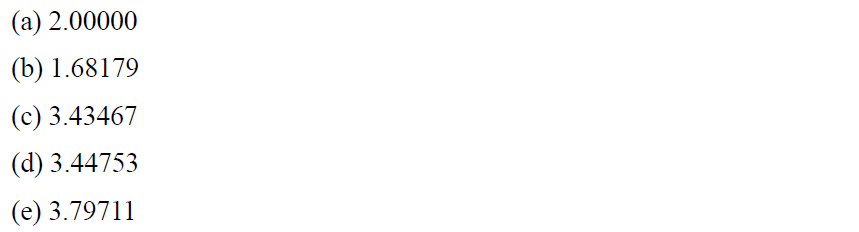
Example 38
Evaluate each of the following numbers by using a calculator(write your answers correct to 5 decimal places):

Answers:
Exercise 9
1. Use a calculator to find the square roots of the following numbers (write your answers correct to 4 decimal places):

2. Use a calculator to find the cube roots of the following numbers (write your answers correct to 4 decimal places):

3. By using a calculator, evaluate each of the following numbers (write your answers correct to 5 decimal places):

Listening to this topic