Mathematics (New)
ALGEBRA
Reading settings
Text size
Line spacing
Colours
ALGEBRA
Algebra is one of the major branches of mathematics that deals with the use of symbols, letters, and numbers to represent quantities and relationships. It provides methods for solving problems in which some values are unknown.
By representing these unknown values with variables, algebra allows us to develop general rules and formulas that can be applied to many different situations.
In algebra, letters such as 𝑥, 𝑦 and 𝑧 are used as variables, which may stand for unknown numbers or quantities that can change. These variables are combined with numbers using mathematical operations to form algebraic expressions, equations, and inequalities.
CONTENTS:
Under this topic you will cover five broad concepts about Algebra as follows:
(i) Binary operations: Which involves combining two numbers or expressions using operations such as addition, subtraction, multiplication, or division.
(ii) Transposition of formulae: The process of rearranging equations to make a particular variable the subject.
(iii) Quadratic expressions: These are algebraic expressions of degree two usually written in the form 𝑎𝑥2+𝑏𝑥+𝑐.
(iv) Factorization of quadratic expressions: It involves writing such expressions as the product of two simpler expressions.
(v) Quadratic equations:This involves finding the values of the variable that satisfy equations of the form 𝑎𝑥2+𝑏𝑥+𝑐=0.
COMPETENCIES:
Upon completion of this chapter, you should demonstrate competencies in Algebra through:
(a) Understanding binary operations: Identifying and performing basic binary operations such as addition, subtraction, multiplication, and division on numbers and algebraic expressions.
(b)Transposing formulae: Rearranging mathematical formulae to make a required variable the subject of the formula.
(c) Working with quadratic expressions: Identifying and simplifying quadratic expressions of the form 𝑎𝑥2+𝑏𝑥+𝑐.
(d) Factorizing quadratic expressions: Writing quadratic expressions into simpler algebraic factors.
(e) Solving quadratic equations: Finding the solutions to quadratic equations using appropriate methods such as factorization, completing the square, or applying the quadratic general formula.
(f) Applying algebraic skills in problem solving: Using algebraic methods to solve mathematical and real-life problems involving quadratic relationships.
These competencies will help you develop logical thinking and strong problem-solving skills that can be applied to many real-life situations.
They enable you to solve practical problems, such as those related to budgeting and personal finance, shopping and discounts, travel and time calculations, construction and measurement, business and profit analysis, as well as planning and scheduling.
In addition, mastering these competencies builds a solid foundation for higher mathematics and enhances your ability to think critically and apply mathematical ideas in everyday life.
Binary operations
A binary operation is a rule that combines two elements of a set to produce another element of the same set. It takes two inputs and gives one output, and the output must belong to the same set.
The basic tenets of binary operations and solve the related problems.
Algebra(Binary Operation)
Explore the basic tenets of binary operations and solve the related problems.
In binary operations we use symbols like (∗ or 𝚫) called operators which may have different meanings in different contexts.
Therefore, these symbols (operators) must be defined either directly or indirectly. Their definition may include the basic mathematical operations such as addition (+), subtraction (−), multiplication (×) or division (÷).
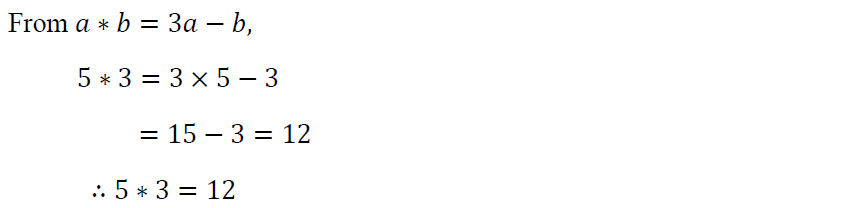
Example 1
Given that 𝑎∗𝑏=3𝑎−𝑏, find the value of 5∗3.
Solution:
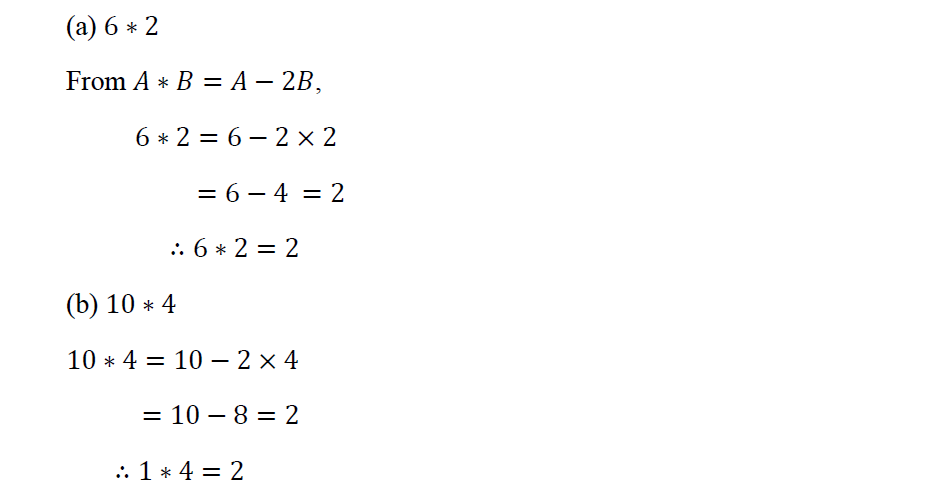
Example 2
If 𝐴∗B=A−2B, find:

Solution:
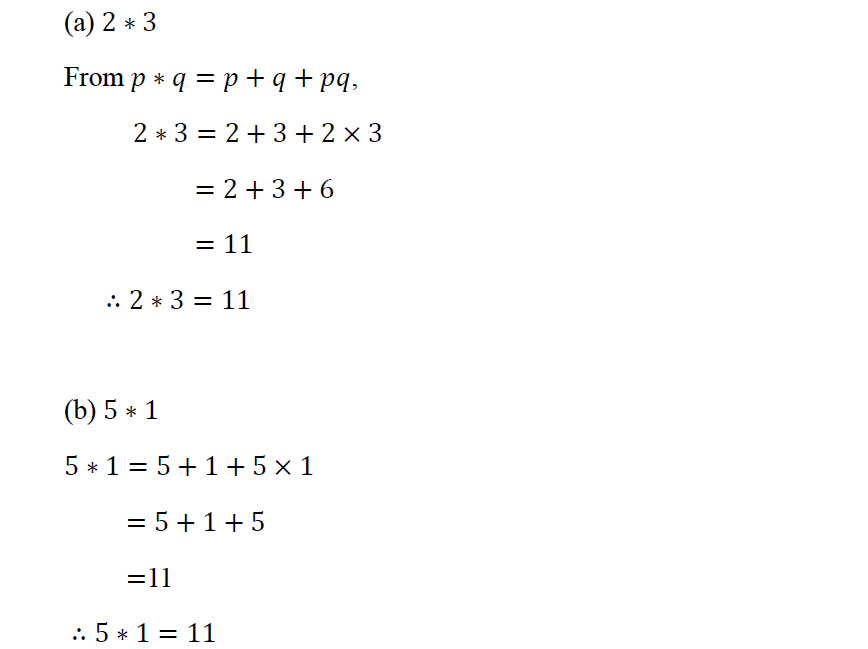
Example 3
Given that 𝑝∗𝑞=𝑝+𝑞+𝑝𝑞, find:

Solution:
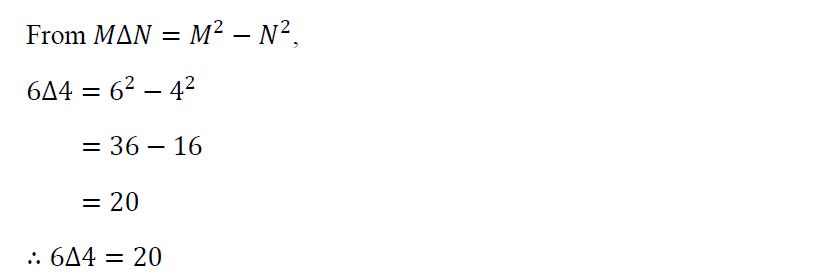
Example 4
If 𝑀Δ𝑁=𝑀2−𝑁2, find 6Δ4.
Solution:
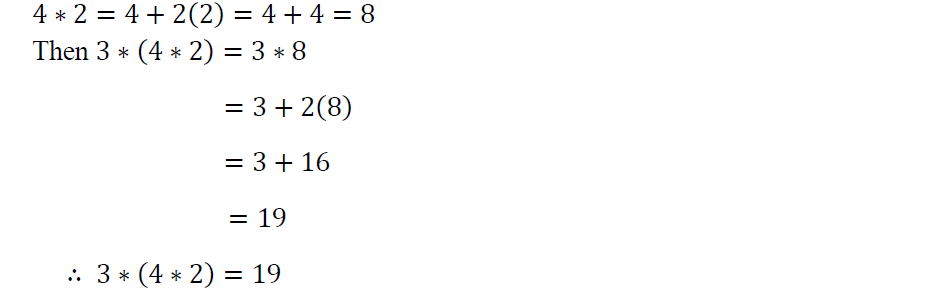
Example 5
Given that 𝑥∗𝑦=𝑥+2𝑦, find the value of:

Solution:
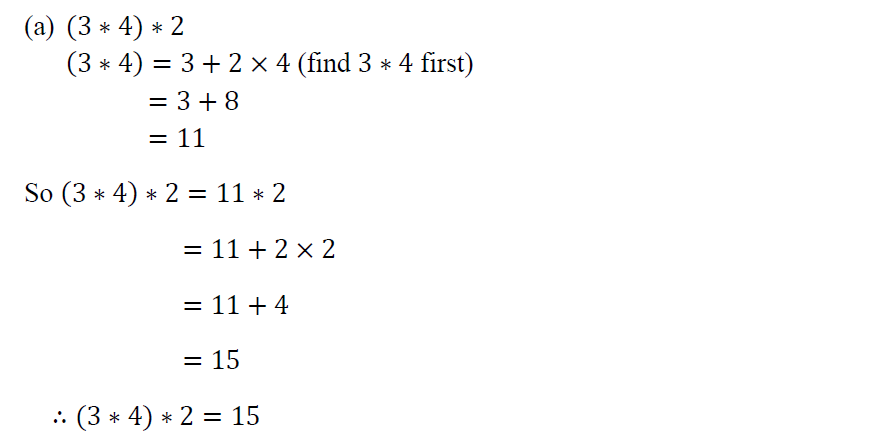
(b) 3∗(4∗2)
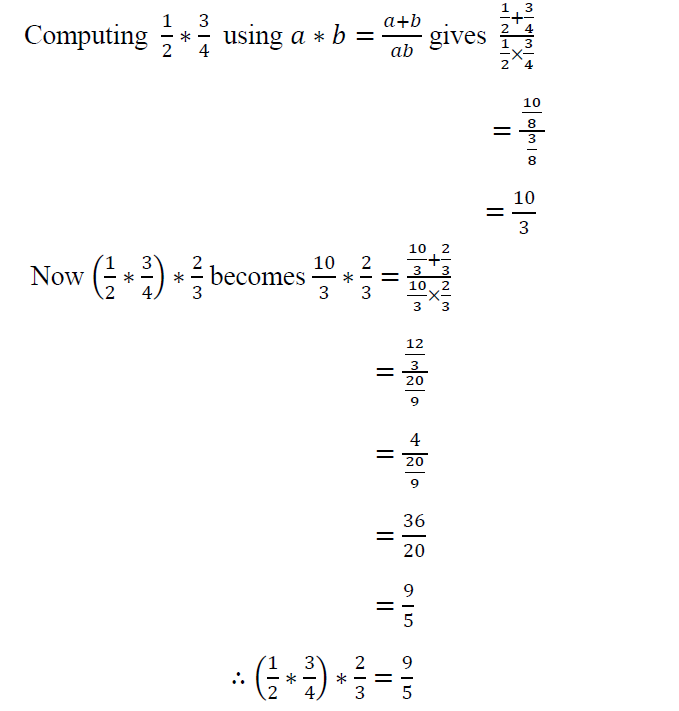
Example 6

Solution:
Exercise 1
1. Given that 𝐴∗𝐵=3𝐴+2𝐵, find:

2. If 𝑎Δ𝑏=2𝑎−𝑏, evaluate 5Δ3.

4. If 𝑎⋆𝑏=𝑎2−𝑏2+2𝑎𝑏, what is the value of 3⋆5?

7. It is defined that 𝑎⋆𝑏=𝑎2−𝑎𝑏+𝑏2. Find 𝑥⋆(𝑥+1).
8. Given that 𝑎Δ𝑏=𝑎+𝑏2 and 𝑎#𝑏=𝑎Δ𝑏+1, find (2Δ3)#4.
9. Let 𝑥∗𝑦=3𝑥−𝑦2, find the value of m if 5∗𝑚=6.
10. Given that 𝑠∗𝑡=2𝑠−𝑡, find (𝑠∗𝑡)∗(𝑠∗𝑡)
11. Let 𝑝∗𝑞=2−𝑝𝑞, what is the value of [(3∗1)∗(1∗3)]∗5

Transposition of formulae
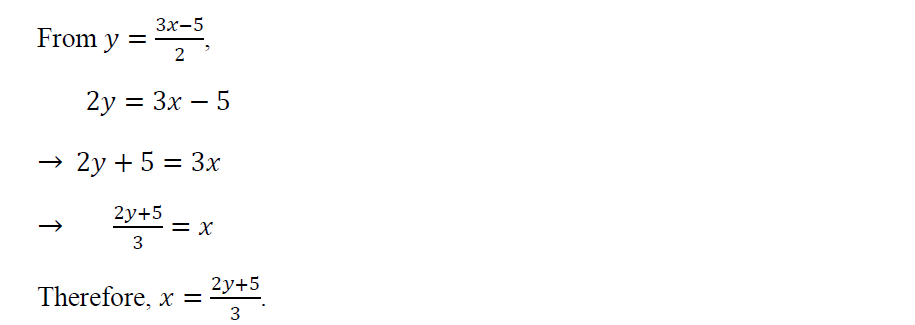
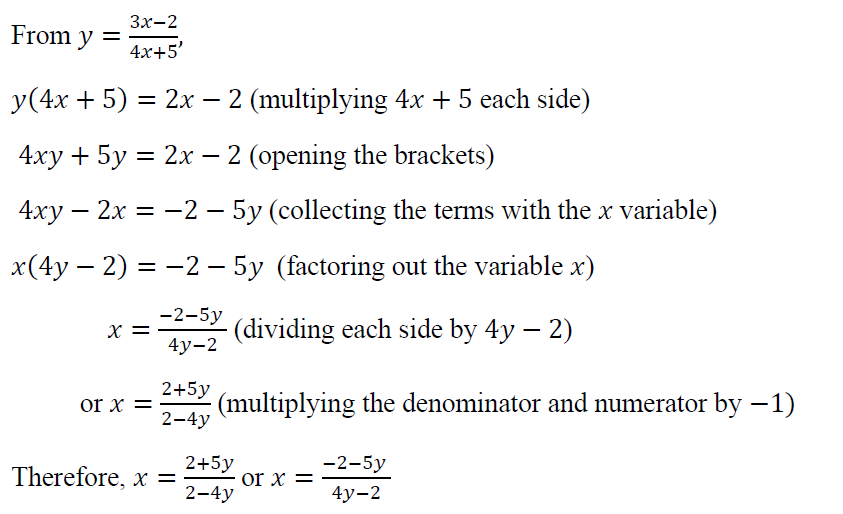
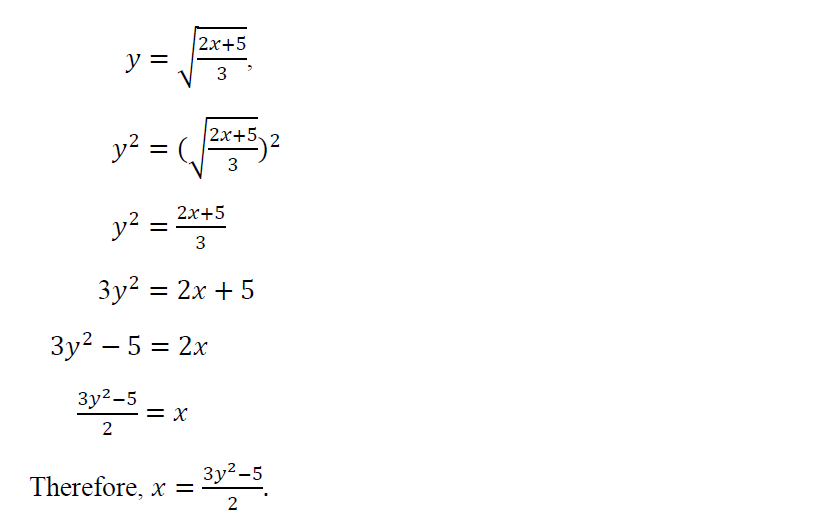
Transposition of formulae is the process of changing the subject of a formula. It involves changing the position of variables in an equation so that the required variable stands alone on one side of the given equation.
For example, in the equation 𝑦=𝑥−3, y is the subject of the formula and it is standing alone in the left side of the equation.
From the equation 𝑦=𝑥−3, we can make 𝑥 the subject by adding 3 on each side of the equation, that is 𝑦+3=𝑥−3+3, which gives 𝑦+3=𝑥 or 𝑥=𝑦+3.
The concept of Transposition of formulae and solve the related problems
Describe the concept of Transposition of formulae and solve the related problems
When transposing a variable in a given formula (equation), you must apply inverse operations to isolate the required variable, therefore:
• Addition becomes subtraction
• Subtraction becomes addition
• Multiplication becomes division
• Division becomes multiplication
Also it is important to keep in mind that whatever you do to one side, do the same to the other.
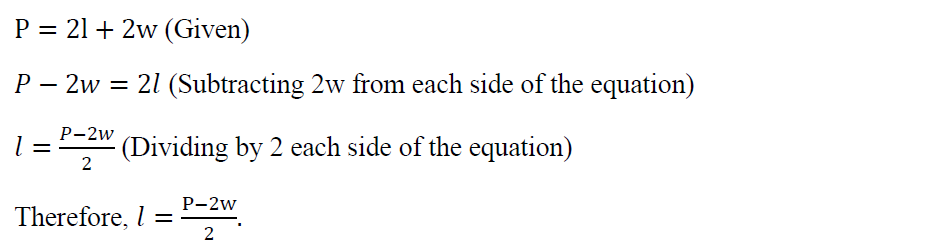
Example 7
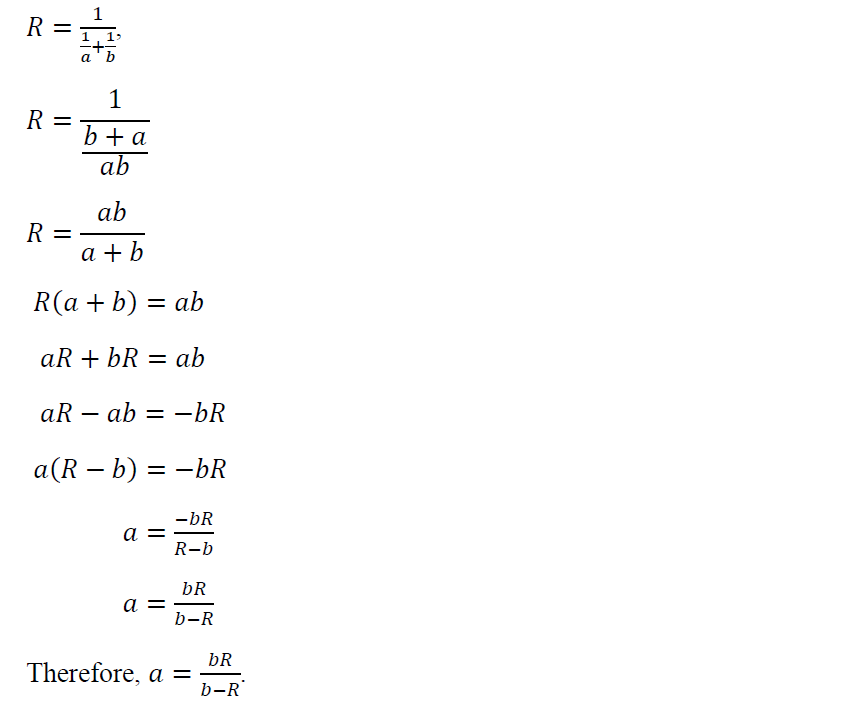
Given that P=2l+2w, make 𝑙 the subject.
Solution:
Example 8
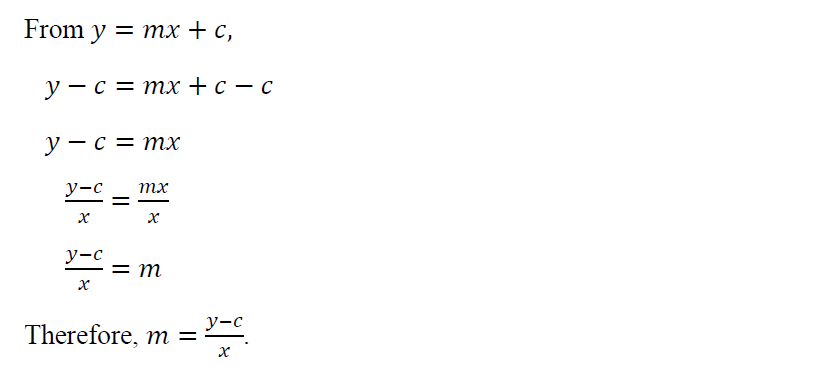
Given that 𝑦=𝑚𝑥+𝑐, make m the subject of the formula.
Solution:
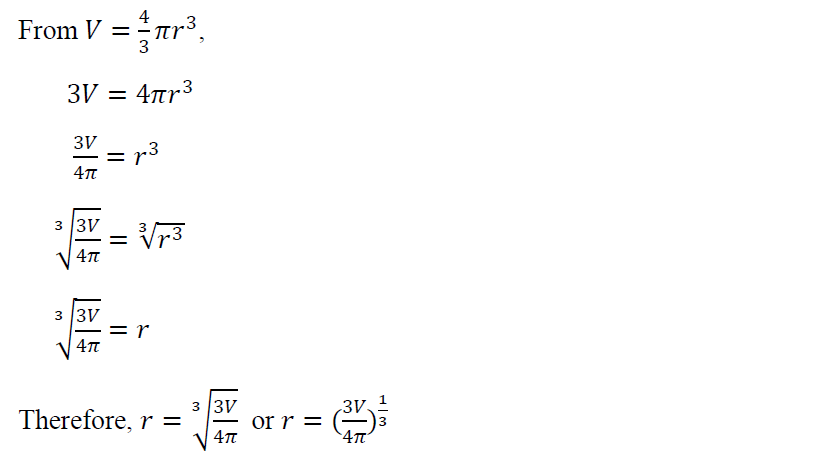
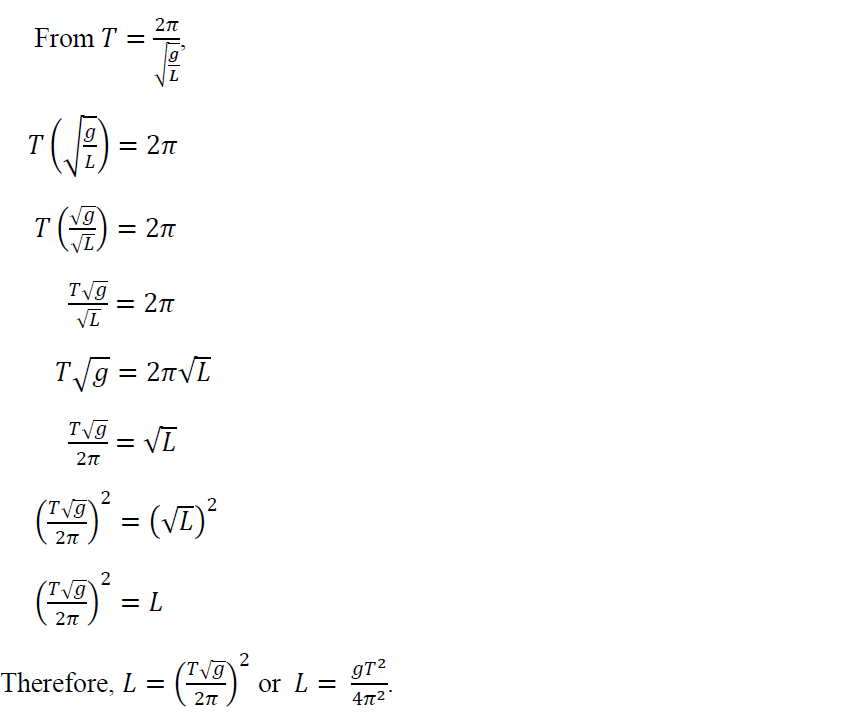
Example 9






Solution:
Exercise 2
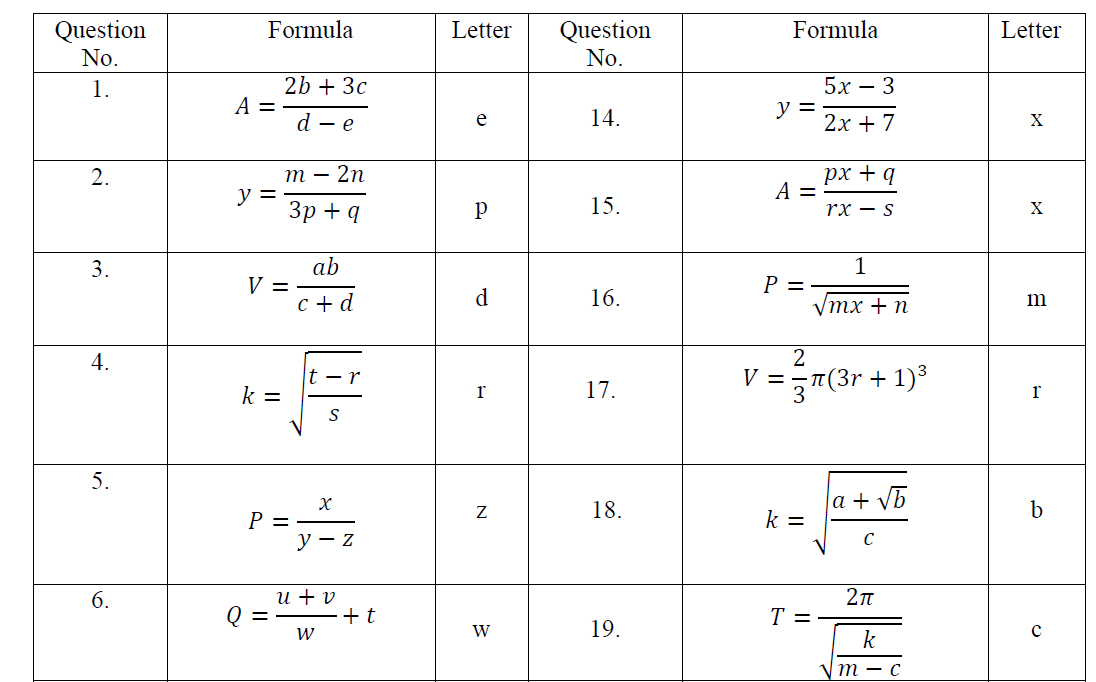
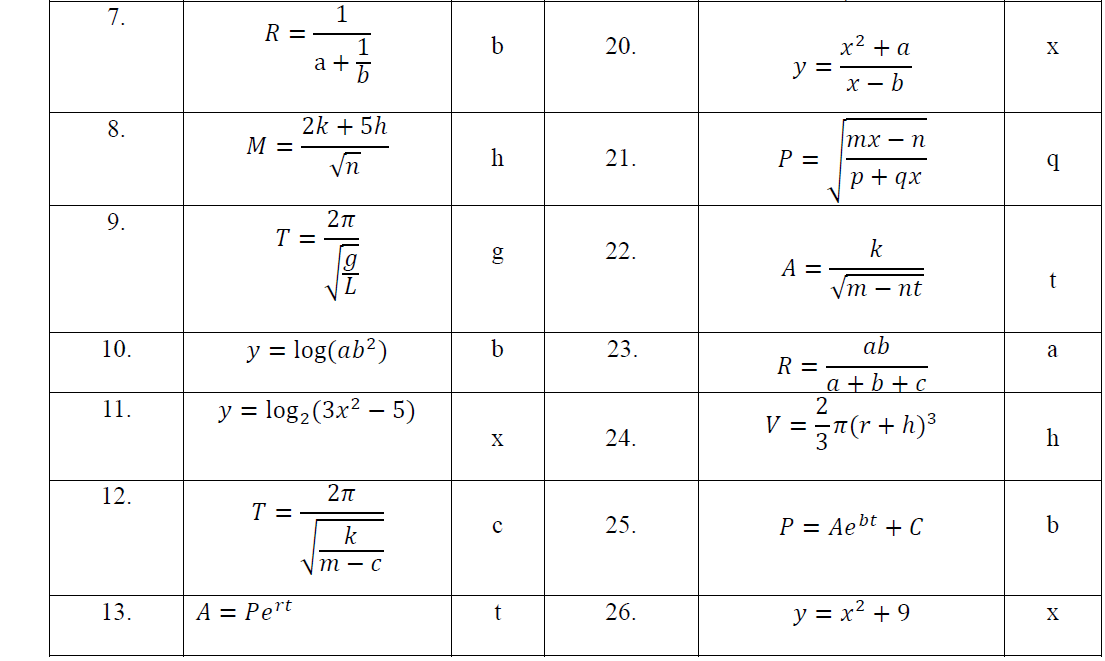
In each of the following, make the given letter the subject of the formula:
Quadratic Expressions
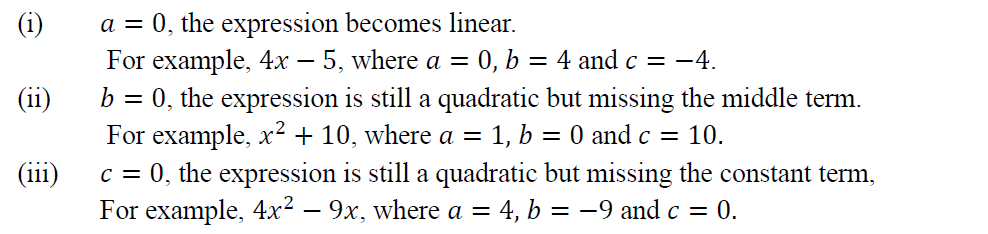
A quadratic expression is an algebraic expression in which the highest power of the variable is 2.These expressions take the form of 𝑎𝑥2+𝑏𝑥+𝑐, where:
• 𝑎, 𝑏, and 𝑐 are constants (real numbers)
• 𝑥 is the variable
• 𝑎≠0 (if 𝑎=0, it is no longer quadratic)
Examples of quadratic expressions include 𝑥2+5𝑥+6, 3𝑥2−7𝑥+1, 4𝑦2−9, 𝑥2+2𝑥, 𝑥2−8 and 3𝑥2.
The basic tenets of quadratic expressions.
Explore the basic tenets of quadratic expressions.
How do quadratic expressions arise in mathematics?
Quadratic expressions arise naturally whenever a situation involves a square of a variable, that is, when a quantity is multiplied by itself.
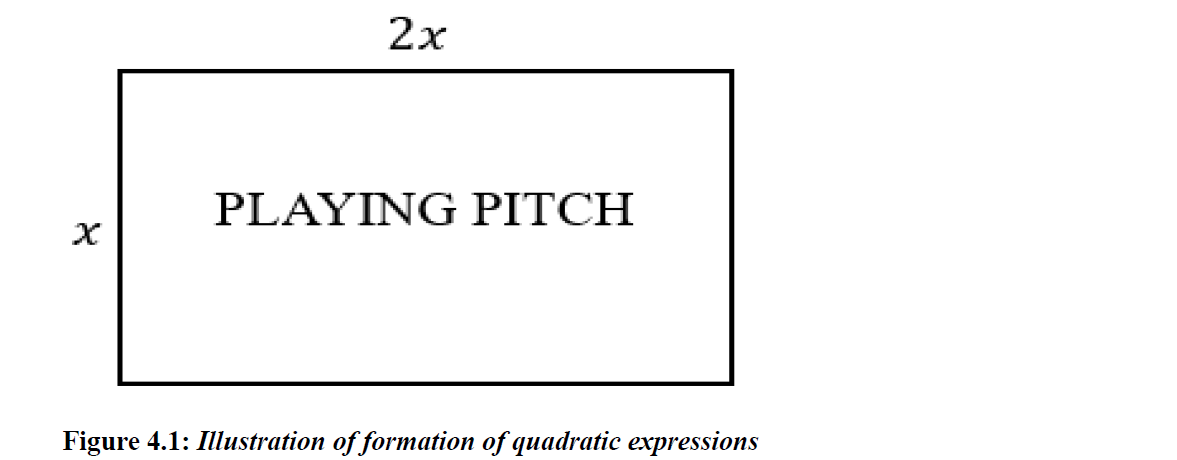
For example, in measuring the area (A) of a rectangular playing pitch, we multiply the Length(L) by Width (W), that is, 𝐴=𝐿×𝑊.
If the pitch has a length of 2𝑥 and width 𝑥 units as shown in figure 4.1 below, then its area is given by 𝐴=𝐿×𝑊=2𝑥×𝑥=2𝑥2.
Suppose that the length of the pitch is increased by 5 and the width by 4 units, then its new dimensions are (2𝑥+5) and (𝑥+4) as shown in figure 4.2 below:
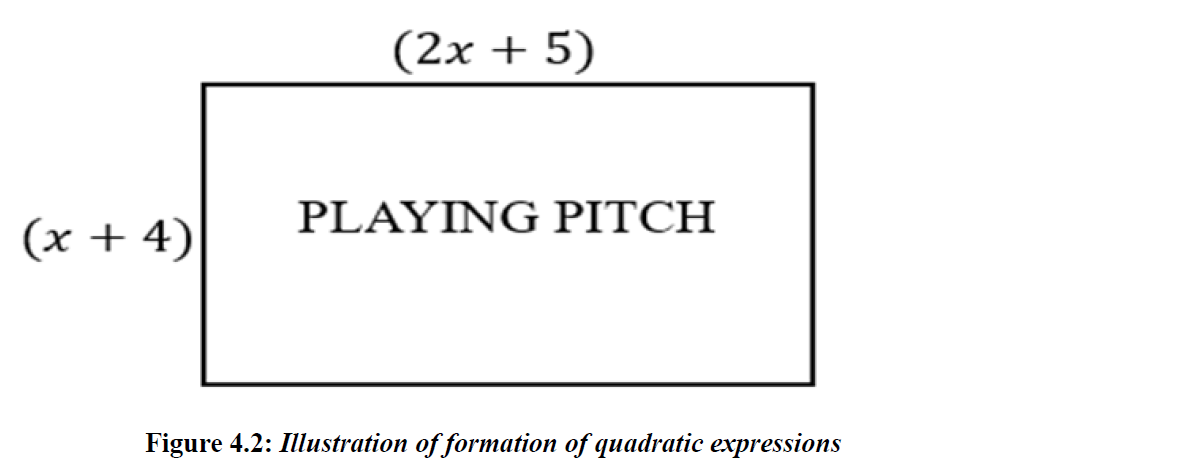
From figure 4.2 above, the new area of the pitch can be found as follows:

Therefore, 2𝑥2 and 2𝑥2+13𝑥+20 are quadratic expressions representing areas of rectangles having (2𝑥 length and 𝑥 width) and (2𝑥+5 length and 𝑥+4 width) respectively.
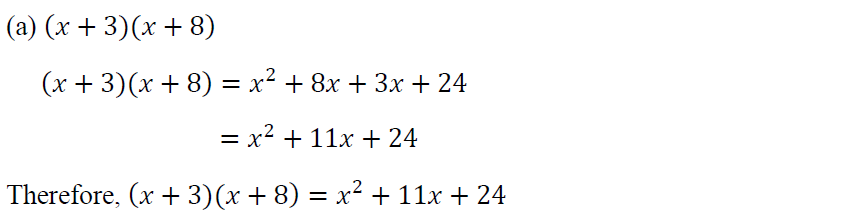
Quadratic expressions also arise when you multiply any two linear expressions, for example(𝑥+2)(𝑥+5), which upon expansion gives 𝑥2+7𝑥+10.
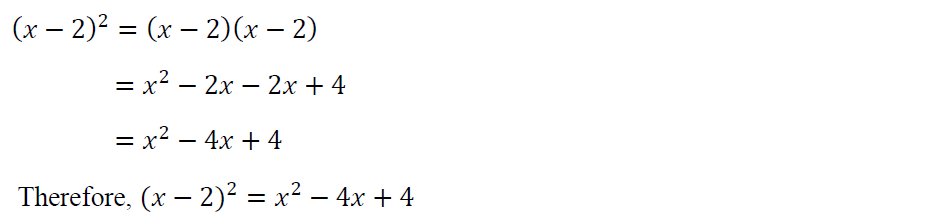
Example 10
Write (𝑥−2)2 in expanded form.
Solution:
Example 11


Solution:
Example 12
Write the middle term from the [removed]2𝑦+6)(3𝑦−5).
Solution:

Example 13
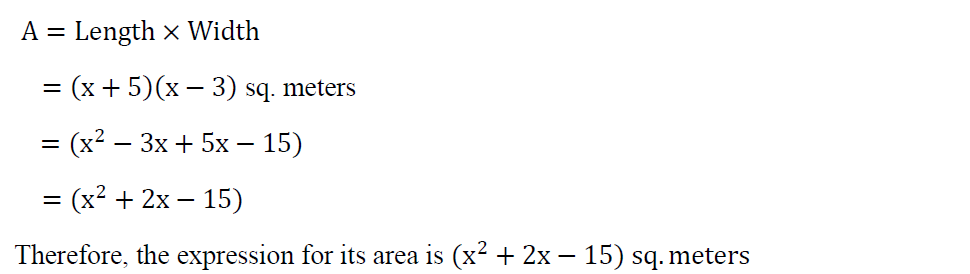
A rectangular garden has length (𝑥+5)meters and width (𝑥−3)meters, write and simplify the expression for its area.
Solution:
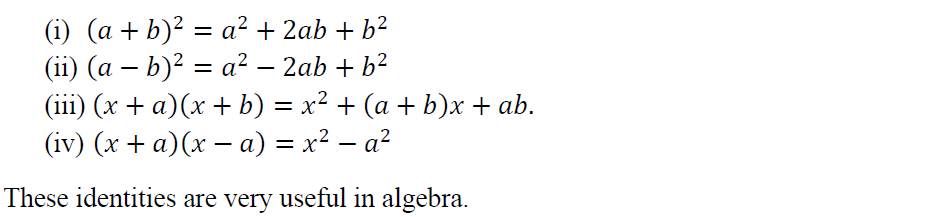
Basic Quadratic Expressions Identities
The following are products which automatically create quadratic expressions
NB: From the general quadratic [removed]ax2+bx+c), if:
Exercise 3
1. Write each of the following expressions in expanded form:


4. Simplify each of the following expressions:

5. Write the middle terms of each of the following expressions:

6. Use the identity (𝑥+𝑎)(𝑥−𝑎)=𝑥2−𝑎2 to find the exact value of each of the following numbers:

7. The length of a rectangle is 𝑥 and the width is (12−𝑥),write and simplify the expression for its area.
8. A company sells an item at 𝑥 dollars each. If sells (100−2𝑥) items per day, write an expression for the daily revenue and simplify it.
9. Two consecutive numbers are such that the second number exceeds the first by 5, write an expression for their product in a simplified form.
Factorization of Quadratic Expressions
Factorization of a quadratic expression simply means rewriting it as a product of two linear expressions. It involves finding the factors of the given quadratic expression.
The concept of factorization of quadratic expressions
Explain the concept of factorization of quadratic expressions.
In algebra, expressions are treated like common numbers, for example, the number 6 can be written as 1×6 or 2×3, therefore, 1, 2, 3 and 6 are the factors of 6.
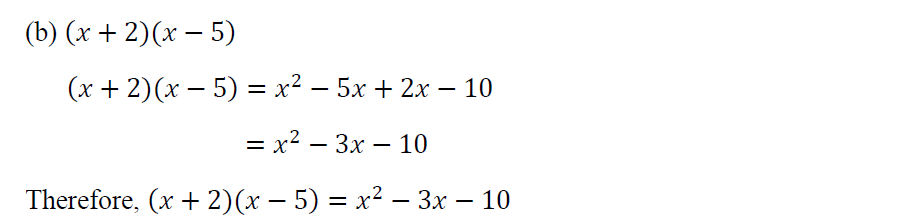
Similarly, 𝑥2−3𝑥−10=(𝑥+2)(𝑥−5) , so (𝑥+2) and (𝑥−5) are the factors of𝑥2−3𝑥−10.
Factorization Methods
Quadratic expressions can be factorized by using the following common methods:
(i) Splitting the Middle Term (ii) Difference of Two squares (iii) Perfect squares
Factorization by Splitting the Middle Term
This method involves writing the middle term ′𝑏𝑥′ into two terms so that we can find the factors by grouping.
Steps:
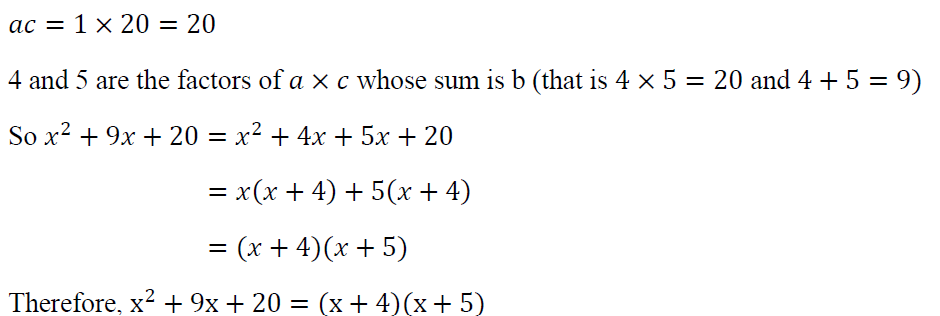
(i) Identify 𝑎 and 𝑐 then find their product
(ii) Find the possible two numbers (factors of 𝑎𝑐) that multiply to 𝑎𝑐 and add to 𝑏.
Example 14
Factorize 𝑥2+9𝑥+20 by splitting the middle term:
Solution:
Example 15
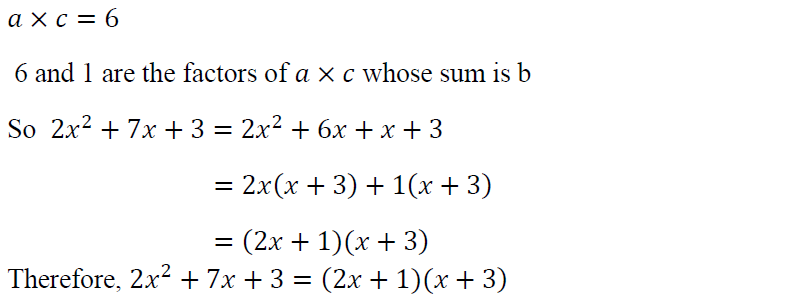
Factorize 2𝑥2+7𝑥+3 by splitting the middle term.
Solution:
Example 16
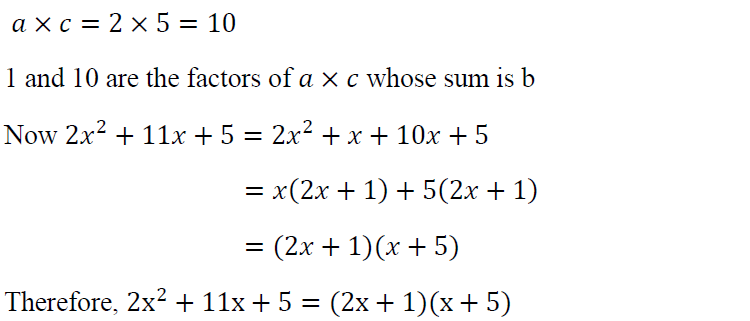
Factorize 2𝑥2+11𝑥+5 by splitting the middle term.
Solution:
Example 17
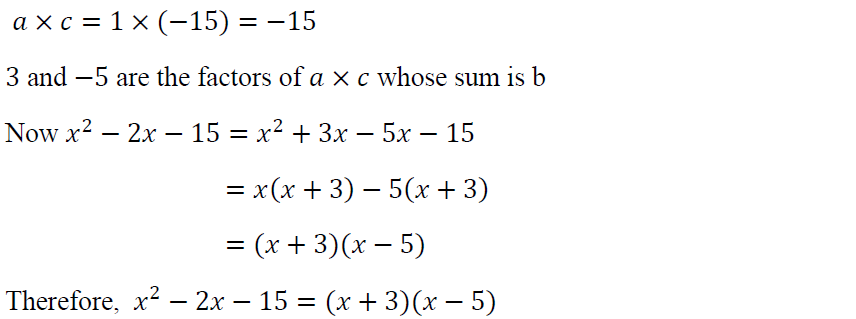
Factorize 𝑥2−2𝑥−15 by splitting the middle term.
Solution:
Exercise 4
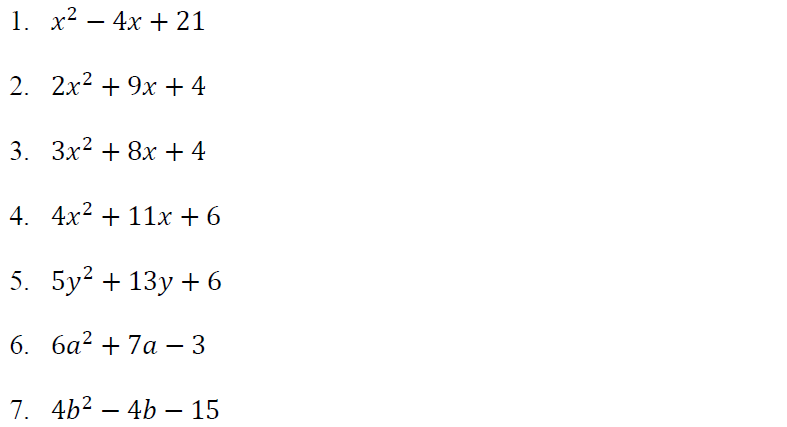
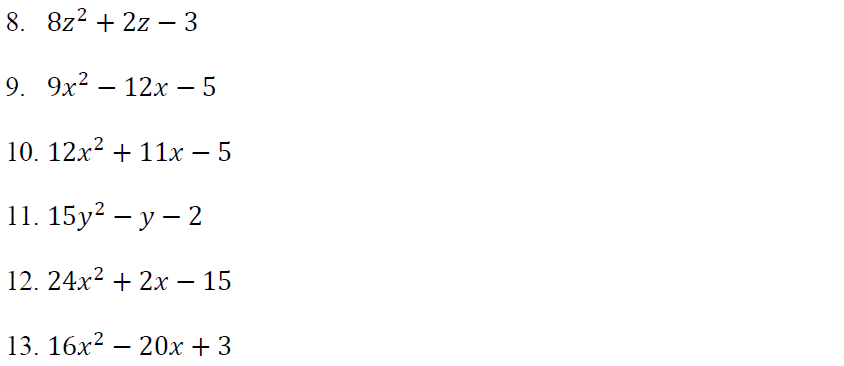
Factorize each of the following quadratic expressions by splitting the middle term:
14. The area of a rectangular garden is given by (3x2+10x+7) Sq. meters, what are the possible dimensions of the garden?
15. The product of two consecutive numbers is given by (y2−7y+12), what are the numbers?
The different methods of factorizing quadratic expressions.
Explore the different methods of factorizing quadratic expressions.
Factorization of Difference of Two squares
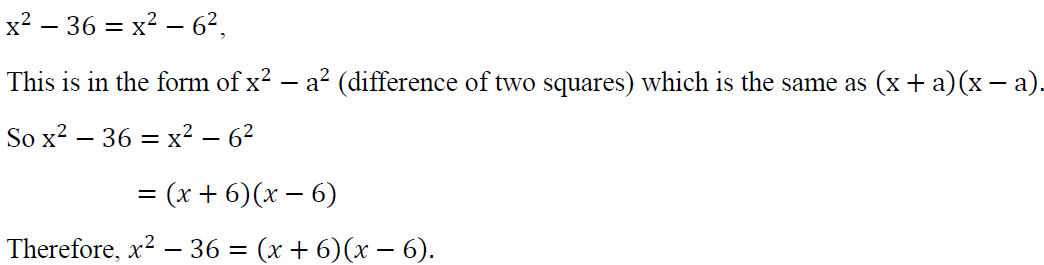
The method is used to factorize quadratic expressions in the form 𝑥2−𝑎2 (the difference of two squares).
Remember that (𝑥+𝑎)(𝑥−𝑎)=𝑥2−𝑎𝑥+𝑎𝑥−𝑎2=𝑥2−𝑎2
So x2−a2=(x+a)(x−a) means (𝑥+𝑎) and (𝑥−𝑎) are the factors of 𝑥2−𝑎2.
Example 18
Factorize 𝑥2−36.
Solution:
Example 19
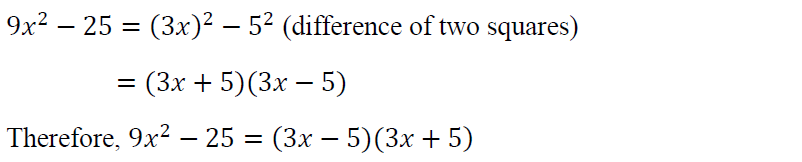
Factorize 9𝑥2−25
Solution:
Example 20
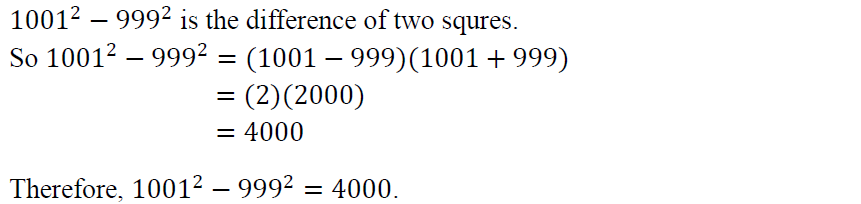
Find the exact value of 10012−9992.
Solution:
Example 21
Find the exact value of 5002−4972.
Solution:

Exercise 5
1. Factorize each of the following expressions:

2. Factorize each of the following expressions:

3. Simplify each of the following numbers:

Factorization of perfect squares
Perfect squares are quadratic expressions formed by squaring a single linear expression, therefore the have two identical factors.
They are written in the form of (𝑥+𝑎)2 or (𝑥−𝑎)2.
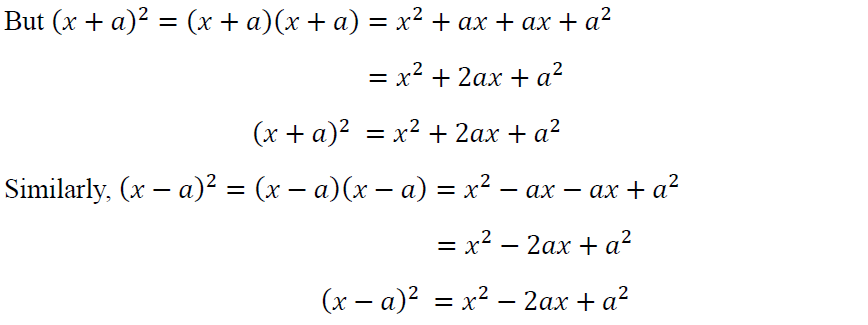
When factorizing perfect squares, the middle term always splits into two equal terms which add up to 2𝑎 or −2𝑎.
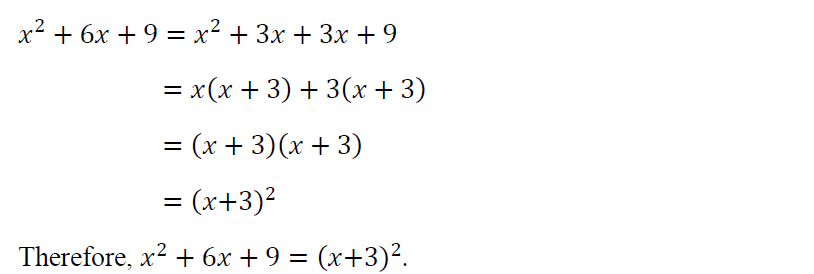
Example 22
Factorize 𝑥2+6𝑥+9.
Solution:
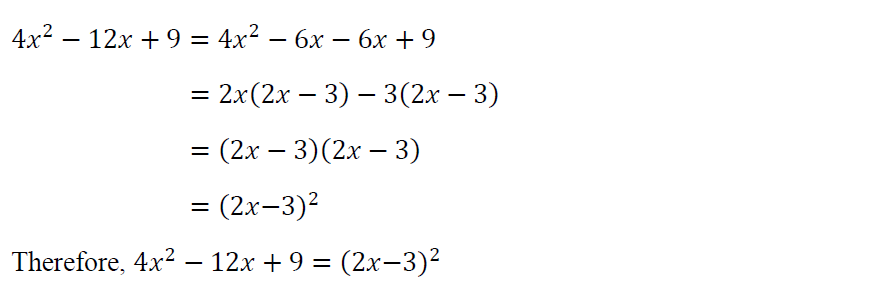
Example 23
Factorize 4𝑥2−12𝑥+9
Solution:
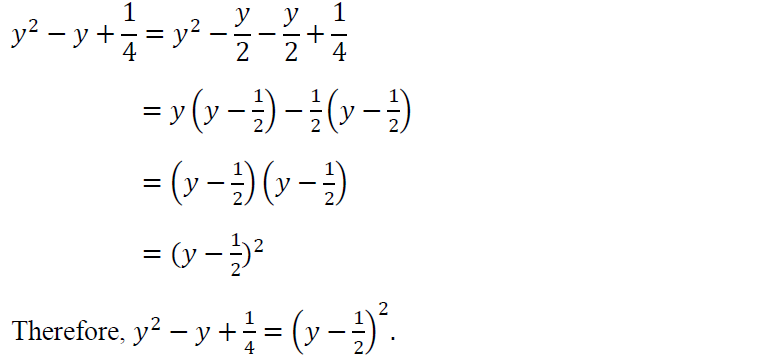
Example 24
Factorize 𝑦2−𝑦+1/4.
Solution:
Exercise 6
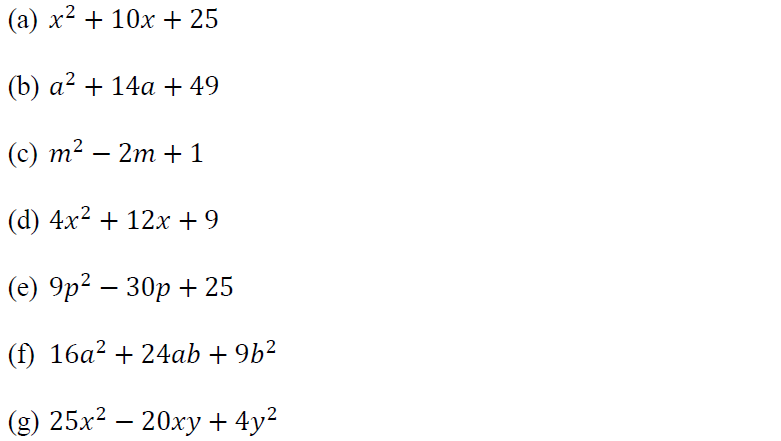
1. Factorize each of the following perfect squares:
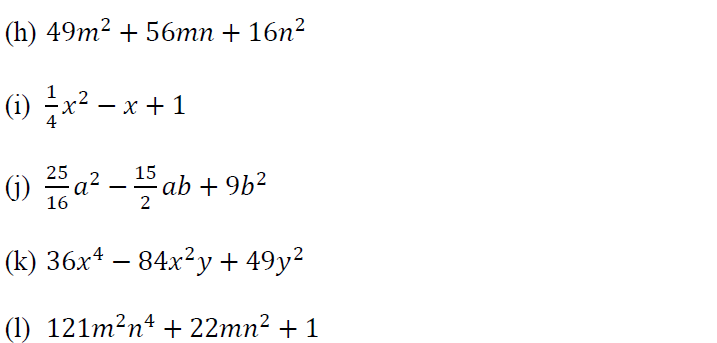
2. Find the value of 𝑘 that makes each of the following expressions perfect squares:

3. Which of the following expressions are perfect squares?

4. A farmer owns a square piece of land whose area is (𝑝2−24𝑝+9) square meters, what is the side length of the land?
5. The area of a square storage room is (36𝑝2+12𝑝+1) square meters, find the length of its one side.
Quadratic Equations
A quadratic equation is an equation in which the highest power of the variable is 2, so it has the general form 𝑎𝑥2+𝑏𝑥+𝑐=0, where:

Examples of such equations include 𝑥2+5𝑥+6=0, 2𝑥2−7𝑥+3=0, 4𝑥2=9 and (𝑥−3)2=16.
Solve quadratic equations by using different methods (factorization, Completing the square and quadratic formula).
Applying The Quadratic Formula
Solve quadratic equations by using different methods (factorization, Completing the square, and quadratic formula).
Solving Quadratic Equations by Factorization Method
Solving quadratic equations by factorization method involves the following steps:
(1) Write the equation in standard form:
Make sure the equation is written as 𝑎𝑥2+𝑏𝑥+𝑐=0 (all terms must be on one side).
(2) Factorize the quadratic expression:
Write the expression 𝑎𝑥2+𝑏𝑥+𝑐 as a product of its two factors.
(3) Let each factor equals to zero and solve for the unknown.
Note that, if (𝑥+𝑘1)(𝑥+𝑘2)=0, then either (𝑥+𝑘1)=0, or (𝑥+𝑘2)=0 or both factors equal to 0, this is called the Zero Product Rule.
Example 25
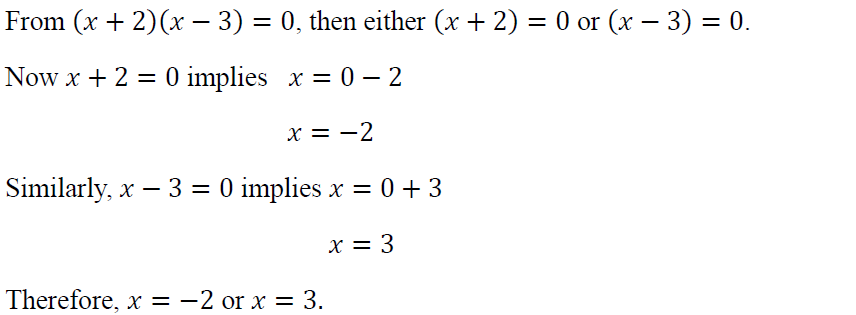
Solve for x in the equation (𝑥+2)(𝑥−3)=0.
Solution:
Example 26
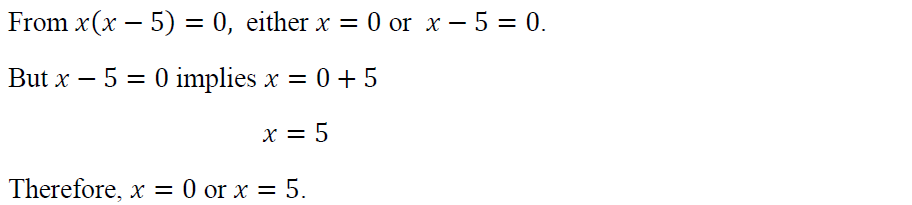
Solve the equation 𝑥(𝑥−5)=0
Solution:
Example 27
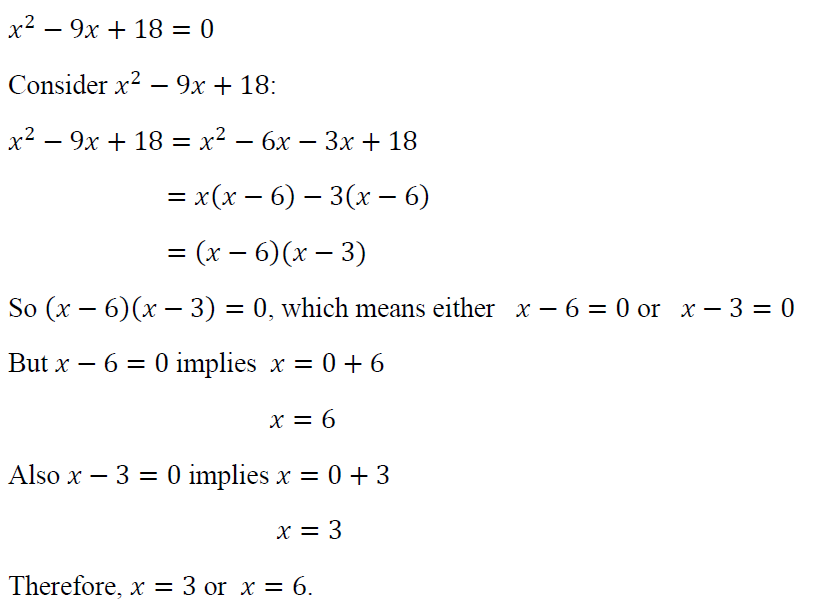
Use the factorization method to solve the equation 𝑥2−9𝑥+18=0.
Solution:
Example 28
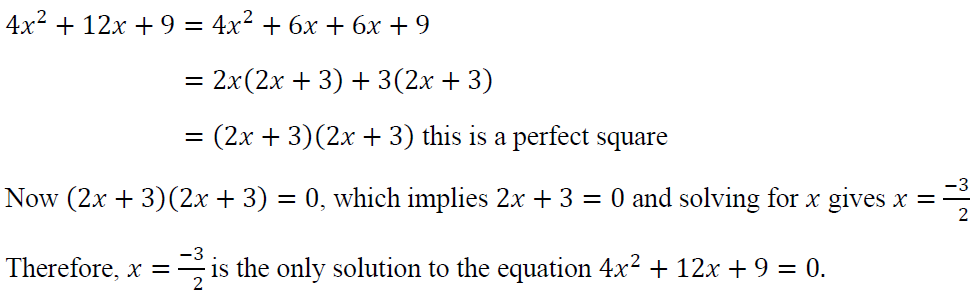
Solve the equation 4𝑥2+12𝑥+9=0 by factorization method.
Solution:
Example 29
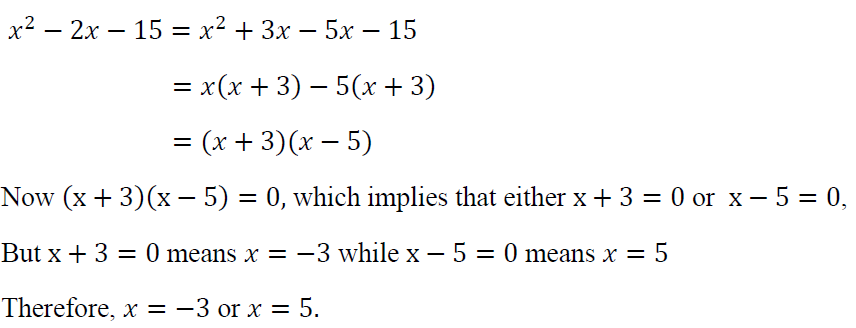
Solve the equation 𝑥2−2𝑥−15=0 by factorization method.
Solution:
Example 30
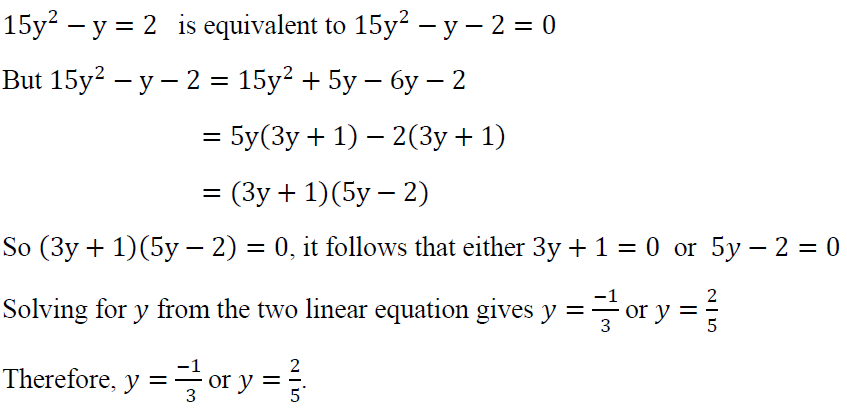
Solve the equation 15y2−y=2 by factorization method.
Solution:
Example 31
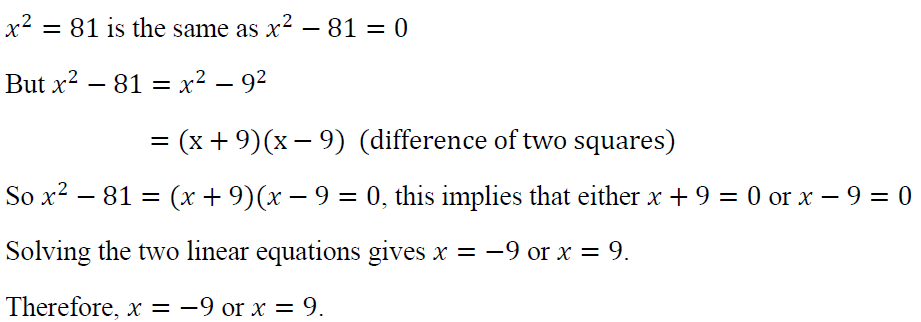
Solve the equation 𝑥2=81 by factorization method.
Solution:
Example 32
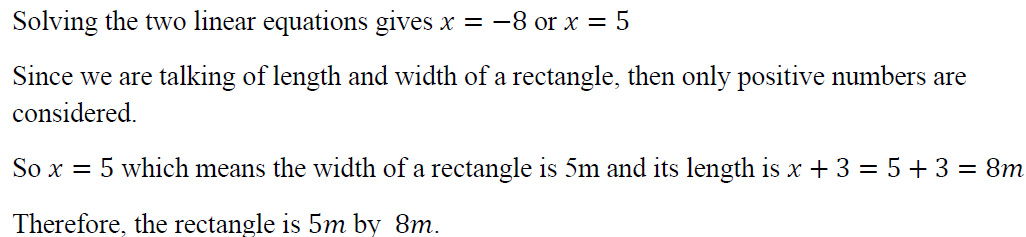
The length of a rectangle is 3m more than its width, if the area of the rectangle is 40m², what are the dimensions of the rectangle?
Solution:
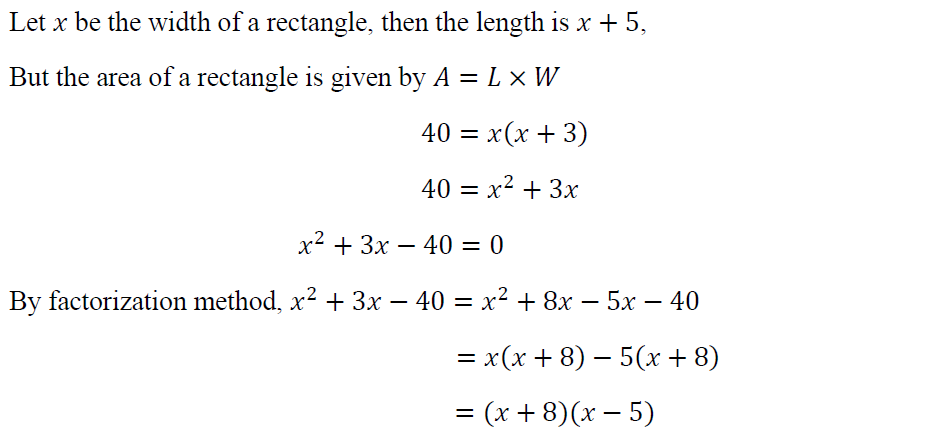
Now 𝑥2+3𝑥−40=(𝑥+8)(𝑥−5)=0, which implies that either 𝑥+8=0 or 𝑥−5=0;
Exercise 7
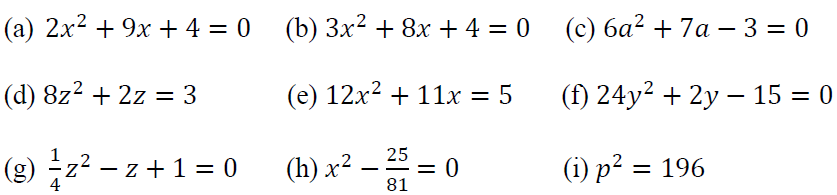
1. Solve the following quadratic equations by using factorization method:
2. The product of two consecutive integers is 56, find the two integers.
3. The base of a triangle is 4 cm longer than its height, if the area of the triangle is 48 cm², find the base and height.
4. The product of two consecutive even integers is 168, find the integers.
5. The side of a square is reduced by 3 meters, if the new area is 40 m² less than the original area, find the original side length.
6. If the sum of two numbers is 15, and their product is 56, what are the two numbers?
7. The perimeter of a rectangle is 34 m, and its area is 60 m². Find its dimensions.
Solving Quadratic Equations by Completing the Square Method
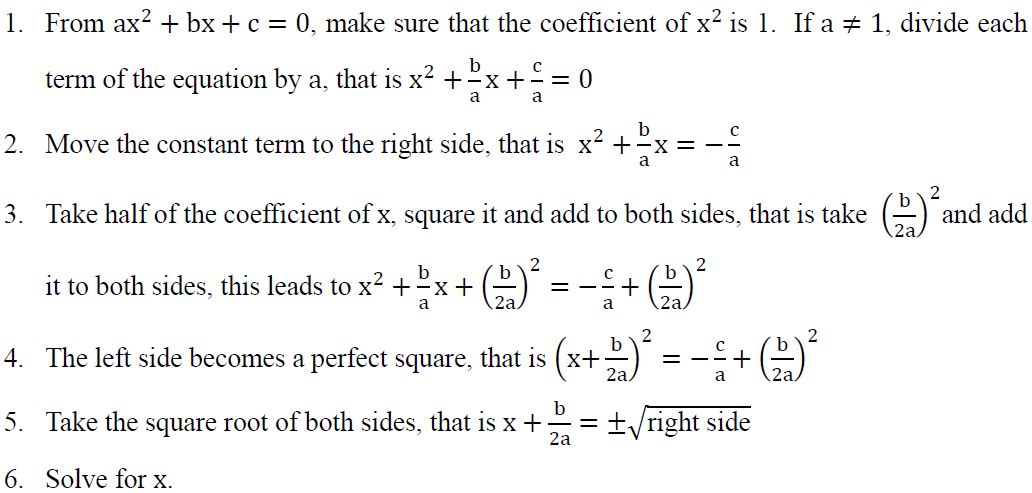
Completing the square is another method used to solve quadratic equations that involves transformation of the left-hand side of the equation into a perfect square.
Procedures:
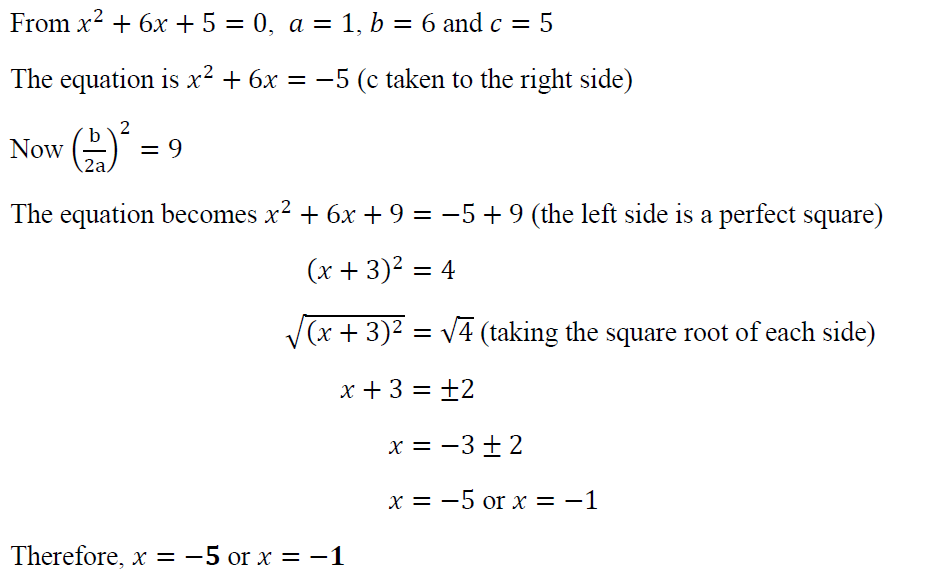
Example 33
Solve the equation 𝑥2+6𝑥+5=0 by completing the square.
Solution:
Example 34
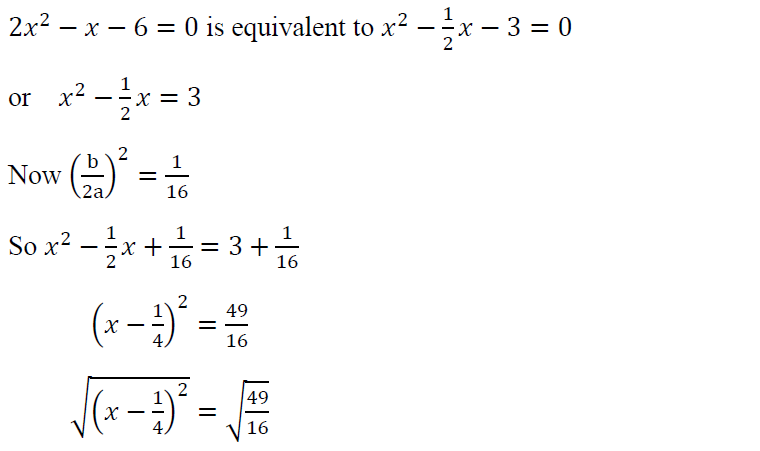
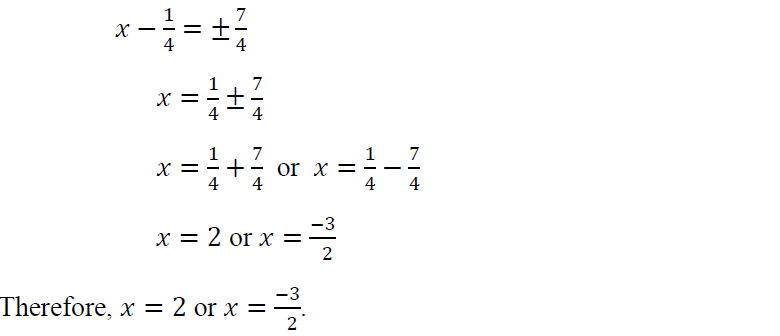
Solve the equation 2𝑥2−𝑥−6=0 by completing the square.
Solution:
Solving Quadratic Equations by General Quadratic Formula
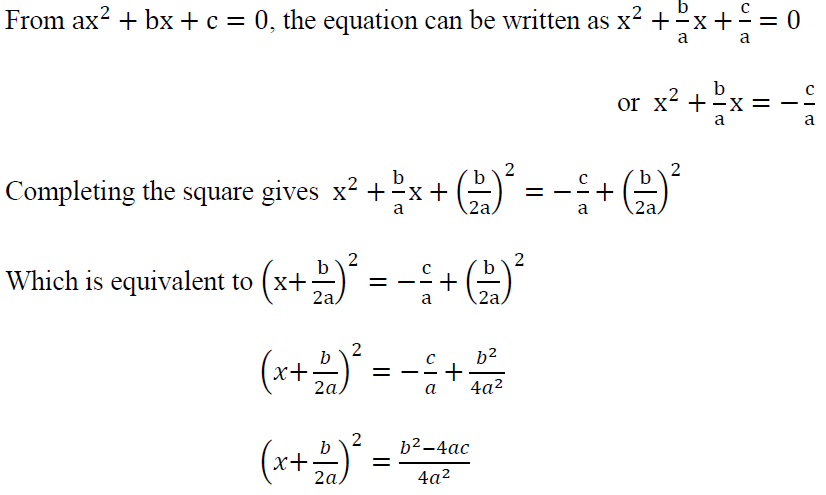
The method of completing the square actually leads to the quadratic general formula, given by the following formula

Formula Derivation :
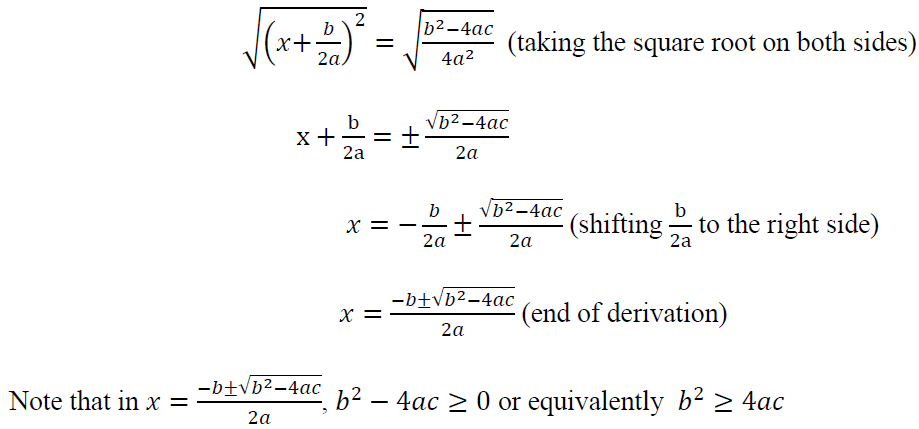
Example 35
Solve the equation 𝑥2+3𝑥−4=0 by using the quadratic general formula.
Solution:
From the equation 𝑥2+3𝑥−4=0, 𝑎=1, 𝑏=3 and 𝑐=−4
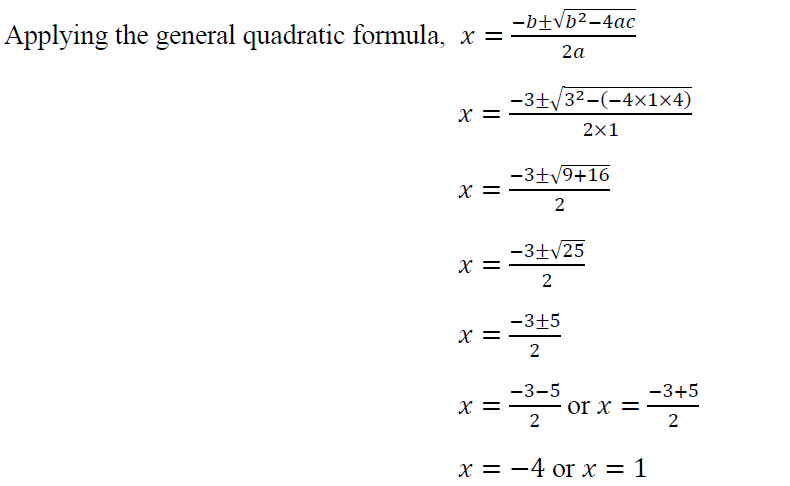
Therefore, 𝑥 =−4 or 𝑥=1.
Example 36
Solve the equation 3𝑥2+2𝑥−8=0 by using the quadratic general formula.
Solution:
From the equation 3𝑥2+2𝑥−8=0 , 𝑎=3, 𝑏=2 and 𝑐=−8;
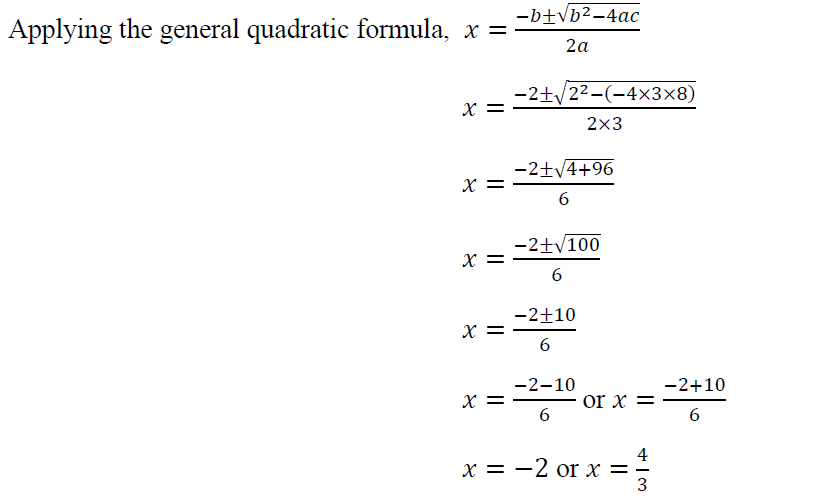
Therefore, 𝑥=−2 or 𝑥=4/3.
Example 37
Solve the equation 𝑥2−12𝑥+35=0 by using the quadratic general formula.
Solution:
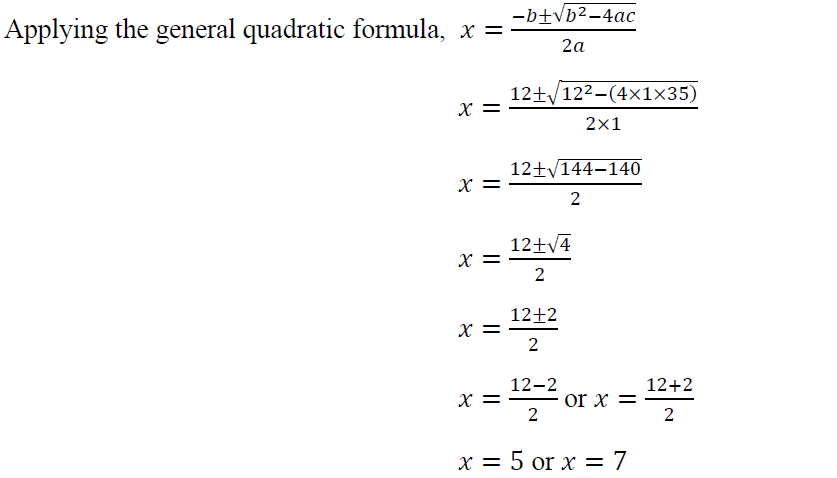
Therefore, 𝑥=5 or 𝑥=7.
Example 38
The product of two positive numbers is 96, if one number is 4 less than the other, what are the numbers?
Solution:

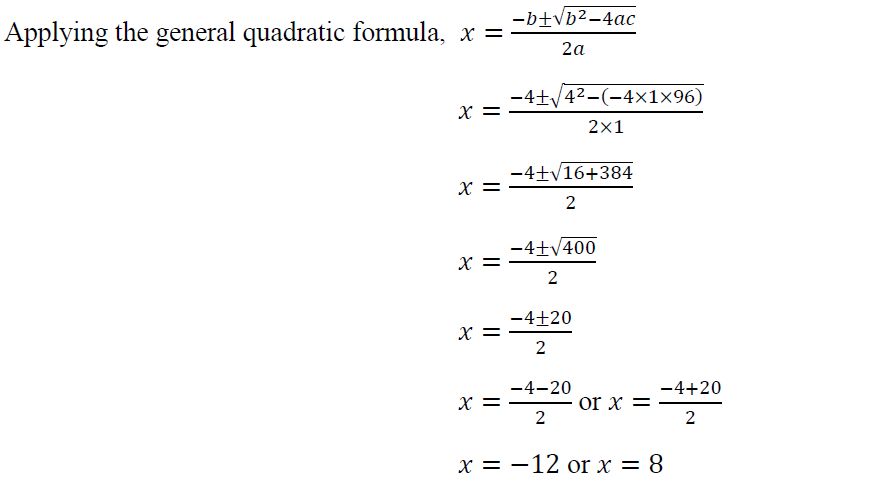
But only positive numbers are required, so the first number is 𝑥=8 and the second number is 𝑥+4=8+4=12.
Therefore, the two numbers are 8 and 12.
Exercise 8
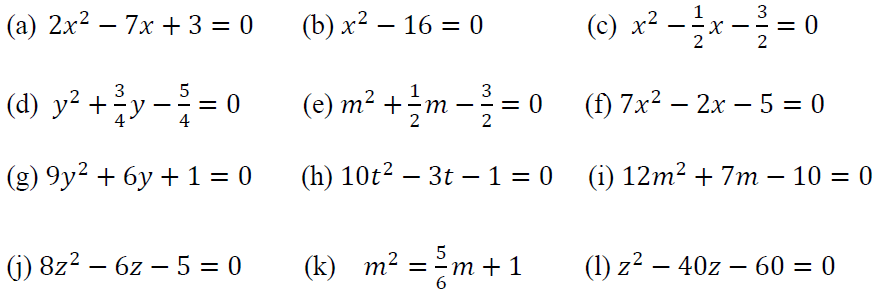
1. Use the general quadratic formula to solve the following equations:
2. Two numbers differ by 6, if their product is 187, find the numbers.
3. A rectangular field has length 3 m more than twice its width. If the area is 65 m², find its dimensions.
4. The product of two consecutive even numbers is 224. Find the numbers.
5. The base of a triangle is 5 cm more than its height. If the area is 84 cm², find the base and height of the triangle.
6. A mother is 24 years older than her daughter. If in 4 years, the product of their ages will be 260, what are their present ages?
Listening to this topic