Mathematics (New)
CONGRUENCE
Reading settings
Text size
Line spacing
Colours
CONGRUENCE
Congruence is a basic concept in geometry that describes when two figures have exactly the same shape and size. This means all their corresponding sides and angles are equal, and one figure can fit perfectly onto another through movements like translation, rotation, or reflection
Congruence is important in solving geometric problems and writing proofs, and it is also used in real life in fields like construction, architecture, and design, where accuracy and matching of shapes are essential.
In learning this topic, we rely on postulates, theorems and proofs, which provide a foundation for logical reasoning and help confirm the validity of mathematical ideas.
CONTENTS: Under this topic you will cover the following concepts about Congruence:
(i) Concept of Congruence (ii) Postulates, Theorems, and Proofs (iii) Congruence of Triangles.
COMPETENCIES:Upon completion of this chapter, you should develop several important competencies, including but not limited to:
(a)Identification of congruent figures: Ability to recognize when two shapes (especially triangles) are equal in both size and shape by comparing corresponding sides and angles.
(b)Understanding congruence conditions: Knowledge of applying SSS, SAS, ASA, AAS, and RHS rules correctly to determine triangles congruence.
(c) Logical reasoning and proof writing: Skills in constructing clear, step-by-step geometric proofs using valid statements and reasons.
(d) Analytical thinking: Ability to break down complex diagrams, identify relationships, and interpret given information accurately.
(e) Problem-solving skills: Competence in solving for unknown sides and angles using congruence principles.
(f) Accuracy in geometric constructions: Skills in drawing precise and correct geometric figures using tools like rulers and compasses.
The competencies developed will enable you to apply congruence in practical areas such as design, engineering and architecture.
Concept of Congruence.
In geometry, CONGRUENCE refers to the condition where two figures have exactly the same shape and size, meaning all their corresponding sides and angles are equal.
It is commonly studied using triangles, where congruence can be established through specific theorems such as Side-Side-Side (SSS), Side-Angle-Side (SAS), Angle-Side-Angle (ASA), Angle-Angle-Side (AAS), and Right angle–Hypotenuse–Side (RHS) for right-angled triangles.
When two triangles are congruent, they are identical in every respect and can be mapped onto each other through rigid transformations like translation, rotation, or reflection without altering their dimensions.
Congruence is an important branch of mathematics since it forms the basis for logical proofs, accurate constructions, and deeper understanding of geometric relationships, while also distinguishing itself from similarity, where figures may have the same shape but differ in size.
The concepts of congruence
What Congruence Means
Congruence: Review
Congnience
Describe the concepts of congruence
Important Terms and Symbols used in Congruence:
In congruence, several basic geometric terms and symbols are used. The following are some common useful terms and symbols in studying congruence of figures.
Congruence (≅): Means two figures have the same shape and size. Example: △ABC ≅ △DEF.
Vertices (singular: vertex): The corner points of a shape (e.g., points A, B, C in a triangle).
An angle: This is a space between two lines that meet at a point.
Right angle: An angle measuring exactly 90°.
An acute angle: An angle whose measure is less than 90°.
Obtuse angle: An angle greater than 90° but less than 180°.
Perpendicular lines (⟂): These are lines that meet at a right angle. Example: AB ⟂ CD.
Parallel lines (∥): The lines lying in the same plane but never meet. Example: AB ∥ CD.
A line segment: Is a part of a line with two endpoints, for example AB.
Corresponding sides: The sides that match in position between two congruent figures(e.g., AB ↔ DE).
Corresponding angles: Angles that are equal and in the same relative position(e.g., ∠A ↔ ∠D).
A bisector: A line that divides another line or angle into two equal parts.
Midpoint: The point that divides a line segment into two equal parts.
Hypotenuse: The longest side of a right-angled triangle (opposite the right angle).
Legs: Sides of a right-angled triangle different from the hypotenuse which meet to form a right angle.
Transversal: A line that cuts across two or more lines (often parallel lines).
These terms and symbols are essential for describing figures and writing clear geometric proofs in congruence.
Postulates, Theorem and Proofs.
In learning this topic (congruence), we rely on postulates, theorems and proofs, which provide a foundation for logical reasoning and help confirm the validity of mathematical ideas.
The concept of Postulates, Theorem and Proofs AND Solve the related problems.
Geometric Terms and Symbols
Explain the concept of Postulates, Theorem and Proofs AND Solve the related problems.
POSTULATES
A postulate is a statement that is assumed to be true without requiring proof. Such statements serve as the foundation for further reasoning and the development of logical arguments. Examples of postulates include:
(i) A circle can be constructed using any chosen center and radius.
(ii) A straight line can be drawn connecting any two points.
(iii) All right angles are equal.
THEOREMS
A theorem is a statement that has been proven to be true using previously established results, definitions, or postulates. Examples of theorems include:
(i) The sum of the interior angles of any triangle is 180°.
(ii) In a right-angled triangle, the square of the hypotenuse equals the sum of the squares of the other remaining two sides.
(iii) The sum of the interior angles of a quadrilateral is 360°.
PROOFS
A proof is a sequence of logical statements built on definitions, established facts, and postulates, used to demonstrate that a mathematical claim is true.
The following are common steps followed when making a proof of a given statement:
(i) Draw a well-labelled diagram to represent the problem, showing all relevant details such as equal angles, parallel lines, and congruent segments.
(ii) List the given information based on the labelled diagram.
(iii) Clearly state what needs to be proven.
(iv) If necessary, add extra constructions (often shown with dotted lines) to make the argument more clear.
(v) When writing the proof:
(a) Refer to the parts of the diagram used in the reasoning.
(b) Support each statement with valid reasons based on given information or known results.
(c) Include statements whose truth is known or self-evident.
(d) End with a concluding statement that confirms what was required to be proven.
Example 1
Prove that if two parallel lines are cut by a transversal, then the alternate interior angles are congruent.
Solution:
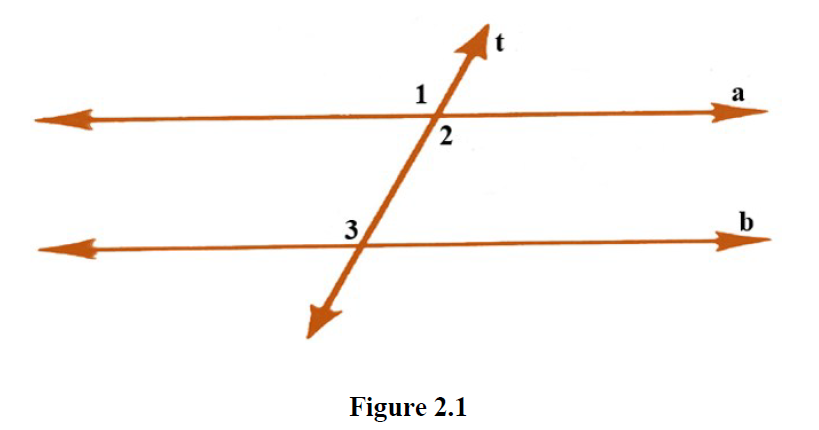
Consider figure 2.1 below, it is required to prove that ∠2≅∠3.
Proof
From figure 2.1, the proof is carried out as follows:
(1) 𝑎∥𝑏 (given)
(2) ∠1≅∠2 (Vertical angles are congruent)
(3) ∠1≅∠3 (a and b are parallel lines cut by a transversal line t).
Therefore, ∠2≅∠3 (transitive property of congruence).
Example 2
Prove that if two lines are perpendicular to the same line, then the two lines are parallel.
Solution:
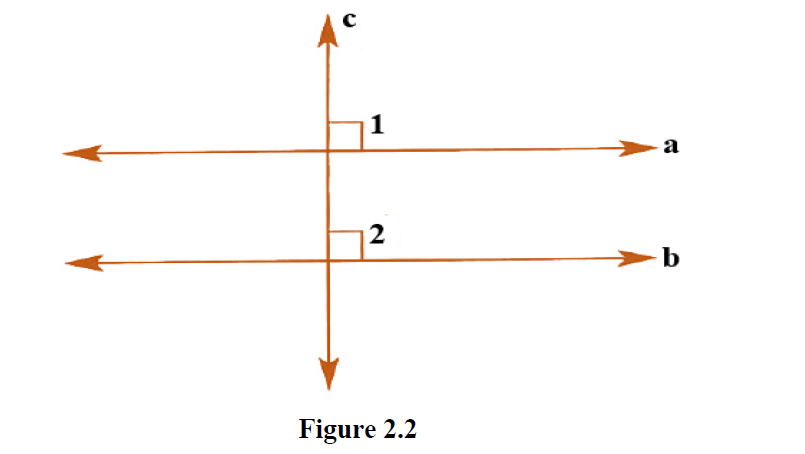
Consider the following figure which illustrates the relationship between the lines a, b and c, where it is required to prove that 𝑎∥𝑏.
From figure 2.2, the proof is as follows:
Given: 𝑎⊥𝑐 and 𝑎⊥𝑐.
Prove: 𝑎∥𝑏.
The arrangement of lines is a special case of the corresponding angles converse. The transversal c intersects both lines a and b at 90° angles.
So, the corresponding angles have a measure of 90°. Since the corresponding angles are equal, then 𝑎∥𝑏.
Example 3
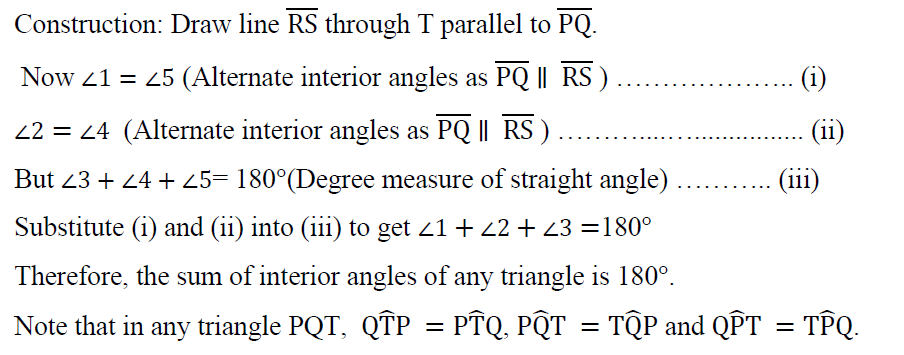
Prove that the sum of interior angles of any triangle is 180°.
Solution:
Consider the triangle PQT as shown in figure 2.3 below.
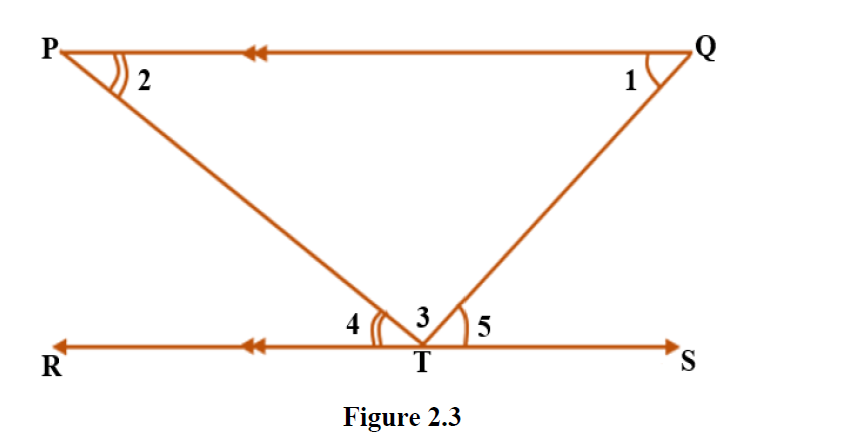
Required to prove that ∠1+∠2+∠3=180°.
Proof
Example 4
Prove that the sum of two interior angles of a triangle is equal to the exterior angle of the third interior angle.
Solution:
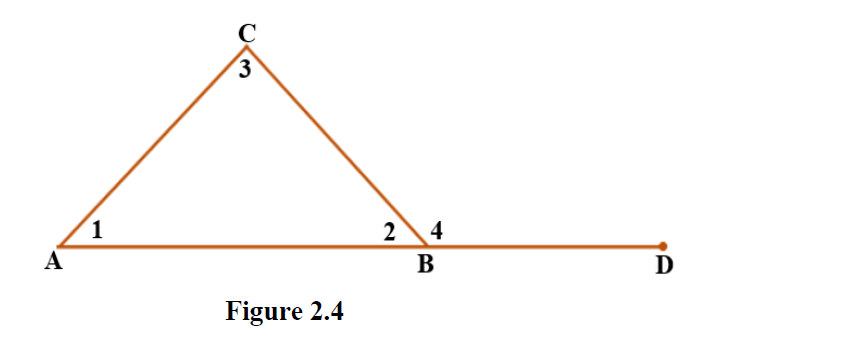
Consider Δ ABC with AB extended to D as shown in the figure 2.4 below. Required to prove that ∠1+∠3=∠4.
Proof
∠1+∠2+∠3=180°……..(i) (Sum of interior angles of a triangle).
∠2+∠4=180°…………... (ii) (Degree measure of a straight line).
Equating (i) and (ii) we get;
∠1+∠2+∠3=∠2+∠4.
∠1+∠3=∠4
Therefore, the sum of two interior angles of a triangle is equal to the exterior angle of the third interior angle.
Example 5
Prove that the bisectors of the angles formed by two intersecting straight lines are at right angles to each other.
Solution:

Required to prove ∠1+∠2=90°.
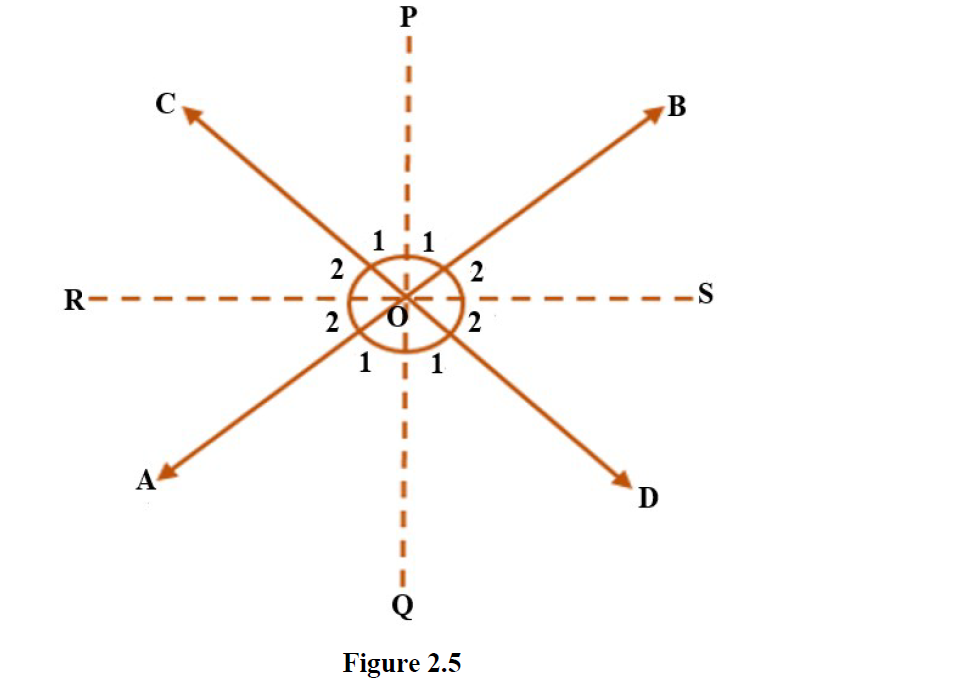
Construction: Draw the bisectors of the angles formed by intersecting lines.
Proof: From the figure above,
∠1+∠1+∠2+∠2=180° (Degree measure of a straight line)
2(∠1+∠2)=180°
∠1+∠2=90°.
Therefore, the bisectors are at right angles to each other.
Exercise 1
1.In any triangle ABC, if ∠B is a right angle, prove that AC is the longest side.
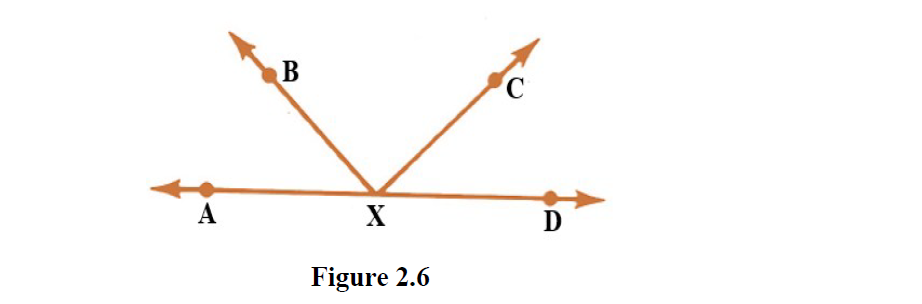
2. In the following figure, ∠BXC is a right angle. Prove that ∠AXB and ∠DXC are complementary.
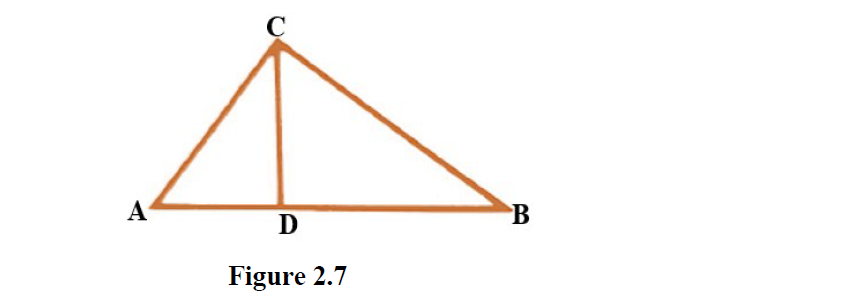
3. In figure 2.7, ∠CDB=90° and ∠CDB≅∠ACB. Prove that ∠ACB is a right angle.
4. Prove the statement that “ If two angles are both congruent and supplementary, then they are right angles”.
5. Prove the statement that “If two angles are vertical angles, then they are congruent”.
6. Prove the statement that “If one angle of a linear pair is a right angle, then the other angle is also a right angle”.
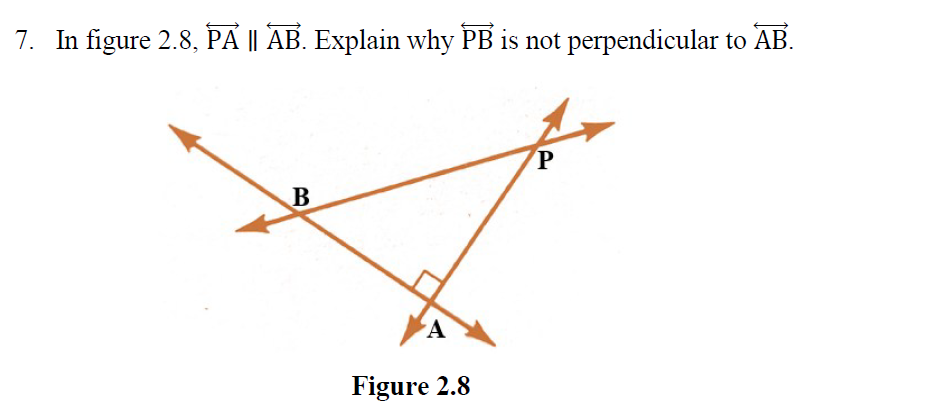
8. In figure 2.9, it is given that AB∥DC, prove that CÂB ≅AĈD.
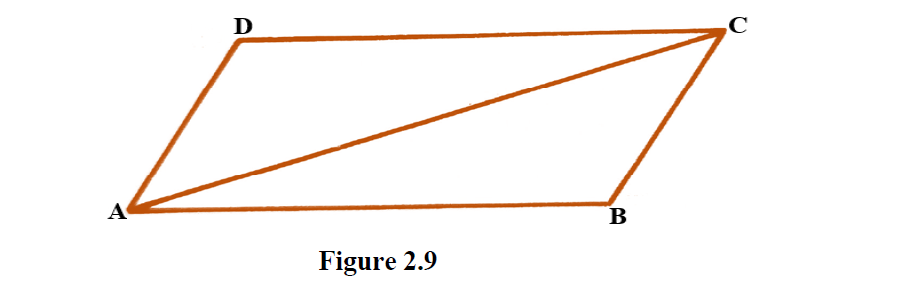
9. In figure 2.10, it is given that SR∥PQ, prove that ∠RSP and ∠SPQ are supplementary.
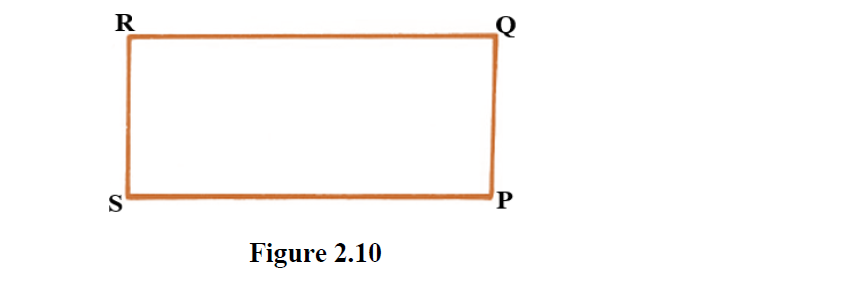
10. In figure 2.11, if JK∥ML, prove that ∠LMX ≅∠XKJ.
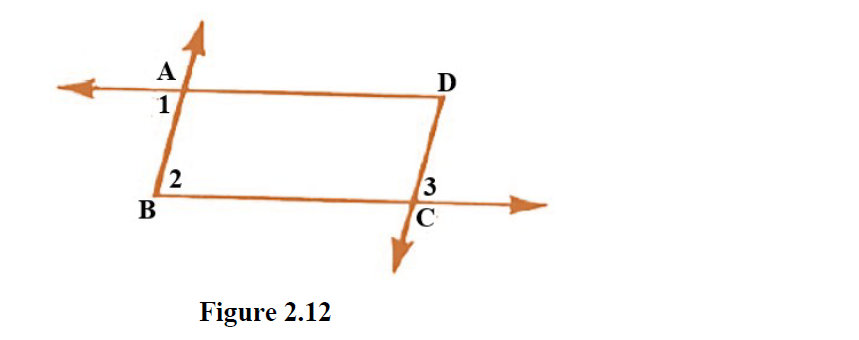
11.In figure 2.12, if AD∥BC and AB∥DC, prove that ∠1≅∠3.
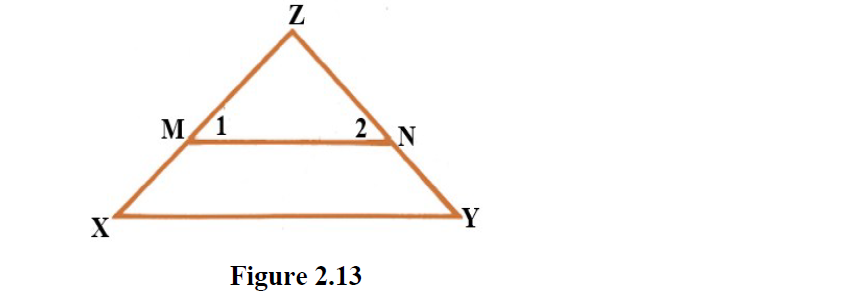
12. In the following figure, if ∠X≅∠1, prove that ∠Y≅∠2 and MN∥XY.
13. Prove that the sum of interior angles of a quadrilateral is equal to four times right angles.
The postulates, proofs, and theorems of congruent triangles
Explain postulates, proofs, and theorems of congruent triangles
Congruent triangles are established using postulates, theorems, and proofs in geometry. The main postulates (SSS, SAS, and ASA) are basic rules accepted without proof.
They are used to determine when two triangles are exactly equal in shape and size, and from these postulates, important theorems such as AAS and RHS are derived.
A proof is a logical, step-by-step explanation that applies these rules. It shows clearly why two triangles are congruent.
Together, postulates, theorems, and proofs form the basis of solving geometric problems. They also help in developing clear and valid mathematical reasoning.
Congruence of Triangles.
Congruence of triangles refers to a situation where two triangles are exactly the same in both shape and size.
In more precise terms, two triangles are said to be congruent if:
• All their corresponding sides are equal, AND
• All their corresponding angles are equal.
Therefore, congruent triangles means equal triangles.
The concept of congruence between two triangles.
Corresponding Sides and Angles
Explain the concept of congruence between two triangles.
Congruent figures means the figures with similar shapes and equal size. So Congruent triangles are triangles whose vertices can be made to correspond in such a way that the corresponding parts are congruent(equal).
We write ΔABC ≅ ΔPQR to mean ΔABC and ΔPQR are congruent. The symbol ≅ means “congruent to”. Figure 2.14 shows congruent triangles.
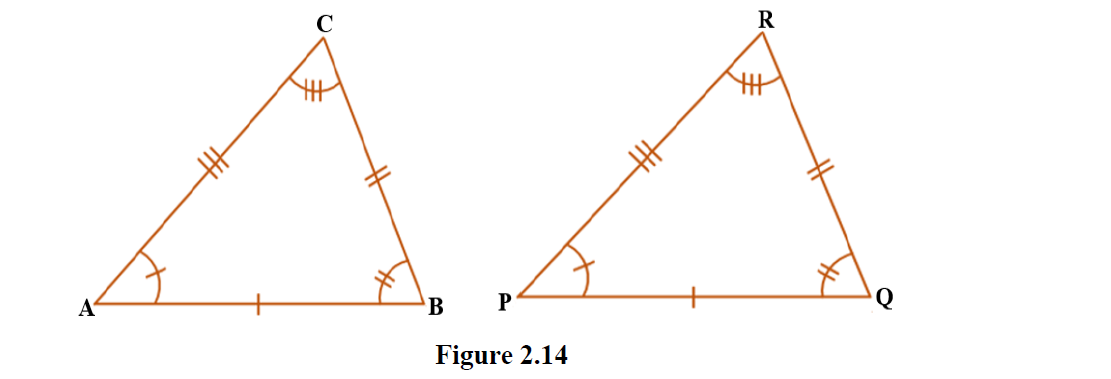
Since Δ ABC ≅ Δ PQR, the pairs of corresponding sides are equal. That is AB= PQ,BC= QR and AC =PR, also the pairs of corresponding angles are equal.
That is ∠ABC =∠PQR, ∠BCA=∠QRP and ∠BAC =∠QPR.
Example 6
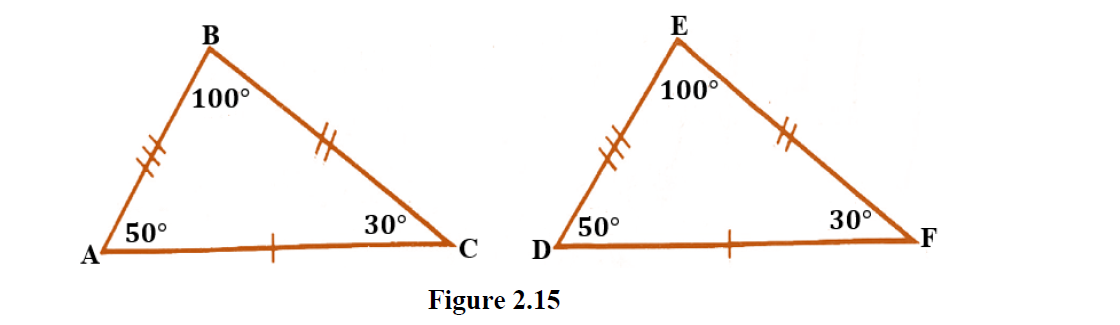
In figure 2.15, below, ABC ≅ Δ DEF, name all the corresponding vertices, angles and sides.
Solution:
Since ABC ≅ Δ DEF, then:
Corresponding Vertices: A corresponds to D, B corresponds to E and C corresponds to F.
Corresponding Angles: ∠A corresponds to ∠D, ∠B corresponds to ∠E and ∠C corresponds to ∠F.

Recognize properties of congruent triangles
Congruence in Right-Angled Triangles
POSTULATES FOR CONGRUENCE OF TRIANGLES
There are four commonly used congruence postulates that help in proving that two triangles are congruent. These are:
(a) Side–Side–Side (SSS) Postulate.
(b) Side–Angle–Side (SAS) Postulate.
(c)Angle–Angle–Side (AAS) Postulate.
(d) Right angle–Hypotenuse–Side (RHS) Postulate.
SIDE-SIDE-SIDE (SSS) POSTULATE
The SSS postulate states that “If three sides of one triangle are congruent to the corresponding three sides of another triangle, then the two triangles are congruent”. The following figure (figure 2.16) illustrates the postulate.
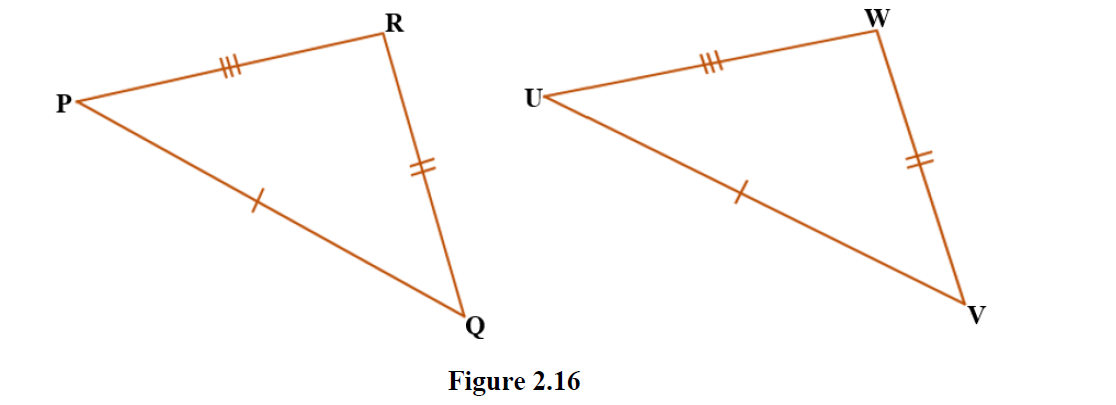
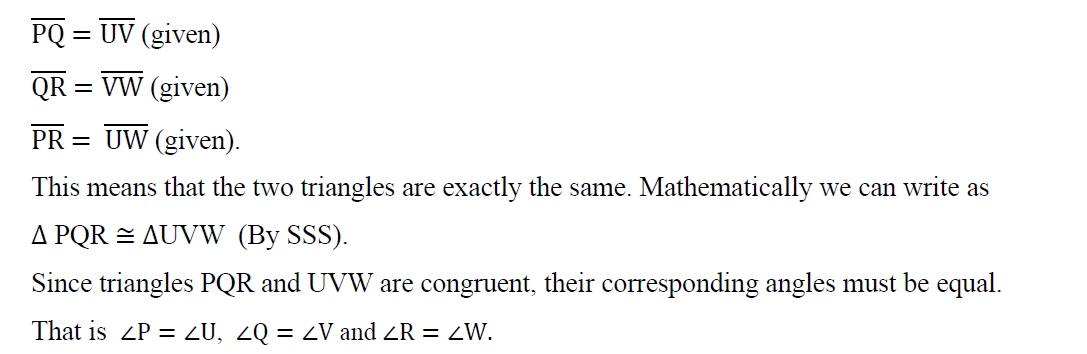
If the triangles PQR and UVW are congruent, then the pairs of corresponding sides are equal. That is
Example 7
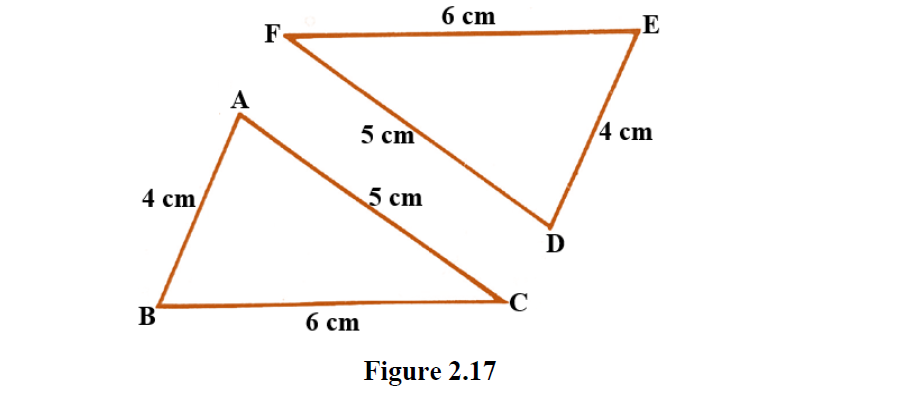
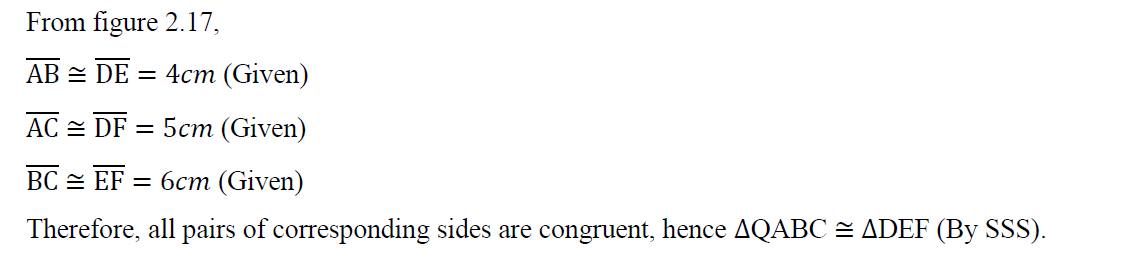
In figure 2.17, show that ΔABC ≅ ΔDEF.
Solution:
Example 8
In figure 2.18, prove that ΔQYN ≅ ΔQYP.
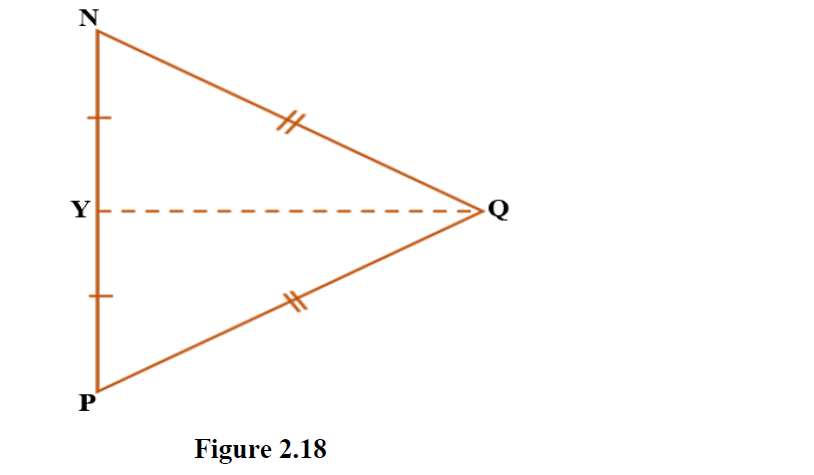
Solution:
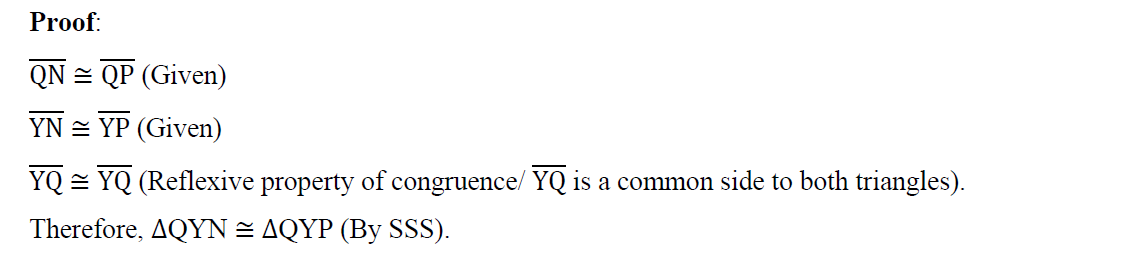
Example 9
Use the following figure to prove that ΔABC ≅ ΔCDA. Hence deduce that ∠C≅∠A.
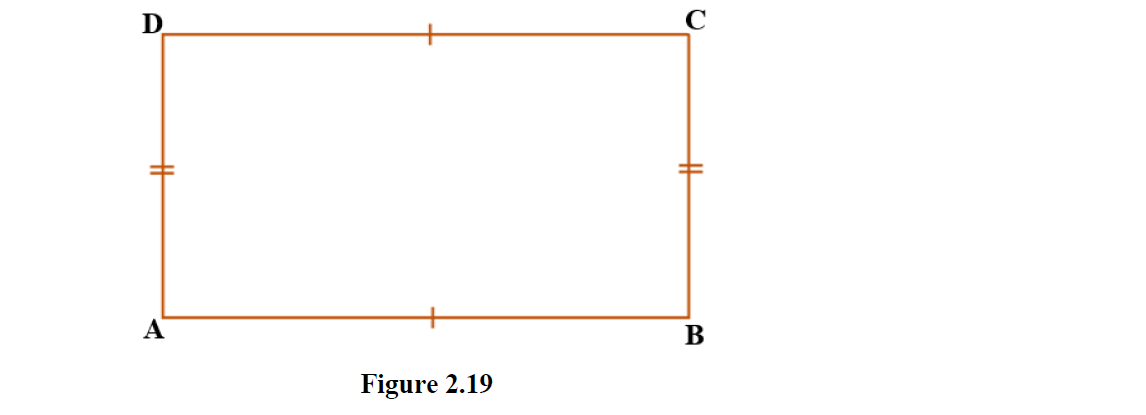
Solution:
Construct a line joining A and C as shown in figure 2.20 below;
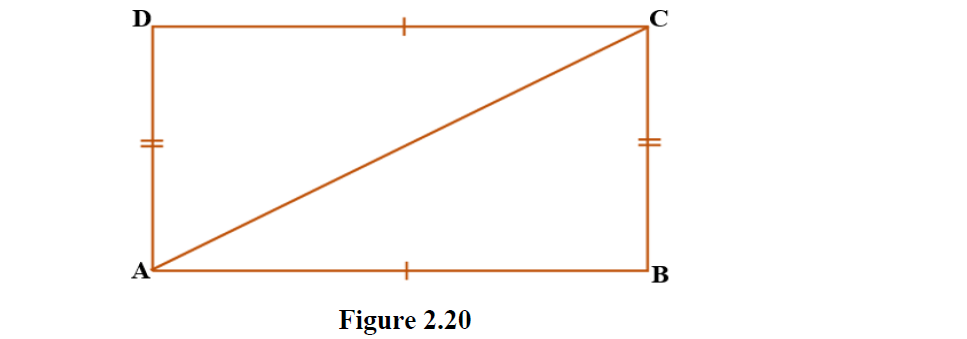
Proof: From ΔABC and ΔCDA
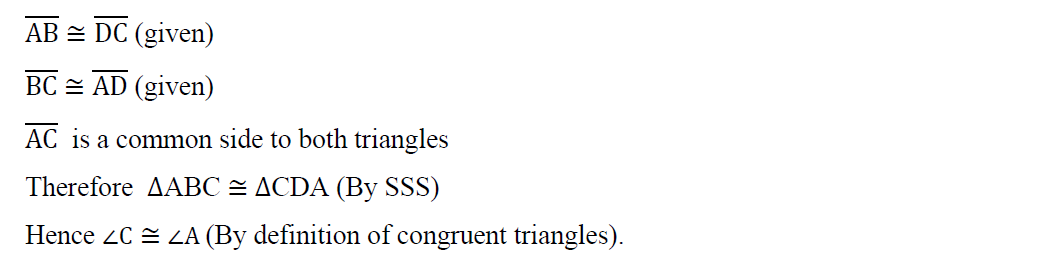
SIDE-ANGLE-SIDE (SAS) POSTULATE
The SAS postulate states that “If two sides and the included angle of one triangle are congruent to the corresponding two sides and the included angle of second triangle, then the two triangles are congruent”.
The following figure (figure 2.22) illustrates the postulate.
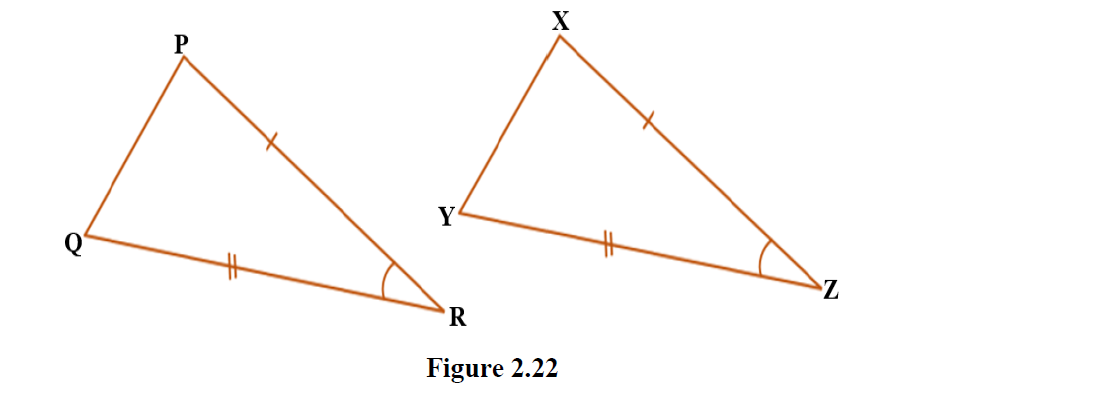
The triangles PQR and XYZ are congruent since two pairs of corresponding sides and the included angle are congruent.

Therefore ΔPQR ≅ ΔXYZ (By SAS)

Example 10
In figure 2.23 below, show that ΔABC ≅ ΔEFG.
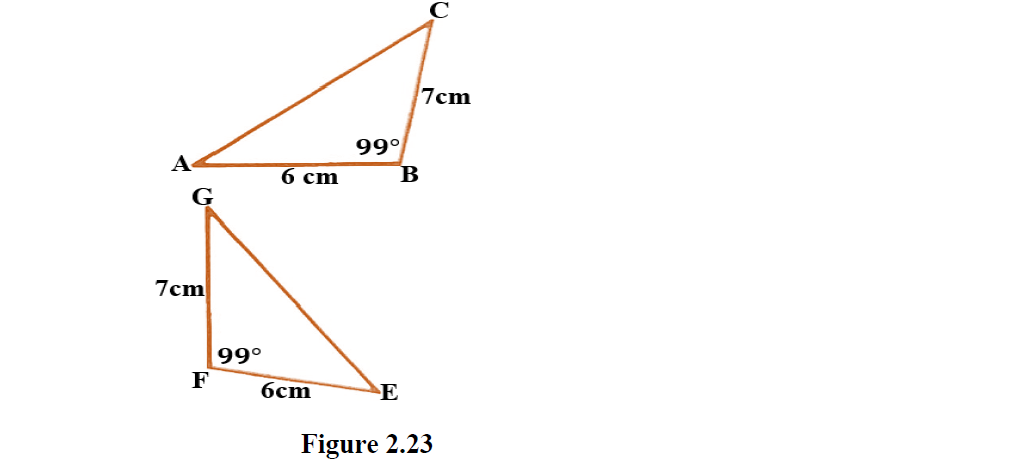
Solution:

Example 11
In figure 2.24, AB ∥CD and the lines AD and BC bisect each other at P, prove that ΔPAB ≅ ΔPDC.
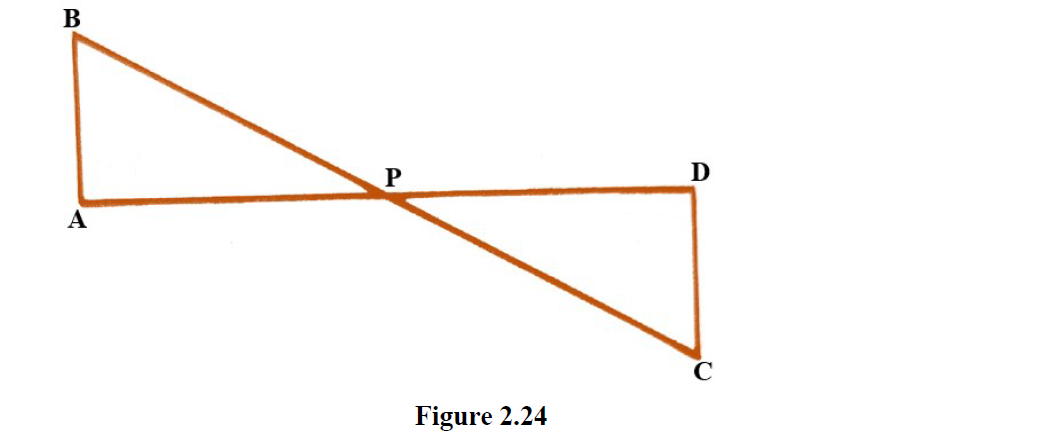
Solution:
Consider triangles PAB and PDC in figure 2.24.

Since two pairs of corresponding sides and the included angle are congruent, then by SAS, triangles PAB and PDC are congruent.
Example 12
Use the following figure to prove that ΔADC ≅ ΔCBA.
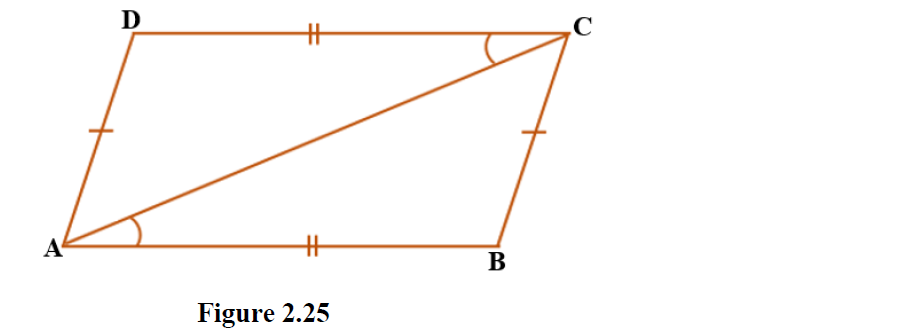
Solution:
Proof: From triangles ADC and CBA;

Therefore, ΔADC ≅ ΔCBA (By SAS).
ANGLE-ANGLE-SIDE (AAS) POSTULATE
The AAS postulate states that “If two angles and a non-included side of one triangle are congruent to two angles and the corresponding non-included side of the other triangle, then the two triangles are congruent”.
The following figure (figure 2.27) illustrates the postulate.
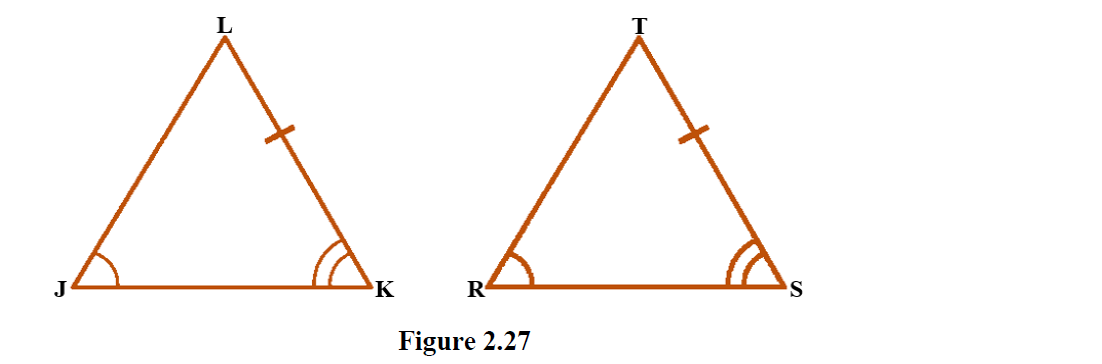
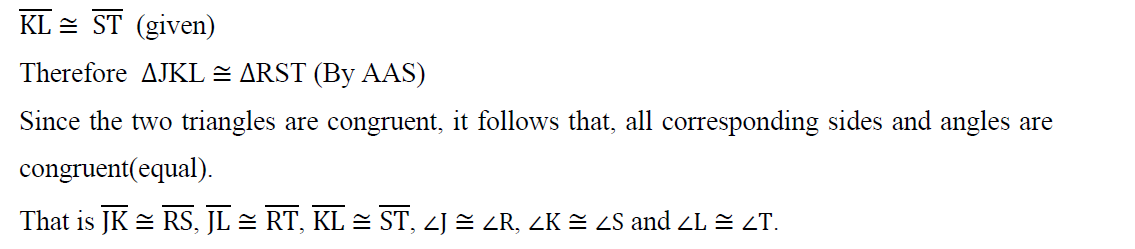
From ΔJKL and ΔRST;
∠J≅∠R (given)
∠K≅∠S (given)
Example 13
In figure 2.28 below, show that ΔABC ≅ ΔPQR.
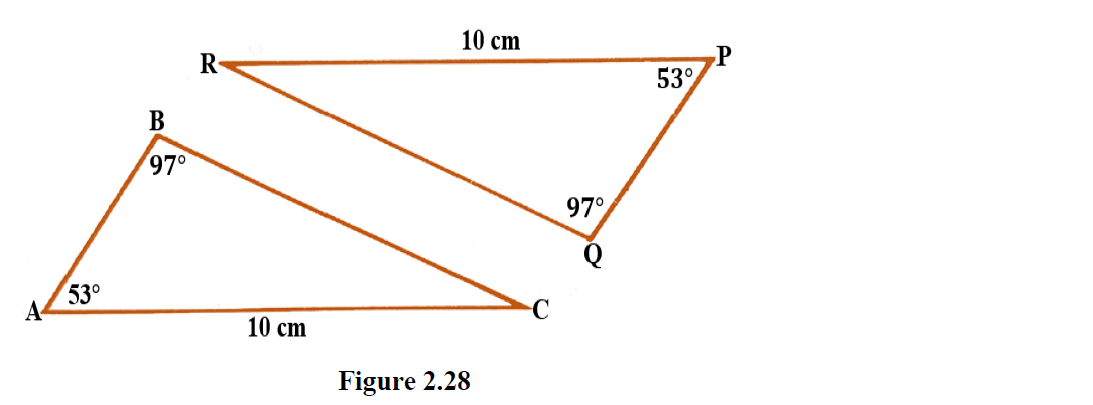
Solution:

Therefore, ΔABC ≅ ΔPQR (By AAS).
ANGLE-SIDE-ANGLE (ASA) POSTULATE
The ASA postulate states that “If two angles and the included side of one triangle are congruent to two angles and the included side of another triangle, then the two triangles are congruent”. The following figure (figure 2.30) illustrates the postulate.
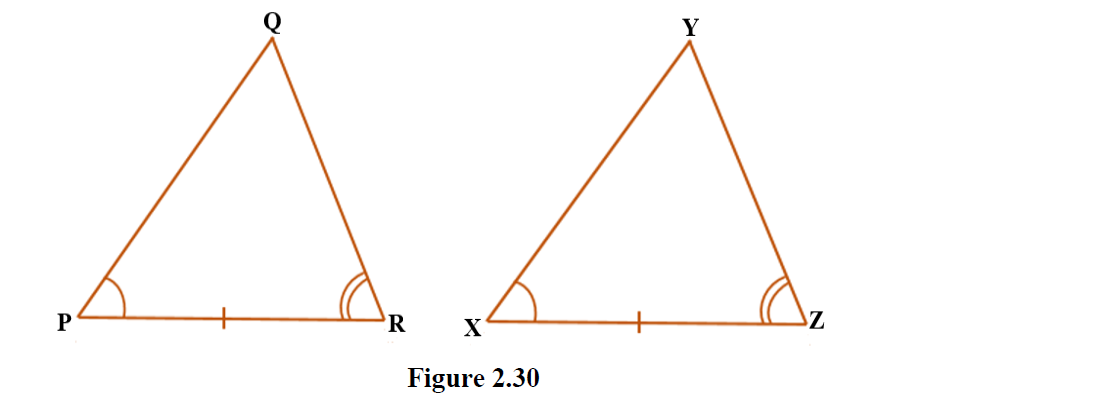
From the triangles PQR and XYZ;

Therefore, ΔABC ≅ ΔXYZ (By ASA postulate).
Example 14
In figure 2.31 below, show that ΔBAP ≅ ΔCDP.
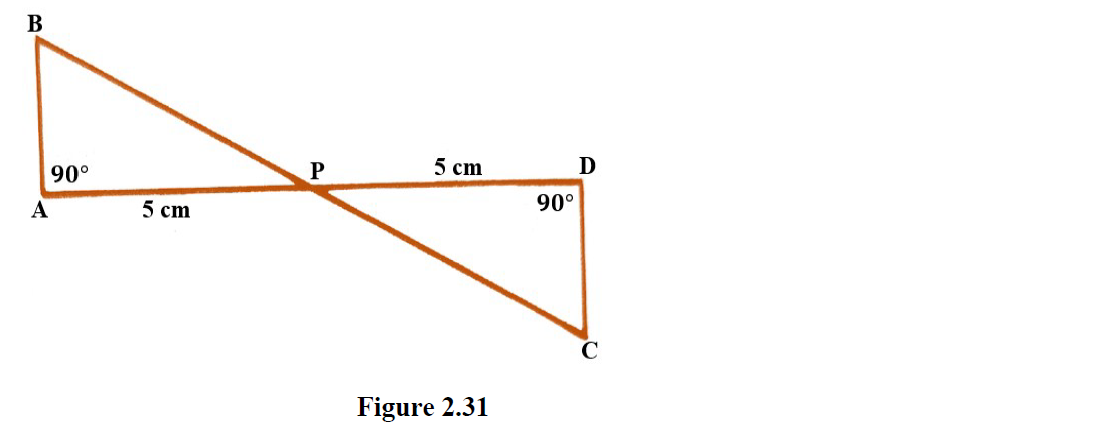
Solution:
Consider triangles BAP and CDP;

Therefore, ΔBAP ≅ ΔCDP (By ASA).
Example 15
In the following figure, prove that ΔRVS ≅ ΔTVU.
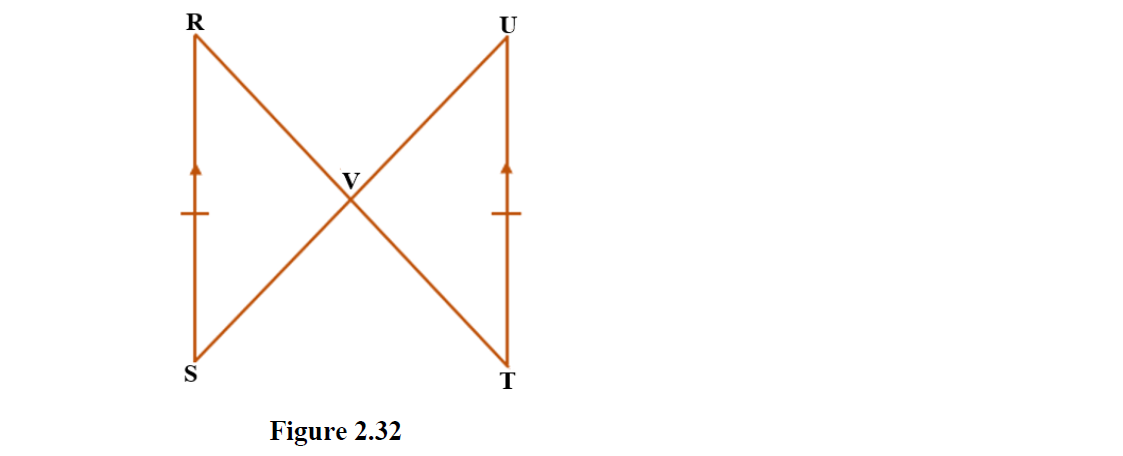
Solution:

Therefore, ΔRVS ≅ ΔTVU (By ASA postulate).
Example 16

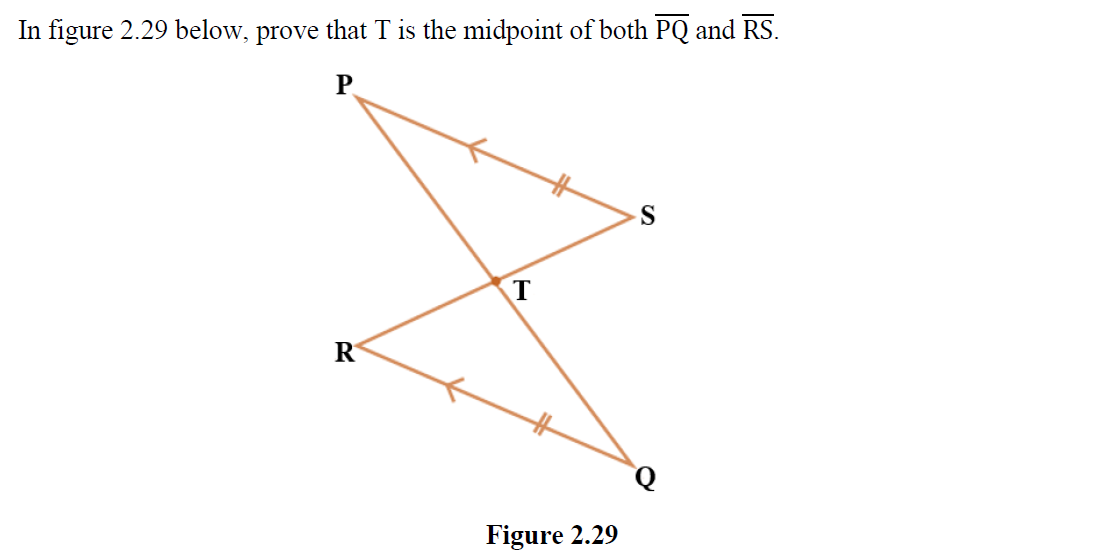
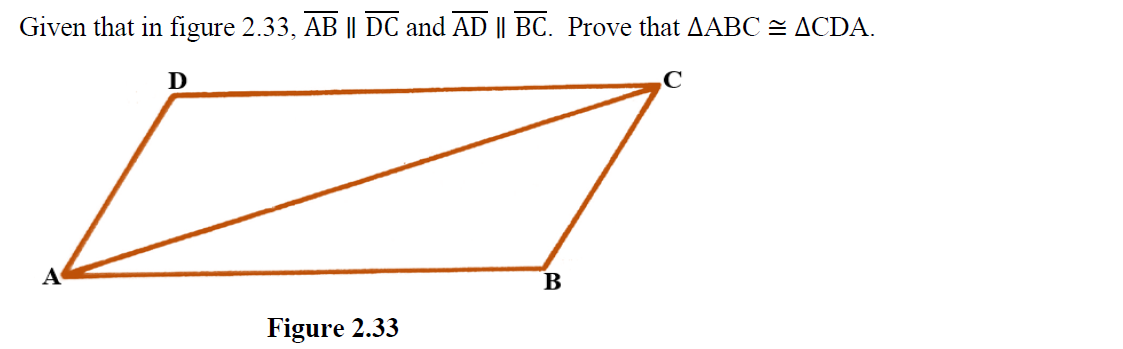
Solution:
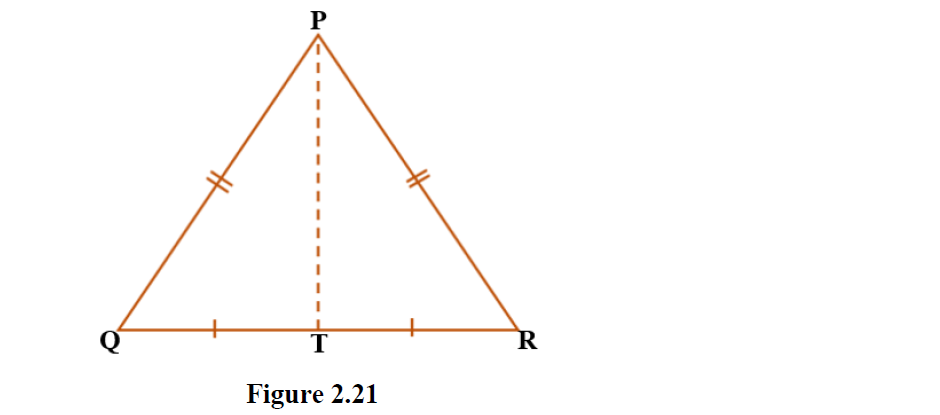
Proof: From the triangles PQT and PRT;

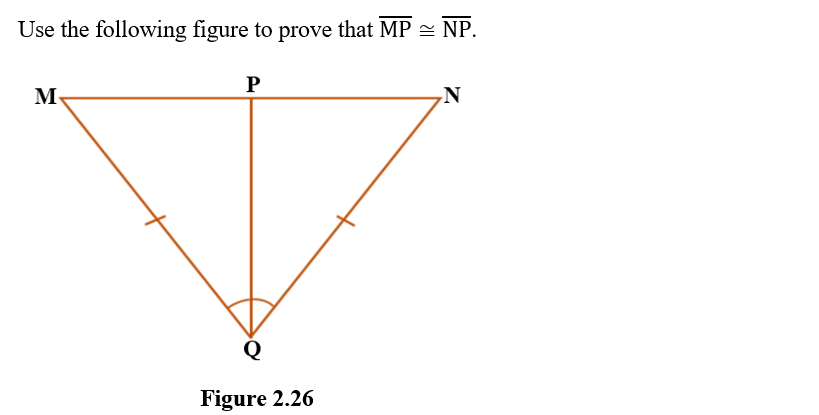
Proof: From triangles MQP and NQP;

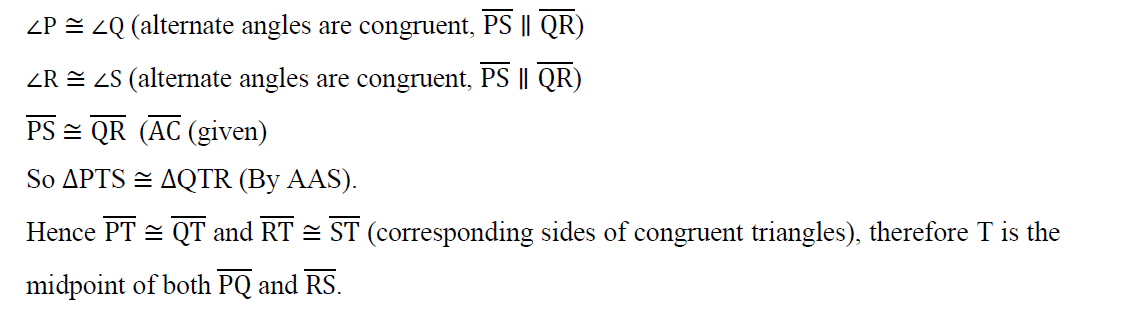
Consider triangles PTS and QTR;
From triangles ABC and CDA;

Therefore, ΔABC ≅ ΔCDA (By ASA Postulate).
Therefore, ΔMQP ≅ ΔNQP (By SAS).

Exercise 2
1. State the condition for two triangles to be congruent.
2.Two triangles are congruent. You know the measures of the sides and angles of one triangle. Do you also know the measures of the sides and angles of the other triangle? Explain your answer.
3. Triangles ABC and DEF are such that 𝐴𝐵=𝐷𝐸=6 cm, 𝐵𝐶=𝐸𝐹=8 cm, and𝐴𝐶=𝐷𝐹=10 cm. Is △ABC≅△DEF? Justify your answer.
4. Why not all equilateral triangles are congruent?
5. A surveyor measures two triangular plots of land as follows:Plot A: 50 m, 60 m, 70 m.
Plot B: 50 m, 60 m, 70 m. Show that the plots are identical in shape and size.
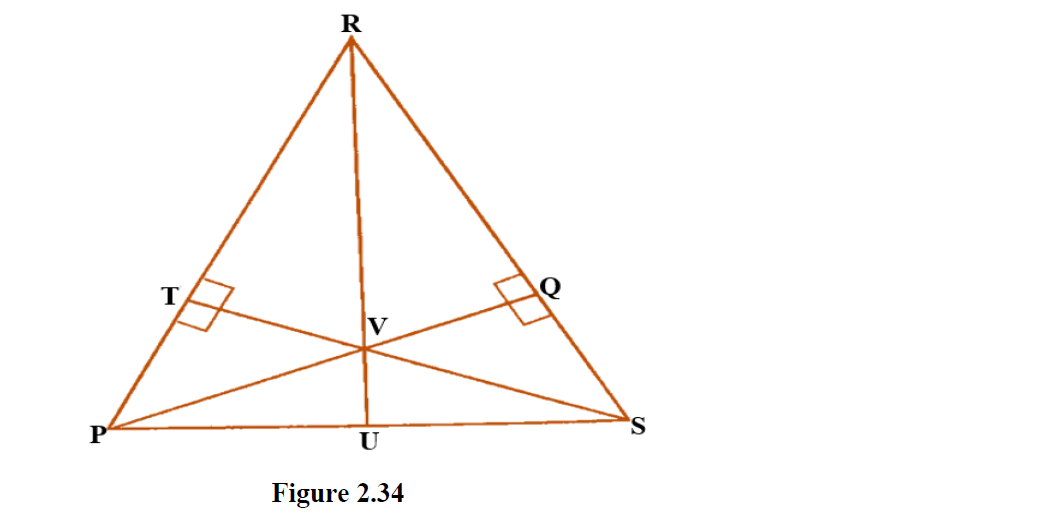
6. Name the four pairs of congruent triangles from the following figure.
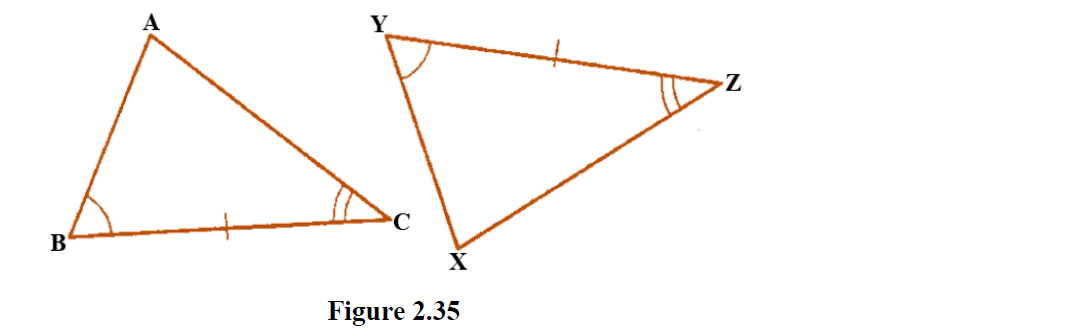
7. In figure 2.35 below, list all the pairs of corresponding sides and corresponding angles if ΔABC ≅ ΔXYZ.
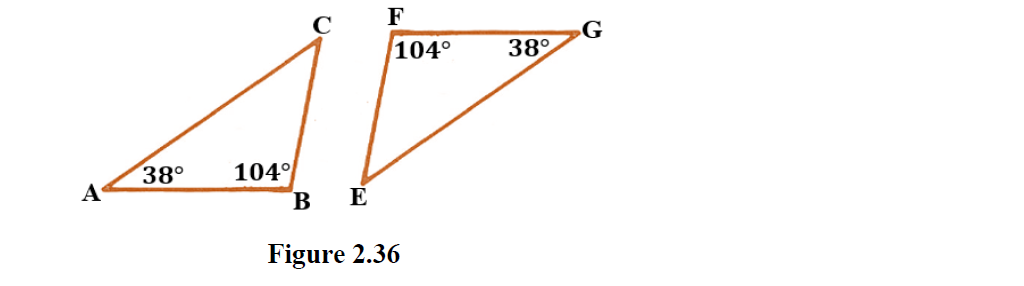
8. In the following figure, can you conclude that ΔABC ≅ ΔEFG if there is no further given information? Explain your answer.
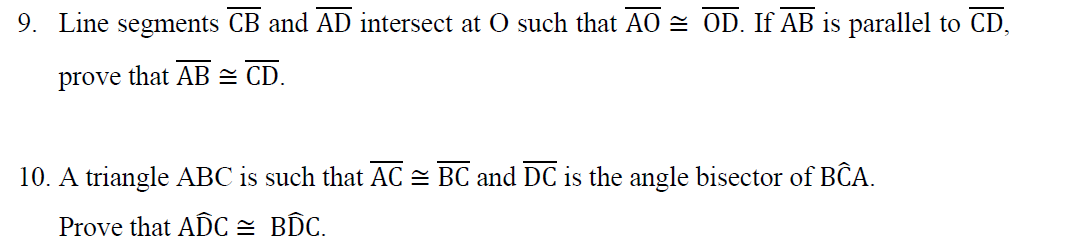
By showing all the necessary steps, attempt the following questions:
11. Two circles with centre at A and B respectively intersect at point P and Q. Prove that AB bisects the angle PAQ (Hint: Use triangles APB and AQB).
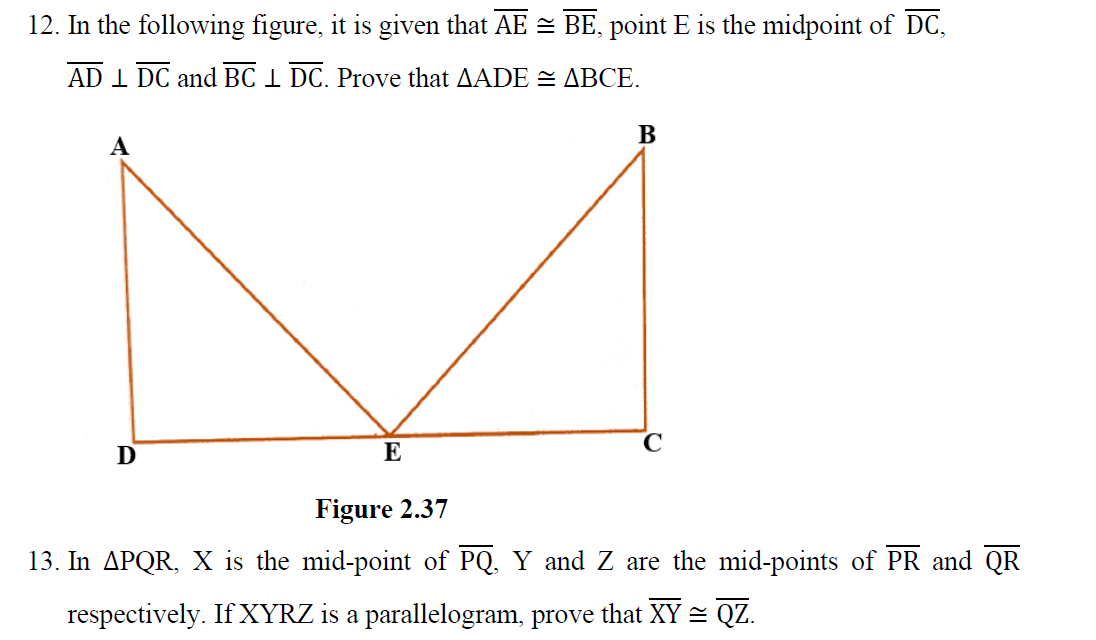
14. In figure 2.38, prove that ΔBXY ≅ ΔYCB.
By showing all the necessary steps and giving reasons, answer the following questions:
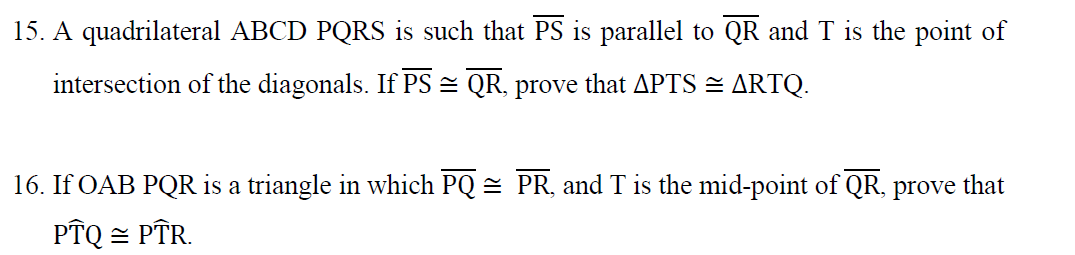
17. In the following figure, prove that ΔPVQ ≅ ΔPVR.
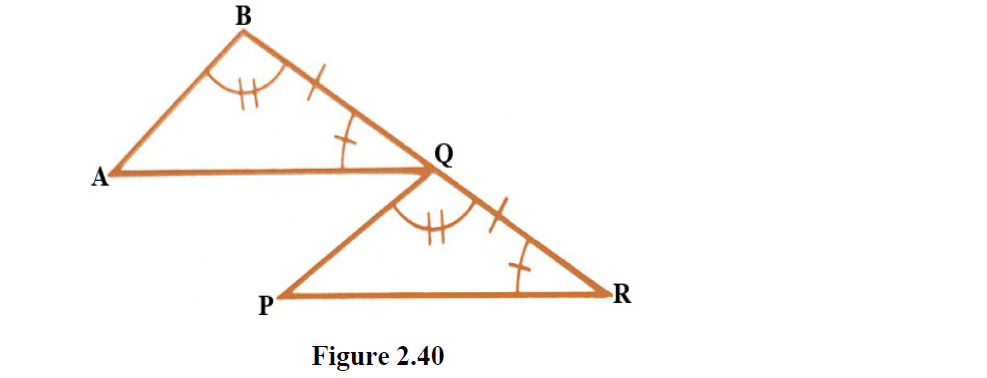
19. In figure 2.40, can it be concluded that ΔQBA ≅ ΔRQP? Give reasons to support your answer?
20. Prove that the line segment from the vertical angle of an isosceles triangle to the mid-point of its base is perpendicular to the base.

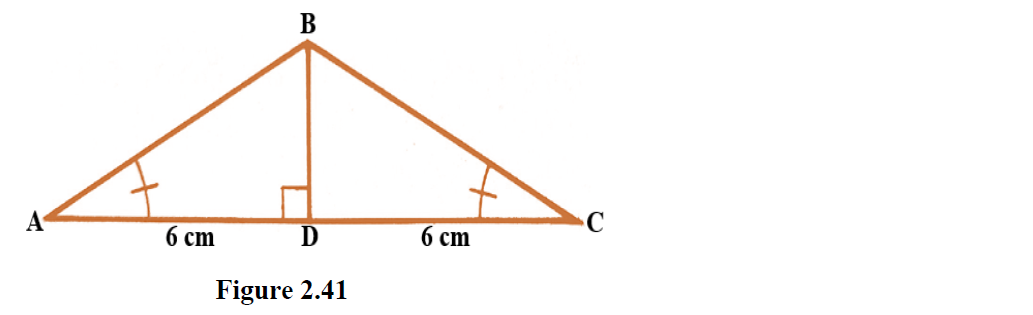
23. In figure 2.41, prove that ΔADB ≅ ΔCDB.
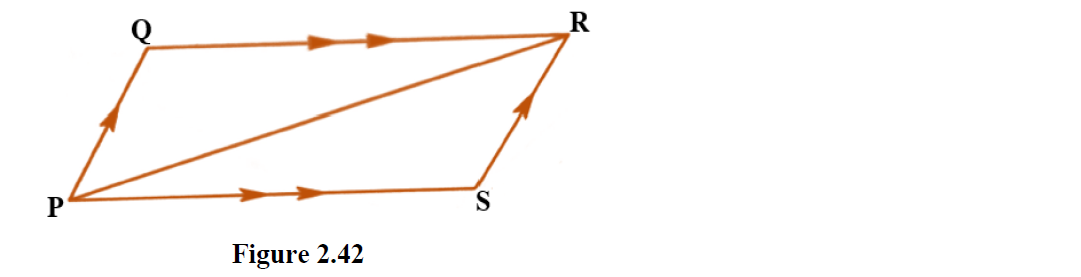
24. In figure 2.42 below, prove that ΔPQR ≅ ΔRSP.
25. Prove that the bisector of the vertical angle of an isosceles triangle is perpendicular to the base at its mid-point.

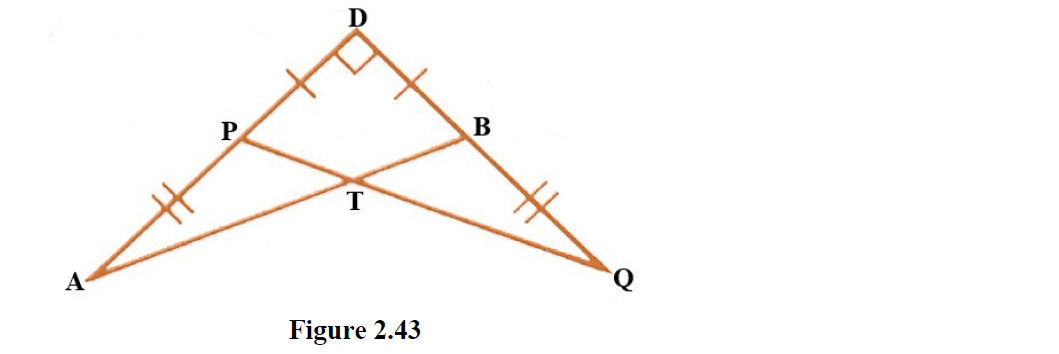
27. In figure 2.43, prove that ΔAPT ≅ ΔQBT and ΔADB ≅ ΔQDP.
28. In figure 2.44, ∠A≅∠B and ∠1≅∠2. Prove that ΔPAQ ≅ ΔQBP.
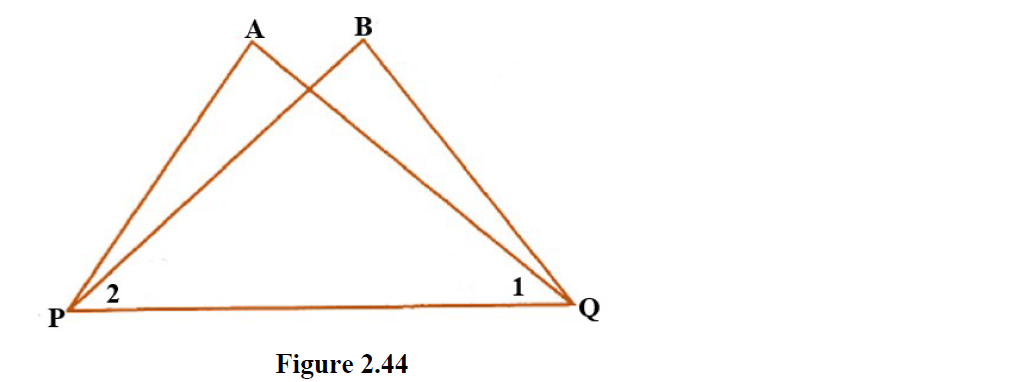
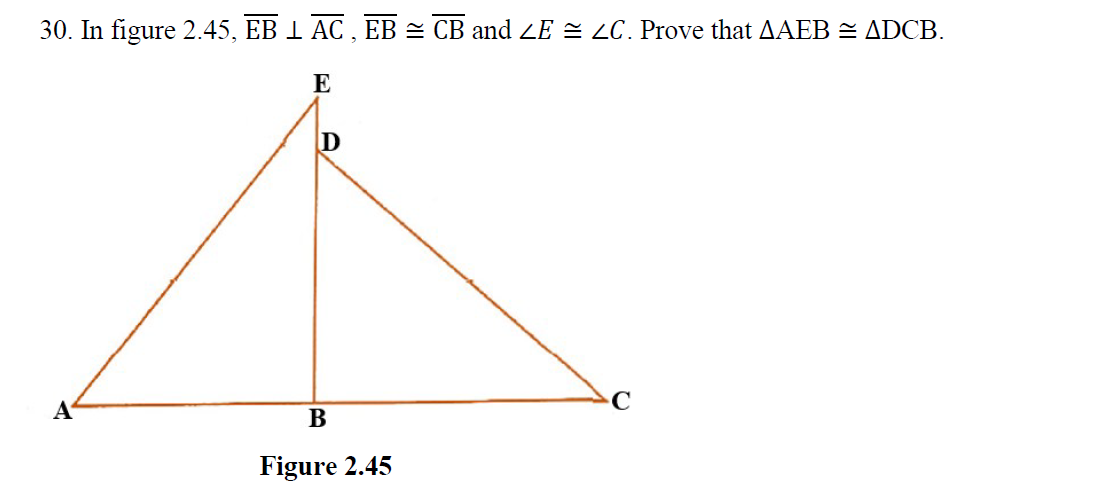
29. Prove that the perpendicular from the vertex to the base of an isosceles triangle bisects the base and the vertical angle.
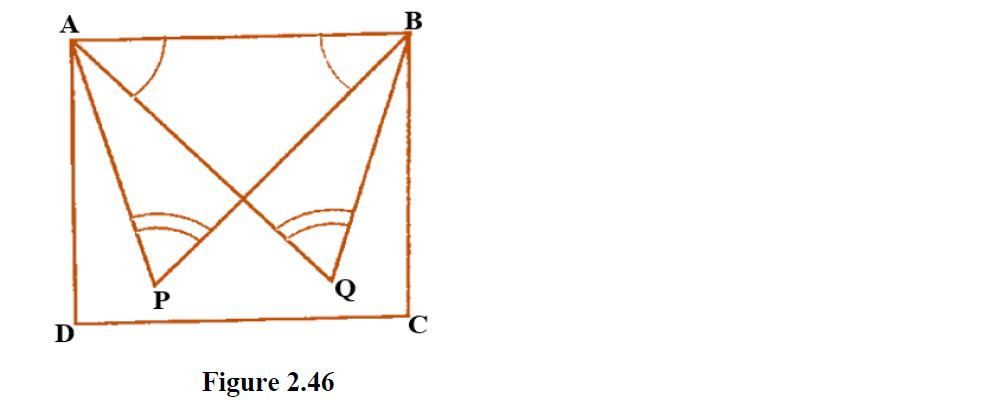
31. In figure 2.46, ABCD is a square, prove that ΔABP ≅ ΔBAQ.
32. If ΔPQR is an equilateral triangle such that PQ is extended to S so that QS ≅ QR, calculate the measure of ∠QRS.
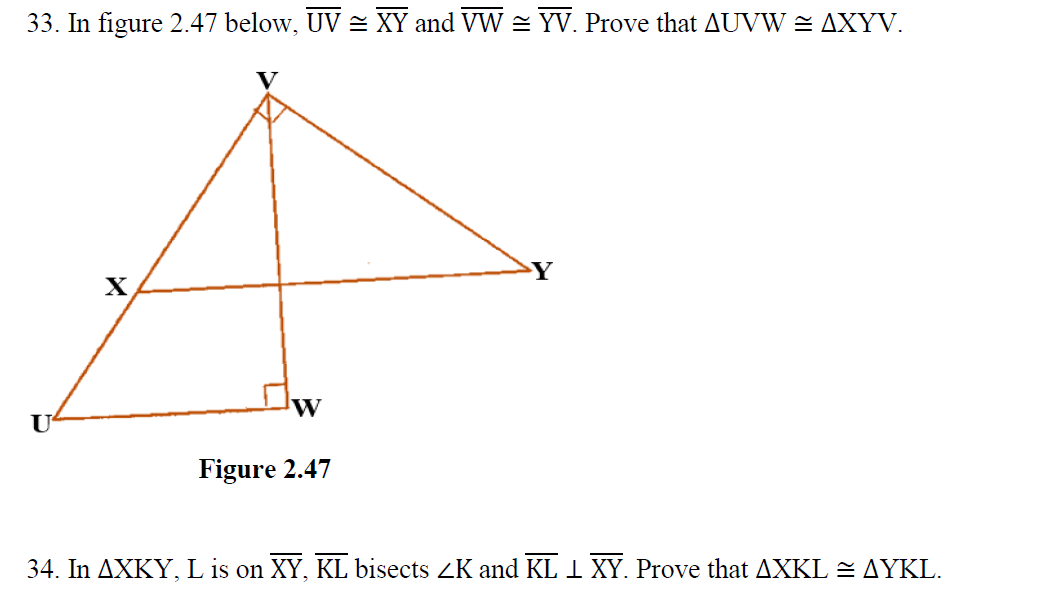
35. Prove that the sum of interior angles of any quadrilateral is equal to four right angles.
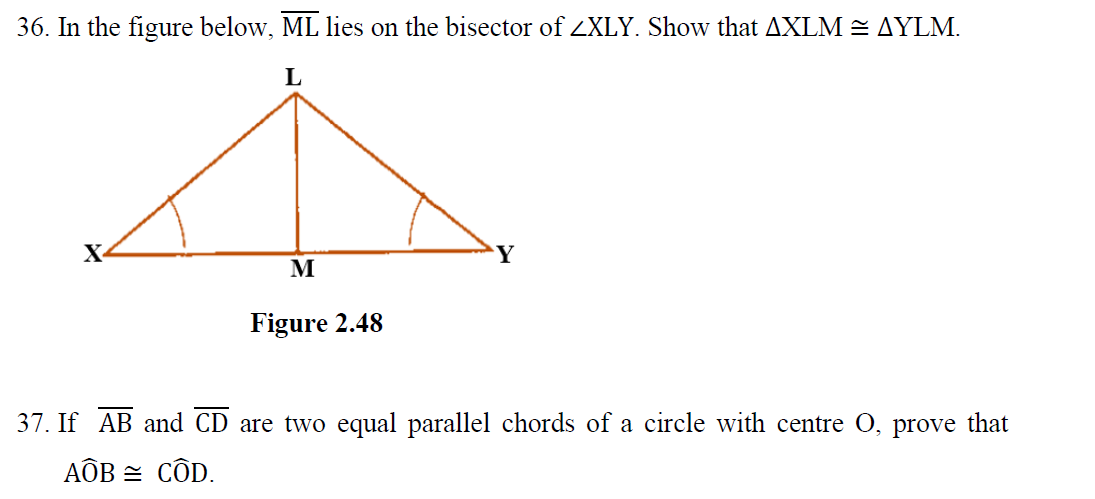
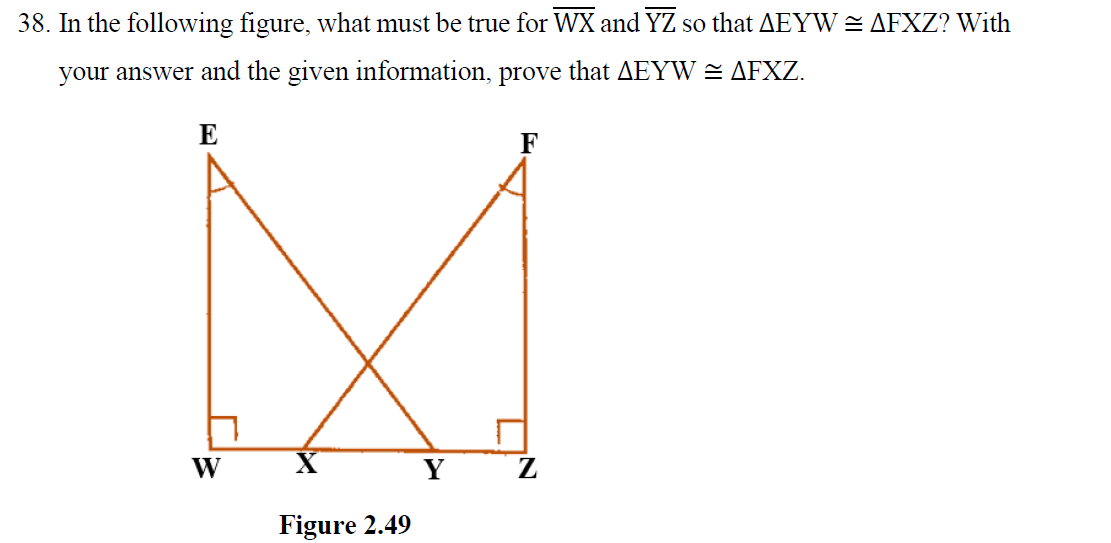
Use the appropriate congruence postulates to attempt the following question:

RIGHT-ANGLED TRIANGLE CONGRUENCE POSTULATES
Definition: A right-angled triangle is a triangle that contains one right angle.
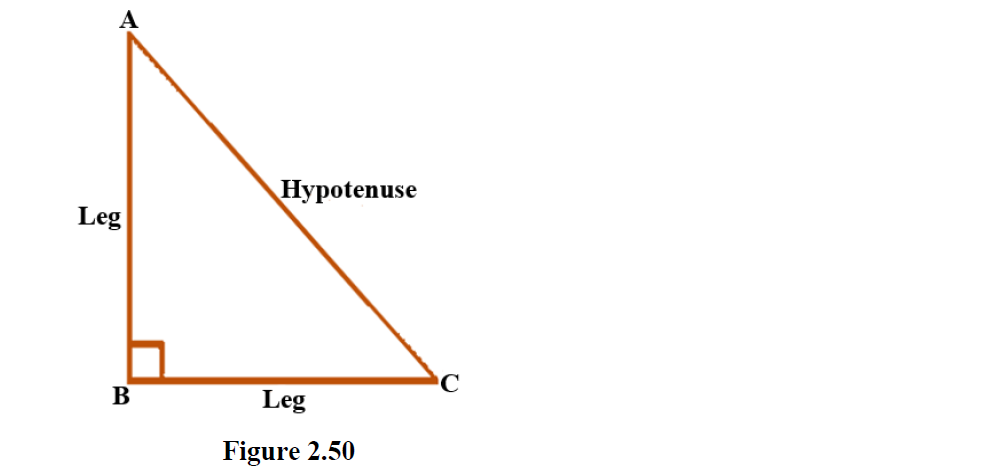
The longest side of any right-angled triangle is called Hypotenuse and the remaining sides which meet to make a right angle (90°) are called Legs.
There are four postulates that can be used to prove the congruence of two right angled triangles as follows:
(1) Leg-Leg (LL) Postulate
The LL postulate states that “If the legs of one right triangle are congruent to the legs of another right triangle, then the two right triangles are congruent”. The following figure (figure 2.51) illustrates the postulate.
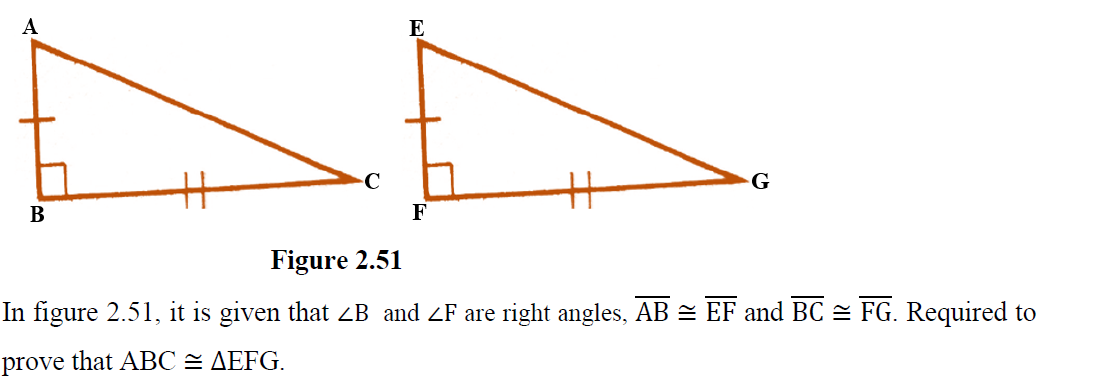
Proof:

(2) Leg-Acute Angle (LA) Postulate
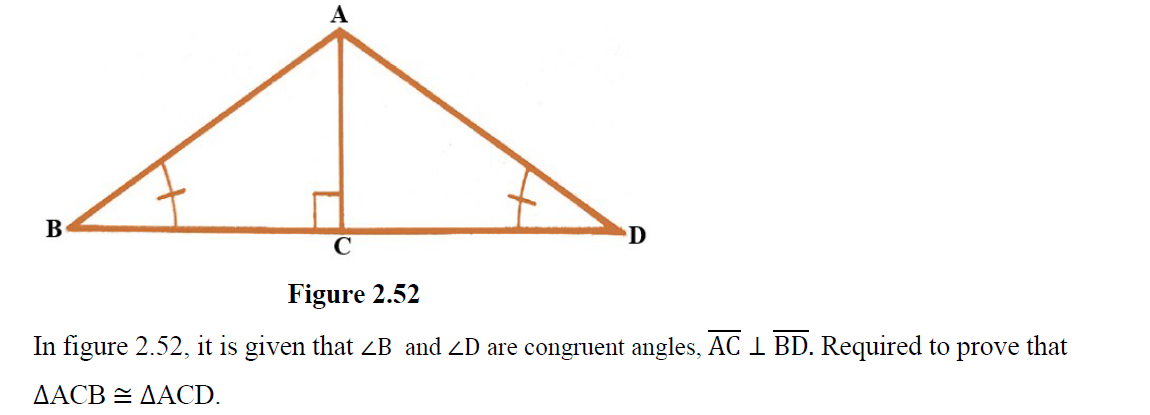
The LA postulate states that “If a leg and an acute angle of one right triangle are congruent to the corresponding parts of another right triangle, then the two right triangles are congruent”. The following figure (figure 2.52) illustrates the postulate.
(3) Hypotenuse-Acute Angle (HA) Postulate
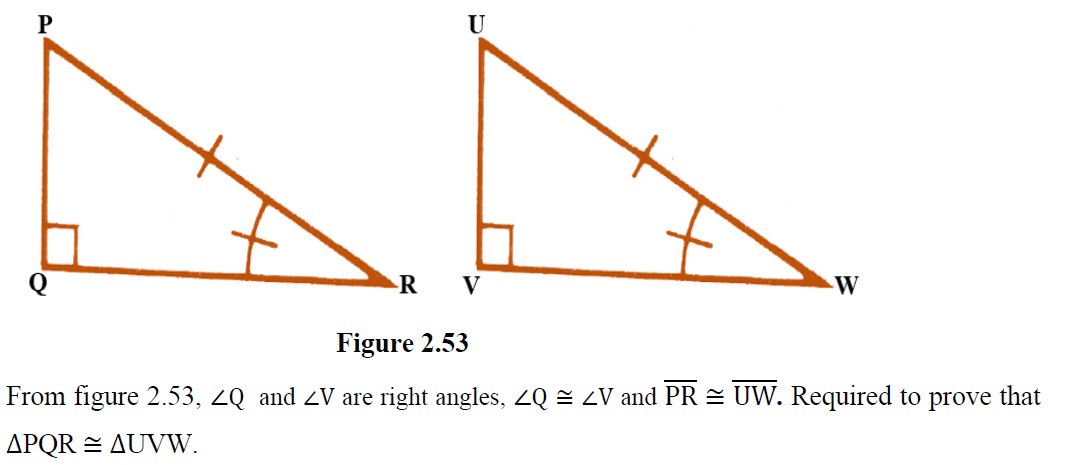
The HA postulate states that “If the hypotenuse and an acute angle of one right triangle are congruent to the hypotenuse and an acute angle of another right triangle, then the two right triangles are congruent”. The following figure (figure 2.53) illustrates the postulate.
(4) Hypotenuse-Leg (HL) Postulate
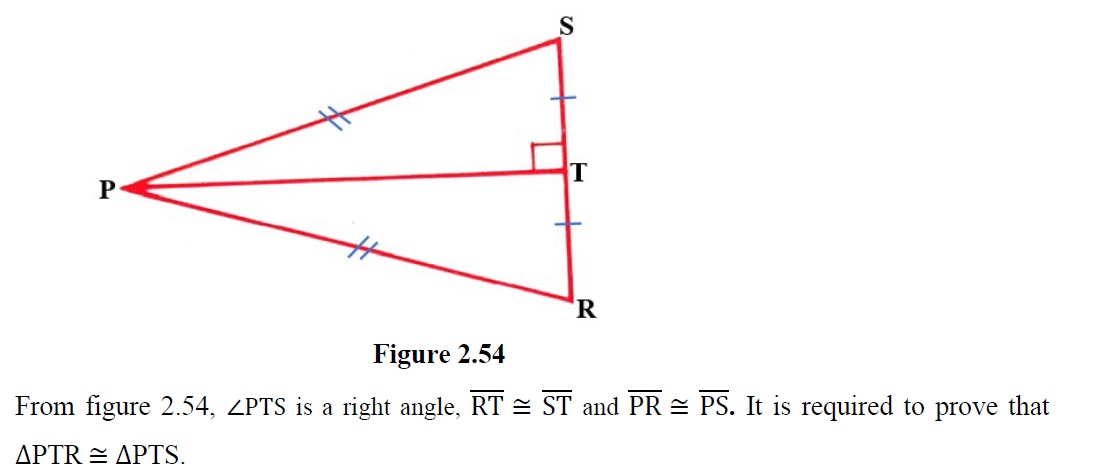
The HL postulate states that “If the hypotenuse and a leg of one right triangle are congruent to the hypotenuse and a leg of another right triangle, then the two right triangles are congruent”. See the following figure (figure 2.54) for illustration.
Example 17
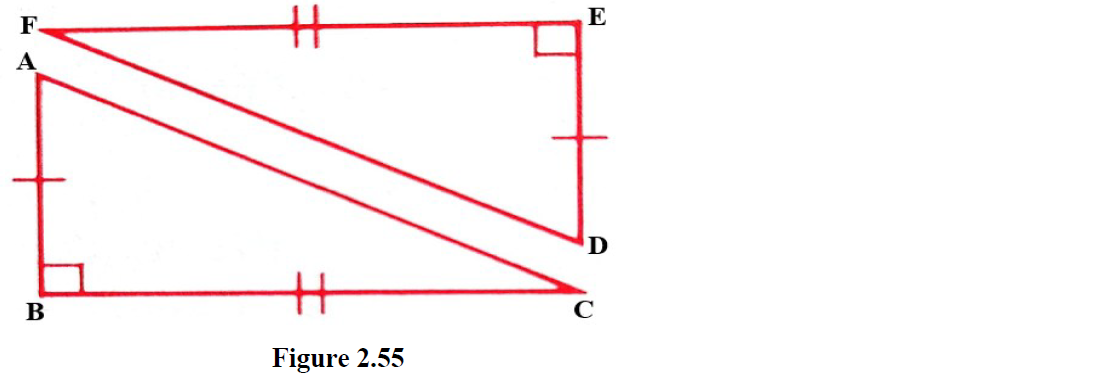
In figure 2.55, prove that ΔABC ≅ ΔDEF.
Solution:
Proof: Considering triangles ABC and DEF,

Example 18
Use the following figure to prove that ΔADB ≅ ΔADC and DB = DC.
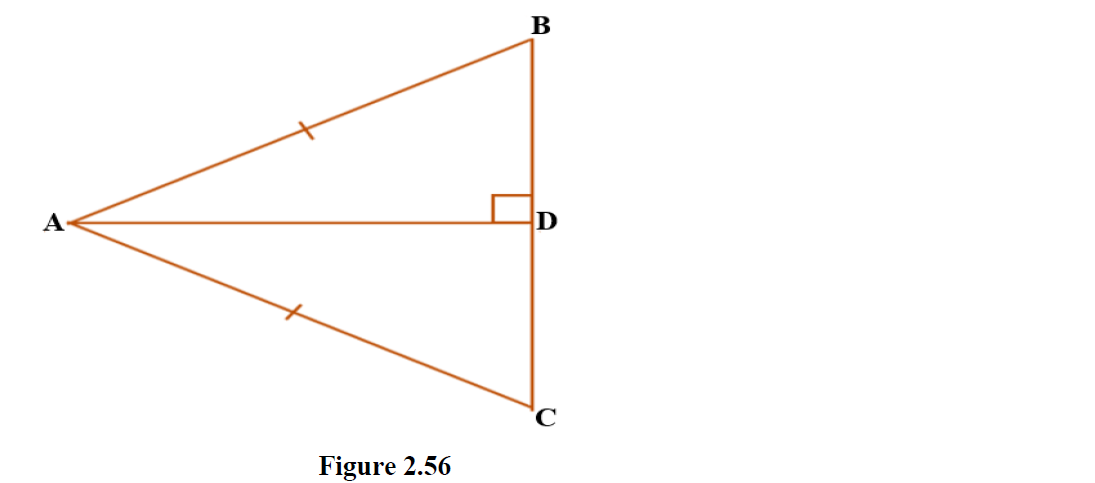
Solution:
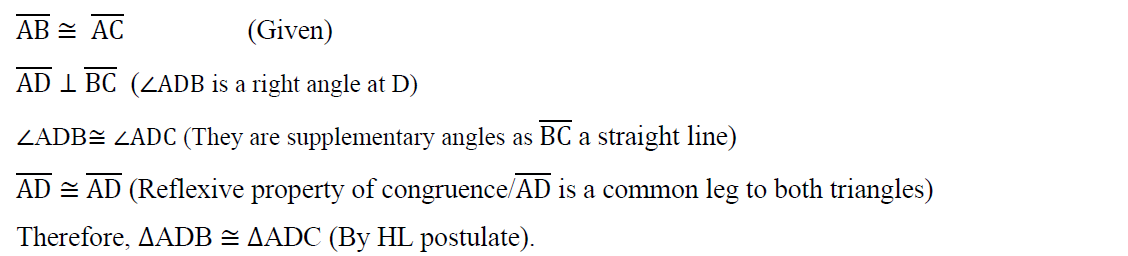
Proof: From ΔADB and ΔADC;
Example 19
In the following figure, point R is equidistant from two lines 𝐿1 and 𝐿2, which intersect at T.
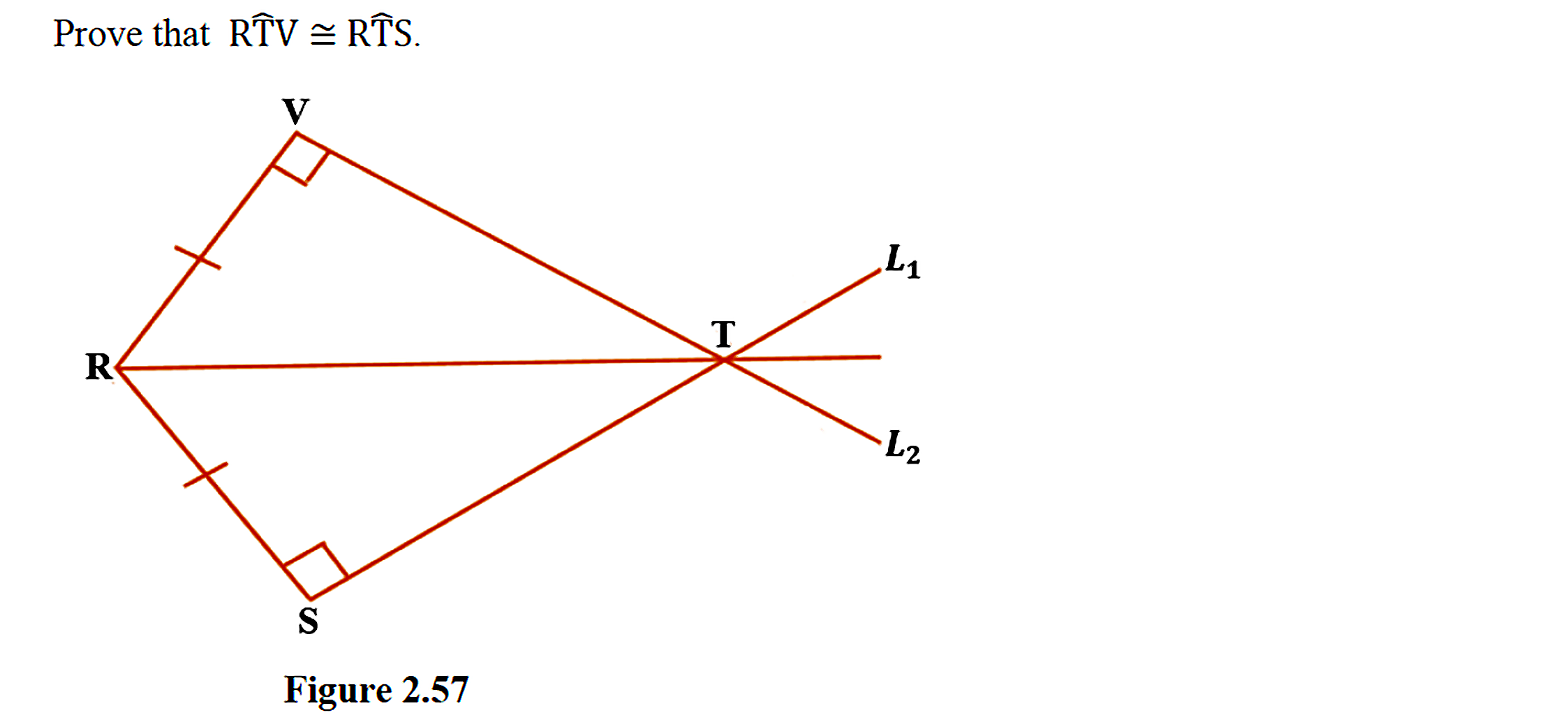
Solution:
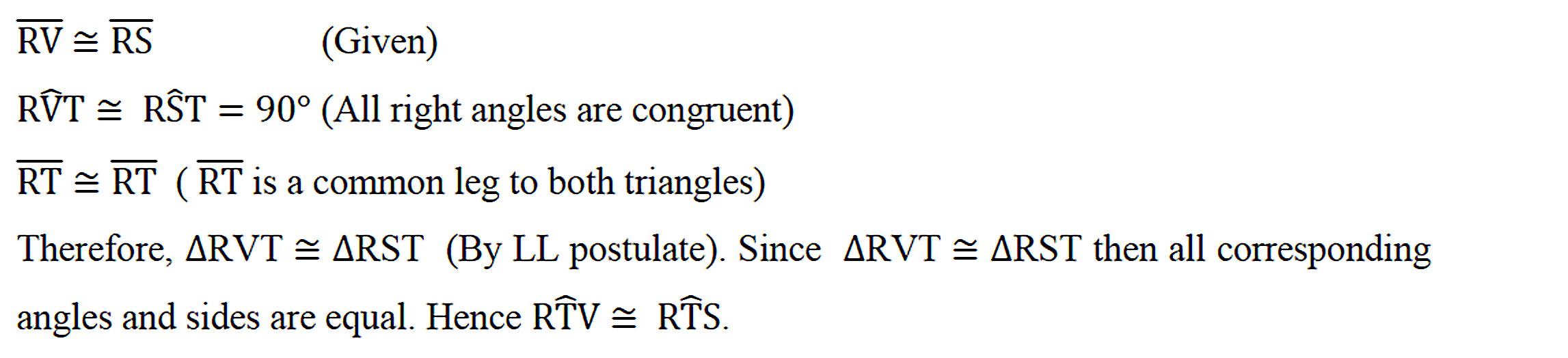
Proof: From ΔRVT and ΔSRT;
Example 20
In the following figure, prove that RQ≅YZ.
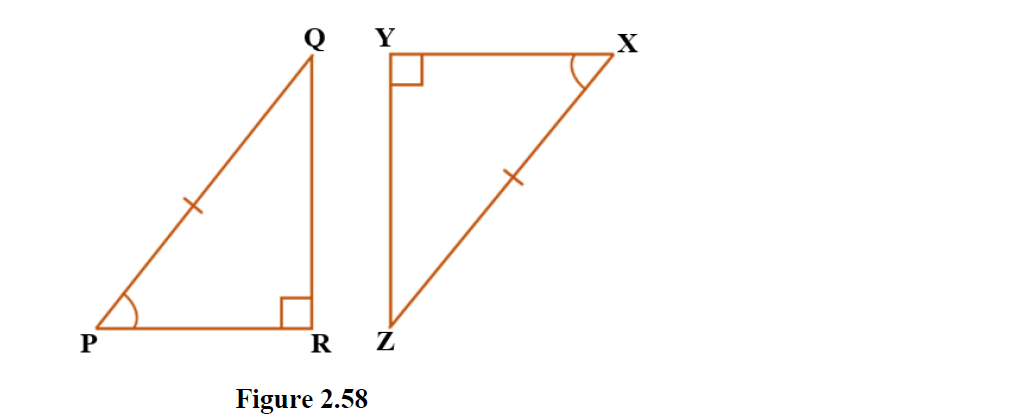
Solution:
Proof: Considering ΔPRQ and ΔXYZ, the proof is as follows:
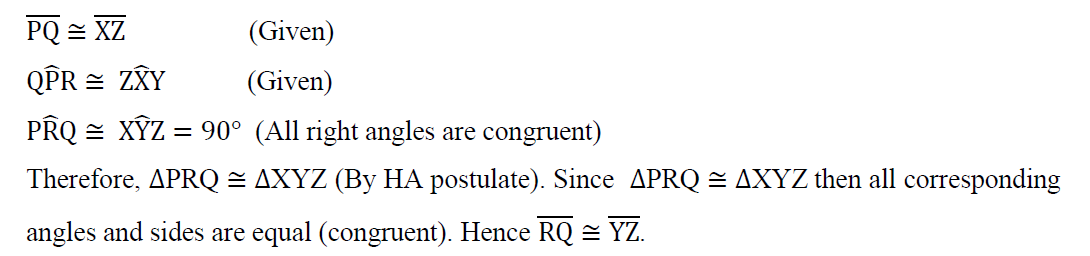
Example 21
Use the appropriate congruence postulates to attempt the following question:
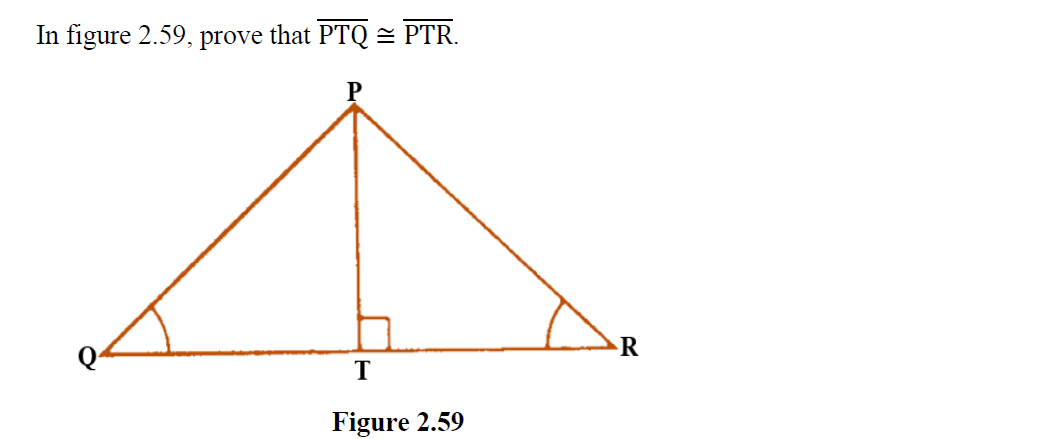
Solution:
Proof: Considering ΔPTQ and ΔPTR, the proof is as follows:
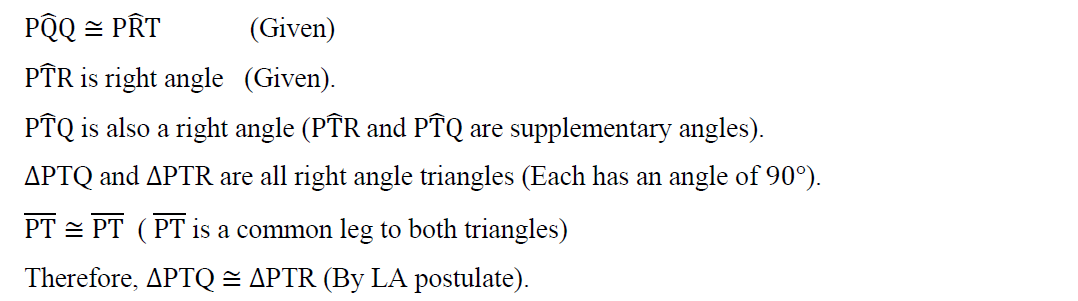
Exercise 3
1. State the four postulates for two right-angled triangles to be congruent.
2. Two right triangles are congruent. You know the measures of the legs and one acute angle of the first triangle. Do you also know the measures of all the sides and angles of the other triangle? Explain your answer.
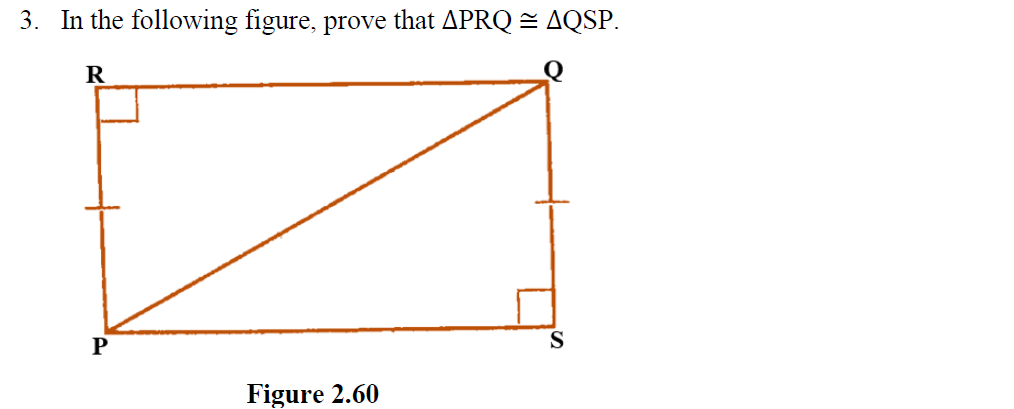
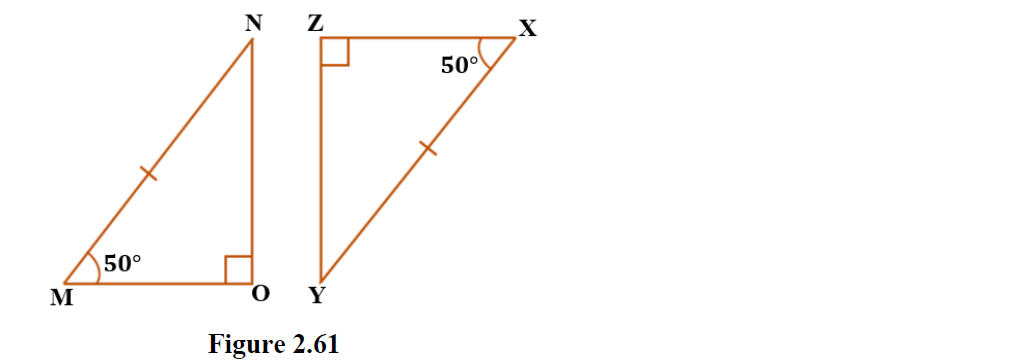
4. In the following figure, prove that ΔMON ≅ ΔXZY.
5. In triangles △ABC and △DEF, ∠B=∠E=90∘, AC=DF=10 cm(hypotenuse), and AB=DE=6 cm. Prove that △ABC≅△DEF.
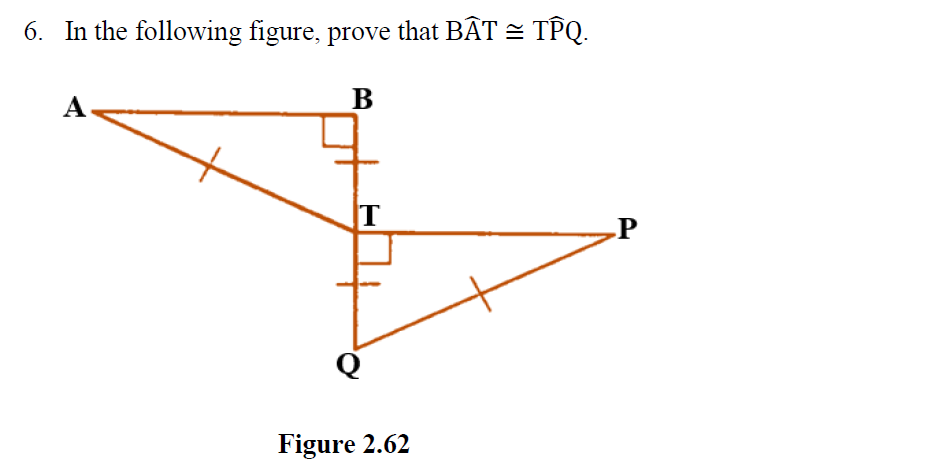
7. From a point 𝑃, perpendiculars 𝑃𝐴 and 𝑃𝐵 are drawn to a line 𝑙. If PA≅PB, prove that △PAX≅△PBX(where 𝑋 is the foot on line 𝑙).
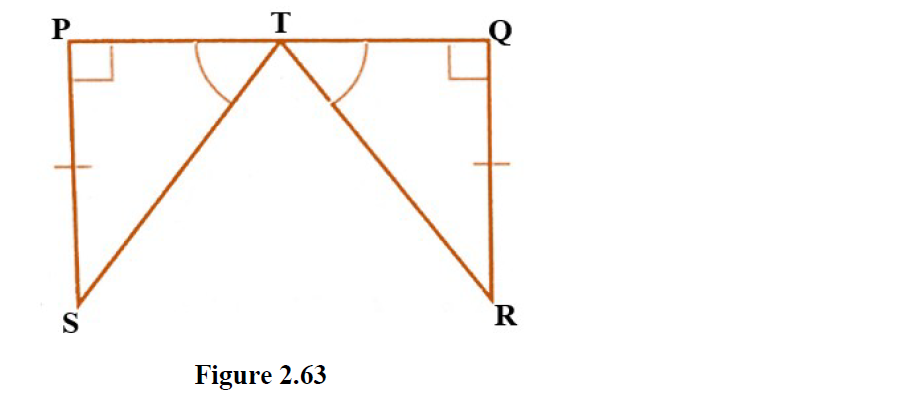
8. In figure 2.63 below, is △PST≅△TQR? Give reasons for your answer.
9. In a rectangle 𝐴𝐵𝐶𝐷, diagonals 𝐴𝐶 and 𝐵𝐷 intersect. Consider triangles formed by diagonals and sides. Prove that a pair of right triangles formed are congruent.
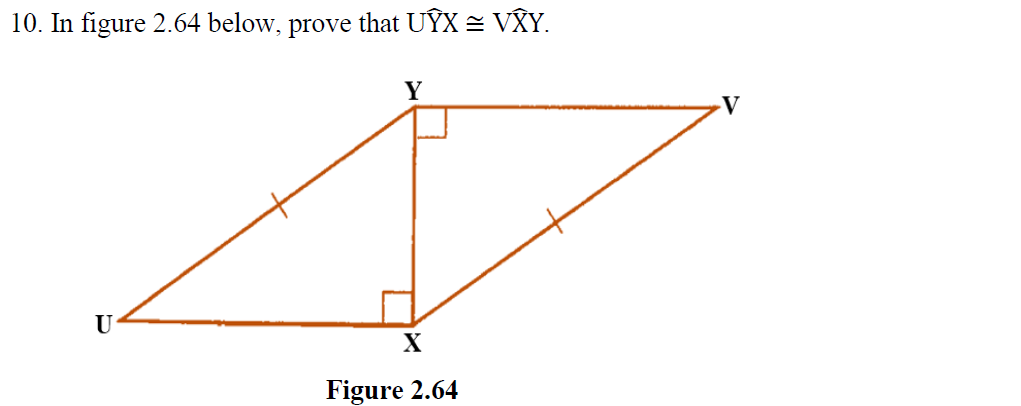
11. In a circle, two radii 𝑂𝐴 and 𝑂𝐵 are drawn perpendicular to tangents at 𝐴 and 𝐵. Show the resulting right triangles are congruent.
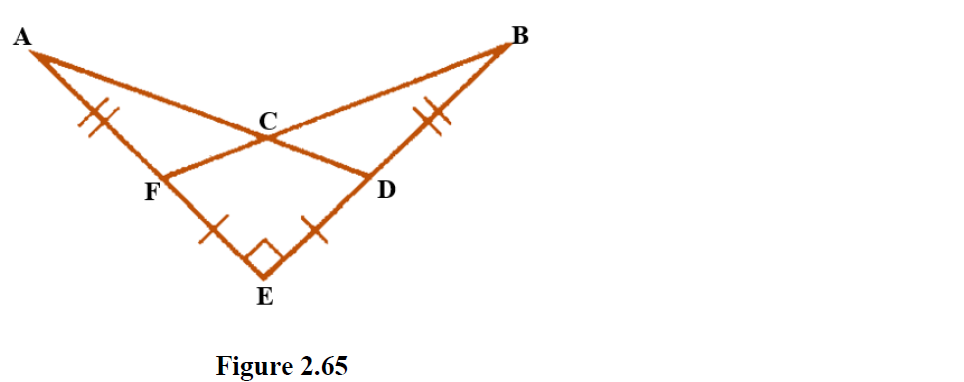
12. In figure 2.65, prove that △AED≅△BEF.
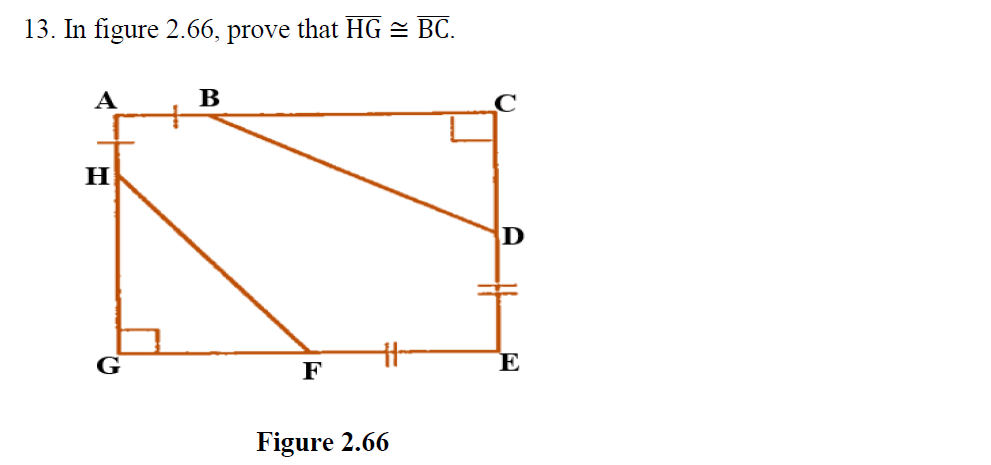
Use the appropriate congruence postulates to attempt the following question:
14. In right triangles, if the hypotenuse and one leg are equal, prove the triangles must be congruent (state theorem and justify).
15. Given two right triangles with equal hypotenuse and equal area, can they be congruent? Justify your answer.
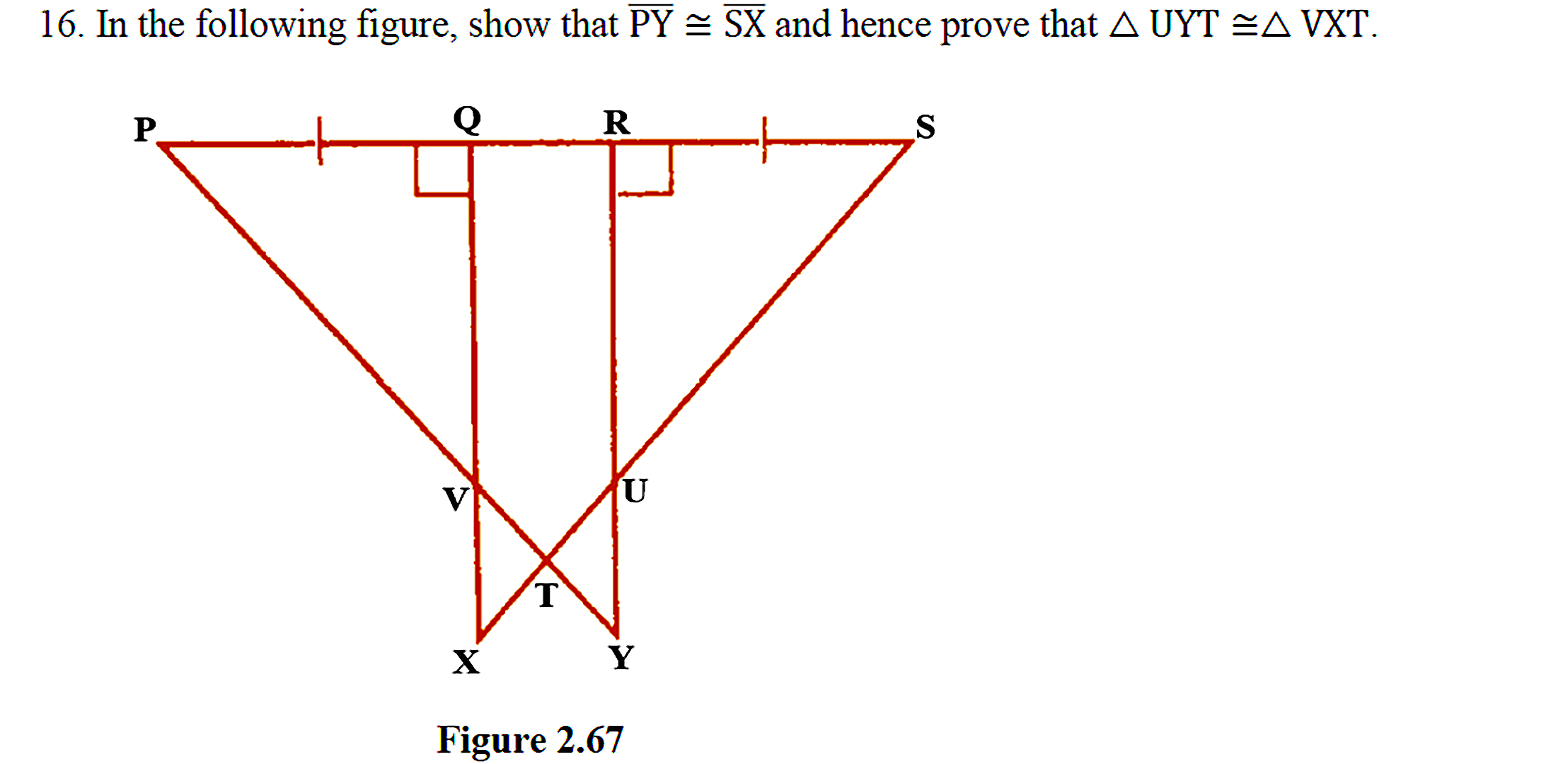
17. Two right-angled triangular plots have Hypotenuse = 25 m, one side =7 m. Show that the plots are identical.
18.Two poles cast shadows forming right triangles. Each pole is 12 m tall and its shadow is 16 m long. Prove that the triangles formed are congruent.
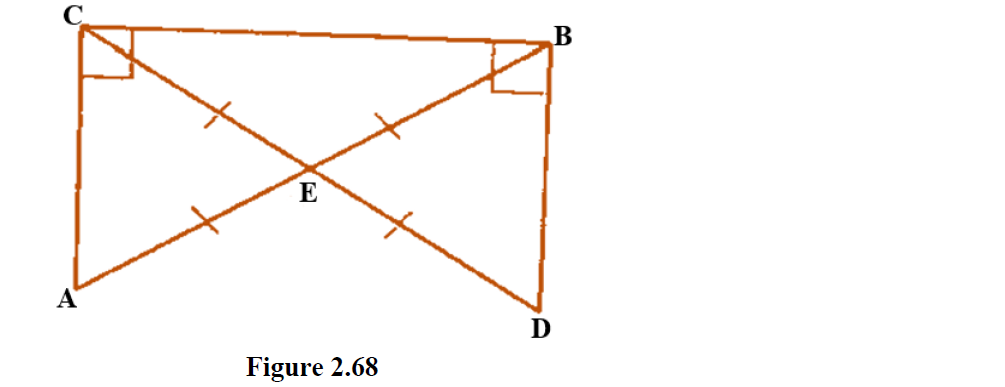
19. In figure 2.68 below, prove that angles CAE and BDE are congruent.
20. Two ladders lean against a wall forming right triangles. Each ladder is 10 m long and placed 6 m from the wall. Show that the triangles formed are congruent.
Listening to this topic