Mathematics (New)
TRIGONOMETRY
Reading settings
Text size
Line spacing
Colours
TRIGONOMETRY
Trigonometry is a branch of Mathematics that studies the relationships between the angles and sides of triangles, especially right-angled triangles. It helps in understanding how the angles and sides of a triangle are connected using special ratios.
Trigonometry connects angles and lengths, using ratios like sine, cosine, and tangent. It extends from simple triangles to complex figures, making it essential in both mathematics and real-world applications.
For example, the concepts like angles of elevation and depression are used to calculate heights and distances in practical situations, demonstrating how trigonometry connects abstract mathematical theory with real-world problems solving.
CONTENTS:
Under this topic you will cover six broad concepts about trigonometry as follows:
(i) Trigonometric Ratios (ii) Trigonometric Ratios of Special Angles (iii) Relationship Between Trigonometric Ratios (iv) Finding Trigonometric Ratios Using a Calculator (v) Inverse of Trigonometric Ratios (vi) The Angle of Elevation and Depression.
COMPETENCIES:
Upon completion of this chapter, you should develop several important competencies, including:
(1) Defining and finding basic trigonometric ratios (sine, Cosine and Tangent) of a given angle correctly.
(2) Identifying the special angles and working with their trigonometric ratios correctly.
(3) Establishing different trigonometric identities and using them correctly in solving the related problems.
(4) Using a Calculator in finding trigonometric ratios of different angles.
(5) Using a Calculator correctly in finding the Angles whose trigonometric ratios are given or known.
(6) Defining the angles of Elevation and Depression and use the idea behind it in solving different real-world problems correctly.
These competencies will enable you to solve various real-world problems such as those related to building constructions, designing, navigation, and many other applications.
Trigonometric Ratios
As explained in the topic overview, Trigonometry is a branch of Mathematics that studies the relationships between the angles and sides of triangles, especially right-angled triangles.
It begins with basic ratios (Sine, Cosine and Tangent), respectively abbreviated as Sin, Cos and Tan of a specified angle within a right angled-triangle and extends to their reciprocals.
The concept of trigonometry and Trigonometric ratios.
Explore the concept of trigonometry and Trigonometric ratios.
Definitions:
Consider the Right Angled-Triangle ABC in figure 8.1 bellow:
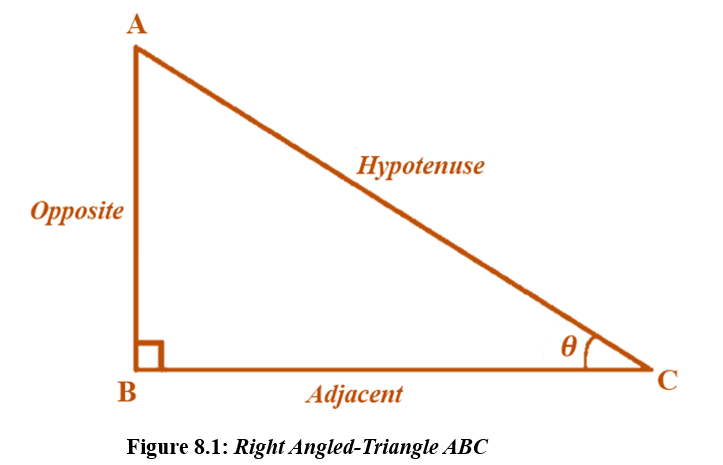

Therefore, we define the basic trigonometric ratios (Sine, Cosine and Tangent) in relation to this angle as follows:
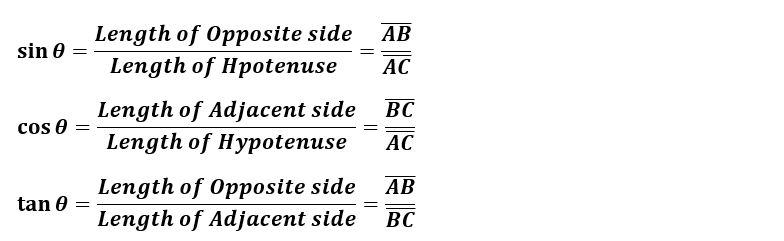
Note that the longest side of any right-angled Triangle is the Hypotenuse and it is always the opposite side to the right angle (90°).

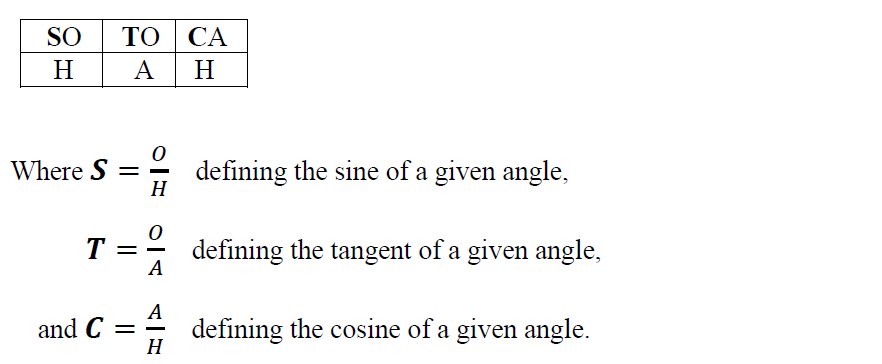
These definitions can easily be remembered by using the following mnemonic:
Example 1
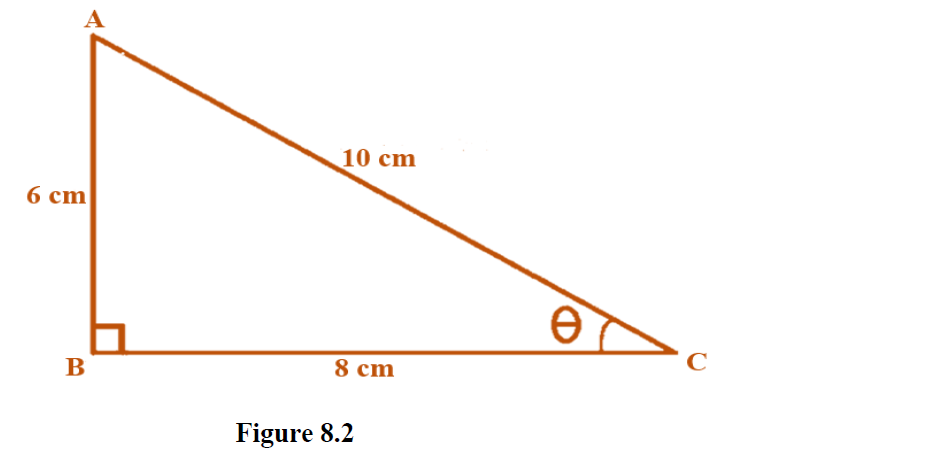
In a triangle ABC represented by figure 8.2 below, the length of side 𝐴B=6 𝑐𝑚 , 𝐵𝐶=8𝑐𝑚 and 𝐴𝐶=10𝑐𝑚. Find the value of sin𝜃, cos𝜃 and tan𝜃.
Solution:
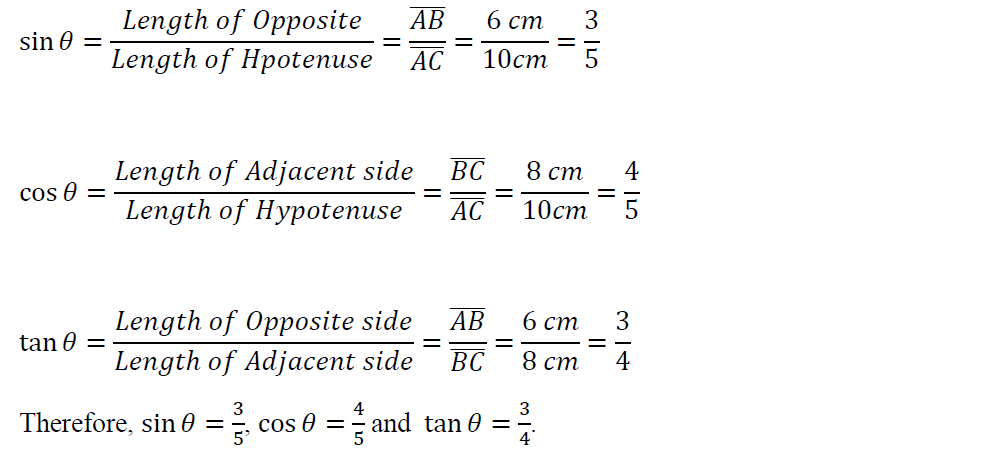
From the right-angled triangle ABC, the opposite side to angle 𝜃 is 6 cm long, the adjacent side is 8cm long and the Hypotenuse is 10cm long.
Now using the definition of trigonometric ratios we have learned, it follows that:
Example 2
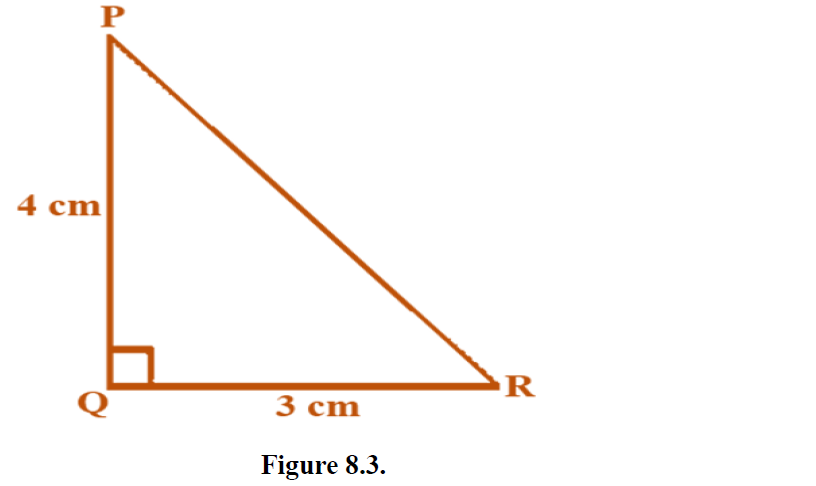
PQR is a right-angled triangle such that the length 𝑃𝑄= 4 𝑐𝑚 , 𝑄𝑅=3 𝑐𝑚 and ∠𝑄 is a right angle as shown in figure 8.3.

Solution:
(a) The length PR:
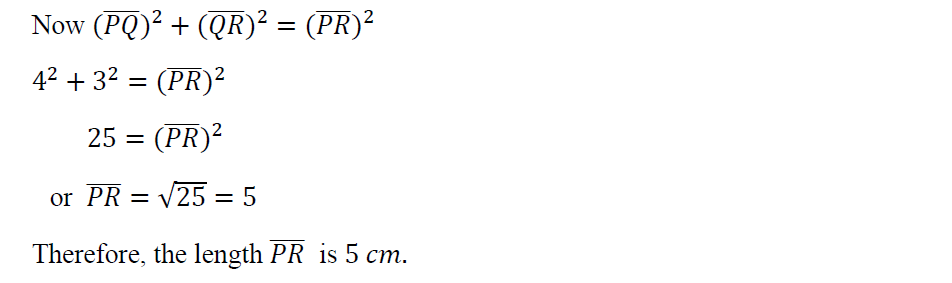
Since Δ𝑃𝑄𝑅 is a right-angled triangle, it obeys the Pythagoras theorem.
(b) The sine of ∠𝑃:

(c) The cosine of ∠𝑅:

(d) The tangent of ∠𝑅:

Example 3
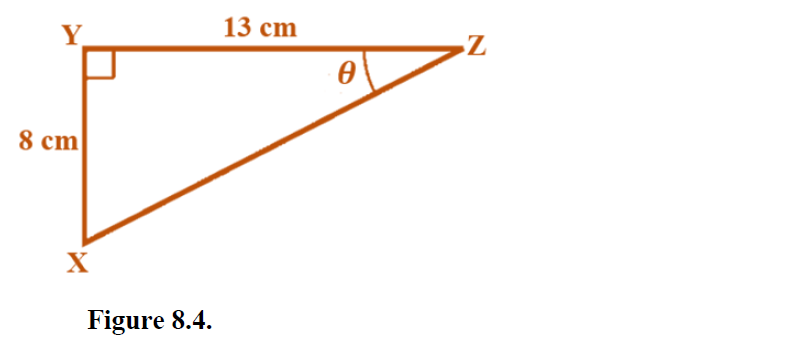
Find the value of sin𝜃, cos𝜃 and tan𝜃 from the following diagram.
Solution:
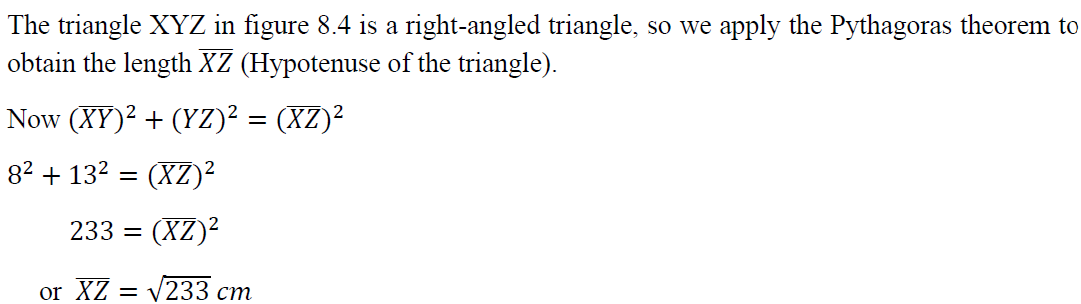
It follows that:
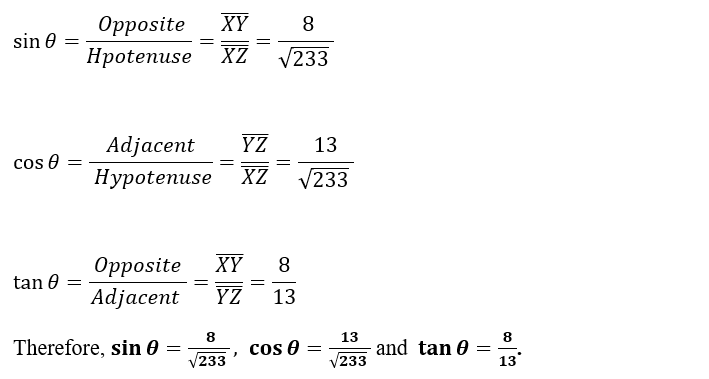
Example 4
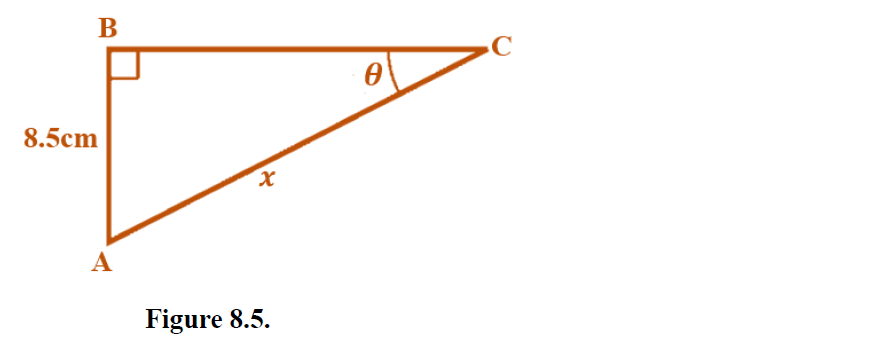
Find the value of 𝑥 in the triangle ABC shown in figure 8.5 bellow if sin𝜃=0.5.
Solution:
From the triangle ABC in figure 8.5, 8.5cm is the length of opposite side to the given angle (𝜃), and 𝑥 is the Hypotenuse of the triangle.
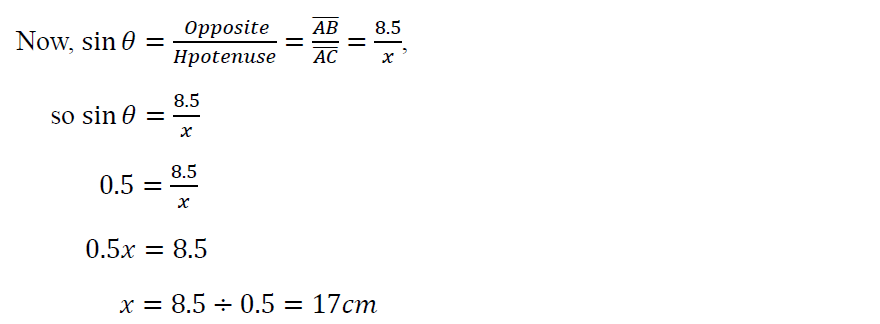
Therefore, the value of 𝑥 is 𝟏𝟕𝒄𝒎.
Example 5
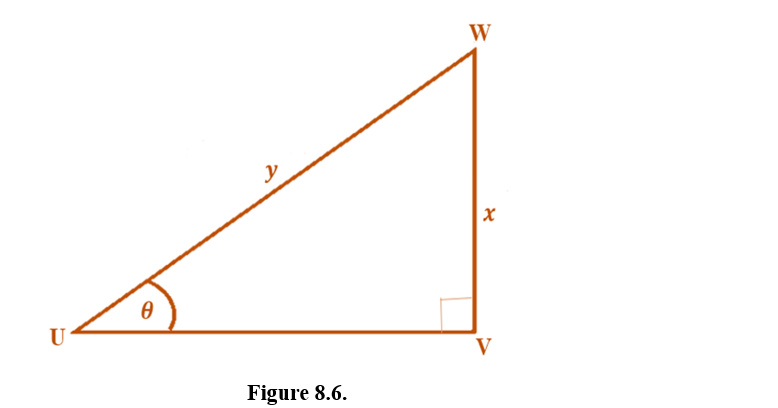
Study the ΔUVW represented by figure 8.6 and then write a simple equation connecting 𝜃, 𝑥 and 𝑦 (expressing 𝑥 in terms of 𝜃 and 𝑦).
Solution:
In a triangle UVW, 𝑥 is the opposite side to angle 𝜃 and 𝑦 is the hypotenuse of the triangle.

Multiplying by 𝑦 each side gives 𝑦sin𝜃=𝑥 or 𝑥=𝑦sin𝜃,
Therefore, the simple equation connecting 𝜃,𝑥 and 𝑦 is 𝒙=𝒚𝐬𝐢𝐧𝜽
Example 6
Given that sin θ = 3/5, find: (a) cos𝜃 (b) tan θ (assuming that θ is an acute angle).
Solution:
Let 𝜃 be one of the acute angles of a right-angled triangle ABC as shown in figure 8.8 below.
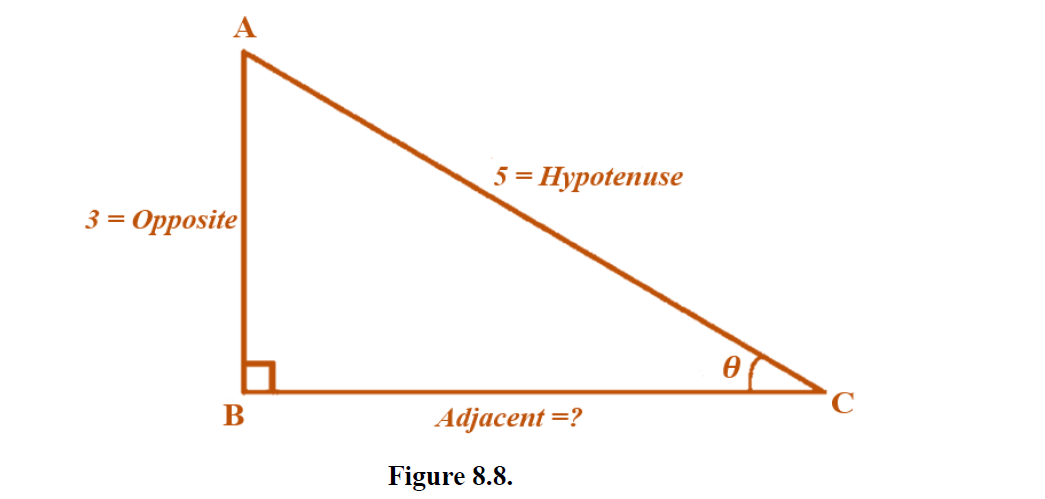
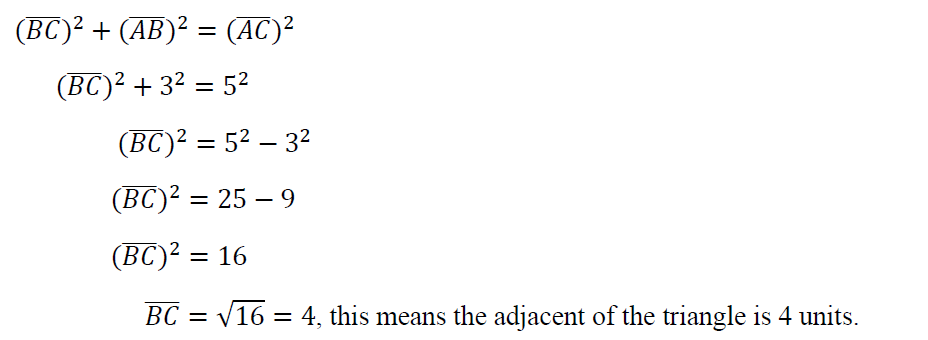
From figure 8.8, we use Pythagoras theorem to find the adjacent (the length 𝐵𝐶) as follows:
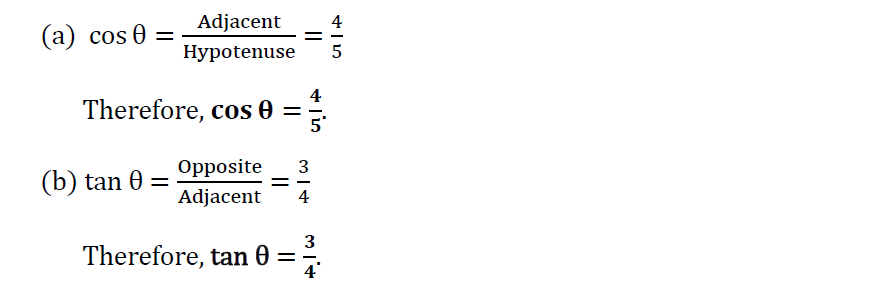
We can now find 𝐜𝐨𝐬𝜽 and tanθ as follows:
Exercise 1

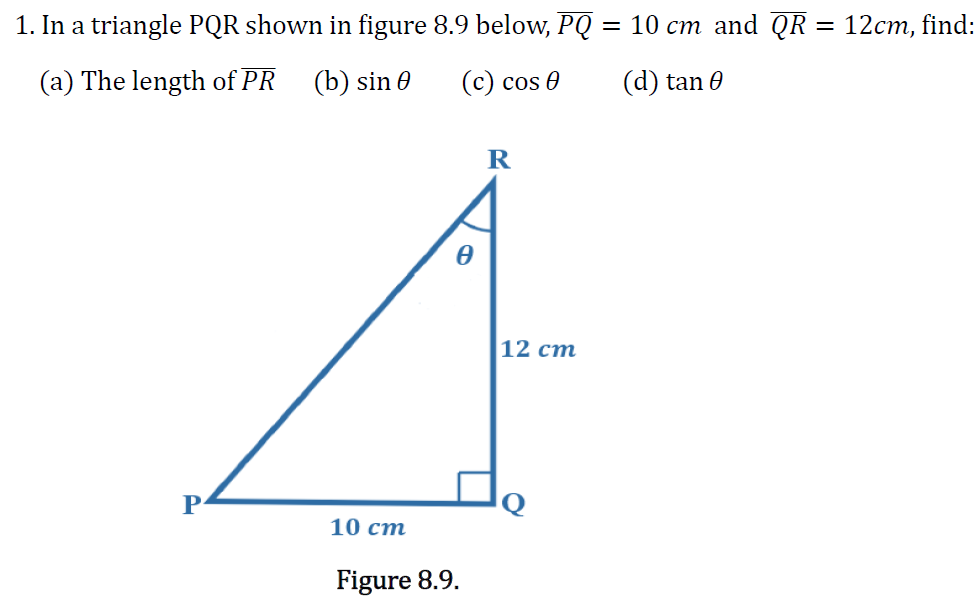
Solution:
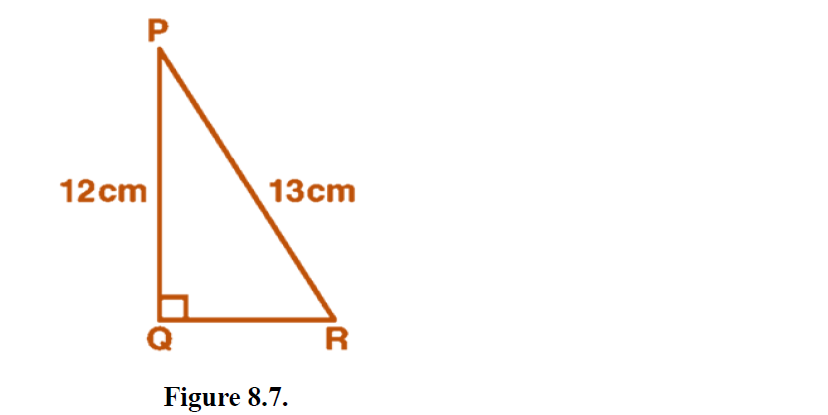
2. Given that sin30°=0.5, use the triangle shown in figure 8.10 below to find:
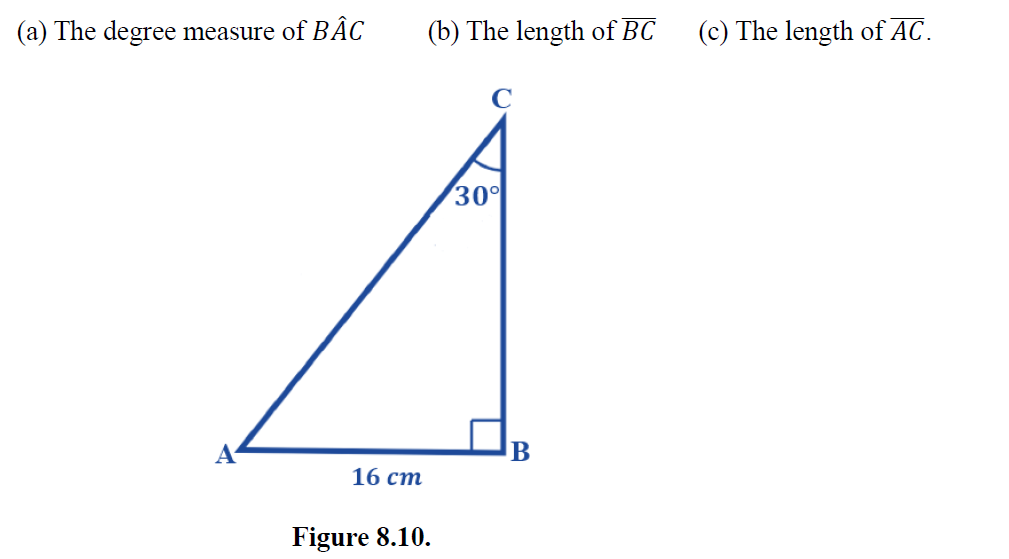
It follows that,
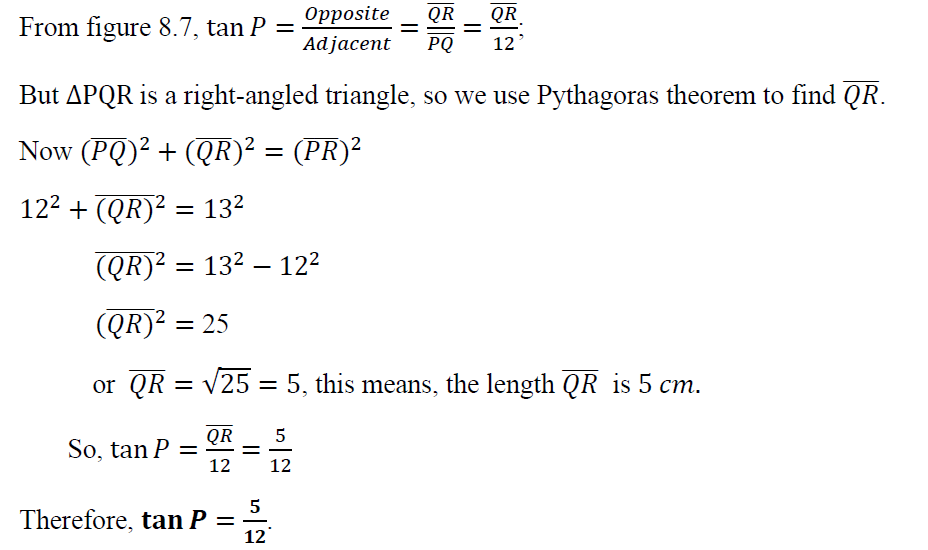
3. In a triangle XYZ, the length 𝑋𝑌=8 𝑚 and 𝑋𝑍=15 𝑚 and the angle at the vertex X=90°.

NB: In any right-angled triangle, one angle measures 90° (right angle) and the remaining two angles have degree measures less than 90° (acute angles).
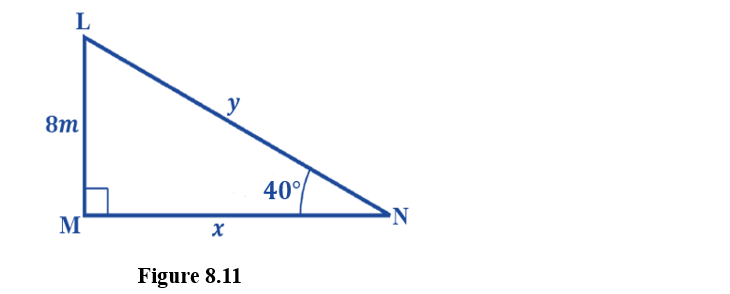
4. Find the values of 𝑥 and 𝑦 from the triangle LMN in figure 8.11 below, given that sin40°=1607/2500. Give your answer in two decimal places.
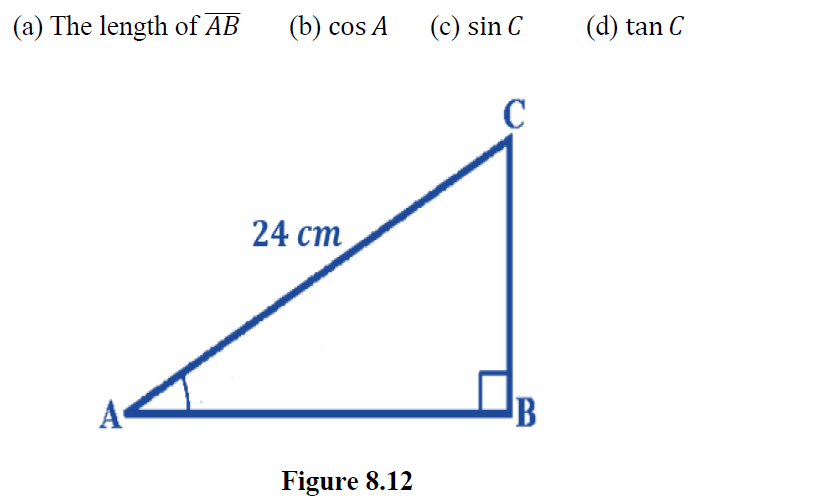
5. In the triangle ABC shown in figure 8.12 below, if sin𝐴=17/25, find:
6. Study the triangle RST shown in figure 8.13 below and then attempt the questions that follow.
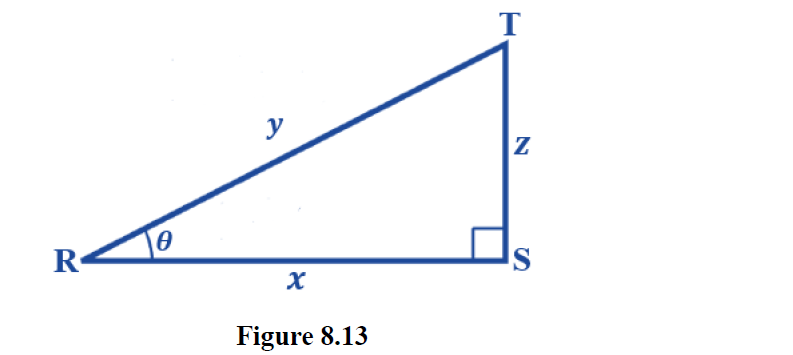
From in figure 8.13, find:
(a) A simple equation connecting 𝜃, 𝑥 and 𝑦.
(b) A simple equation connecting 𝜃, 𝑥 and 𝑍.
(c) A simple equation connecting 𝜃, 𝑦 and 𝑧.
(d) The equation connecting 𝑥, 𝑦 and 𝑧.
7. Given that sin𝜃=4/5, by assuming that 𝜃 is an acute angle, find the value of:
(a) cos𝜃
(b) tan𝜃
8. Given that sin𝜃=1/2, by assuming that 𝜃 is an acute angle, find the value of:
9. Given that 𝑐𝑜𝑠𝜃=1/2, by assuming that 𝜃 is an acute angle, find the value of:
(a)sin𝜃
10. Let 𝐴 be an acute angle such that tan𝐴=1, find the exact values of:
(a) sin𝐴
(b) cos𝐴
11. Study the figure below and then answer the questions that follow.
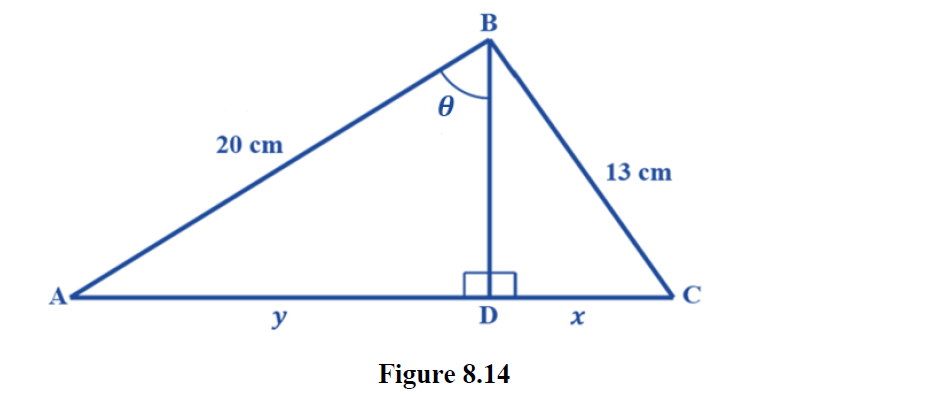
From figure 8.14 above, if cos𝜃=3/5, find the exact values of:

Trigonometric Ratios of Special angles
In trigonometry, special angles are specific angles whose trigonometric ratios such as sine, cosine, and tangent have exact values that can be expressed using simple fractions and square roots rather than approximations.
In this subtopic we discuss the values of trigonometric ratios of special angles which include 0°, 30°, 45°, 60°, and 90°.
The special angles and their corresponding trigonometric ratios.
Explore the special angles and their corresponding trigonometric ratios.
Trigonometric Ratios of 𝟑𝟎° and 𝟔𝟎°
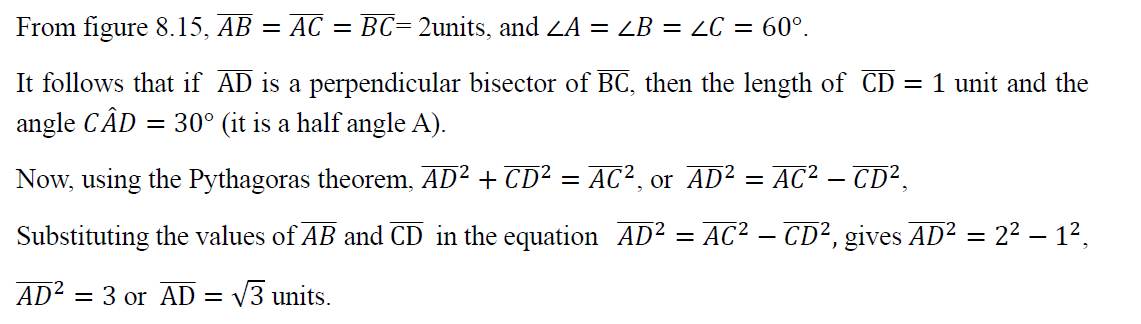
Consider the equilateral triangle ABC bisected by the line AD to form two right-angled triangles as shown in figure 8.15 below:
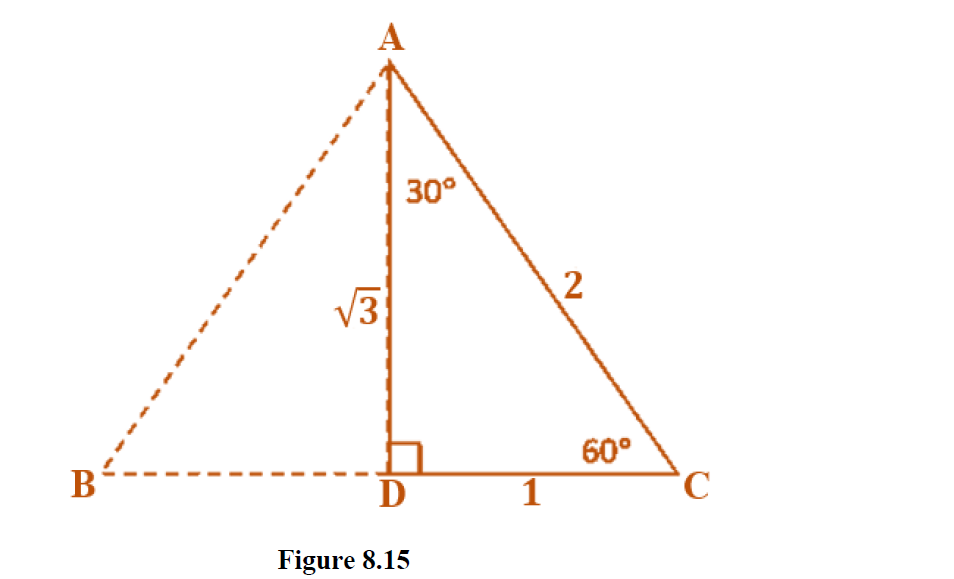
Observation:
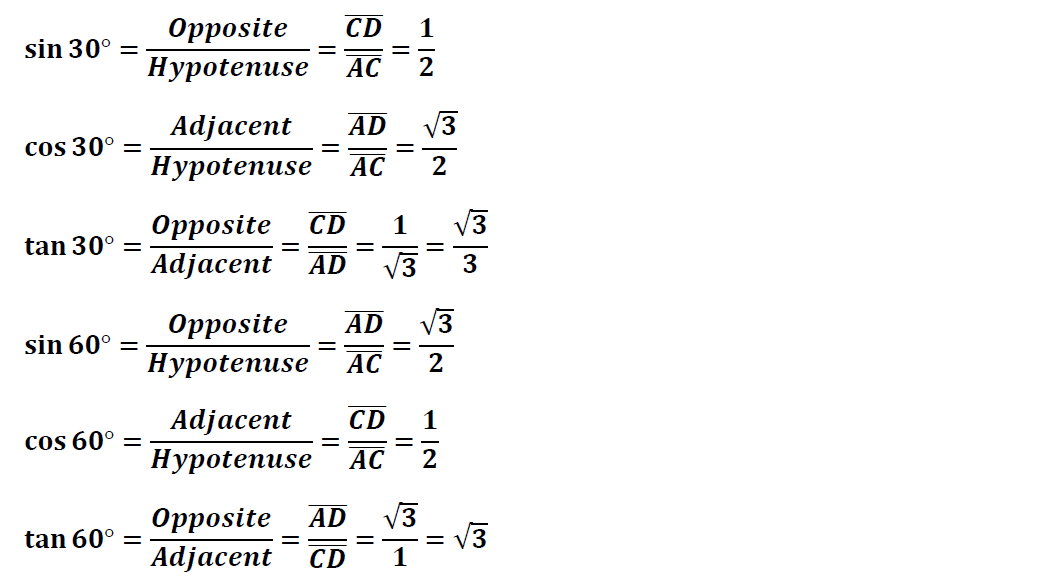
Thus, the following trigonometric ratios are obtained:
The Sine, Cosine and Tangent of 𝟒𝟓°
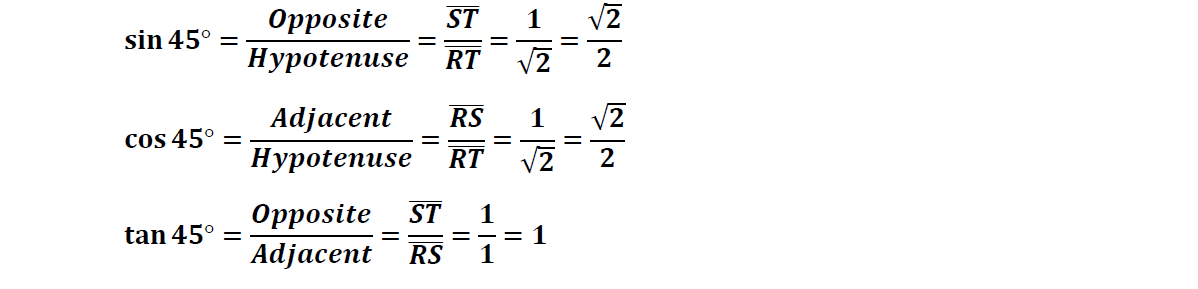
To obtain trigonometric ratios of 45°, consider the isosceles triangle RST as shown in figure 8.16 below:
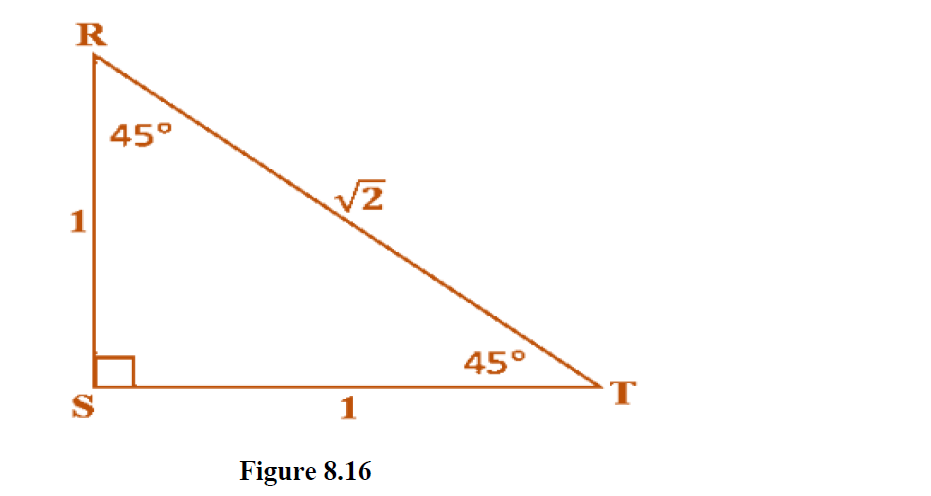
Observation

By using the definitions of trigonometric ratios, we obtain Sin45°, Cos45° and Tan45° as follows;
Trigonometric Ratios of 𝟎° and 𝟗𝟎°
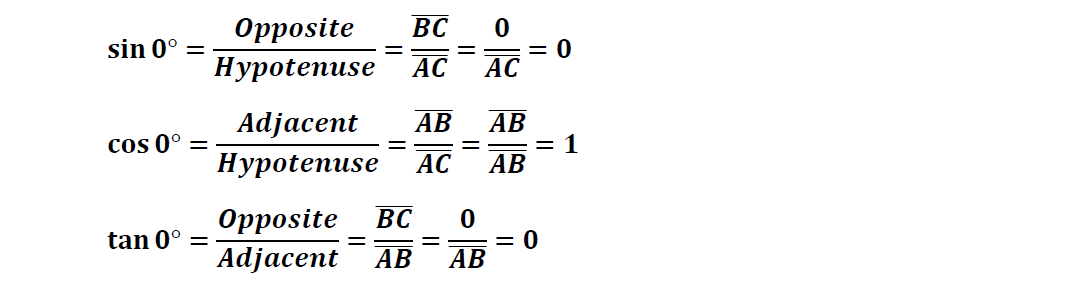
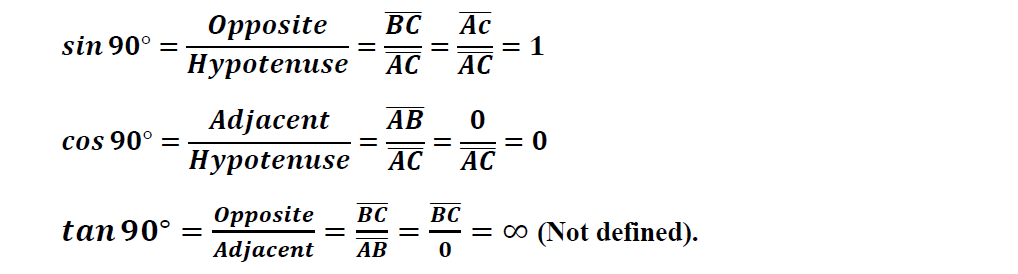
The trigonometric ratios of 0° and 90° can be derived by analyzing the limiting behavior of a right-angled triangle as one of its acute angles approaches zero or the right angle (90°).
Trigonometric Ratios of 𝟎°
Consider a right-angled triangle ABC such that ∠𝐵=90° and let ∠𝐴=𝜃 as shown in figure 8.17 below:
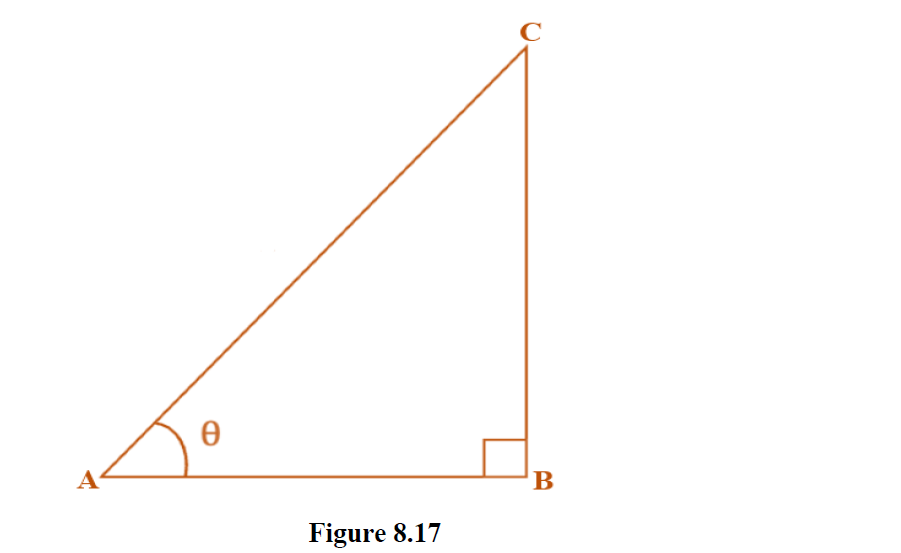
Therefore, by using the definitions of trigonometric ratios, it follows that:
Trigonometric Ratios of 𝟗𝟎°

From the definitions of trigonometric ratios, it follows that:
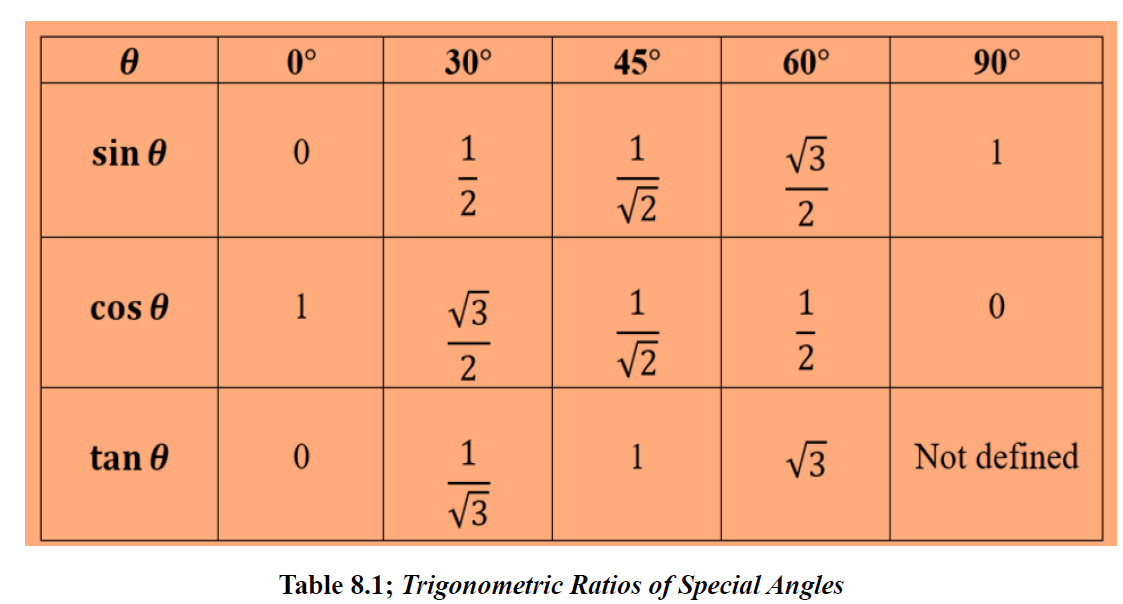
The following table summarizes the results of trigonometric ratios of all special angles (0°, 30°, 45°, 60°, and 90°).
Example 7
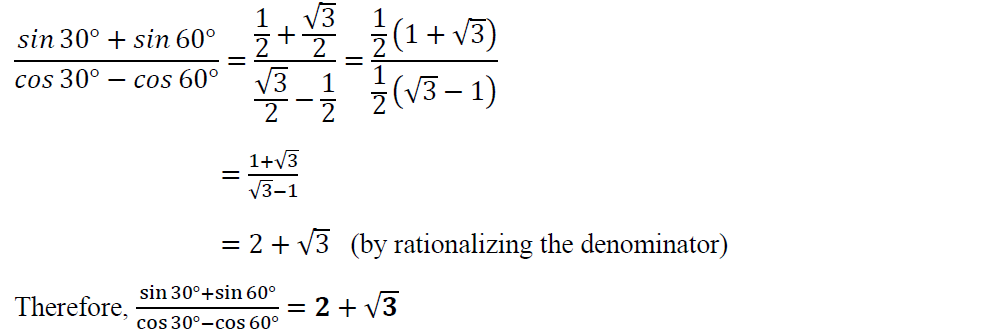
Without using any calculating device, find the value of 4cos60°+8sin30°−5tan45°.
Solution:

Example 8

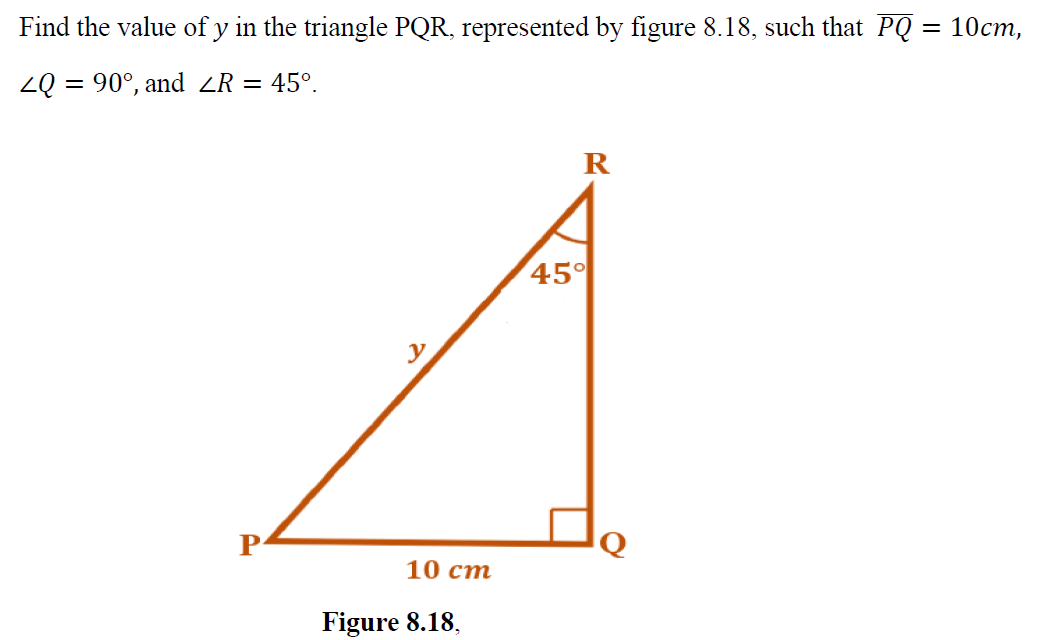
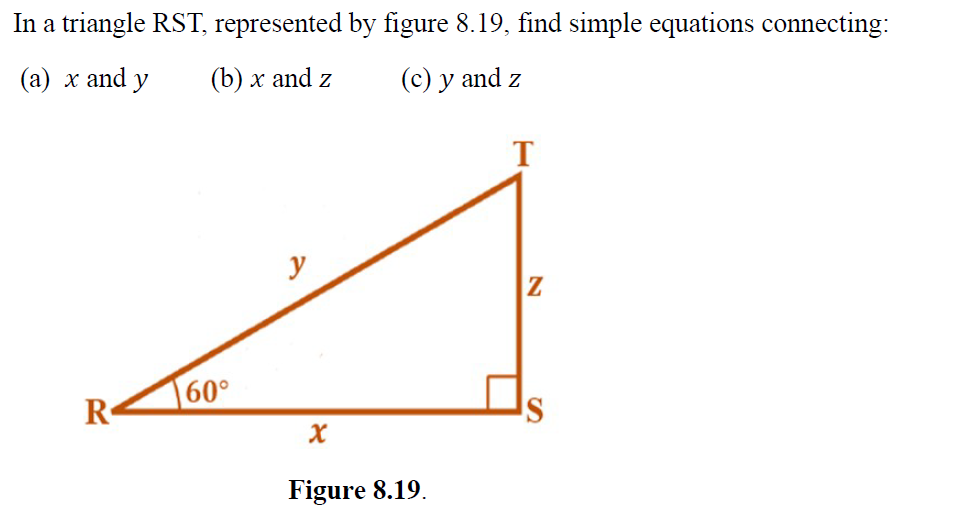
Solution:
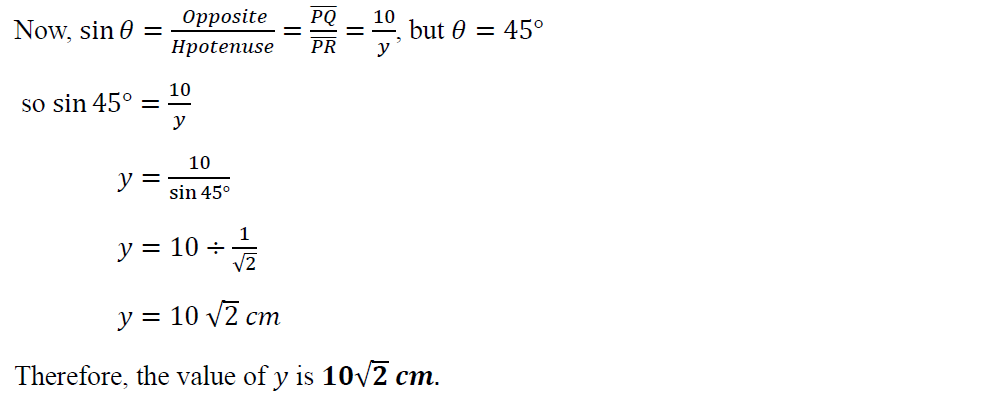
(a) Simple equation connecting 𝑥 and 𝑦:
From the triangle PQR in figure 8.18, 10 cm is the length of opposite side to the given angle (45°), and 𝑦 is the Hypotenuse of the triangle.
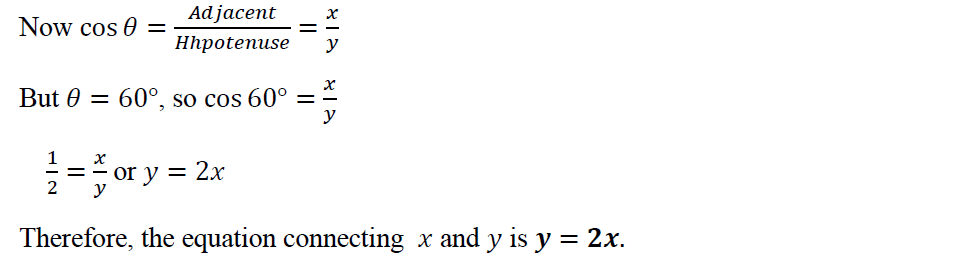
From the triangle RST, 𝑥 is the adjacent to the given angle (60°) and 𝑦 is the hypotenuse of the triangle.
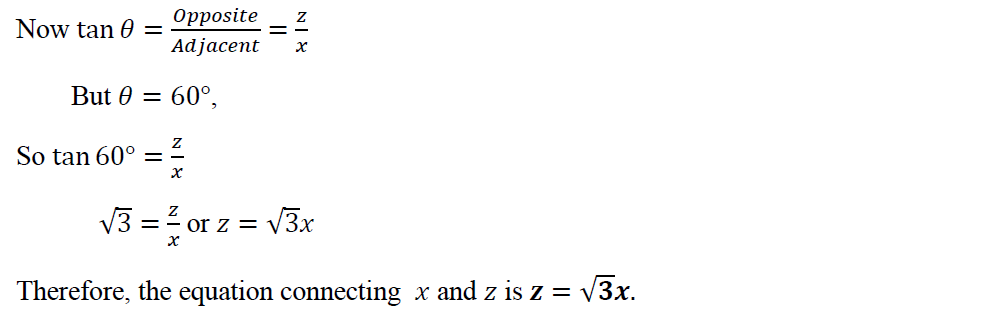
(b) The equation connecting 𝑥 and 𝑧:
From the triangle RST, 𝑥 is the adjacent to the given angle (60°) and 𝑧 is the opposite side of the given angle.
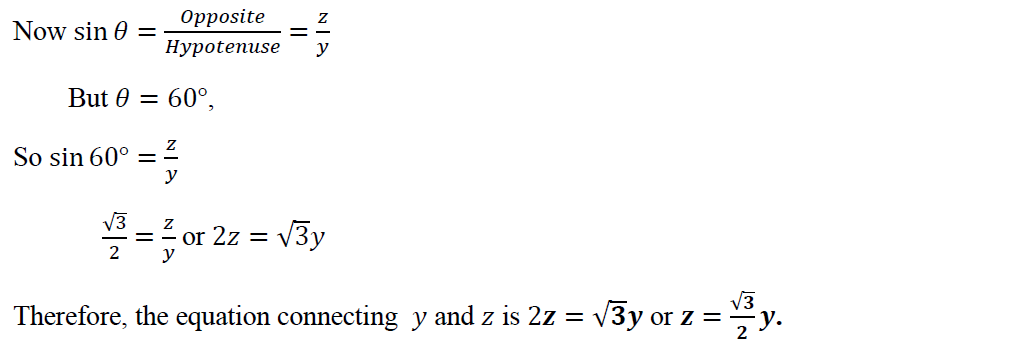
(c) The equation connecting 𝑦 and 𝑧:
Again, from the triangle RST, 𝑦 is the hypotenuse of the triangle while 𝑧 is the opposite side the given angle (60°).
Example 9
Find the dimensions of a rectangular garden PQRS shown in figure 8.20 below:
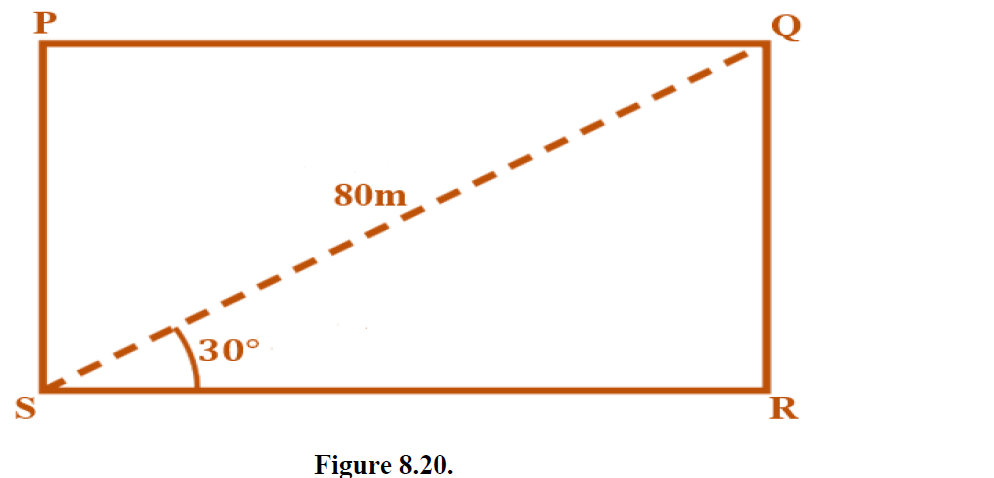
Solution:
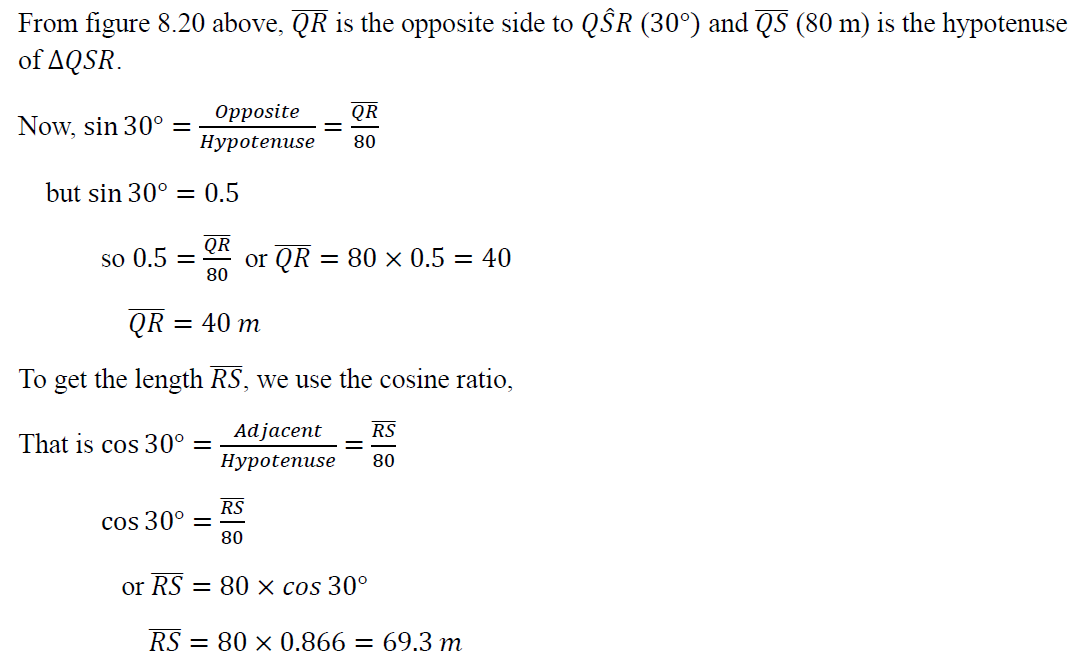
Therefore, the rectangular garden is 𝟔𝟗.𝟑 𝒎 long and 𝟒𝟎 𝒎 wide.
NB: After obtaining one side of the rectangular garden, you may use Pythagoras theorem to find the remaining side and you must end up with the same result.
Exercise 2
1. Find the exact value of each of the following expressions:

2. Simplify each of the following expressions:

In questions 3 and 4, prove the given identities:

5. If 2sin𝜃−1=0 and 𝜃 is an acute angle, find:

6. A ladder leans against a vertical wall and makes an angle of 60° with the wall. If the highest point of the ladder is 10m from the ground, what is the length of the ladder?
7. One end of a rope of length 24m is tied to the top of a flagpole and another end is fixed to a point on the ground. If the angle the rope makes with the flagpole is 60°, find:
(a) The height of the flagpole.
(b) The distance between the fixed point on the ground and the base of the flagpole.
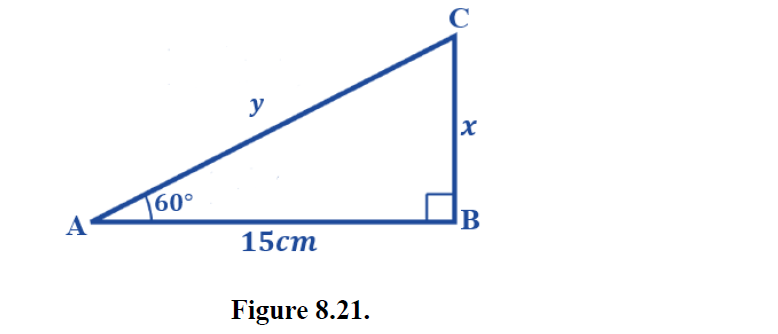
8. Find the value of 𝑥 and 𝑦 from the triangle ABC shown in figure 8.21 below:
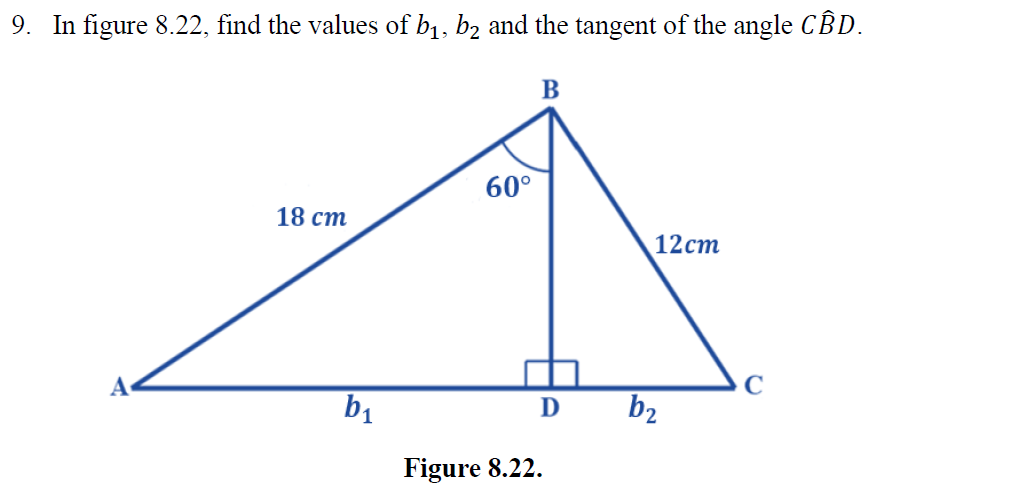
10. A ladder 10 m long leans against a wall making an angle of 60° with the ground. Find the height reached on the wall.
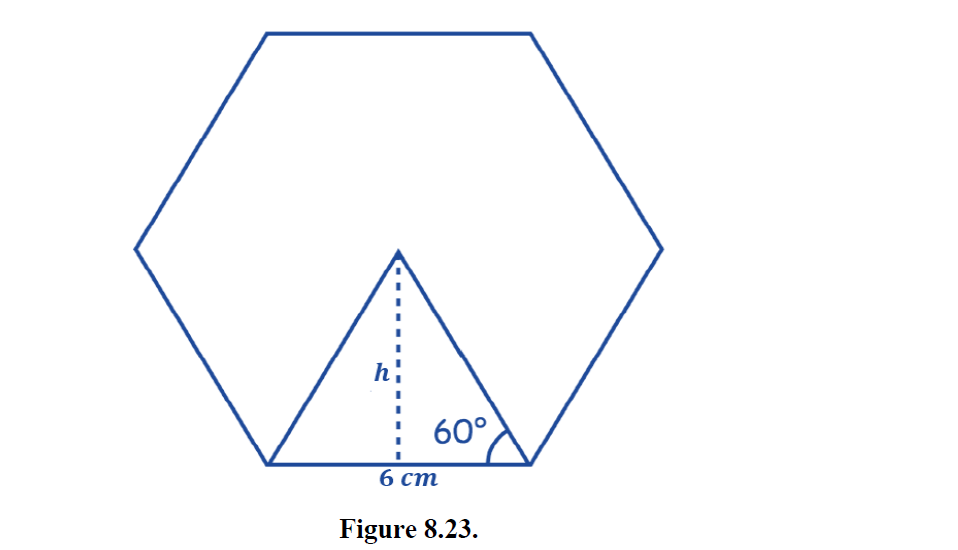
11. A regular hexagon can be split into six equal equilateral triangles. Figure 8.23 shows one of these triangles. Use trigonometry to determine the height ′ℎ′ of the equilateral triangle.
Trigonometric Ratios of Any Angle
Trigonometric ratios like sine, cosine, and tangent are not limited to acute angles (angles less than 90°).
In advanced study, particularly in Trigonometry, these ratios are extended to cover any angle, including those greater than 90°, angles up to 360° and beyond, as well as negative angles.
To make this possible, we move from right-angled triangles to a more powerful concept called the unit circle (a circle with radius 1 centered at the origin of a coordinate plane).
Trigonometric ratios of any angle(𝜃) in the first quadrant.
Consider a circle with radius 1 unit divided into four congruent sectors by the coordinate axes whose origin is at the center of the circle as shown in figure 8.24 below:
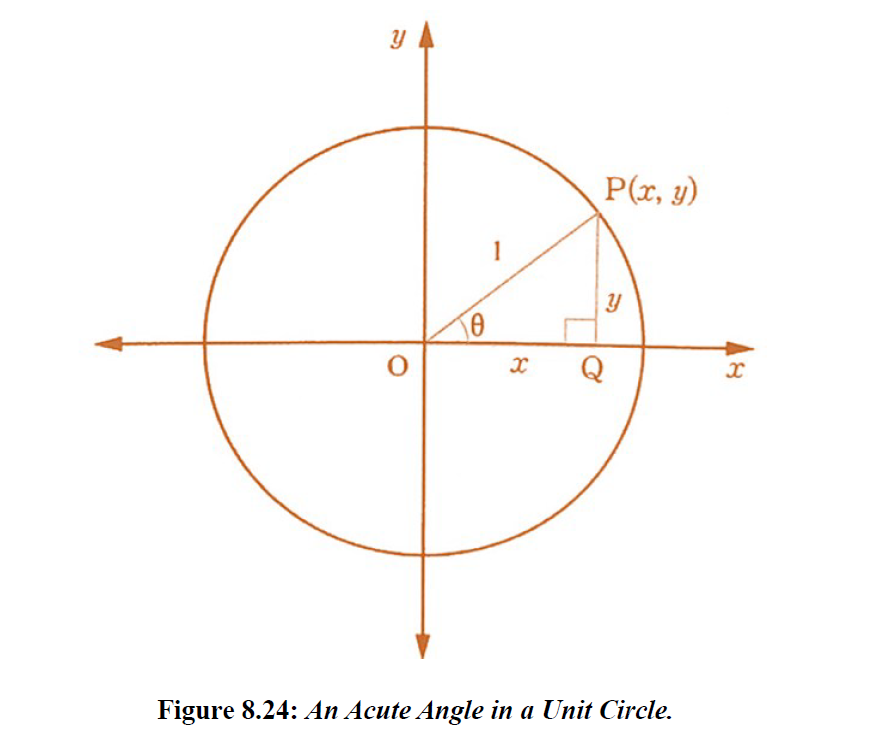
From figure 8.24, 𝜃 is an acute angle between 0° and 90° lying in the first quadrant.
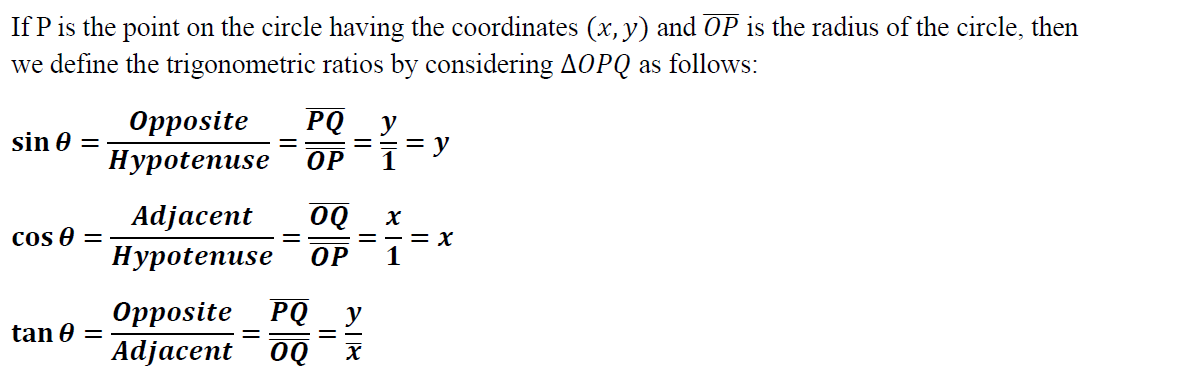
Observation: Since both 𝑥 and 𝑦 in this quadrant are positive, then all the trigonometric ratios are positive.
Trigonometric ratios of any angle(𝜃) in the second quadrant.
Considering figure 8.25 below, 𝜃 is an obtuse angle between 90° and 180°, lying in the second quadrant.
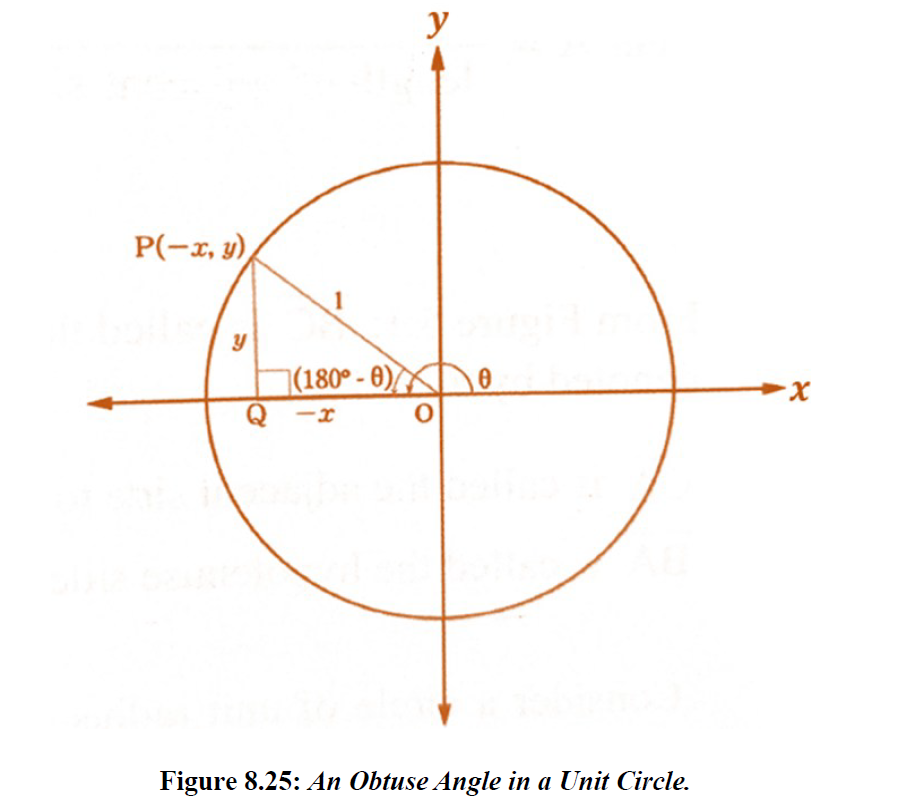
The trigonometric ratios of angle 𝜃 in the second quadrant are equivalent to the trigonometric ratios of 180°−𝜃.
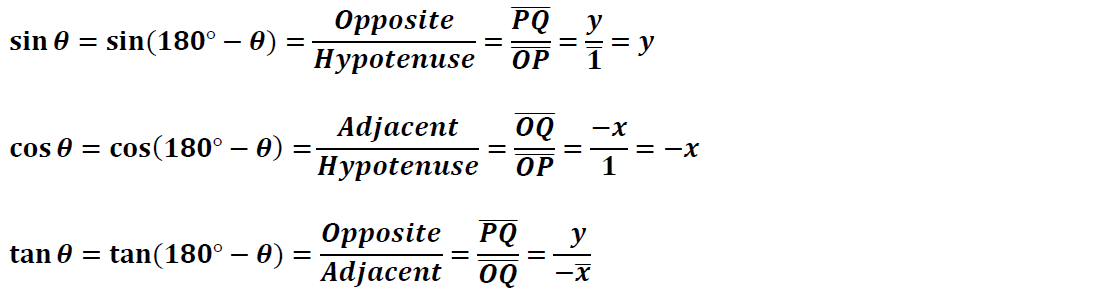
Observation: From figure 8.25, we observe that the trigonometric ratios of any angle (𝜃) lying in the second quadrant are such that 𝐬𝐢𝐧𝜽 is positive (+), while 𝐜𝐨𝐬𝜽 and 𝐭𝐚𝐧𝜽 are negative (-).
Trigonometric ratios of any angle(𝜃) in the third quadrant.
By considering figure 8.26 below, 𝜃 is a reflex angle between 180° and 270°, lying in the third quadrant.
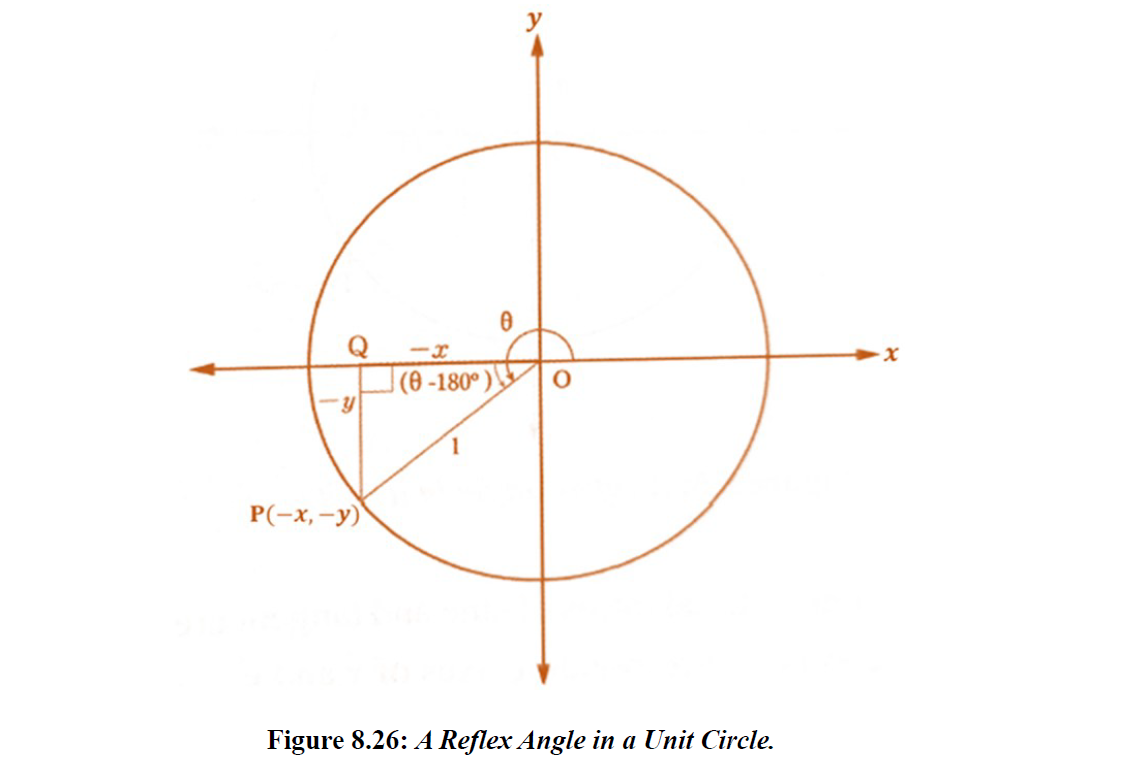
The trigonometric ratios of angle 𝜃 in the third quadrant are equivalent to the trigonometric ratios of 𝜃−180°.
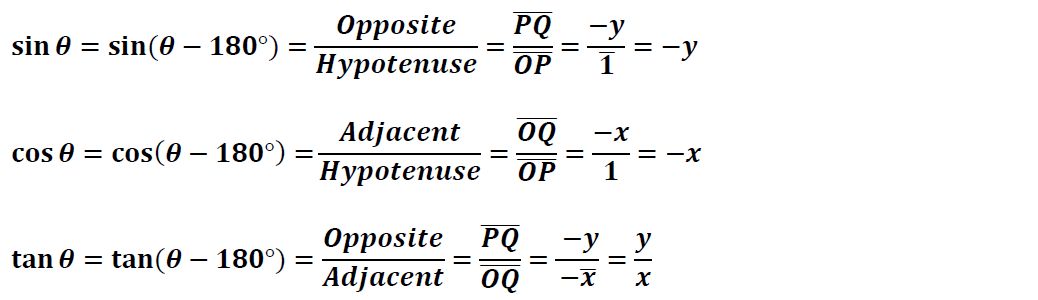
Observation: From figure 8.26, we observe that the trigonometric ratios of any angle (𝜃) lying in the second quadrant are such that 𝐭𝐚𝐧𝜽 is positive (+), while 𝐬𝐢𝐧𝜽 and 𝐜𝐨𝐬𝜽 are negative (-).
Trigonometric ratios of any angle(𝜃) in the fourth quadrant.
By considering figure 8.27 below, 𝜃 is a reflex angle between 270° and 360°, lying in the fourth quadrant.
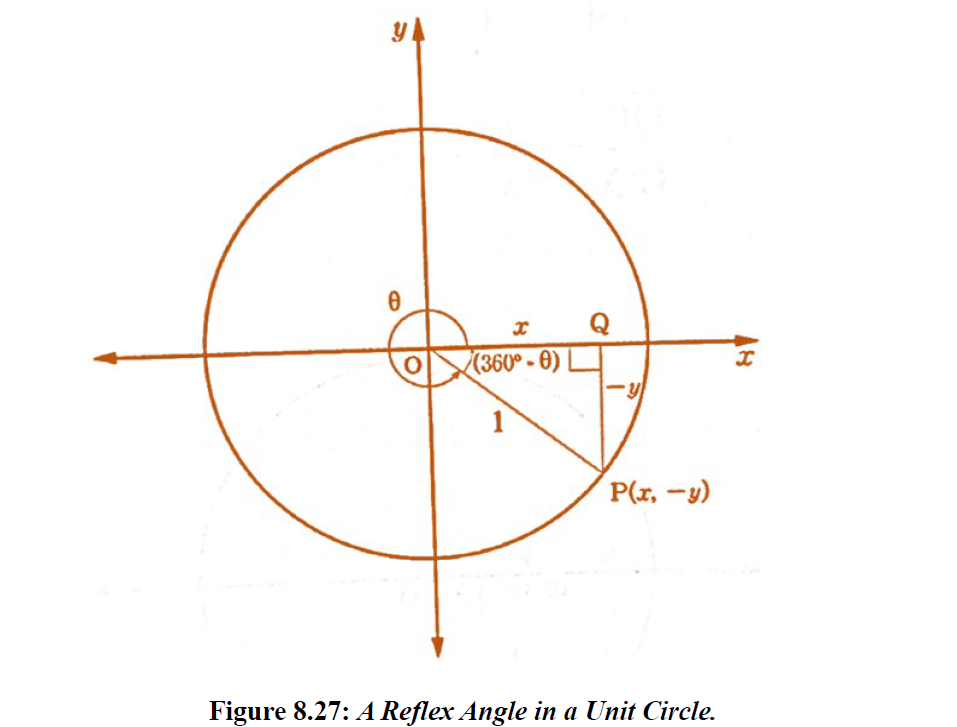
The trigonometric ratios of angle 𝜃 in the fourth quadrant are equivalent to the trigonometric ratios of 360°−𝜃.
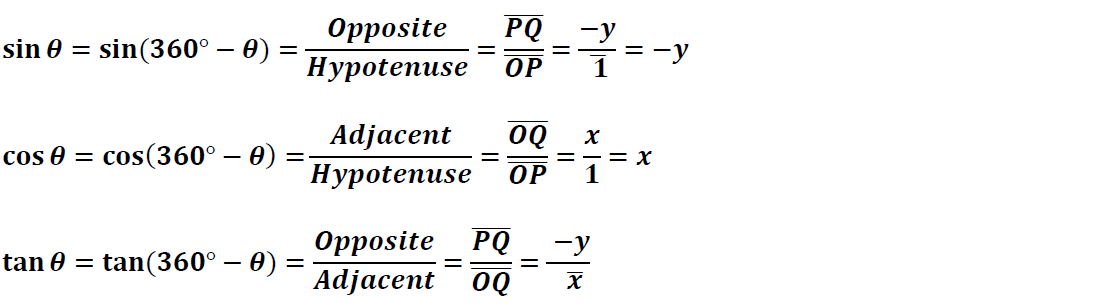
Observation: From figure 8.27, we observe that the trigonometric ratios of any angle (𝜃) lying in the fourth quadrant are such that 𝐜𝐨𝐬𝜽 is positive (+), while 𝐬𝐢𝐧𝜽 and 𝐭𝐚𝐧𝜽 are negative (-).
Note that we have observed different angles in different quadrants having different trigonometric ratios signs.
To remember the signs of trigonometric ratios of any angle in different quadrants, the four words MNEMONIC “All Students Take Chemistry’’ may help you.

This means that:

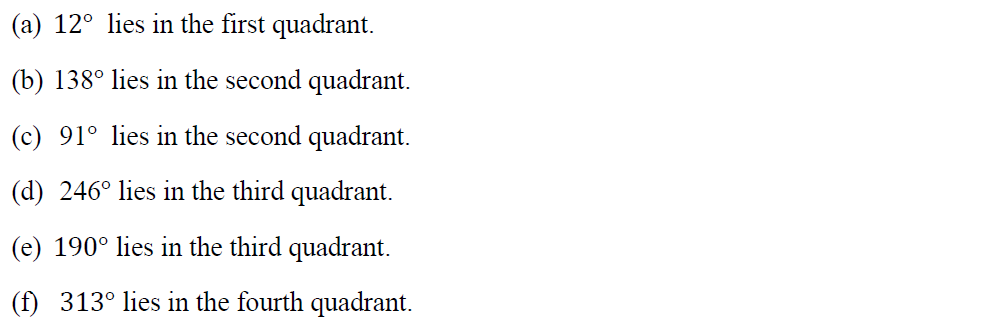
Example 10
State the quadrant in which each of the following angles lies:

Solution:
Example 11
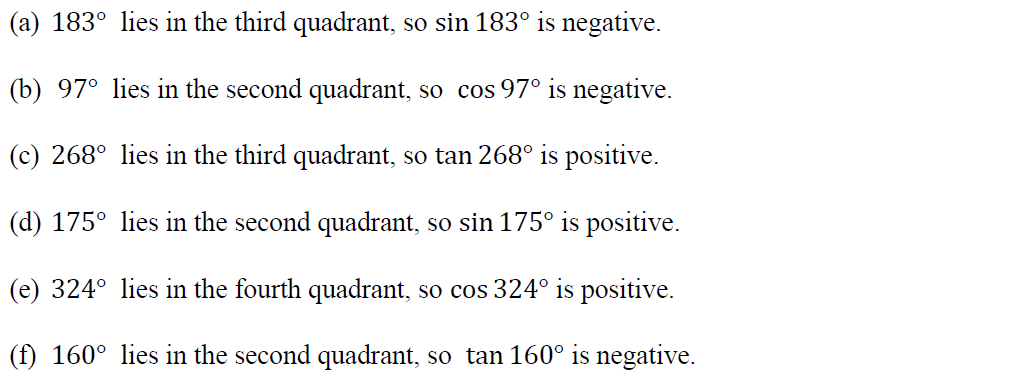
Write the signs of each of the following trigonometric ratios.

Solution:
Example 12
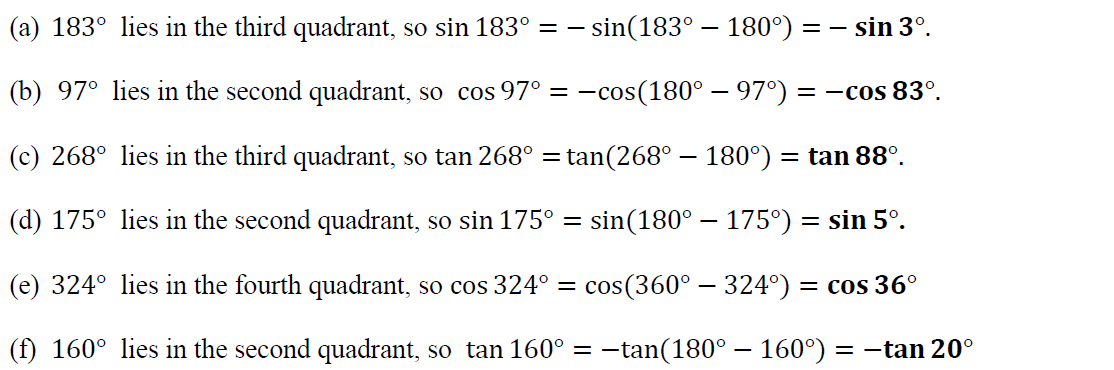
Express each of the following in terms of an acute angle:

Solution:
Positive and Negative Angles
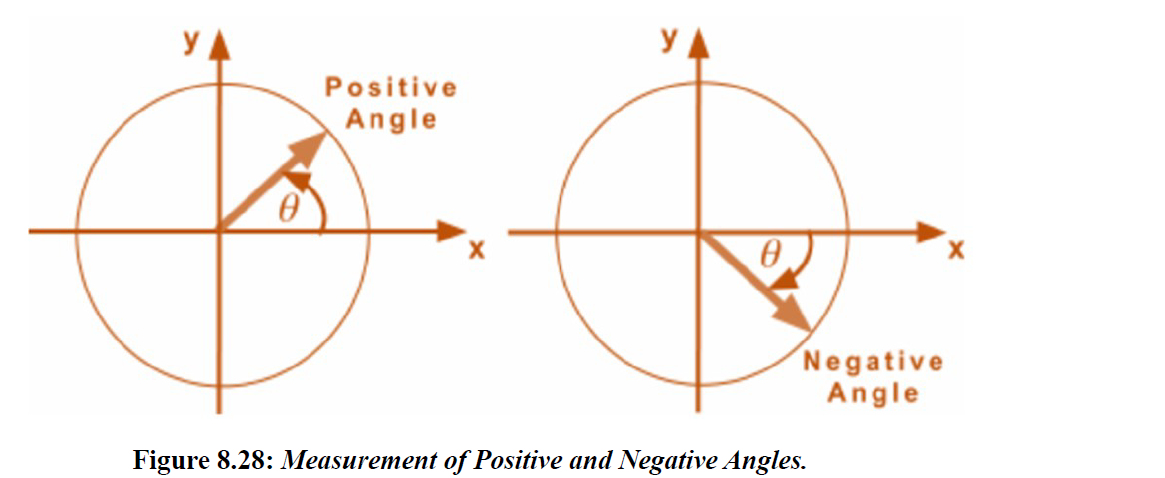
In Trigonometry, angles are measured based on the direction of rotation from a starting line (usually the positive x-axis).
Therefore, positivity or negativity of angles only means the direction in which the angle is measured.
Definition:
A positive angle is formed when you rotate anticlockwise (counterclockwise), while a negative angle on the other hand is formed when you rotate clockwise.
Negative and positive angles always go in the opposite direction of each other as shown in figure 8.29 below;
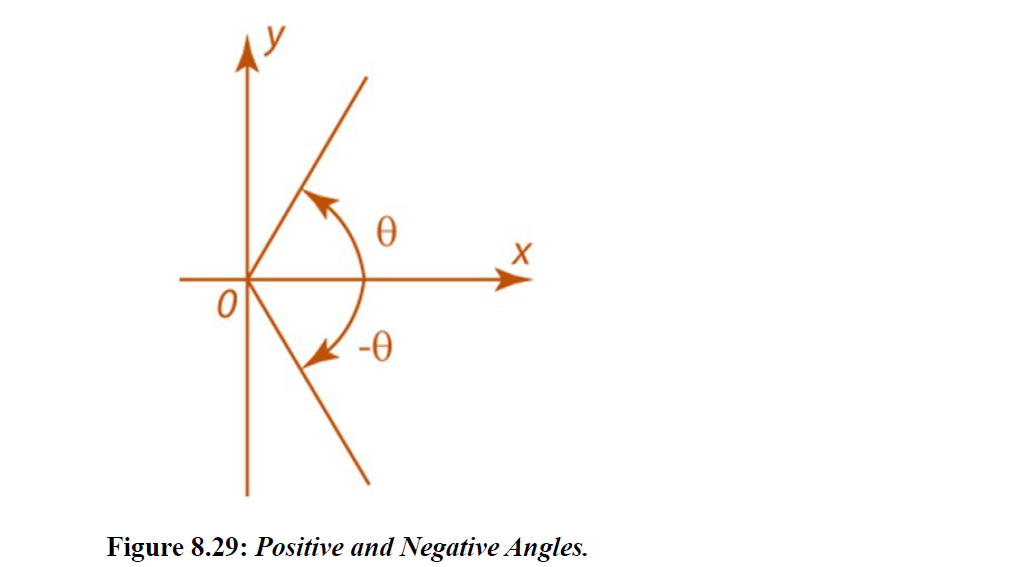
A negative angle has the same terminal side as a positive angle found by adding 360° (or multiples of 360°).
For example, when you measure 90° ant-clockwise, the same end terminal side can be reached by measuring (rotating) 270° in the clockwise direction, this means the negative angle corresponding to 90° is −270°.
In general, if 𝜃 is positive, its corresponding negative angle is (−360°+𝜃) and if it is negative, its corresponding positive angle is (360°+𝜃).
NB: sin(−𝜃)=−sin𝜃, cos(−𝜃)=cos𝜃 and tan(−𝜃)=−tan𝜃
Example 13
Find the negative angles corresponding to:

Solution:
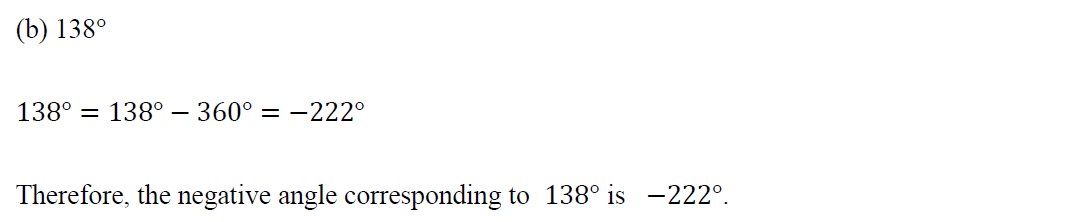
(a) 12°
12°=12°−360°=−348°
Therefore, the negative angle corresponding to 12° is −348°.
(c) 91°
91°=91°−360°=−269°
Therefore, the negative angle corresponding to 91° is −269°.
(d) 246°
246°=246°−360°=−114°
Therefore, the negative angle corresponding to 246° is −114°.
(e) 190°
190°=190°−360°=−170°
Therefore, the negative angle corresponding to 190° is −170°.
(f) 313°
313°=313°−360°=−47°
Therefore, the negative angle corresponding to 313° is −47°.
Example 14
Find the positive angles corresponding to:

Solution:
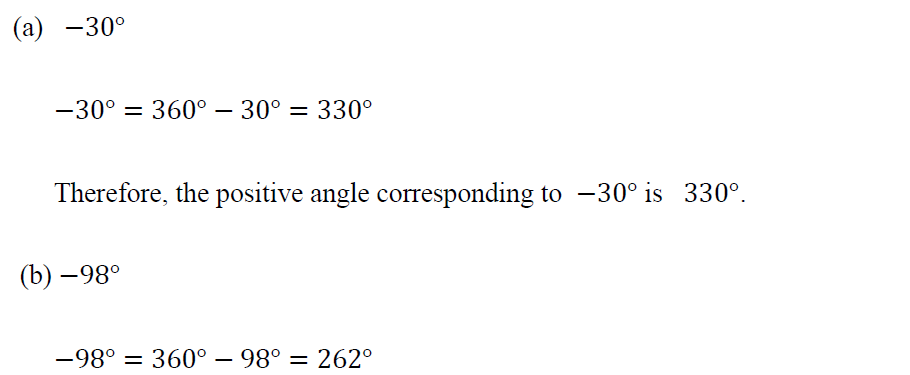
Therefore, the positive angle corresponding to −98° is 262°.
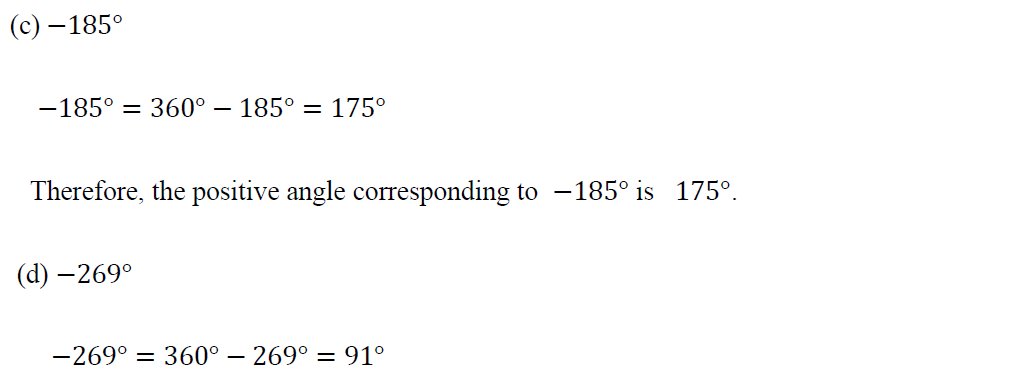
Therefore, the positive angle corresponding to −269° is 91°.
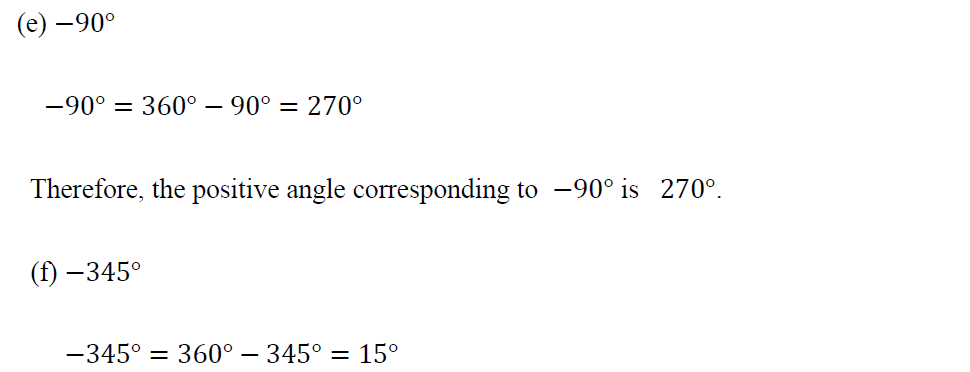
Therefore, the positive angle corresponding to −345° is 15°.
Example 15
Find the value of each of the following:

Solution:
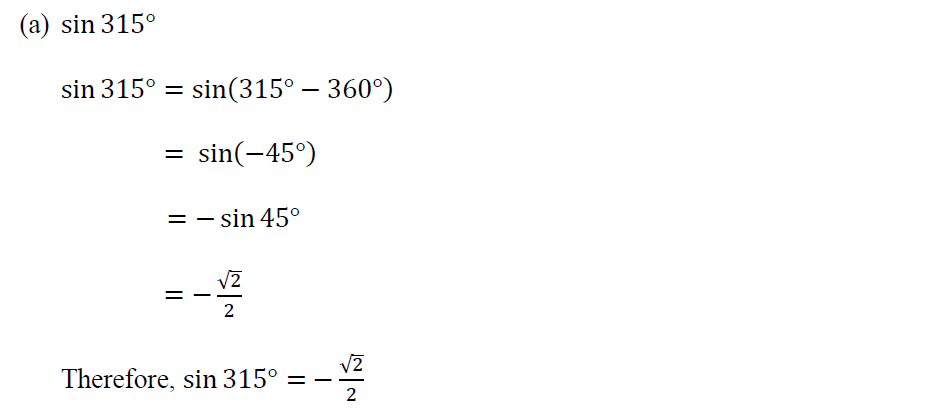
(b) cos300°
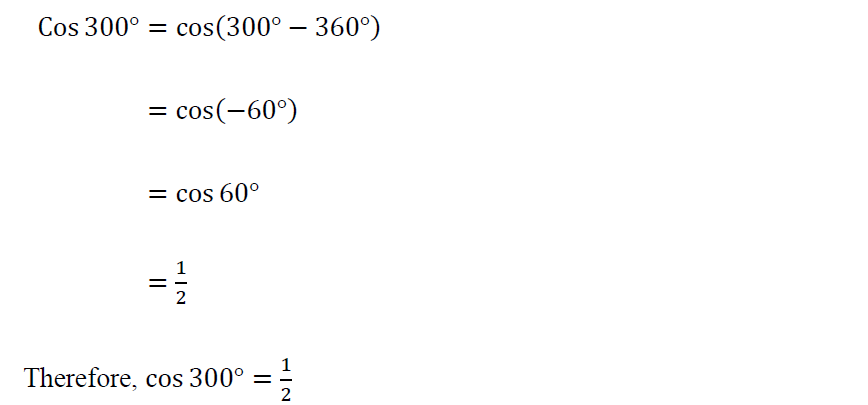
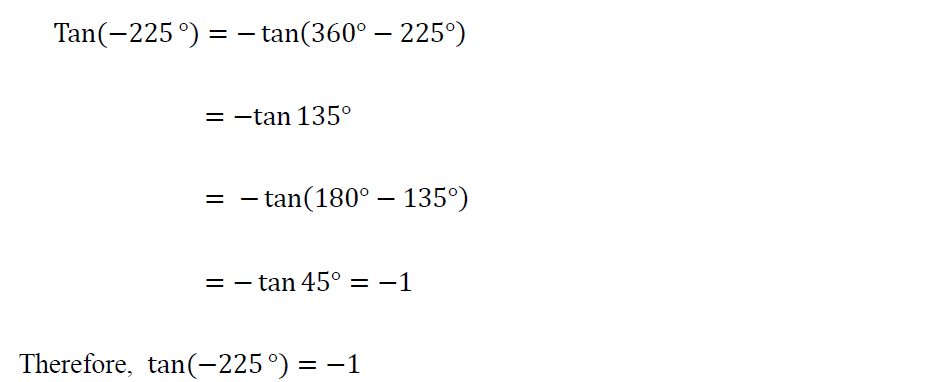
(c) tan(−225°)
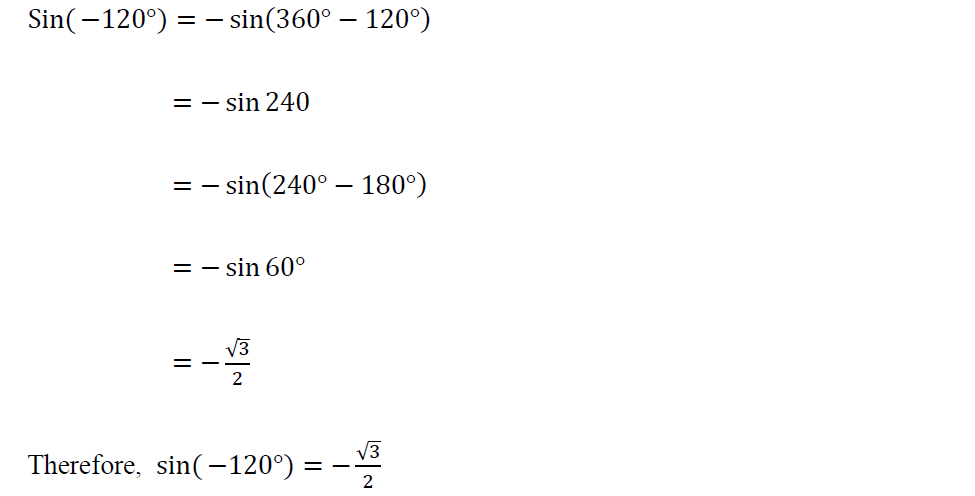
(d) sin(−120°)
Exercise 3
1.State the quadrant in which each of the following angles lies:

2. Write the signs of each of the following trigonometric ratios:

3. Write each of the following in terms of an acute angle:

4. Find the positive angles corresponding to:

5. Find the negative angles corresponding to:

6. Find the exact value of each of the following:

7. Write each of the following in terms of sin35°:

8. Express each of the following in terms of cos40°:

9. Write each of the following in terms of tan25°:

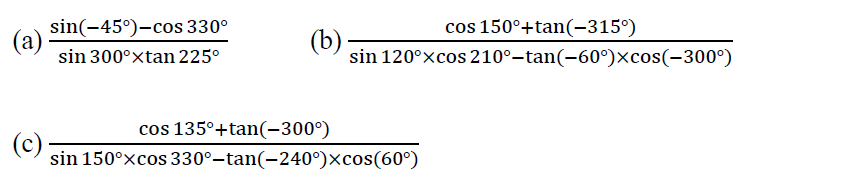
10. Without using a calculator, find the value of each of the following:
Relationship Between Trigonometric Ratios
The trigonometric ratios are closely connected through a set of standard identities. These relationships help you to express one ratio in terms of another and make solving problems much simpler and more efficient.
In addition, these relationships are based on fundamental ideas such as the properties of right-angled triangles, the concept of ratios, and the Pythagorean theorem.
The relationship Between Trigonometric Ratios of an angle and solve the related problems.
Explore the relationship Between Trigonometric Ratios of an angle and solve the related problems.
Consider a right-angled triangle ABC such that ∠𝐵=90° as shown in figure 8.30 below:
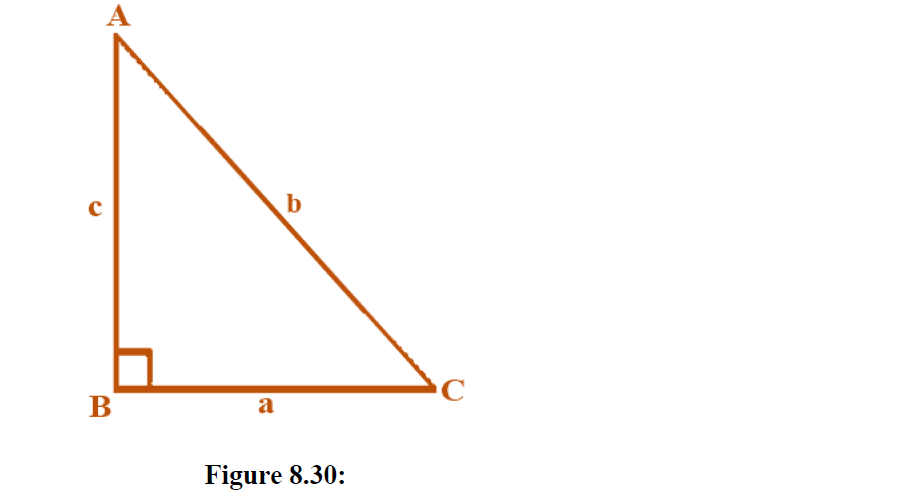
From figure 8.30, ∠𝐴 and ∠𝐶 are complementary, so ∠𝐴+∠𝐶=90°. It follows that:
(1) Using the definition of trigonometric ratios, we have the following;
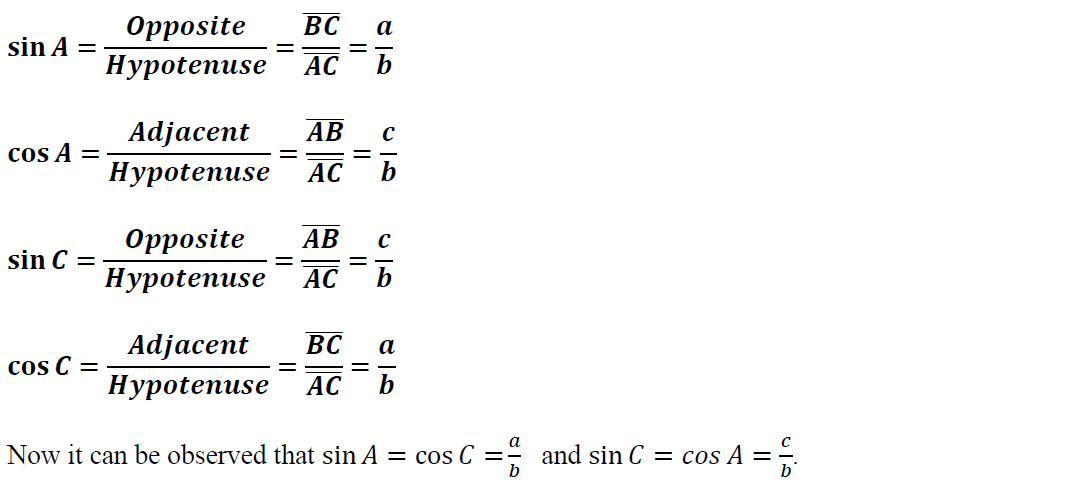
Therefore, we conclude that, for any two complementary angles (say A and B), the sine of one angle equals the cosine of the remaining angle. That is 𝐬𝐢𝐧𝑨=𝐜𝐨𝐬𝑩 and 𝐬𝐢𝐧𝑩=𝐜𝐨𝐬𝑨.

Therefore, for any angle (say 𝜃), its tangent equals its sine divided by its cosine, that is 𝐭𝐚𝐧𝜽=𝐬𝐢𝐧𝜽/𝐜𝐨𝐬𝜽.
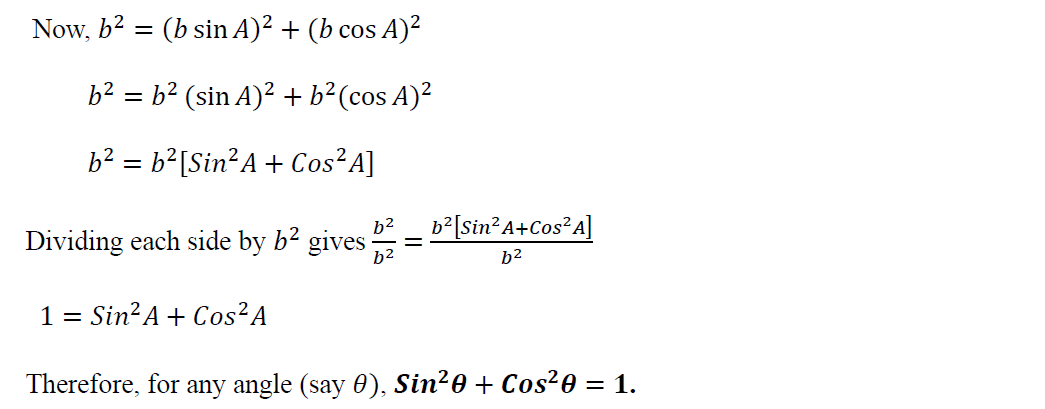
(3) Since Δ𝐴𝐵𝐶 in figure 8.30 is a right-angled triangle, then it obeys Pythagoras theorem, giving the relationship 𝑏2=𝑎2+𝑐2……….(𝑖)
But from trigonometric ratios, 𝑎=𝑏sin𝐴 and 𝑐=𝑏cos𝐴……….(𝑖𝑖)
Example 16
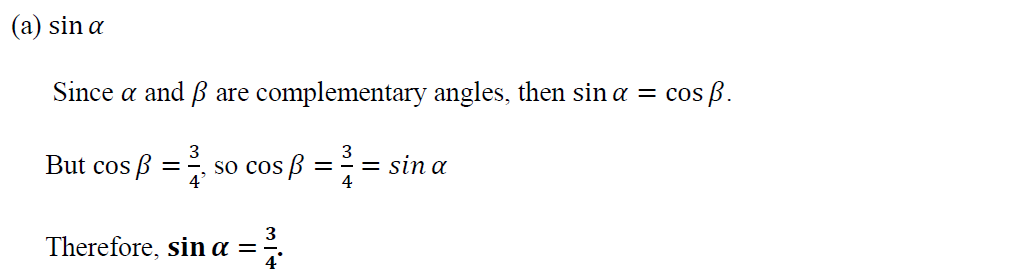
Given that 𝛼 and 𝛽 are complementary angles such that cos𝛽=3/4, find the value of:

Solution:
(b) tan𝛼
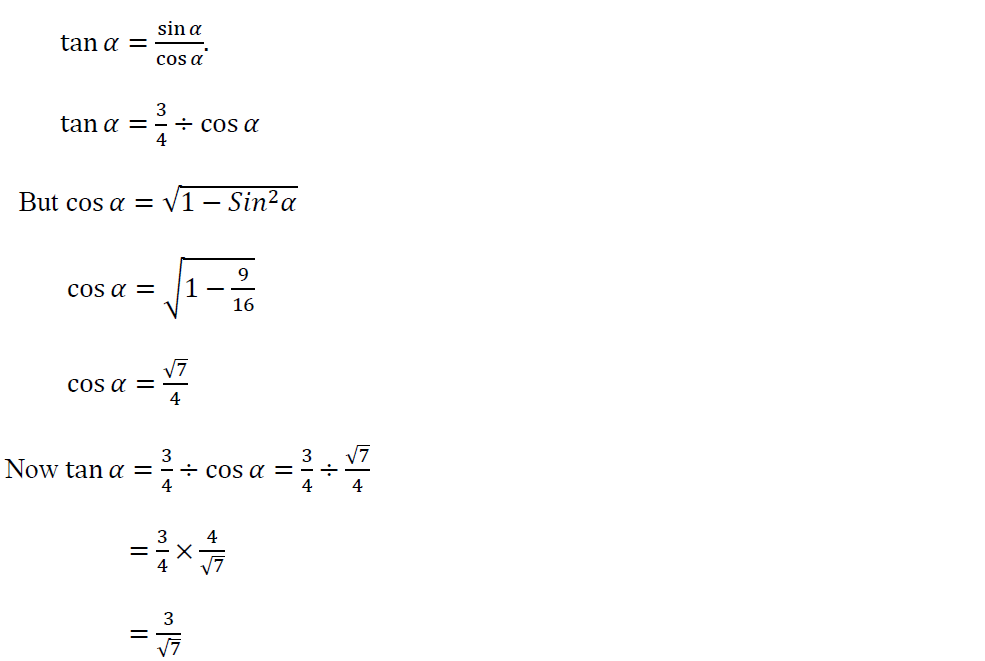
Therefore, 𝐭𝐚𝐧𝜶=𝟑/√𝟕.
Example 17
Given that sin𝜃=3/8 and 0°<𝜃<90°, find the value of:

Solution:
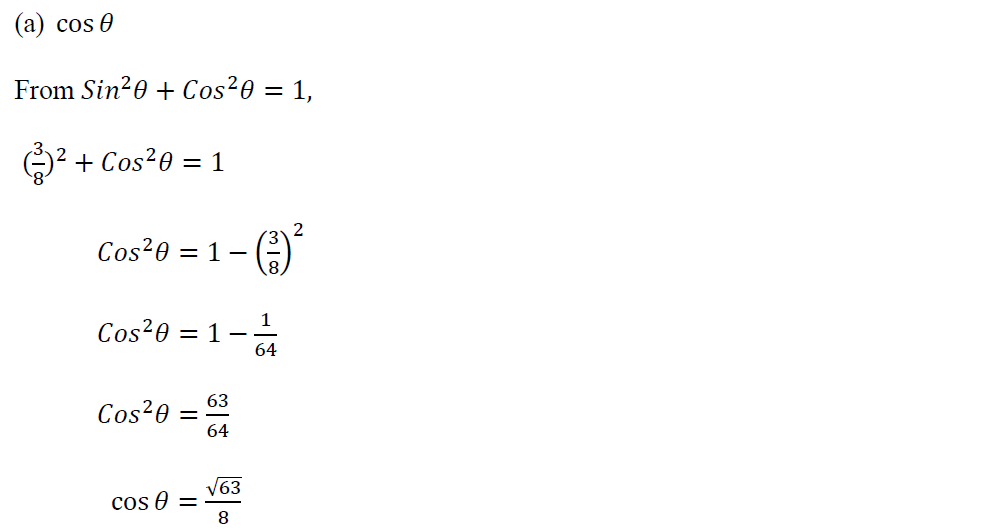
Therefore, 𝐜𝐨𝐬𝜽=√𝟔𝟑/𝟖.
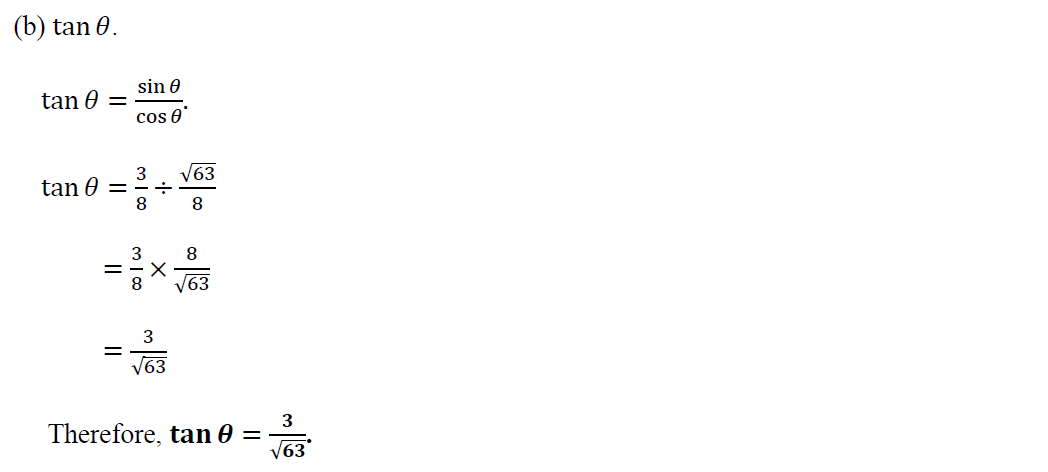
Example 18
Given that sin𝜃=0.682 and tan𝜃=0.933, what is the value of cos𝜃 ?
Solution:
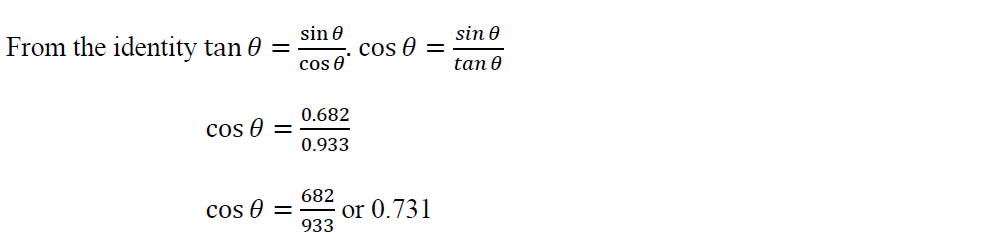
Therefore, 𝐜𝐨𝐬𝜽=𝟎.𝟕𝟑𝟏.
Exercise 4
1. Given that sin𝜃=5/13 and 0∘<𝜃<90∘, find the exact value of:
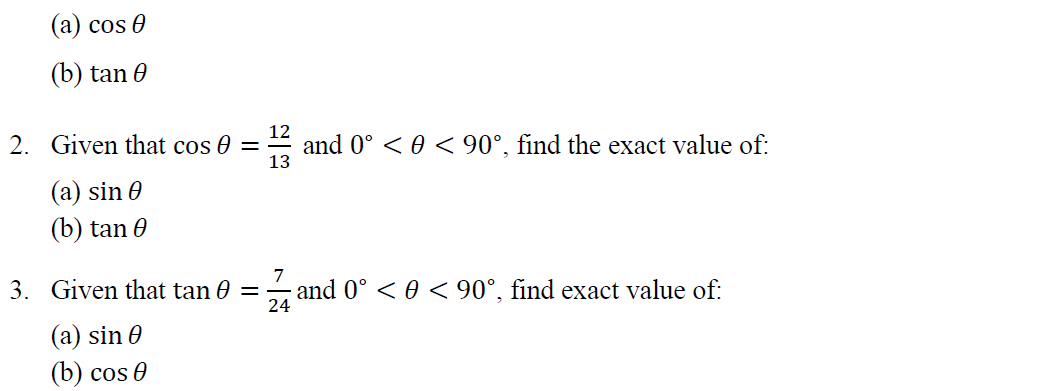
4. Given that cos 𝜃=𝑘 , find each of the following in terms of k:
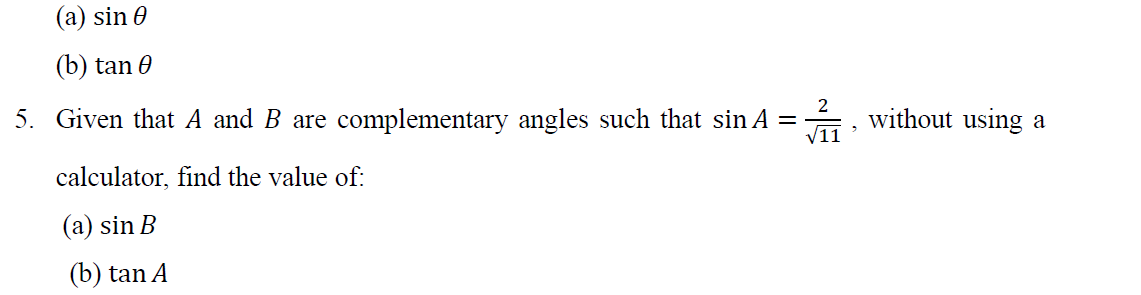
6. If tan𝛼=5/√8, find the value of cos(90°−𝛼).
7. If cos 𝜃=12/13, find the value of sin (90∘−𝜃).
8. If tan 𝛽=𝑚, find cos (90∘−𝛽) in terms of m.
9. If cos 𝜃=15/17, find the value sin (90∘−𝜃)−cos (90∘−𝜃).
10.If cos𝛽=𝑚/𝑛 and tan 𝛽=𝑟/𝑡, what is the value of sin𝛽 ?
11. Given that sin 𝜃=0.6 and tan 𝜃=0.75, find cos𝜃.
12. If sin𝜃=0.342 and tan 𝜃=0.364, find cos𝜃.
13. Given that sin𝛽=0.829 and cos𝛽=0.5592, what is the value of tan𝛽?
14. Given that cos𝜃=0.3584 and tan 𝜃=2.6051, find sin𝜃.

Calculating Trigonometric Ratios with a Calculator
The advancement of science and technology has been closely linked to better calculation tools. Before calculators, trigonometric ratios were computed using tables and manual methods, which were slow and less accurate.
The invention of electronic calculators, like those from Casio, allows quick and precise computation of sine, cosine, and tangent, making trigonometry much easier to work with and use it in different fields such as engineering, physics, and navigation.
The image below shows an example of a scientific calculator used for performing these trigonometric calculations.
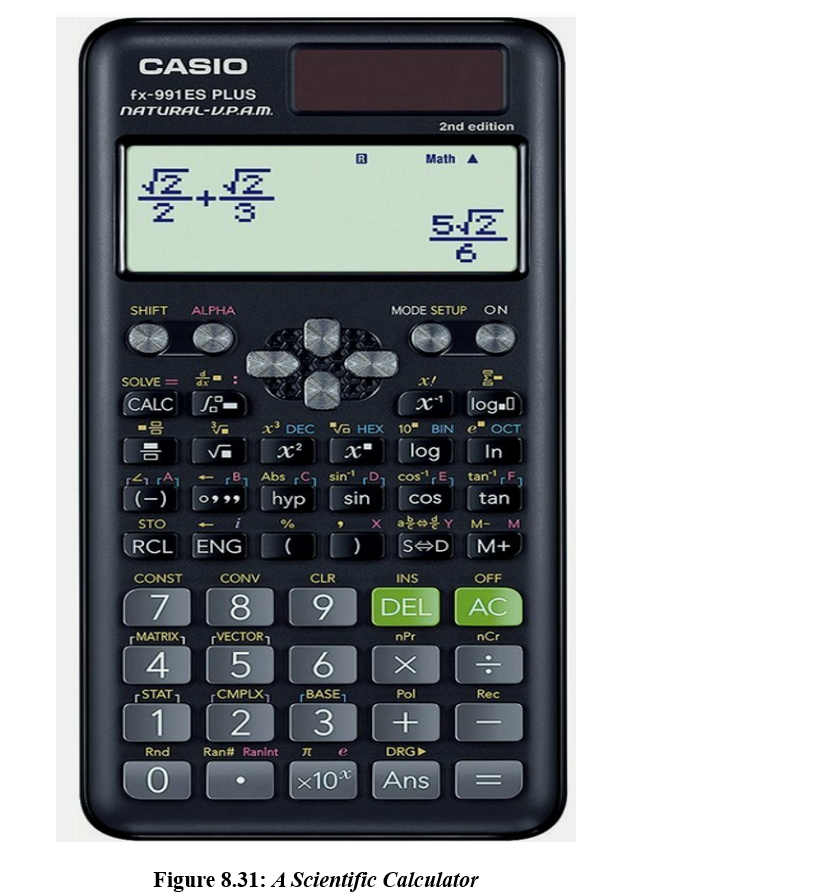
Use a Calculator to find the trigonometric ratios of a given angle.
Steps to be followed when finding trigonometric ratios by using a calculator
To find trigonometric ratios using a calculator, you need to follow the steps below:
(i)Turn your calculator ON.
(ii) Set the angle mode to degrees (DEG).
(iii) Press the appropriate trigonometric function key (sin, cos, or tan).
(iv) Enter the given angle.
(v)Press equals sign (=) to get the result.
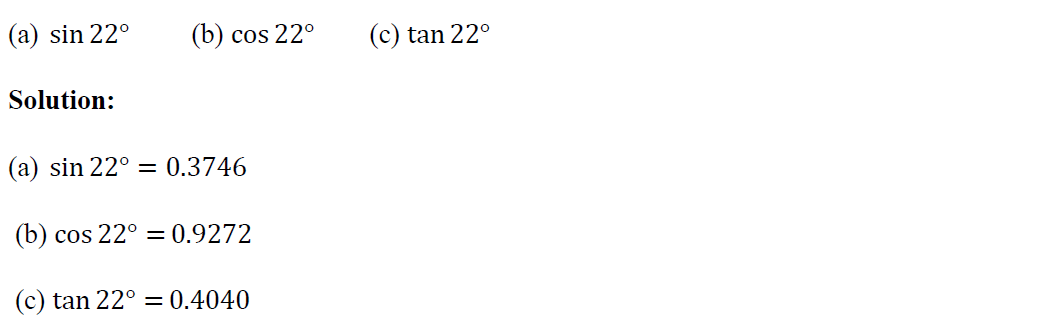
Example 19
By using a calculator, evaluate each of the following correct to four decimal places:
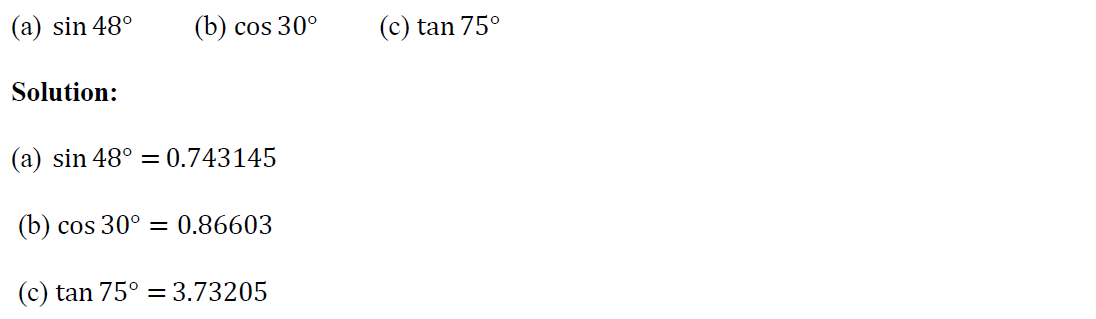
Example 20
Use a calculator to evaluate each of the following, giving your answers correct to five decimal places:
Example 21
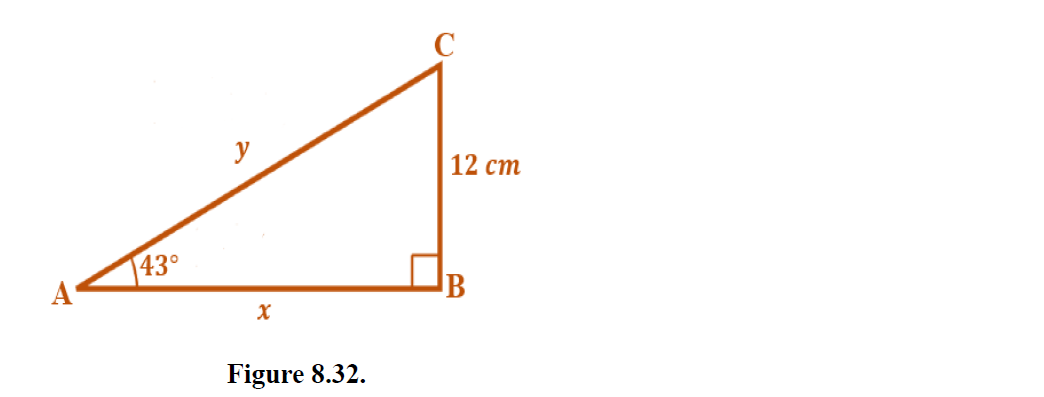
With a help of a calculator, find the values of 𝑥 and 𝑦 in Δ𝐴𝐵𝐶 represented by figure 8.32 below:
Solution:
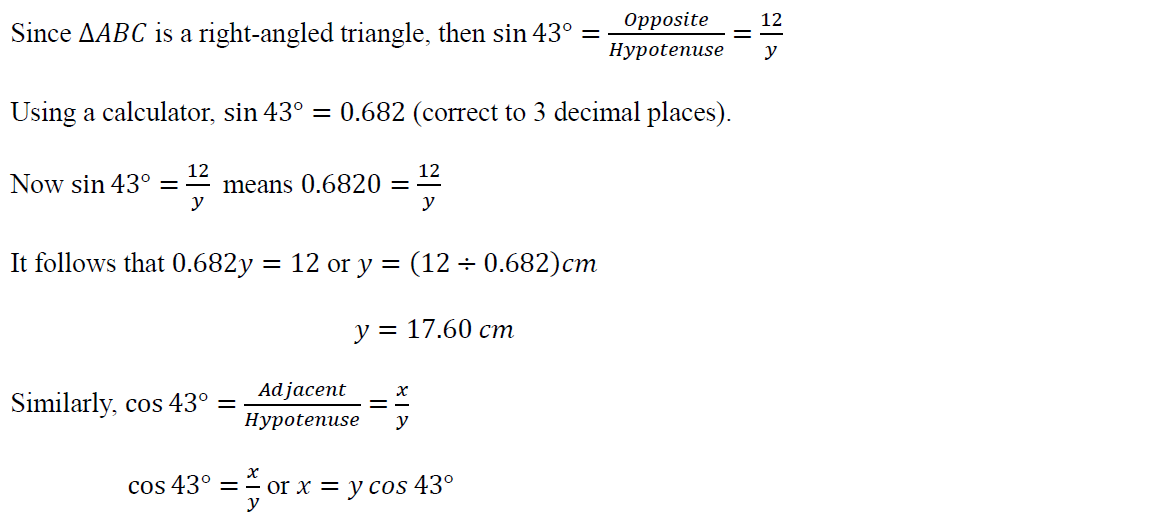
But 𝑦=17.6 𝑐𝑚 and 𝑐𝑜𝑠43°=0.731
𝑥=17.60×0.731=12.87𝑐𝑚
Therefore, 𝒙=𝟏𝟐.𝟖𝟕𝒄𝒎 and 𝒚=𝟏𝟕.𝟔𝟎 𝒄𝒎.
NB: After obtaining the value of 𝑦, you can choose to apply Pythagoras' theorem instead of cos43° to find the value of 𝑥.
Inverse of Trigonometric Ratios
Inverse trigonometric ratios are functions used to find an angle when the value of a trigonometric ratio is known. They are the opposites (inverses) of sine, cosine, and tangent represented by 𝒔𝒊𝒏−𝟏, 𝒄𝒐𝒔−𝟏 and 𝒕𝒂𝒏−𝟏 respectively.
This means, if the sine of an angle is given for example, the inverse sine function helps find the angle itself.
For example, if sin θ = 0.5, then θ = sin⁻¹(0.5) = 30°. Inverse trigonometric ratios are obtained by using a scientific calculator or mathematical tables.
The Concept of Inverse of Trigonometric Ratios and workout the related problems.
Explain the Concept of Inverse of Trigonometric Ratios and workout the related problems.
How to find the angle already knowing its sine, cosine or tangent value using a calculator?
To find the angle already knowing its sine, cosine or tangent value using a calculator, follow the steps below:
(i)Turn your calculator ON.
(ii) Set the angle mode to degrees (DEG).
(iii) Press the SHIFT (or inverse) button.
(iv)Press the appropriate trigonometric function key (sin, cos or tan).
(v) Enter the given value.
(vi) Press equals sign (=) to get the result (ANGLE).
Example 22
By using a calculator, find the value of 𝜃 (correct to two decimal places), given that 𝜃 is an acute angle and:

Solution:
(a) sin𝜃°=0.7660 means 𝜃=𝑠𝑖𝑛−10.7660=50.00°
(b) cos𝜃°=0.0523 means 𝜃=𝑐𝑜𝑠−10.0523=87.00°
(c) tan𝜃°=0.8872 means 𝜃=𝑡𝑎𝑛−10.8872=41.58°
Therefore, 𝜽=𝟒𝟏.𝟓𝟖°
Example 23
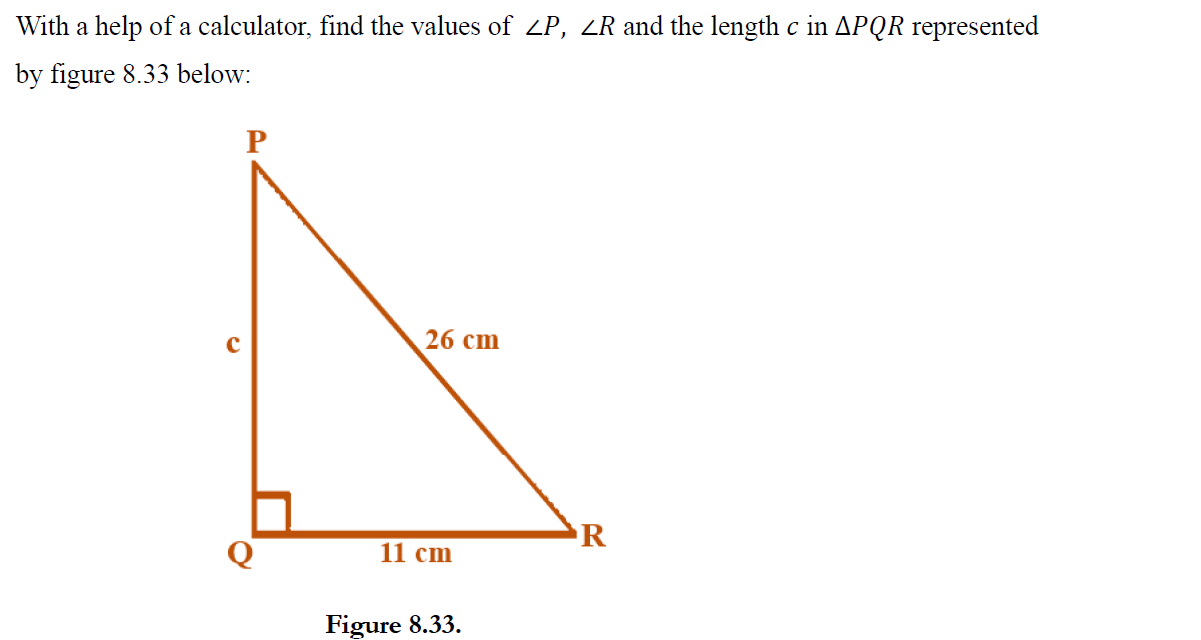
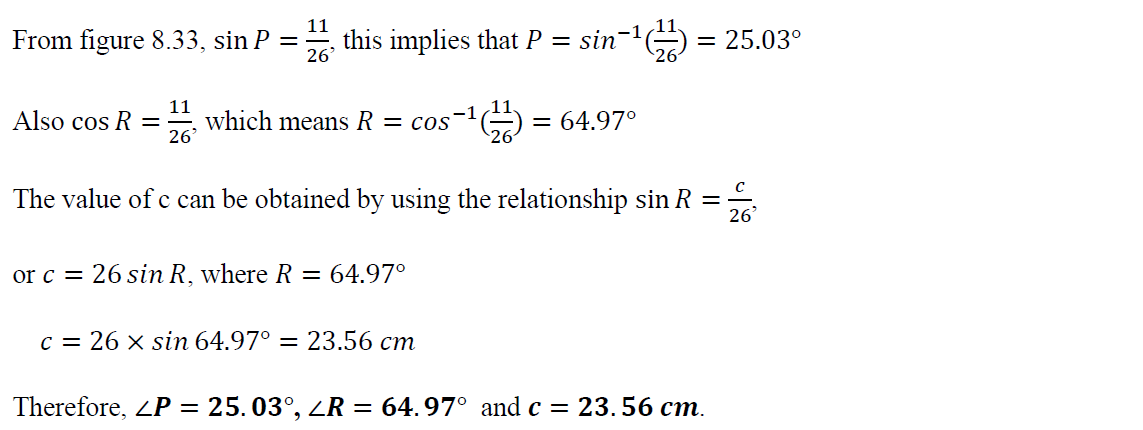
Solution:
Exercise 5
1.By using a scientific calculator, evaluate each of the following correct to three decimal places:

2.Use a scientific calculator to find the value of 𝜃 (correct to two decimal places), given that 𝜃 is an acute angle and:

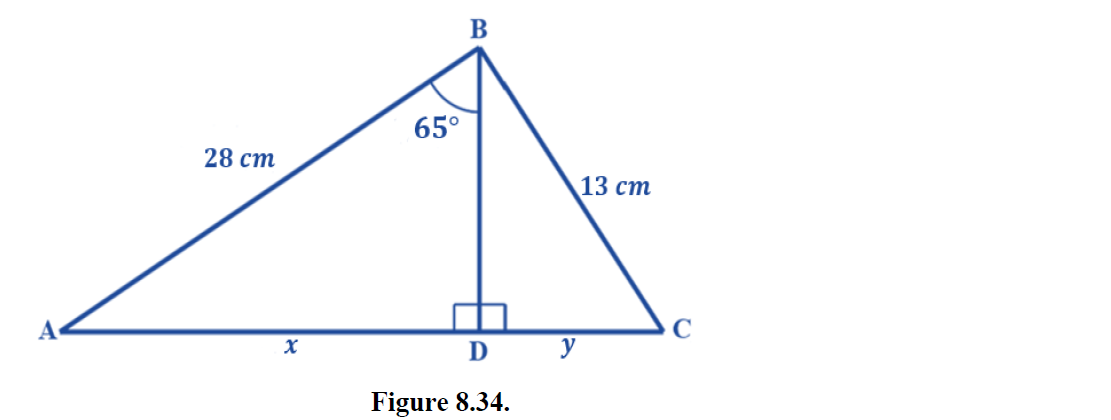
3.With a help of a calculator, find the values of 𝑥, 𝑦 and ∠𝐶 in Δ𝐴𝐵𝐶 represented by figure 8.34 below:
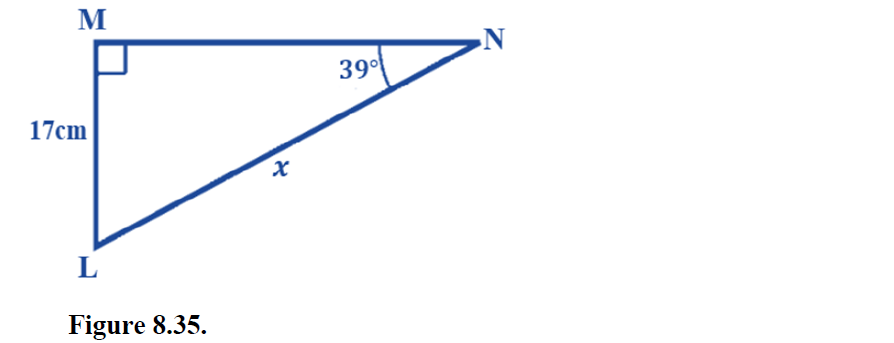
4. In Δ𝐿𝑀𝑁 represented by figure 8.35 below, find the value of 𝑥 correct to one decimal place:
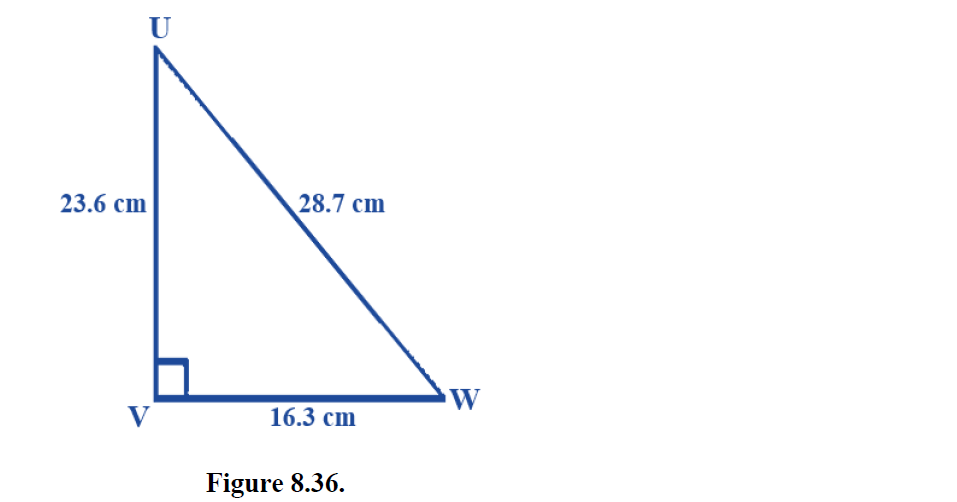
5.In Δ𝑈𝑉𝑊 represented by figure 8.36 below, find the value of ∠𝑈 and ∠𝑊 (Give your answers correct to one decimal place):
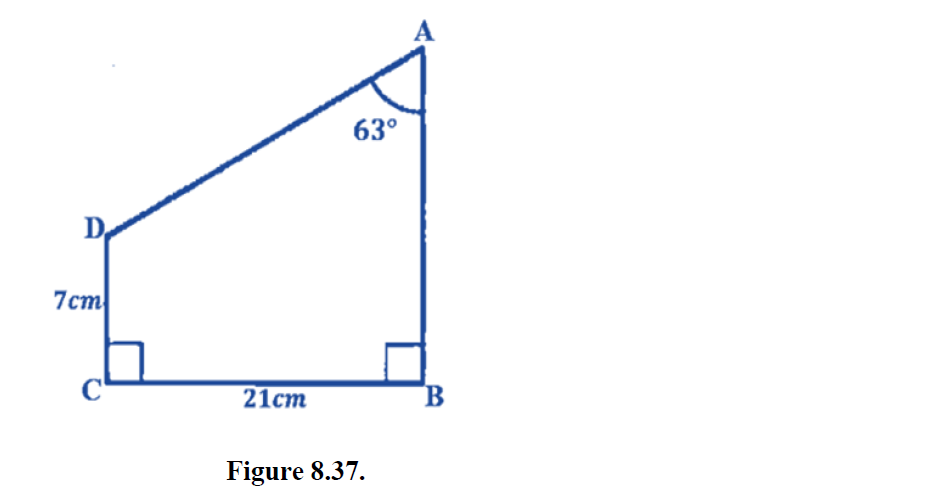
6. In figure 8.37 below, calculate the length from 𝐴 to 𝐵 and that from 𝐴 to 𝐷 (Give your answers correct to one decimal place).
7.PQR is a right-angled triangle such that the length from 𝑃 to 𝑄=14 𝑐𝑚 , 𝑄 to 𝑅=19 𝑐𝑚 and ∠𝑄 is a right angle, find: (a) The length from 𝑃 to 𝑅 (b) ∠𝑃 (c) ∠𝑅 (Give your answers correct to one decimal place).
10. A water tap can be reached from a certain school by walking 200𝑚 North and then 100𝑚 East. Find the bearing (direction) of the water tap from the school.
11. A helicopter leaves Dodoma city and flies due East for 150 𝑘𝑚. Then the helicopter flies 90 𝑘𝑚 North before landing.
(a) Calculate the direct distance of the helicopter from Dodoma city.
(b) What is the bearing of the helicopter from Dodoma city?
12. A 13-foot ladder is placed against a house wall and reaches a second-floor window that is 12 feet above the ground. Find the angle between the ladder and the wall of the house, giving your answer correct to three decimal places.
13. An 18-foot ladder is placed against a wall and touches a point 14 feet above the ground. Find the angle between the ladder and the wall, correct to three decimal places.
14. A boat travels 600 𝑀 East and then 250 𝑀 North. Find the straight-line distance from the starting point and the angle measured from the East direction.
The angle of Elevation and Depression
Angles of elevation and depression are trigonometric ideas used to describe the angles between a horizontal line and a line of sight when looking at an object.
The angle of elevation is formed when looking upward, while the angle of depression is formed when looking downward.
The concept of angles of Elevation and Depression and solve the related problems.
Explain the concept of angles of Elevation and Depression and solve the related problems.
The Angle of Elevation
This is the angle formed between the horizontal line (which is at the observer’s eye level) and the line of sight when the observer looks upward toward an object that is positioned above them, such as a building, tree, or mountain.
It describes how steeply the observer must look up from the horizontal to see the object clearly. Figure 8.38 below illustrates this situation.
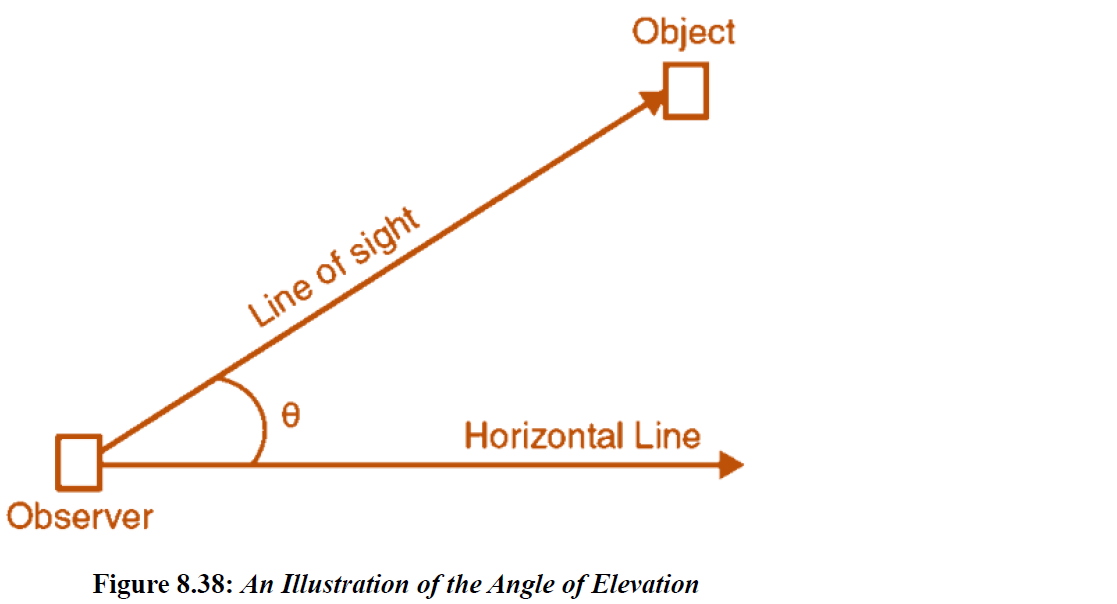
From figure 8.38, 𝜃 is the angle of elevation.
The Angle of Depression
This is the angle formed between the horizontal line (at the observer’s eye level) and the line of sight when the observer looks downward toward an object that is positioned below them.
In other words, it shows how steeply the observer must look down from the horizontal to clearly see the object.
To understand this better, imagine a hawk sitting on a tree branch and looking down at a hen on the ground.
The angle between the hawk’s straight horizontal line of sight and the downward direction toward the hen is called the angle of depression. This is illustrated in the figure 8.39 below.
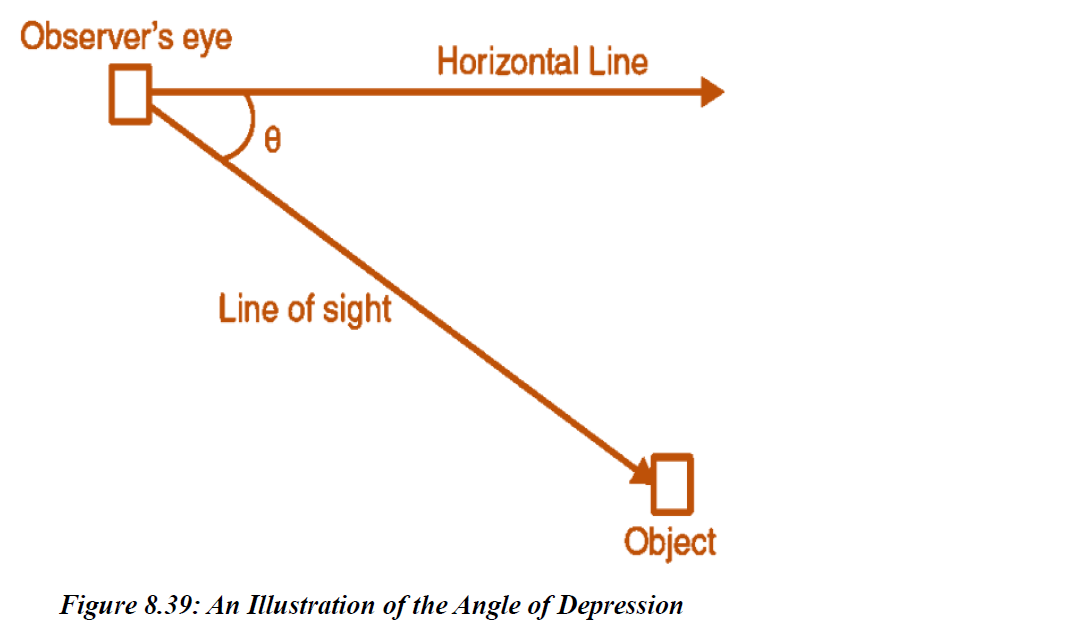
From figure 8.39 above, 𝜃 is the angle of depression.
NB: Since the angles of elevation and depression lie between parallel lines, they are equal as alternate interior angles.
Example 24
The angle of elevation between the top of a flagpole from a point on the ground 34 𝑚 from the base of the flagpole is 51°, what is the height of the flagpole to the nearest meters?
Solution:
Let P be the point on the ground 34 m from the flagpole base, and T be the top of the flagpole from the base B as shown in figure 8.40 below:
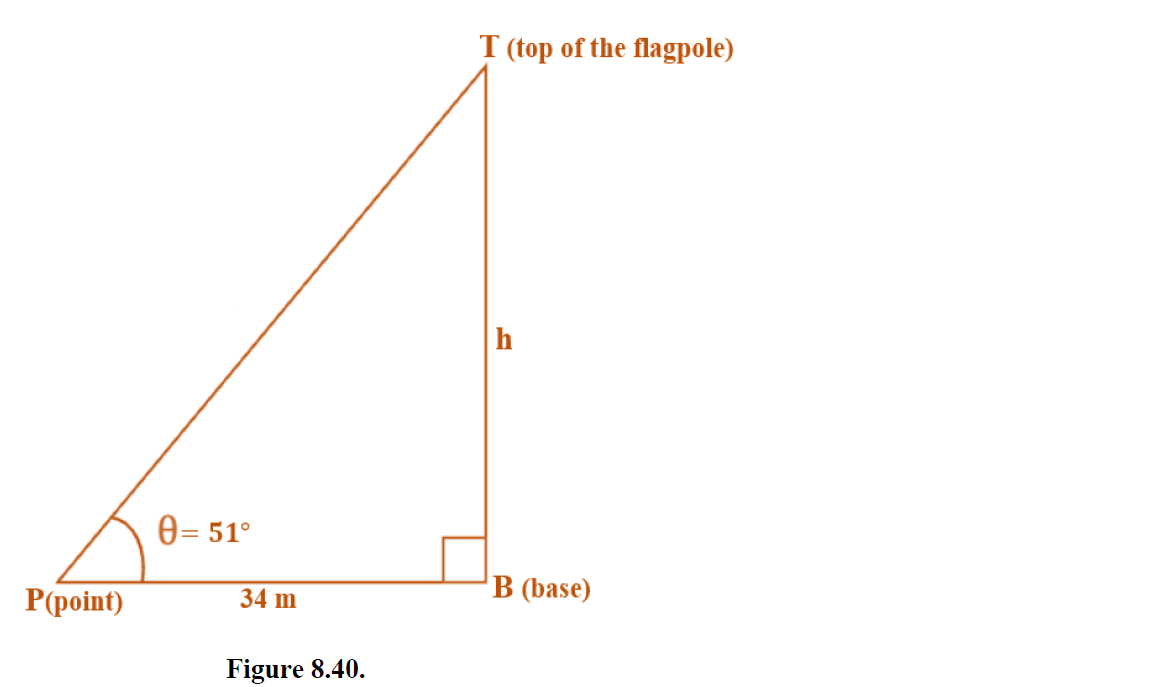
From figure 8.40 above, the distance from 𝐵 to 𝑇, represented by ℎ is obtained as follows:
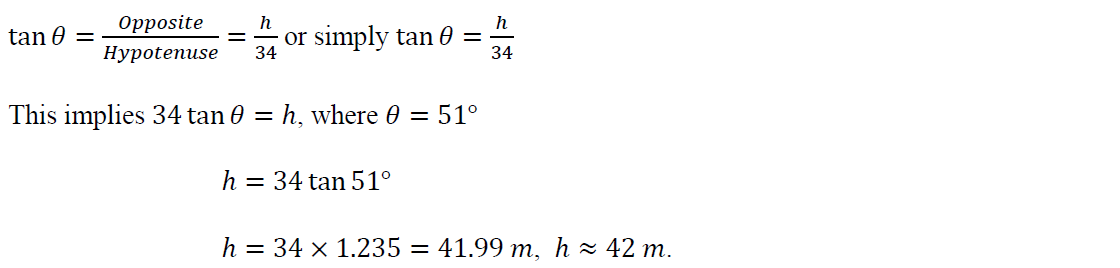
Therefore, the height of the flagpole is 𝟒𝟐 meters.
Example 25
A ship is sailing near a cliff that is 96 meters above sea level. If the angle of depression from the top of the cliff to the ship is 21°, how far is the ship from the base of the cliff, rounded to the nearest meters?
Solution:
Let O be the position of the observer, B the base of the cliff and S the position of the ship observed, as shown in figure 8.41 below:
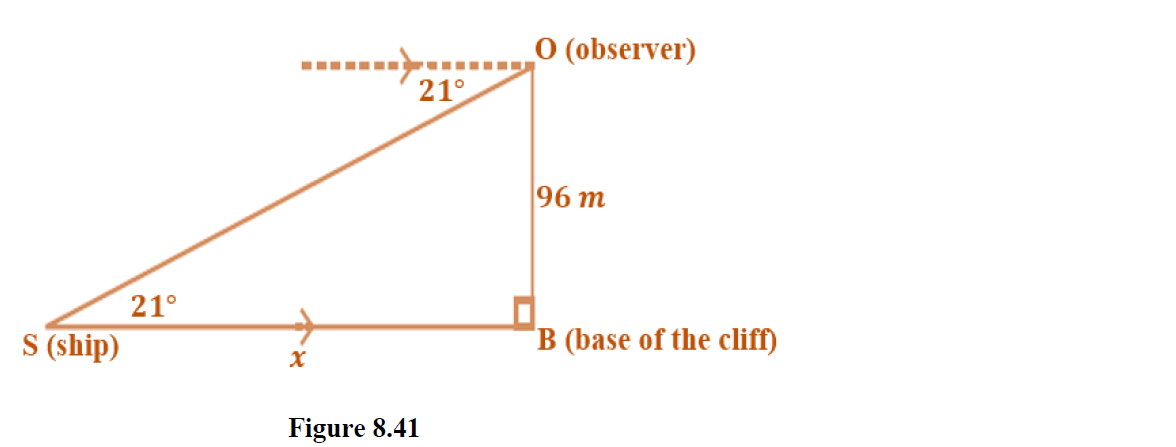
From figure 8.41 above, the distance between the ship and the base of the cliff, represented by 𝑥 is obtained as follows:
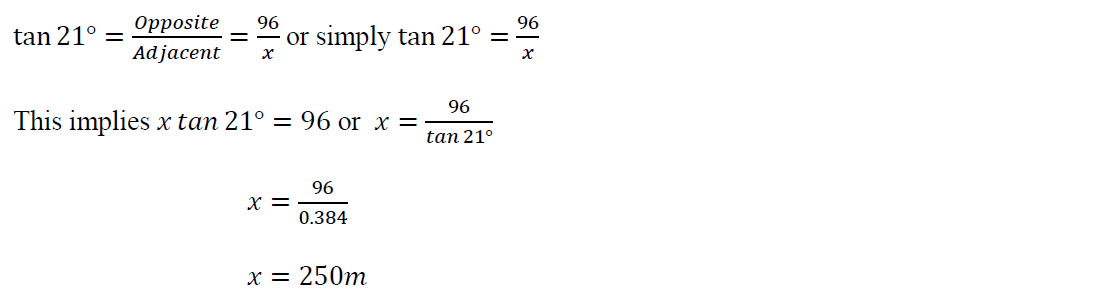
Therefore, the ship is 𝟐𝟓𝟎 meters from the base of the cliff.
Example 26
At a certain day time, a man 240 cm tall, notices that his shadow is 492 cm long. What is the angle of elevation between the sun and the ground?
Solution:
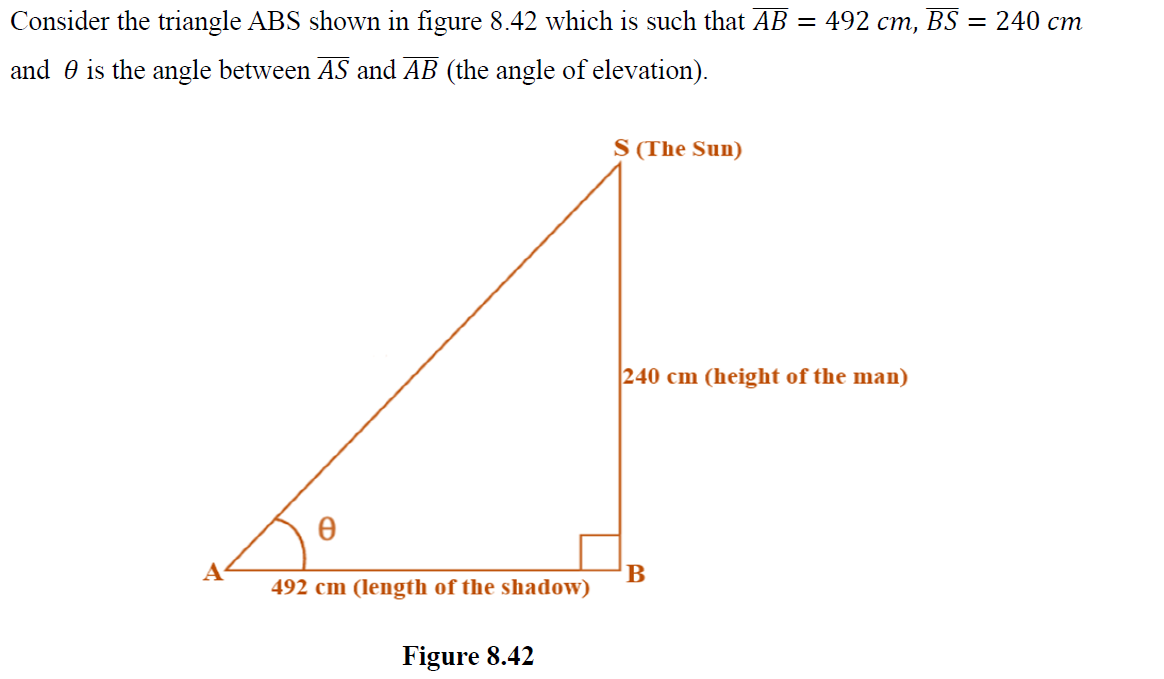
From figure 8.42 above, it follows that:
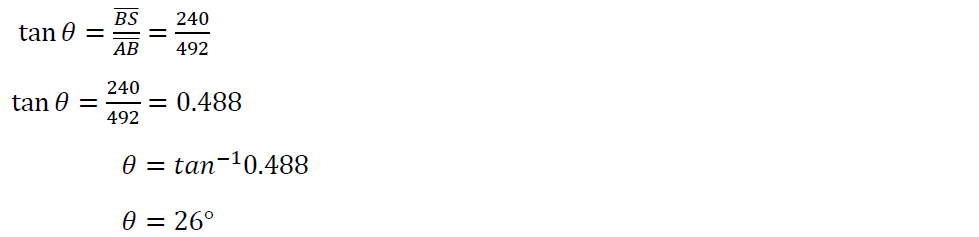
Therefore, the angle of elevation between the sun and the ground is 𝟐𝟔°.
Example 27
At point R, an engineer observed the angle of elevation of the top of a communication tower to be 46°. He moved 43 m further away to point Q on the same horizontal level as the bottom of the tower S and observed the new angle of elevation to be 35°. Find the distance RS and the height of the tower.
Solution:
Let ℎ and 𝑦 be the height of the tower and distance 𝑅𝑆 respectively as shown in figure 8.43 below:
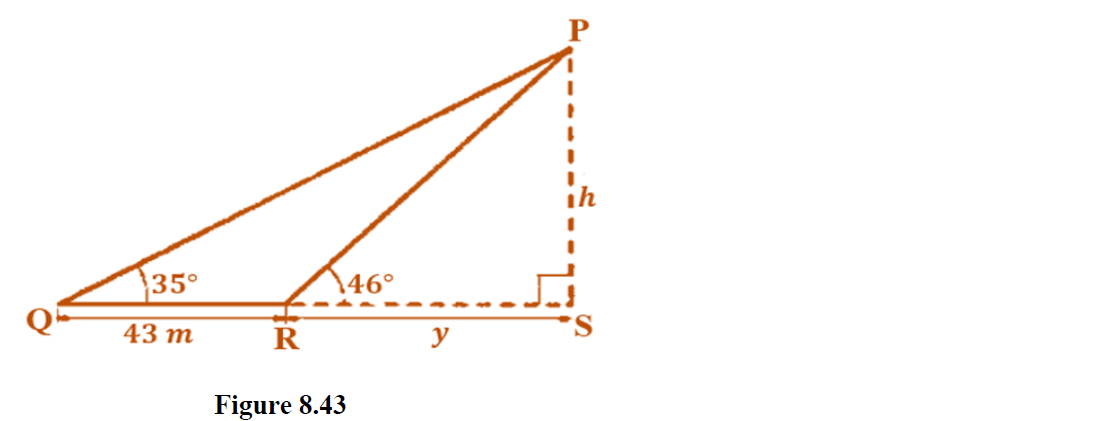
From figure 8.43, tan35°=ℎ/(43+𝑦) and tan46°=ℎ/𝑦.
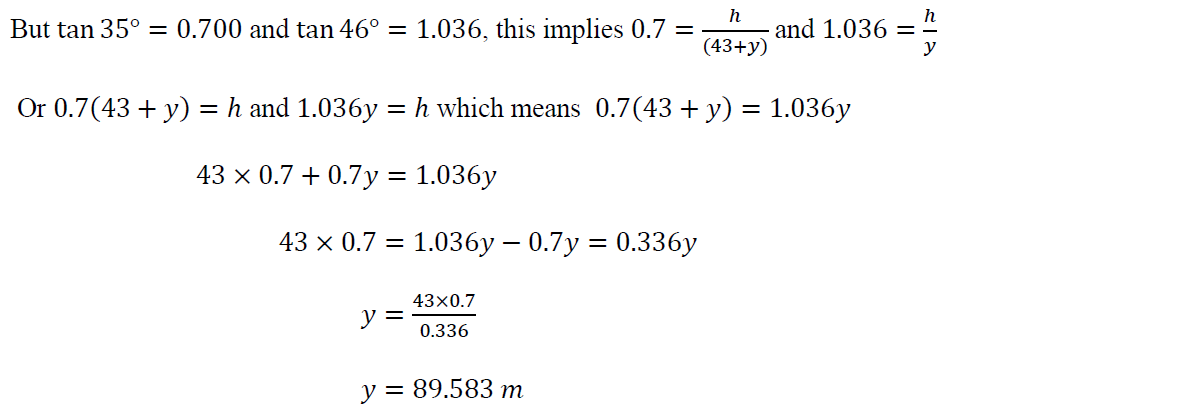
From 1.036𝑦=ℎ, substituting the value of 𝑦 gives ℎ=1.036×89.583=92.808 𝑚.

Example 28
A plane is flying at an altitude of 950 meters. If the pilot observes the base of a tree on the ground at a depression angle of 38°, how far is the plane from the tree’s base, rounded to the nearest tenth of a meter?
Solution:
Let P be the position of the Plane, B the base of the plane altitude and T the position of the tree as shown in figure 8.44 below:
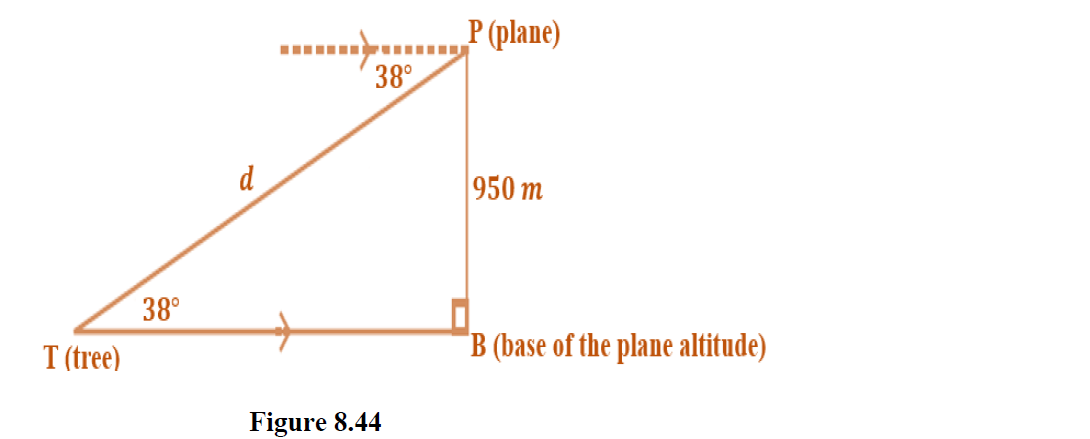
From figure 8.44 above, the distance between the plane and the base of the tree, represented by 𝑑 is obtained as follows:
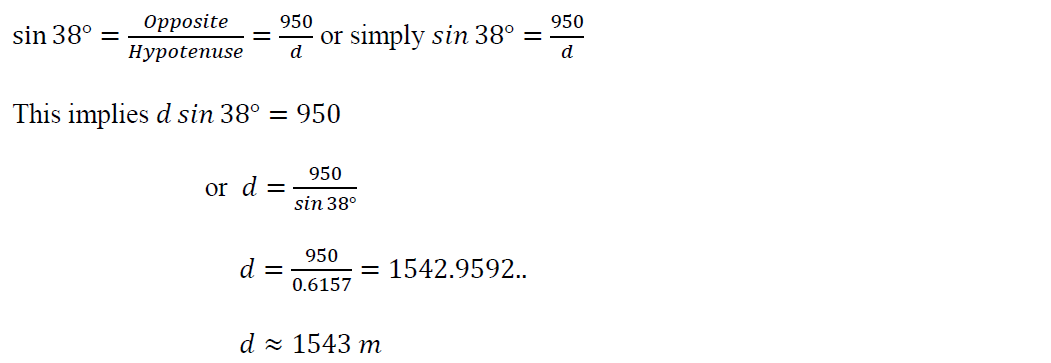
Therefore, plane is 1543 meters from the tree’s base.
Exercise 6
1.The height of a church tower is 24 metres. If a man looks at the tower from a distance of 100 metres, what is the angle of elevation of the top of the tower from the man?
2.In order to find the height of the school building, some form two students move 61 meters from the base of the building and measure the angle of elevation as 19°. What is the height of the building?
3. An airplane is flying at an altitude of 850 meters. From the plane, the angle of depression to the base of a tree on the ground is measured as 30°. What is the distance from the plane to the base of the tree, rounded to the nearest tenth of a meter?
4.The angle of elevation of the top of a mountain from the bottom of a tower 197 𝑚 high is 23.5°. From the top of the tower the angle of elevation is 16°. Calculate: (a) The height of the mountain (b) The distance between the base of the mountain and the base of the tower.
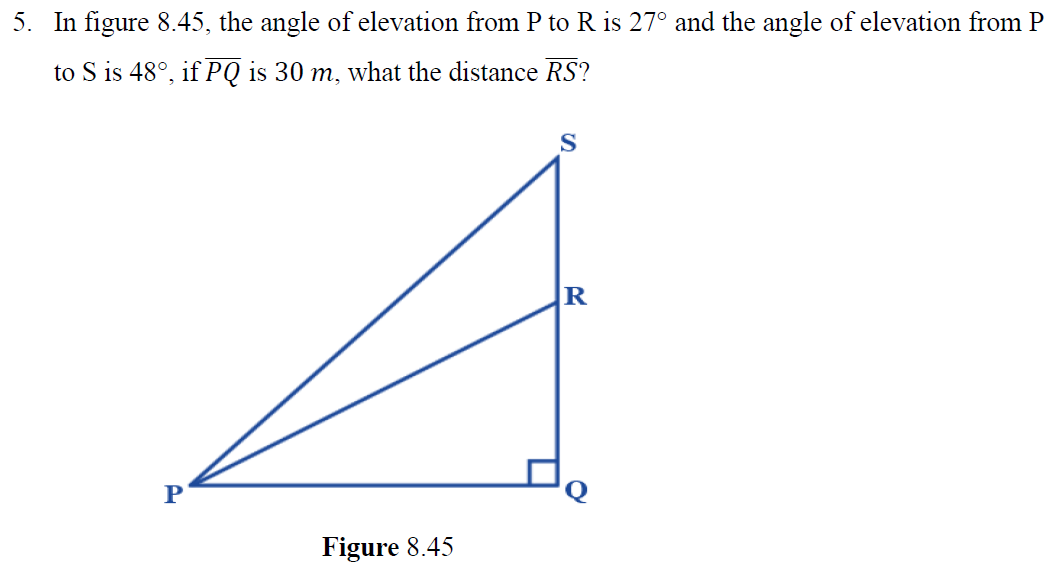
6.Two people, 2 km apart, stand on opposite sides of the telecommunication tower and in the same straight line with it. From one, the angle of elevation of the top of the tower is 18° and, from the other, it is 32°. What is the height of the tower in meters?
7. From a point Q on a horizontal plane, the angle of elevation of the top of a distant mountain is 26.7°. At a point P, 430 m further away in a direct horizontal line, the angle of elevation of the mountain is 17.3°. What is the height of the mountain?
8. A surveyor, who measures the angle of elevation of a tree as 29.2° and then walks 7𝑚 directly towards the tree, finds that the new angle of elevation is 36.9°. What is the height of the tree?
9. From the top of a lighthouse, 80 m above sea level, the angle of depression to a boat is 25°. How far is the boat from the base of the lighthouse, to the nearest metre?
10.Mr.Paul is sitting in a tree-top 13 m tall and he observes the car on the ground, 300 m from the base of the tree. What is the angle of depression from Paul to the car?
11. A person standing on a cliff 120 m high observes a ship at an angle of depression of 30°. Find the distance of the ship from the base of the cliff.
12. From the top of a building 60 m tall, the angle of depression to a car on the ground is 20°. Calculate how far the car is from the base of the building.
13. A tower stands on level ground. From its top, the angle of depression to a point on the ground is 15°. If the tower is 50 m high, find the distance of the point from the base of the tower.
14. From the top of a hill 90 m high, the angle of depression to a river is 18°. How far is the river from the base of the hill?
15. A lighthouse is 70 m tall. The angle of depression of a ship from the top of the lighthouse is 35°. Find the horizontal distance between the ship and the base of the lighthouse.
16. From the top of a vertical cliff, the angle of depression to a boat is 12°. If the cliff is 110 m high, calculate the distance of the boat from the base of the cliff.
17. The angle of elevation of the top of a flag pole from a point 25m from its base is 22°, what is height of the pole?
18. A boy observes a car approaching on the desert plain from his position on top of a 20 m hill. The angle of depression of the car at that instant is 40°. How far from the base of the cliff is the car?
19.Mr. John observes a ship out to sea from his position at the top of a 50 𝑚high lighthouse. The angle of depression to the ship is 17°. Find the distance to the ship:
(a) from the base of the lighthouse.
(b) directly along John’s line of sight.
20. A bulldozer lumbers up a hill for 98 m. Its instruments show that the hill has an angle of elevation of 28°. Find:
(a) The vertical distance that the bulldozer has traveled.
(b)The horizontal distance that the bulldozer has traveled.
21. Kelvin is on top of a building and observes a small boy on top of another taller building nearby at an angle of elevation of 26°. If his building is 80 m high and the other is 120 m tall how far in a direct line is Kelvin from the boy?
22.The 18m arm of a crane is horizontal before it lifts its load from the ground to a point 11 m vertically above the ground. What is the angle of elevation through which the load has been lifted?
23. A tourist is standing on a cliff-top and observes the angle of depression to a point P in a deep gorge to be 48°. The tourist then turns in the opposite direction and observes another point Q in a second gorge to have an angle of depression of 56°. The points, P and Q, are both on the same horizontal level 48 m beneath the tourist. What is the distance between P and Q?
Listening to this topic