Mathematics (New)
SIMILARITY
Reading settings
Text size
Line spacing
Colours
SIMILARITY
Similarity is a key concept in geometry that describes figures with the same shape but possibly different sizes. Two shapes are similar when their corresponding angles are equal and their corresponding sides are proportional.
This means one figure can be obtained from the other by scaling (either enlarging or reducing) without changing its form. Similarity is commonly studied in triangles using criteria such as AA, SAS, and SSS.
In real life, similarity is widely applied in areas like map reading, architecture, and engineering, where accurate scaling is essential.
It is also used in photography and computer graphics to resize images without distortion, and in indirect measurement, such as finding the height of tall objects using shadows. This makes similarity both a practical and powerful tool for solving everyday problems.
CONTENTS: Under this topic you will cover the following three main concepts about Similarity: (i) Similar Figures (ii) Similar Triangles (iii) Similarity Theorems.
COMPETENCES: Studying similarity will help you develop the ability to:
(a) Identify and compare shapes:This is through checking equal angles and proportional sides. It builds skills in applying similarity criteria (AA, SAS, SSS) to determine whether figures, especially triangles, are similar.
(b) Calculate unknown lengths in different geometrical figures: It is possible by using ratios and scale factors.
(c) Interpret diagrams: Understanding and analyzing geometric figures accurately.
(d) Build problem-solving and logical reasoning skills: This is because you learn to apply similarity in different contexts. It also develops the ability to apply mathematical concepts to real-life situations, such as scaling drawings, interpreting maps, and making indirect measurements.
The competencies developed will enable you to apply similarity in solving a wide range of practical problems, including those related to map reading and navigation, architecture and engineering, photography, art, and computer graphics, as well as in indirect measurement situations such as estimating heights and distances.
Similar Figures.
Similar figures are shapes that have the same form but may differ in size. They have equal corresponding angles and proportional corresponding sides, meaning that one figure is an enlargement or reduction of the other.
The relationship between their sides is constant, and this constant ratio is called the scale factor. Similar figures can include triangles, polygons, and other geometric shapes.
The concept of Similarity.
Similar Shapes in Everyday Life
What Makes Figures Similar
The Two Conditions for Similarity
Similarity: Review
Describe the concept of Similarity.
Definition:
Similar Figure (polygons) are polygons whose vertices can be paired in such a way that corresponding angles are congruent and corresponding sides are proportional.
To say that corresponding sides of similar polygons are proportional means that the ratios of their measures are equal.
Note that the definition of similar polygons requires that ALL corresponding angles be congruent and that all corresponding sides be proportional.
Unless both these requirements are met in full, it cannot be said that two polygons are similar. For example, the following pairs of polygons are not similar.
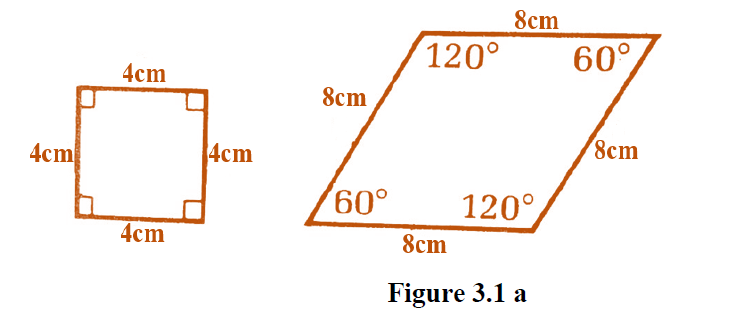
The rhombus and square are not similar. All corresponding sides are proportional, but it is not true that all corresponding angles are congruent.
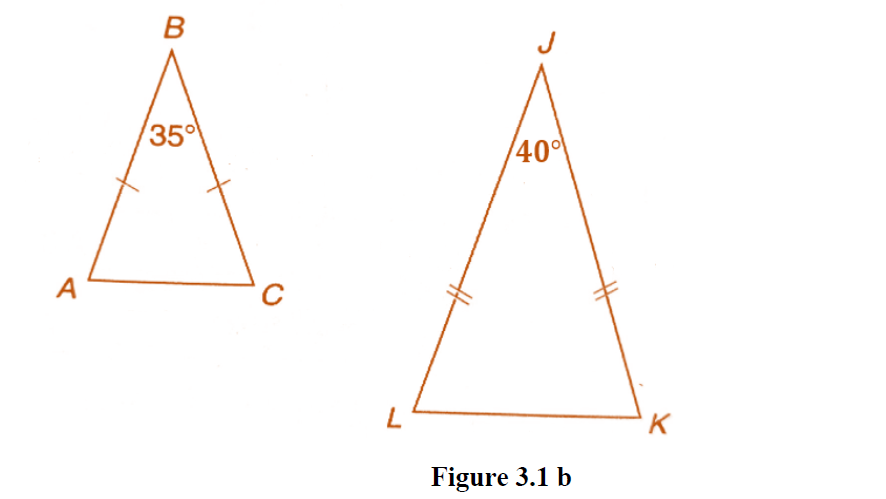
The isosceles triangles ABC and LJK are not similar. Their corresponding sides are proportional but their corresponding angles are not congruent.
Similar Triangles.
Triangles are considered similar if their matching angles are equal and the lengths of their corresponding sides are in the same ratio. The triangles ACD and BCD in figure 3.2 represent an example of similar triangles.
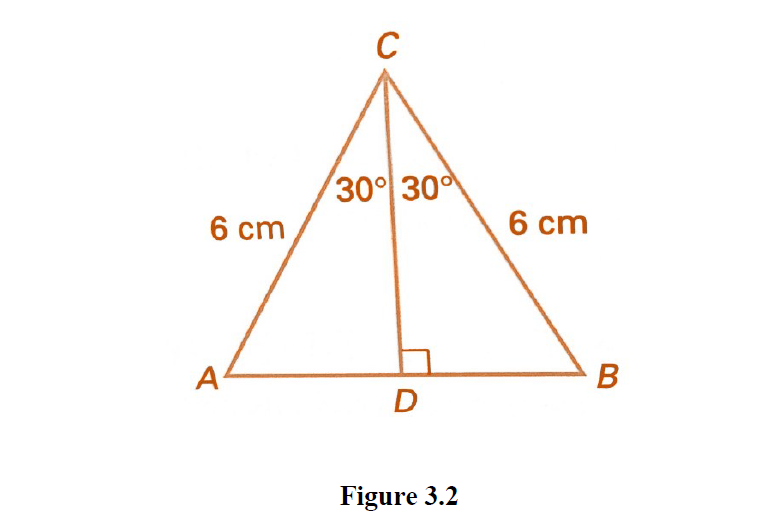
From ΔACD and ΔBCD,
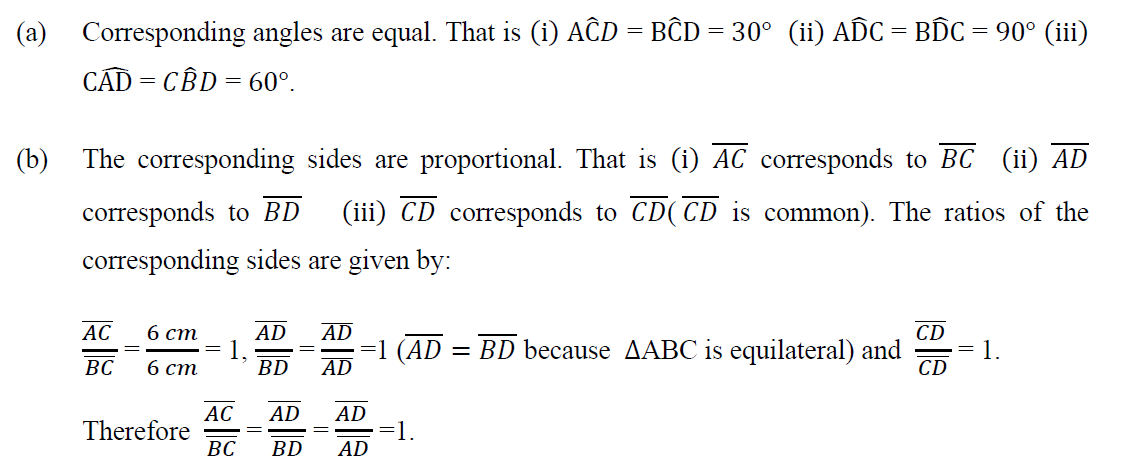
Since the corresponding angles are equal, and the corresponding sides are proportional, the two triangles are similar.
The ratio of the lengths of corresponding sides of similar polygons is also called the scale factor of the similar polygons.
We write ΔPQR ~ ΔUVW to mean ΔPQR is similar to ΔUVW. The symbol ~ means “similar to.”
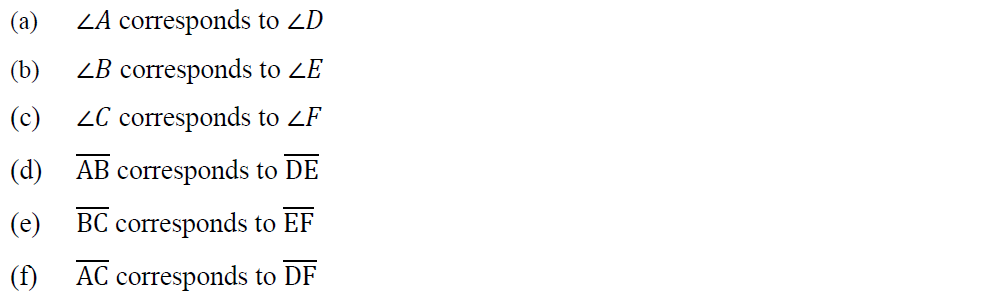
NOTE:Similar figures (polygons) are named according to the order of their vertices. For example, in ΔABC and ΔPQR, it can be deduced from the order of the vertices that AB corresponds to PQ, BC corresponds to QR, and AC corresponds to PR.
Recognize properties of similar triangles AND solve the related problems.
Similar Triangles and Their Ratios
Example 1
Given that ΔABC ~ ΔDEF, identify all the corresponding angles and the corresponding sides.
Solution:
Using the order of vertices of the two similar triangles, we get the following corresponding angles and sides.
Example 2
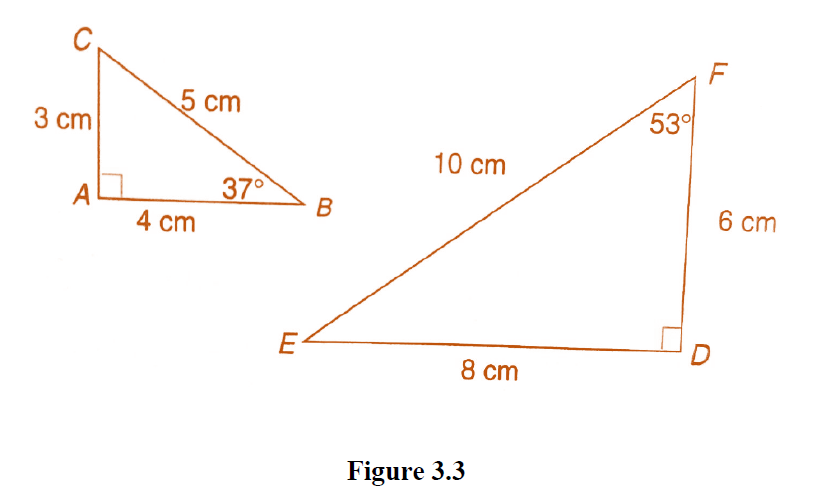
In figure 3.3 below, verify that ΔABC ~ ΔDEF.
Solution:
From the definition of similar figures, ΔABC ~ ΔDEF if and only if their corresponding angles are congruent(equal) and their corresponding sides are proportional.
Now in ΔABC and ΔDEF,
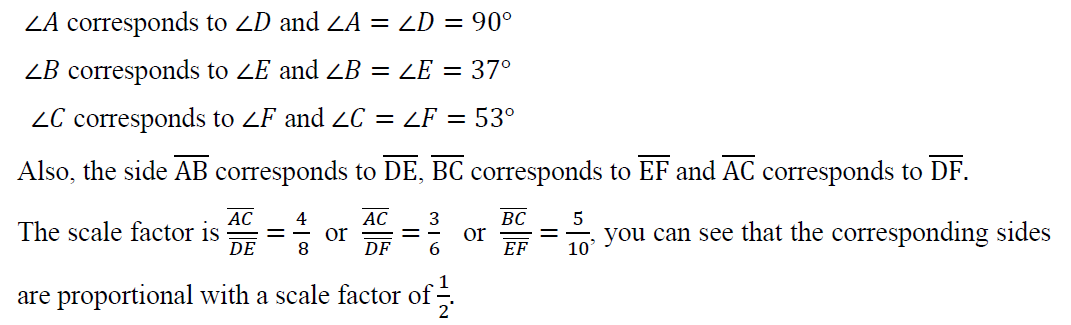
Therefore, ΔABC ~ ΔDEF because their corresponding angles are equal(congruent) and their corresponding sides are proportional.
Example 3
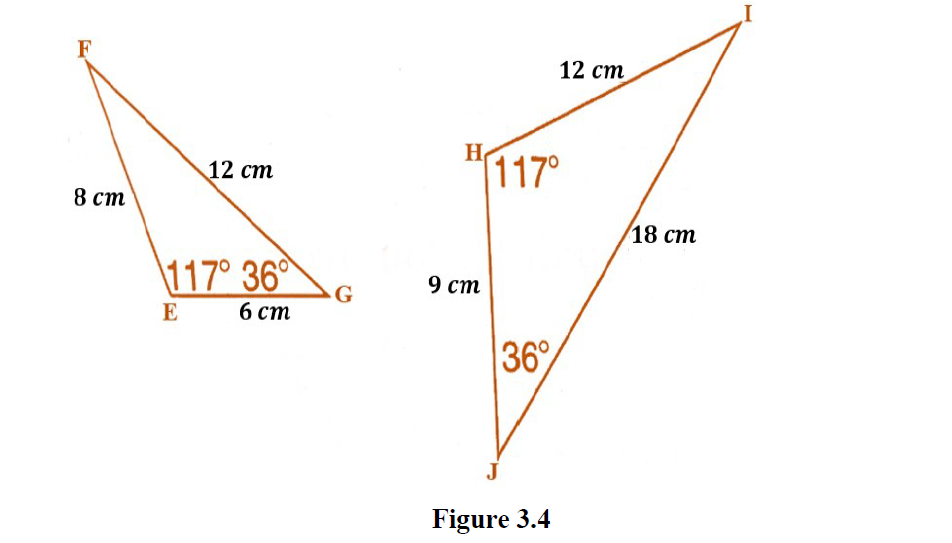
Verify that the two triangles (ΔEFG and ΔHIJ) shown in figure 3.4 below are similar.
Solution:
Check that the corresponding angles are congruent.
From the given measures,
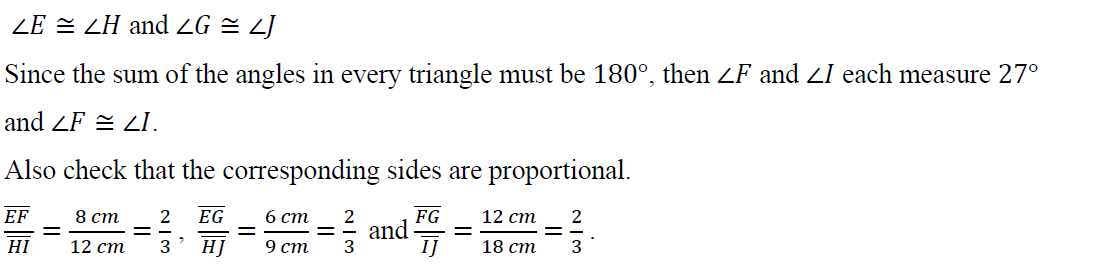
The two conditions for similarity are met, so ΔEFG~ΔHIJ.
Example 4
Given that ΔABC ~ ΔPQR, find the value of angle ABC if:

Solution:
Consider figure 3.5 indicating ΔABC and ΔPQR.
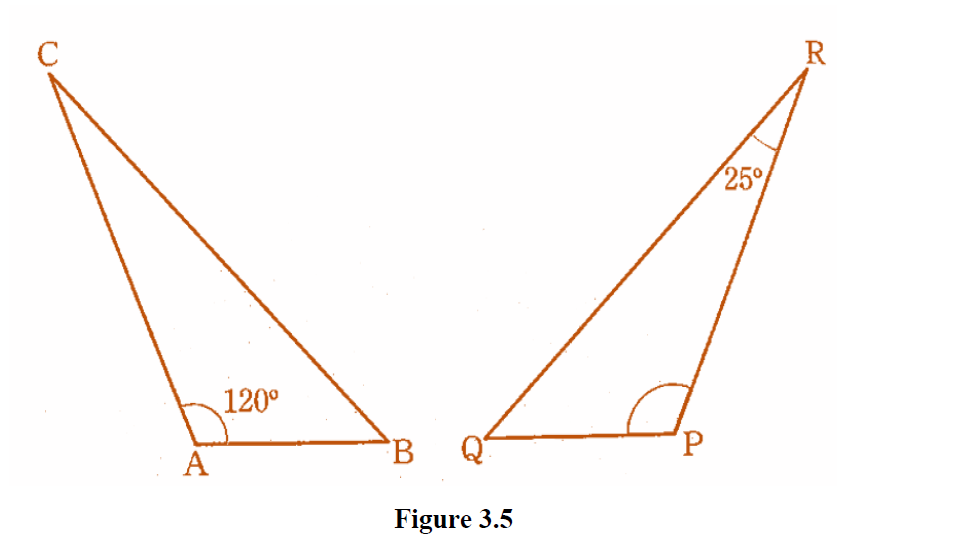
Consider ΔABC and ΔPQR:
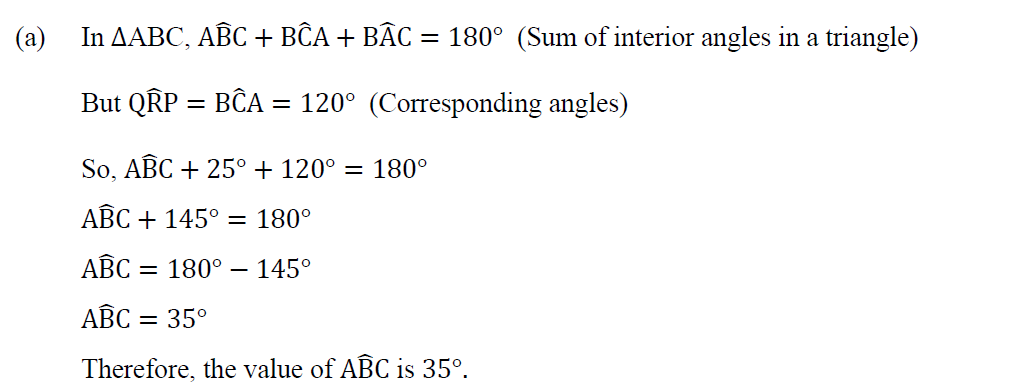
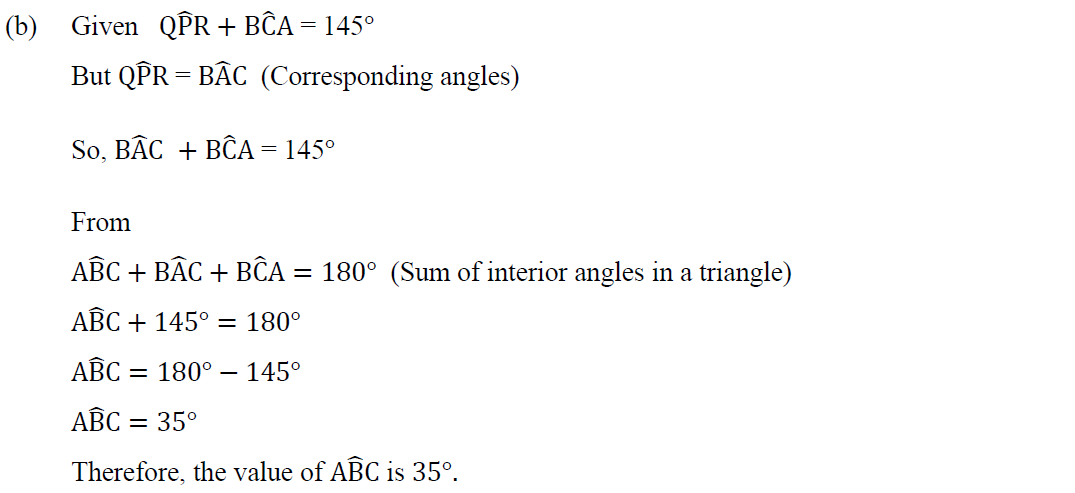
Example 5
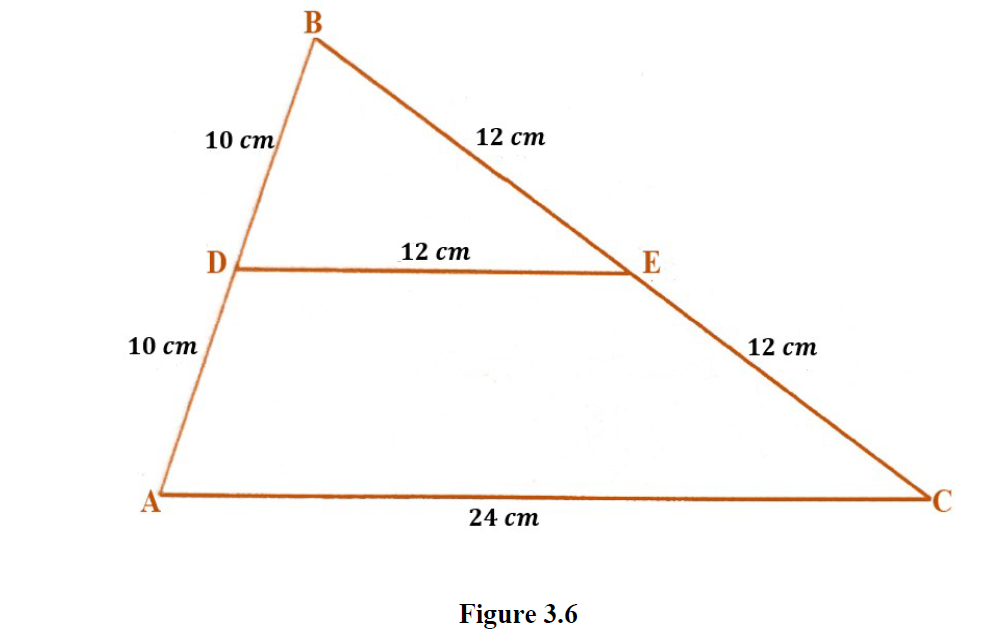
In figure 3.6, name the triangles which are similar and determine the constant of proportionality (scale factor) needed to show their similarity, given that AC∥DE.
Solution:
Consider ΔABC and ΔDBE,

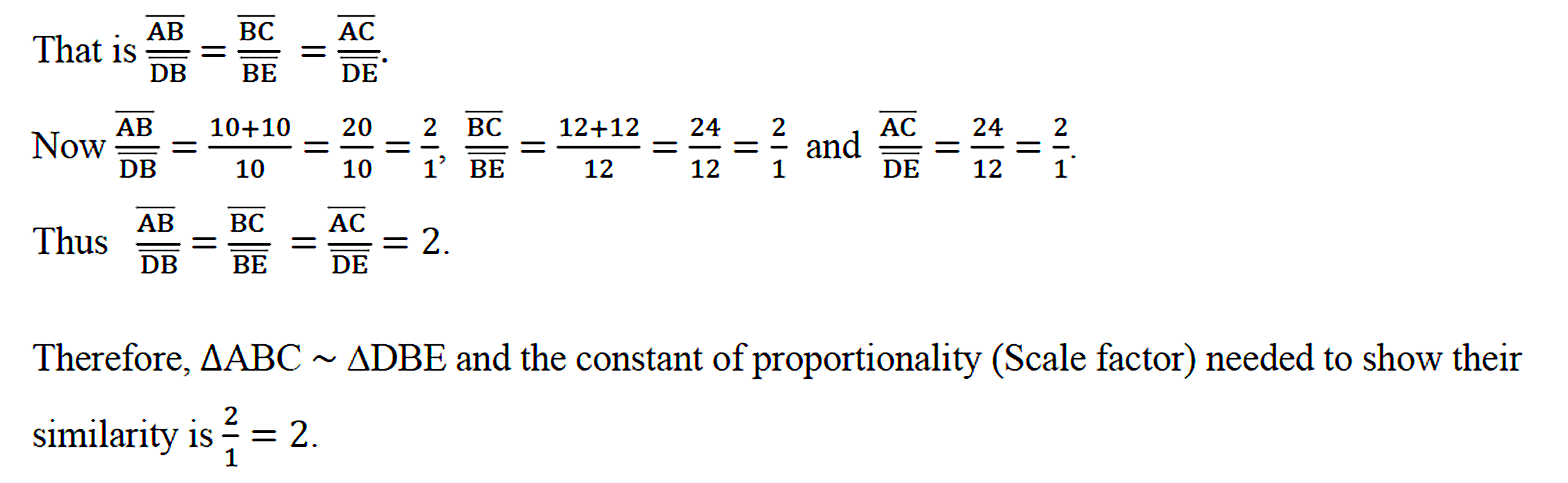
The second condition which completes the verification that ΔABC ~ ΔDBE is to show that their corresponding sides are proportional;
Example 6
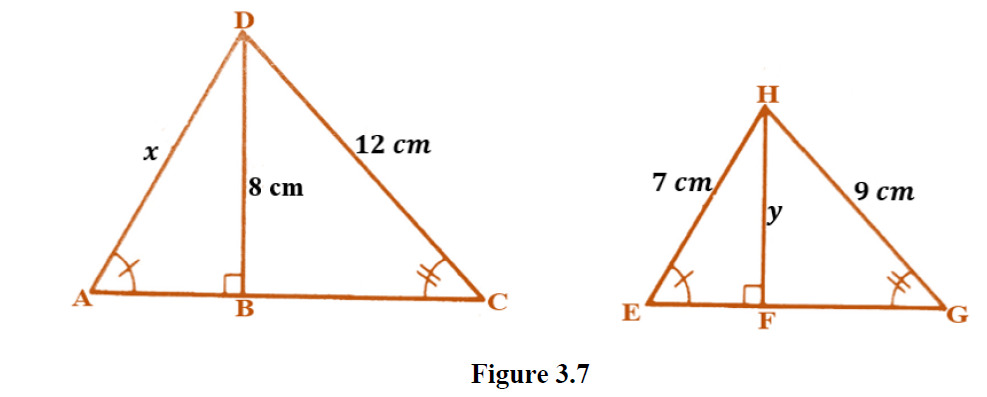
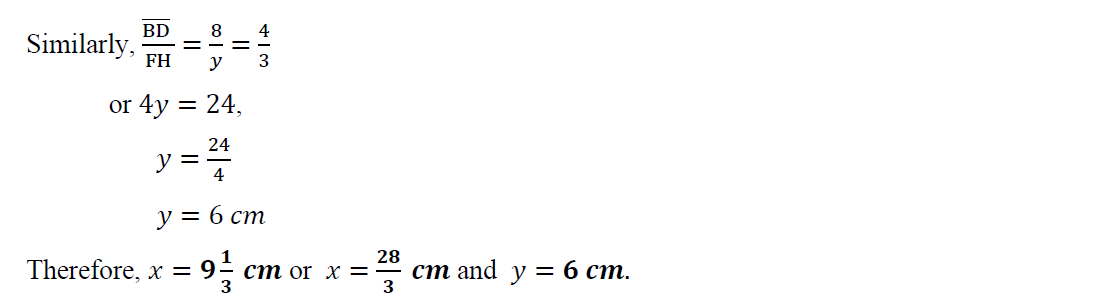
Find the value of 𝑥 and 𝑦 from the following figure if ΔACD ~ ΔEGH.
Solution:
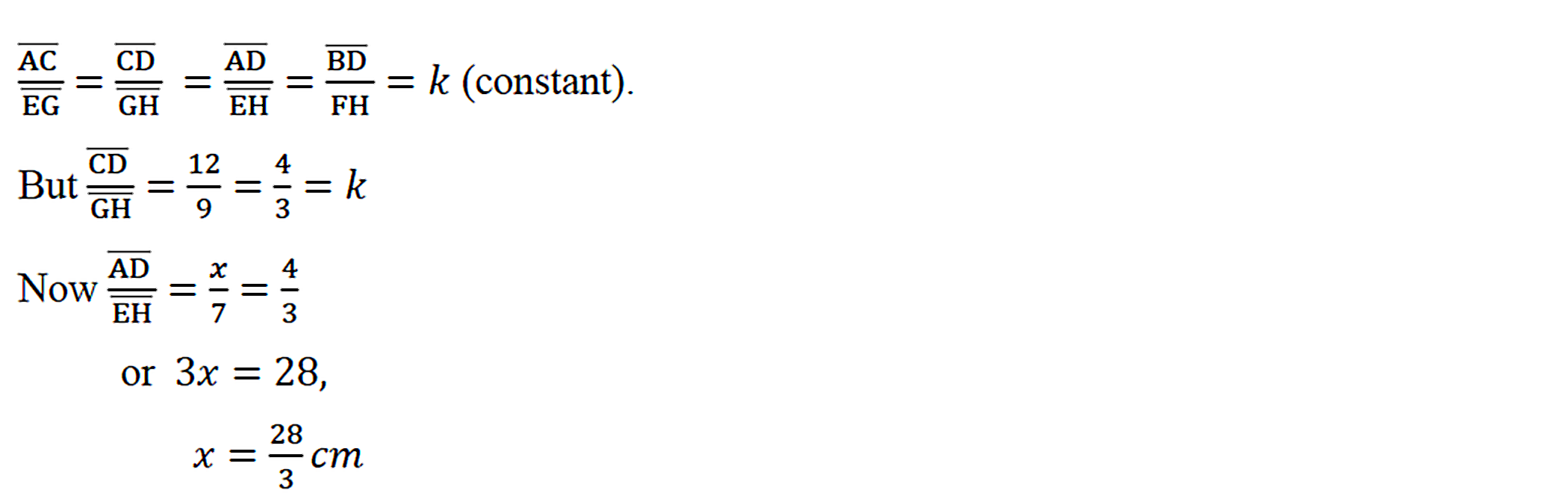
Since ΔACD ~ ΔEGH, the ratio of lengths of corresponding sides are given by:
Exercise 1
1. (a) Given that Δ PQR ~ ΔTSM, identify the corresponding angles and the corresponding sides.
(b) Given that Δ PQR ~ ΔLMN and Δ PQR ~ ΔABC, identify the corresponding angles and corresponding sides between ΔABC and ΔLMN.
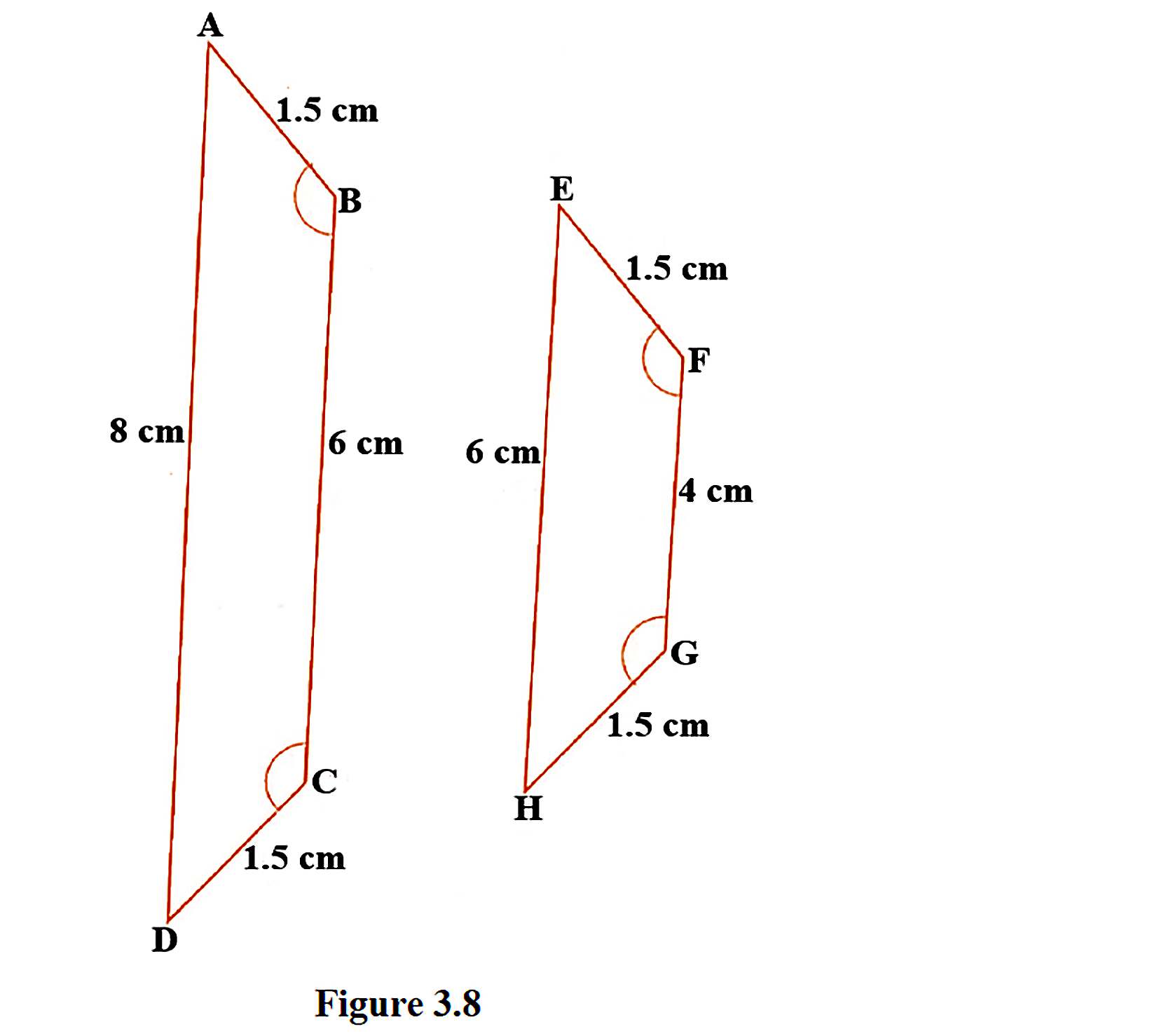
2. With reasons, state whether the two polygons shown in figure 3.8 are similar or not.
3. One rectangle is 12 cm long and 8 cm wide, while another measures 48 cm in length and 32 cm in width. Determine whether the two rectangles are similar or not, and give reason to support your answer.
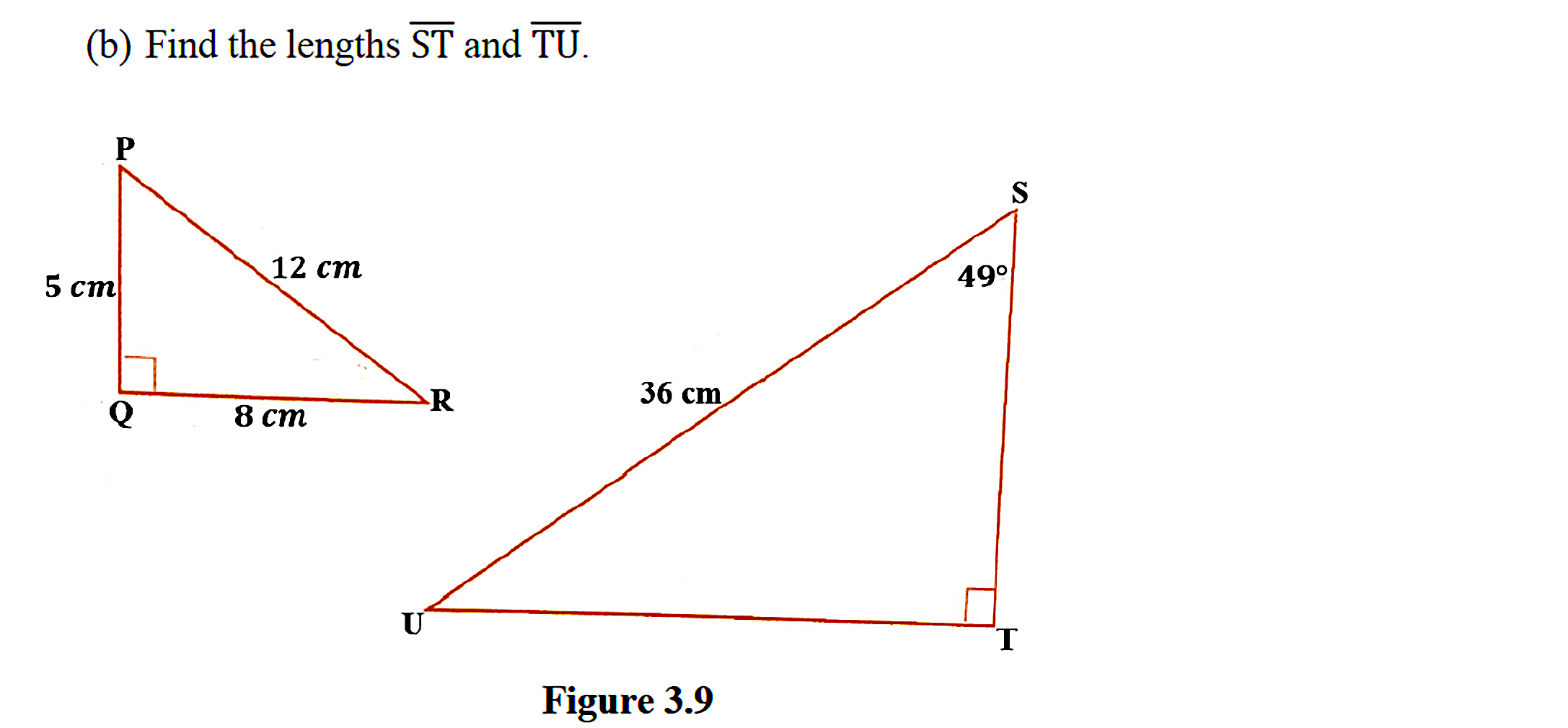
4. In figure 3.9 Δ PQR ~ ΔSTU:
(a) What are the angle measures for ∠𝑃 and ∠𝑅?
5. A rectangle has a length of 23 cm and width of 16 cm. A second rectangle has a length of 12 cm and a width of 9 cm. Are the two triangles similar? Explain your answer.
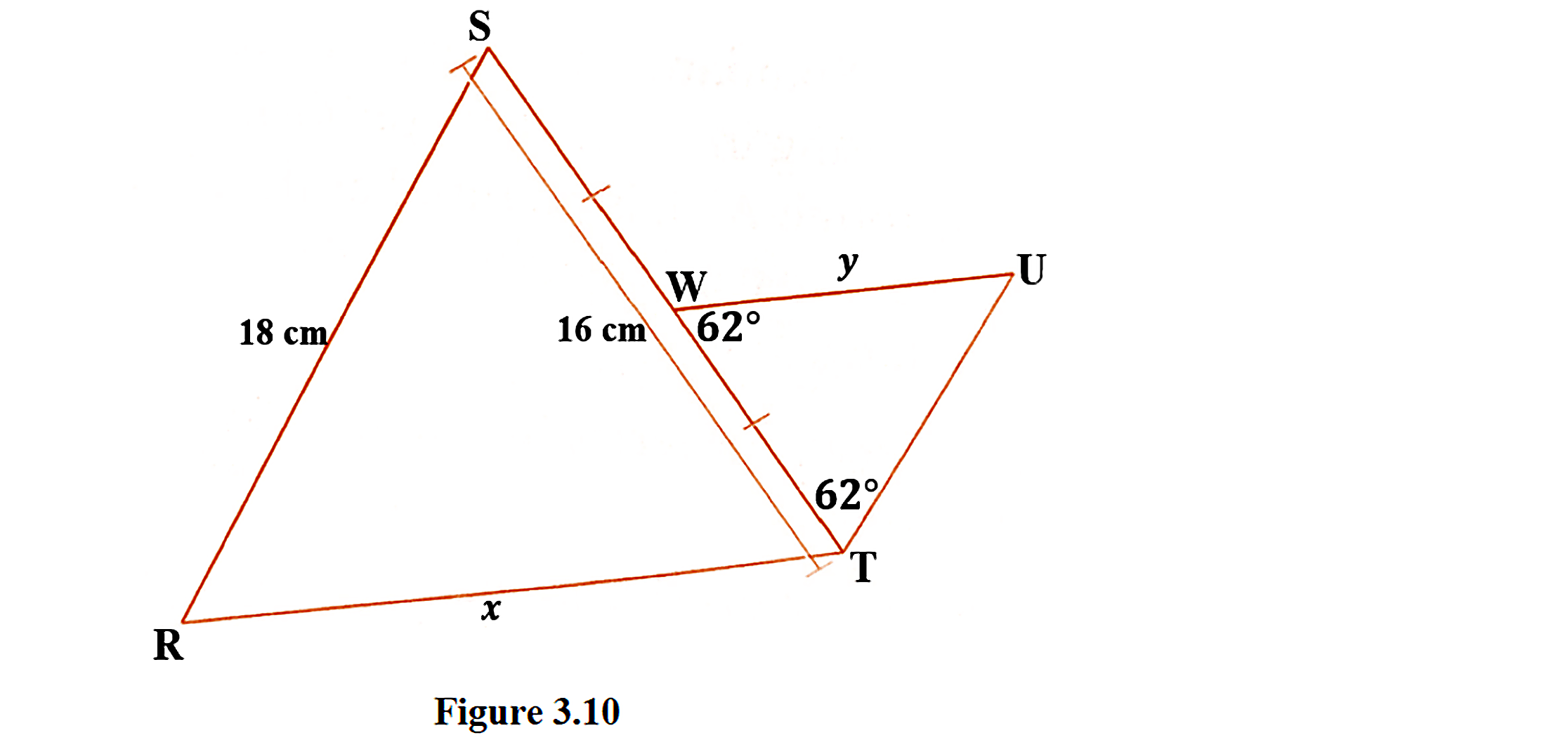
6. In figure 3.10 ΔRST ~ ΔUTW, what is the value of 𝑥 and 𝑦?
7. Given that ΔABC and ΔLMN are similar, find the value of AĈB if:

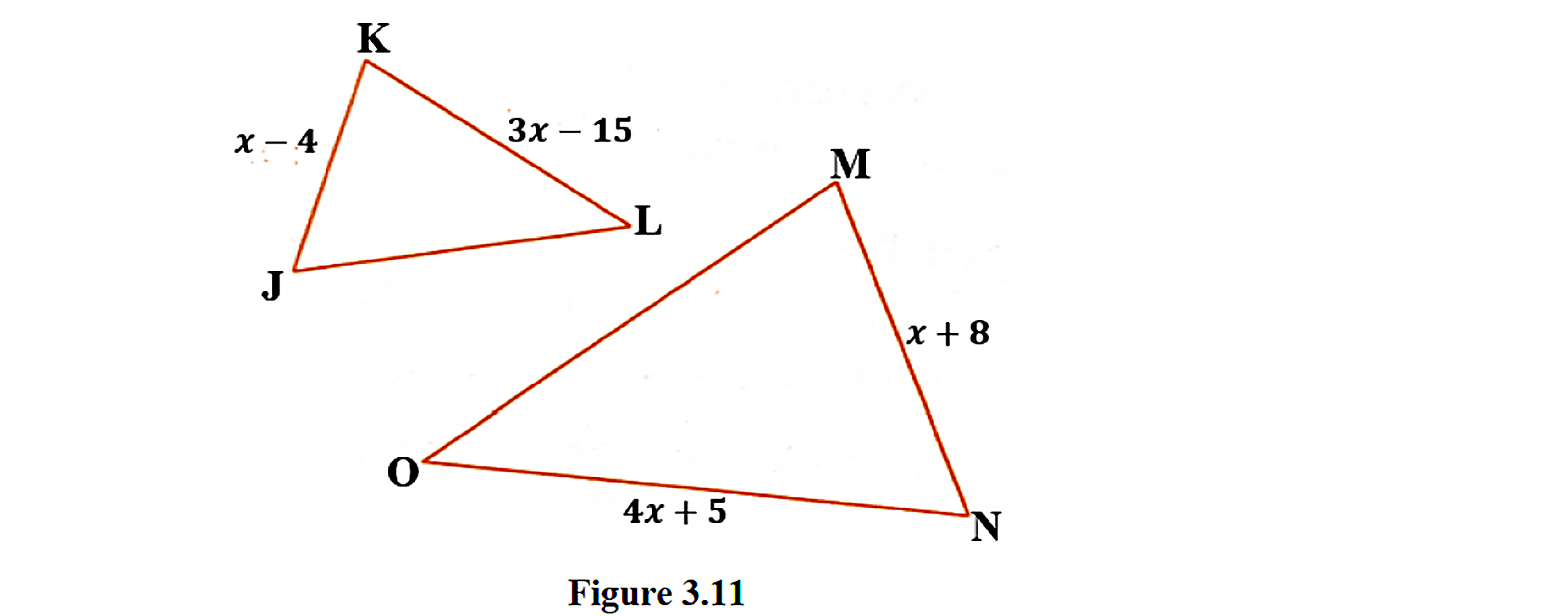
8. Given that in figure 3.11, ΔJKL is similar to ΔMNO. Find the value of 𝑥 and the scale factor for the similarity.
9. Given that
_1778069641869.png)
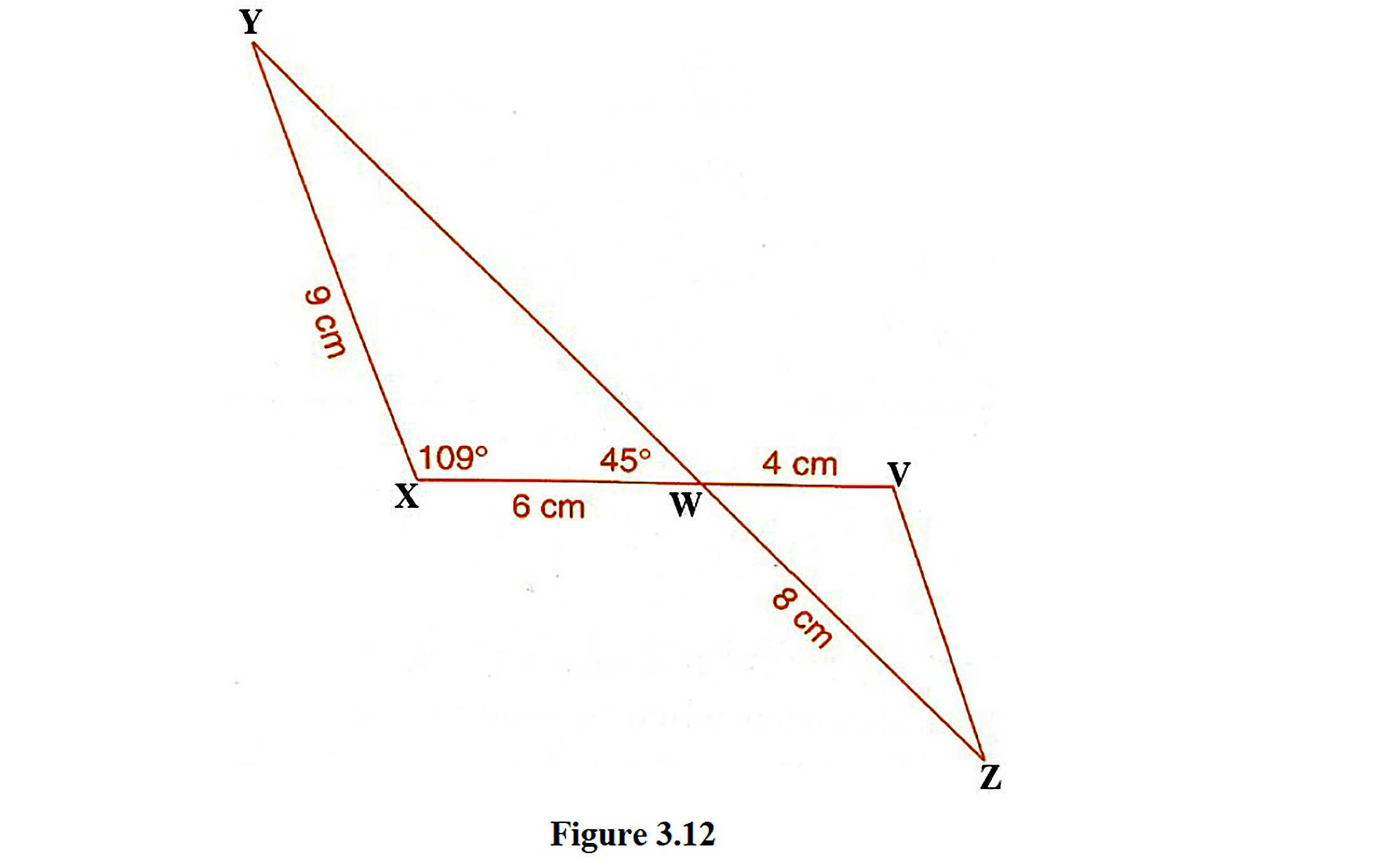
10. Find all the angle measures and side lengths for each triangle in figure 3.12, given thatΔWXY ~ ΔWVZ.
Similarity Theorems
Similarity theorems are applied when solving problems that involve similar triangles. For instance, if ΔABC ~ ΔXYZ, this implies that:
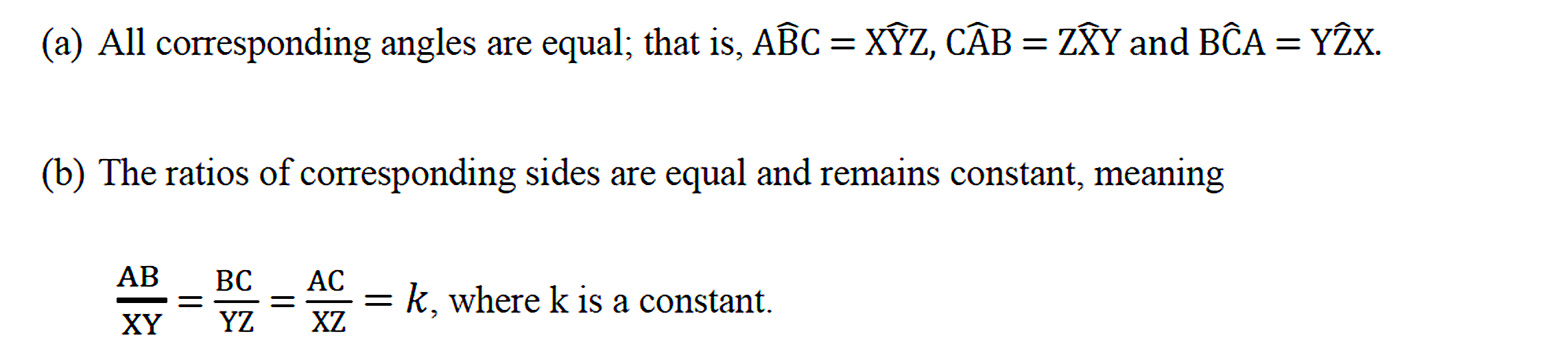
This constant ratio between corresponding sides of similar figures is known as the scale factor or constant of proportionality.
Similarity Theorems and solve the related Problems.
Explore Similarity Theorems and solve the related Problems.
To establish that two triangles are similar, only one of the following conditions is sufficient:
(a)Two triangles are similar if any two pairs of their corresponding angles are equal. This condition is known as the Angle–Angle (AA) similarity theorem.
(b) Similarity is established when all three pairs of corresponding sides of the triangles are in proportion. This is referred to as the Side–Side–Side (SSS) similarity theorem.
(c) If two pairs of corresponding sides are proportional and the included angle between those sides is equal in both triangles, then the triangles are similar. This is called the Side–Angle–Side (SAS) similarity theorem.
ANGLE-ANGLE (AA) SIMILARITY THEOREM
This theorem states that in any two triangles, if two pairs of corresponding angles are congruent(equal), then the triangles are similar. This implies that if two pairs of angles are equal, the third pair of angles will also be equal. See figure 3.13 below.
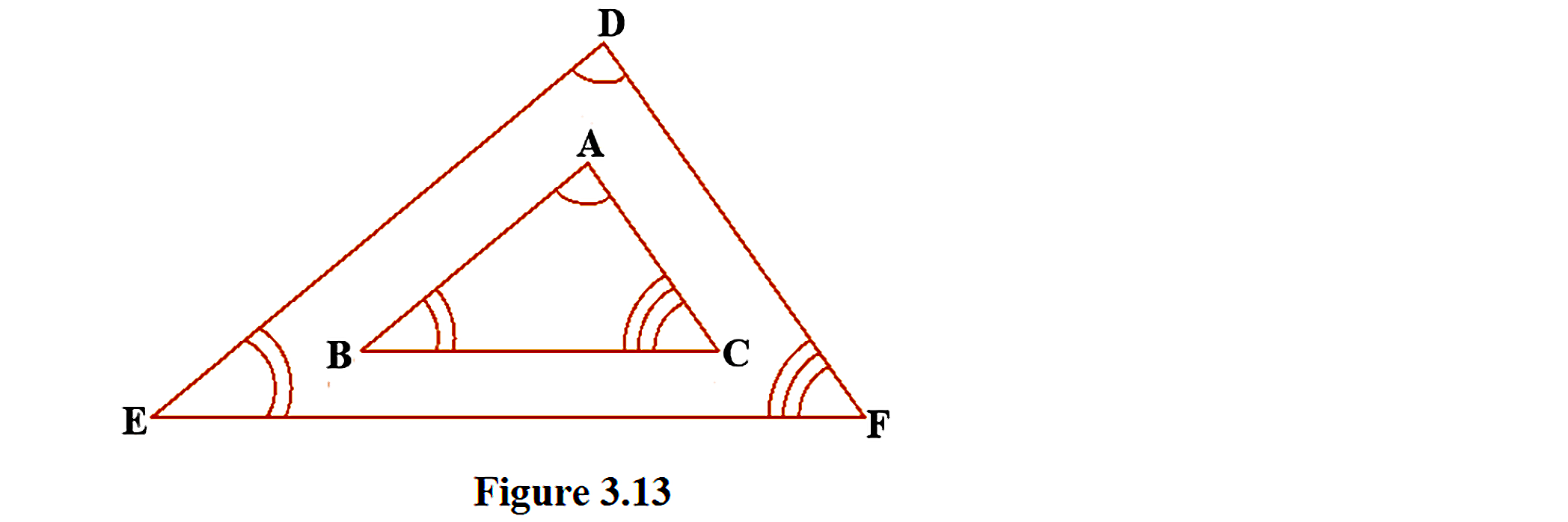
In figure 3.13, ΔABC ~ ΔDEF because all corresponding angles in the two triangles are congruent.
Example 7
Name two similar triangles from figure 3.14 below.
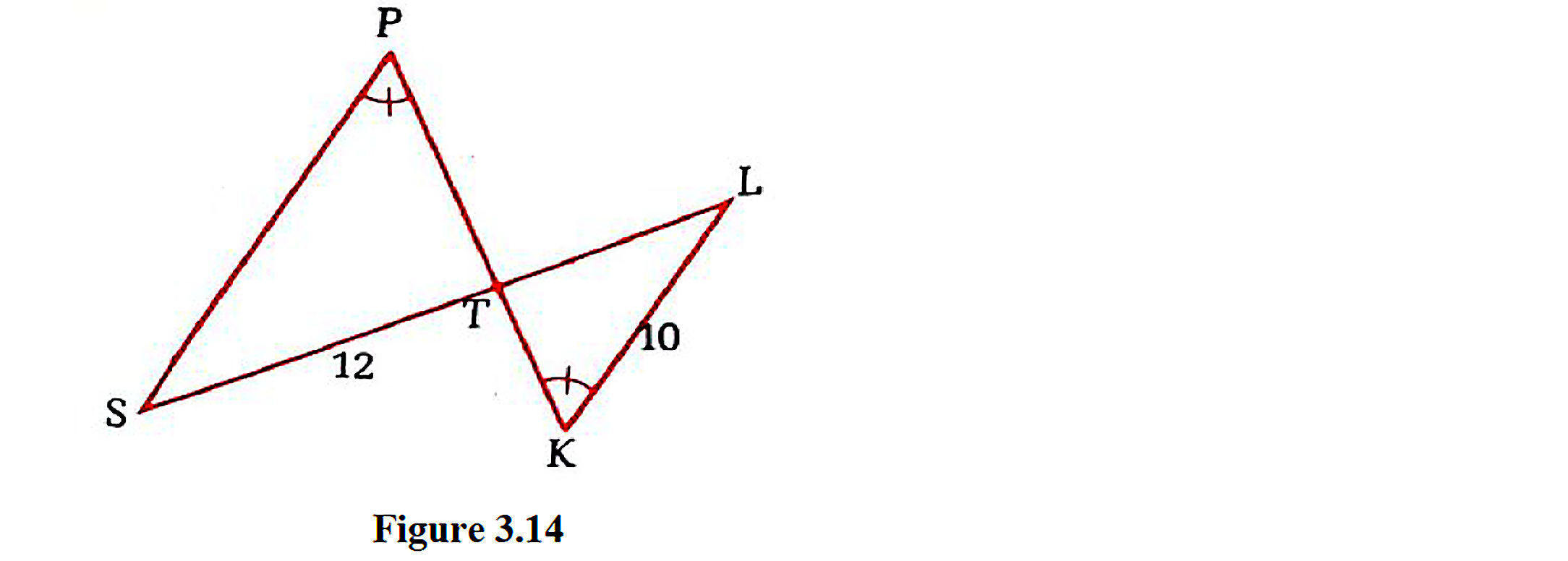
Solution:

Note that you can name pairs of similar triangles in different ways depending on first vertex of triangle you choose. For example (ΔTKL and ΔTPS) and (ΔPST and ΔKLT) are also the pairs of similar triangles.
Example 8
In figure 3.15, prove that ΔUVW ~ ΔXYZ.
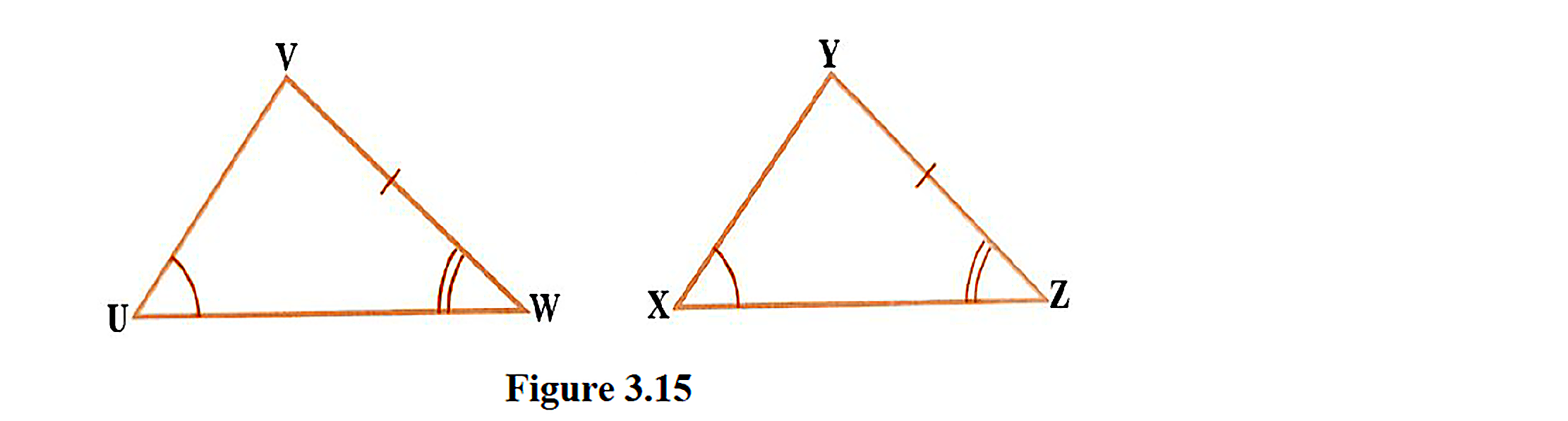
Solution:
From ΔUVW and ΔXYZ;

Example 9
Use figure 3.16 to prove that:

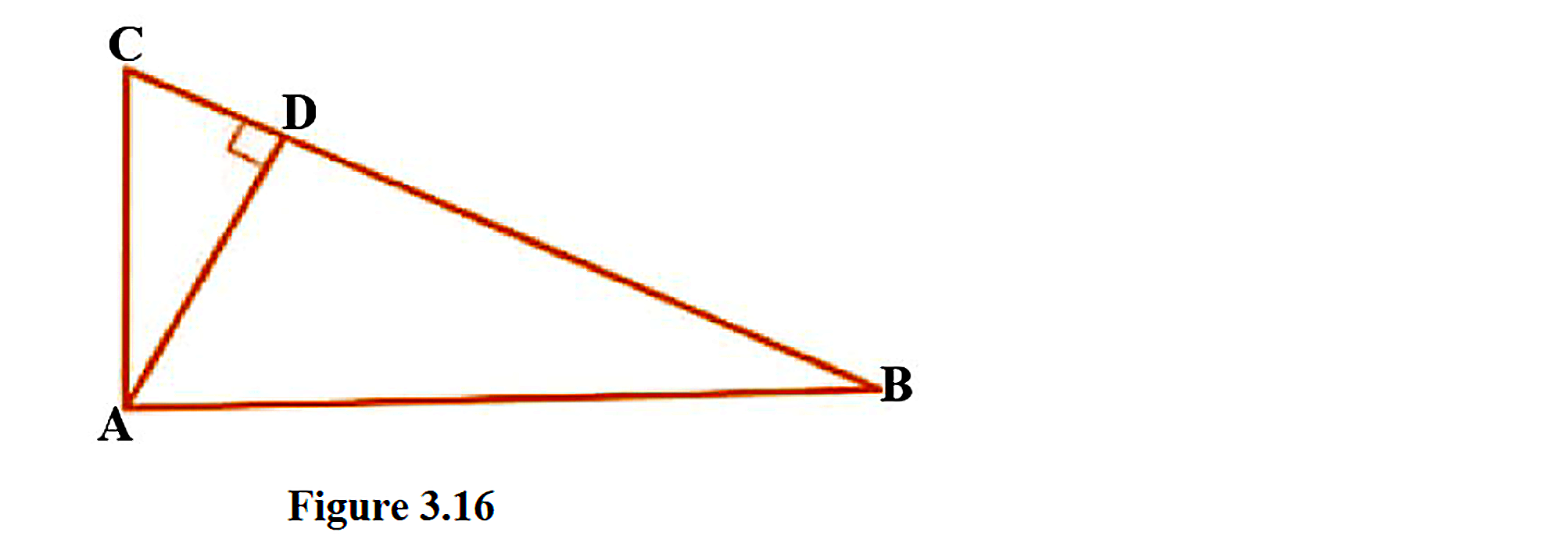
Solution:
(a)The numerators contain the vertices A, D and C while the denominators contain A, B and C. Thus, the two triangles are ADC and ABC.

Therefore, ΔADC ~ ΔABC (By AA similarity theorem). Since ΔADC ~ ΔABC, then the ratio of corresponding sides is constant. That is:

(b) The numerators contain the vertices A, B and D while the denominators contain A, D and C. Thus, the two triangles are ADC and BDA.
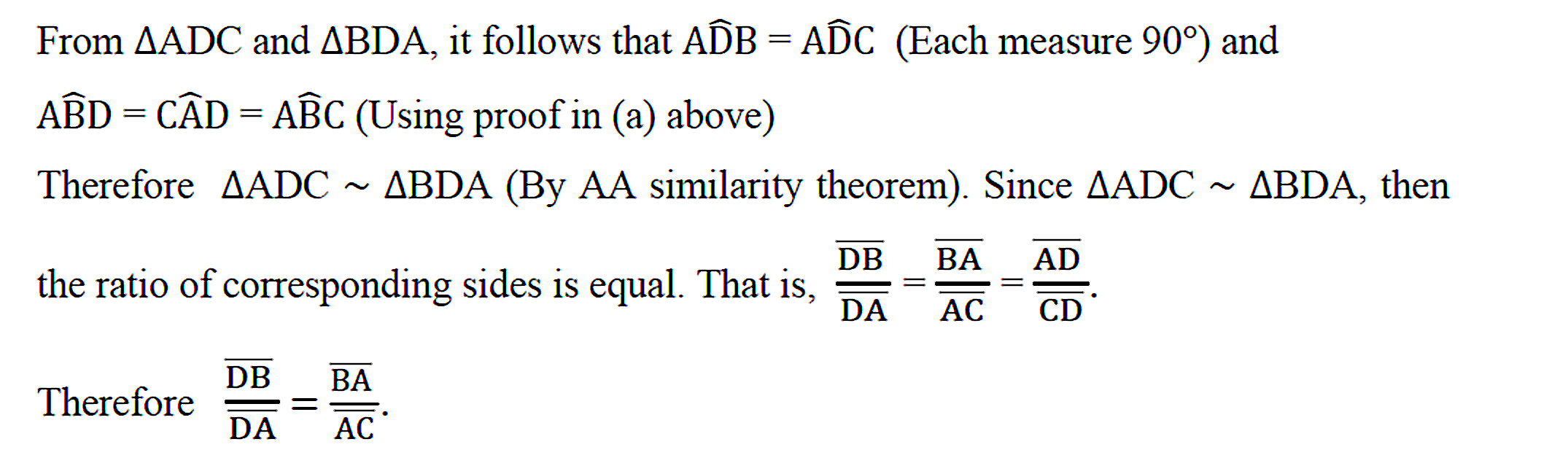
Example 10
In figure 3.17, find the value of:
(a) 𝑥
(b) 𝑦
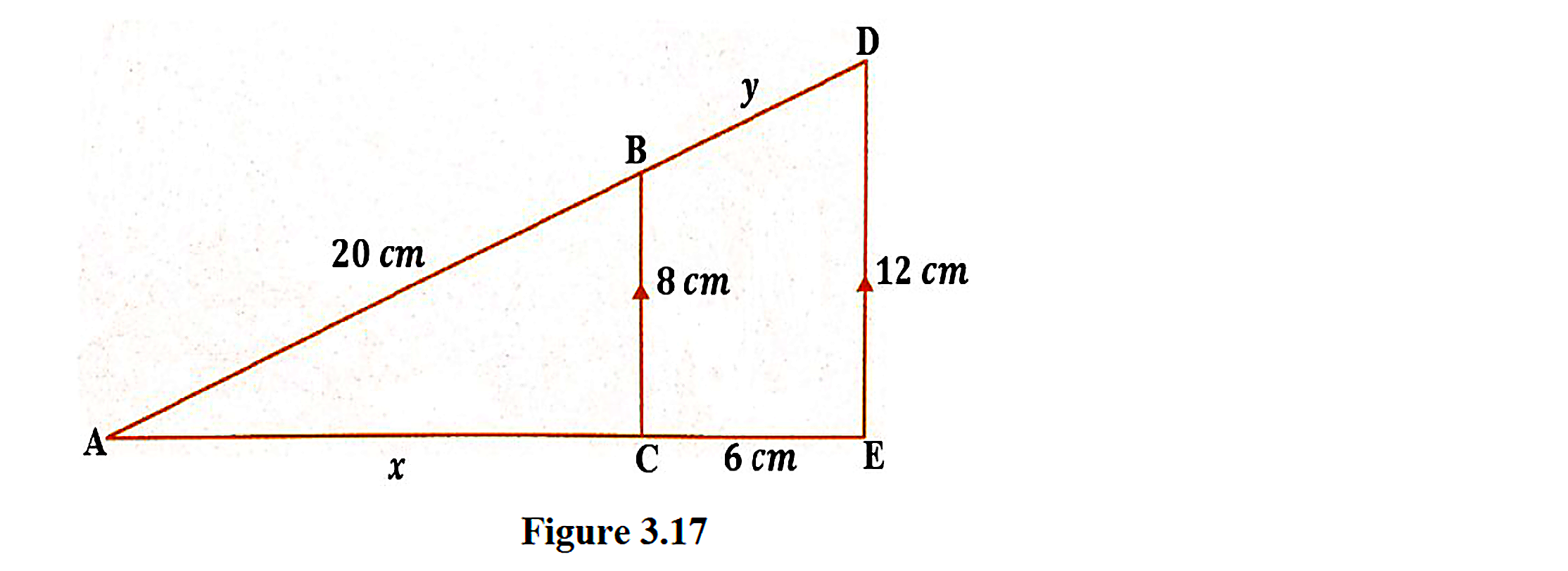
Solution:
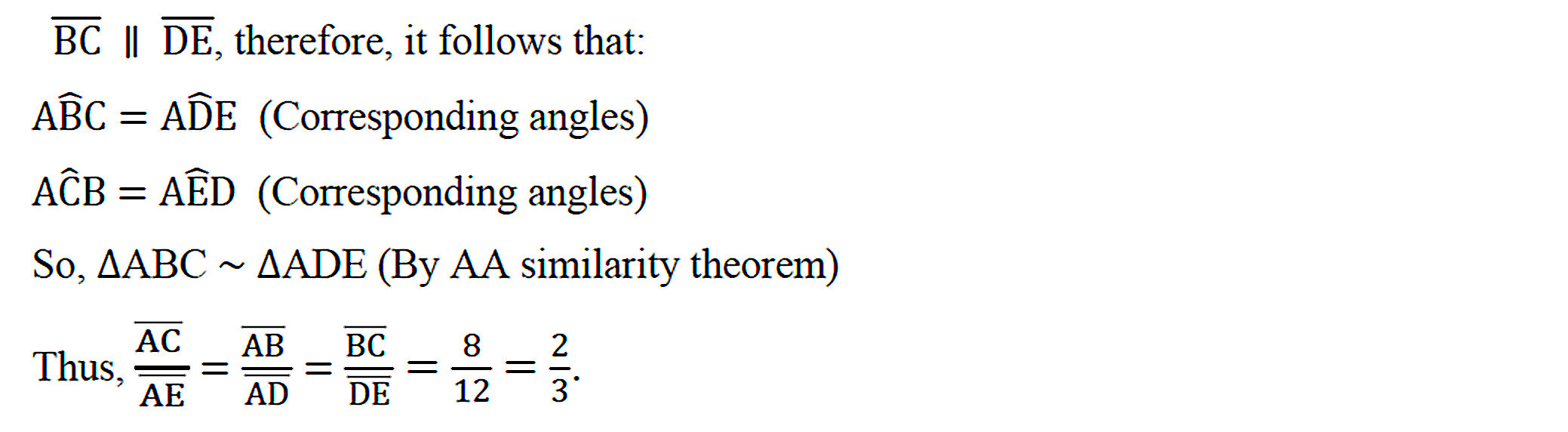
Now the value of 𝑥 and 𝑦 are found as follows:
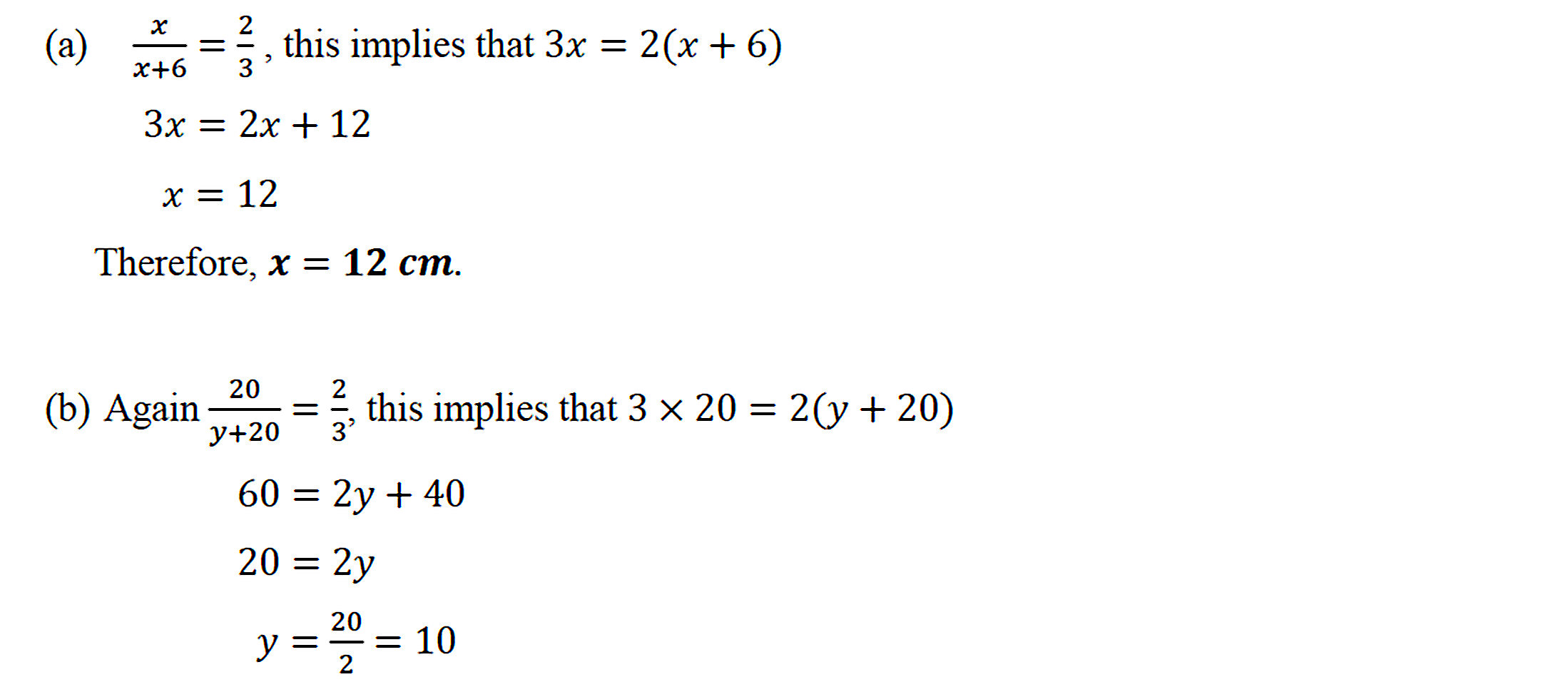
Therefore, 𝒚 =𝟏𝟎 𝒄𝒎.
Example 11
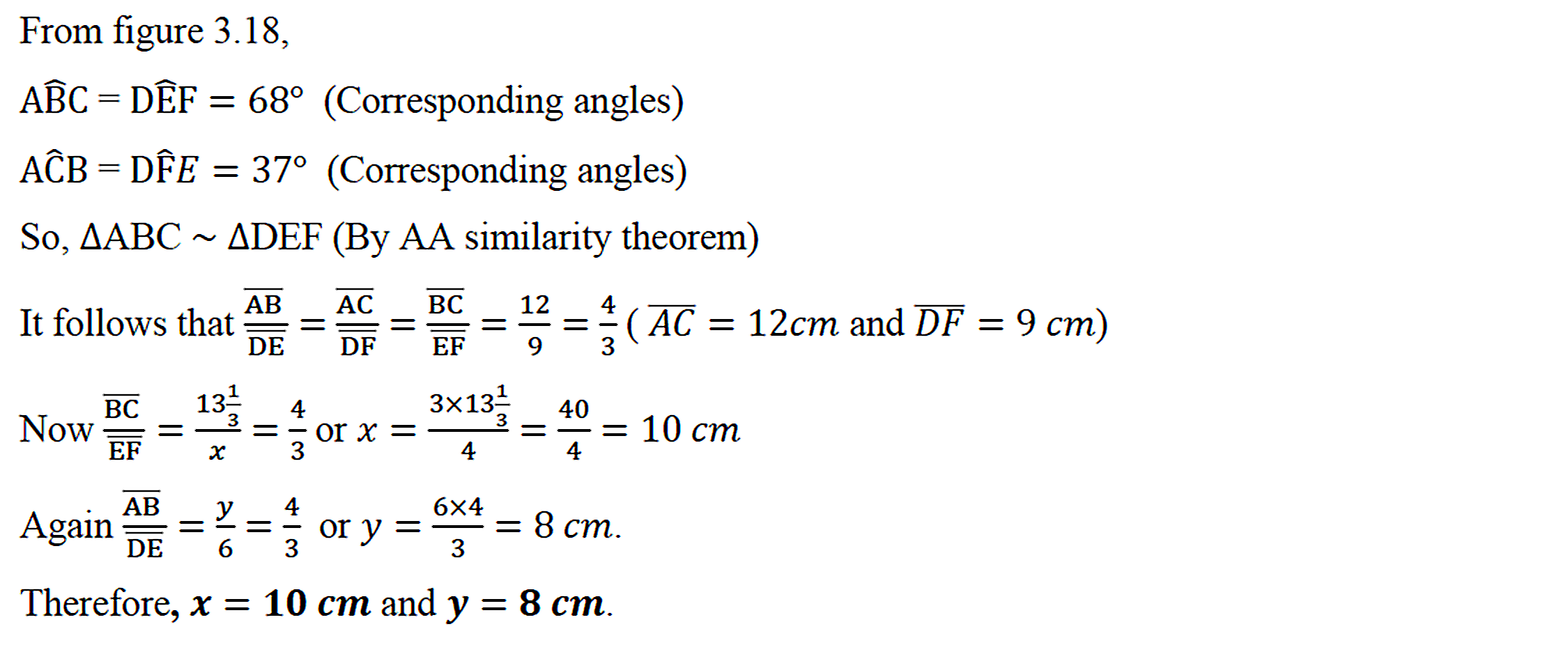
In figure 3.18 below, find the value 𝑥 and 𝑦.
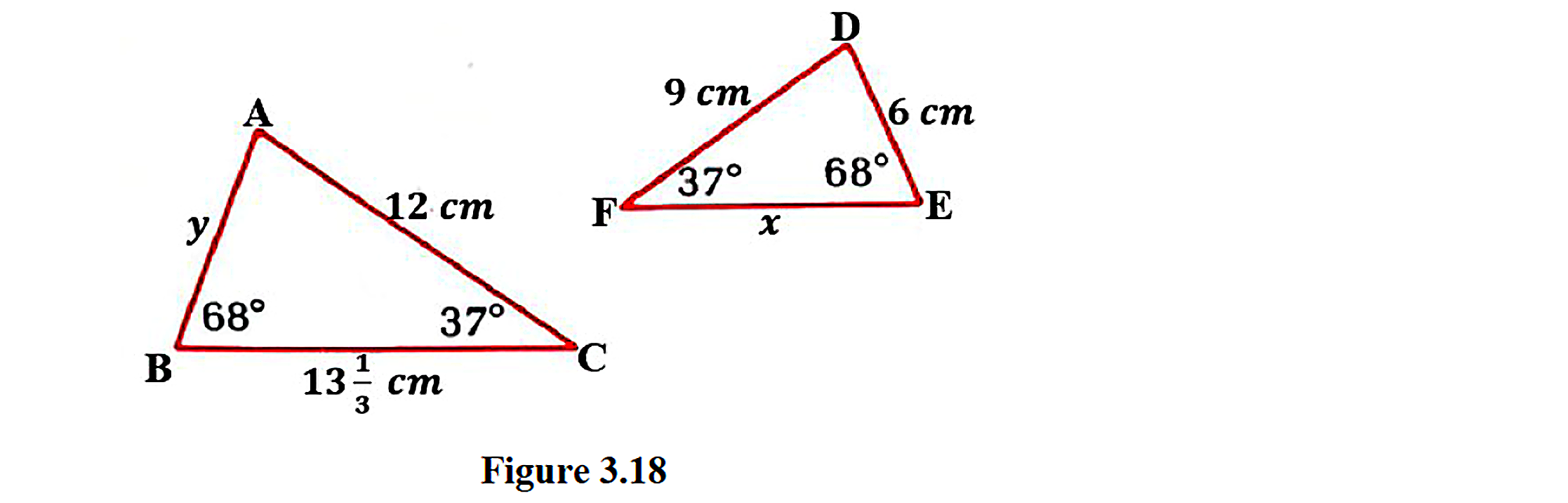
Solution:
Exercise 2
1. Explain why the AA similarity theorem requires only two pairs of congruent angles.
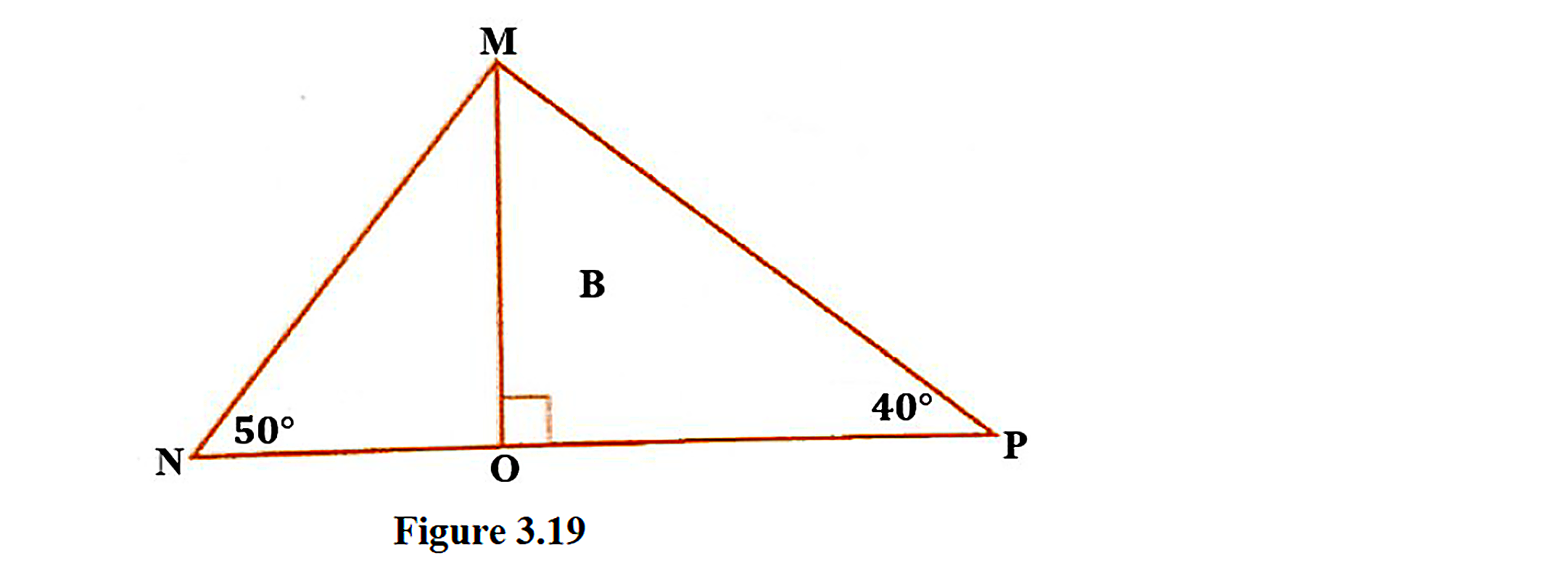
2. In the following diagram, state two triangles which are similar and the theorem for their similarity.
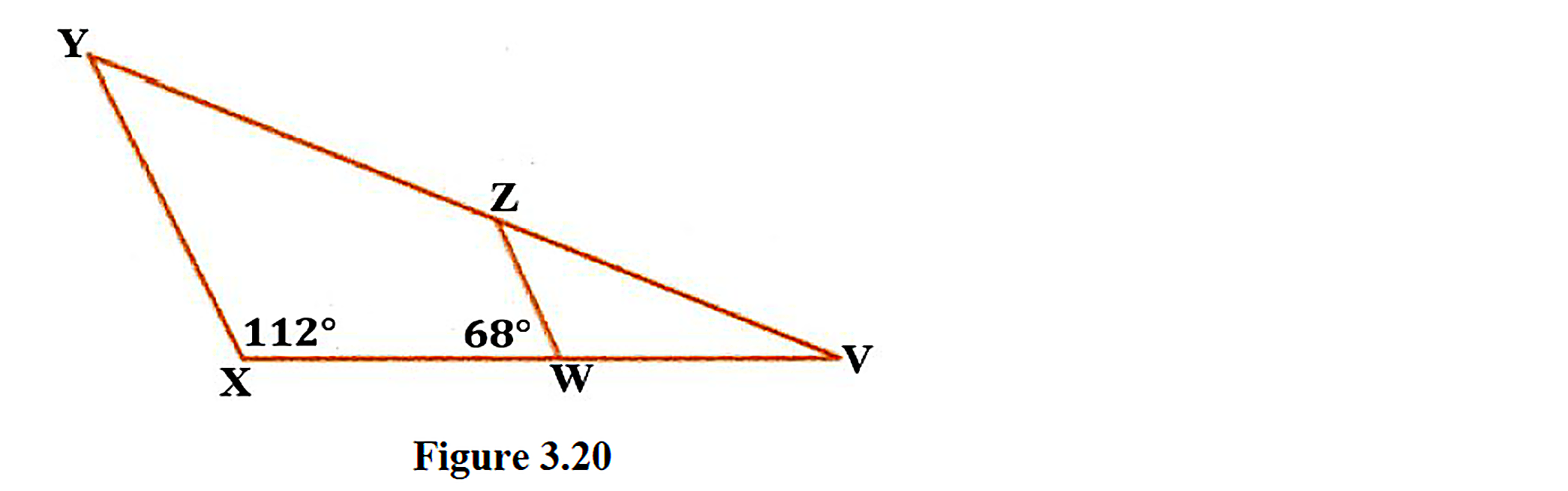
3. In figure 3.20, prove that ΔYXV ~ ΔZWV.
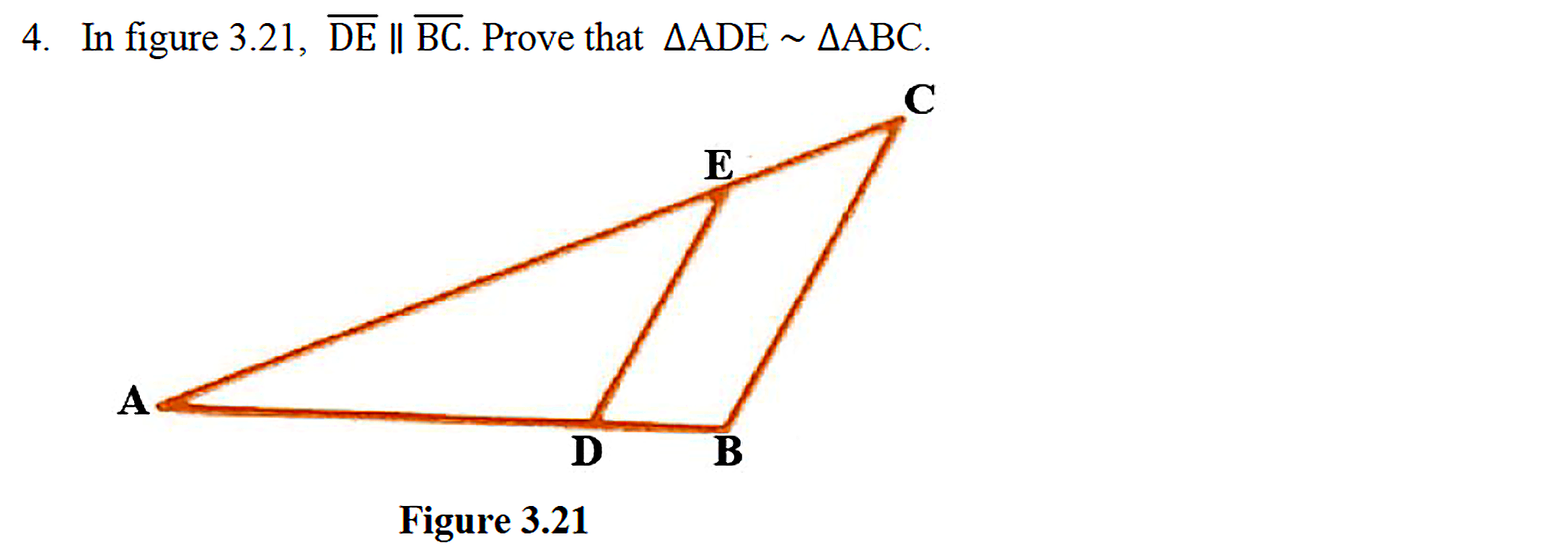
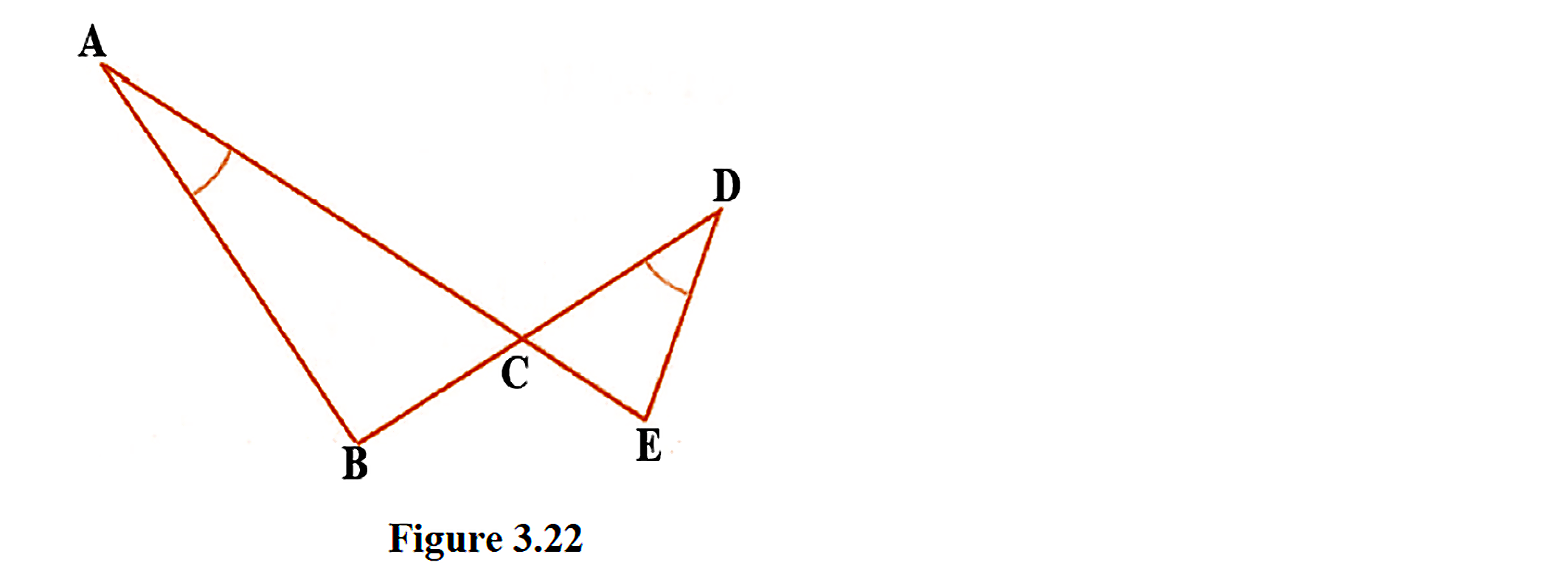
5. Determine whether the following two triangles shown in figure 3.22 are similar or not. Indicate the similarity theorem used to support your answers.
6. A man wishes to find the width of a river. There is a post at A on the far bank directly opposite post B and another at E so that A, C and E align with each other, with ED being at the right angles with the bank. BC, DC, and DE are measured and found to be 117m, 26m and 16 m respectively. Find the width of the river.
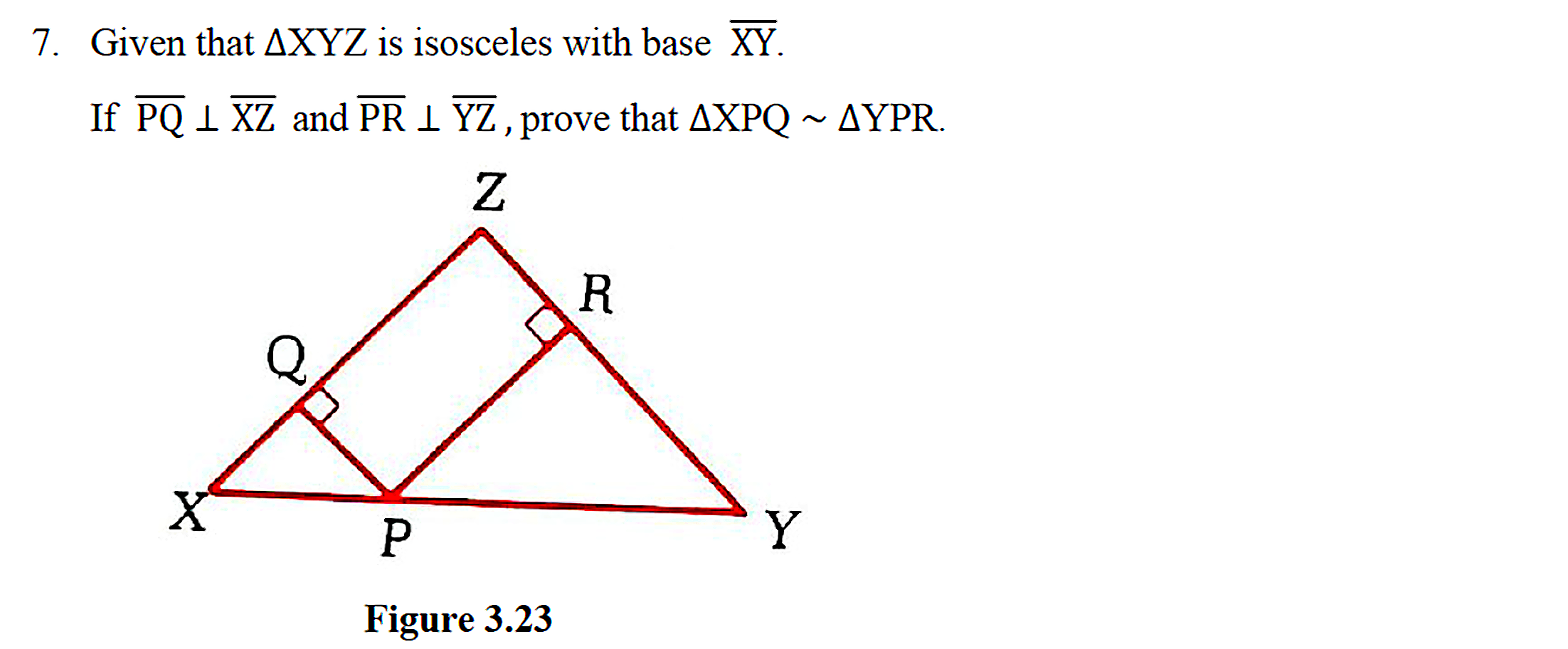
8. In figure 3.24, EFGH is a parallelogram. Prove that:
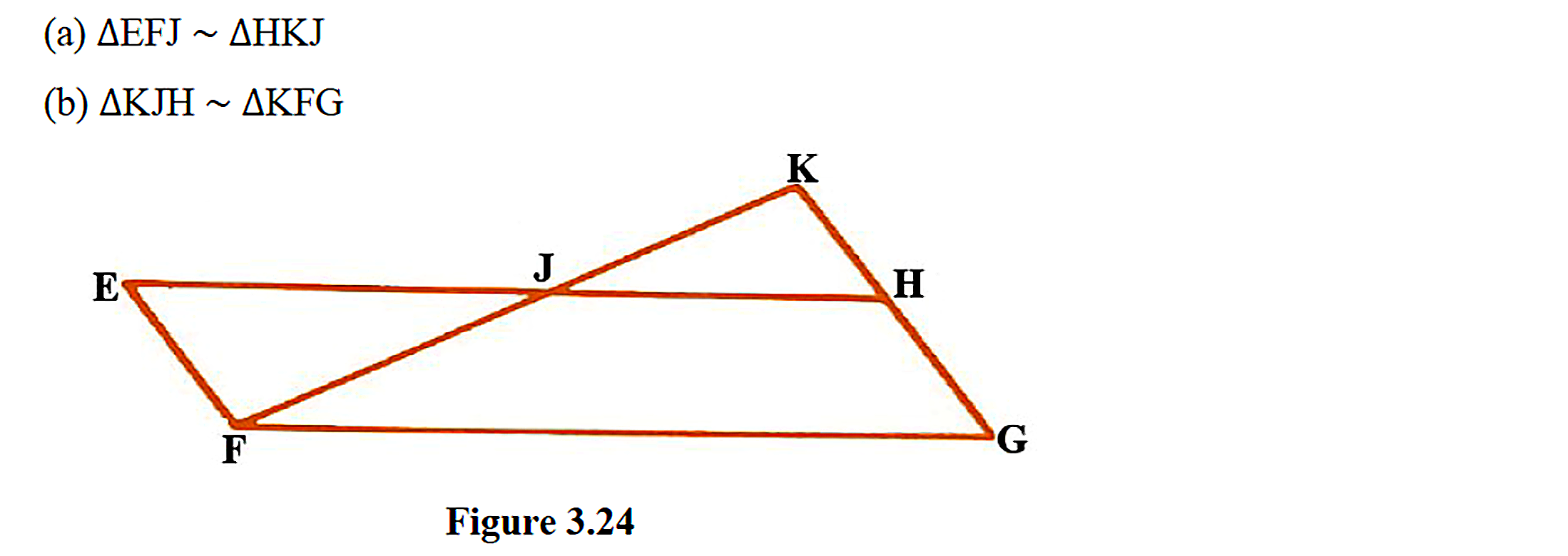
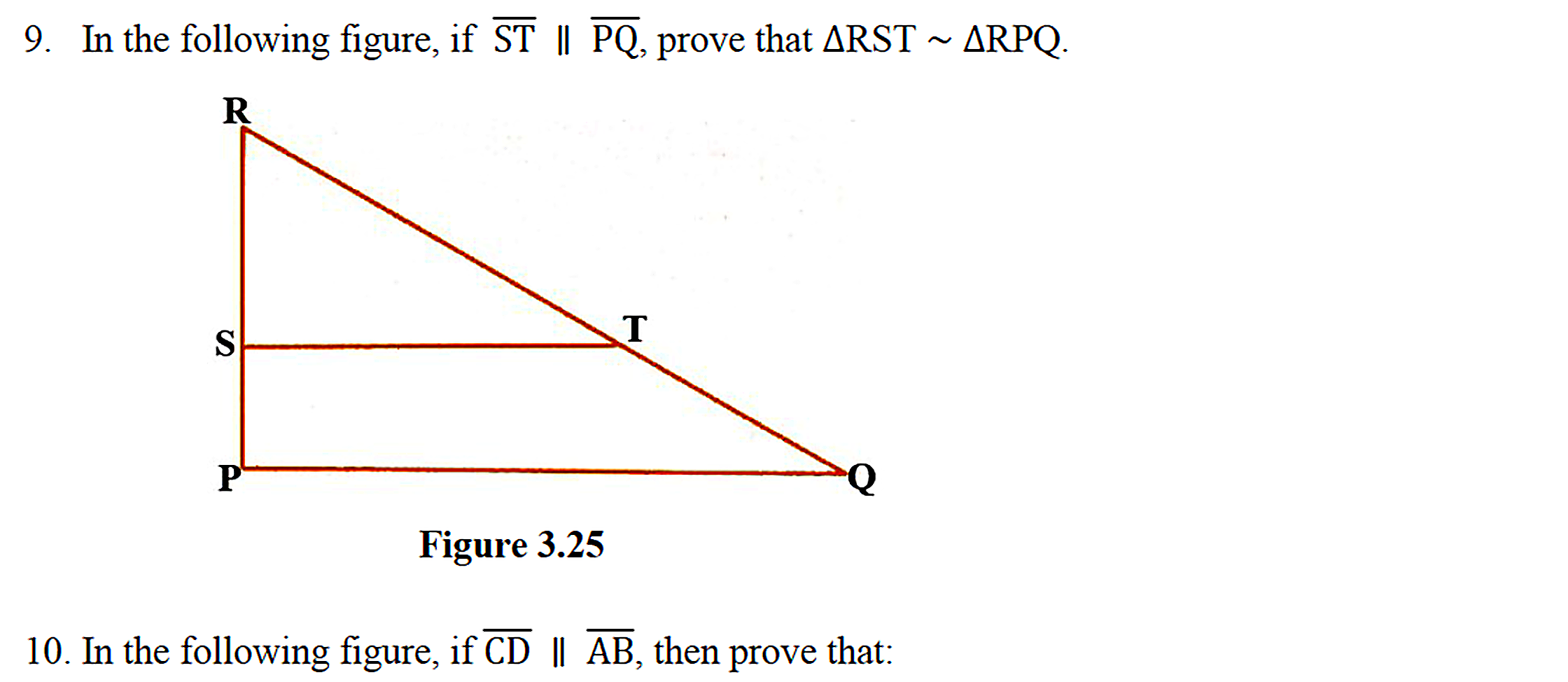
(a) ΔABO ~ ΔDCO.
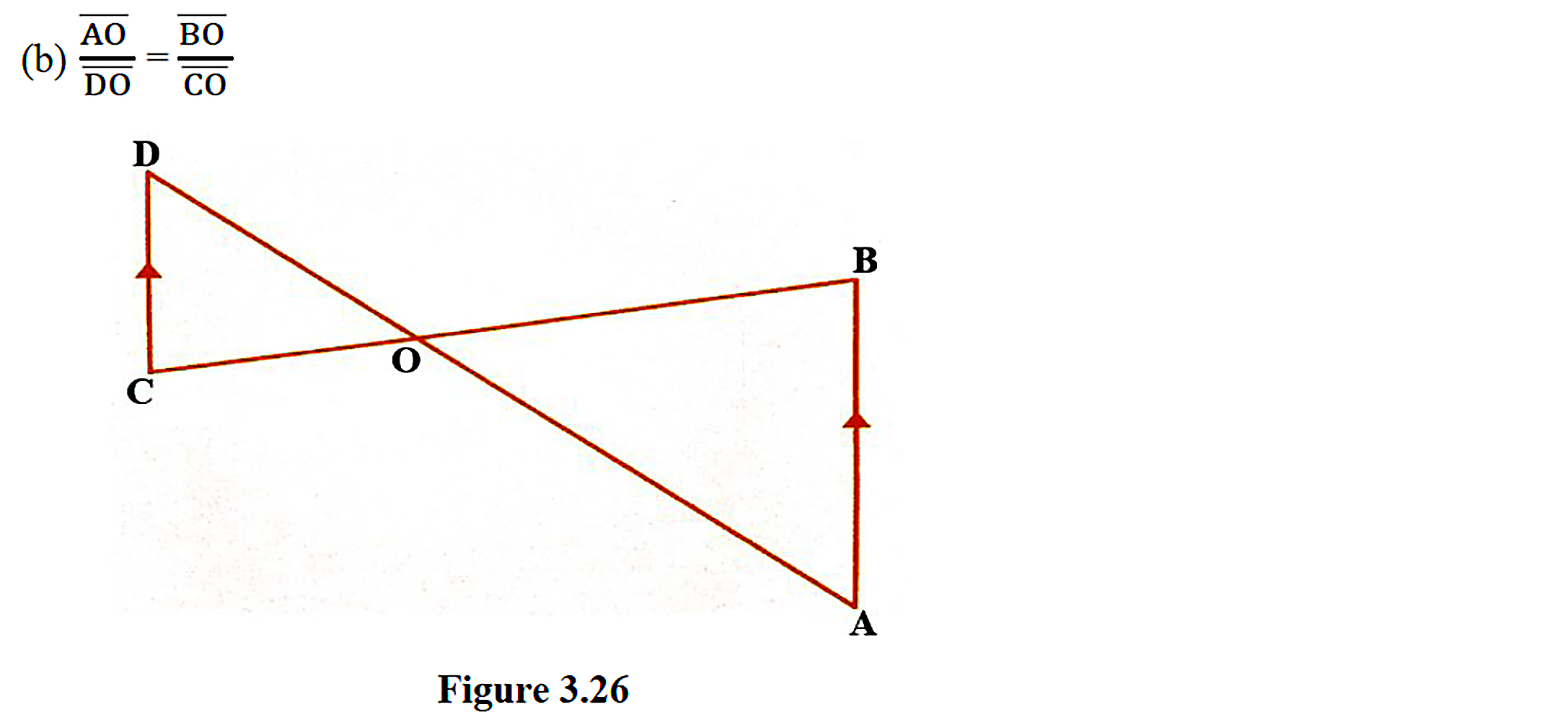
For each of the following questions, state reason for every step in making your proofs;
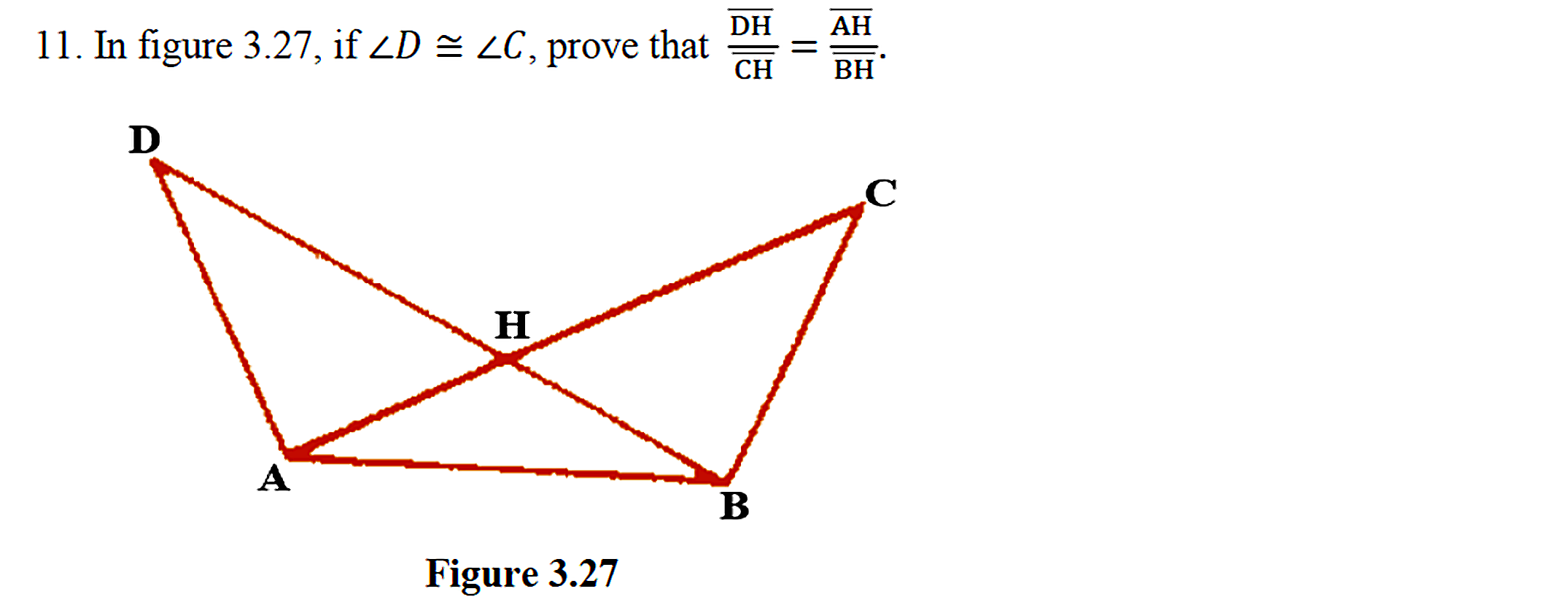
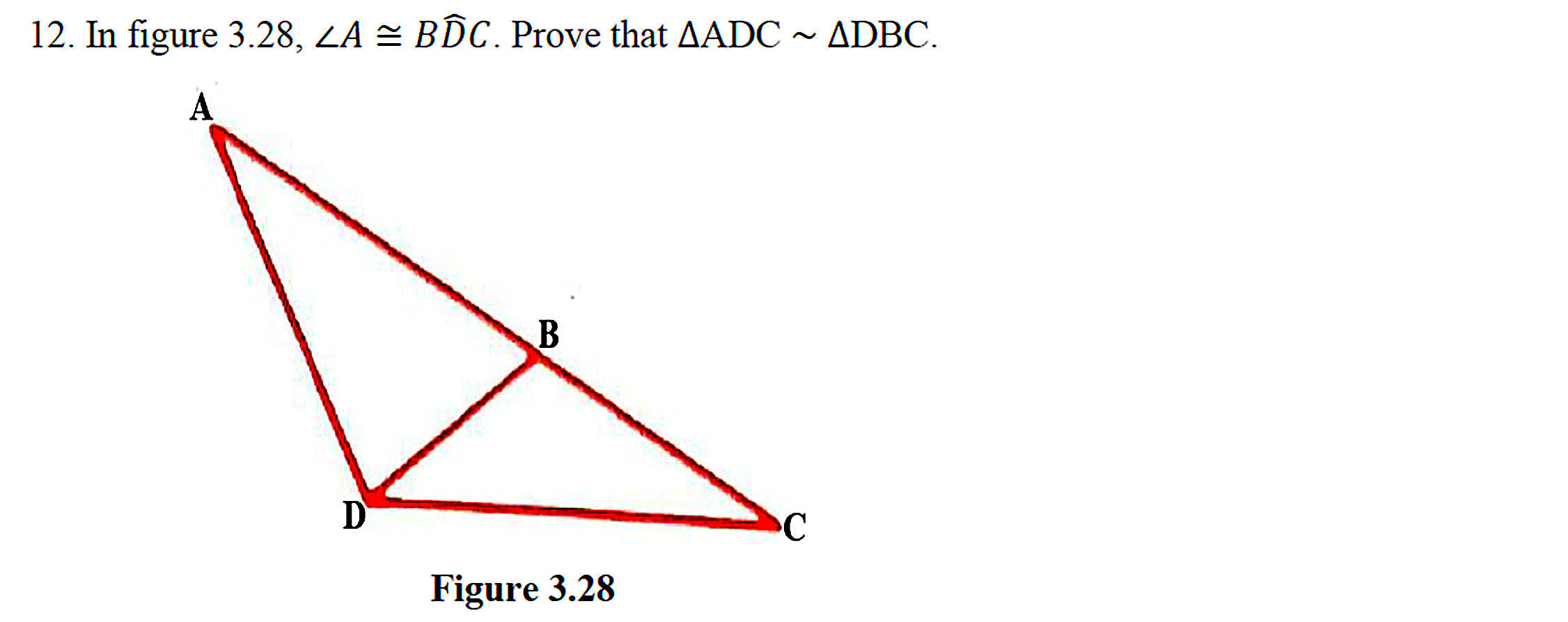
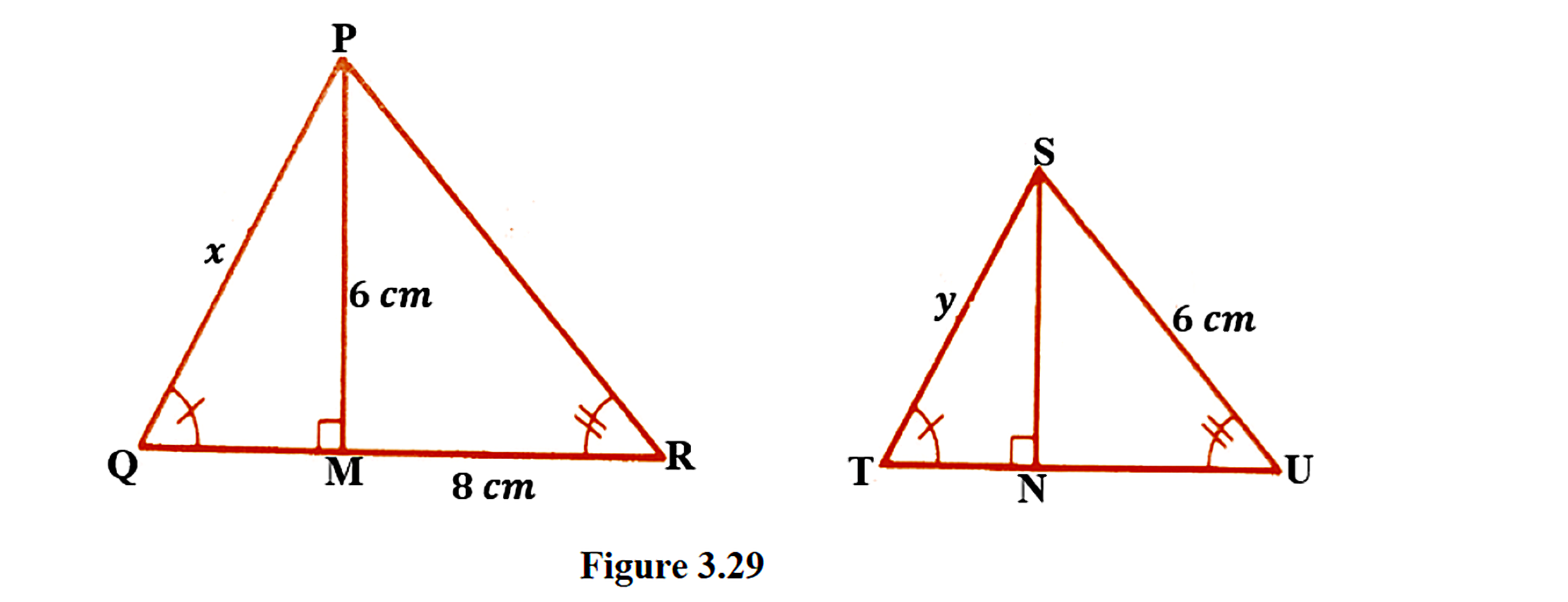
13. In figure 3.29, find the value of 𝑥 and 𝑦.
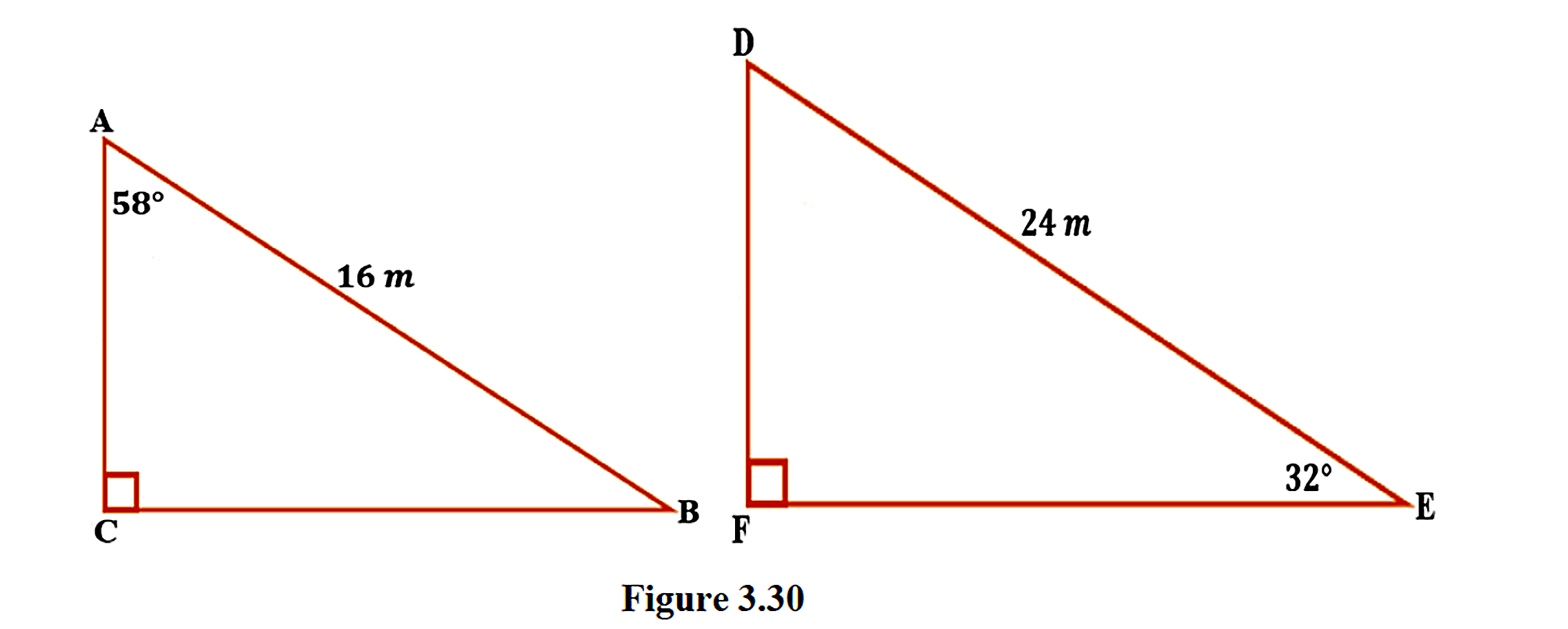
14. In figure 3.30, is ΔABC similar to ΔDEF? Give a reason for your answer.
SIDE-SIDE-SIDE (SSS)-SIMILARITY THEOREM
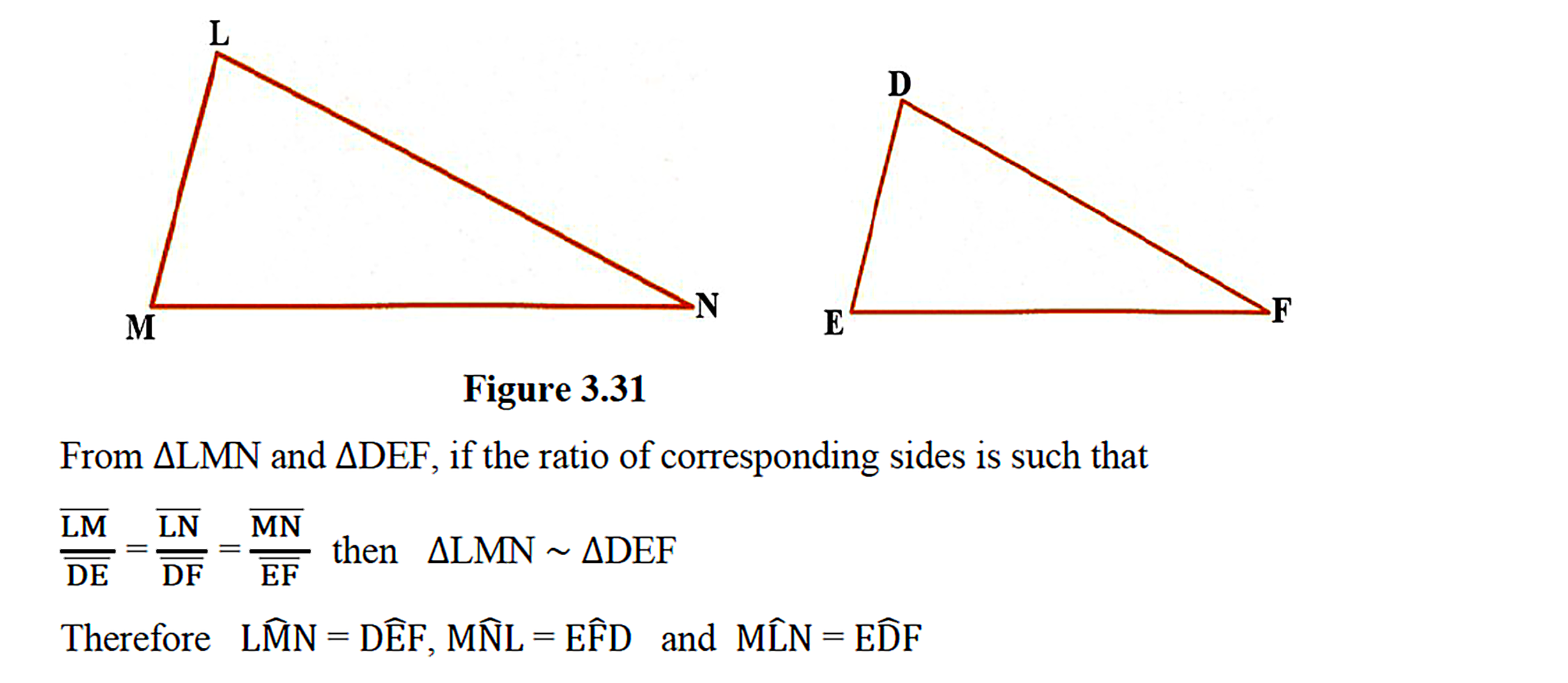
This theorem states that “If all pairs of corresponding sides of two triangles are proportional, then the triangles are similar”.
Figure 3.31 below describes the SSS theorem. If the three sides of one triangle are proportional to the three corresponding sides of a second triangle, then the triangles are similar.
Example 12
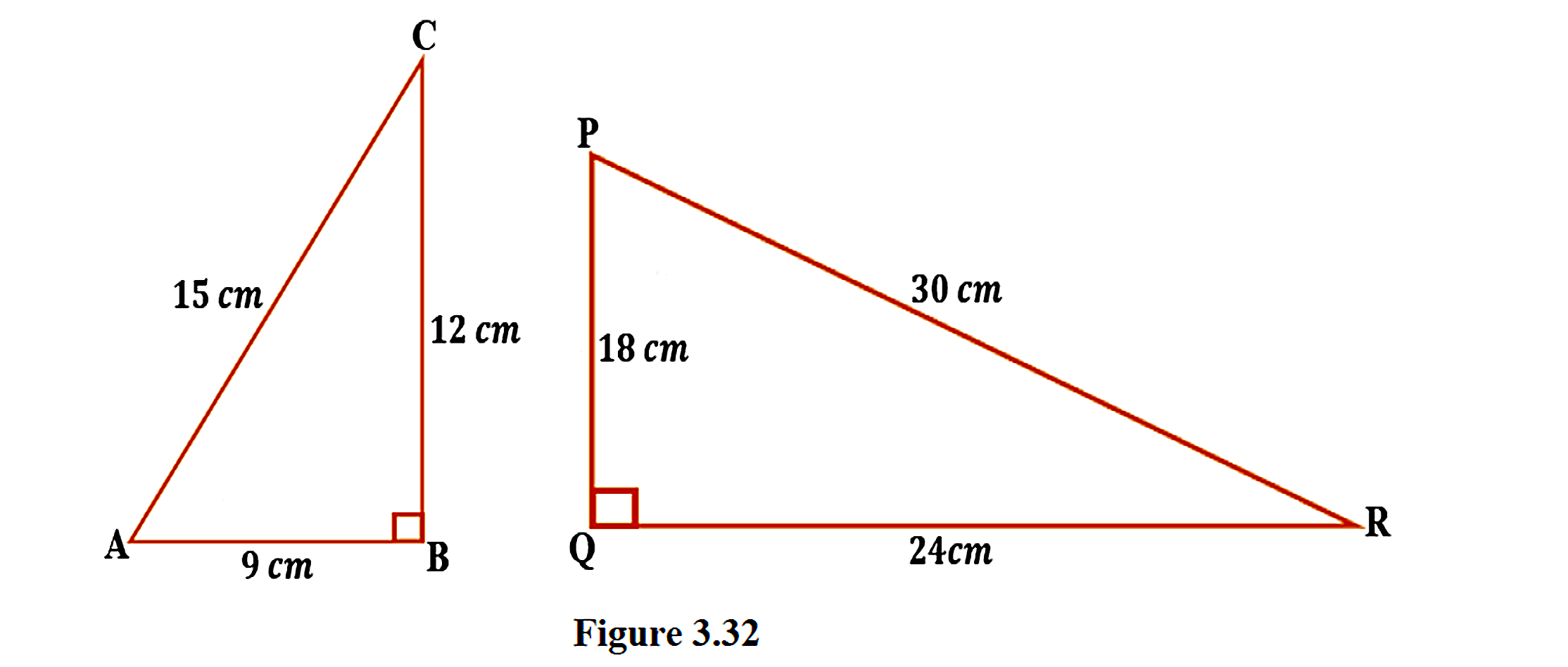
In figure 3.31, state whether or not ΔABC is similar to ΔPQR.
Solution:

Since all pairs of corresponding sides of two triangles are proportional, then the triangles are similar. Therefore, ΔABC ~ ΔPQR (by SSS similarity theorem).
Example 13
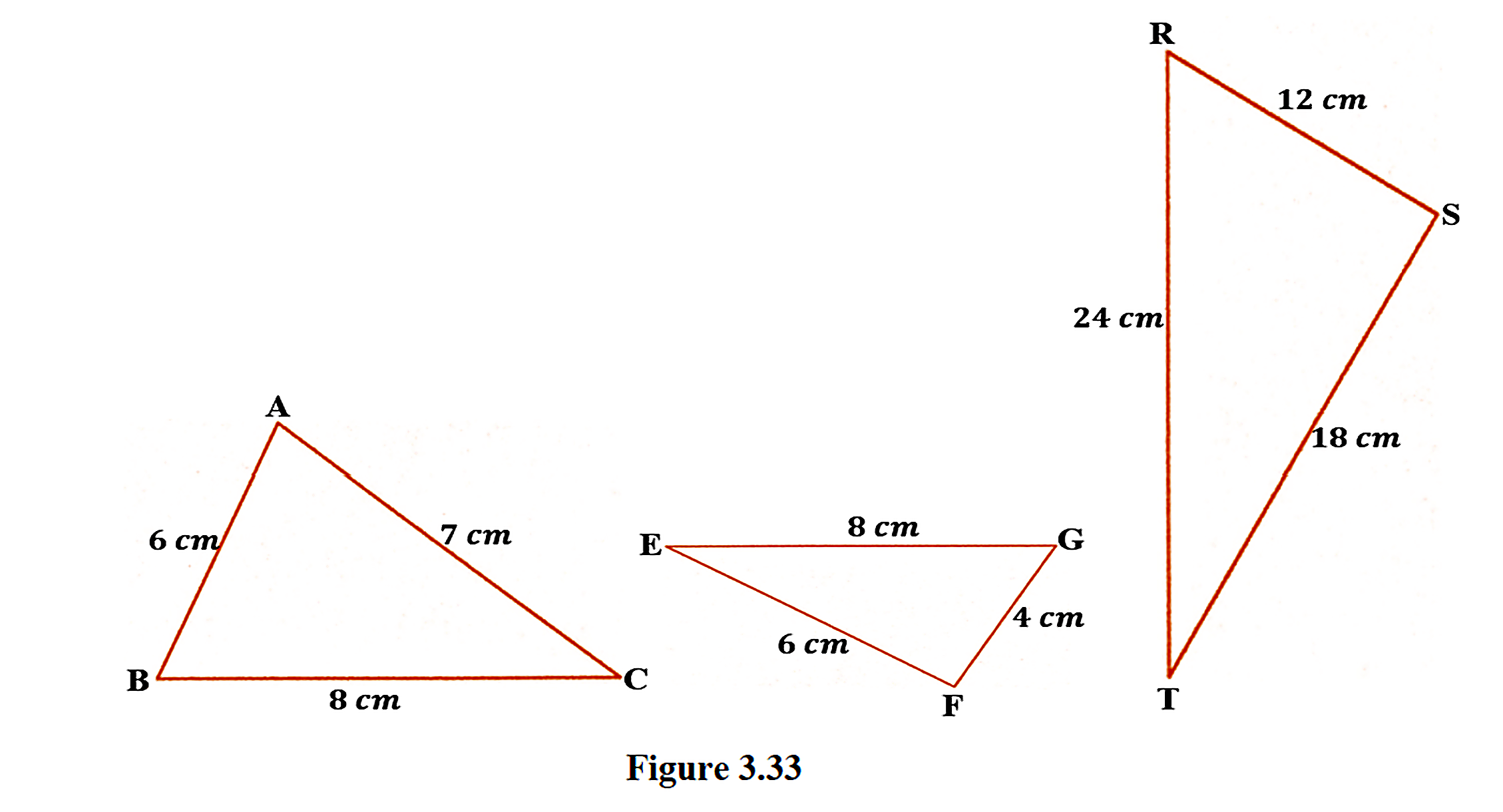
With reasons, identify a pair of triangles which are similar in figure 3.33 below.
Solution:
To show that the triangles are similar, find the ratio of the length of corresponding sides (shortest, longest and the remaining sides).
Comparing ΔABC and ΔEFG:

The ratios of the corresponding sides are not all equal. Therefore ΔABC and ΔEFG are not similar.
Comparing ΔEFG and ΔRST:

The ratios of the corresponding sides are all equal. Therefore ΔEFG~ΔRST.
Comparing ΔABC and ΔRST:
_1778145257532.png)
The ratios of the corresponding sides are not all equal. Therefore ΔABC and ΔRST are not similar.
Exercise 3
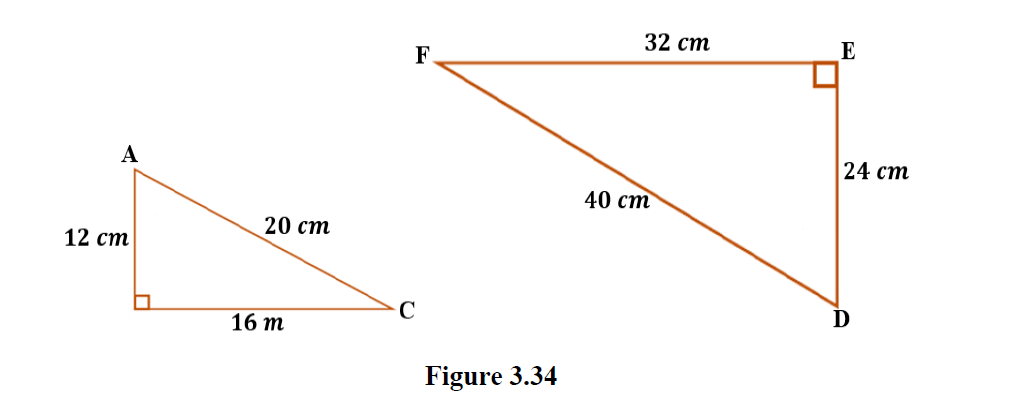
1. In figure 3.34 determine whether ΔABC and ΔDEF are similar or not. Indicate the similarity theorem used to support your answers.
2. If ΔABC ~ ΔDEF and AB =5 𝑐𝑚, DE=15 𝑐𝑚, find the scale factor.
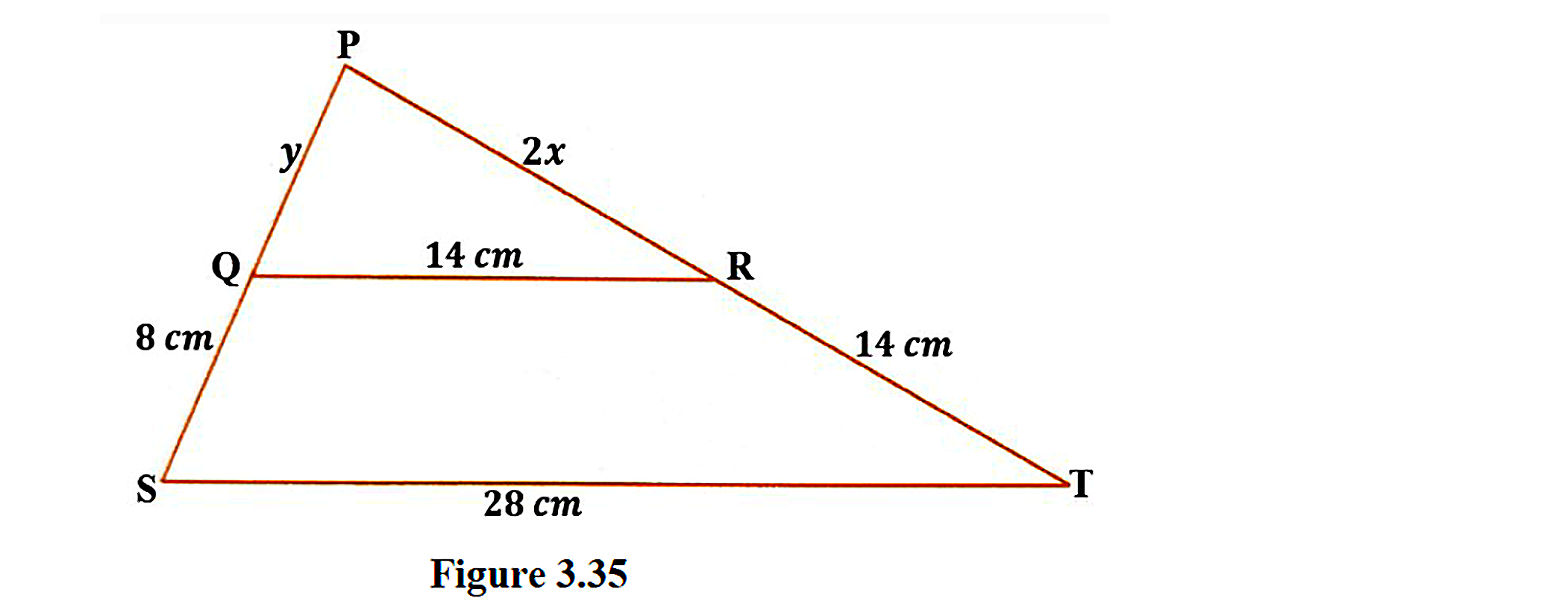
3. In figure 3.35, find the value of 𝑥 and 𝑦 if ΔPQR~ΔPST.
4. Two triangles are similar. If the small triangle has sides 5 cm, 7 cm, and 9 cm. What is the length of the shortest side of the larger triangle, if its longest side is 27 cm?
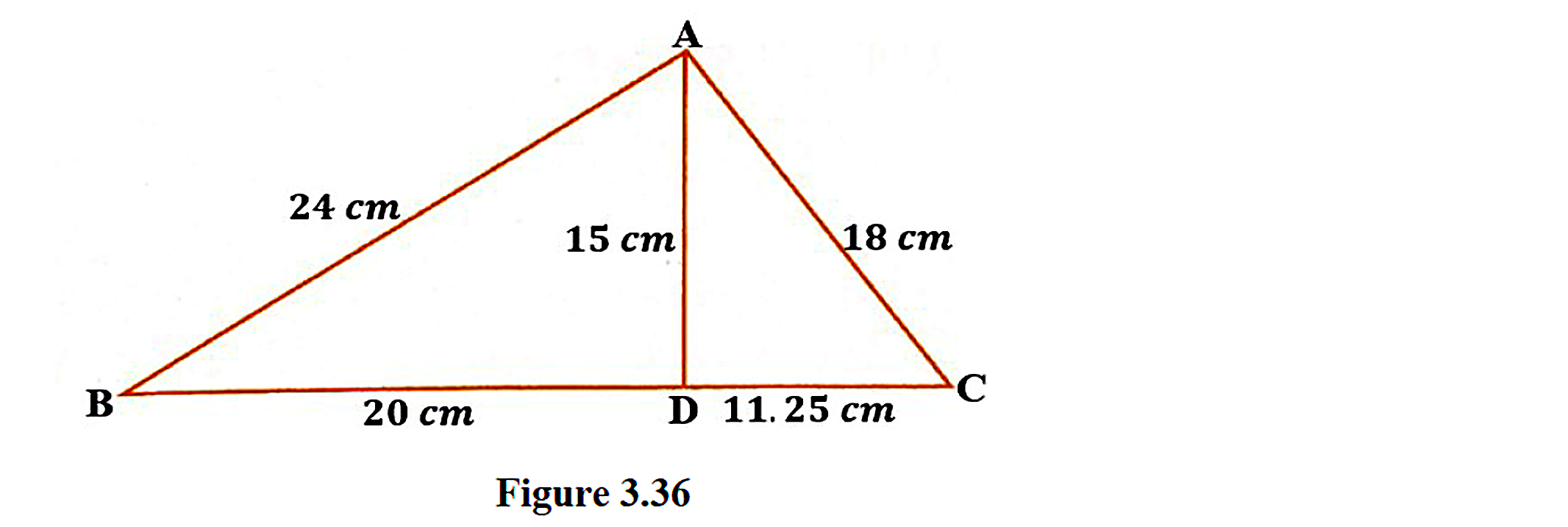
5. In figure 3.36, identify the two similar triangles and state the similarity theorem to support your answer.
6. ΔABC ~ ΔDEF, if AB =𝑥 , BC=𝑥+2, AC=𝑥+4 and DE=2𝑥, EF=2𝑥+4, DF=2𝑥+8, verify their similarity.

9. In ΔABC, the sides are 4 cm, 6 cm, and 8 cm. In ΔDEF, the sides are 2 cm, 3 cm, and x cm. Find x such that the triangles are similar.
10. Two triangular boards have side lengths proportional to 4:6:8 and 2:3:4. Verify their similarity and determine the ratio.
11. Two triangular plots of land have sides in the ratio 1:2. The smaller plot has sides 5m, 7m, and 9 m. Show that the plots are similar and find the sides of the larger plot.
12. A model triangle has sides 3 cm, 5 cm, and 7 cm. A real triangle has sides 6 cm, 10 cm, and 14 cm. Prove that they are similar and find the scale factor.
SIDE-ANGLE-SIDE (SAS) SIMILARITY THEOREM
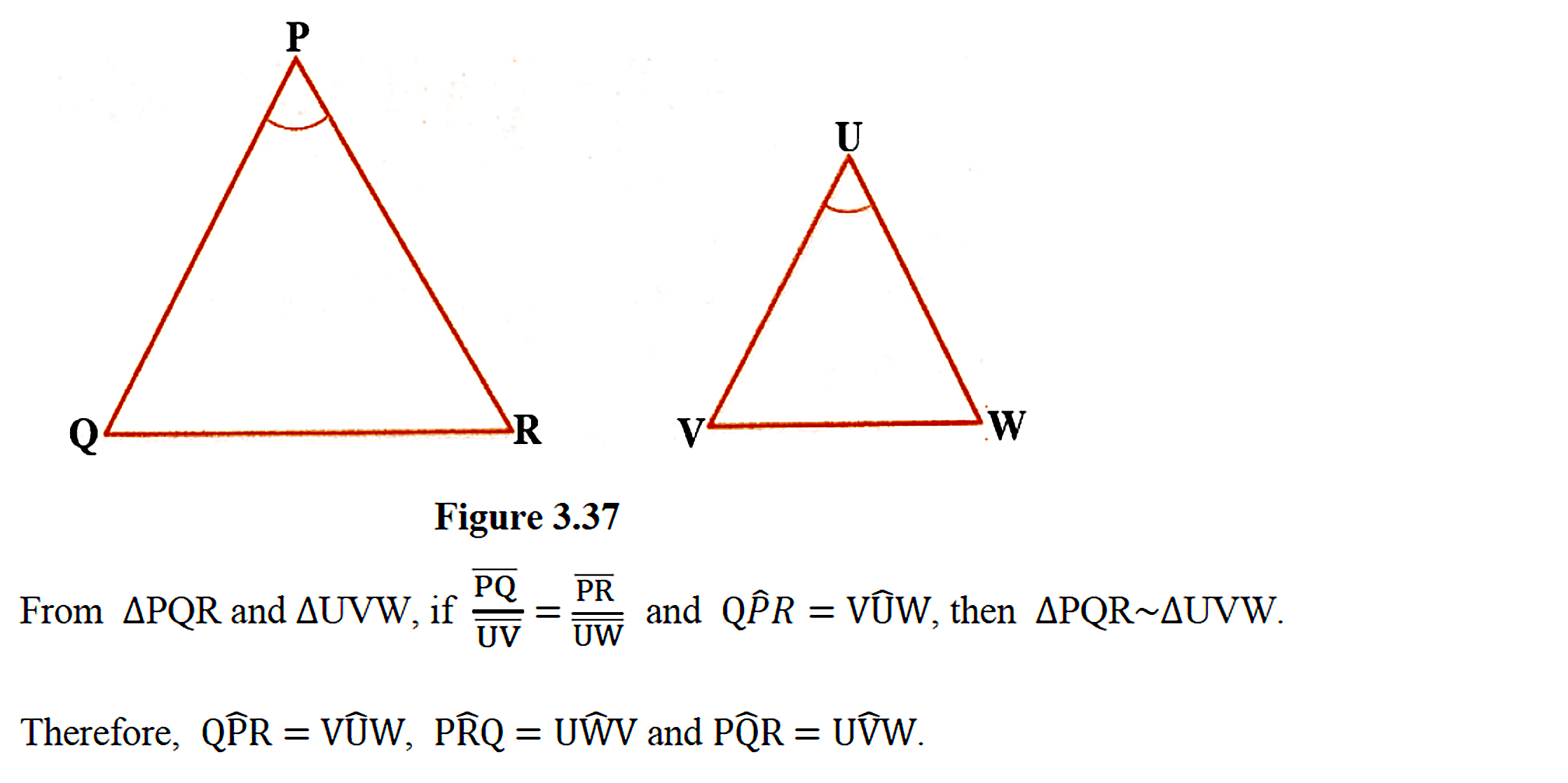
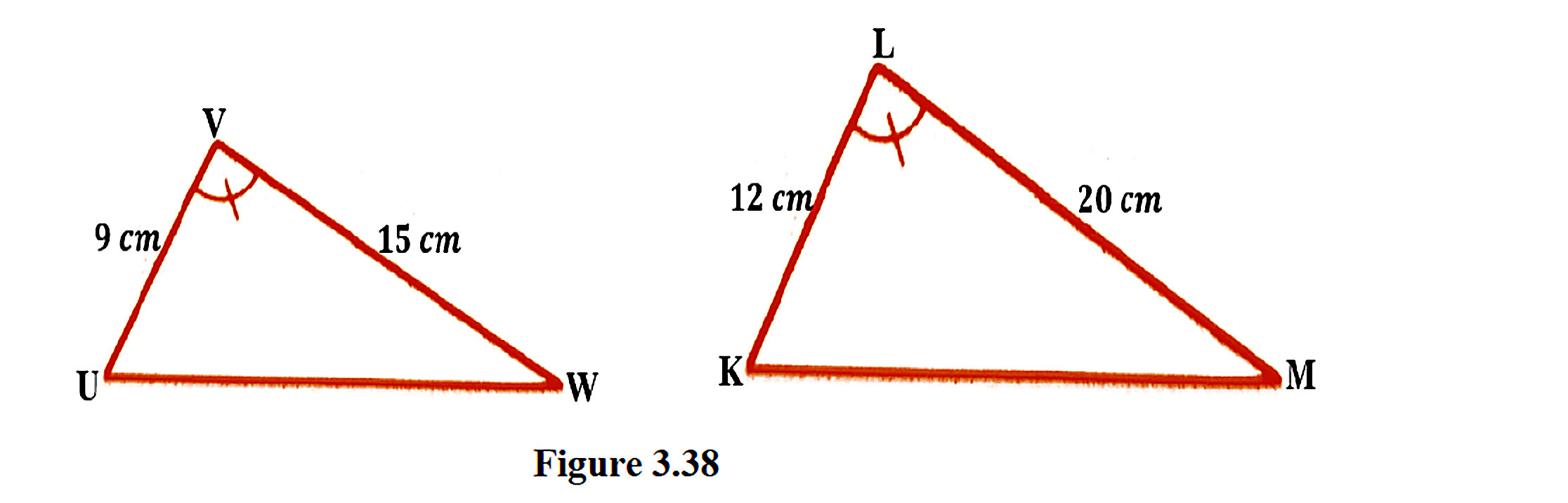
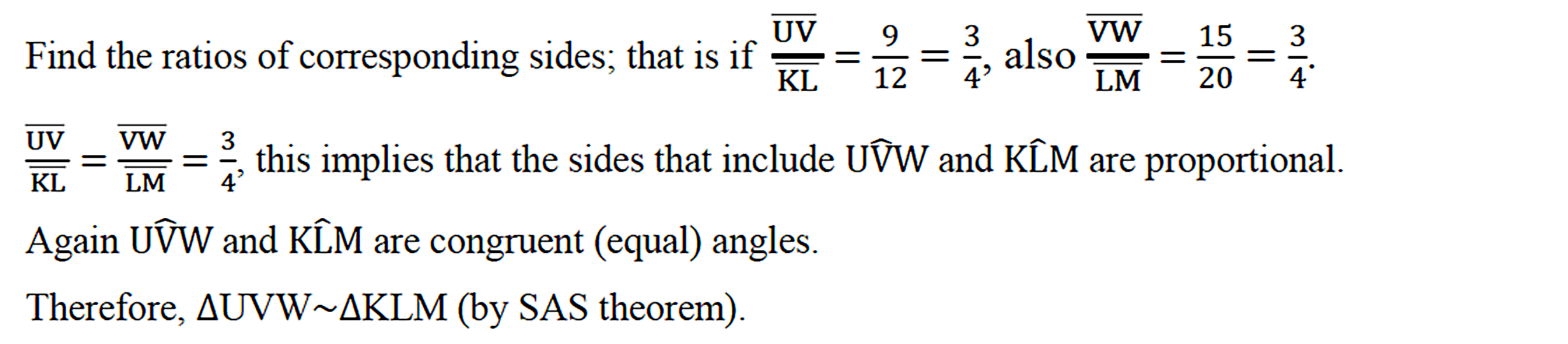
This theorem states that “If one angle of a triangle is congruent to one angle of another triangle and the sides that include those angles are proportional, then the two triangles are similar”. Figure 3.8 below describes the SAS theorem.
Example 14
In figure 3.38, are triangles UVW and LKM similar?
Solution:
Example 15
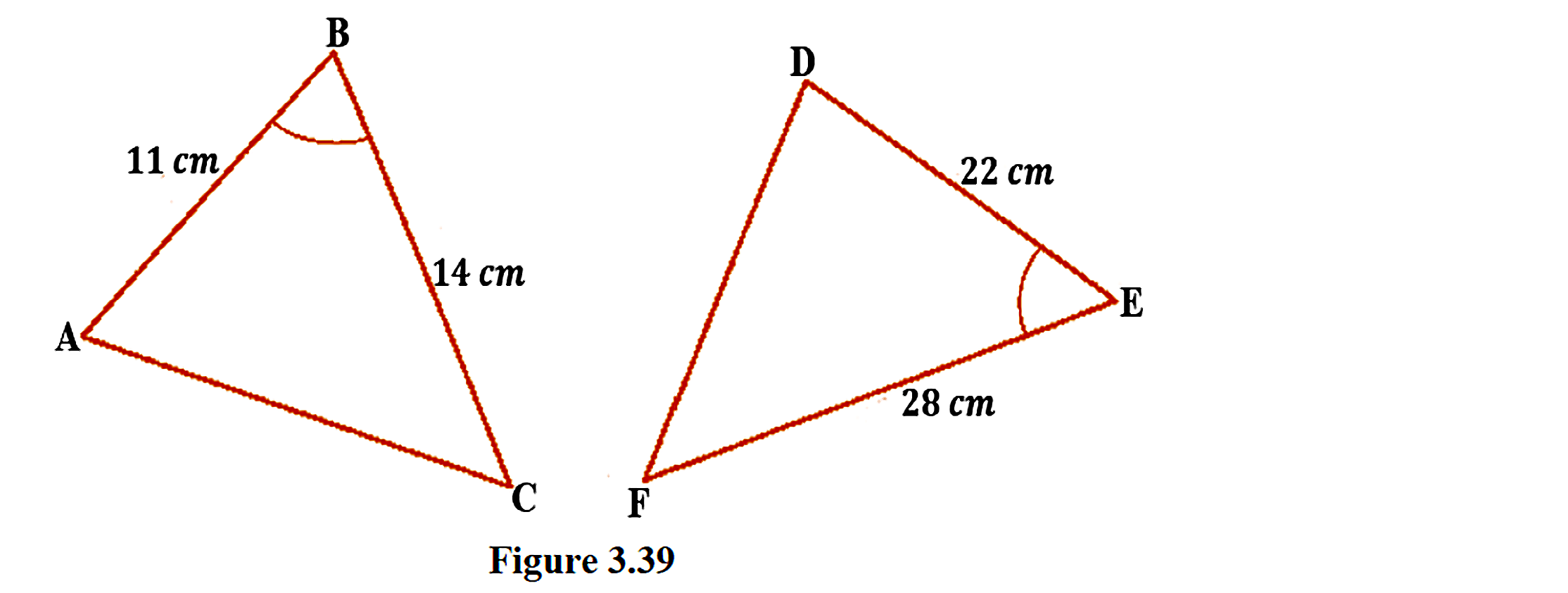
Given two triangles in figure 3.39, prove that ΔABC and ΔDEF are similar.
Solution:
Proof

Therefore, ΔABC~ΔDEF (by SAS theorem).
Exercise 4
1. In similar triangles, the ratio of two sides is 5:7. If one triangle has sides 10 cm and 14 cm, what are the corresponding sides in the second triangle?
_1778150414964.png)
3. Two triangles have sides in ratio 2:3 and the included angle is equal. If one triangle has sides 6 cm and 9 cm, find the corresponding sides of the other triangle.
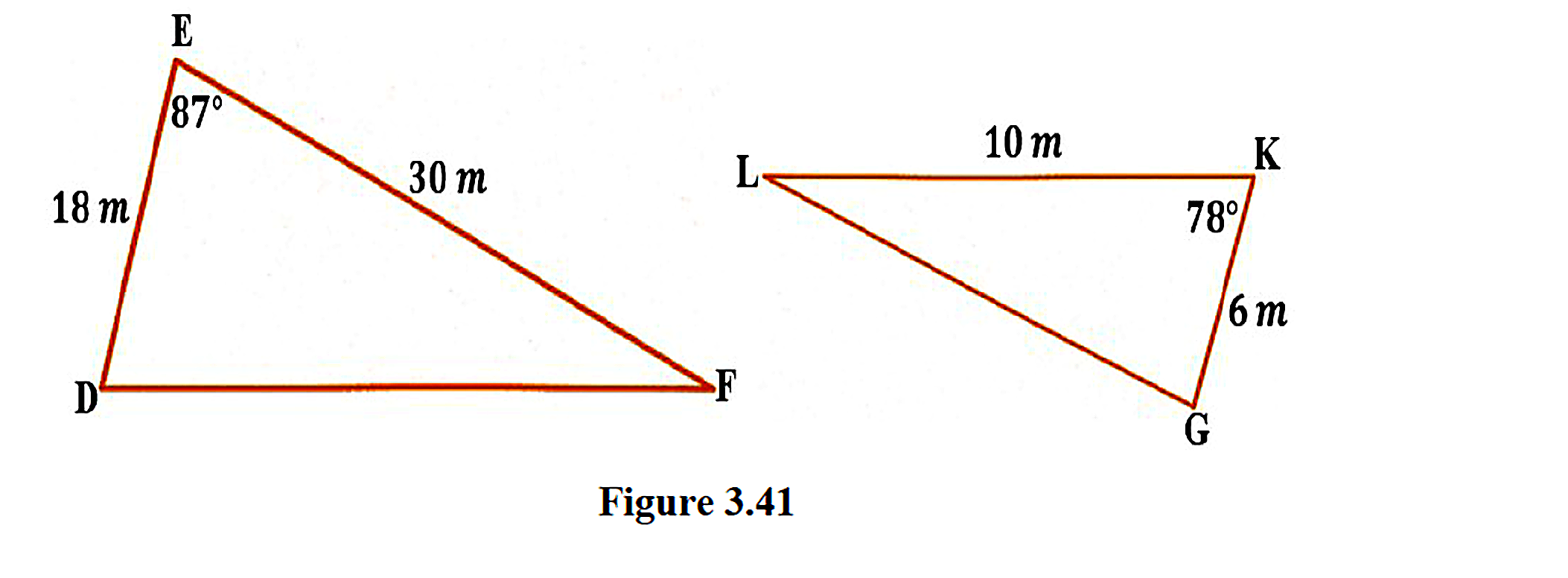
4. In figure 3.41 below, are ΔDEF and ΔGKL similar? Give reasons for your answer.
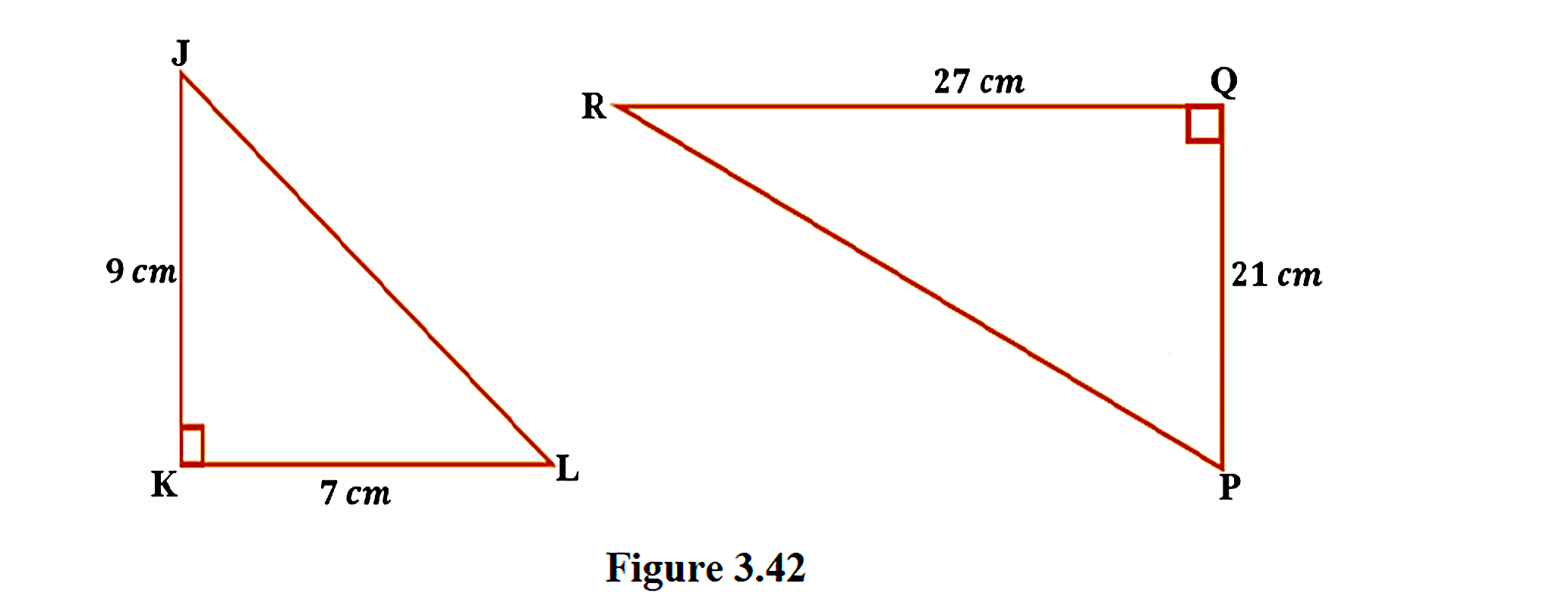
5. In figure 3.42 below, are triangles JKL and PQR similar? Give reasons for your answer.
6. Two triangles (ABC and DEF) are such that:
AB= 5 cm, AC=7 cm, ∠A=60°
DE=10 cm, DF=14 cm, ∠D=60°
Using the given information, show that the two triangles are similar.
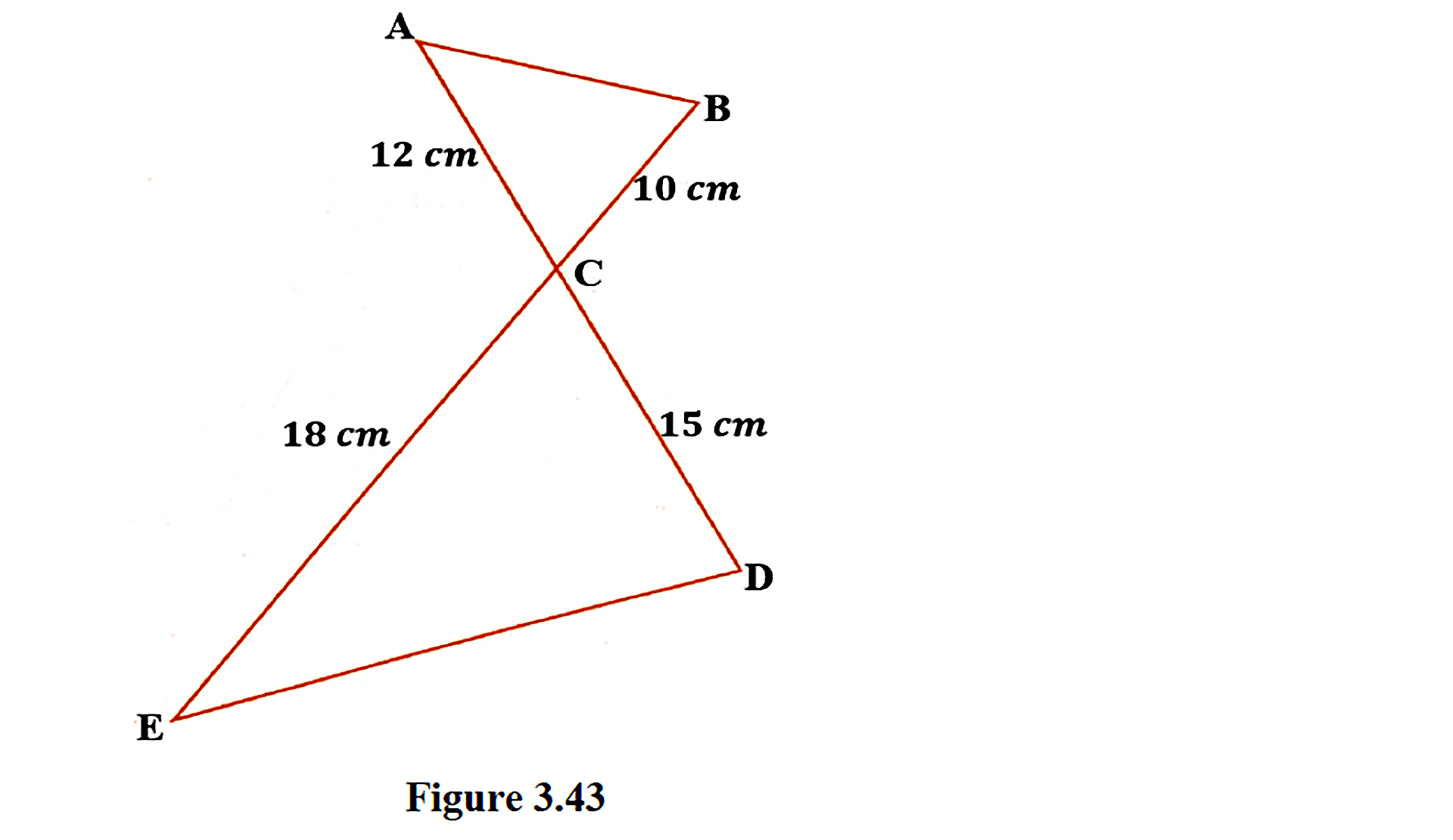
7. In figure 3.43 below, prove that ΔBCA~ ΔDCE.
8. If ABC and DEF are two given triangles such that AB/DE = AC/DF and ∠A =∠D,and AB = 12, AC = 18, DE = 8, what is the value of DF?
9. Two triangles have sides (x, 8) and (6, 12) with included angles equal.Find x for similarity.
10. A small triangular garden has sides 5 m and 7 m with included angle 45°. A larger garden has sides 10 m and 14 m with the same included angle. Prove their similarity and find the scale factor.
11. Two triangles have sides (x, x+2) and (2x, 2x+4) with included angles equal. Show that they are similar for all valid values of x.
Listening to this topic