Mathematics
ALGEBRA
In this topic, you will learn how to translate real-life situations into algebraic equations and solve them. Word problems are a way to connect mathematics to everyday life. You will explore problems involving unknown quantities, represented by variables such as x, and learn how to apply the four basic operations—addition, subtraction, multiplication, and division—to form equations.
An algebraic equation is a mathematical statement that shows two expressions are equal and contains an unknown variable (such as x, y, or a). Examples of algebraic equations are:
- x + 6 = 14
- y − 5 = 8
- 4a = 20
- b ÷ 3 = 7
Generating simple algebraic equations means forming mathematical statements using numbers, a letter for an unknown number, and an equals sign (=).
To generate a simple algebraic equation, follow these steps:
- Identify the unknown number. Represent it with a letter, such as x.
- Identify the operation. Use +, −, ×, or ÷.
- Write the equation. Use an equals sign (=) to show that both sides have the same value.
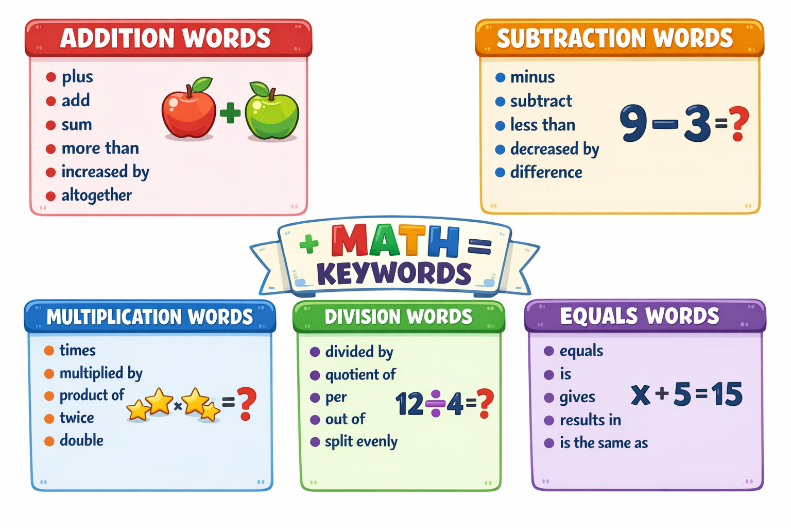
Study the poster and perform yourself
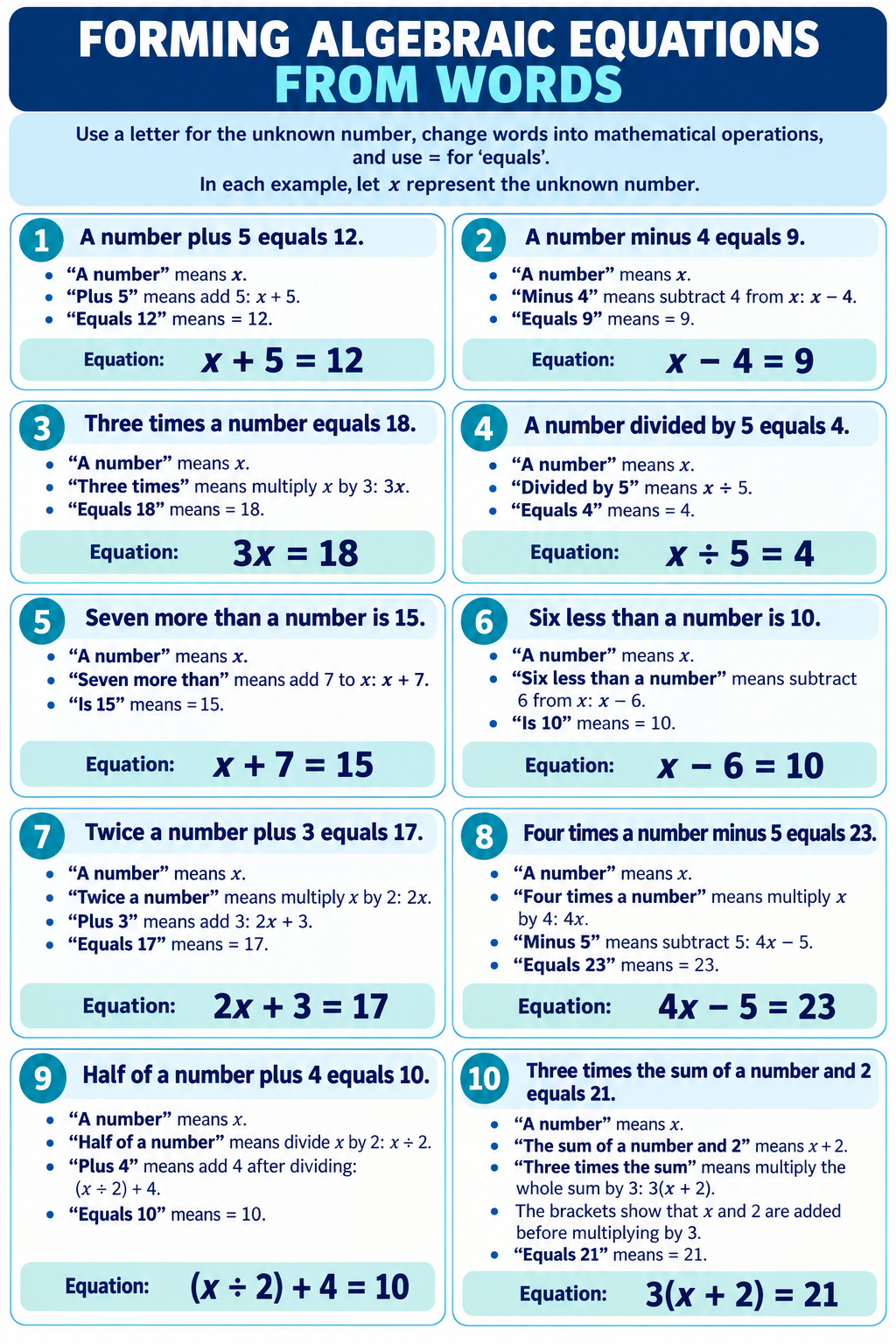
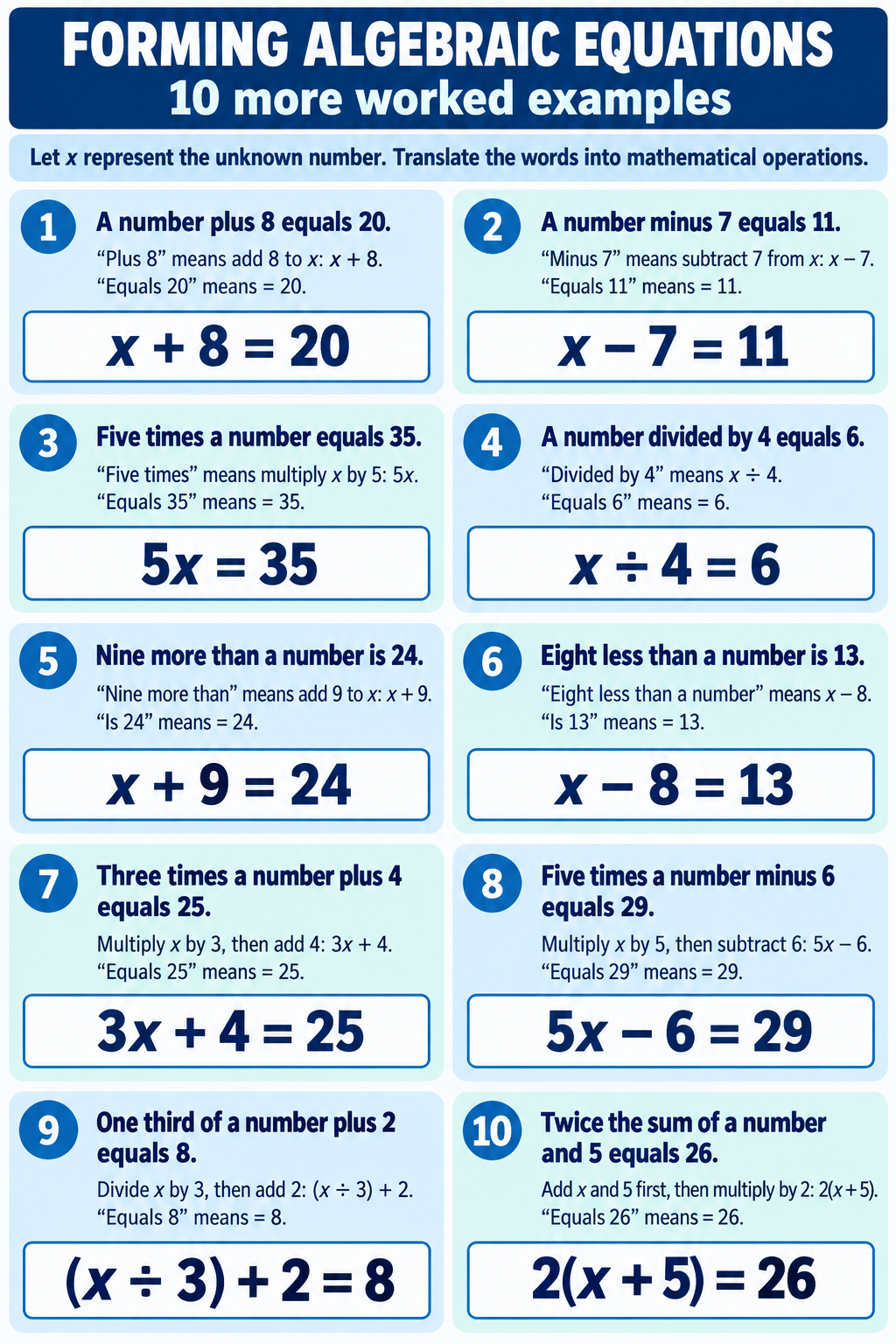
Study the following examples
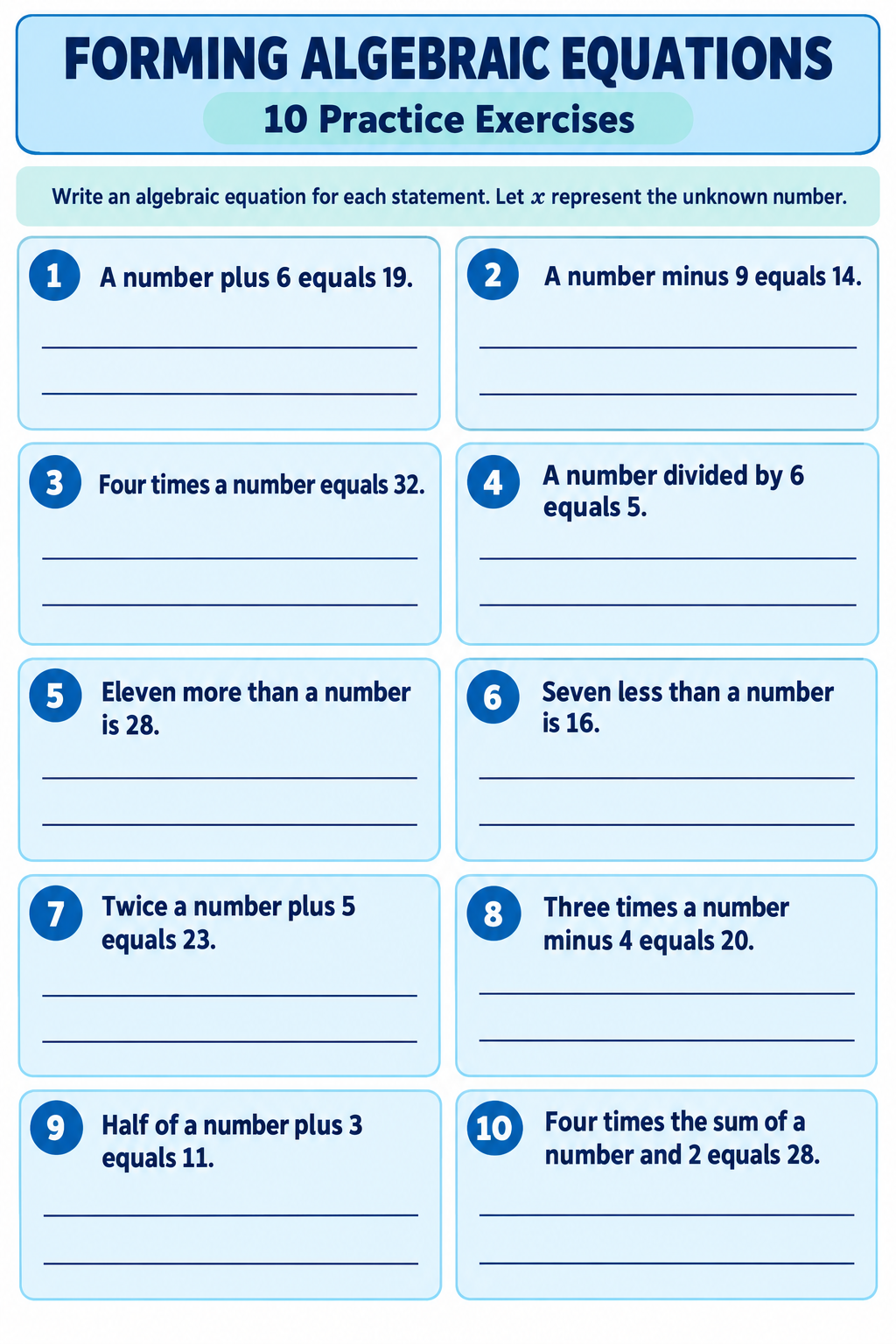
Generate the algebraic equation for each of the following statements
- The sum of a number and 15 is 23.
- The difference between a number and 4 is 16.
- A number multiplied by 5 equals 35.
- A number divided by 3 plus 2 equals 8.
- Double a number decreased by 1 is 13.
- Eight more than twice a number equals 24.
- Nine less than three times a number is 12.
- A number increased by 4 and then multiplied by 2 is 24.
- A number divided by 2 and then increased by 5 is 13
- Six more than half of a number is 14.
Follow the steps described below to solve the following algebraic equations
- Identify the common denominator.
- Multiply every term on both sides by that denominator to remove the fractions.
- Isolate the unknown by performing the same operation on both sides.
- Check your answer by substituting it into the original equation.
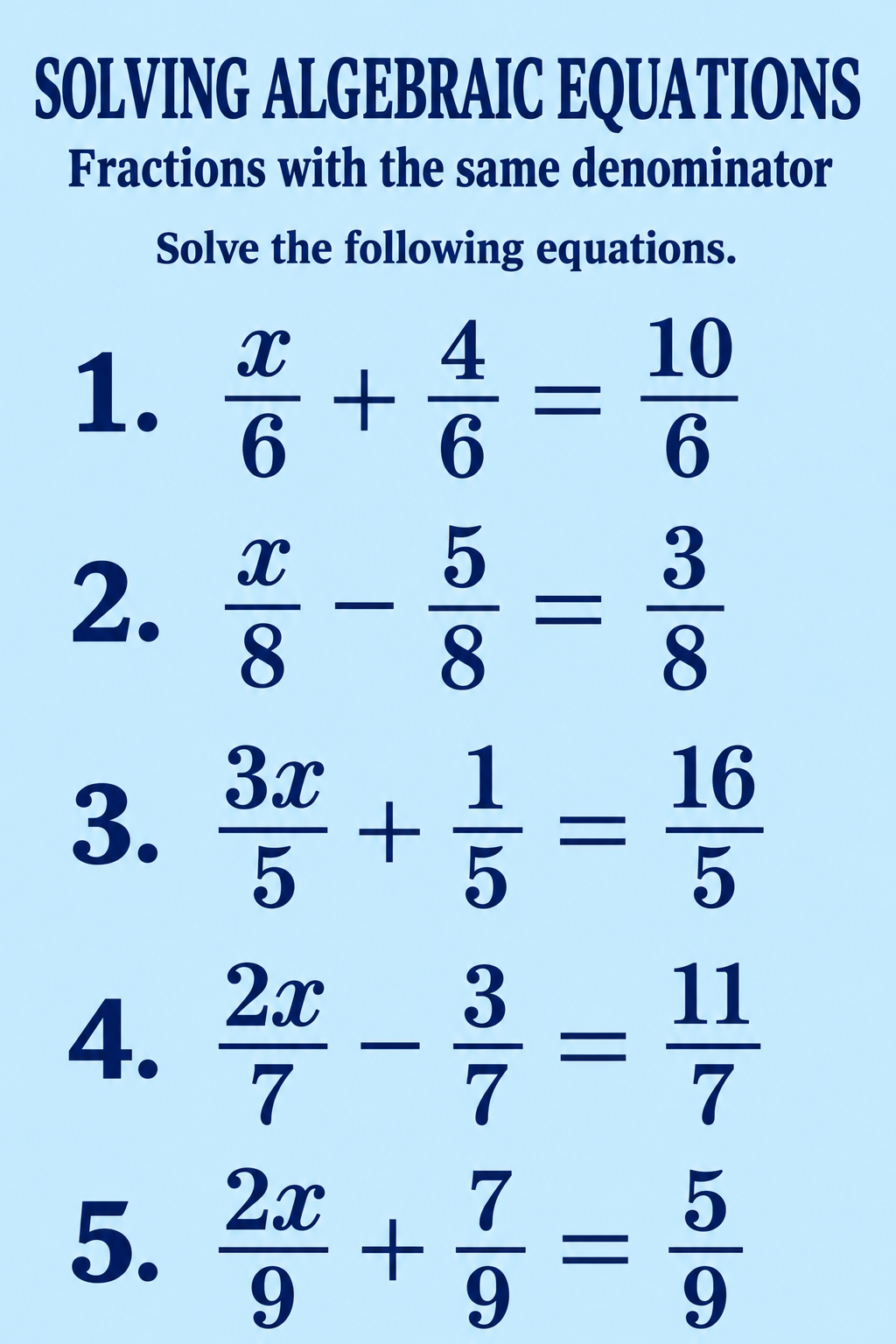
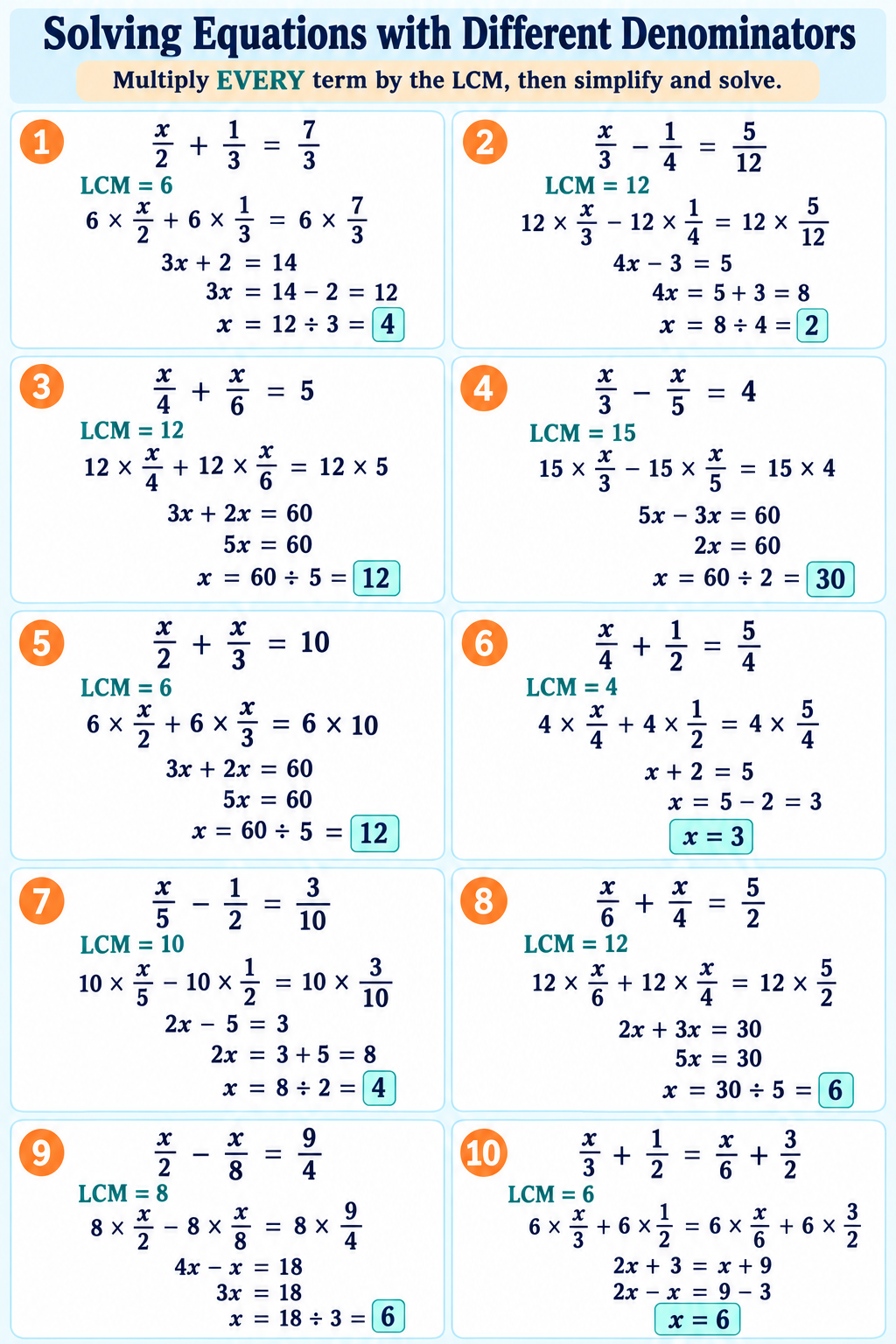
Study the following examples
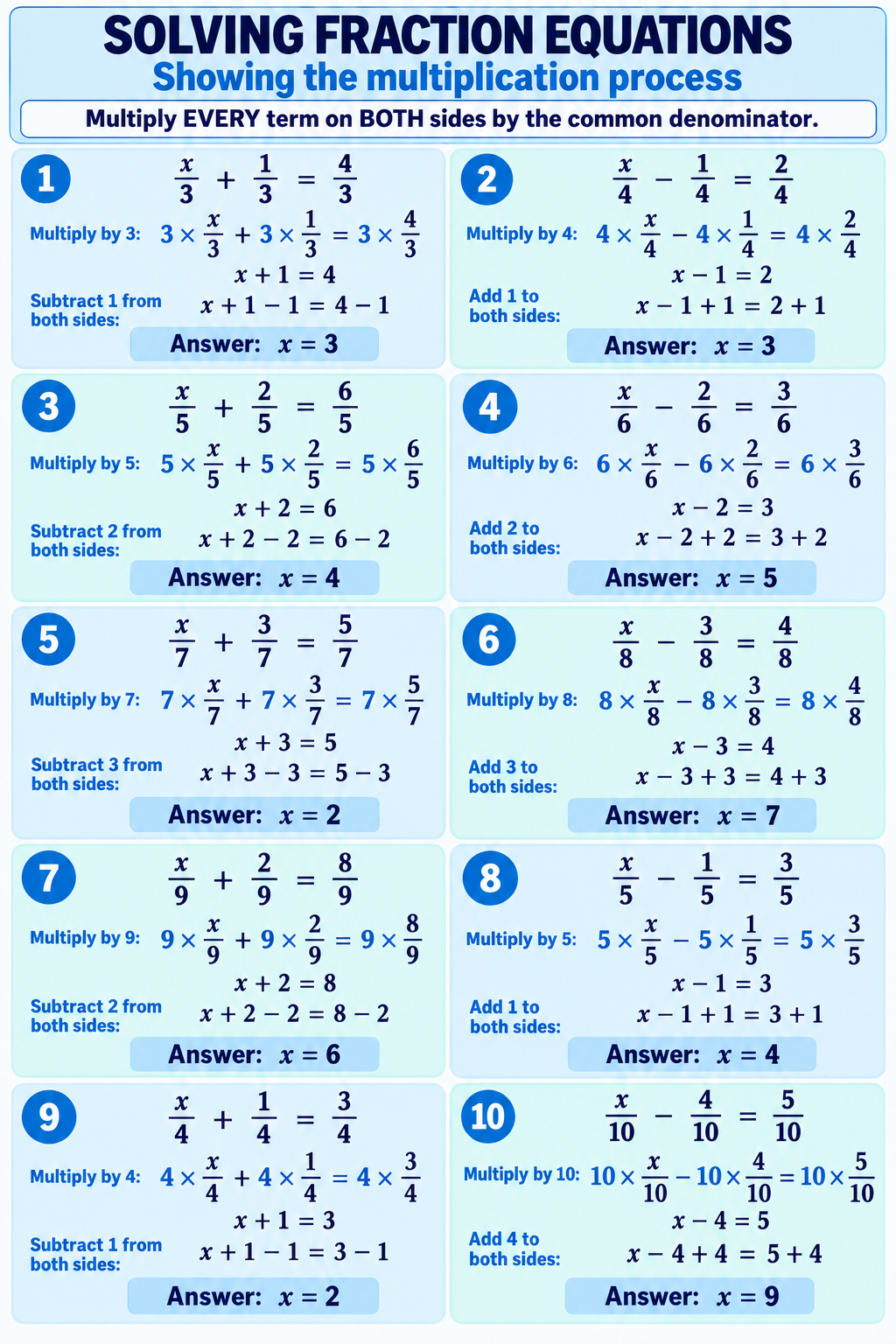
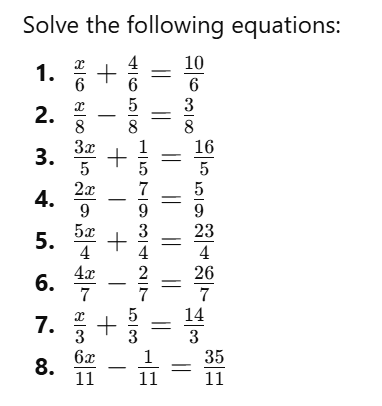
Follow the steps described below and use them to solve the equations
- To solve simple algebraic equations involving fractions with different denominators, follow these steps
- Identify the denominators.
- Find their LCM.
- Multiply every term on both sides by the LCM.
- Simplify, then isolate the unknown by performing the same operation on both sides.
- Check your answer in the original equation.
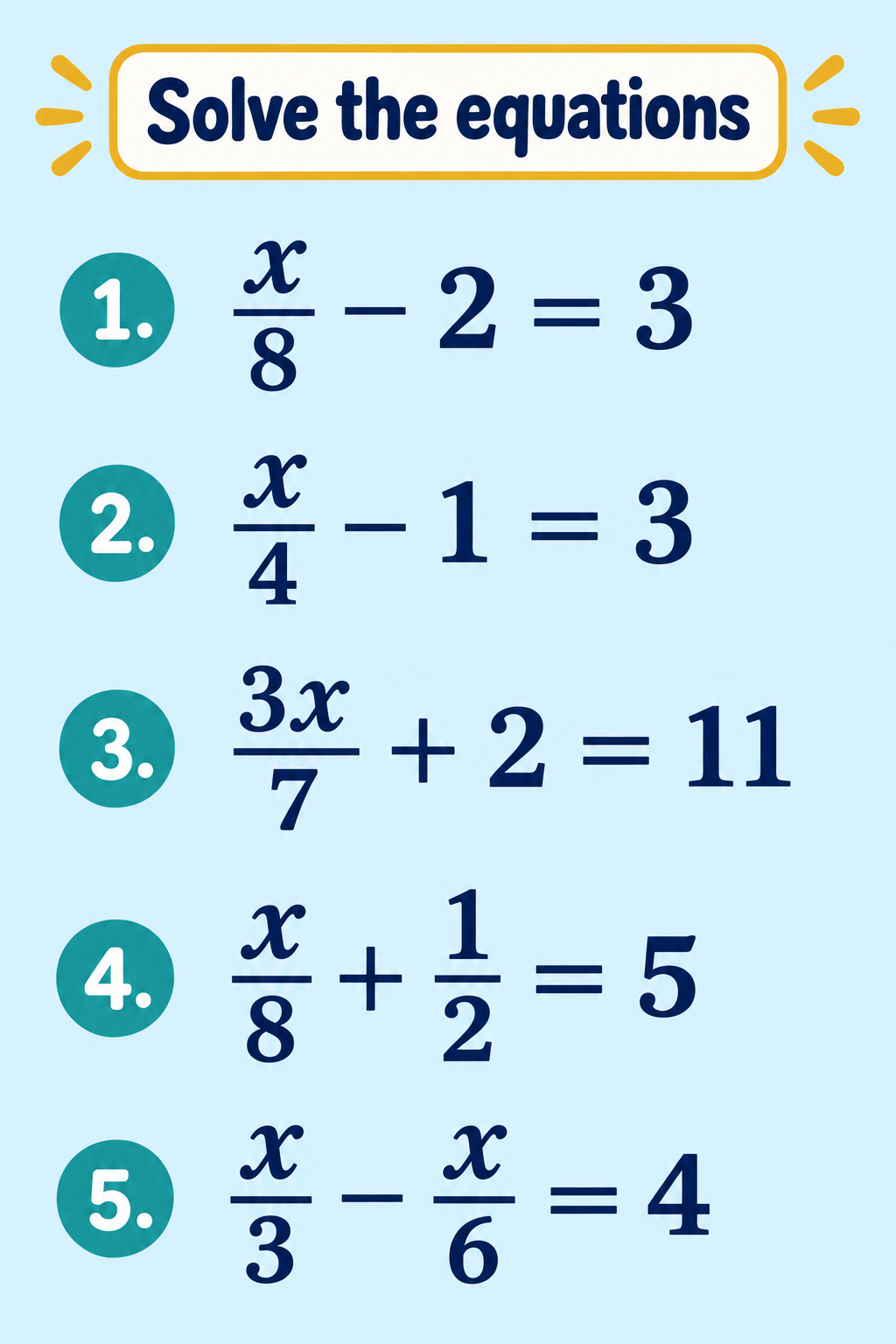
Study the following examples
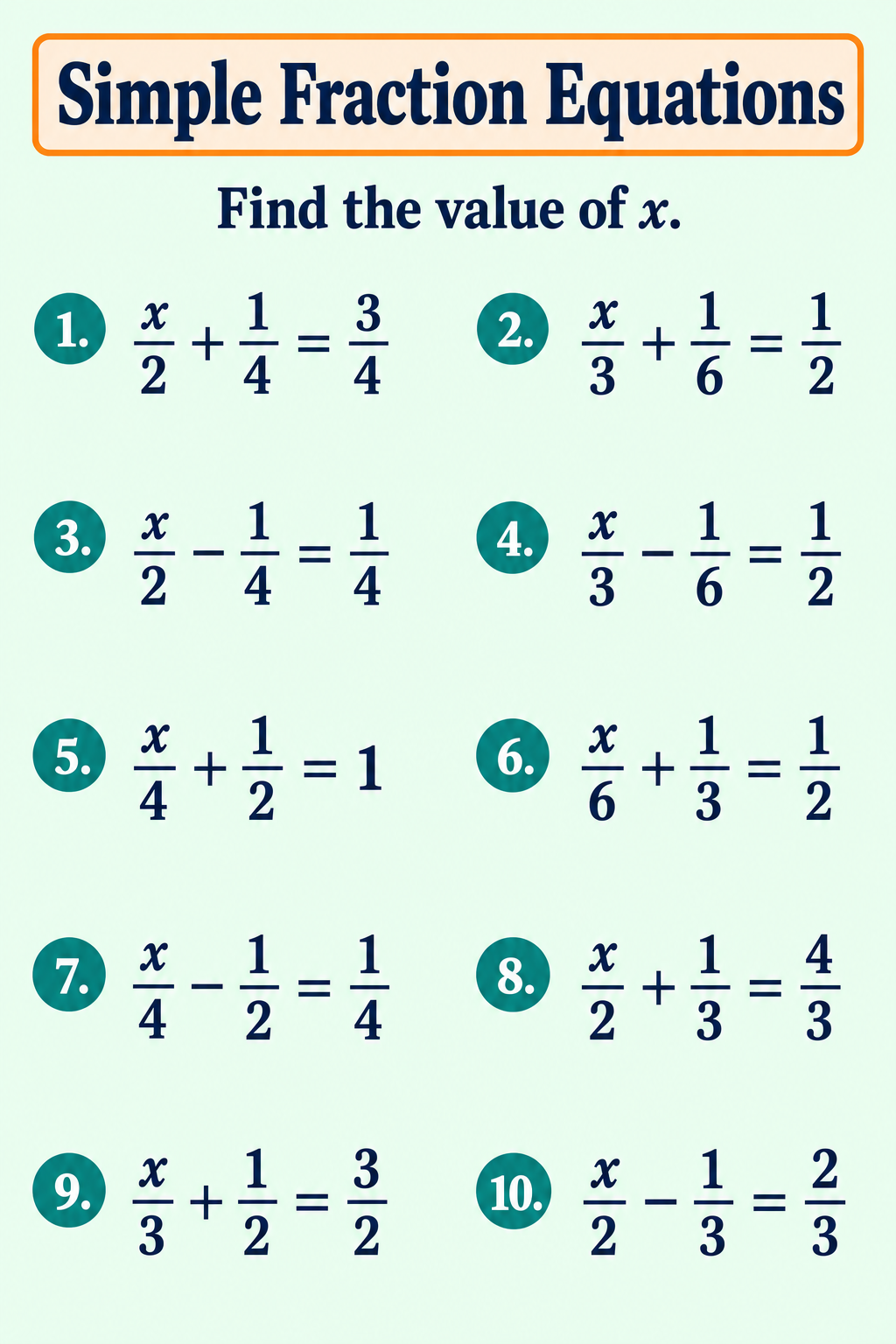
Solve the following equations
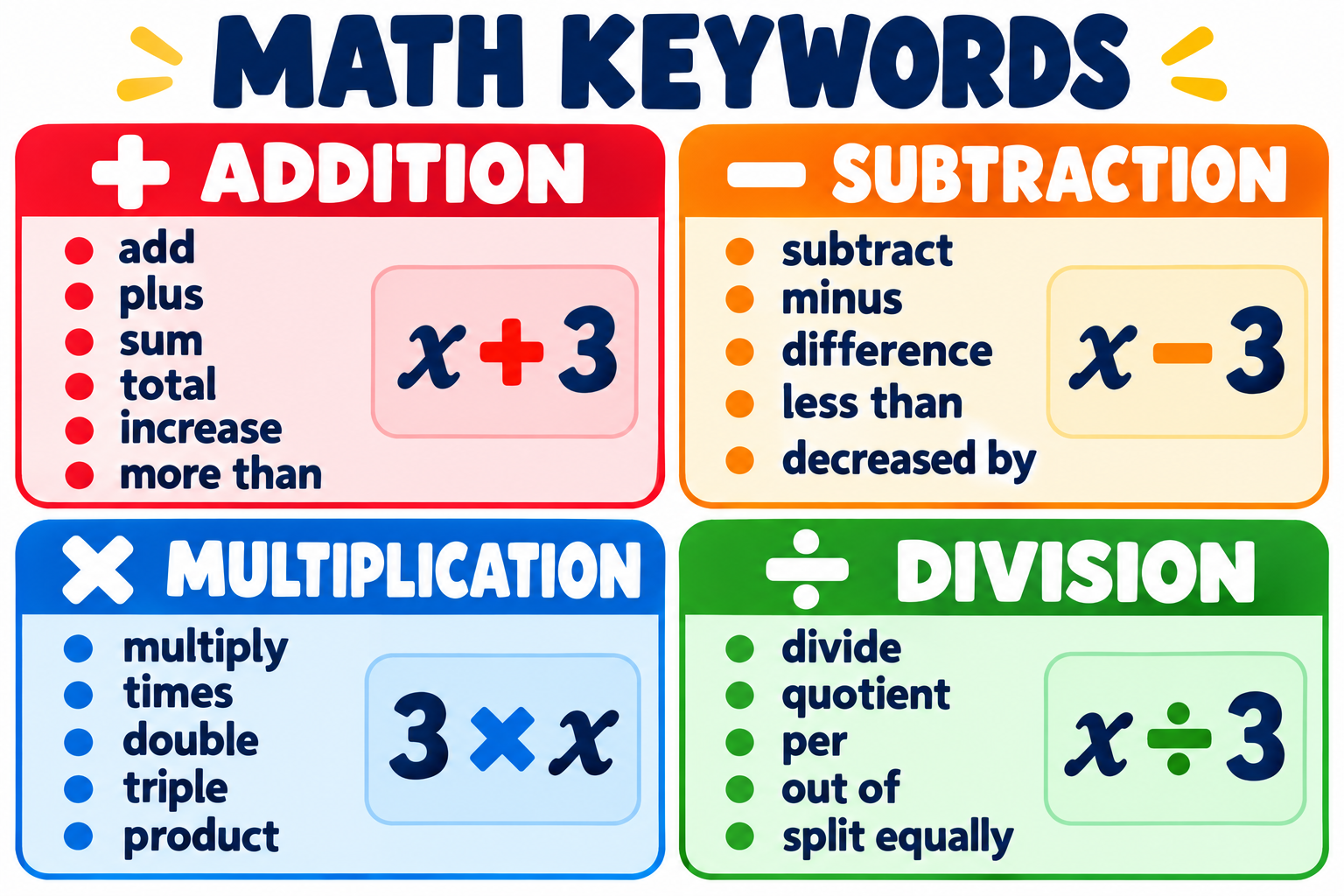
Key word from word problems
Study the following keywords from word problems
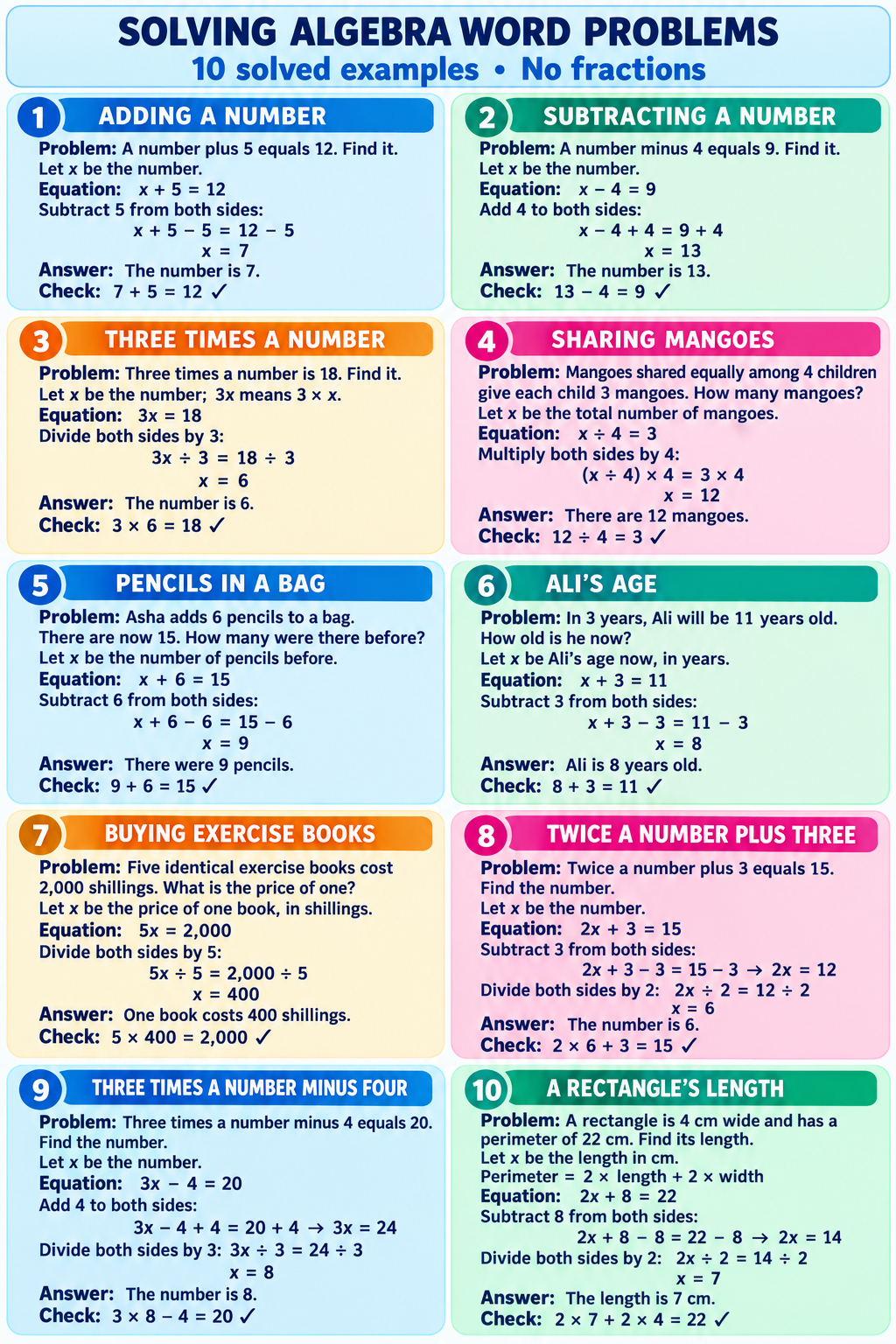
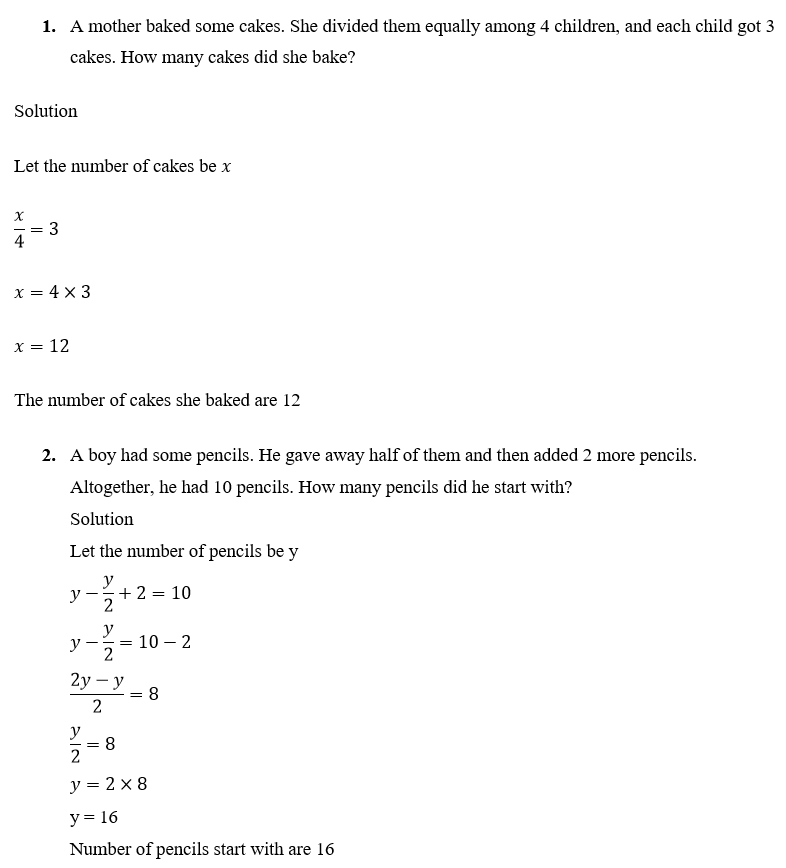
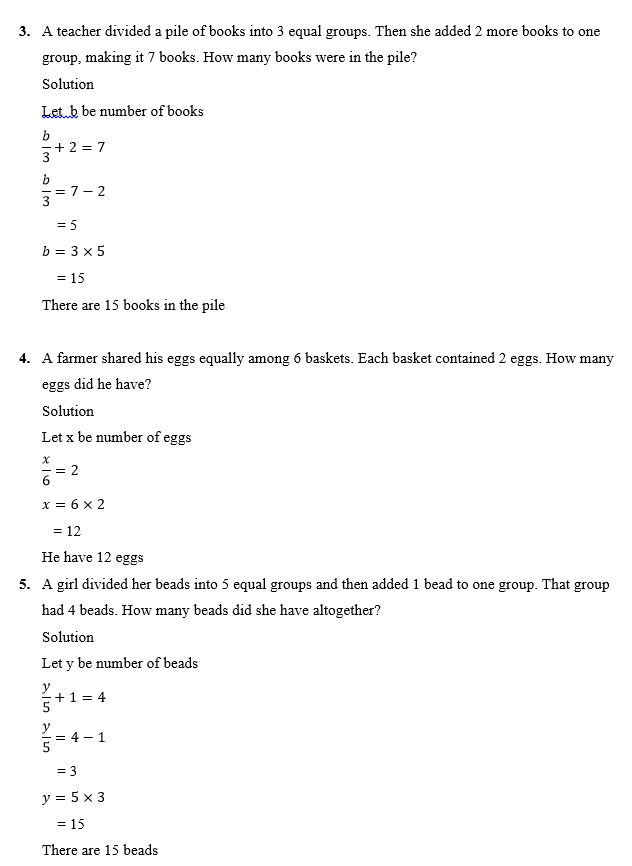
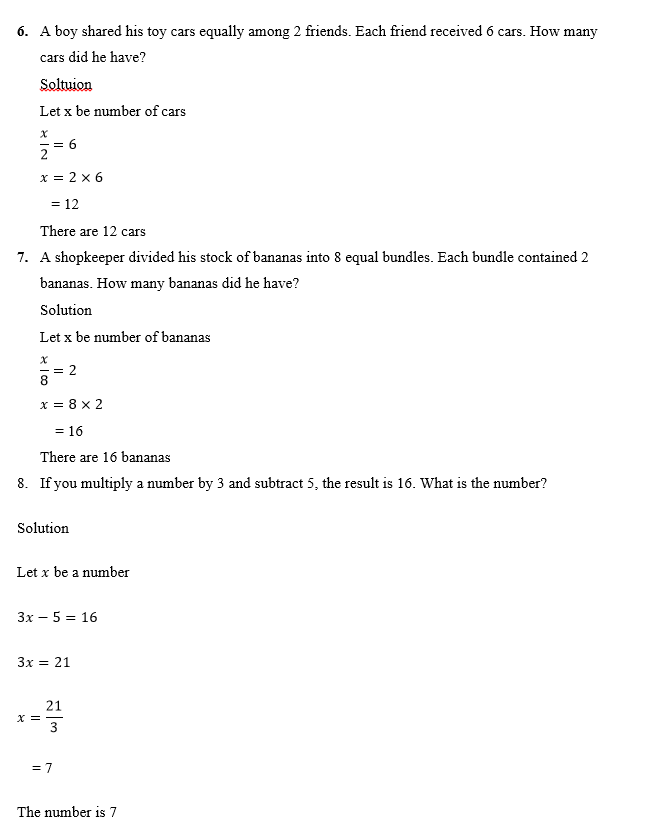
Study the following examples
- Twice a number minus 9 equals 25. What is the number?
- The sum of one-third of a number and 8 equals 20. Find the number.
- A number divided by 7 gives 11. What is the number?
- Three times a number plus 4 equals 19. What is the number?
- One-fourth of a number minus 5 equals 3. Find the number.
- Five times a number divided by 2 equals 25. What is the number?
- 1. Salma bought a packet of sweets. She shared them equally among 2 friends, and each friend received 7 sweets. How many sweets were in the packet?
- 2. A farmer harvested some mangoes. He gave away half of them and then added 3 more to the basket. Altogether, he had 9 mangoes left. How many mangoes were harvested?
- 3. A boy had some marbles. He gave away one-fifth of them and then added 2 more marbles to his collection. Now he has 5 marbles. How many marbles did he start with?
- 4. A group of children shared a packet of biscuits equally among 6 of them. Each child received 2 biscuits. How many biscuits were in the packet?
- 5. Salma bought a packet of sweets. She shared them equally among 2 friends, and each friend received 7 sweets. How many sweets were in the packet?
- 6. A farmer harvested some mangoes. He gave away half of them and then added 3 more to the basket. Altogether, he had 9 mangoes left. How many mangoes were harvested?
- 7. A boy had some marbles. He gave away one-fifth of them and then added 2 more marbles to his collection. Now he has 5 marbles. How many marbles did he start with?
- 8. A group of children shared a packet of biscuits equally among 6 of them. Each child received 2 biscuits. How many biscuits were in the packet?
- 9. A teacher distributed some pencils equally among 5 pupils. Each pupil received 4 pencils. How many pencils did the teacher distribute?
- 10. A basket contained some oranges. When the oranges were shared equally among 4 children, each child got 3 oranges. How many oranges were in the basket
- 11. A shopkeeper packed some apples into 3 bags. Each bag contained 6 apples. How many apples did the shopkeeper pack?