Mathematics
BASE
Reading settings
Text size
Line spacing
Colours
BASE
In this chapter, students will learn the concept of bases in numeration systems. They will explore how to count objects in different bases, read and write base numerations, and understand their meaning. They will also practice changing numbers between bases and performing arithmetic operations within and across bases.
Concept of base
A base (or radix) is the number of unique digits used to represent numbers in a number system.Examples:
- Base 10 → Digits: 0–9
- Base 2 → Digits: 0, 1
- Base 3 → Digits: 0, 1, 2
- Base 5 → Digits: 0, 1, 2, 3, 4
Use base in the classroom
Activity 1
Study the following examples. Objects can be grouped according to a chosen base.
- Base 10 grouping, take 23 counters (23 = 2 groups of ten + 3 ones)
- Base 5 grouping, take 17 counters (17 = 3 groups of five + 2 ones)
- Base 2 grouping, take 6 counters (6 = 3 groups of two + 0 ones)
- Base 3 grouping, take 14 counters (14 = 4 groups of three + 2 ones)
- Base 5 grouping, take 25 counters (25 = 5 groups of five + 0 ones)
- Base 2 grouping, take 9 counters (9 = 4 groups of two + 1 one)
- Base 3 grouping, take 10 counters (10 = 3 groups of three + 1 one)
- Base 10 grouping, take 45 counters (45 = 4 tens + 5 ones)
- Base 5 grouping, take 8 counters (8 = 1 five + 3 ones)
- Base 2 grouping, take 7 counters (7 = 3 twos + 1 ones)
Exercise 1
Group the following in the indicated base:
- 18 objects in base 5
- 11 objects in base 3
- 9 objects in base 2
- 36 objects in base 10
- 14 objects in base 5
- 8 objects in base 3
- 5 objects in base 2
- 62 objects in base 10
- 22 objects in base 5
- 13 objects in base 3
Count objects in base (10, 5, 3 and 2)
Activity 2
Observe the following examples. Counting follows place values of the base.
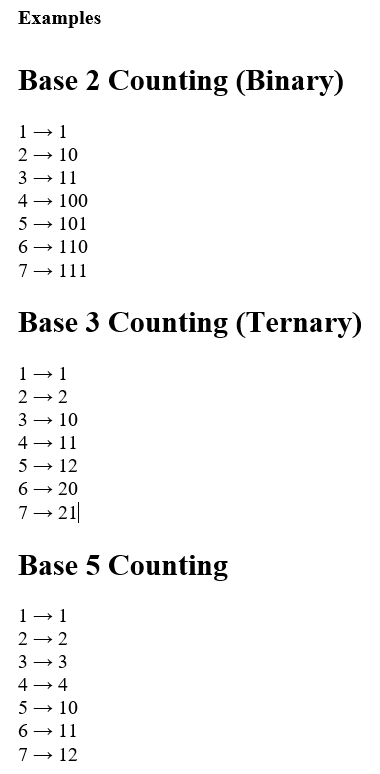
Exercise 2
Write the next number
- Base 2: 101, ___
- Base 3: 12, ___
- Base 5: 34, ___
- Base 2: 111, ___
- Base 3: 22, ___
- Base 5: 44, ___
- Base 2: 10, ___
- Base 3: 20 , ___
- Base 5: 14, ___
- Base 2: 110, ___
Read and write base numerations
Activity 3
Reading a Base 5 Number: Observe the following examples
- 2435 Read as: Two-four-three base five.
- 2045 Read as:Two-zero-four base five
- 4325 Read as: Four-three-two base five.
- 10015 Read as: One-zero-zero-one base five.
- 34025 Read as: Three-four-zero-two base five.
Activity 4
Reading a base 3 number" Study the following examples
- 2103 Read as Two-one-zero base three.
- 20023 Read as Two zero zero two base three
- 12013 Read as One two zero one base three
- 22021 Read as Two two zero two one base three
Activity 5
Reading a base 2 number: Look the following examples
- 10112 Read as: One-zero-one-one base two.
- 11102 Read as: One-one -one-zero base two
- 1002 Read as: One-zero-zero-two base two
Exercise 3
Write the following numbers in words
- 3245
- 2. 12223
- 3. 101102
- 4. 221023
- 5. 44325
Exercise 4
Write the following numbers in numerals
- Four three two base five
- Two one two zero base three
- One zero zero zero base two
- One two one zero base three
- One four three zero base five
Explain the meaning of base numerations
Activity 6
Read the following information
- Base numeration (or number bases) refers to the system of counting and representing numbers using a fixed set of digits.
- The "base" tells us how many unique digits are available before we need to "carry over" to the next place value.
- Key Points
- Definition: The base of a number system is the number of digits it uses to represent numbers.
- Place Value: Each position in a number represents a power of the base.
- Base 10 (Decimal): Uses digits 0, 1, 2, 3, 4, 5, 6, 7, 8 and 9.
- Base 5 (Quinary): Uses digits 0, 1, 2, 3 and 4
- Base 3 ( Ternary): Uses digits 0, 1 and 2
- Base 2 (Binary): Uses digits 0 and 1
Changing of bases
Write base 10 in base 2, 3 and 5
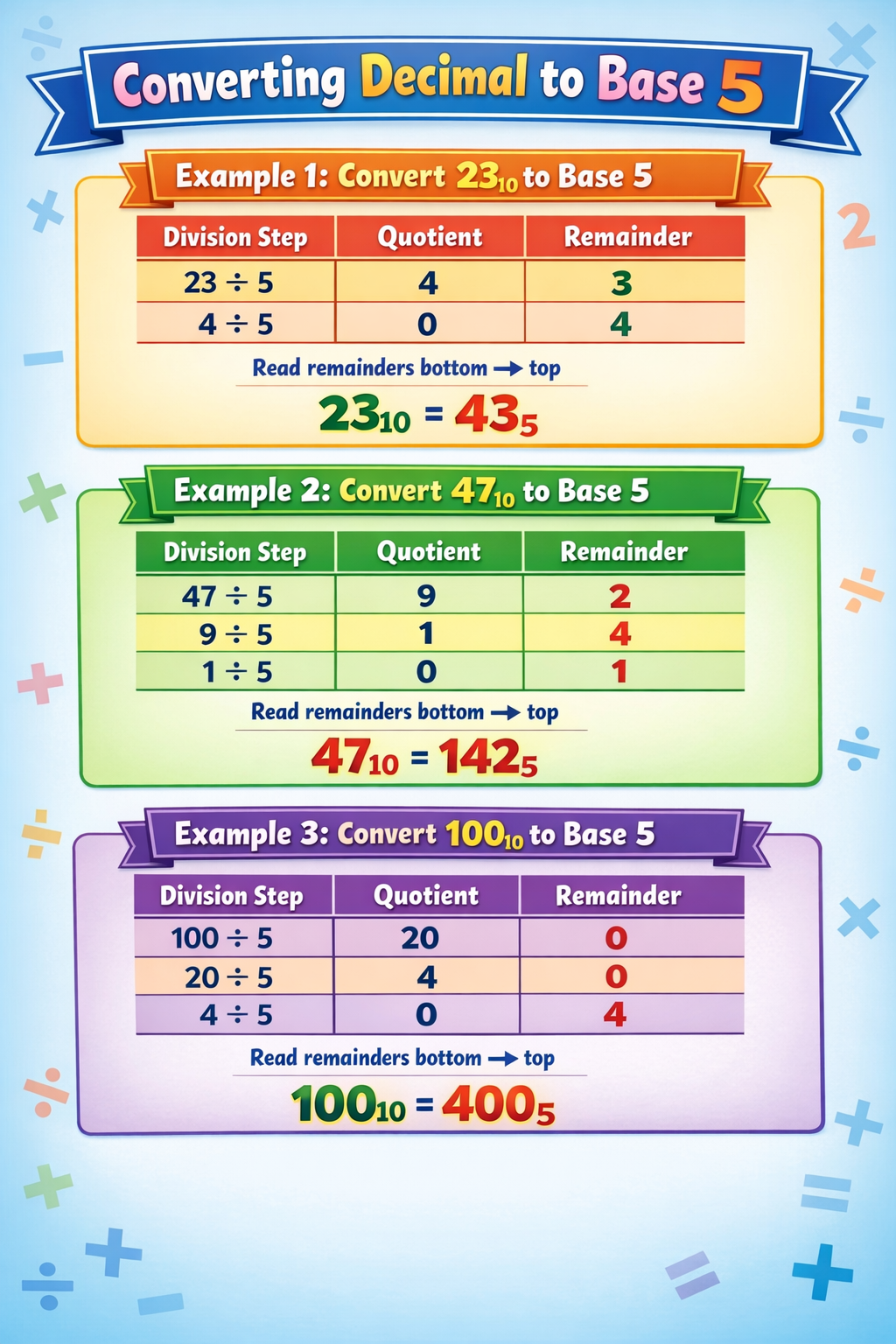
Example 1
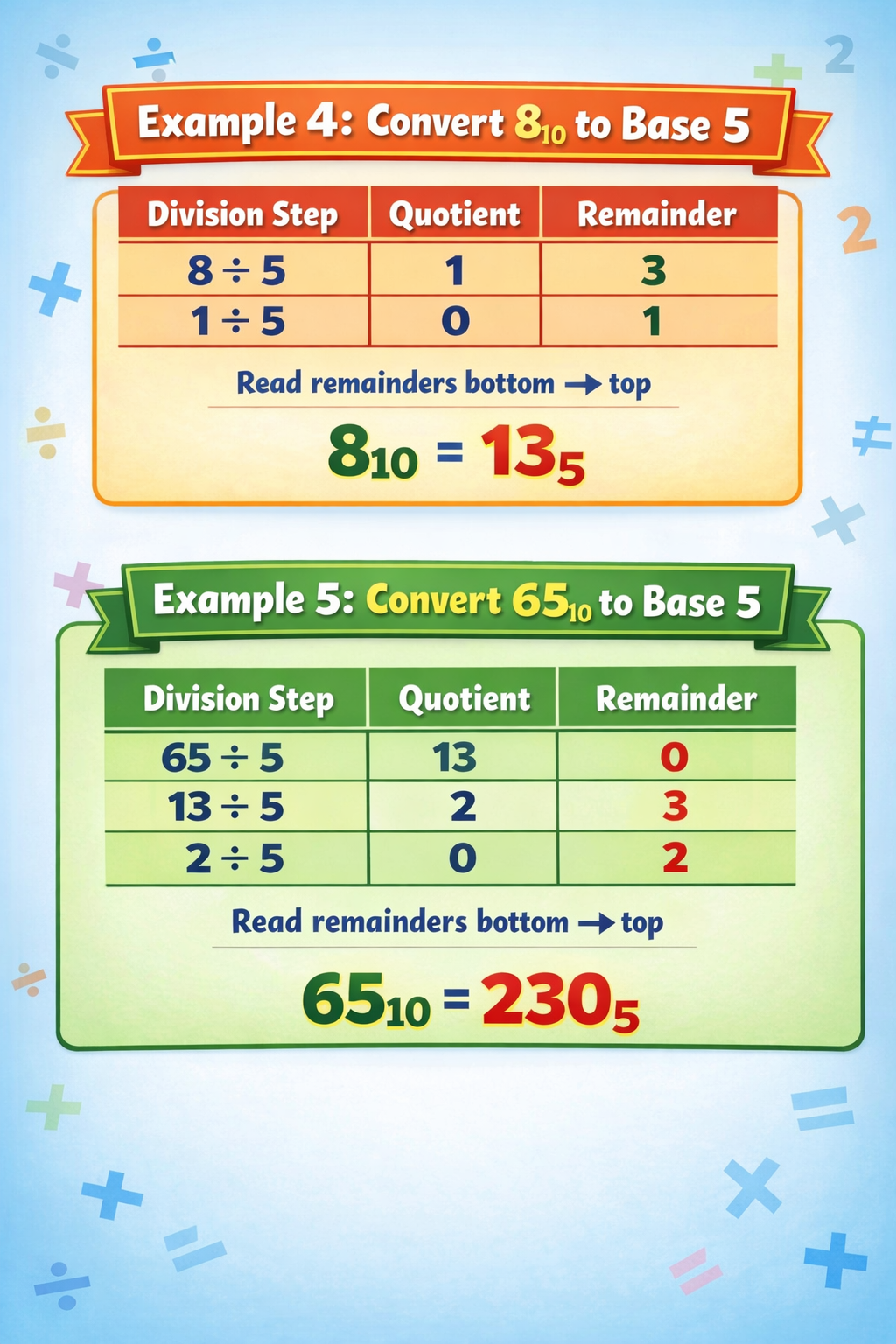
Changing base 10 to base 5: Observe the following examples
Exercise 5
Convert the following decimal numbers to base 5:
- 7
- 12
- 18
- 23
- 29
- 31
- 36
- 42
- 48
- 55
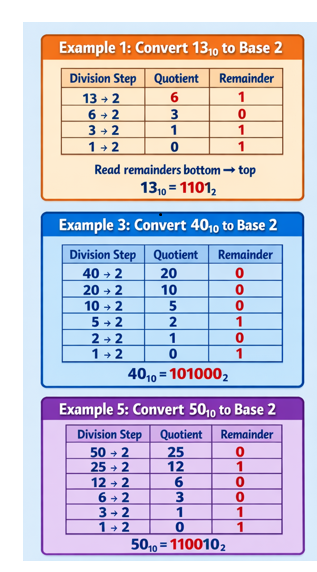
Activity 7
Changing base 10 to base 2: Observe the following examples
Example 2
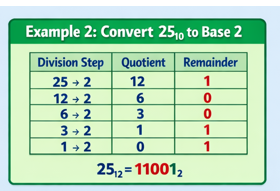
Exercise 6
Change the following decimal numbers into base 2 numbers
- 6
- 13
- 19
- 25
- 31
- 8
- 14
- 22
- 37
- 50
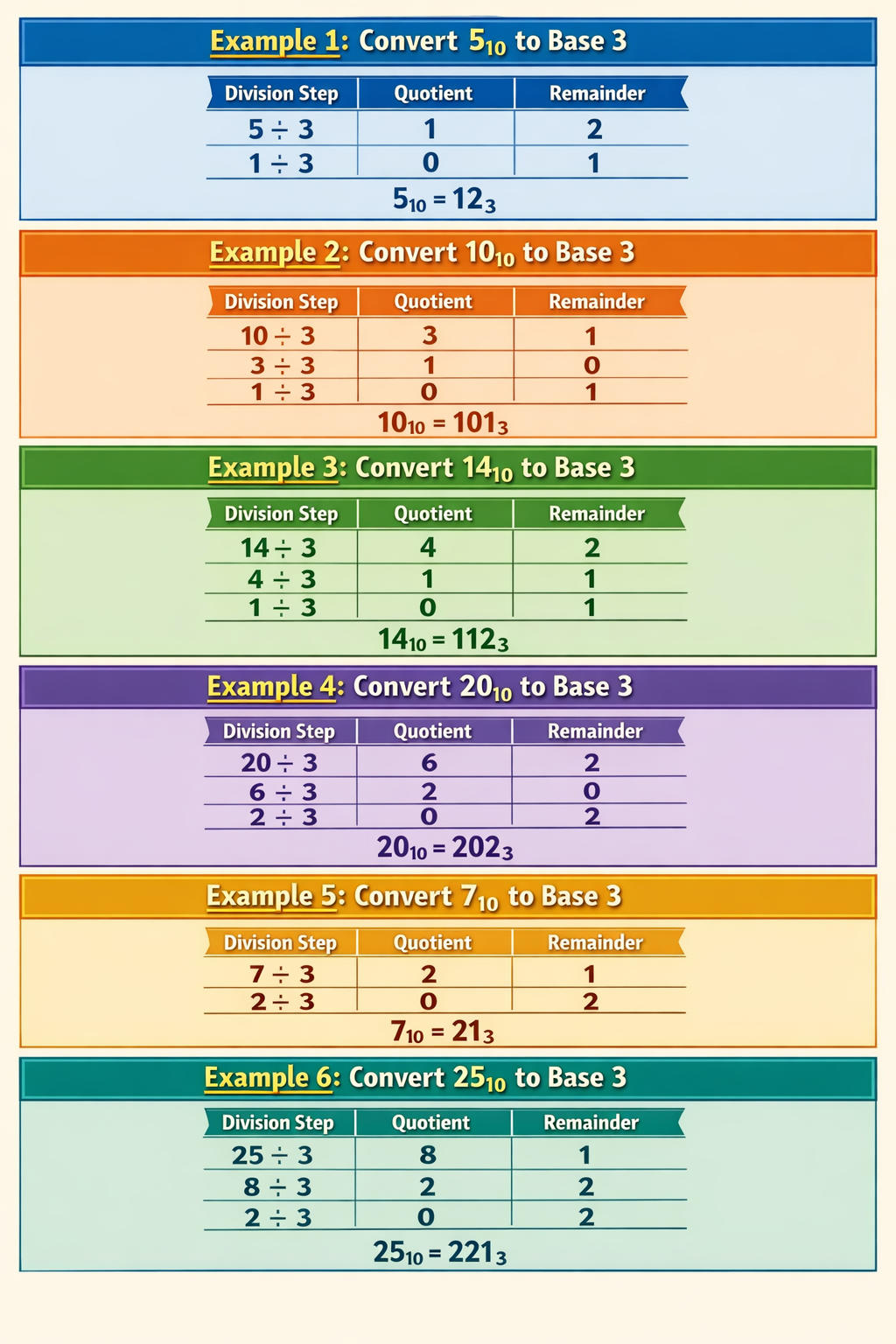
Example 3
Change base 10 numbers into base 3 numbers: Observe the following examples
Exercise 7
Convert the following decimal numbers ( base 10) to base 3:
- 5
- 11
- 14
- 20
- 23
- 7
- 18
- 27
- 35
- 40
Express base 2, 3, and 5 in base 10
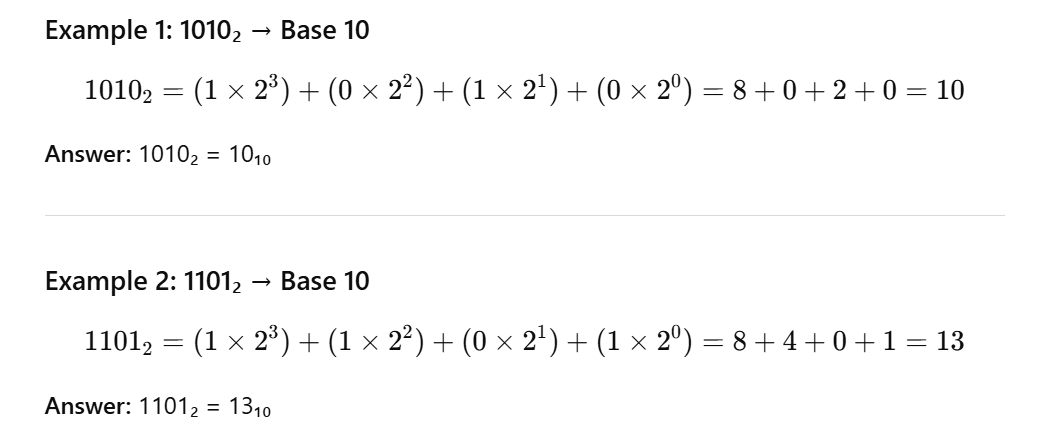
Example 4
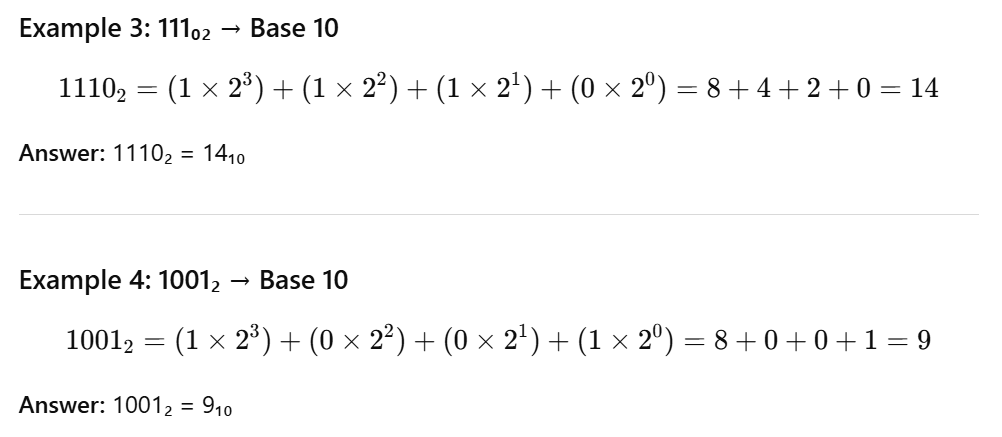
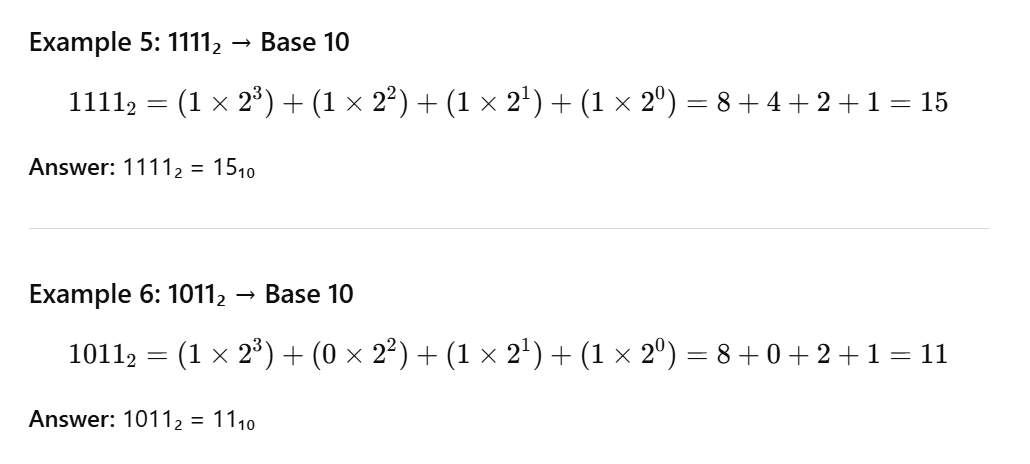
Express base 2 in base 10: Observe the following examples
Activity 8
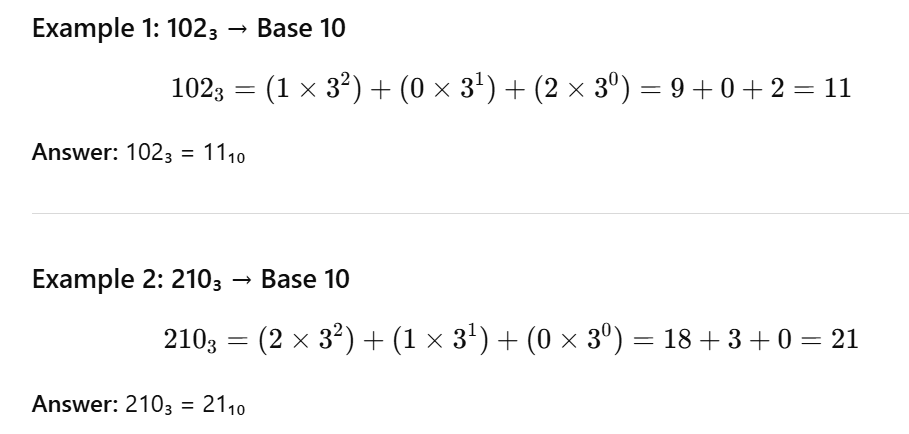
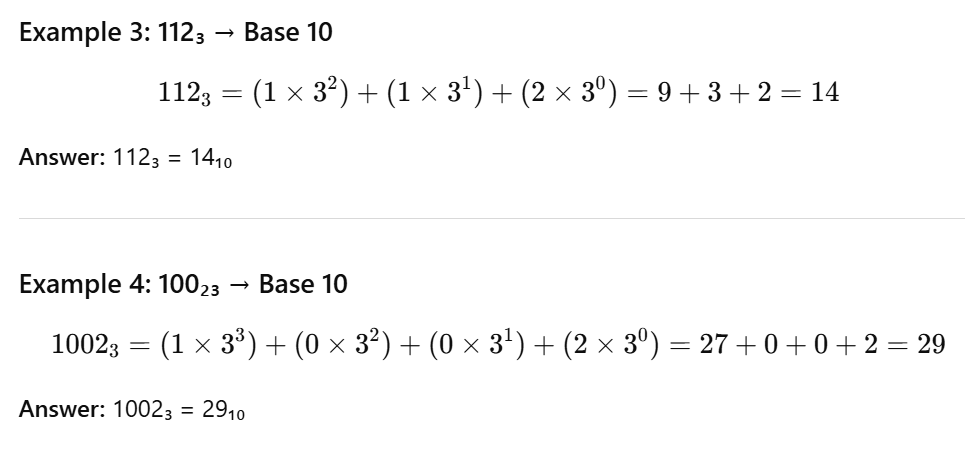
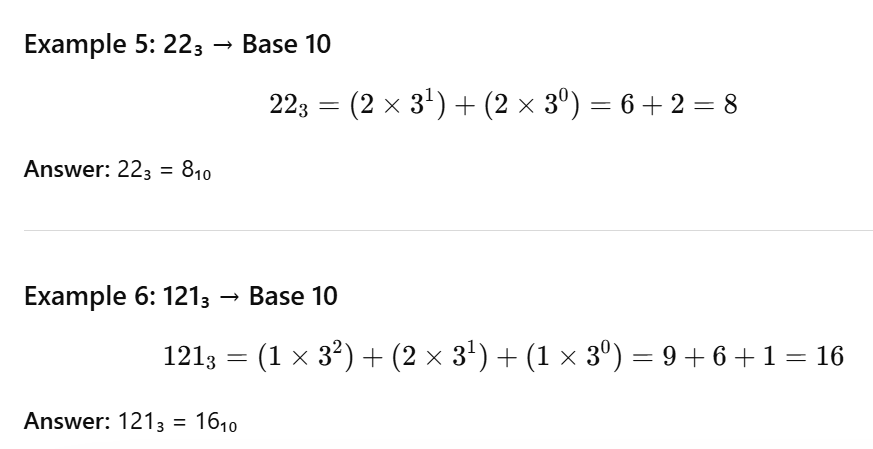
Express base 3 numbers in base 10: Observe the following examples
Activity 9
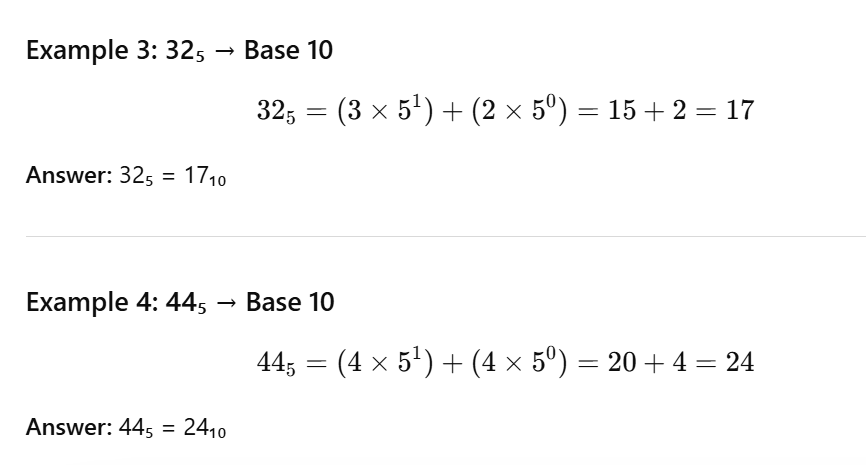
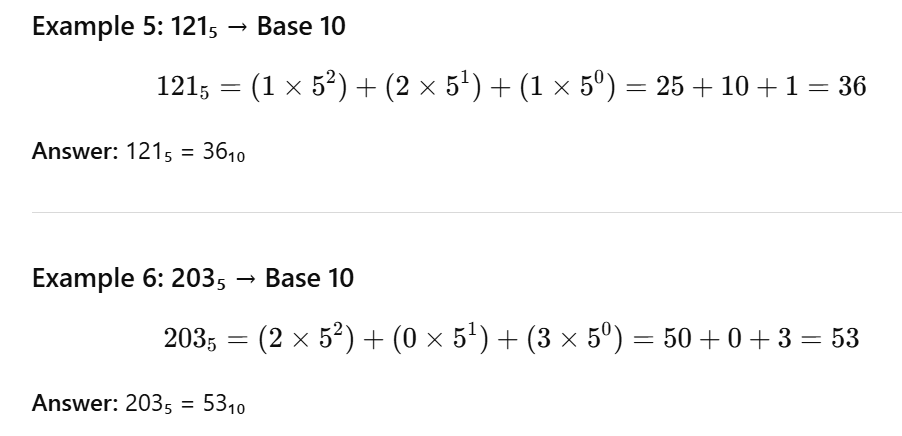
Express base 5 numbers in base 10: Observe the following examples
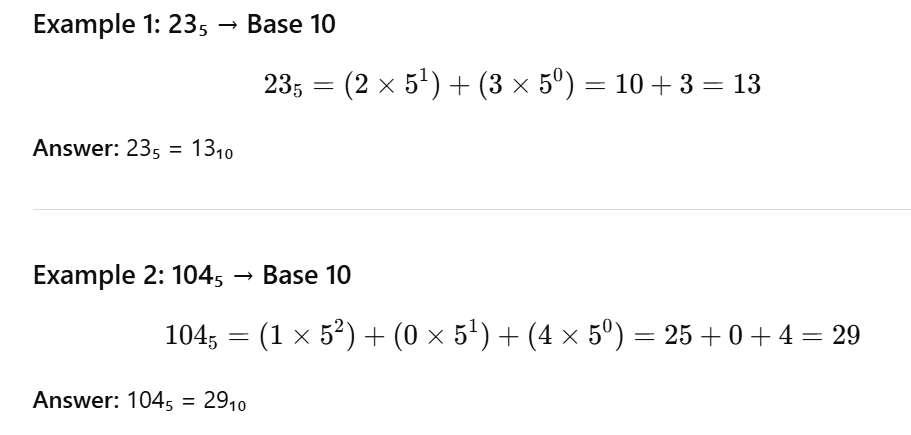
Example 5
Exercise 8
Convert the following to base 10:
- (100)₂
- (101)₂
- (22)₃
- (12)₃
- (44)₅
- (13)₅
- (111)₂
- (20)₃
- (24)₅
- (102)₃
Convert base 2 to base 5 and vice versa
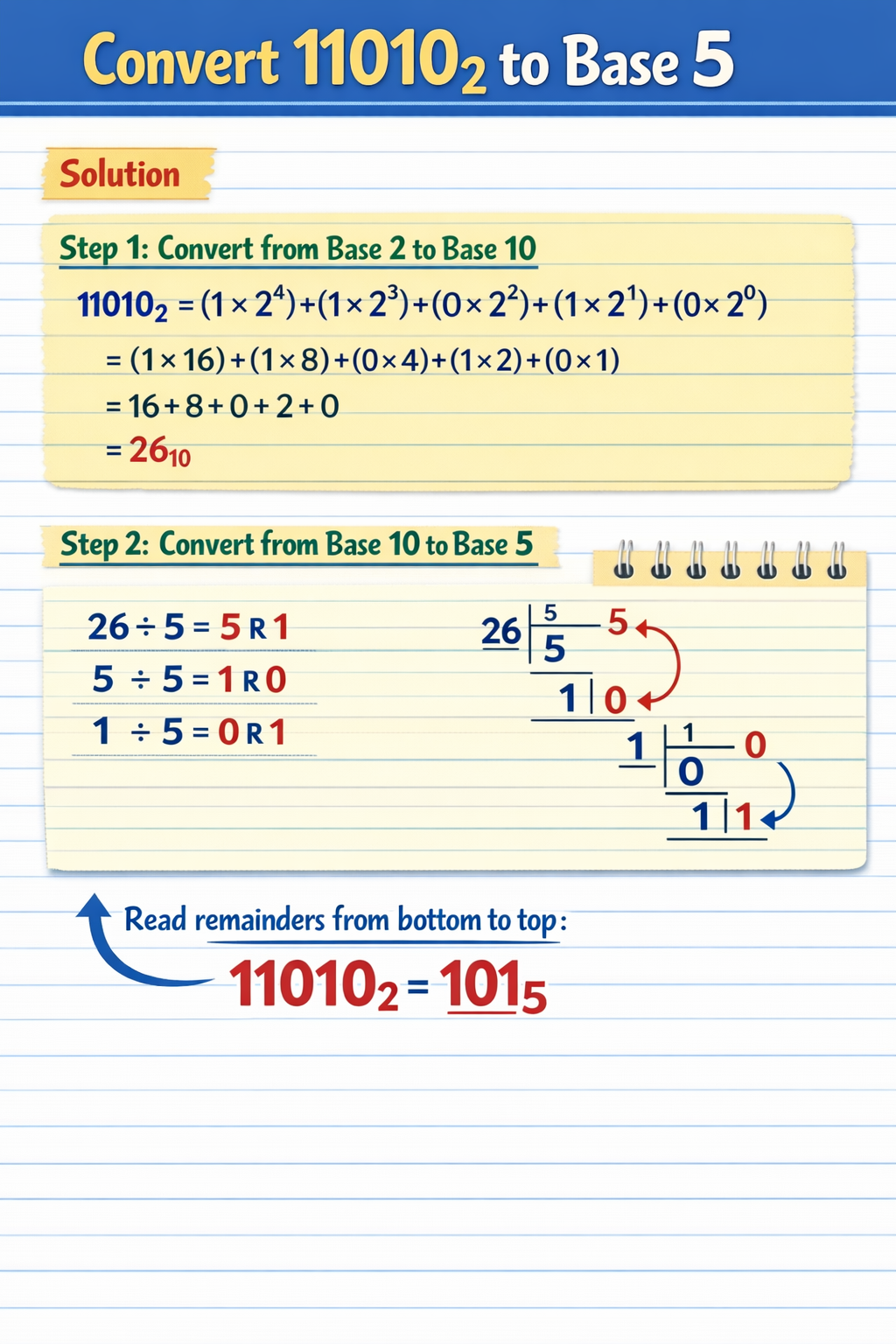
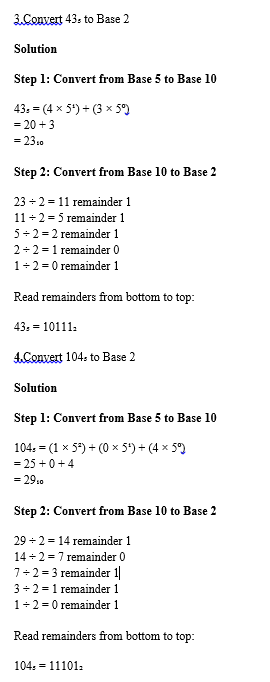
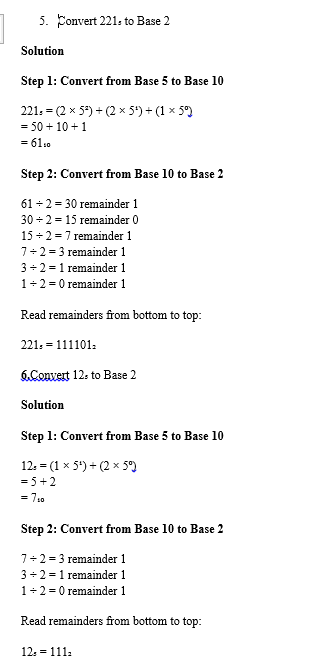
Example 6
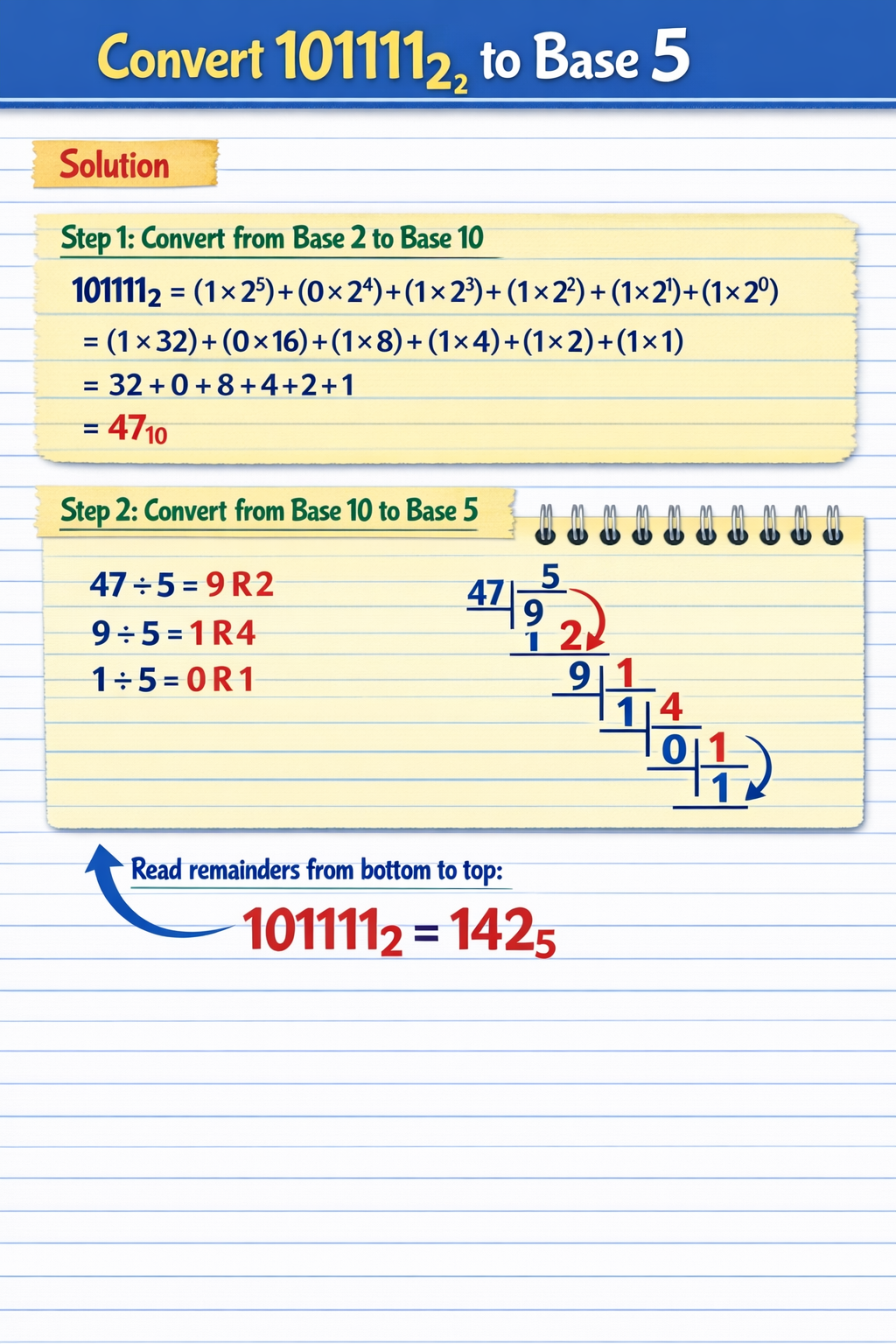
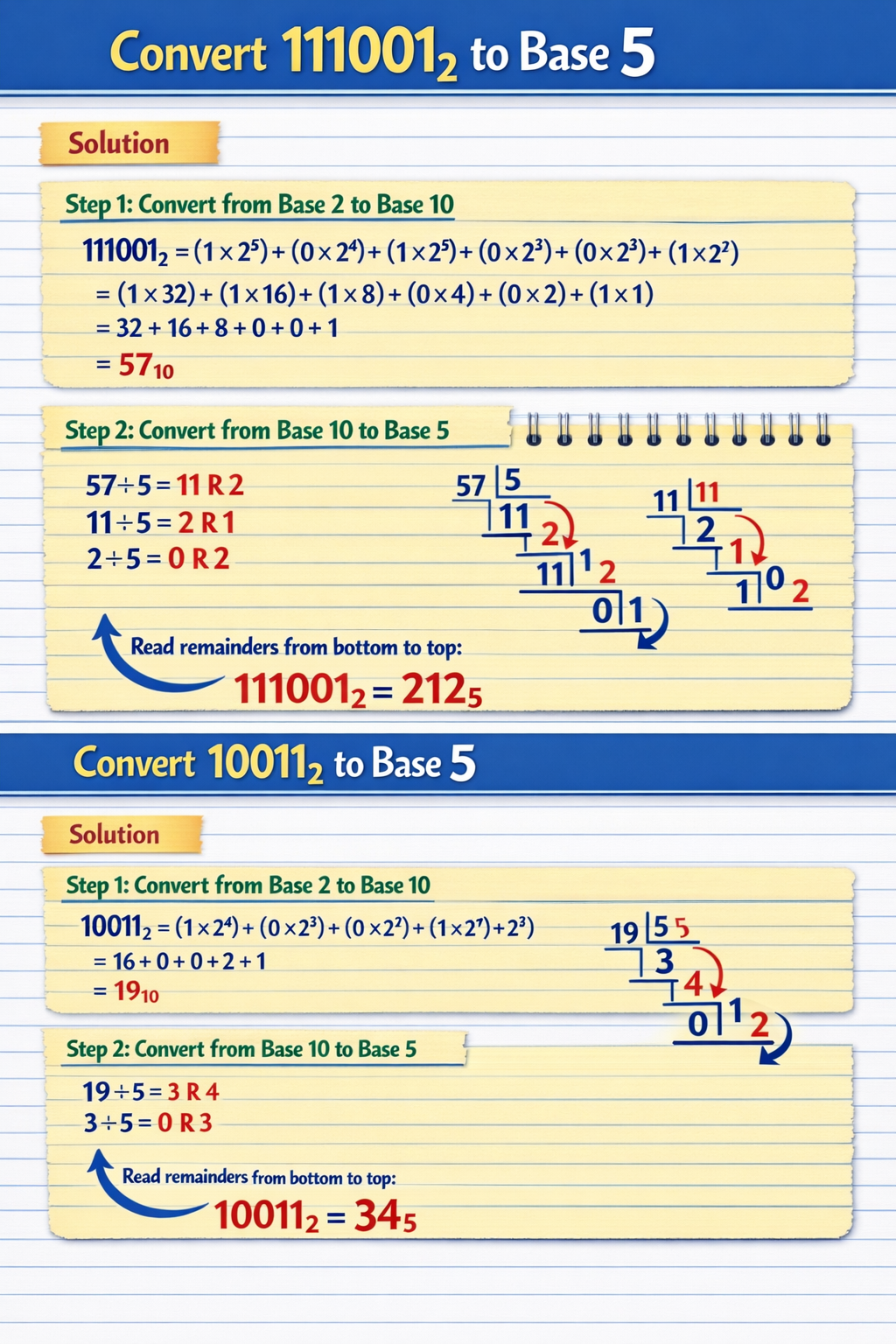
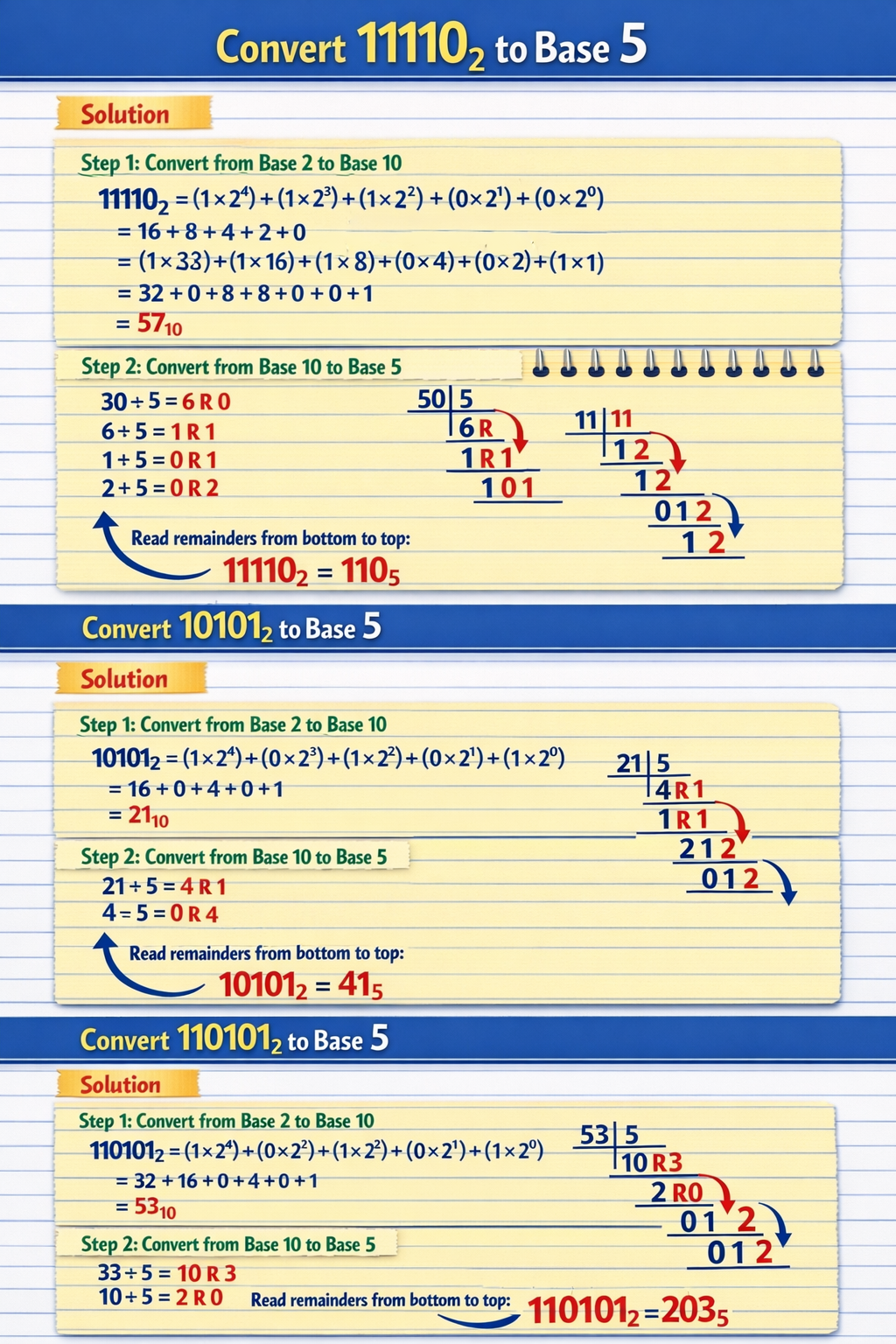
Convert base 2 to base 5: Study the following examples
Example 7
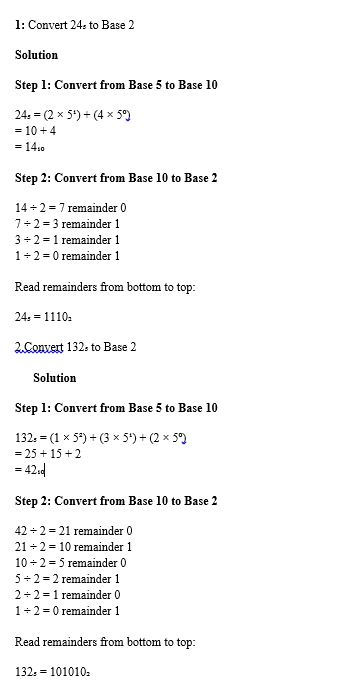
Converting base 5 to base 2: Study the following examples
Example 8
Exercise 9
Do the following conversion
- (101)₂ to base 5
- (111)₂ to base 5
- (20)₅ to base 2
- (13)₅ to base 2
- (100)₂ to base 5
- (4)₅ to base 2
- (110)₂ to base 5
- (11)₅ to base 2
- (1010)₂ to base 5
- (12)₅ to base 2
Use base 2 in multiplication of two numbers
Arithmetic operations on base
Add base numerations which are in the same base
Activity 10
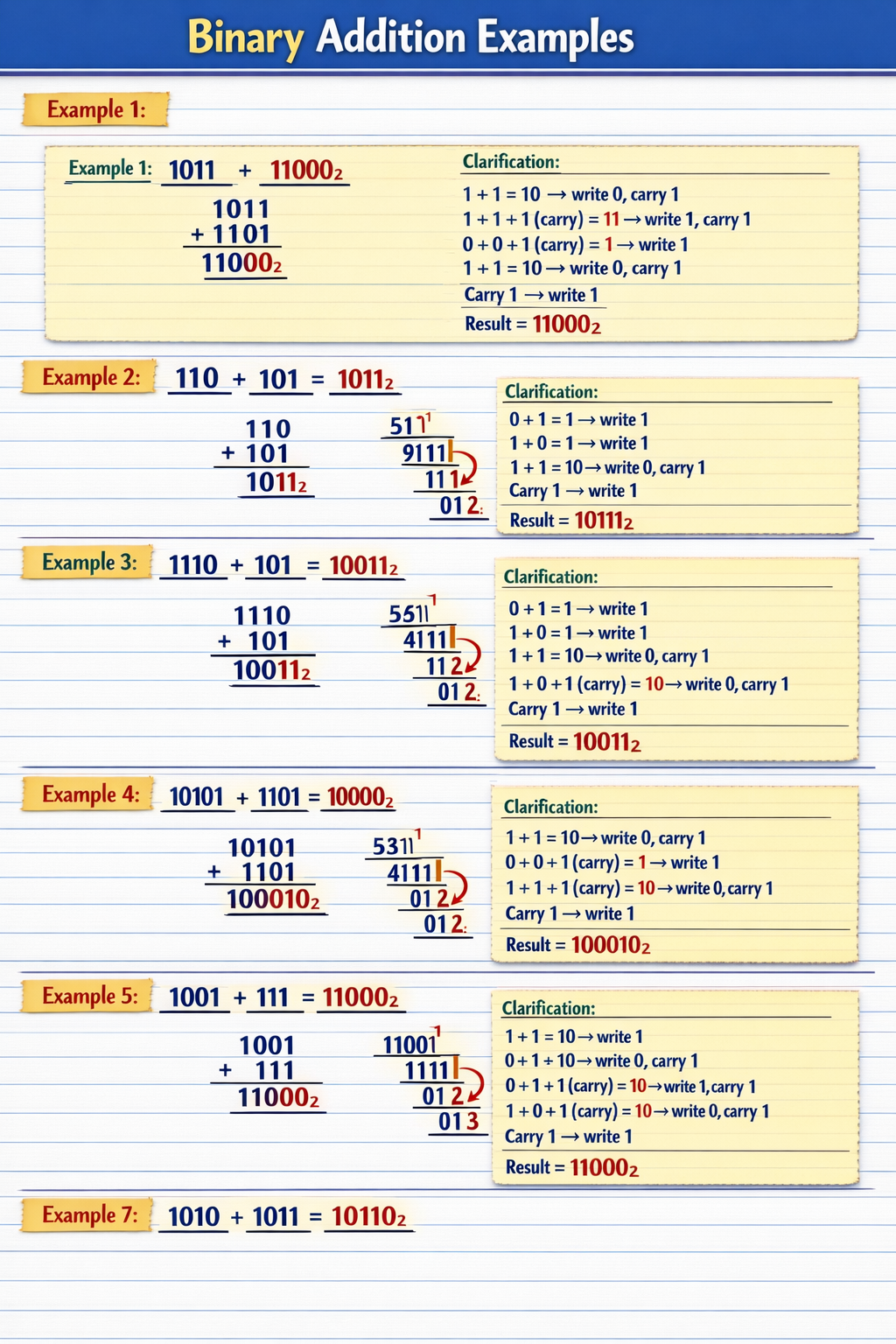
Addition of base 2 numbersThe four basic rules for adding binary digits are as follow
- 0 + 0 = 0 Sum of 0 with carry of 0
- 0 + 1 = 1 Sum of 1 with carry of 0
- 1 + 0 = 1 Sum of 1 with carry of 0
- 1 + 1 = 10 Sum of 0 with carry of 1
Example 9
Study the following examples
Exercise 10
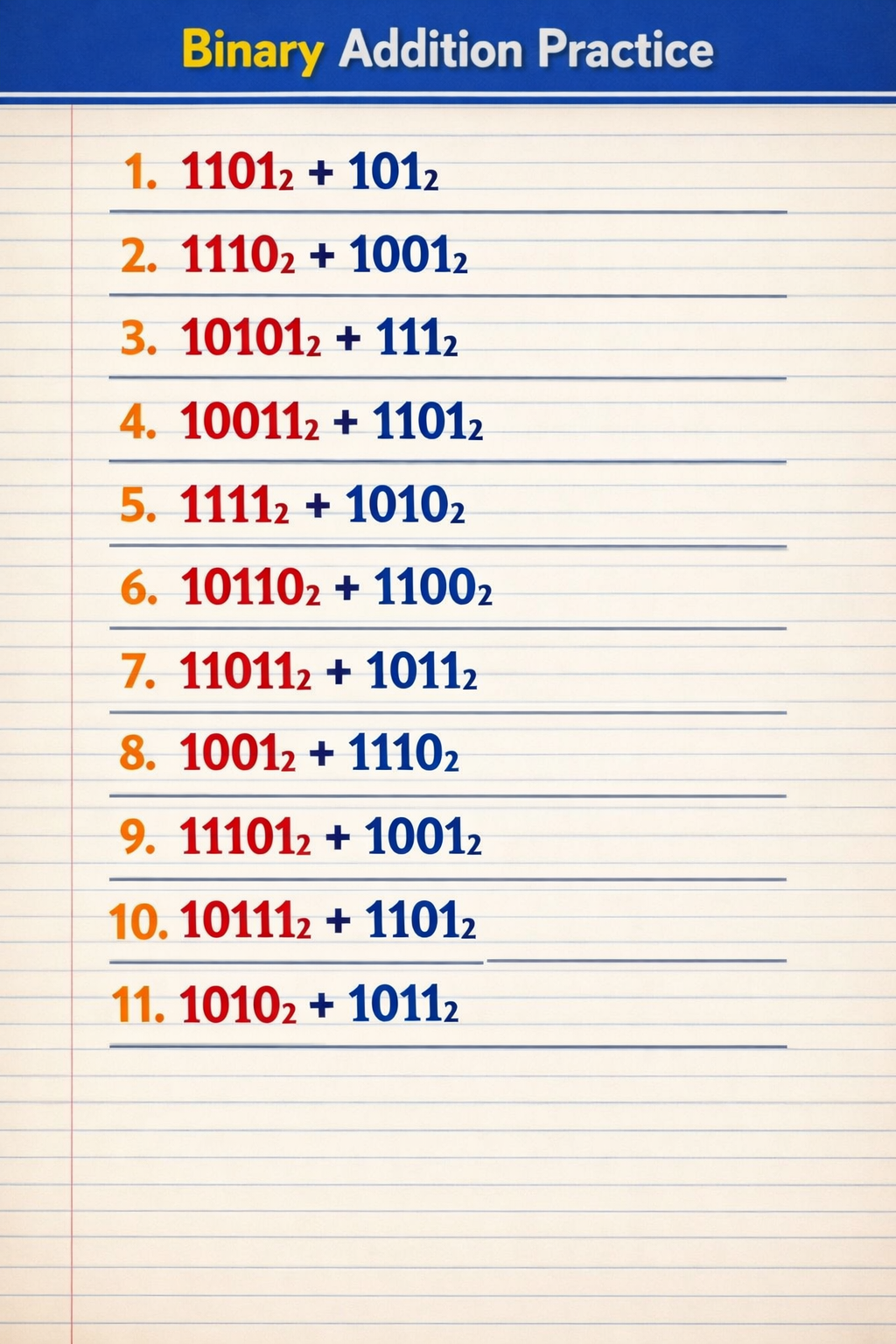
Add the following base 2 numbers
Example 10
Addition of base 5 numbers: Study the following examples;
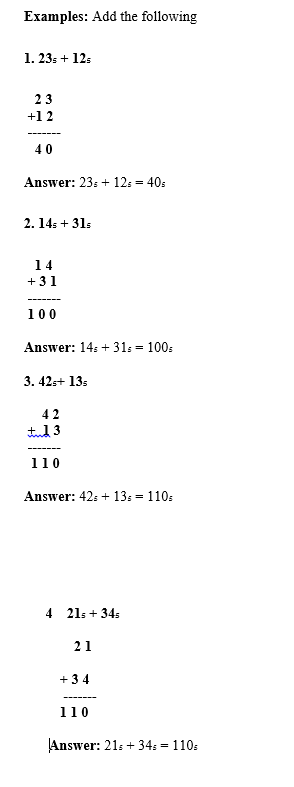
Example 11
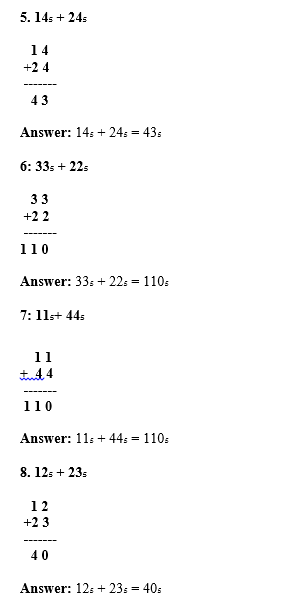
Exercise 11
Add the following
- 1. 12₅ + 23₅
- 2. 44₅ + 31₅
- 3. 103₅ + 24₅
- 4. 234₅ + 111₅
- 5. 342₅ + 128₅
- 6. 132₅ + 243₅
- 7. 214₅ + 134₅
- 8. 44₅ + 32₅
- 9. 103₅ + 42₅
- 10. 221₅ + 33₅
- 11. 144₅ + 213₅
- 12. 32₅ + 44₅
- 13. 401₅ + 34₅
- 14. 123₅ + 321₅
- 15. 44₅ + 111₅
Subtract base numerations which are in the same base
Example 12
Subtraction of base 2 numbers: Study the following examples
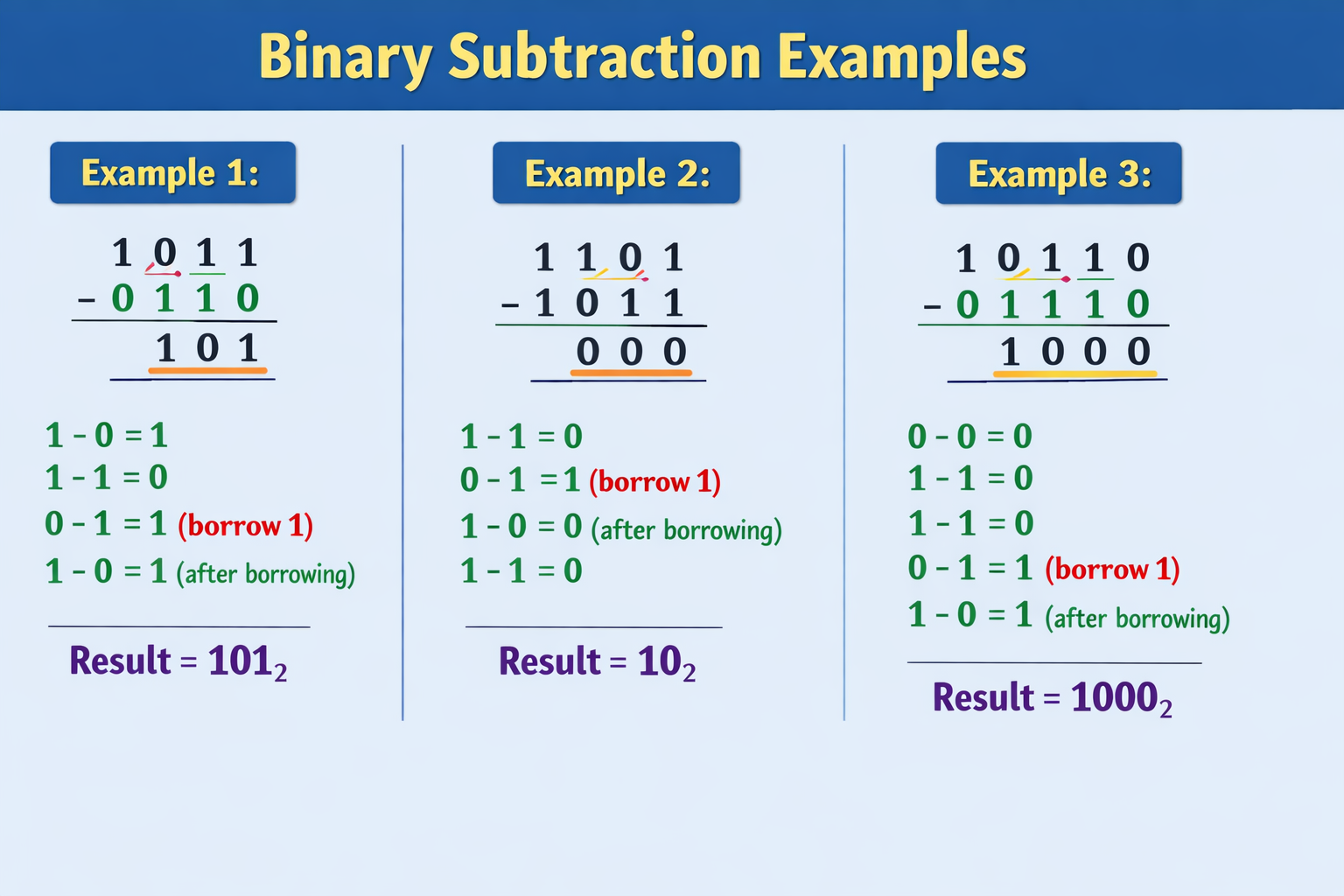
Example 13
Study the following examples
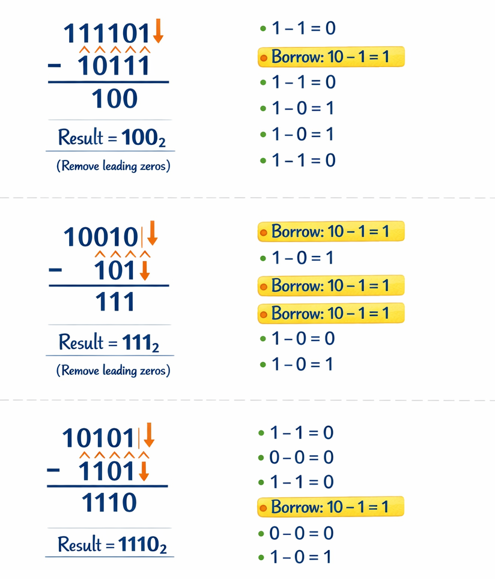
Exercise 12
Subtract the following base two numbers
- 1. 1011₂ - 110₂ =
- 2. 1110₂ - 101₂ =
- 3. 1001₂ - 11₂ =
- 4. 1101₂ - 1011₂ =
- 5. 10101₂ - 1100₂ =
- 6. 1111₂ - 1010₂ =
- 7. 10010₂ - 1101₂ =
- 8. 11010₂ - 1011₂ =
- 9. 10111₂ - 1110₂ =
- 10. 11101₂ - 1001₂ =
Example 14
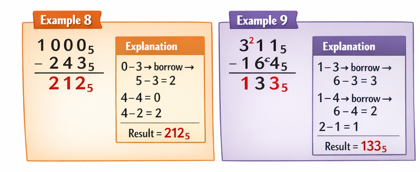
Exercise 13
Perform the following operation
- 1. (243)₅ − (132)₅
- 2. (214)₅ − (103)₅
- 3. (121)₅ −( 44)₅
- 4. (304)₅ − (144)₅
- 5. (150)₅ − (42)₅
- 6. (402)₅ − (213)₅
- 7. (440)₅ − (121)₅
- 8. (444)₅ − (134)₅
- 9. (210)₅ − (44)₅
- 10. (123)₅ − (32)₅
Add base numerations which are in different bases
Example 15
Study the following examples
- Example 1: (101)₂ + (12)₃ = 5 + 5 = 10
- Example 2: (10)₅ + (11)₂ = 5 + 3 = 8
- Example 3: (22)₃ + (4)₅ = 8 + 4 = 12
- Example 4: (111)₂ + (10)₃ = 7 + 3 = 10
- Example 5: (14)₅ + (11)₂ = 9 + 3 = 12
- Example 6: (21)₃ + (10)₂ = 7 + 2 = 9
- Example 7: (100)₂ + (3)₅ = 4 + 3 = 7
- Example 8: (12)₃ + (10)₅ = 5 + 5 = 10
- Example 9: (110)₂ + (2)₃ = 6 + 2 = 8
- Example 10: (4)₅ + (11)₂ = 4 + 3 = 7
Exercise 14
Perform the following operation
- (101)₂ + (10)₃
- (11)₂ + (2)₅
- (12)₃ + (1)₂
- (14)₅ + (10)₂
- (22)₃ + (3)₅
- (100)₂ + (10)₅
- (21)₃ + (11)₂
- (10)₅ + (12)₃
- (111)₂ + (2)₃
- (4)₅ + (10)₂
Subtract base numerations which are in different base
Example 16
Study the following examples
- Example 1: (101)₂ − (10)₃ = 5 − 3 = 2
- Example 2: (10)₅ − (11)₂ = 5 − 3 = 2
- Example 3: (22)₃ − (3)₅ = 8 − 3 = 5
- Example 4: (111)₂ − (10)₃ = 7 − 3 = 4
- Example 5: (14)₅ − (10)₂ = 9 − 2 = 7
- Example 6: (21)₃ − (1)₂ = 7 − 1 = 6
- Example 7: (100)₂ − (2)₃ = 4 − 2 = 2
- Example 8: (12)₃ − (1)₅ = 5 − 1 = 4
- Example 9: (110)₂ − (10)₅ = 6 − 5 = 1
- Example 10: (4)₅ − (10)₂ = 4 − 2 = 2
Exercise 15
Subtract the following
- (101)₂ − (1)₃
- (10)₅ − (10)₂
- (22)₃ − (1)₂
- (111)₂ − (2)₃
- (14)₅ − (11)₂
- (21)₃ − (10)₂
- (100)₂ − (1)₅
- (12)₃ − (10)₂
- (110)₂ − (2)₅
- (4)₅ − (1)₂
Listening to this topic