Mathematics
RATIO AND PROPORTION
Reading settings
Text size
Line spacing
Colours
RATIO AND PROPORTION
In this topic, students learn about ratios and proportions—ways of comparing quantities. They focus on identifying ratios, writing ratios in fraction form, and solving problems involving ratios. They also explore direct and inverse proportion, learning how to recognize constant relationships and apply them to real-life word problems.
Ratio
Identify concept of ratio
Study the following information with examples A ratio compares two quantities of the same kind. It tells us how many times one quantity is contained in another. Ratios can be written with a colon (:) or as a fraction. Ratios must compare quantities of the same unit (e.g., apples to oranges, boys to girls).
Example 1
Study the following examples
- The ratio of boys to girls in a class with 12 boys and 8 girls is 12:8.
- The ratio of mangoes to oranges in a basket with 15 mangoes and 10 oranges is 15:10.
- The ratio of red beads to blue beads when there are 20 red and 5 blue is 20:5.
- The ratio of cats to dogs in a compound with 9 cats and 6 dogs is 9:6.
- The ratio of pens to pencils in a bag with 14 pens and 7 pencils is 14:7.
- The ratio of chairs to tables in a room with 18 chairs and 9 tables is 18:9.
- The ratio of teachers to students in a school with 25 teachers and 100 students is 25:100.
- The ratio of cups to plates in a kitchen with 12 cups and 4 plates is 12:4.
- The ratio of cars to bicycles in a parking area with 16 cars and 8 bicycles is 16:8.
- The ratio of goats to sheep on a farm with 30 goats and 15 sheeps is 30:15.
Exercise 1
Write the ratio for each situation by using colon (:)
- The ratio of boys to girls in a class with 10 boys and 5 girls.
- The ratio of apples to bananas in a basket with 8 apples and 12 bananas.
- The ratio of books to rulers in a bag with 6 books and 3 rulers.
- The ratio of red flowers to yellow flowers in a garden with 7 red and 14 yellow.
- The ratio of cows to goats on a farm with 18 cows and 9 goats.
- The ratio of desks to chairs in a classroom with 20 desks and 25 chairs.
- The ratio of pencils to erasers in a box with 15 pencils and 5 erasers.
- The ratio of mangoes to pineapples in a crate with 9 mangoes and 3 pineapples.
- The ratio of buses to cars in a station with 4 buses and 16 cars.
Write ratio in fraction form
Ratios can be expressed as fractions. A ratio a:b can be expressed as a fraction by writing the first number as the numerator and the second number as the denominator:
Example 2
Study the following examples
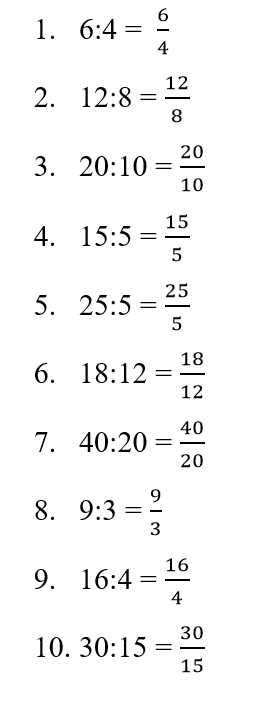
Example 3
The following examples show to write ratio in fraction form
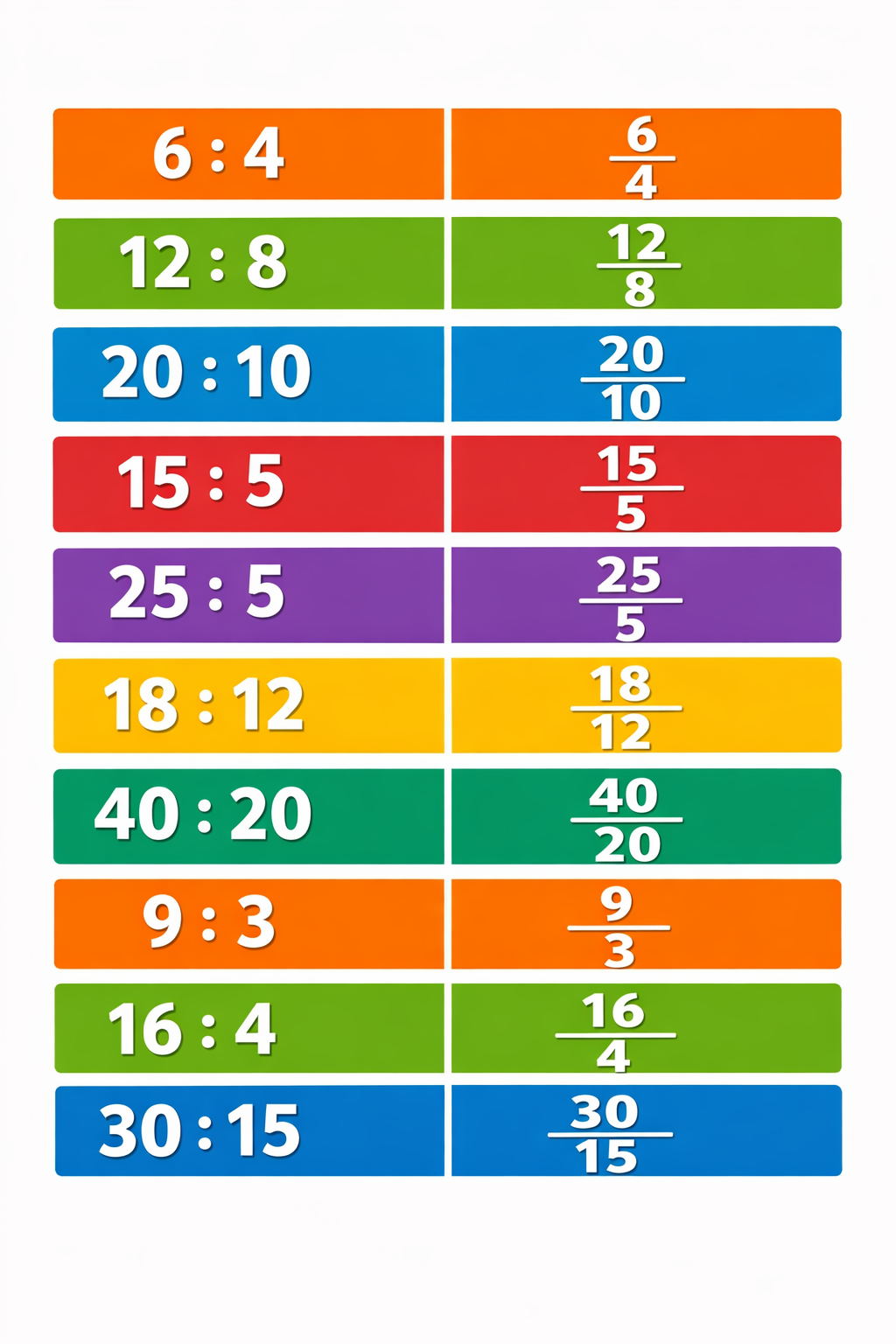
Exercise 2
Write each ratio in fraction form and simplify.
- 8:2
- 24:6
- 14:7
- 50:25
- 21:14
- 36:12
- 45:15
- 10:5
- 18:9
- 60:30
Solve problems involving ratios
Activity 1
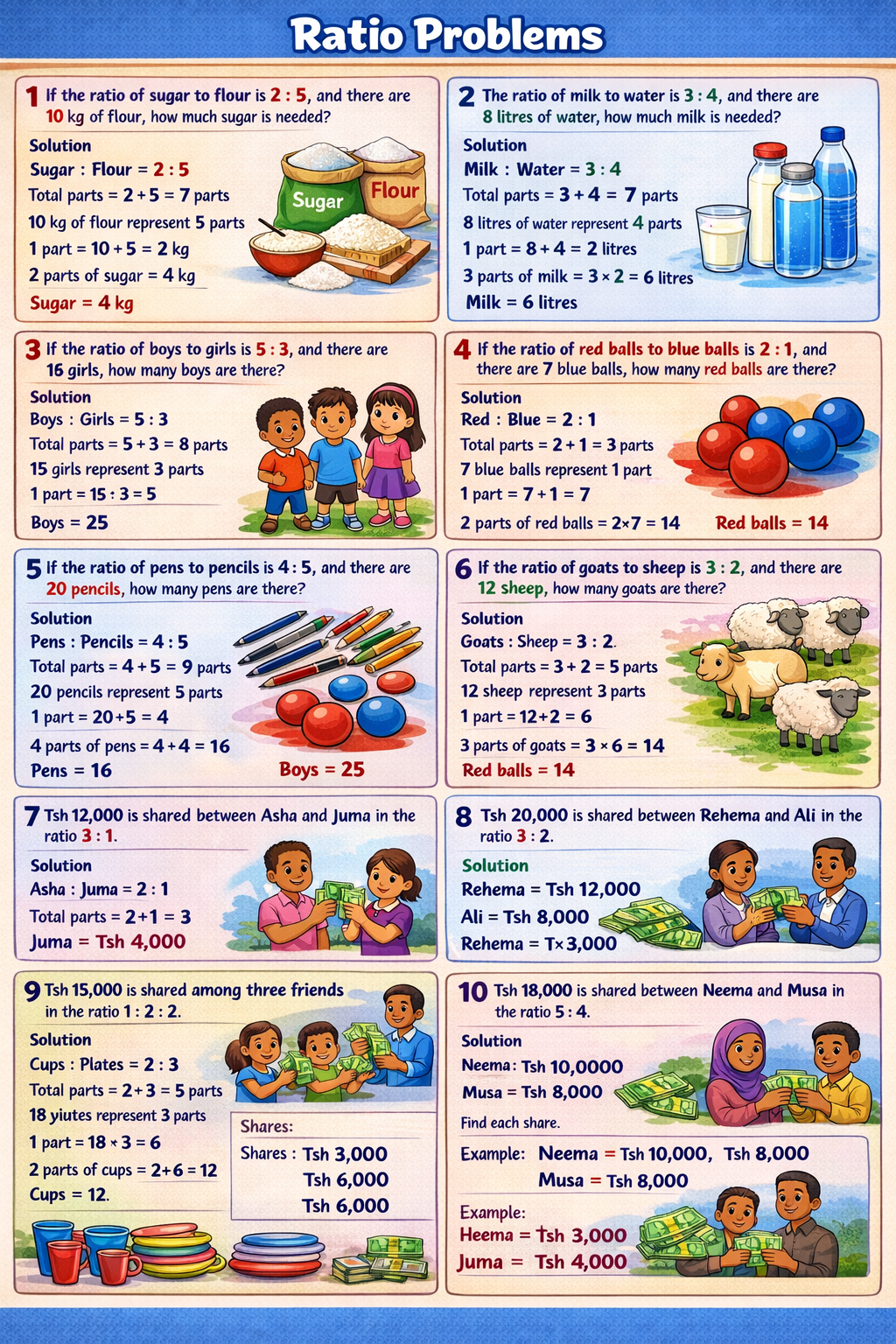
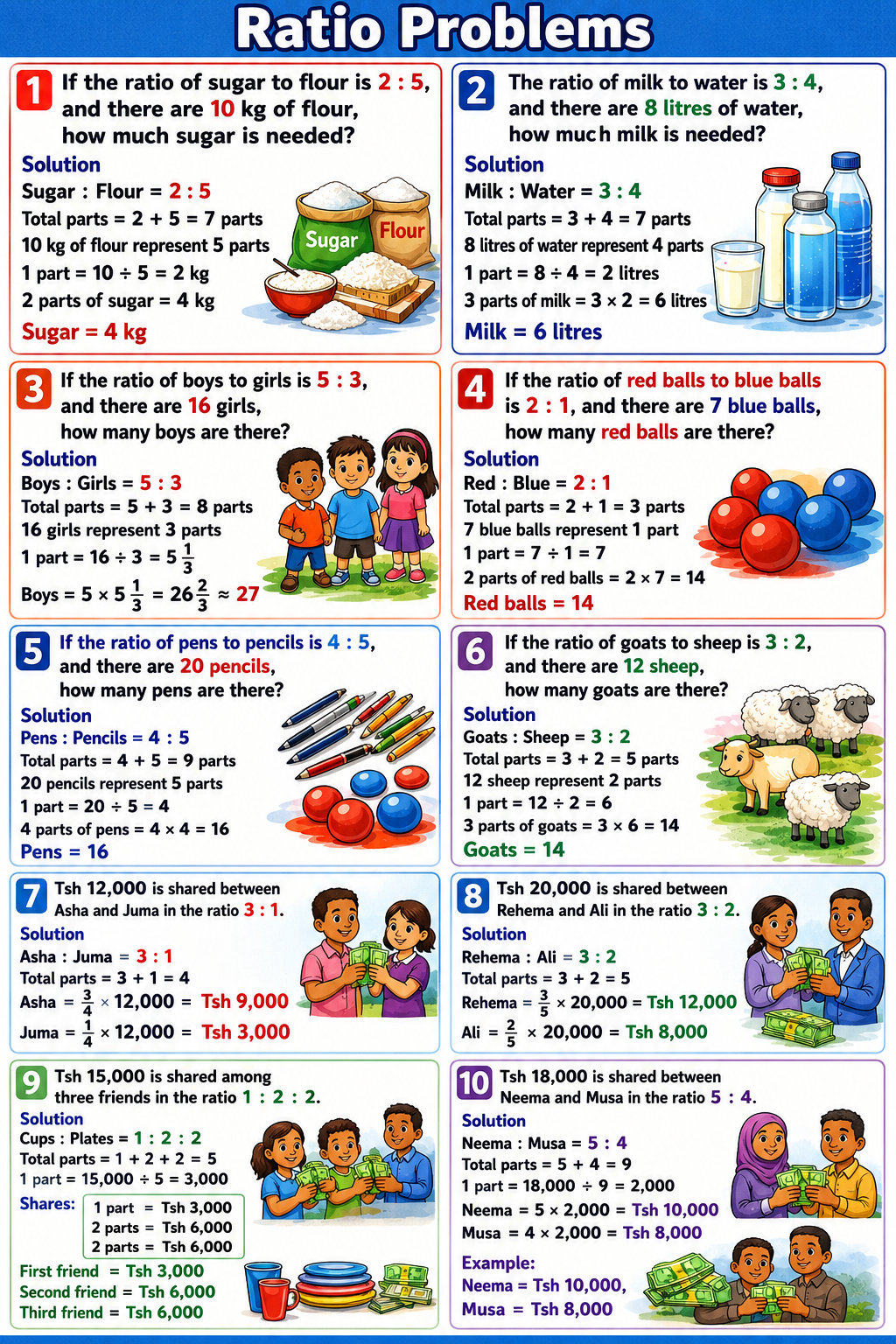
Study the following information Steps to be followed when solving problems involving ratios
Steps to be followed when solving problems involving ratios
- Interpret ratios correctly
- Determine the total parts in a ratio
- Find the value of one part
- Find the value of another part
Example 4
Example 5
Study the following examples
Example 6
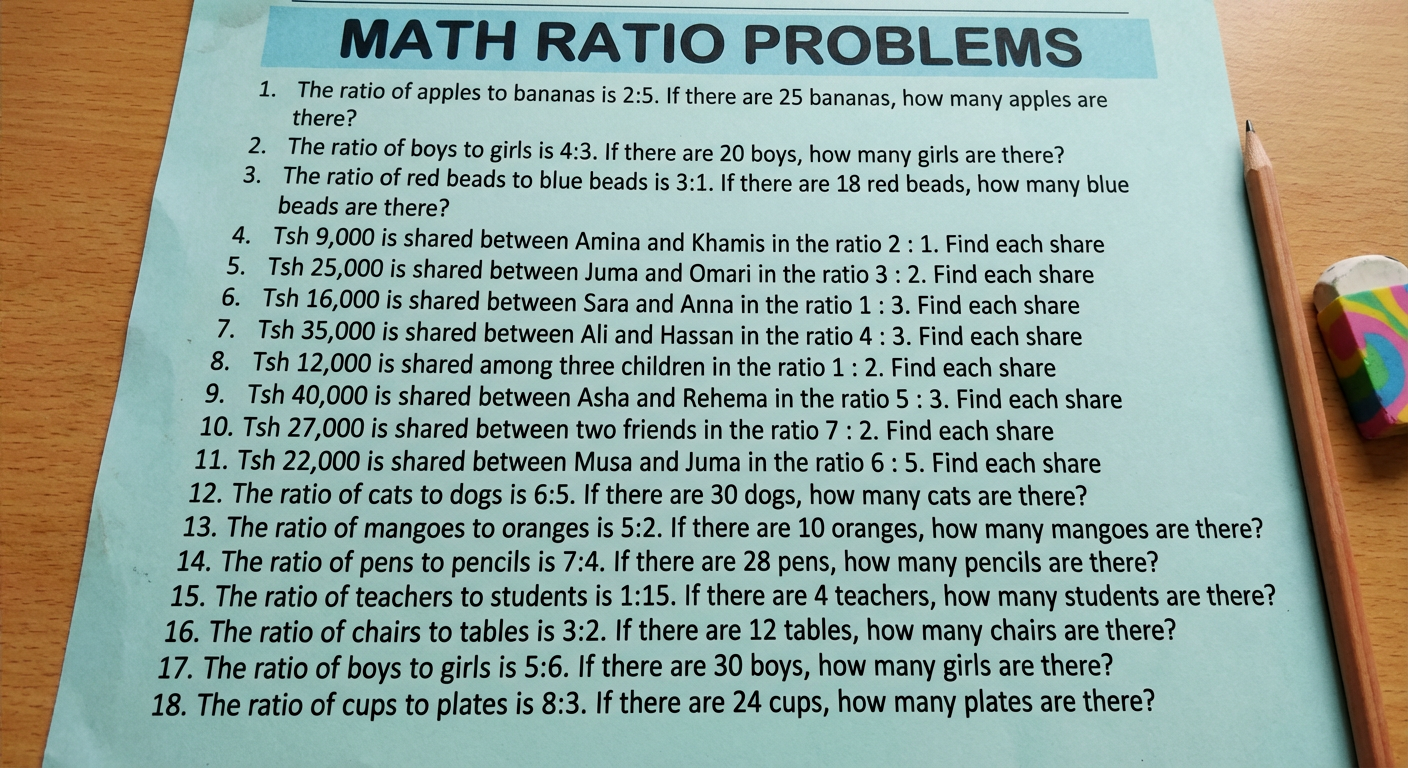
Study the following examples, and then do the exercise below
Exercise 3
Solve the following problems
Direct proportion
Identify concept of direct proportion
Activity 2
Study the following real life scenarios
- Cost of Items and Quantity BoughtThe total cost increases as the number of items bought increases.
- Wages and Hours WorkedThe amount of money earned increases as the number of hours worked increases.
- Number of Litres of Fuel and CostThe cost of fuel increases with the number of litres purchased.
- Ingredients in CookingWhen cooking for more people, the amount of ingredients increases proportionally.
Activity 3
Read the following information
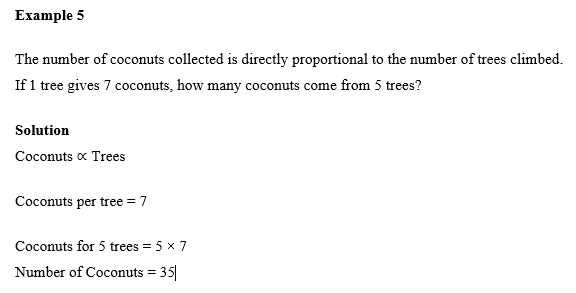
- Two quantities are directly proportional if one increases, the other increases at the same rate. OR
- Two quantities are directly proportional if one decreases, the other decreases at the same rate
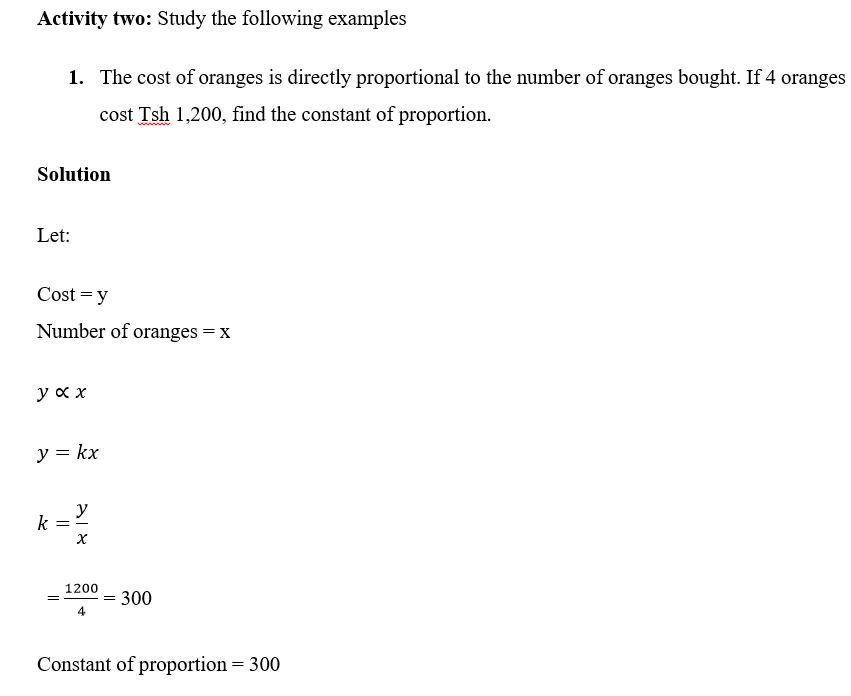
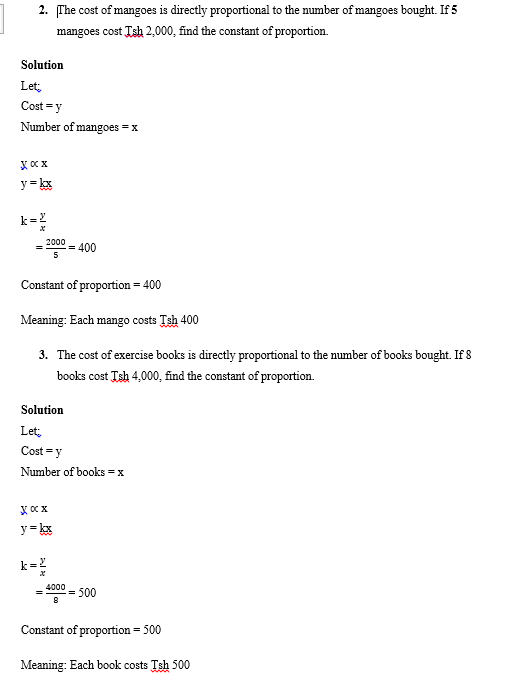
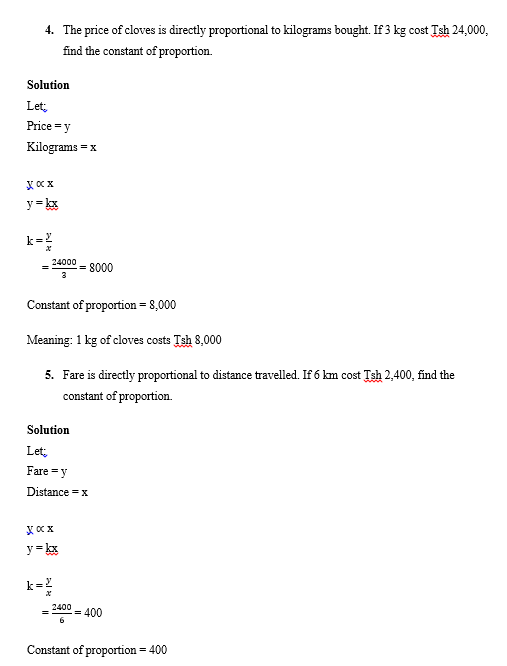
- Formula: (y = kx).
Explore constant of direct proportion statement
Example 7
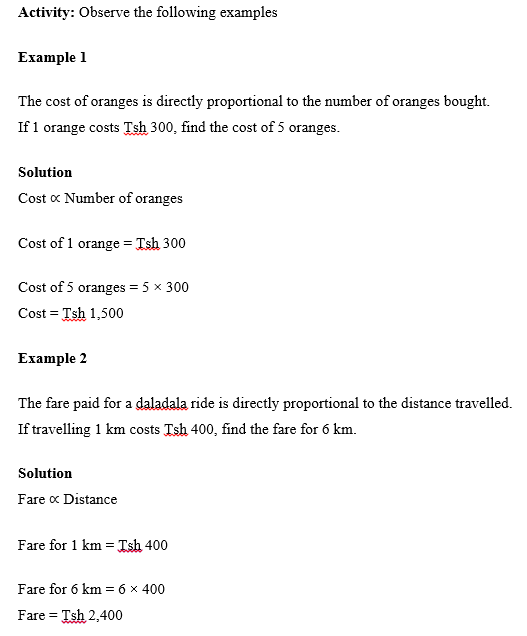
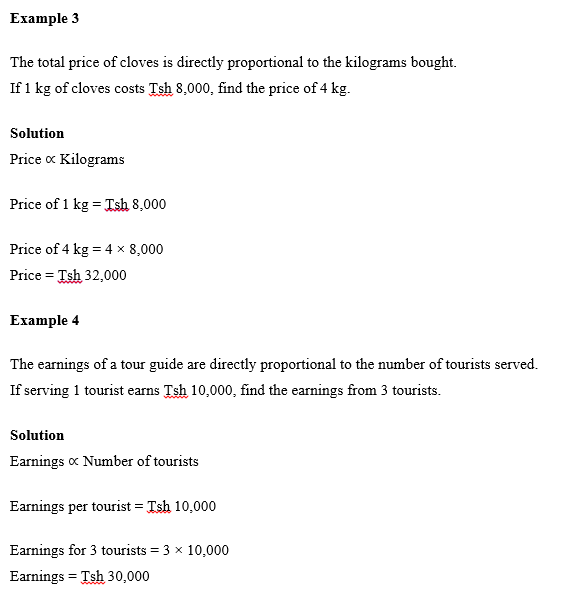
Study the following examples
Exercise 4
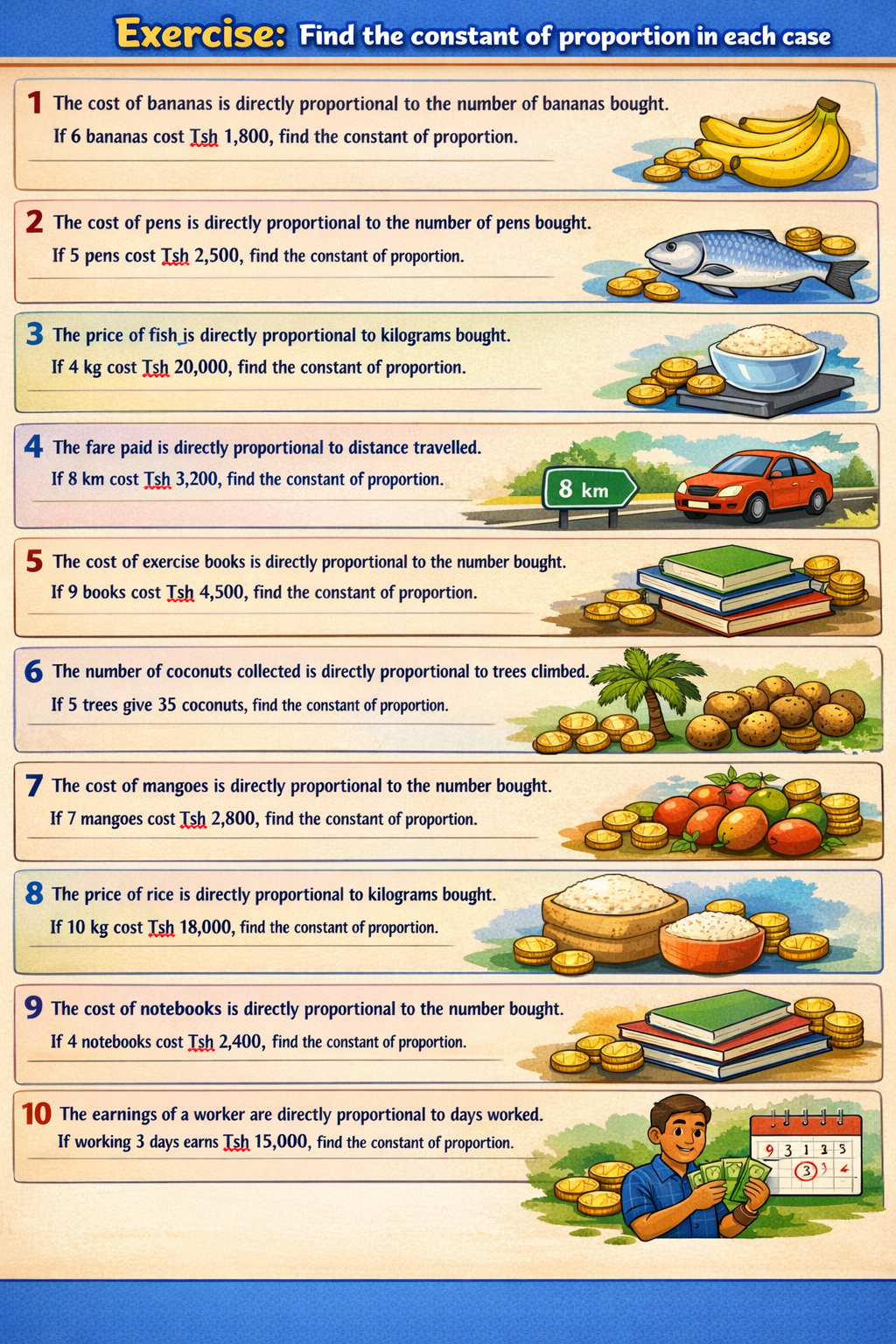
Find the constant of proportion in each case.
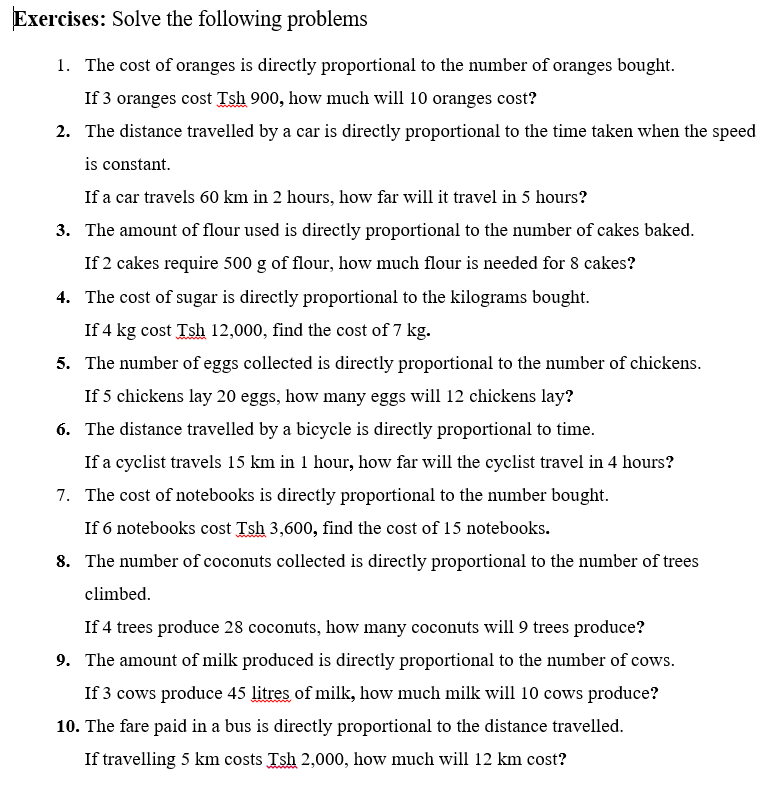
Exercise 5
Solve the following problems
Exercise 6
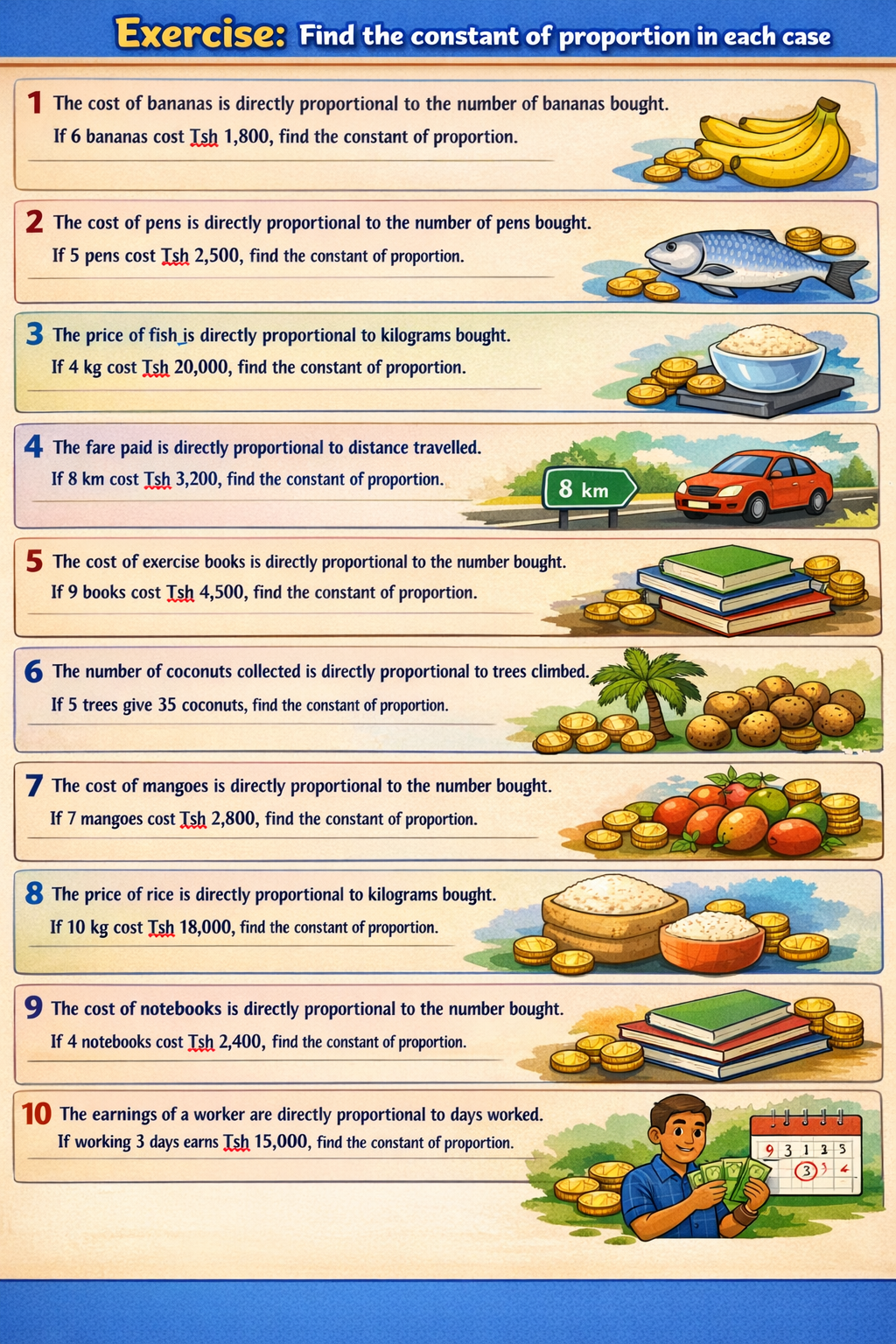
Find the of proportionality for each case
Solve problems of direct proportion
Exercise 7
Inverse proportion
Identify concept of inverse proportion
Activity 4
Study the following scenarios
- Workers and Time to Complete Work: If more workers are assigned to a job, the time needed to finish the work decreases.
- Speed and Time for a Journey: When the speed of a vehicle increases, the time taken to cover the same distance decreases.
- Number of Taps Filling a Tank: If more taps are used to fill a tank, the time required becomes less.
- Number of Machines Producing Goods: More machines working together will reduce the time needed to produce the same amount of goods.
- Sharing Work Among People: If a task is shared among more people, each person works for a shorter time.
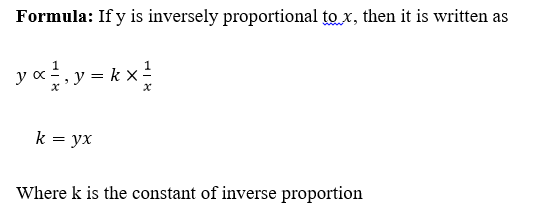
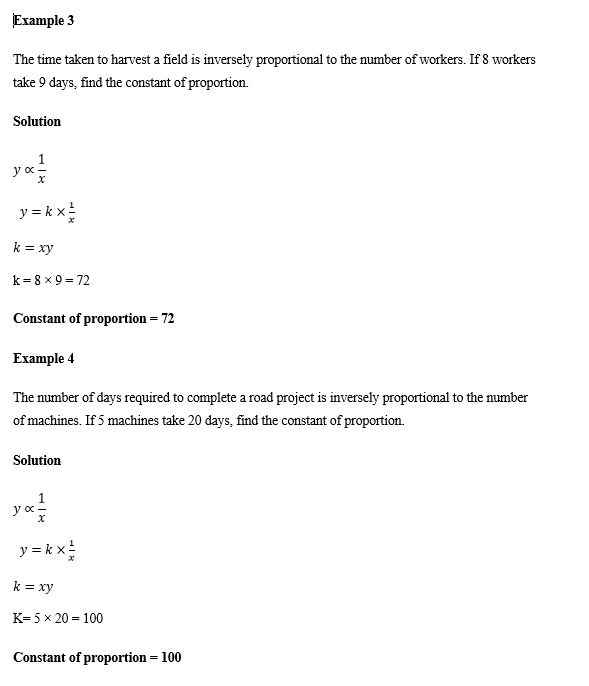
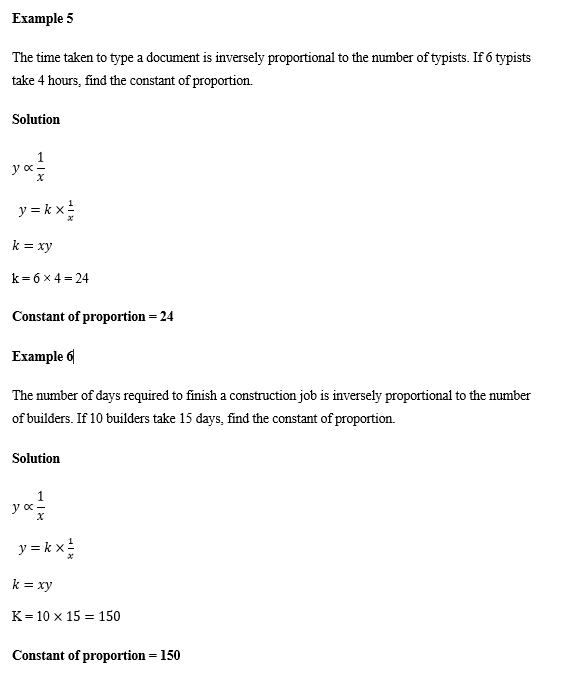
Study the following informationTwo quantities are inversely proportionalif:
- When one quantity increases, the other decreases at the same rate
- When one quantity decreases, the other increases at the same rate
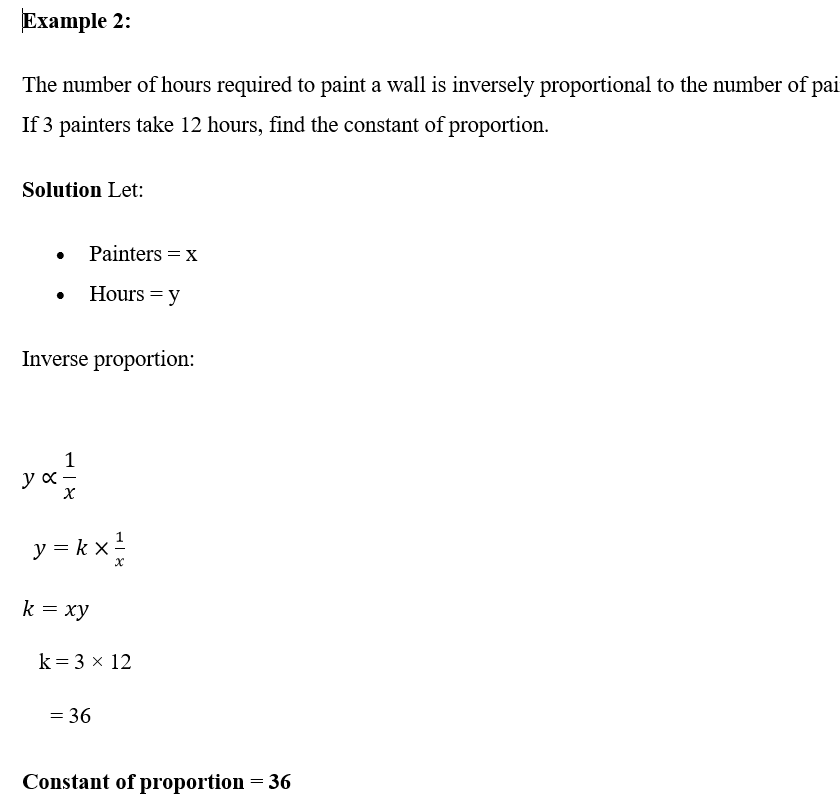
Explore constant of inverse proportional statement
Example 8
Exercise 8
Do the following exercise
- The number of workers and the number of days needed to complete a job are inversely proportional. If 4 workers finish the job in 12 days, find the constant of inverse proportion.
- The speed of a car and the time taken to travel a fixed distance are inversely proportional. If a car travels at 60 km/h and takes 3 hours, find the constant of inverse proportion.
- The number of taps filling a tank and the time taken to fill the tank are inversely proportional. If 2 taps fill the tank in 10 hours, find the constant of inverse proportion.
- The number of machines and the time needed to produce goods are inversely proportional. If 5 machines produce the goods in 8 hours, find the constant of inverse proportion.
- The number of workers and the time needed to paint a house are inversely proportional. If 6 workers paint the house in 5 days, find the constant of inverse proportion.
- The number of students sharing work and the time required to complete the work are inversely proportional. If 3 students finish the work in 12 hours, find the constant of inverse proportion.
- The number of pumps and the time needed to drain a tank are inversely proportional. If 4 pumps drain the tank in 6 hours, find the constant of inverse proportion.
- The number of boats catching fish and the number of days needed are inversely proportional. If 2 boats catch the fish in 9 days, find the constant of inverse proportion.
- The number of workers and the days required to build a wall are inversely proportional. If 8 workers build the wall in 7 days, find the constant of inverse proportion.
- The number of machines and the time taken to complete a task are inversely proportional. If 3 machines complete the task in 15 hours, find the constant of inverse proportion.Bottom of Form
Solve problems of inverse proportion
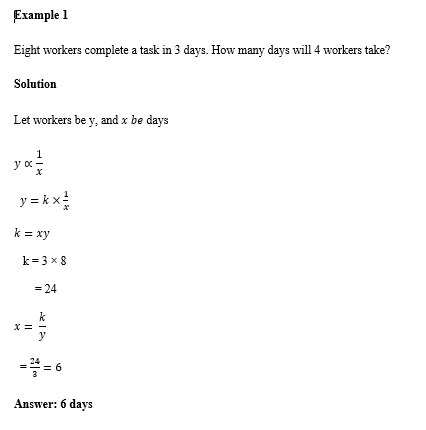
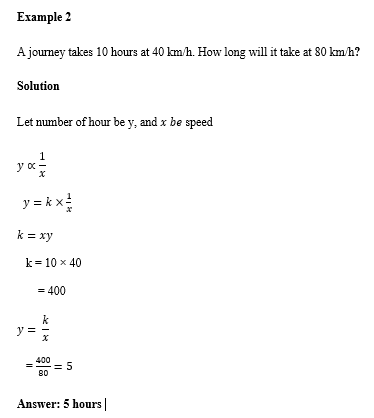
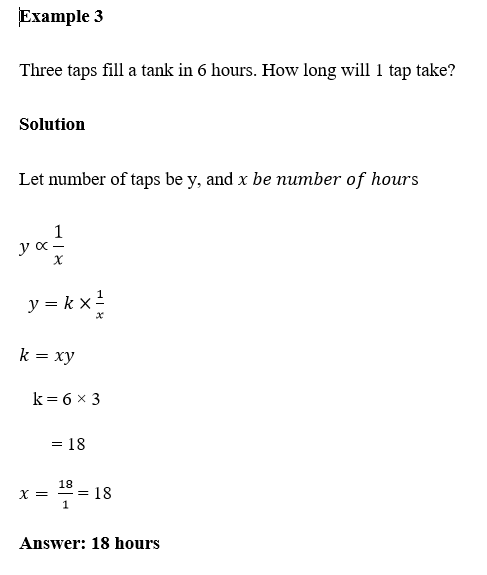
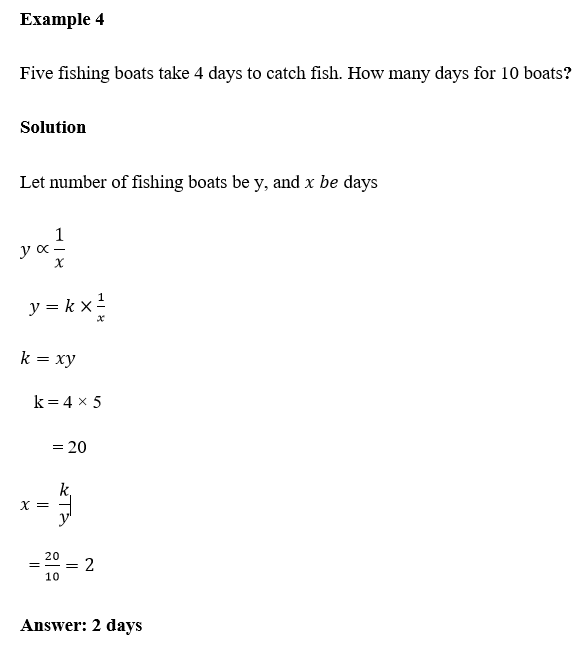
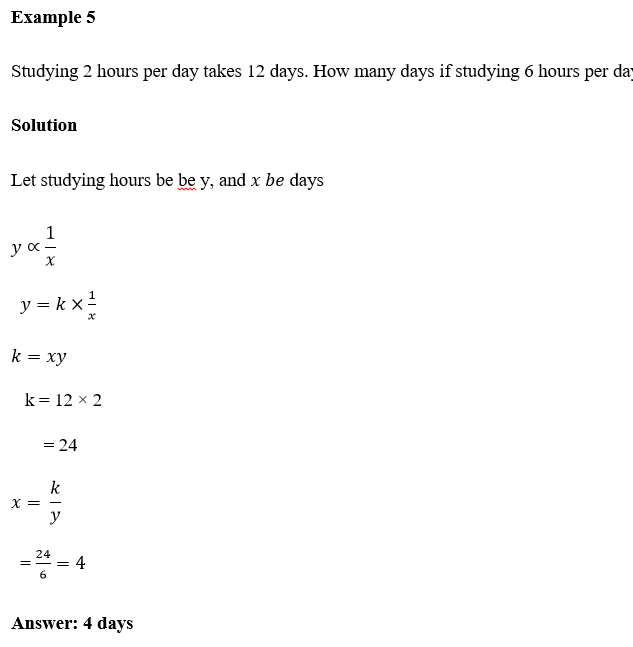
Example 9
Study the following examples
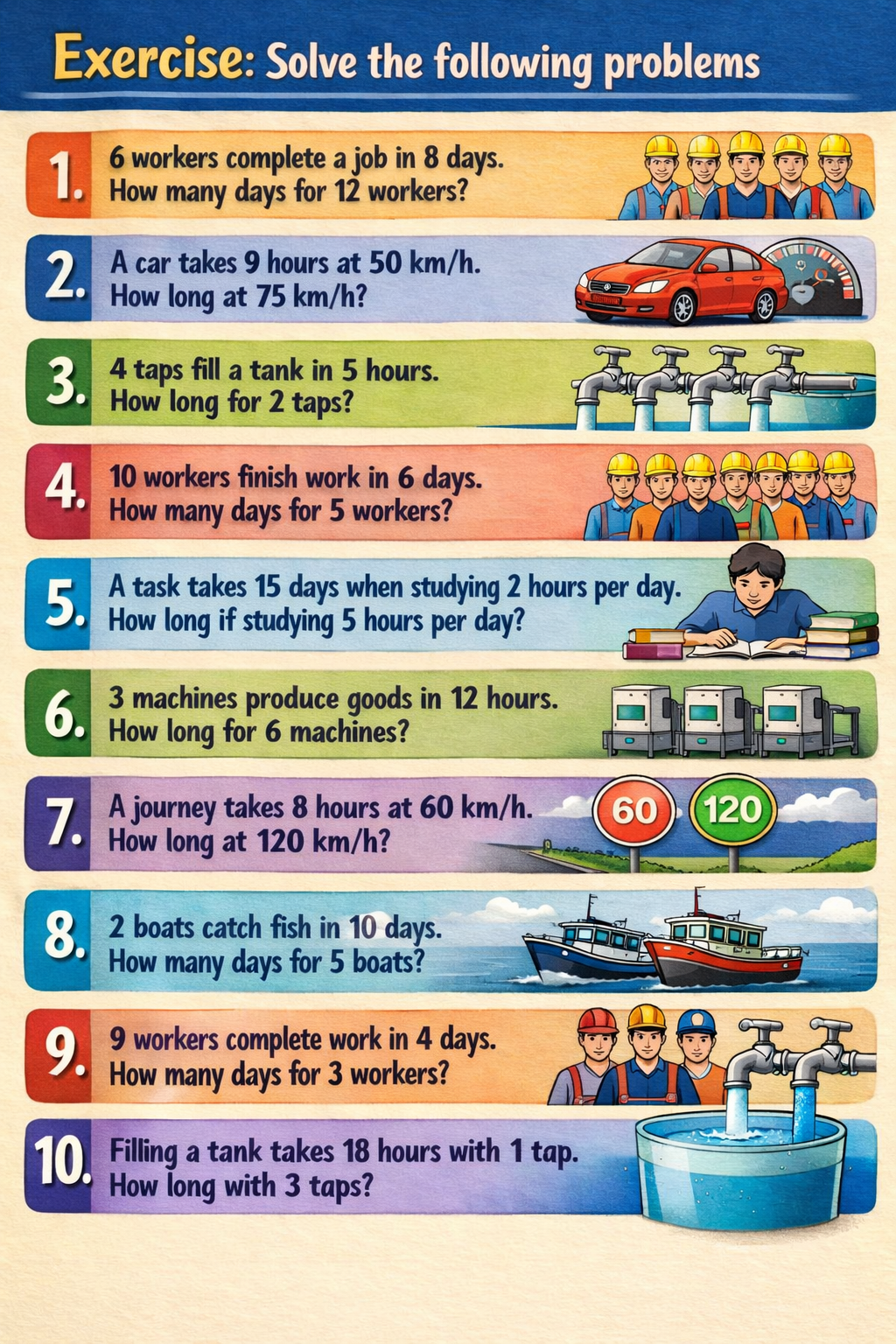
Exercise 9
Listening to this topic