English
REPORTING
Reading settings
Text size
Line spacing
Colours
REPORTING
Telephone messages
Introduction:
Reporting is the act of explaining or providing details about something that has happened. It is a way of sharing information with others so they can understand an event, a message, or a situation that they did not witness themselves. In our daily lives, we report many things: we tell our parents what happened at school and in other places. In this topic, we will learn two sub-topics, Telephone Messages and Study Visit, where we write down what we saw during an educational trip. Good reporting must be accurate, clear, and honest.

Expected Competency.
By the end of this sub-topic, the learner should be able to identify important issues to be reported in different situations, write clear and correct telephone messages, and explain the delivery status of the messages appropriately
Identify issues to be reported in different situations.
Telephone messages help people pass important information when someone is not available.
Concept:
Reporting is sharing information accurately.
You will learn what in brief.
You will learn to listen for the "Who, What, and When" of a call.
Explanation:
Pupils learn to notice important details like emergencies, meeting changes, visitor arrivals, lost items, or school announcements.
Imagine the phone rings and it is for your mother, but she is busy. You should listen to the caller to know: Who is calling? Why are they calling? Is there a specific message or a special plan? Reporting helps us give accurate information without making mistakes.
Example 1
Examples of Issues to Report:
- A change in meeting time.
- A request for a call back.
- An emergency (e.g., a sick friend).
- A reminder to buy bread.
- A thank-you message.
- Directions to a party.
Activity 1
Draw and Identify.
- Draw two situations that need reporting.
- Draw one situation that does not need reporting.
- Write one sentence explaining each drawing.
Exercise 1
Exercise: Listening and Reporting Skills.
1. Question: What are three important details that pupils should learn to notice at school? Answer: Pupils should notice emergencies, school announcements, and lost items.
2. Question: If the phone rings for your mother while she is busy, what is your responsibility?
- Answer: My responsibility is to listen carefully to the caller and take a message.
3. Question: List three things you should find out from a caller.
- Answer: I should find out who is calling, why they are calling, and if there is a specific message.
4. Question: Why is reporting information accurately very important?
- Answer: Accurate reporting is important because it helps us give the right information without making mistakes.
5. Question: Give two examples of changes or events you should pay attention to.
- Answer: You should pay attention to meeting changes and visitor arrivals.
Exercise 2
General Question and Answer
Q: Why identify issues? A: To report correct information.
Conclusion:
When you know what to report, communication becomes clear and powerful—and remember, a good report starts with listening carefully!
Write the telephone messages.
Telephone messages must be simple and accurate so that the receiver clearly understands the information. Writing a message is better than memorizing it because people can forget details. A written note helps keep the message safe and correct since it does not forget important information.
Expected Competency:
Write clear, short, and neat telephone messages.
Concept:
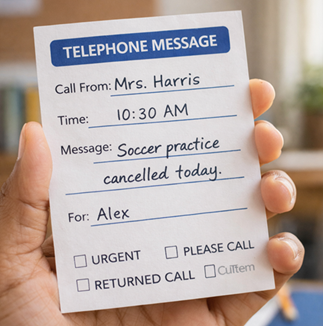
A message includes caller name, time, and information.
You will learn what in brief:
Learn structure of a good message.
Explanation:
Write who called, when they called, what they said, and who should receive the message.
When you write a telephone message, you are like a secretary. You need a pen and paper. You must write the Date, the Time, the Name of the Caller, and the Message. Always write clearly so that the person who reads it understands everything!
Example 2
Examples of Written Messages:
- "Mr. Ali called at 10 AM. Please call him back."
- "Doctor: Your appointment is moved to Friday."
- "Juma: Bring the football to school tomorrow."
- "Grandma: She will arrive at 4 PM."
- "Teacher: No homework today!"
Activity 2
Fill the Message Form:
- Listen to or read a short telephone message.
- Fill in a simple form:
This.
- Caller Name:
- Time:
- Message:
- Receiver:
3. Check spelling and punctuation.
Activity 3
Write Your Own Message:
- Imagine your teacher called your parent.
- Write a short telephone message (3–4 sentences).
- Include who called, why, and what to do next.
Conclusion:
Good writing ensures correct communication because it helps the receiver understand the information exactly as intended; ultimately, a clear message makes everyone happy!
Explain the delivered status of the messages.
In today’s digital world, when we send a message through a phone or a computer, it goes through different stages. It is important to know if our message has reached the other person or if they have seen it. These stages are called the "Delivered Status." Just like sending a letter through a post office, we want to know if our "digital letter" has been dropped off or opened!
Key Terms to Learn:
| English | Meaning |
| Sent | The message has left your phone. |
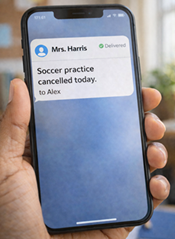
| Delivered | The message has reached their phone. |
| Read / Seen | The person has opened and looked at it. |
| Failed | The message did not go through. |
..
Expected Competency:
Explaining whether a message has been 'Sent,' 'Delivered,' or 'Read' is essential because checking the status helps us know if our communication was successful. By understanding these stages, we can be sure that the information reached the right person at the right time!
Key Takeaways:
- Sent.
- Delivered.
- Read.
Concept:
"The status of a message shows whether it is sent, received, or still pending; it is important to remember that communication is only truly complete when the message has been successfully delivered."
You will learn what in brief:
You will learn the meaning of different message statuses.
Explanation:
"Understanding message status is simple: 'Delivered' means the message reached the person, 'pending' means it is still waiting, and 'missed' means it was not received at all. On phones today, we see small signs like ticks to show this; usually, one tick means Sent (it has left your phone), two ticks mean Delivered (it has reached their phone), and if they turn blue, it means the message has been Read. You can see this in real life too—for example, if you give a paper message to your sister, the status becomes 'Delivered' the moment she takes it from your hand!"
Example 3
Examples of Status:
- Pending: The message is waiting for network.
- Sent: It has left your phone.
- Delivered: It is on the other person's phone.
- Read/Seen: The person has looked at it.
- Failed: The message did not go through.
Activity 4
Message Status Matching:
1. Match the message status with meaning:
- Delivered
- Not Delivered
- Received
- Pending
2. Write one sentence explaining each status.
Activity 5
Status Role Play (Individual )
- Read three short message examples.
- Decide the status of each message.
- Write why you chose that status.
Exercise 3
General Questions:
- What does "Delivered" mean?
- Is a message useful if it "Failed"?
Answers:
- It reached the destination.
- No, the person will not get the information
Conclusion:
In conclusion, learning how to report is a superpower that helps us connect with others. Whether you are taking a telephone message, writing about a study visit, or checking a message’s status, your goal is always to be accurate and clear. Remember, a good reporter is a great listener and a neat writer. By mastering these skills, you become a responsible person who can be trusted to share information that makes everyone’s life easier!
Study visit
A study visit is a structured educational or professional excursion designed to provide first-hand experience and practical insight into a specific field, industry, or environment. Unlike theoretical learning, a study visit bridges the gap between classroom concepts and real-world application, allowing participants to observe systems, interact with experts, and understand operational dynamics.
Expected Competency:
By the end of this sub-topic, the student should be able to identify and list the essential parts of a study visit report, explain the step-by-step process of writing a report from the beginning to the end, and produce a clear, simple, and complete report based on a study visit.
Identify elements to be included in a report.
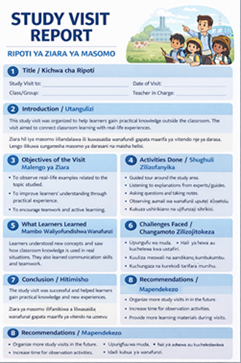
Imagine you are a little explorer. After your visit, you should tell your friends what you discovered. You should write five (5) important sections.
Expected Competency:
The student should be able to list the essential parts of a study visit report.
Concept:
A report is like a story, but it only tells the facts about what happened.
You will learn what in brief:
You will learn the "building blocks" of a report, such as the title, date, and what you saw.
Explanation:
To identify elements means to look for the key parts of your trip. Think of it like a puzzle. For your report to be complete, you need: Where did you go? When did you go? Who was with you? and What did you learn? Without these parts, your report will be like a car without wheels—it won't go anywhere!
Important Sections:
- The Title (What is it about?): Every report must have a name. For example: "Our Visit to the Zoo."
- The Introduction (Who, Where, and When): Tell us who went, where you went, and what date it was.
- The Middle Part (What did you see and do?): This is the longest part. Mention the animals, machines, or people you saw. What did they look like? What were they doing?
- The Exciting Part (The thing you liked most): What surprised you the most? Was it a tall giraffe or a big machine?
- Conclusion (What did you learn?): Finish by saying one thing that you know now, but you didn't know before the visit.
Example 4
Examples of Elements:
- Title: (The name of the place visited).
- Date: (When the visit happened).
- Objective: (Why you went there).
- Participants: (Who went on the trip).
- Findings: (What you saw or learned).
- Conclusion: (Your final thoughts).
Activity 6
The "Report Puzzle"
Write the main parts of a report (Title, Introduction, Findings, Conclusion, Recommendations) on separate pieces of paper. Mix them up and ask the student to arrange them in the correct order on a table.
Activity 7
The "Missing Piece" Detective.
Give the student a short sample report that is missing one element (e.g., the Title or Conclusion). Ask them to read it and identify which part is missing and why it is important.
Exercise 4
General Questions:
- Recall: Name the first thing that must appear at the top of a report.
- Why is the "Date" important in a report?
General Answers:
- The Title.
- To know exactly when the event happened.
Conclusion:
In conclusion, a good report is like a well-organized story of what we learned. By following the correct order, we make sure our information is clear and easy for everyone to read. Learning how to put a report together helps us become better communicators and great students.
Discuss the steps of writing a report.
Writing a report is a great way to share what we have learned with others. It is not just about writing sentences; it is like building a house where you need a good plan first. In this report, we will look at the simple steps you need to follow to write a clear and organized report. We will learn how to choose a topic, how to find information, and how to put it all together so that anyone can understand it.
Expected Competency:
Explain the process of creating a report from beginning to end.
Concept:
The process (steps) ensures you don't miss any important information.
You will learn what in brief:
You will learn to prepare, draft, and finish your report.
Explanation:
Writing a report is a process that requires organization. Below are the essential steps:
Step 1: How to Prepare.
Before you pick up your pen, you need a plan! Think of it like a treasure hunt. First, you must know what you are looking for. Collect your facts from books or the internet. Then, make a list of the main things you want to say. This is your Map. Since you are writing about your Study Visit, you already have a starting point.
Step 2: How to Draft.
Now, start writing! Don't worry about being perfect yet. Use your "Map" (the list you made) to write your story. Write one paragraph for each main idea. If you get stuck, just keep going! This is your First Try, so it's okay to make a few mistakes.
Step 3: How to Finish.
This is where you make your report shine! Read what you wrote and fix the spelling or grammar. Check if you have a title and clear headings. Finally, write it out neatly or type it. You can even add a picture to make it look beautiful. Now your report is Ready to Read!
Example 5
Examples of Steps:
- Taking notes during the visit.
- Grouping similar ideas together.
- Writing the introduction.
- Proofreading (fixing spelling).
- Sharing the report with the teacher.
Activity 8
Flowchart Creation:
Draw a flowchart showing the steps:
- Preparation (Taking notes),
- Drafting,
- Reviewing,
- Final Writing.
Let the student explain what happens at each stage.
Activity 9
The Interviewer:
Ask the student to "teach" you how to write a report. They should explain step-by-step what they would do after coming back from a visit to a farm or museum.
Exercise 5
General Exercises and Answers:
- Question: According to the text, why is writing a report compared to building a house? Answer: Because you need a good plan before you start.
- Question: What is the main purpose of writing a report? Answer: To share what we have learned with others.
- Question: List the three main steps mentioned in the text for writing a report. Answer: Choosing a topic, finding information, and putting it all together.
- Question: Is a report just about writing sentences? Explain. Answer: No, it is about organizing information so that anyone can understand it.
- Question: What is the first thing you need before you start writing? Answer: A good plan (or a chosen topic).
Exercise 6
Questions and Answers
- Task (Topic Selection): You visited a local market. Write a suitable title for your report. Answer: A Study Visit to [Name of Market] Market.
- Task (Finding Information): If your topic is "How Bread is Made," name one person you should talk to for information. Answer: A baker.
- Task (Organizing): Arrange these steps in the correct order: (A) Write the report, (B) Choose a topic, (C) Gather facts. Answer: B → C → A.
- Task (Structure): Write one sentence that could be used as an 'Introduction' for a report about a school garden. Answer: Last Monday, our class visited the school garden to learn about different types of vegetables.
- Task (Conclusion): What should you write at the very end of your report to show who wrote it? Answer: My name and the date.
Conclusion:
In conclusion, writing a report is easy if you follow these simple steps. By preparing your facts, drafting your ideas, and finishing with a neat check, you can create a report that everyone will love to read. Remember, practice makes you better! The more reports you write, the easier it becomes. Now you are ready to be a great young writer!
Write reports on study visit.
Now it is time to use what we learned to write our own report!
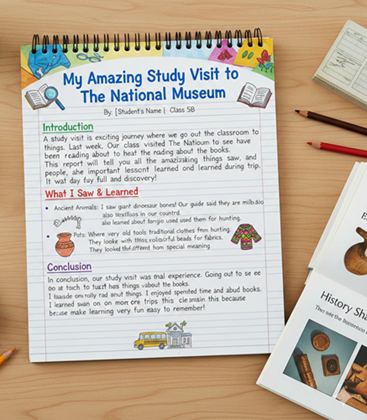
A study visit is an exciting journey where we go out of the classroom to learn new things. Last week, our class visited (The National Museum) to see what we have been reading about in our books. This report will tell you all about the amazing things we saw, the people we met, and the important lessons we learned during our trip. It was a day full of fun and discovery!
Expected Competency:
Produce a complete, simple report about a study visit.
Concept:
Use simple sentences and clear order.
You will learn what in brief:
Practice writing a report using a real or imaginary visit.
Explanation:
After our study visit, learn how to write a report. You have seen many new things and learned many real-life lessons. How will you explain everything that happened to someone who was not there? We do this by writing a report.
1. Title
Write where you went and the date.
Example: A Visit to the National Museum.
2. Introduction.
Explain why you went there and who went with you.
On 12th February, Class Five students visited the farm to learn about modern irrigation.
3. Findings/Body.
Describe what you saw and what you learned. Use bullet points to make it clear.
- We saw different types of crops.
- We learned how to plant seeds in rows.
4. Conclusion.
Give your final thoughts on the trip.
The visit was very educational and we enjoyed learning outside the classroom. rite introduction, body, conclusion using own words.
Example 6
Examples of Sentences in a Report.
- On 12th February, Class 5 visited the National Museum.
- The purpose of the trip was to learn about history.
- First, we saw old coins used long ago.
- We also saw a large skeleton of a dinosaur.
- The visit ended at 3:00 PM and we felt very happy.
Activity 10
The Mini-Visit Report:
Ask the student to conduct a "mini-visit" to the kitchen or garden at home. They should observe what is happening and write a 3-paragraph report using the elements learned (Title, What they saw, Conclusion).
Activity 11
Postcard Report:
Using a piece of manila paper, the student writes a summary report of a real or imaginary school trip. Encourage them to use descriptive words and proper report format.
Exercise 7
Questions and Answers.
- What is report? Ans. Written information
- Why write report? Ans. Share learning
- Write short paragraph. Ans. pupil task
- Good vs poor report. Ans. Compare
- Best report. Ans. Clear structure
- Full visit report
Exercise 8
General Questionsand Answers:
Q: What should report include? A: Place, activities, learning.
Q: Which tense do we mostly use in a report? Past or Future? A: Past Tense (because the trip already happened).
Q: Is a report supposed to be very long or very clear? A: Clear.
Conclusion:
In conclusion, our study visit was a wonderful experience. Going out of the classroom helped us to see and touch the things we usually only read about in books. I learned so many new things, and I enjoyed spending time with my classmates and teachers. I hope we can go on more trips like this because they make learning very fun and easy to remember!
Listening to this topic