English
TELLING TIME
Reading settings
Text size
Line spacing
Colours
TELLING TIME
Introduction:
Telling time is an essential skill that helps us know when to do various activities, such as waking up, going to school, eating, studying, and playing. We use clocks and time markers to understand the time of day. A clock has numbers and hands that help us read hours and minutes. Learning to tell time helps a student organize their activities, become responsible, and follow daily schedules. In this topic, there are two sub-topics: a) A quarter past Hours and b) Half Past Hours. Additionally, the student will learn how to read time accurately and understand the different parts of a clock in a simple and engaging way.
A quarter past hours
Introduction.
Time Magic
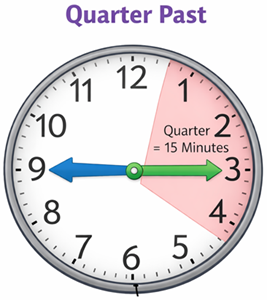
When we talk about time, a "Quarter Past" means that 15 minutes have passed after the hour.
Imagine a clock face is like a round pizza. If you cut the pizza into four equal parts, each part is called a quarter. In a clock, one quarter is equal to 15 minutes. When the long hand (the minute hand) points at number 3, we say it is "Quarter Past."
- Example: If the short hand is just past 2 and the long hand is at 3, the time is Quarter Past Two (2:15).
Expected Competency.
The pupil demonstrates the ability to accurately identify, manipulate, and read time involving quarter-past intervals on an analogue clock.
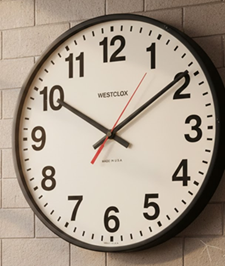
Identify the placement of numerals and hands on the clock face for a quarter past hours.
Telling time 1
Introduction.
A clock helps us know time. Quarter past means 15 minutes after an hour.
Concept.
Quarter past = 15 minutes. Minute hand at 3, hour hand slightly after the hour.
What you will learn in brief:
- Meaning of quarter past
- Placement of hands
- Reading quarter past
Explanation:
A clock has numbers 1–12. The long hand shows minutes and the short hand shows hours. In quarter past, the minute hand points to 3 and the hour hand moves slightly after the hour number.
Example 1
Examples.
- Quarter past 1 - 1:15
- Quarter past 3 - 3:15
- Quarter past 5 - 5:15
- Quarter past 8 - 8:15
- Quarter past 10 - 10:15
Activity 1
Paper Clock.
Pupils place hands for quarter past times.
Activity 2
Draw and Show.
Teacher calls time; pupils draw the clock.
Exercise 1
Exercises and Answers.
- Minutes in quarter past? Answer:15
- Minute hand position? Answer:3
- Draw 2:15
- Minute hand at 3, hour near 7 Answer: 7:15
- Hour hand exactly on 4? Answer: Wrong
Exercise 2
General Questions.
- Where is the minute hand?
- How is the hour hand placed?
Answers.
- On 3
- Slightly after the hour
Conclusion:
Quarter past is easy: minute hand at 3 and hour hand slightly ahead.
Adjust the clock at a given time.
Telling time 2
Introduction.
Adjusting a clock might seem like a simple task, but the "how-to" depends entirely on the technology under the hood. Whether you're dealing with a vintage heirloom, a digital bedside companion, or a modern smartwatch, the goal is the same: synchronization.
Expected Competency.
To successfully adjust a timepiece, the user should demonstrate the following skills: Mechanical Awareness: Distinguishing between mechanical, quartz, and digital movements.
- Precision: Understanding how to sync with a reliable time source.
- Dexterity: Operating small buttons or crowns without damaging internal gears.
Concept.
The core concept of adjusting a clock is Temporal Management. It is the process of aligning a local timekeeping device with a primary reference standard (such as an atomic clock or UTC).
What you will learn in brief:
- Set minute hand at 3
- Move hour hand slightly ahead
Explanation:
This topic covers the technical and practical methods used to ensure that timekeeping devices reflect the most accurate universal time.
• Why do clocks need adjustment?
Every clock works using a steady beat called an oscillator. This beat can come from a swinging pendulum, a small quartz crystal that vibrates, or digital signals from the internet. After some time, things like temperature changes, low battery, or wear and tear can make the clock run a little fast or slow. This is called a timing error.
• What is clock adjustment?
Clock adjustment means fixing the time so it shows the correct or true time again. Sometimes a person adjusts the clock by hand. Digital clocks and phones can adjust themselves automatically using the internet. They contact a special time server through something called Network Time Protocol (NTP) to get the correct time and update their display.
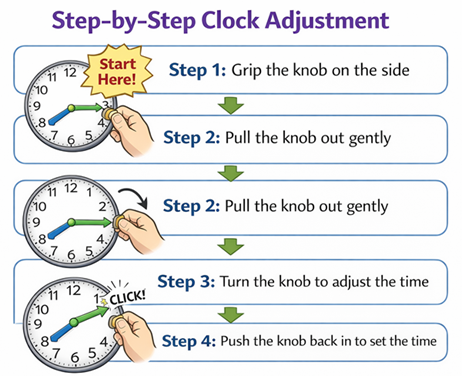
To set quarter past, place minute hand at 3 and hour hand just after the hour.
Example 2
Examples.
- 2:15
- 4:15
- 7:15
- 9:15
- 11:15
Activity 3
Activities.
Teacher Calls Time – pupils adjust clocks
Activity 4
Pair Clock Work – one says, one adjusts
Exercise 3
Exercises.
- Minute hand? → 3
- Set 5:15
- Identify wrong clock
- Make your own time
Exercise 4
General Questions.
- Which hand first? Answer: Minute hand
- Final step? Answer: Adjust hour hand.
Conclusion:
Adjusting clocks builds practical understanding.
Tell time in a quarter past hours.
Telling Time 3
Reading time helps manage daily routines.
Concept.
“Quarter past” means 15 minutes after the hour. It shows that a quarter of the hour (15 minutes) has passed since the last full hour.
Explanation:
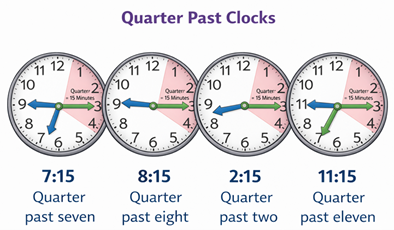
If the minute hand is at 3, read the hour hand and say quarter past + hour.
Example 3
Examples.
- 1:15,
- 3:15,
- 6:15,
- 8:15,
- 12:15
Activity 5
Activities One.
Time Reading Circle
Activity 6
Flash Card Reading Game
Exercise 5
Exercises.
- Quarter past minutes? → 15
- Read 4:15
- Compare 4:15 vs 4:30
- Draw your own time
Exercise 6
General Questions.
- Where is minute hand? → 3
- How do you read? → Quarter past + hour
Conclusion:
Quarter past helps pupils read time confidently and manage daily schedules.Bottom of Form
Half past hours
Introduction.
Half past is the time that shows 30 minutes after the full hour. For example, half past 3 is 3:30. In this topic, you will learn how to read, write, and recognize half-past intervals using clocks and everyday examples. This will help you understand time and plan your activities well.
Expected Competency.
The pupil will be able to read, write, and tell half past hours correctly using clocks and real-life situations, and apply this knowledge in managing daily activities effectively.
Identify the placement of numerals and hands on clock face for half past hours.
Telling time 1 On Air
Introduction.
Time helps us know when to wake up, go to school, eat, and play. Clocks help us read time easily. Today we will learn about half past hours, which means 30 minutes after an hour. Learning half past time helps pupils manage their daily routines and become more responsible with time.
Concept.
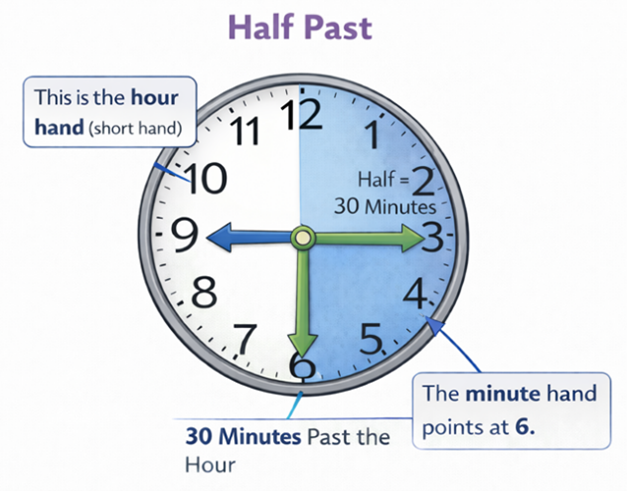
Half past means half of an hour has passed. Since one hour has 60 minutes, half past equals 30 minutes. On a clock, the minute hand points at 6, and the hour hand moves halfway between two numbers.
What You Will Learn in Brief.
- Meaning of half past time
- Placement of numerals on a clock
- Position of minute and hour hands during half past
- How to read and write half past time
- Practical use of half past time in daily life
Explanations:
A clock has numbers from 1 to 12 arranged in a circle. The minute hand is usually longer and shows minutes, while the hour hand is shorter and shows hours.
When we say half past, it means 30 minutes after an hour. At half past:
- The minute hand always points at number 6 because it represents 30 minutes.
- The hour hand does not stay exactly on a number. Instead, it moves halfway between the current hour and the next hour.
For example:
- Half past 3 means 3:30. The minute hand is at 6, and the hour hand is between 3 and 4.
- Half past 7 means 7:30. The minute hand is at 6, and the hour hand is between 7 and 8.
Pupils should always check:
- Is the minute hand on 6?
- Is the hour hand between two numbers?
If yes, it is a half past time.
Example 4
Examples.
- Half past 1 Answer: 1:30
- Half past 4 Answer: 4:30
- Half past 6 Answer: 6:30
- Half past 9 Answer: 9:30
- Half past 11 Answer: 11:30
Activity 7
Human Clock Game.
Objective: Understand clock hand placement through movement.
- One pupil stands as the center of the clock.
- Two pupils act as hour and minute hands.
- Teacher says a half past time.
- Pupils position themselves correctly
Exercise 7
Exercises and Answers.
- What number does the minute hand point to at half past? Answer: 6
- What does half past mean? Answer: 30 minutes after an hour
- Draw half past 2. Answer: Minute hand at 6, hour hand between 2 and 3.
- If the minute hand is at 6 and hour hand between 8 and 9, what time is it? Answer: Half past 8 (8:30)
- A pupil says half past 5 has the hour hand exactly on 5. Is that correct? Answer: No
- Create your own half past time and draw it. Sample Answer: Half past 10 (10:30)
Exercise 8
General Questions.
- Where is the minute hand during half past time?
- How does the hour hand look during half past?
- Why is half past equal to 30 minutes?
- How can you identify half past quickly?
- Give two examples of half past times.
Answers.
- On number 6.
- Between two numbers.
- Because half of 60 minutes is 30.
- Check minute hand at 6.
- Example: Half past 3, Half past 7.
Conclusion:
Half past time is easy to read when pupils remember two key things: the minute hand points at 6 and the hour hand stays halfway between numbers. Understanding half past helps pupils manage daily activities like school time, playtime, and rest time.
Adjust the clock at a given time.
Time telling 4
Adjusting clocks helps pupils practice real-life time skills.
Concept.
Set minute hand first, then hour hand.
What You Will Learn in Brief.
- Move minute hand to 3
- Adjust hour hand slightly forward
Explanation:
The term "Quarter Past" refers to the point where 1/4 of an hour (15 minutes) has elapsed. On an analog clock, the minute hand must point exactly at the number 3.
- The Logic: Since an hour is 60 minutes, 60 ÷4 = 15.
- Setting it: If the goal is to set the time to 2:15, the hour hand should be slightly past the 2, and the minute hand exactly on the 3.
To adjust quarter past time, place the minute hand on 3 and move the hour hand slightly after the hour number.
Example 5
Examples.
- 2:15,
- 4:15,
- 7:15,
- 9:15,
- 11:15
Activity 8
Teacher Calls Time – pupils set clocks.
Activity 9
Pair Work Clock – one student says, another adjusts.
Exercise 9
Exercises.
- Minute hand? → 3
- Set 5:15
- Identify wrong clock
- Correct clock
- Create your own time
Exercise 10
General Questions.
- Which hand first? Answer: Minute hand.
- Last step? Answer: Adjust hour hand.
Conclusion:
Clock adjustment strengthens practical learning.
Tell time in half past hours.
Telling time 3
Introduction.
Reading time helps pupils follow daily routines. "Today we are going to learn how to tell the time when 15 minutes have passed.
A clock is like a circle. When we divide this circle into four equal parts, each part is called a quarter. In terms of time, a quarter is 15 minutes. When the long hand (the minute hand) points to number 3, we use the phrase 'Quarter past'.
What you need to remember:
First, we say 'Quarter past'. Then, we say the number where the short hand (the hour hand) is.
Example: “Quarter past ten."
Concept: The movement of the minute hand through one-quarter of the clock face.
- Meaning: An hour has 60 minutes. When we divide 60 by 4, we get 15 minutes. In English, 15 minutes is called a quarter.
- The Indicator: On an analogue clock, we know it is a "quarter" when the long hand (minute hand) points exactly to number 3.
- The Phrase: We use the term "Quarter past" to show that 15 minutes have passed after a certain hour.
- The Rule: In English, we mention the minutes (Quarter past) before the hour.
Example: Quarter past two.
What You Will Learn in Brief:
- Check minute hand
- Read hour
- Say quarter past
Explanation:
If the minute hand is at 3, read the hour hand and say “quarter past and hour.”
Examples.
| (Digital) | How to Tell the Time |
| 08:15 | It is quarter past eight. |
| 02:15 | It is quarter past two. |
| 05:15 | It is quarter past five. |
| 11:15 | It is quarter past eleven. |
Activity 10
Flash Card Reading Game (Main Game)
How to Play.
- Shuffle your flash cards and place them face down.
- Pick one card.
- Set your drawn clock to match the time.
- Say aloud: “Quarter past ___.”
- Check: Is the minute hand on number 3? If yes, continue.
Exercise 11
Exercises.
- Minutes? Answer: 15
- Read 4:15
- Compare 4:15 vs 4:30
- Identify mistake
- Draw your own clock
Exercise 12
General Questions.
- Where is minute hand? Answer: 3
- How do you read? Answer: Quarter past and hour.
Conclusion:
Quarter past skills help pupils read time confidently and manage daily activities.
Listening to this topic