English
COMPARING AND DIFFERENTIATING
Reading settings
Text size
Line spacing
Colours
COMPARING AND DIFFERENTIATING
Animals in terms of their physical features and food
Introduction.
Looking at two or more things to find their similarities and differences.
Comparing is finding what is the same between things. Differentiating is finding what is different between things.
Expected Competency:
The learner will be able to correctly group animals according to their physical features and the type of food they eat, explain clearly the characteristics of different animals, and accurately compare animals by identifying their similarities and differences.
Categorize animals in relation to their physical features and food.
Introduction.
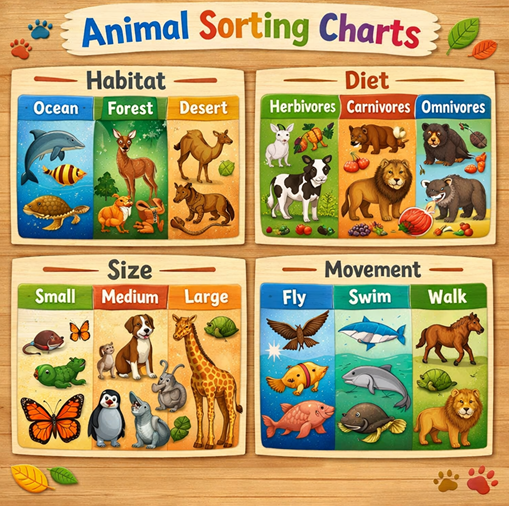
Animals can be grouped based on how they look and what they eat.
Animals are living things. Animals are everywhere. Some are large, others are small; some eat plants and others eat meat. In this lesson, we will learn to compare animals, put them into groups, and understand their shapes as well as the food they eat.
Concept:
Grouping animals by body features and food types.
What You Will Learn in Brief:
Learn herbivores, carnivores, omnivores and body features like wings, legs, fur.
Explanation:
Categorizing animals means putting animals into groups based on similarities such as body covering and food.
It is the classification of animals based on:
- Physical characteristics – appearance and body parts.
- Food – the types of food they eat.
1. Grouping by Physical Characteristics
How it works: Observe:
- Skin: fur/feathers, scales, or shells.
- Legs: two, four, or none.
- Body parts: wings, fins, or beaks.
- Movement: flying, swimming, or walking.
2: Grouping by Food.
How it works:
- Plant eaters (Herbivores)
- Meat eaters (Carnivores)
- Eaters of both (Omnivores)
Thus: Food shows the animal's role in the environment.
Example 1
Example 1: Lion and Cow
- Lion – sharp teeth, eats meat.
- Cow – flat/broad teeth, eats grass.
- How: Compare the teeth and the food.
- Why: The teeth indicate the type of food eaten.
Example 2
Example 2: Fish and Chicken
- Fish – fins, lives in water.
- Chicken – feathers, lives on land.
- How: Look at the body and the habitat.
- Why: The body structure shows the environment they live in.
Remember: Grouping animals helps students understand animal life, their environments, and how they obtain food.
Example 3
Examples:
- Cow – eats grass – hooves
- Lion – eats meat – sharp teeth
- Hen – wings – eats grains
- Goat – horns – eats plants
- Dog – eats meat & plants
Activity 1
"Be the Animal" (Role-Play)
Play this activity; it will help you understand how an animal's body works and why it needs specific features to get its food."
What You Need:
- Common household items (e.g., a spoon, a fork, or a clothespin).
- Pictures of a Lion (Carnivore) and a Cow (Herbivore).
Steps to Follow:
1. Act like a "Plant Eater" (The Cow):
- The Action: Ask the child to pretend to "grind" some paper scraps or leaves using only the palms of their hands (representing the broad, flat teeth of a cow).
- The Question: "Is it easy to crush the plants with flat surfaces?"
- The Goal: The child will realize that flat teeth are perfect for grinding grass into a paste.
2. Act like a "Meat Eater" (The Lion):
- The Action: Ask the child to use a fork or their fingers shaped like claws to "grab and tear" a piece of cloth or a cushion.
- The Question: "Why does the lion need 'hooks' and sharp points instead of flat surfaces?"
- The Goal: The child will see that sharp teeth and claws are necessary to catch and tear meat.
3. Act out Movement (Physical Features):
- The Action: Have the child mimic different movements: "Fly" like a bird (wings) or "slither" like a snake (no legs).
- The Goal: To show that how an animal moves is a physical feature that helps it reach its specific food.
The Big Lesson (The "Why"):
After the role-play, discuss this with the child:
"Could a lion eat grass with its sharp teeth? Could a cow catch a fast animal with its flat teeth?"
The Conclusion: Every animal has a body designed specifically for the food it eats. This is how they survive in their environment.
Exercise 1
Exercises and Answers:
- Name 3 herbivores. Answer: Cow, Goat, Rabbit.
- Why is lion carnivore? Answer: Eats meat
- Group hen and lion. Answer: Different food groups.
- Compare goat and cow. Answer: Both herbivores.
- Which is safer pet? Answer: Dog (example)
- Draw your own animal group.
Exercise 2
General Questions
- What is categorizing?
- Name two carnivores.
- Which animals have wings?
Answers.
- Putting into groups
- Lion, Dog
- Hen, Bird
Conclusion.
Animals can be grouped using features and food.
Explain features of different categories of animals in terms of their physical features and food.
Animals have special features that help them eat and survive.
Concept.
Understanding characteristics of animal groups.
What You Will Learn in Brief:
Learn herbivores (flat teeth), carnivores (sharp teeth), birds (wings).
Explanation:
This topic helps the pupil categorize animals based on:
- Physical features. Physical features help an animal survive. Example: wings for flying, fins for swimming.
- The food they eat. Food shows the animal's role in the environment and the food chain.
The goal is not just to name the groups, but to explain the reason why an animal belongs to a specific group, as explained at the beginning of this topic.
Example 4
Examples.
- Lion – sharp teeth – meat eater.
- Cow – flat teeth – plant eater.
- Eagle – wings – hunts meat.
- Duck – webbed feet – water life.
- Rabbit – long ears – plant eater.
Activity 2
Match Animal to Food.
Pupils match animals with their food and explain how their physical features help them eat.
1. Materials.
- Animal Cards: Lion, cow, goat, hen, dog, giraffe, cat.
- Food Cards: Meat, grass, leaves, grains, insects.
2. Procedures.
- Introduction: Ask, "What does this animal eat?" Let them guess.
- Matching: In groups, match the animal to its food.
- The "Why" (Drawing/Writing): For each match, note the feature.
Examples.
| Animal | Food | Feature & Why |
| Lion | Meat | Sharp teeth: To tear meat. |
| Cow | Grass | Flat teeth: To grind plants. |
| Hen | Grains | Beak: To pick up seeds. |
3. Conclusion.
- Herbivores: Eat plants (e.g., Cow).
- Carnivores: Eat meat (e.g., Lion).
- Omnivores: Eat both (e.g., Hen, Human).
Assessment Questions.
- Why do herbivores have flat teeth?
- Which animals from your cards eat both plants and animals?
Exercise 3
Exercises and Answers.
- What do cows eat? Grass.
- Why eagle has wings? Flying.
- Identify carnivore. Lion.
- Compare duck & hen. Feet difference.
- Best swimmer? Duck.
- Design animal chart.
Exercise 4
General Questions:
- Which animals have sharp teeth?
- Name one omnivore.
- Why do birds have wings?
Answers.
- Lion, Dog.
- Human/Dog.
- To fly.
Conclusion:
Animal features help them survive and find food.
Describe similarities and differences of animals in terms of their physical features and food.
Some animals look alike while others are very different.
Concept.
Finding similarities and differences.
What You Will Learn in Brief:
Compare body size, food type, legs, teeth.
Explanation:
Animals may look different, but many share some physical features and feeding habits. By comparing animals, pupils understand how body parts help animals survive and find food in their environments.
Similarities of Animals.
Some animals have similar physical features because they eat similar food or live in similar environments.
Examples of Similarities.
- Herbivores like cows and goats have flat teeth for grinding plants.
- Carnivores like lions and cats have sharp teeth and claws for catching and tearing meat.
- Birds such as hens and ducks have beaks that help them pick food.
How It Works.
Animals develop body features that make it easier to eat their food. For example:
- Flat teeth crush and grind leaves.
- Sharp teeth cut and tear meat.
- Beaks help birds pick seeds or insects.
Why It Works.
Animals must eat to survive. If their bodies match their food type, they can find food easily and stay healthy.
Differences of Animals.
Animals differ in physical features because they eat different types of food.
Examples of Differences.
- A lion has sharp teeth for meat, but a cow has flat teeth for grass.
- A giraffe has a long neck to reach high leaves, but a chicken has a short neck to peck food from the ground.
Each animal’s body is designed for a specific feeding habit:
- Long neck → reach tall plants.
- Strong claws → catch prey.
- Strong beak → crack seeds.
Different environments have different foods. Animals adapt their bodies so they can survive where they live.
Examples (Comparison)
Example 1: Lion and Cow
Similarities.
- Both are mammals.
- Both have four legs and tails.
Differences.
- Lion: sharp teeth, eats meat → carnivore.
- Cow: flat teeth, eats grass → herbivore.
How and Why.
- Lion’s teeth help tear meat because it hunts animals.
- Cow’s teeth help grind plants because it eats grass.
Example 2: Giraffe and Chicken.
Example 5
Examples.
- Cow and Goat – both herbivores.
- Lion and Dog – sharp teeth.
- Hen and Duck – both birds.
- Elephant and Cow – different size.
- Cat and Rabbit – different food.
Activity 3
Compare Two Animals Drawing.
The pupil will be able to:
- Draw two animals.
- Identify similarities and differences in physical features.
- Explain how body parts help animals get food.
Materials.
- Drawing paper
- Pencil and eraser
- Colored pencils or crayons
- Picture samples of animals (optional for support)
Pupil Activity Steps.
Choose Two Animals.
- The pupil selects two different animals (example: lion & cow, giraffe & chicken, dog & goat).
Draw the Animals.
- Draw both animals on one page.
- Label main body parts:
- Teeth
- Legs
- Neck
- Beak or claws
- Tail
Compare Through Drawing Notes.
Under the drawings, the pupil writes:
Similarities.
- Both have four legs.
- Both have tails.
Differences.
- One has sharp teeth; the other has flat teeth.
- One eats meat; the other eats plants.
Explain Food and Features.
The pupil completes:
- Animal 1 eats ______ because it has ______.
- Animal 2 eats ______ because it has ______.
Assessment (Individual Task)
The pupil:
- Names one similarity.
- Names one difference.
- Explains one physical feature and its food.
Exercise 5
Exercises and Answers
- Name two birds. Answer: Hen, Duck
- How goat and cow similar? Answer: Eat plants
- Compare lion and cow. Answer: Food difference
- Duck vs hen. Answer: Feet difference
- Which animal flies? Answer: Eagle
Exercise 6
General Questions.
- What is a similarity?
- Give one difference between lion & cow.
- Name two herbivores.
Answers.
- Things that are alike
- Food type
- Goat, Cow
Conclusion:
Comparing animals helps us understand nature better.
Objects in terms of their characteristics
Introduction.
Objects around us have different characteristics that help us identify and describe them. These characteristics include shape, size, color, texture, weight, and the materials they are made from. By observing these features carefully, learners can group, compare, and differentiate objects found in their environment. Understanding objects in terms of their characteristics helps learners to develop observation and classification skills in daily life.
Expected Competency.
The pupil demonstrates the ability to identify and describe different characteristics of objects such as shape, size, color, texture, and material. The pupil accurately classifies objects based on these characteristics and shows the ability to compare and differentiate objects correctly in various real-life situations.
Classify different objects.
Introduction.
We use many objects every day such as books, bottles, balls, and pencils. These objects can be grouped according to their size, shape, colour, and material.
Concept:
Grouping objects according to shared features.
What You Will Learn in Brief:
Sorting by colour, size, shape, material.
Explanation:
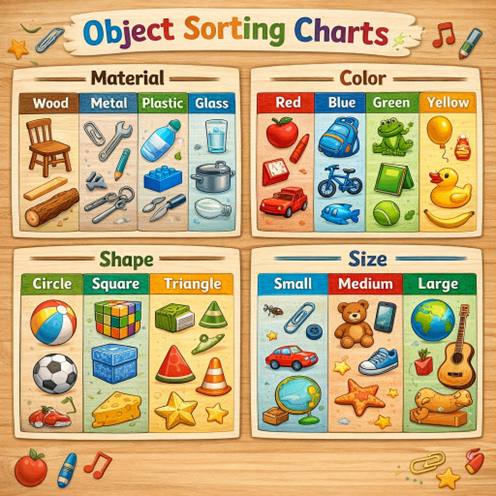
Classifying objects means grouping items based on shared characteristics such as shape, size, color, material, texture, or use. It is a scientific and logical skill used in mathematics, science, and daily life to organize information and make understanding easier.
How Classification Works.
- Observation – Carefully look at an object’s physical properties (e.g., metal, plastic, round, heavy).
- Identification of Features – Recognize specific characteristics that make objects similar or different.
- Comparison – Compare objects using measurable or observable traits.
- Grouping – Place objects into categories based on common features.
- Verification – Check if each object truly fits the category rules.
Example technical criteria:
- Material type (wood, metal, plastic)
- Function (used for writing, eating, building)
- Physical properties (hard/soft, heavy/light)
Supporting Facts and Learning Benefits.
- Educational research suggests that pupils remember information 30–50% better when they organize items into categories instead of memorizing random lists.
- Studies on child development show that classification strengthens critical thinking, comparison skills, and problem-solving ability.
- Science learning often begins with classification because it helps pupils see patterns and relationships.
Why Classification Works.
- The human brain naturally organizes information into patterns to reduce confusion.
- Grouping helps pupils quickly identify similarities and differences.
- It improves memory because structured information is easier to recall.
Examples:
Example 1: Classroom Objects.
Objects: pencil, spoon, book, plate, ruler
Classification:
- Writing tools → pencil, ruler
- Eating tools → spoon, plate
- Reading materials → book
How: Pupils look at the function of each object.
Why: Objects used for similar tasks share similar purposes and features.
Example 2: Natural and Man-Made Objects
Objects: stone, plastic bottle, leaf, glass cup.
How: Identify origin (from nature or made by humans).
Why: Understanding origin helps pupils know how objects are used and cared for.
Example 6
Examples:
- Plastic bottle – plastic group.
- Wooden chair – wood group.
- Red ball – colour group.
- Big box – size group.
- Round plate – shape group.
Activity 4
Object Sorting Game:
Pupils sort classroom items into colour or material groups.
Activity 5
Group Table Activity:
Each group receives mixed objects and creates their own classification chart.
Exercise 7
Exercises and Answers.
- Name 2 round objects. Answer: Ball, Plate
- Why group plastic bottles together? Answer: Same material
- Put pencil & book. Answer: School objects.
- Compare big vs small box. Answer: Size difference
- Best group for spoon? Answer: Metal objects
- Draw your own object group.
Exercise 8
General Questions.
- What is classifying?
- Name two objects made of wood.
- Which objects are round?
Answers.
- Putting into groups
- Chair, Table
- Ball, Plate
Conclusion.
Classifying objects helps us organize and understand the world around us.
Identify characteristics of different objects
Introduction.
Objects have different characteristics such as hard or soft, heavy or light, smooth or rough.
Concept:
Recognizing features of objects.
What You Will Learn in Brief:
Compare texture, weight, colour, size, material.
Explanation:
To compare objects, we look at their different characteristics and explain how they are similar or different:
- Texture: This shows how an object feels when you touch it. Some objects are rough (like a stone), while others are smooth (like glass).
- Weight: This tells us how heavy or light an object is. For example, a stone is heavier than a piece of paper.
- Colour: This is the appearance of an object such as red, blue, green, or yellow. Objects can have the same or different colours.
- Size: This shows how big or small an object is. For example, an elephant is bigger than a goat.
- Material: This tells us what an object is made of, such as wood, plastic, metal, or glass.
By comparing these characteristics, you can understand objects more easily and explain their differences clearly.
Activity 6
Touch and Tell:
Pupils feel objects and describe texture.
Activity 7
Weight Test:
Compare heavy and light objects using hands.
Example 7
Examples.
- Sponge – soft
- Stone – hard
- Feather – light
- Glass – smooth
- Sandpaper – rough
Exercise 9
Exercises and Answers.
- Name one soft object. Answer: Sponge
- Why stone is hard? Answer: Solid material
- Find a smooth object. Answer: Glass
- Compare feather and stone. Answer: Weight difference
- Which object is safest to throw? Answer: Sponge
- Create: Draw objects with labels of characteristics.
Exercise 10
General Questions.
- What is texture?
- Name one heavy object.
- Which object is smooth?
Answers.
- How something feels
- Stone
- Glass
Conclusion:
Knowing characteristics helps us choose and use objects safely.
Explain the similarities and differences of objects in terms of their characteristics.
Introduction.
To explain similarities and differences of objects means to describe how objects are alike and how they are not alike by looking at their characteristics.
Concept:
Finding similarities and differences between objects.
What You Will Learn in Brief:
Compare texture, weight, colour, size, material.
Explanation:
To explain similarities and differences of objects in terms of their characteristics means to look at the features of objects and describe how they are the same and how they are different.
- Similarities are the features that objects share. For example, a ball and an orange are both round in shape and may have a smooth texture.
- Differences are the features that make objects not the same. For example, a ball is made of rubber, while an orange is a fruit and can be eaten.
We use characteristics such as:
- Colour (same or different colours)
- Size (big or small)
- Shape (round, square, etc.)
- Texture (smooth or rough)
- Material (wood, metal, plastic, etc.)
By explaining similarities and differences, pupils can clearly understand objects and describe them correctly.
Example 8
Examples:
- Cup and Glass – both for drinking
- Spoon and Fork – metal but different shapes
- Book and Notebook – both paper
- Ball and Orange – round but different uses
- Chair and Table – wood but different purpose
Activity 8
Venn Diagram – Comparing Two Animals.
The pupil should be able to:
- Compare two animals using a Venn diagram.
- Describe similarities and differences in physical features.
- Explain the relationship between physical features and the food they eat.
Materials.
- Paper
- Pencil and eraser
- Colored pens/crayons
- Books or animal pictures - optional
Step-by-Step Instructions.
1.Choose Two Animals.
Choose two different animals (Example: a lion and a cow, or a giraffe and a goat).
- Write their names at the top of your paper.
2. Draw the Venn Diagram.
- Draw two large circles that overlap (cross each other) in the middle.
- Write the name of one animal above each circle.
3. List Physical Features.
- Left Circle: Features of the first animal (type of teeth, legs, neck, claws, or beak).
- Right Circle: Features of the second animal.
- Middle Part: Things that are the same (similarities).
Example:
- Middle: Both have four legs.
- Left (Lion): Sharp teeth and claws.
- Right (Cow): Flat teeth and hooves.
4.Add Diet Information.
Write down what each animal eats.
- Explain how their body features help them eat that food.
5. Reflection. Write down:
- One similarity.
- Two differences.
- One reason why their bodies are different.
Exercise 11
Exercises and Answers
- Name two round objects. Answer: Ball, Orange
- How book and notebook similar? Answer: Paper
- Compare spoon & fork. Answer: Shape difference
- Glass vs cup. Answer: Material difference
- Best for eating soup? Answer: Spoon
- Create: Draw two objects and write differences
Exercise 12
General Questions.
- What is a similarity?
- Give one difference between chair & table.
- Name two objects made of metal.
Answers.
- Things that are alike
- Purpose/use
- Spoon, Fork
Conclusion:
Comparing objects helps pupils think critically and make good choices.
Listening to this topic