English
LIBRARY USE
Reading settings
Text size
Line spacing
Colours
LIBRARY USE
Introduction:
A library is a special place where pupils find books and learning materials. It helps pupils read, research, and grow their knowledge. When pupils use the library well, they become better readers and independent pupils.
Expected Competency:
The learner should be able to use the library properly by identifying different sections, locating books easily, and using them responsibly for learning purposes.
Concept:
A library is not just a room full of books; it is a system. Everything has its specific place so that anyone can find what they need without searching for hours.
School library
"A school library is not just a room full of books; it is a treasure chest of knowledge. It is a quiet place where you can travel to the moon, dive into the ocean, or learn about history just by picking up the right material."
Expected Competency:
By the end of this lesson, the pupil should be able to identify and name different types of learning materials found in the school library and explain how each supports learning. The learner should also be able to explain the functions of the school library and demonstrate the correct steps for borrowing and taking care of a book. In addition, the learner should be able to identify different types of books, understand library rules, and follow them properly.
Identify various learning materials in school library.
Introduction:
A school library is an important place where learners find different materials for learning. These materials include books, newspapers, magazines, charts, and maps. Identifying these learning materials helps learners to choose the right resources for their studies and improve their knowledge.
Expected Competency:
By the end of this lesson, you should be able to identify and name different types of learning materials found in your school library and understand how each one helps you learn.
Concept:
The library is organized so that every student can find "Learning Materials." These are tools like books, maps, and digital files that carry information. Knowing the difference between them helps you find the right information quickly.
What You Will Learn:
You will learn to identify storybooks, textbooks, reference books (dictionaries/encyclopedias), and non-book materials like maps and globes.
Explanation:
Inside a library, materials are divided into groups. Textbooks help you with school subjects like Math or Science. Storybooks (fiction) take you on adventures. Reference books like Dictionaries tell you the meaning of words. There are also Visual materials like Maps that show you where countries are.
Example 1
Examples:
- Textbook: (Primary Mathematics Grade 5.)
- Storybooks: (Kiu)
- Reference Book: (Oxford Swahili-English Dictionary.)
- Periodical : (Mwanaspoti or a Children’s Magazine.)
- Visual Material: (A Map of Tanzania.)
Activity 1
Go to the library and find one book for each: A storybook, a dictionary, and a map. Write down their titles. Library Treasure Hunt – Pupils search and list five materials.
Activity 2
The Labeling Game:
Look at a pile of materials and put them in groups. Put "Textbooks" in one corner and "Storybooks" in another.
Exercise 1
Exercises and Answers
- Name two materials. Answer: Book, Dictionary.
- Name three items you can find in a library. Answer: Books, Maps, Globes.
- Why use a dictionary? Answer: To find meanings
- Find one atlas. Answer: Atlas example
- Difference textbook vs storybook. Answer: Learning vs entertainment
- Which helps research most? Answer: Textbook
Exercise 2
General Questions and Answers
- What are learning materials? Answer: Tools that help pupils learn.
- Why should we keep the library quiet?
Answer: To help everyone concentrate and understand what they are reading.
Conclusion:
The school library is your best friend in learning. By knowing how to identify the right materials, you become a smarter and faster pupil. Visit your library today and pick a new "treasure" to explore!
Explain the steps of borrowing books from the library.
Introduction:
A library is a magical place filled with thousands of stories, facts, and adventures. It is not just a room with shelves; it is a gateway to the whole world!
Expected Competency.
By the end of this lesson, you will be able to identify the functions of a school library and demonstrate the correct steps for borrowing a book.
Concept:
Borrowing steps are actions followed to take and return books safely. The concept centers on understanding how the school library supports learning and the formal process of taking books home responsibly.
What You Will Learn:
The importance of the school library.
- Step-by-step instructions on how to borrow a book.
- Library rules and etiquette.
Explanation:
Your school library is a treasure chest! It helps you find information for your homework and fun stories to read. To make sure everyone gets a turn, we "borrow" books. This means we take them for a short time and then bring them back safely for the next person.
Find book → Ask librarian → Record name → Borrow → Read → Return on time.
Example 2
Examples:
- Sign borrowing card.
- Stamp date.
- Return book.
- Queue politely.
- Keep book clean.
Activity 3
The Library Detective:
Go to the library and find one book about animals and one book about space. Write down their titles.
Exercise 3
Exercises and Answers
- First step? Answer:Find book
- Why return? Answer:Others need it
- Arrange steps. Answer:Correct order
- What happens if late? Answer:Penalty
- Best rule? Answer:Return on time
- Make borrowing rules chart
Exercise 4
General Questions and Answers
Q: Why follow steps?A: To keep books safe and organized.
Q: Can I eat inside the library?A: No, food can stain or damage the books.
Q: What happens if I lose a library book?A: You should tell the Librarian; usually, you might have to replace it or pay a small fine.
Conclusion:
The library is your best friend for learning. By following the borrowing steps, you help keep the library organized so everyone can enjoy reading!
Read different books.
Introduction:
Reading is like having a superpower! When we read different types of books, we open our minds to new worlds. Some books tell us funny stories that make us imagine, while others teach us real facts about animals, planets, and history. By reading many kinds of books, we learn new words, improve our thinking, and become wiser every day.
Expected Competency:
By the end of this lesson, you should be able to:
- Identify different types of books in the library.
- Understand the rules of the library.
- Follow the correct steps to borrow and care for a book.
Concept:
The library is organized so that every student can find what they need. Books are arranged by categories (like stories or facts) to help us become better readers and independent pupils.
What You Will Learn:
You will learn how to navigate the library, the difference between "Fiction" (make-believe) and "Non-Fiction" (real facts), and the importance of returning books on time so others can use them.
Explanation:
Students should read story books, science books, poems, and informational texts to develop their skills.
When you go to the library, imagine you have entered a special room where you can travel to the moon, meet talking animals, or learn how to cook — all without leaving your chair! That is the School Library.
To use the library well, you must:
- Be Quiet: Use a “library voice” (a whisper).
- Take Care of Books: Make sure your hands are clean and do not fold book pages.
- Know Book Sections: Books are usually divided into Fiction (imaginary stories) and Non-Fiction (true facts and information).
Example 3
Examples:
- Storybook
- Science book
- Poetry book
- History book
- Comic
Activity 4
Activities:
Reading Circle
Activity 5
Reading Circle
Exercise 5
Exercises and Answers
- What is a school library? Answer: A place in school where books are kept for reading and borrowing.
- What is the difference between a Fiction and a Non-Fiction book? Answer: Fiction is based on imagination/stories; Non-Fiction is based on real facts/information.
- If you borrow a book on Monday and must return it in 5 days, what day is it due? Answer: Saturday (or Friday, depending on school days).
- Why is it important to have rules in the library? Answer: Rules keep the library quiet for studying and ensure that books are not lost or damaged.
Exercise 6
Questions and Answers.
Q: What improves reading?A: Practice with different books.
Q: Can I eat in the library?A: No. Food and drinks can spill and ruin the books.
Q: What should I do if I lose a library book?A: You should tell the librarian immediately. You may have to replace the book or pay a small fine.
Conclusion:
"The library is your best friend in school. By learning how to use it, you open the door to a world of stories and facts. Remember: Read, Respect, Borrow, and Return!"
Reading simple stories
Introduction:
ading simple stories is the best way to improve your language and imagination. A relevant storybook is one that matches your age, interests, and reading level.
Expected Competency:
By the end of this lesson, the learner should be able to choose a simple storybook appropriate for their grade level, read it fluently with understanding, identify the main characters, and explain the events of the story clearly. The learner should also be able to determine the main idea of the story and rewrite it in a few simple sentences using their own words.
Identify relevant storybooks.
Introduction:
To "Identify Relevant Storybooks" means to find a book that is interesting and easy for you to understand. Not every book in the library is right for a Grade 5 student. Some are too easy (for babies), and some are too hard (for adults).
To identify a relevant book, you should check:
- The Title: Does it sound like a story you would enjoy?
- The Cover Image: Does the picture show things you like, such as adventure, animals, or sports?
- The Blurb: Read the short summary at the back of the book to see what the story is about.
Concept:
Not every book is for everyone. Choosing the right storybook helps you enjoy reading without getting frustrated by hard words.
What You Will Learn:
You will learn how to use the "Five Finger Rule" to pick a book and how to use the cover and title to guess what the story is about.
Explanation:
To find a relevant storybook, look at the Title and the Cover Image. If the book has many pictures and few hard words, it is likely a "Simple Story." Use the Five Finger Rule: Open to any page and start reading. If you find 5 words you don't know, the book might be too hard for now!
The Five Finger Rules:
Do you want to know if a book is too easy, too hard, or just right? Open a page in the middle and start reading. For every word you don't know, put up one finger:
- 0-1 Finger: Too easy.
- 2-3 Fingers: Just right! This is your "Goldilocks" book.
- 4 Fingers: Give it a try, but it might be tough.
- 5 Fingers: Too hard for now. Save it for later!
Example 4
Examples:
- Animal stories
- School stories
- Adventure
- Friendship
- Folk tales
- Moral stories
Activity 6
Book Selection Game:
Choose suitable story and explain reason.
Activity 7
The Cover Judge:
Look at three different book covers. Based only on the pictures, tell your partner which one looks like a storybook for Grade 5.
Activity 8
The Five Finger Test:
Pick a book, read one page, and hold up a finger for every word you can't pronounce.If you have 0-2 fingers up, it’s perfect!
Exercise 7
Exercises and Answers.
- What is a storybook? → Book with stories.
- Why check pictures? → Understand content.
- Pick age-appropriate book → Example.
Exercise 8
Exercises:
- What part of the book tells you the name of the story? Ans: The Title.
- Why should we choose books with pictures? Ans: Pictures help us understand the story better.
- If a book has 10 hard words on one page, is it a "simple story" for you? Ans: No, it is too difficult.
- Analyze: Hard vs simple story. Ans: Language level
- Best story. Ans: Reason
- Design book cover
Conclusion:
Choose wisely to enjoy reading.
Finding the right storybook makes reading fun. Remember: Read, Respect, Borrow, and Return!
Read the simple stories.
Introduction:
Once you have chosen a good book, the next step is to read it carefully. Reading simple stories helps you understand how sentences are built and how characters solve problems.
Concept:
Reading is not just about saying words; it is about understanding the message. Simple stories use easy words and short sentences. Use easy words to teach big lessons.
What You Will Learn:
You will learn how to read at a good pace, how to look for the "Beginning, Middle, and End" of a story, and how to enjoy the pictures while reading.
Explanation:
Reading a story is like going on a mini-adventure. To understand it deeply, you don't just look at the words; you have to think about what they mean.
1. Read Slowly and Picture It.
When you read, try to create a "movie" in your head. If the book says, "The cat sat on a sunny porch," try to see that cat and feel the warmth of the sun.
2. Look for the Big Three.
To understand any story, you need to find these three things:
- Characters: Who is the story about?
- Setting: Where and when is the story happening?
- The Problem: What is the main challenge the character is facing?
3. Ask Questions While You Read.
Stop after a few sentences and ask yourself:
- Why did the character do that?
- How do they feel right now?
4. Summary Time.
After finishing, try to retell the story in just three sentences using the words First, Then, and Finally.
Examples:
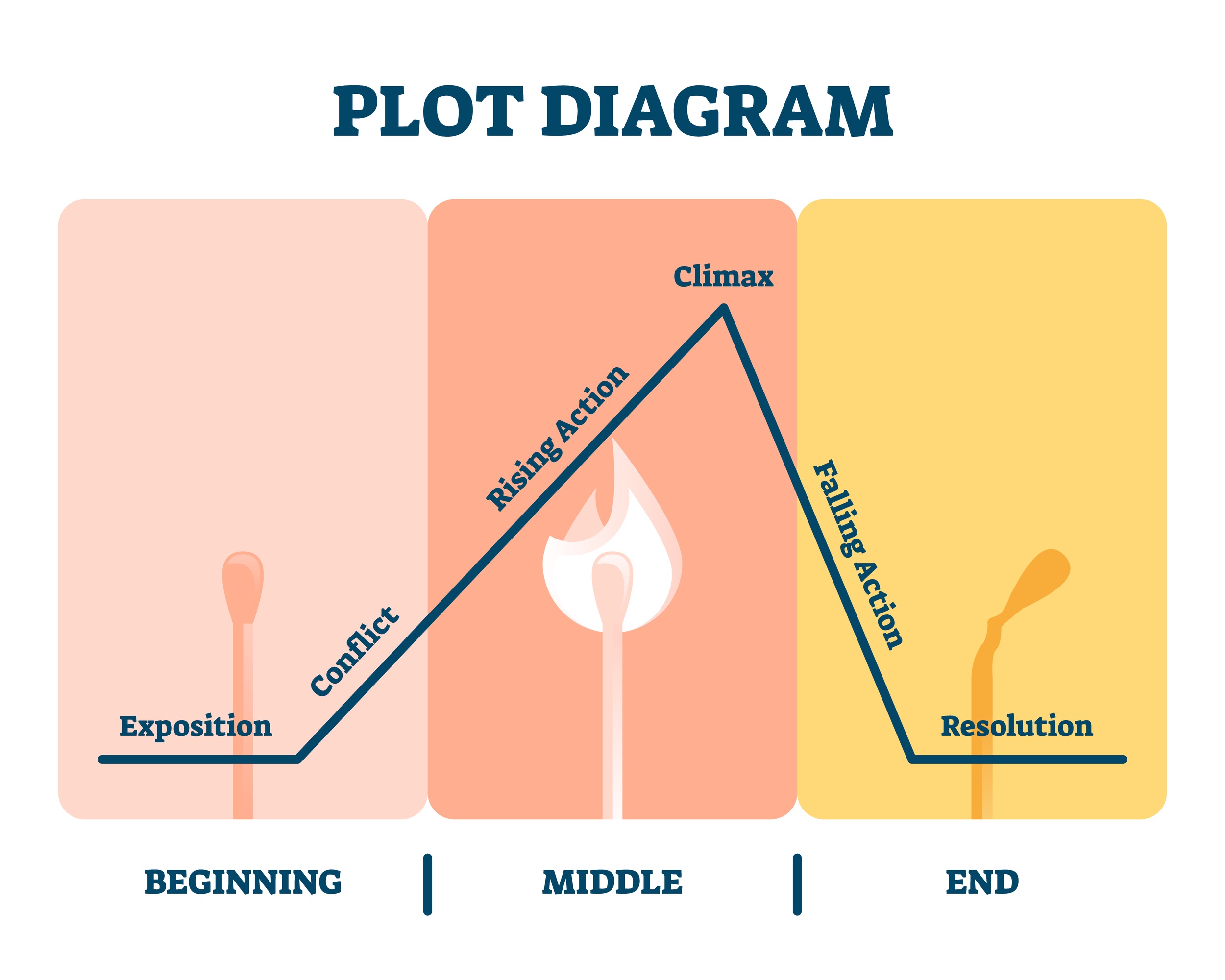
Story Structure Explanation.
In writing and reading simple stories for Standard 5, we use this three-part structure:
- Beginning: Introduces the characters and the setting.
- Middle: Shows the problem or the main event (like this one about the Hyena's greed).
- End: Shows the solution or the lesson of the story.
Plot Diagram.
Activity 9
Activity.
- Write the story of the Greedy Hyena. Follow the steps provided.
- The Story of a Greedy Hyena:
Beginning: The Hyena sees food.
Middle: He wants to eat it all by himself.
End: He loses everything.
- The Boy Who Cried Wolf
Activity 10
Draw the Ending.
Read a story but stop before the last page. Draw what you think will happen at the end
Exercise 9
Exercises and Answers.
- Who are the people or animals in a story called? Ans: Characters.
- What is the "Setting" of a story? Ans: It is where and when the story takes place.
- Why did the character in the story feel sad? Ans: (Based on the story read, e.g., because he lost his toy).
- Favorite character. Ans: reason
- Write new ending
Exercise 10
General Questionsand Answers.
Q: How improve reading? A: Practice daily.
Q: What should I do if I don't understand a sentence? A: Read it again slowly or ask the teacher for help.
Conclusion:
Practice builds confidence.
Reading simple stories builds your brain. The more you read, the better you become! Remember: Read, Respect, Borrow, and Return!
Summarize the stories.
Summarizing means telling the most important parts of a story in a short way. It is like giving someone a "preview" of the book without reading the whole thing to them.
Expected Competency:
You should be able to identify the main idea and rewrite a story using only a few sentences. Summaries tell main ideas.
Concept:
A good summary answers: Who was there? What happened? and How did it end?
What You Will Learn:
You will learn how to pick out the "Main Events" and leave out the small details that are not very important.
Explanation:
To summarize perfectly, we use the "Five Finger Strategy" (but a different one from picking a book!). Think of these five words: Somebody, Wanted, But, So, Then.
The Five Steps:
- Somebody: Who is the main character?
- Wanted: What did the character want to do or achieve?
- But: What was the problem or the obstacle?
- So : How did the character try to solve the problem?
- Then: How did the story end?
Example 5
How to Summary.
- The Greedy Hyena: A hungry hyena wanted to steal another hyena's meat but it was just a shadow, so he lost his own meat, then he ended up with nothing.
- The Tortoise and the Hare: A fast hare wanted to win a race but he fell asleep, so the slow tortoise kept crawling, then the tortoise won the race.
- Lion and the Mouse: A lion wanted to eat a mouse but the mouse begged for mercy, so the lion let him go, then the mouse saved the lion from a net later.
- The Boy Who Cried Wolf: A boy wanted to trick villagers but he lied too many times, so when a real wolf came nobody helped, then his sheep were eaten.
- Cinderella: Cinderella wanted to go to the ball but her stepmother stopped her, so her fairy godmother helped her, then she married the prince.
- Little Red Riding Hood: She wanted to visit her grandma but a wolf tried to trick her, so a woodsman helped her, then she and grandma were safe.
Activity 11
The "Three-Sentence Challenge"
Choose a story you know. You must tell the whole story to your partner using only 3 sentences: One for the beginning, one for the middle, and one for the end.
Activity 12
Summary Sketch.
Fold a piece of paper into 3 parts. In the first part, draw the "Somebody." In the middle, draw the "Problem." In the last, draw the "Ending." Use these drawings to tell the summary.
Exercise 11
Exercises and Answers.
- What does it mean to summarize? Ans: Telling a story in a short way.
- Why do we skip small details in a summary? Ans: To keep the summary short and focus on main ideas.
- Summary a story where a girl loses her shoe at a party. Ans: Cinderella.
- Write a two sentence summary of the story "The Greedy Hyena." Ans: A greedy hyena left his meat to steal another's. He found only a shadow and lost his meat to a hawk.
Exercise 12
General Questions and Answers.
Q: What should summary include? A: Main ideas only.
Q: Can a summary be longer than the story? A: No, a summary must always be much shorter.
Conclusion:
Summaries help remember stories. Summarizing helps you remember what you read. It is a great skill for every student! Remember: Read, Respect, Borrow, and Return!
Listening to this topic