Chemistry
Oxygen
Reading settings
Text size
Line spacing
Colours
Chemistry is all around us. Did you know that everything is made out of chemicals? Any reaction taking place in body cells of all living and non living organisms correlates with chemistry. In chemistry we study materials that make up the earth and universe. Chemistry is sometimes called the central science because it bridges other natural sciences, including physics, geology and biology. Therefore, when talking about chemistry, we are referring to life on Earth.
Oxygen
Introduction
Oxygen exists in the air to an extent of 21% by volume (or 23% by weight). It is the most abundant element on earth, accounting for half the total mass of the Earth’s crust. Oxygen is mainly found in combined states as oxides, hydroxides, silicates, sulphates, carbonates, and water. Its ease of combination with other elements to form compounds shows that oxygen is a very reactive element. In this chapter, you will learn about the preparation, properties, and uses of oxygen. By the end of this chapter, you should be able to prepare a sample of oxygen gas in the laboratory, perform simple experiments to determine properties of oxygen gas, explain the properties of oxygen, list uses of oxygen in daily life, and relate some uses of oxygen to its properties
Preparation and Properties of Oxygen
Oxygen can be prepared in the laboratory from either hydrogen peroxide solution or potassium chlorate salt.
A Sample of Oxygen Gas in the Laboratory
Prepare a sample of oxygen gas in the laboratory
(i) Laboratory preparation of oxygen from hydrogen peroxide solution
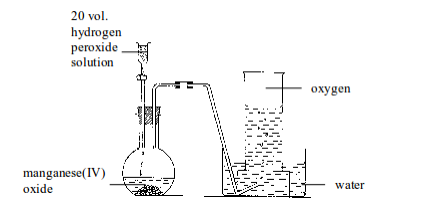
The most common method for the preparation of oxygen in the laboratory is by decomposition of hydrogen peroxide solution. The gas is prepared by catalysing the decomposition of hydrogen peroxide with manganese (IV) oxide. At room temperature hydrogen peroxide decomposes (breaks down) very slowly. It decomposes to water and oxygen.

To speed up the decomposition process, and hence collect substantial amount of oxygen gas within a short time, black manganese (IV) oxide is added as a catalyst.

A catalyst is a substance that, although present in small quantities, will alter the rate of a chemical reaction but will remain chemically unchanged at the end of the reaction.
Experiment 1.1
Aim: To prepare a sample of oxygen from hydrogen peroxide solution
Materials: thistle funnel, rubber bung, gas jar, trough, beehive shelf, delivery tube, flatbottomed flask, manganese(IV) oxide, and hydrogen peroxide solution
Procedure
- Put 5 g of manganese(IV) oxide into the flask.
- Arrange the apparatus as shown in Figure 1.1.
- Add 50 cm3 of hydrogen peroxide drop by drop to manganese(IV) oxide, which catalyses the decomposition of the peroxide
- Collect the gas over water, only after the gas jar is full
Results
Oxygen is collected over water as shown in Figure 1.1. The gas is collected by downward displacement of water because it is only slightly soluble in water.
(ii) Laboratory preparation of oxygen from potassium chlorate
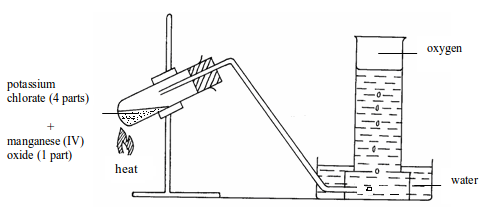
Oxygen can also be prepared by thermal decomposition of potassium chlorate. When this compound is heated, it decomposes slowly into potassium chloride and oxygen:

The rate of the reaction can be increased by adding a little manganese(IV) oxide as a catalyst. If potassium chlorate is heated alone, it gives off oxygen, but only at a fairly high temperature of about 400 ºC. But, if mixed with manganese(IV) oxide, it gives off oxygen at a much lower temperature and much more readily
Preparation method
A grinded mixture of potassium chlorate and manganese (IV) oxide, at a ratio of 4:1, is placed in hard glass tube and fitted up as shown in figure bellow. The mixture is then heated and oxygen gas is readily given off. The gas is collected over water. Oxygen has almost the same density as air, so it cannot be collected by the upward displacement of air. It is possible to collect it by downward displacement of water as shown in the figure because it is only slightly soluble in water.
Experiment 1.2
Aim: To demonstrate the properties of oxygen.
Materials: glowing splint of wood, a jar of oxygen gas, red and blue litmus papers, distilled water, some metals (magnesium, silver and iron), non metals (sulphur and phosphorus), deflagrating spoon and Bunsen burner
Procedure
- Prepare and collect oxygen gas in a gas jar.
- Place a glowing splint of wood in a jar of oxygen gas.
- Take a small sample of each of the named metals and non metals, one after another, and place each on a deflagrating spoon
- Heat each element strongly with a Bunsen burner flame until it is to red hot or bursts into flames.
- Place the hot or burning element in a gas jar of oxygen and hold it there until the colour changes or the burning stops.
- Dip the red and blue litmus papers in distilled water and place each wet paper in a jar of oxygen.
- Record your observations for each of the tests above.
- What happens when a glowing splint of wood is placed in a jar of oxygen?
- What happens when metals and non metals are heated in oxygen? What products are formed?
- Did the colour of the litmus papers change when the wet litmus papers were lowered in a jar of oxygen?
Simple Experiments to Demonstrate Properties of Oxygen Gas
Perform simple experiments to demonstrate properties of oxygen gas
1. Action of oxygen on metals
The manner in which oxygen reacts with metals is summarized in the list below.

- Sodium, When burnt in excess oxygen, sodium burns with an intense golden yellow flame to give sodium peroxide. The product is a yellow solid of sodium peroxide which dissolves in water to give an alkaline solution.
- Calcium, The metal burns in air with a red flame giving a white solid of calcium oxide.
- Magnesium, Magnesium burns with a brilliant white flame, leaving white ash of magnesium oxide.
- Iron, Iron burns in air with a shower of sparks leaving a brown-black solid of iron(III) oxide.
- Copper, Copper burns in a stream of oxygen to give a black solid of copper(II) oxide. In general, metals react with oxygen to form basic oxides
Action of oxygen on non-metals
Carbon
Red-hot carbon combines vigorously with oxygen to form carbon dioxide, giving no residue:
Sulphur
Sulphur burns with a blue flame giving misty white fumes of sulphur dioxide:
Phosphorus
Phosphorus bursts into flame in air or oxygen, without being heated (that is why it is stored under water). A white solid, phosphorus pentoxide is formed.
Properties of Oxygen
Explain properties of oxygen
Physical properties
- It is a clear, colourless gas with no smell.
- It is a neutral gas (it is neither basic nor acidic in character)
- It is slightly soluble in water (100 cm3 of water at room temperature dissolves about 4 cm3 of oxygen).
- It has almost the same density as water although slightly denser than air. 5. It boils at -183ºC and freezes at -218ºC.
Chemical properties
- Oxygen supports combustion
- It is a very strong oxidizing agent.
- Oxygen is very reactive. It reacts vigorously with a great many metals and non-metals to form basic and acidic oxides respectively. Metal + Oxygen gives metallic oxide (most of these are basic in character). Non-metals + Oxygen gives non–metallic oxide (most of these are acidic in character).
Uses of Oxygen
Uses of Oxygen in Daily Life
List uses of oxygen in daily life
includes
- The oxygen in the air and that dissolved in water and soil is used by all respiring organisms. Also all types of burning need oxygen.
- It is used in the oxyacetylene (oxygen–ethyne) flame for welding and cutting steel.
- It is extensively used for removing impurities from pig iron in order to produce steel. Oxygen is blown into molten iron to remove impurities such as carbon or phosphorus, which are expelled in the form of gases, i.e. their oxides.
- Oxygen is used as an aid to breathing in hospitals, high altitude climbing or flying, and in deep sea diving.
- Liquid oxygen is used in the burning of fuels such as kerosene, hydrogen and hydrazine used in various types of rockets.
- It is used in the L-D process for making steel.
Relationship between Some Uses of Oxygen to its Properties
Relate some uses of oxygen to its properties
Some of the uses of oxygen closely relate to its properties. These relationships are explained below
- Solubility , Oxygen gas is fairly soluble in water, which makes aerobic life in rivers, lakes and oceans possible. This property also makes it a breathing aid in hospitals, higher altitude flying, and deep sea diving since it easily diffuses easily through the wet alveoli of the lungs into the blood
- Oxidizing properties, Oxygen combines with other elements to form compounds. This indicates that oxygen is a powerful oxidizing agent. That is why it is used for removing impurities from pig iron. It combines with impurities to form oxides which are then expelled from the final product as gases
- Supporter of combustion , The fact that oxygen supports combustion is used in all types of burning such as burning of fuels in automobile engines and at homes and industries
Chapter summary
- Oxygen is a component of air. It exists in the air to an extent of 21% by volume (or 23% by weight)
- Oxygen can be prepared in the laboratory from either hydrogen peroxide solution or potassium chlorate salt. Manganese(IV) oxide is used as a catalyst to speed up the reaction.
- A catalyst is a substance that alters the rate of a chemical reaction but remains chemically unchanged at the end of the reaction
- Oxygen is a very reactive gas. It reacts with some metals and non metals to produce metallic and non metallic oxides, respectively
- Oxygen is a colourless gas with no smell. It is neutral to litmus paper and only slightly soluble in water.
- Some of the uses of oxygen include supporting life, welding and cutting steel, removing impurities from pig iron, aiding breathing in hospitals, and burning of fuels.
Review questions
Question Time 1
2. _______catalyses the decomposition of hydrogen peroxide into oxygen and water
- Hydrogen
- Manganese(IV) oxide
- Potassium permanganate
- Lead(IV) oxide
2. Oxygen exists in air to the extent of ________.
- 21% by weight
- 23% by volume
- 50% by weight
- 23 by weight
3. Oxygen can be prepared by heating a mixture of potassium chlorate and manganese(IV) oxide. In what ratio should the two substances be mixed?
- 1% manganese(IV) oxide and 4% potassium chlorate
- 4 parts manganese(IV) oxide and 1 part potassium chlorate
- 25% manganese(IV) oxide and 75% potassium chlorate
- ¾ manganese(IV) oxide and ¼ potassium chlorate
4. The method of collecting oxygen gas in a class experiment is known as_______.
- downward displacement of water
- downward displacement of air
- upward displacement of water
- upward displacement of air
5. Which of the following is not a physical property of oxygen?
- It reacts with metals to form basic oxides.
- It is a clear, colourless gas with no smell.
- It is neutral to litmus paper.
- It boils at -183 °C.
B. State whether the following statements are True or False:
- Manganese(IV) oxide releases gas during the preparation of oxygen.
- Oxygen occupies ½ the total mass of the air.
- Oxygen supports combustion.
- Oxygen reacts with non metals to form basic oxides.
- Oxygen is used for removing impurities from pig iron.
7. With the aid of well-labelled diagrams, describe laboratory preparation of oxygen from each of the following compounds:
- Hydrogen peroxide
- Potassium chlorate
8. Give the chemical properties and physical properties of oxygen.
9. Explain any four (4) uses of oxygen.
10. Name a catalyst used in the preparation of oxygen and explain the reason why the catalyst is used
11. In both methods of preparation of oxygen, manganese(IV) oxide is used as a catalyst. What is a catalyst?
12. Describe the test for oxygen
13. Which other gas has properties similar to oxygen?
REFERENCES
- Harwood, R. (2003). Chemistry (2nd ed.). Cambridge University Press. London.
- Holderness, A., Lambert, J., & Thompson, J.J. (1987). A New Certificate Chemistry (6th ed.). Clays Limited, St Ives Plc. London.
- Tanzania Institute of Education (1995). Secondary School Chemistry, Book One. NPC (KIUTA). Dar es Salaam.
- SCSU, MoEVT-Zanzibar. (2008). Chemistry for Zanzibar Secondary Schools, Forms 1 & 2. Oxford University Press. Dar es Salaam.
Listening to this topic