Chemistry
Hydrogen
Reading settings
Text size
Line spacing
Colours
Chemistry is all around us. Did you know that everything is made out of chemicals? Any reaction taking place in body cells of all living and non living organisms correlates with chemistry. In chemistry we study materials that make up the earth and universe. Chemistry is sometimes called the central science because it bridges other natural sciences, including physics, geology and biology. Therefore, when talking about chemistry, we are referring to life on Earth.
Hydrogen
Introduction
Hydrogen is the lightest of all the elements. There is very little hydrogen in the Earth's atmosphere. Hydrogen is so light that its molecules are not held by the earth's gravity and they diffuse into space. Overall, it is the most common element in the universe. It is probable that it forms about 90% of the total mass of the universe. It is believed that the sun is composed of mostly hydrogen and helium. Hydrogen occurs naturally in compound form with other elements in liquids, solids, or gases and in almost all organic substances (For example proteins, carbohydrates, and fats). In this chapter, you will learn about preparation and properties of hydrogen, and uses of hydrogen. By the end of the chapter, you should be able to explain the preparation of hydrogen gas in a laboratory, explain the properties of hydrogen, state uses of hydrogen gas in daily life, and relate some uses of hydrogen to its properties
Preparation and Properties of Hydrogen
Hydrogen
The Preparation of Hydrogen Gas in a Laboratory
Explain the preparation of hydrogen gas in a laboratory
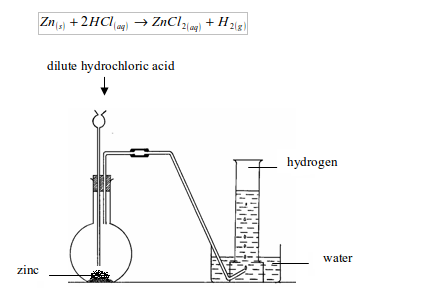
Hydrogen is most commonly prepared in the laboratory by the action of dilute mineral acids on certain metals. The most convenient way to prepare hydrogen in the laboratory is by addition of dilute hydrochloric acid on zinc granules. Zinc and hydrochloric acid are chosen because they produce the gas at a steady rate.
The gas may be collected by downward displacement of water. But when the gas is required free from moisture, it is passed through water to remove, first, any hydrogen chloride gas and then through concentrated sulphuric acid to remove moisture before being collected by upward delivery. The gas is prepared by downward displacement of water because it is lighter than air and is almost insoluble in water. Also, because the gas is lighter than air, when a test tube containing air is inverted over another test tube containing hydrogen, the hydrogen gas rises up into an inverted test tube. A mixture of hydrogen and air explodes with a 'pop' sound when a flame is applied. This is a test for hydrogen gas
Experiment 2.1
Aim: To prepare hydrogen gas
Materials: flat bottomed flask, dilute hydrochloric acid, zinc granules, delivery tube, gas jar, beehive shelf, trough, thistle funnel, two-holed rubber bung, and water
Procedure
- Put some granules of zinc into a flask.
- Set up the apparatus as shown in Figure 2.1.
- Add dilute hydrochloric acid by means of a thistle funnel.
- Collect the gas over water. Remove the gas jar only when it is full of hydrogen gas.
There is effervescence and the gas, which is collected over water, is given off. The reaction equation is as follows:
Experiment 2.2
Aim: To test for some properties of hydrogen gas.
Materials: flat bottomed flask, dilute hydrochloric acid, zinc granules, delivery tube, gas jar, beehive shelf, trough, thistle funnel, two-holed rubber bung, water in a beaker, matchbox and sticks, red and blue litmus papers, a boiling tube containing oxygen gas, and 4 empty test tubes and stoppers
Procedure
- Arrange the apparatus as shown in Figure 2.1 and collect hydrogen gas over water.
- Collect some of the gas in 4 test tubes and stopper properly.
- Light a match stick and pass it over the mouth of one of the test tubes. Observe and record your observation
- Take another test tube and breath some of the gas to your nose. Record your observation.
- Invert a test tube containing air over a test tube containing hydrogen for one minute. Then immediately open the test tubes, light up a match stick and pass it close to the mouths of each of the two test tubes. Observe and record all your observations
- Dip the blue and red litmus papers in water until they are wet enough. Then lower the papers into a gas jar containing hydrogen gas. Observe and record all your observations.
- What was observed when a burning splint was passed over the mouth of one of the test tubes containing hydrogen gas
- Did the wet litmus papers change in colour when dipped in a gas jar containing hydrogen gas? Explain
Questions for discussion
- What was observed when a burning splint was passed over the mouth of one of the test tubes containing hydrogen gas
- Did the wet litmus papers change in colour when dipped in a gas jar containing hydrogen gas? Explain
Test for hydrogen
A mixture of hydrogen and air explodes with a 'pop' sound when a flame is applied.
The Properties of Hydrogen
Explain the properties of hydrogen
Physical properties
Includes
- It is a colourless, tasteless and odourless gas.
- It is almost insoluble in water (2 volumes of hydrogen gas dissolve in 100 volumes of water at 8ºC).
- It is the lightest of all gases. It is about 20 times lighter than air (one litre of hydrogen at 0ºC and 760 mmHg pressure weighs 0.0899 grams)
- It condenses at -254ºC to a colourless liquid (and liquid hydrogen freezes at -259 ºC to form colourless crystals).
- It is neutral to litmus.
- It does not support combustion.
Chemical properties
1. It combines easily with other chemical substances at high temperatures. For example, it combines with oxygen to form water. A mixture of the two gases will not react at room temperature. At higher temperatures, or when a flame is applied, the mixture will explode. When hydrogen and oxygen explode, the product is steam, which condenses to form water upon cooling

Water is just the common name for the substance "hydrogen oxide".
2. Hydrogen acts as a reducing agent, by removing oxygen from some compounds. For example, copper (II) oxide is reduced to copper by heating it in a stream of hydrogen. The hydrogen is oxidized to water.

3. It is neither acidic nor basic, so it a neutral gas.
4. A mixture of hydrogen and oxygen explodes when lit.
An experiment on reduction of copper (II) oxide (CuO) using hydrogen
Aim: To investigate the effect of hydrogen on copper (II) oxide
Materials: copper(II) oxide, test tube, thistle funnel, dilute hydrochloric acid, zinc granules, bent glass tubes, U-tube, calcium chloride, and cobalt(II) chloride paper
Procedure
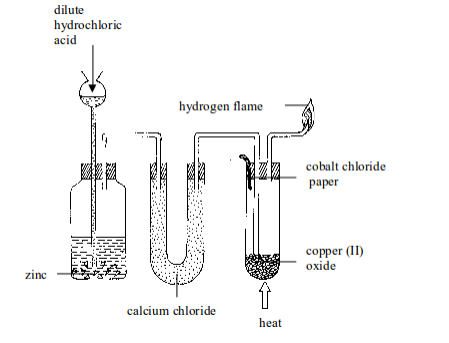
- Put about 5 g of copper (II) oxide in a Pyrex test tube and set up the apparatus as shown in figure bellow. Observe and note the colour of copper (II) oxide before the start of the experiment. What colour is it?
- By means of a thistle funnel, add hydrochloric acid in a bottle containing zinc metal to generate hydrogen gas. Pass the gas through a U-tube containing a solid drying agent, calcium chloride.
- Place a dry cobalt (II) chloride paper near the mouth of a test tube as shown in figure bellow.
- Allow the hydrogen gas to pass through the apparatus for some time in order to displace all the air before lighting it.
- Heat the copper (II) oxide strongly until no further changes in colour of the cobalt (II) chloride paper takes place. You may repeat the experiment using lead (II) oxide and compare the results.
Questions
- What happens to the copper (II) oxide during the experiment?
- (a) What happens to cobalt (II) chloride paper? (b)Why is it used? (c) What other substance can serve the same purpose as cobalt (II) chloride paper?
- Enough time should be allowed for all the air in the test tube to be replaced by hydrogen before lighting the gas. What is bad about lighting a mixture of air and hydrogen?
- What do you think can cause the size of the hydrogen flame to deteriorate?
- (a) What element did hydrogen take from the copper (II) oxide? (b) Can hydrogen take the same element from any metal oxide?
Answers
1. Black copper (II) oxide is reduced by hydrogen to brown copper metal.
2. (a) Cobalt (II) chloride paper changes its colour from blue to pink.
(b) The paper is used to indicate that water has been formed in the reaction between copper (II) oxide and hydrogen. This water turns the colour of the paper from blue to pink.
(c) The other substance that can be used instead of cobalt (II) chloride paper is white anhydrous copper (II) sulphate, which turns blue when in contact with water.
3. Enough time should be allowed for hydrogen to replace the air in the test-tube because a mixture of hydrogen and oxygen in the tube is explosive when lit.
4. The size of the hydrogen flame deteriorates with time as hydrogen supply grows smaller following complete displacement of hydrogen of the hydrochloric acid with zinc. Deterioration can also be caused by use of excess copper (II) oxide or strong heating, meaning that most hydrogen is used in the reduction of the oxide.
5. (a) The element taken by hydrogen from copper (II) oxide is oxygen. In this experiment, hydrogen reduces copper (II) oxide to copper, while hydrogen itself is oxidized to water:

(b) No. Hydrogen can only reduce those metals that are below it in the electrochemical (activity) series.
Uses of Hydrogen
Uses of Hydrogen Gas
State uses of hydrogen gas
1. It is used in the manufacture of ammonia by the Haber process, which is based on the direct combination of hydrogen and nitrogen.

2. It is used in the hardening of vegetable oils to make margarine.
3. It was formerly used for inflating balloons and air ships. But hydrogen is inflammable and many accidents occurred. Its use has been replaced by helium (another gas occurring in air). Nowadays, hydrogen is used by meteorologists to fill weather balloons, which carry weather instruments that record information on various elements of weather in the upper atmosphere.
4. It is used to prepare water gas, which is used as a fuel for space rockets. When hydrogen contained in water gas is burned in air, it produces extremely high heat energy that is used to power rocket engines.
5. It is used in welding by the atomic hydrogen torch. The complete combustion between hydrogen and oxygen is a highly exothermic reaction and can produce an oxy-hydrogen flame that has a temperature of nearly 2000ºC, and is therefore useful in the welding and cutting of metals. However, the explosive nature of the combustion of hydrogen with oxygen makes the use of oxy-hydrogen flame less favourable than the oxyacetylene flame.
6. It is used in the synthesis of hydrochloric acid. In this case, hydrogen combines directly with chlorine to form hydrogen chloride gas.

The hydrogen chloride gas is then dissolved in water to form hydrochloric acid.
7. It is used in the manufacture of methanol (wood spirit). In this process hydrogen combines directly with carbon monoxide.

Relationship of some uses of hydrogen to its properties
Some uses of hydrogen are related to its properties. The following are some of these properties:
- Density , Owing to its lowest density and being lighter than all gases, hydrogen is used to fill weather balloons. These balloons carry weather instruments to the upper atmosphere to record various elements of weather
- Direct combination , Hydrogen combines directly with other substances. For example, it combines directly with nitrogen to form ammonia, which is used in the manufacture of fertilizers. It also combines with chlorine to make hydrogen chloride gas which is used in the industrial manufacture of hydrochloric acid.
- Reduction , Hydrogen reduces (hydrogenates) animal fats and oils to make margarine.
- Highly exothermic, Combustion of hydrogen in oxygen produces a very hot oxy-hydrogen flame which is used for welding. It is for the same reason that hydrogen is used to produce water gas, which is used as a fuel for space rockets
Chapter summary
- Hydrogen is the lightest of all the elements. It forms about 90% of the total mass of the universe and occurs naturally as hydrogen gas. It also occurs in combined states in many compounds
- Hydrogen is prepared in the laboratory by the action of dilute hydrochloric acid on zinc metal. The gas is prepared by downward displacement of water because it is lighter than air and is almost insoluble in water.
- Hydrogen is colourless, tasteless, odourless and sparingly soluble in water. It is the lightest of all gases, neutral to litmus paper and does not support combustion.
- The uses of hydrogen include the manufacture of ammonia, hardening of oils to make margarine, filling weather balloons, preparation of water gas, welding, synthesis of hydrochloric acid, and manufacture of methanol.
Review questions
Question Time 1
A. 1. Which of the following statements is true about hydrogen?
- It is the lightest of all the elements.
- It supports combustion.
- It can be prepared from metals.
- It is an acidic gas.
2. Which of the following substances does not contain hydrogen?
- Water
- Natural gas
- Hydrochloric acid
- Nitrogen oxide
3. Which gas combines with oxygen to form water?
- Nitrogen
- Hydrogen
- Oxygen
- Carbon dioxide
4. Why is hydrogen called ‘reducing agent’?
- It readily combines with other elements.
- It removes oxygen from other compounds.
- It adds oxygen to other substances.
- It combines with oxygen to form water.
5. Which of the following when mixed with hydrogen forms an explosive mixture?
- Air
- Nitrogen
- Carbon dioxide
- Water
6. Hydrogen is prepared in the laboratory by the action of dilute mineral acids on certain metals. However, zinc and hydrochloric acid are the most preferred reactants because______.
- they are cheaply and locally available
- they react vigorously
- they produce the purest gas
- they produce the gas at a steady rate
B. Write True for a correct statement and False for a wrong statement
- Hydrogen is a colourless, tasteless and odourless gas.
- Hydrogen is used in the hardening of vegetable oils to make margarine.
- When used in the synthesis of hydrochloric acid, hydrogen combines directly with chlorine to form hydrochloric acid.
- The Haber process is used in the industrial manufacture of hydrogen.
- Hydrogen reacts with water to give oxygen.
- In the reduction of copper(II) oxide with hydrogen, copper removes oxygen from the oxide.
- Hydrogen is an oxidizing agent.
- Black copper(II) oxide is reduced by hydrogen to brown copper metal.
- Hydrogen can only displace those metals below it in the electrochemical series.
- A mixture of oxygen and hydrogen can react at room temperature
C. 1. Hydrogen can be prepared in the laboratory by the action of any dilute mineral acid on metals. However, zinc and hydrochloric acid are commonly used to prepare the gas. Explain the reason for choosing the named acid and metal
2. Explain the preparation of hydrogen gas from zinc and dilute hydrochloric acid. Use well labelled diagrams to support your answer
3. State the reasons for passing hydrogen gas through the following substances during its preparation:
- Water
- Concentrated sulphuric acid
4. Explain any four uses of hydrogen gas.
5. Name the two reagents normally used in the laboratory preparation of hydrogen from a named metal and acid
6. State the forms in which hydrogen occurs naturally.
7. Hydrogen makes nearly 90% of the total mass of the universe but the gas is very little in the atmosphere. Give reasons
8. There are two unlabelled containers containing two different gases. One of the containers is said to contain hydrogen gas. Explain how you would go about determining which container contains hydrogen
9. State the
- physical properties
- chemical properties of hydrogen
10. Explain any four uses of hydrogen gas
REFERENCES
- Childs, A. (2000). Macmillan Secondary Chemistry (International edition). Macmillan Publishers Limited. Malaysia.
- Gallagher, R. and Ingram, P. (2000). Complete Chemistry. Oxford University Press. London.
- Harwood, R. (2003). Chemistry (2nd ed.). Cambridge University Press. London.
- Holderness, A., Lambert, J. & Thompson, J.J. (1987). A New Certificate Chemistry (6th ed.). Clays Limited, St Ives Plc. London.
- Tanzania Institute of Education (1995). Secondary School Chemistry, Book One. NPC (KIUTA). Dar es Salaam.
- SCSU, MoEVT-Zanzibar. (2008). Chemistry for Zanzibar Secondary Schools, Forms 1 & 2. Oxford University Press. Dar es Salaam.
Listening to this topic