Chemistry
Water
Reading settings
Text size
Line spacing
Colours
Chemistry is all around us. Did you know that everything is made out of chemicals? Any reaction taking place in body cells of all living and non living organisms correlates with chemistry. In chemistry we study materials that make up the earth and universe. Chemistry is sometimes called the central science because it bridges other natural sciences, including physics, geology and biology. Therefore, when talking about chemistry, we are referring to life on Earth.
Water
Introduction
Water is an essential constituent of animal and plant lives. Without water, no life could exist on earth. Animals need to drink sufficient amount of water to replace the water lost from their bodies via sweat, urine, breath, and faeces. Plants also need sufficient amount water from the soil to replace the water lost through the process of transpiration. In this chapter, you will learn about the occurrence and nature of water, properties of water, treatment and purification of water, and uses of water. By the end of the chapter, you are expected to be able to describe the occurrence and nature of water, describe the water cycle, relate water cycle to environmental conservation, perform simple experiments on the physical and chemical properties of water, explain the properties of water, perform domestic water treatment and purification, describe the processes of urban water treatment, explain the water treatment and purification, state uses of water, and compare the solubility of different substances in water and organic solvents
Occurrence and Nature of Water
Water
Water
The Occurrence and Nature of Water
Describe the occurrence and nature of water
Water is the most abundant liquid in nature. It is a compound of hydrogen and oxygen. It occurs in seas, oceans, rivers, springs, and wells. It also occurs in the atmosphere as rain, water vapour, and clouds
Types of water
There are four kinds of natural water namely, rain water, spring and well water, river water, and lake and sea water. Natural water is never pure. Water from difference natural sources contains substances dissolved in it.
Rain water
This is naturally distilled water. It is almost pure and it contains gases and dust dissolved from the air. If the dissolved gases are acidic, for example, sulphur dioxide, carbon dioxide or nitrogen dioxide, they may form "acid rain". In heavily industrialized countries where the emissions of these gases are very great, acid rain has been experienced. Rain water in nonindustrial areas is fairly pure. Any taste in water is due to substances dissolved in it
Spring and well water
When the rain falls, some water sinks into the ground to form ground water. This water percolates down the earth until it meets layers of impervious or impermeable (non-porous) rocks, which stop it from percolating or seeping any further. The ground water may reach the earth's surface as a spring. When a whole deep enough is dug to reach the ground water, a well results. Spring or well water is supposed to be clean, although it contains dissolved substances. As water passes through the earth, it is naturally filtered.
River water
River water contains dissolved and suspended solid materials. The water in some rivers is very muddy or sandy depending on the nature of the land from which the river originates and on which it flows. Most of the water we drink or use at home and industries is from rivers. To make the river water fit for use, all the substances dissolved and suspended in it must be removed or filtered.
Lake and sea water
Lakes and seas receive water from rivers. River water contains dissolved salts. As it flows through the land, some of its water evaporates into the air. When it reaches the sea or lake, more water still evaporates. As a result, sea and lake water will necessarily contain vast quantities of dissolved substances. Sea water contains about 3.6% by mass of the dissolved solids. Most of the dissolved solids compose largely of sodium chloride that can be obtained from sea water in large quantities. Three quarters of the ocean salts is sodium chloride (common salt).
The Water Cycle
Describe the water cycle
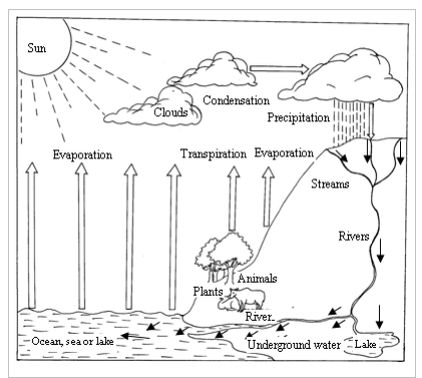
Water is always on move, travelling a never-ending, cyclical journey between the earth and the sky. This journey is referred to as the water cycle or hydrological cycle. The water cycle describes the continuous movement of water on, above and below the surface of the earth. During its movement, water is continuously reused and recycled. It also changes its physical state or form (liquid, vapour, and ice) at various stages in the water cycle. Figure 3.1 is a diagrammatic representation of the water cycle. It shows how the water moves around the earth's environment, changing its form through the process of evaporation, transpiration (loss of water from plants), condensation and precipitation (rainfall, snow, hail, fog, smog, etc.) Stages of the water cycle are described below:
- Heat from the sun causes water to evaporate from exposed water bodies such as oceans, seas, lakes, rivers dams, etc. This causes huge amounts of water vapour to float (laden) in the air. The vapour rises up. In the cooler upper parts of the atmosphere, the vapour cools and condenses to form tiny water droplets. The droplets form clouds.
- The clouds are drifted by wind. They cool further, and the droplets join to form larger drops of water which fall down as rain due to gravitation pull. On the other hand, if the air is very cold, they fall as hail, sleet or snow. The whole process is called precipitation.
- Some rain water soaks, and reappears as springs. Some flows over the ground as streams. The springs and streams feed rivers. The rivers flow to the ocean, sea or lake. The whole cycle starts again.
Water Cycle and Environmental Conservation
Relate water cycle to environmental conservation
Everyone understands why it is so important to keep our water clean. The fresh water that is available for use by people, plants and animals must be clean and safe.
Water plays an important role in the conservation of the environment and in determining human settlements and development. It also governs plant and animal distributions. Animals and plants, as components of the environment, are mainly concentrated in water or in areas where water is found
Plant roots bind the soil particles together, making the soil compact and less susceptible to erosion. However, vegetation will only grow and flourish on land that receives sufficient rainfall. This is possible only if the water cycle is properly maintained by conserving natural forests and planting more trees to attract rainfall. So, it is obvious that there is a strong relationship between rainfall (as a crucial stage of the water cycle) and the vegetation and soil (as components of the environment)
We use water from the lakes, rivers, wells or springs to irrigate crop and non-crop plants. So, when we distort the water cycle in some way or the other, we may not have enough rainfall to fill up rivers or springs from which we obtain the water we use to conserve our environment (vegetation)
Properly watered soils support more plants. Plants absorb carbon dioxide from the atmosphere, therefore, helping to purify the air naturally. In addition, plants produce oxygen gas, which is needed by all living organisms. If there is not enough rainfall, most plants will die, hence resulting in excessive accumulation of carbon dioxide, which may rise to toxic levels
Strong relationships exist between environmental conservation and the water cycle. Environmental degradation can lead to serious and irreparable aftermath of the water cycle
Properties of Water
Simple Experiments on Physical and Chemical Properties of Water
Perfom simple experiments on physical and chemical properties of water
Activity 1
Perfom simple experiments on physical and chemical properties of water.
Properties of Water
Explain properties of water
Water has physical and chemical properties, just like other chemical substances. The physical properties of water include properties such as colour, smell, taste, and melting, boiling and freezing points.
Physical properties
Experiment 3.1
Aim: To determine the melting point of ice and boiling point of water.
Materials: thermometer, Bunsen burner, beaker, iron stand, glass rod, wire gauze, tripod stand, stopwatch, sewing thread, and ice cubes prepared from distilled water
Procedure
- Half-fill a beaker with crushed ice obtained from distilled water.
- Tie the thermometer to sewing thread and suspend it from the clump vertically as shown in Figure 3.2. Ensure the bulb of the thermometer is completely surrounded by ice but does not touch the beaker.
- Record the temperature after every 1 minute until the ice melts and the thermometer reading remains constant for 2 minutes. Note the readings in the observation table (Table 3.1).
- Heat the beaker contents while stirring them with a glass rod. Read and record the temperature in the observation table (Table 3.1) until the water boils.
- Continue heating for 5 more minutes and record the readings after every 1 minute.
| Time (min) | Temperature when water starts boiling (T1 °C) | Temperature when water continues to boil till constant (T2 °C) | Boiling point of water (T1 +T2 ) /2 °C |
| 1 | |||
| 2 | |||
| 3 | |||
| 4 |

Physical characteristcs of water include;
- Extremely pure water is colourless, odourless and tasteless. The colour, taste or odours in water are due to dissolved impurities of organic and inorganic nature.
- Pure water is a very poor conductor of heat and electricity. However, water containing some dissolved inorganic impurities may conduct appreciably.
- Pure water freezes at 0ºC.
- Pure water boils at 100ºC at a pressure of 760 mmHg; and pure water will boil away completely with no change in temperature. Its melting point and boiling point are abnormally high due to hydrogen bonding.
- It is the only substance that occurs naturally in all the three states of matter – solid, liquid and gas.
- Water, as compared to other liquids, dissolves almost all substances, though in varying degrees of solubility. For this reason, water is usually called the universal solvent.
- It has a high surface tension than other liquids.
- It has a high specific heat index, which means that it can absorb a lot of heat before getting hot.
- It is miscible with many liquids, for example ethanol.
- The maximum density of pure water is 1 g cm-3 at 4ºC. When water is cooled gradually, it reaches its maximum density at 4 centigrade. The actual change from water to ice takes place at 0ºC.
- Pure water is neutral to litmus and has a pH of 7.0.
- Water expands when it freezes. Most substances contract when they change from liquid to solid state. Water is one of the very few substances that expand when they freeze. This behaviour is called anomalous expansion of water. Ice is therefore much less dense than water. The water molecules in the ice crystals are further apart from each other than in liquid water.
3.2.2 Chemical tests for water
Experiment 3.2
Aim: To demonstrate the chemical tests for water.
Materials: anhydrous copper(II) sulphate powder, distilled water, beaker, cobalt chloride paper, and blue and red litmus papers, and watch glass
Procedures
- Pour some distilled water into a beaker.
- Dip the red and blue litmus papers into the water. Do the same for cobalt chloride paper.
- Put a little anhydrous copper(II) sulphate powder onto a watch glass and add a few drops of distilled water.
Question for discussions
What colour changes are observed in each of the tests performed?
Conclusion
Water is neutral to litmus paper. It will have no effect on red or blue litmus papers. Therefore, no colour changes in the litmus papers will be observed. The copper(II) sulphate powder will change its colour from a white powder to blue crystals
Water can be recognized by its action of turning white anhydrous copper(II) sulphate to blue. The test, however, confirms the presence of water and not the absence of everything else except water. For example, dilute sulphuric acid would turn anhydrous copper(II) sulphate from white to blue. That is why this test is called a physical test as opposed to a chemical test for water.
Cobalt chloride paper will change its colour from blue to pink. The presence of water can also be shown by the use of cobalt chloride paper. This is a filter paper impregnated with cobalt(II) chloride. The paper is blue in colour. The blue paper turns pink when in contact with water
The tests above only confirm the presence of water, but do not indicate the purity of the water. To find out if a liquid is pure water, its boiling point or its freezing point must be measured. Pure water boils at exactly 100 ºC and freezes at 0 ºC at a pressure of one atmosphere (760 mmHg)
Chemical properties
Action of heat
Water is extremely stable to heat. A stable compound does not decompose easily by heating. It requires a very high temperature to decompose water. Water decomposes lightly at 2500ºC. It approaches complete decomposition at 5000ºC
Reaction with metals
The state in which water reacts with metals depends on the position of a metal in the electrochemical series as shown below:
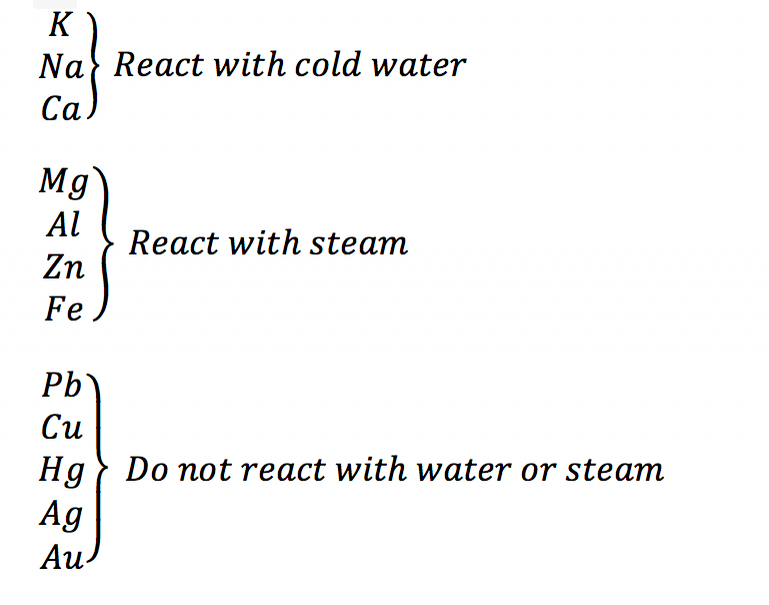
It can be seen that water attacks metals differently depending on the metal’s position in the activity series. This is called the chemical activity series of metals.
Potassium
Potassium is vigorously attacked with cold water, producing hydrogen gas. The reaction of water with potassium is very violent and the hydrogen produced catches fire spontaneously with a lilac flame. The colour is due to the burning of small quantities of potassium vapour.

Sodium
The reaction of sodium with water is vigorous but the hydrogen liberated does not catch fire. Sodium reacts with cold water to produce hydrogen gas, which is detected by effervescence as the gas is liberated. If a flame is applied, it burns with a yellow flame (the yellow colour is from sodium).

Calcium
Calcium reacts with water relatively slowly compared to sodium and potassium. The gas (hydrogen) given off explodes if mixed with air, and if a flame applied.

Magnesium
Magnesium reacts with steam to liberate hydrogen and magnesium oxide.

Zinc
If zinc is heated to redness in a current of steam, hydrogen is liberated.

Iron
Iron does not react with cold water, but readily reacts with excess steam at red heat.

The above reaction can be made to proceed in the reverse direction by passing excess of hydrogen over heated triiron tetraoxide.
Reaction with non-metals
Carbon
Red-hot carbon reacts with steam at 1000ºC to give a mixture of carbon monoxide and hydrogen, known as water gas.

Red-hot carbon reacts with steam at 1000ºC to give a mixture of carbon monoxide and hydrogen, known as water gas.
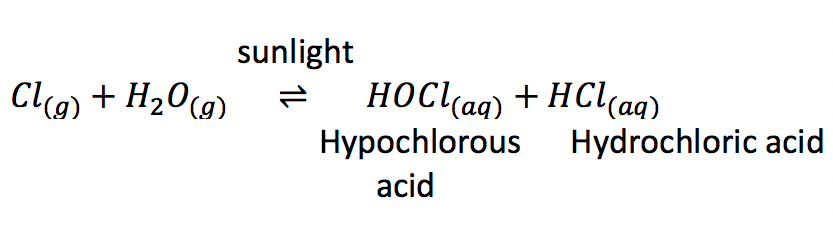
Chlorine reacts with water to form a mixture of two acids.
Reaction with oxides
1. Water reacts with the oxides of most reactive metals to form hydroxides:
2. Water reacts with the oxides of some non–metals to form acids. Examples of these oxides are carbon dioxide, sulphur dioxide, sulphur trioxide and phosphorus(V) oxide.
Formation of hydrates
Water combines with many salts to form hydrates. Different salt hydrates have different number of molecules of water of crystallization. The following are some examples:

Treatment and Purification of Water
Processes of Domestic Water Treatment and Purification
Perform processes of domestic water treatment and purification
Water for domestic use is chiefly obtained from rivers, springs and wells; and sometimes from lakes and seas. However, lake and sea waters may be to too salty for drinking or washing and hence not normally used for such purposes. But for some countries, the sea is a major source of drinking water. However, this water must be desalinized (have its salt removed) and purified before being used for drinking. The process is very expensive. It involves an expenditure of big sums of money. It is only practised in developed countries.
River and spring water must be boiled and filtered before drinking. At homes, water is normally boiled in big pans, cooled down, and then filtered by using a white, sterile and clean piece of cloth. The cloth is tied around the mouth of the container as shown in figure 3.3(a). As water is poured through the cloth, the particles in it are filtered off. The clean water is then poured in clay pots or plastic buckets and placed in a cool place, or put in a refrigerator to cool down ready for drinking.
Alternatively, boiled water can be filtered using a funnel as shown in figure (b) bellow, but you must ensure the gravel, sand and cotton wool used are thoroughly sterile. Sterilization can be achieved by soaking the gravel and sand in hot boiled water for quite some time.
The gravel traps any large floating substances. The coarse sand prevents small particles from passing through. The fine sand ensures even the small suspended particles do not pass through, while the cotton wool filters the very tiny particles.
At home, water can also be purified with chemical purifiers. These chemicals are in liquid or tablet form. To purify water, a recommended amount of the purifier is added to a specific amount of water in a container. The water is shaken or stirred well. Then it is left to settle for at least 20 minutes before it can be safe for drinking and other domestic uses. To get the clearest water, it is advisable to filter the water thoroughly before adding the purifier. The commonest and most widely used purifiers are the waterguard and aquaguard.
In developed countries, commercial filters may be used to purify water at home. These filters contain charcoal or ceramic element that purifies the water as it passes through the filter.
Experiment 3.3
Aim: To filter water using a piece of cloth.
Materials: a bucket of boiled water, a clean piece of cloth, a clean string of cloth or rope, an empty and clean bucket, and water jug
Procedures.
- Obtain a bucket full of boiled water. Observe the colour of water before filtering.
- Tie a clean piece of cloth around the mouth of an empty bucket as shown in Figure 3.3.
- Using a water jug, carefully draw water from the bucket filled with water.
- Pour the water into an empty bucket through the piece of cloth.
- Repeat the procedure until all water is filtered. Observe the colour of the water after filtering.

- Does the piece of cloth look the same before and after filtering water?
- What substance is seen on the cloth after filtering?
- Is there any change in the appearance of water before and after filtering?
Observation.
After filtering, the piece of cloth will be soiled with fine mud which is left on the top side of the cloth. Filtered water looks clear than unfiltered water. Almost all particles in water were filtered off. The water is now safe for drinking
Experiment 3.4
Aim: To prepare a simple water filter.
Materials: gravel, coarse sand, fine sand, cotton wool, funnel, unfiltered water, water jug and 2 buckets
Procedures,
- Arrange the materials in a funnel as shown in Figure 3.4.
- Use the assembled set up to filter water and record your observation.
Questions for discussion,
- Is the filtered water different from the original water?
- What role is played by gravel, coarse sand, fine sand and cotton wool in the filtering process?
Conclusion
The filtered water is clearer than the unfiltered water. The gravel traps big particles floating in the water, while course sand traps and filters moderately large particles. The fine sand filters the smallest particles suspended in water. The cotton wool ensures that any tiny particles left in the water are filtered off
The Processes of Urban Water Treatment
Describe the processes of urban water treatment
We obtain our water supply from surface water (for example, rivers, lakes and reservoirs) and ground water (for example, underground aquifers and lakes). Water from these sources is never completely pure, particularly if it is drawn from a river. The water may contain:
- bacteria – most are harmless, but some can cause diseases.
- dissolved substances – for example, calcium and magnesium compounds dissolved from rocks; and gases from the air.
- solid substances and debris – particles of mud, sand, grit, twigs, dead plants and perhaps tins and rags that people have dumped.
All these impurities are gathered by water as it passes through different parts of land as rivers or streams. Before water is safe to drink, the bacteria and solid substances must be removed.
Different towns and regions of the world apply different methods of water treatment. The more sophisticated and expensive methods are used by rich nations such as the UK and USA. Some steps in water treatment, however, are basic and used by all. They include the following:
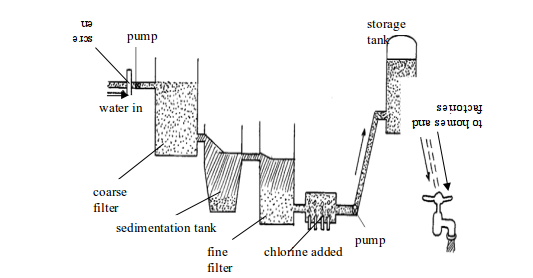
1. After water has been pumped through the screen to get rid of the larger bits of rubbish, it is pumped through a coarse filter which traps larger particles of solid. The filter could be beds of gravel and fine sand or anthracite.
2. In older purification plants, it may go to a sedimentation tank where chemicals are added to make smaller particles stick together. Then they sink to the bottom of the tank. Many chemicals could be used but the basic ones are the following:
(i) copper sulphate to remove algae;
(ii) sodium carbonate for softening; and
(iii) Aluminium sulphate, in the form of potash alum, and slaked lime are added for coagulating and precipitating all the suspended earthy materials (clay matter). Bacteria and other microorganisms are captured by the coagulated mud and precipitated. Sometimes instead of potash alum, iron(III) alum can be used.
The two chemicals (potash alum and slaked lime) react to form aluminium hydroxide and calcium sulphate:

The aluminium hydroxide is bulky and sticky. Therefore, bacteria, microorganisms and small particles can stick to it and get precipitated. The calcium sulphate is by far denser than water. Both the solid products (aluminium hydroxide, plus organic and inorganic particles stuck on it, and calcium sulphate) sink to the bottom of the tank. The whole process is called sedimentation.
3. Water from the sedimentation tank is passed through a fine filter. The filter could be made of layers of sand, gravel or carbon granules with thousands of tiny pores. The carbon removes coloured matter, odours (tastes) and noxious smells from the water. Filtration beds are expensive to install and require considerable labour to maintain.
4. After filtering, the water is chlorinated and may be aerated. Chlorine is added to kill harmful bacteria. Chlorine is such a useful disinfectant that it is used in swimming pools to kill bacteria. In aeration, water is pumped through fountains and sprout into the air. Aeration kills many dangerous aquatic bacteria. In some countries and regions, water is fluorinated by adding sodium fluoride to the water supply to help prevent tooth decay.
5. Finally, the water is pumped to storage tanks, and then to homes and factories.
Importance of water treatment and purification
It is very important that community water supply be well treated and purified. There are several reasons for this practice. The following are some of the reasons:
- To kill harmful and disease-causing microorganisms such as bacteria, fungi, actinomycetes, amoeba, salmonella, etc.
- To remove toxic substances dissolved in water
- To remove solid substances and debris from the water such as tins, lags, plant remains, sand, algae, spirogyra, etc.
- To remove suspended earthy material (clay matter)
- To remove odour and unpleasant smells caused by different contaminants dissolved in water.
- To remove water hardness - sodium carbonate is added in water to remove both temporary and permanent hardness in water to make the water soft. Soft water forms lather easily with soap as compared to hard water which forms scum instead. This means that soft water requires less soap to form enough lather than hard water does. Therefore, soft water saves soap and hence money that could have been spent to purchase extra soap for washing.
- The sodium fluoride added to water in some areas helps to fight tooth decay.
Uses of Water
Uses of Water
State uses of water
Water is one of the most vital natural resources for all life on earth. The availability and quantity of water have always played an important part in determining not only where people can live, but also their quality of life. Even though there always has been plenty of fresh water on earth, water has not always been available when and where it is needed, nor is it always suitable for all uses. Water must be considered as a finite resource that has limits and boundaries to its availability and sustainability for use.
Where water supply is limited, conflicts may result between and among the various uses. The balance between supply and demand for water is a delicate one. The availability of usable water has and will continue to dictate where and to what extent development will occur. Water must be in sufficient supply for an area to develop, and an area cannot continue to develop if water demand far exceeds supply.
Water has numerous uses in life. The following are some of the uses of water:
- Biological use: Water is essential to life. Most of the reactions in animals and plants take place in solutions in water. Plants absorb minerals from the soil in solution form. Animals and plants are found near or in areas where water can be found.
- Domestic use: Domestic water use is probably the most important daily use of water for most people. It includes water that is used in the home every day including water for normal household purposes such as washing clothes and dishes, drinking, bathing, food preparation, flushing toilets, and watering lawns and gardens, etc.
- Industrial use: Water is a valuable resource to the nation’s industries for such purposes as processing, cleaning, transportation, dilution, and cooling in manufacturing industries. Major water-using industries include cloth, steel, chemical, paper, and petroleum refining. Industries often reuse the same water repeatedly for more than one purpose. Water is used as a solvent in many industrial processes. It is also used for cooling certain parts of machines.
- Irrigation: Water is artificially applied to farm, orchard pasture, and horticultural crops, as well as leaching of salts from the crop root zone in sodic soils. Non-agricultural activities include self-supplied water to irrigate public and private flower gardens, loans, football pitches, etc. Crop production in areas that receive little rainfall per year can be achieved through the practice of irrigation. Water for irrigation purposes can be drawn from rivers, lakes, swamps and even from seas.
- Water as a solvent: Water is regarded as a universal solvent. It dissolves almost all substances. For this reason, it is used for dissolution of chemicals ranging from poisonous chemicals used in agriculture to non-poisonous chemicals used in hospitals, laboratories, research stations and for other general purposes.
- Cooling and heating: Due to its high specific heat capacity, water is used as a coolant for cooling automobile engines and other machines. Hot water is used during winter for heating homes in temperate countries. In higher plants, evaporation causes a cooling effect and therefore helps to cool plant organs. During hot weather, some animals tend to wallow in water in order to cool their bodies either through evaporation or by water itself.
- Habitat: Water is a habitat for fish and all aquatic animals and plants.
- Livestock use: This includes water for stock animals, feedlots, dairies, fish farms and other non-farm animals. In arid regions of Tanzania, the Government has constructed dams to supply water to cattle, and for some domestic uses.
- Mining: Water is used in mines for extraction of naturally occurring minerals: solids, such as coal and ores; liquids, such as crude petroleum; and gases, such as natural gas. This includes quarrying, milling (such as crushing, screening, washing, and flotation), and other operations as part of mining activity.
- Generation of electricity: Hydroelectric power is generated by river water. Fast-moving river water (especially in waterfalls and cataracts) is used to turn turbines to generate hydroelectricity that is supplied to homes, industries, towns, etc. Most of the electricity we use at home is generated by this means. Only a small portion is generated through other means.
- Navigation and recreation: People, goods and services can be transported via water bodies like rivers, lakes and oceans by using vessels such as boats, dhows, canoes and ships. Water is also used for sports such as swimming, canoeing, fishing, yachting, water skiing, and many other sports carried out on, in and under the water.
The Solubility of Different Substances in Water and Organic Solvents
Compare the solubility of different substances in water and organic solvents
Water is a very good solvent for many ionic substances. There are few substances, which do not dissolve in water to some extent. Even when you drink a glass of water, you are also drinking a little of the glass as well. The amount is very small indeed, but for certain experiments ordinary glass vessels cannot be used as containers for water because of this solvent effect. Water is the commonest solvent in use, but other liquids, are also important. The other solvents are generally organic liquids such as ethanol, propanone, trichloroethane, etc. These organic solvents are also important because they will often dissolve substances that do not dissolve in water. The following are examples of substances that dissolve in water:
- All common sodium, potassium and ammonium salts,
- All common nitrates of metals,
- All common chlorides of metals except, silver, mercury(I) and lead chloride
- All common sulphates, except lead, barium and calcium sulphates
- Sodium, potassium and ammonium carbonates, but other common carbonates are insoluble,
- Sodium, potassium and ammonium hydroxides, but other common hydroxides are insoluble
When salt is added to water and the mixture stirred, the salt dissolves. The product formed is termed as a solution. The solid that dissolves is known as a solute and the liquid (water) in which a solute dissolves is a solvent.
We can continue to add more salt and stir until no more salt dissolves. At this point, the water has dissolved the maximum amount of salt possible. The amount of salt dissolved denotes the maximum amount of salt which can normally be held in solution.
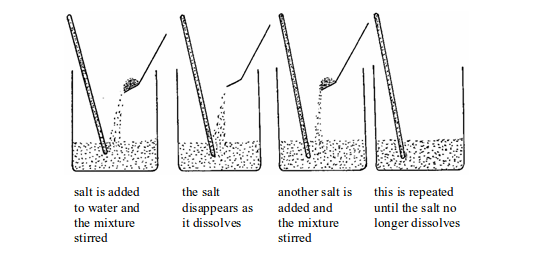
The solution made is called saturated solution. The amount of the salt that has dissolved is called the solubility of the salt in water. The solubility of a substance is usually expressed as the mass of the substance dissolved in 100g of water. Solubility is sometimes expressed in moles of solute per dm3 of solution at that temperature.
To give a quantitative meaning to solubility, it is necessary to fix the amount of the solvent used and to state the temperature at which dissolution occurs. The amount of solvent is usually fixed at 100g. For example, the solubility of sugar (sucrose) at 20ºC is 240g in 100g of water. What is the maximum weight of sugar that will dissolve at 20ºC in a cup containing 350g of water? A saturated solution of a solute at a particular temperature is the one which will not dissolve any more of the solute at that temperature.
The solubility of a solute in water at a given temperature is the maximum amount of it that will dissolve in 100g of water at that temperature.
Dissolving a solid in water
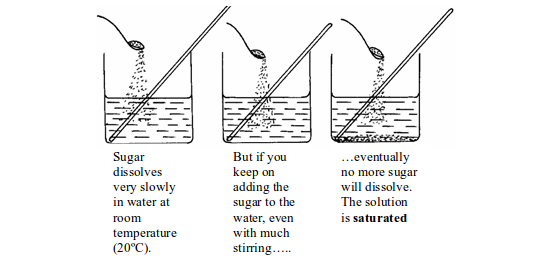
Generally, the solubility of a solute increases with increase in temperature. However, there are a few exceptions e.g. the solubility of calcium hydroxide decreases with increase in temperature. Sugar dissolves very slowly in water at room temperature (20ºC). Stirring helps to make sugar dissolve more quickly. But if you keep on adding sugar to the water even with continuous stirring, eventually no more sugar will dissolve. Extra sugar sinks to the bottom. The solution is saturated.
Now let us look at what happens when you heat the sugar solution. If you heat the solution up to 20ºC there is still undissolved sugar at the bottom of the beaker. Increasing the temperature to 50ºC makes some sugar dissolve but there is still some left. But if the temperature is raised up to 80ºC all the sugar dissolves. You might even be able to dissolve more sugar!
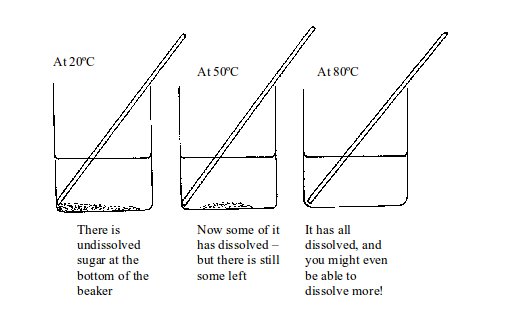
Therefore, sugar is more soluble in hot than in cold water. In fact, this is usually the case with soluble solids. If a solid is soluble in a liquid, it usually gets more soluble as the temperature rises.
Chapter summary
Water is the most abundant liquid in nature. Types of natural water include spring and well water, lake and sea water, rain water, and river water.
Water cycle (or hydrologic cycle) is the circulation of water from the water body to the atmosphere and back again. This involves evaporation, transpiration, condensation, and precipitation, and may include surface runoff, rivers, and glaciers.
Water treatment and purification are that acts of making water clean and safe for drinking. Water can be purified at home and also in industry
At home, water can be purified with chemical purifiers. The commonest and most widely used purifiers are the Waterguard and Aquaguard. However, the simplest and most common method to purify drinking water is to boil it
It is important to treat and purify water in order to remove dirt and kill disease-causing organisms
Many salts dissolve in water while some are sparingly soluble. Other few substances are insoluble in water. That is why water is referred to as a universal solvent
Review questions
Question Time 1
A.1. Which of the following types of water is referred to as ‘naturally distilled water’?
- Rain water
- River water
- Spring water
- Sea water
2.______ is the sequence in which water passes from the atmosphere to the land and back into the atmosphere.
- Water journey
- Water cycle
- Precipitation
- Evaporation
3. Acid rain is most prevalent in ______ areas.
- rural
- coastal
- industrial
- commercial
4. Which of the following is not a property of water?
- It is a poor conductor of heat.
- It freezes at 0 °C.
- It can exist in three states of matter
- It has a maximum density of 4 g cm3 at 1 °C
5. The major salt in sea water is_______.
- magnesium chloride
- calcium carbonate
- sodium chloride
- potassium chloride
6. The process by which water is converted into vapour or steam is called_______.
- condensation
- transpiration
- precipitation
- evaporation
7. ______ is the simplest way to purify water at home.
- Freezing
- Condensing
- Filtering
- Cooling
8. Pure water is ________.
- acidic
- basic
- neutral
- both acidic and basic
9. Which of the following processes best summarizes the water cycle?
- Evaporation → precipitation → condensation
- Condensation → precipitation → evaporation
- Precipitation → evaporation → condensation
- Evaporation → condensation → precipitation
10. State the importance of water in sustaining life
B. briefly
- What is water cycle?
- How can you relate the water cycle to environmental conservation?
- State at least four physical and two chemical properties of water.
- Explain how you would purify river water at home and make it suitable for consumption
- State two physical and one chemical test(s) for water.
- What is the significance of treating and purifying water?
- Explain any five uses of water.
- List any 5 salts that are soluble in water and 4 salts that are insoluble in water.
References
- Childs, A. (2000). Macmillan Secondary Chemistry (International ed.). Macmillan Publishers Limited. Malaysia.
- Gallagher, R. & Ingram, P. (2000). Complete Chemistry. Oxford University Press. London.
- Harwood, R. (2003). Chemistry (2nd ed.). Cambridge University Press. London.
- Holderness, A., Lambert, J. & Thompson, J.J. (1987). A New Certificate Chemistry (6th ed.). Clays Limited, St Ives Plc. London.
- Leeds, D., Payne, R., & McDuell, B. (2001). Chemistry for OCR A. Bath colour Books Limited.
- Tanzania Institute of Education (1995). Secondary School Chemistry, Book One. NPC (KIUTA). Dar es Salaam.
- SCSU, MoEVT-Zanzibar. (2008). Chemistry for Zanzibar Secondary Schools, Forms 1 & 2. Oxford University Press. Dar es Salaam.
Listening to this topic