Chemistry
Periodic Classification
Reading settings
Text size
Line spacing
Colours
Chemistry is all around us. Did you know that everything is made out of chemicals? Any reaction taking place in body cells of all living and non living organisms correlates with chemistry. In chemistry we study materials that make up the earth and universe. Chemistry is sometimes called the central science because it bridges other natural sciences, including physics, geology and biology. Therefore, when talking about chemistry, we are referring to life on Earth.
Periodic Classification
Introduction
Periodic classification of elements is the method by which elements are grouped on the basis of their characteristics. The arrangement of all elements in accordance with their increasing atomic number and recurring chemical properties is known as Periodic Table. The Periodic Table is one of the most important concepts in chemistry. In this chapter, you will learn about periodicity and general trends. By the end of this chapter, you should be able to explain the concept of periodicity, explain the changes in properties of elements across the periods, explain the changes in properties of elements down the periods, and use electronic configurations to locate the positions of elements in the Periodic Table
6.1 History of the Periodic Table
Constructing the modern periodic table has been a major scientific achievement. The first steps towards working out this table were taken long before anyone had any idea about the structure of atoms. The number of elements discovered increased steadily during the 19th century. Chemists began to find out patterns in their properties.
The Law of Triads
In 1817, the German scientist Johann Dobereiner noticed that calcium, strontium and barium had similar properties, and that the atomic weight of strontium was halfway between the other two. He found the same pattern with chlorine, bromine and iodine and also with lithium, sodium and potassium. So, he put forward the law of Triads: “If elements are arranged in groups of three in order of increasing atomic weights, having similar properties, then the atomic weight of the middle element is the arithmetic mean of the atomic weights of the other two elements”, E.g.
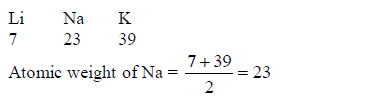
The following are examples of Dobereiner's triads:(Lithium, Sodium and Potassium)(Calcium, Strontium and Barium)(Chlorine, Bromine and Iodine) and(Iron, Cobalt and Nickel)
The Law of Octaves
In 1863 John Newlands, an English chemist noted that there were many pairs of similar elements. In each pair, the atomic weights differed by a multiple of 8. So, he produced a table with the elements in order of increasing atomic weights, and put forward the Law of Octaves: “If elements are arranged in order of their increasing atomic weights, the properties of the 8th element, starting from a given one, are a kind of repetition of the first element”.
This finding was comparable to the 8th note of music, hence the use of the word "octave".
This was the first table to show a periodic or repeating pattern of properties. But it was not widely accepted because there were too many inconsistencies. For example, he put copper and sodium in the same group, even though have very different properties. Also iron was placed in the same group as oxygen and sulphur.
The Periodic Law
Dmitri Mendeleev was born in Siberia, Russia, in 1834. By the time he was 32, he was a professor of Chemistry. In 1869 Mendeleev advanced the work done by Newlands and contributed very useful new ideas. He began by listing all the known elements in order of increasing atomic mass. He spotted that elements with similar properties appear at regular intervals or periods down the list. His findings were the basis for the Periodic Law: “The properties of elements are a periodic function of their atomic masses”.
Mendeleev placed similar elements into groups. He realized that not all elements had been discovered. So he left gaps for new ones in the correct places in his table. He also swapped the order of some elements to make them fit better. He predicted the properties of the missing elements from the properties of the elements above and below them in the table. He also listed separately some elements which did not appear to fit into any group i.e. iron, cobalt, nickel, etc.
Table 6.1: Mendeleev’s short form of the Periodic Table
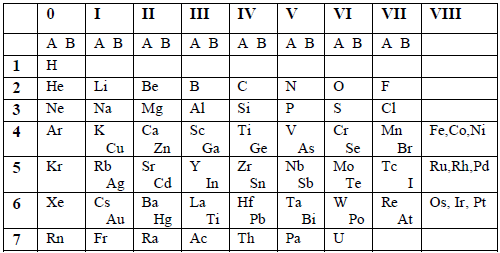
The table had 9 vertical columns which he called Groups. The groups were numbered from 0 to 8. The elements in group 0 were not known by then, but were discovered later on. Groups 1 to 7 were subdivided into A and B subgroups. Group 0 included the transition elements. Noble gases were later placed in group 0.
There were 7 horizontal rows which he called periods. All vacant positions in the table stood for new elements yet to be discovered.
Usefulness of Mendeleev's classification
- The table summarized a large amount of information about the elements based on their chemical properties.
- The table was very useful in predicting the existence and properties of undiscovered elements, for which gaps had been left in the table.
- The table was also used in checking relative atomic masses of elements.
Limitations of Mendeleev's classification
- In three cases, pairs of elements had to be included in one group based on inverse order of their atomic weights so as to fit into groups of elements having similar properties. These pairs were argon (39.9) and potassium (39.1), cobalt (58.9) and nickel (58.9); plus tellurium (127.5) and iodine (126.9). This difficulty was resolved when the basis of classification was based on the atomic number instead of the atomic mass.
- The elements that were placed in group VIII formed an incompatible mixture.
- The placing of two different families in one group e.g. K and Cu; Ca and Zn, etc.
The periodic table is the chemists map. It helps you understand the patterns in chemistry. Today we take it for granted. But it took hundreds of years, and work of hundreds of chemists, to develop.
The Modern Periodic Table is similar to that of Mendeleev, but contains several improvements. Elements are arranged in order of atomic number instead of atomic mass. This means that elements no longer have to swap places to fit correctly. Many new elements have been discovered and slotted into the spaces left by Mendeleev. Also metals and non-metals are clearly separated. The Modern Periodic Table is shown in Figure 6.1.
Figure 6.2: The Modern Periodic Table

The long form of the periodic table is the commonly used form of the periodic table. The elements in the table are arranged based on their atomic weights, starting from hydrogen (1), helium (2), lithium (3), beryllium (4) and so on. The elements appear in vertical columns and horizontal rows.
The vertical columns in the table are called Groups, numbered I, II, III, IV, V, VI, VII and 0, which is also known as group VIII. Group I contains the elements lithium (L), sodium (Na), rubidium (Rb), caesium (Cs) and francium (Fr). Group II consists of elements starting from beryllium (Be) down to radium (Ra). Some of the groups have special names.
- Group I is often called the alkali metals.
- Group II the alkaline earth metals.
- Group VII the halogens.
- Group 0 the noble gases.
The horizontal rows are called Periods. Period 1 consists of hydrogen (H) and helium (He).
Period 2 contains lithium (Li), beryllium (Be), boron (B), carbon (C), nitrogen (N), Oxygen (O), fluorine (F), and neon (Ne). Can you mention the elements found in periods 3 and 4?
The transition metals (or elements) form a separate block in the middle of the periodic table between group II and III. The atoms of these elements have more complicated electron arrangements. Note that the group contains many common metals such as iron (Fe), Nickel (Ni), copper (Cu), and Zinc (Zn). One of the interesting properties of these elements is that they form coloured compounds.
Main features of the Modern Periodic Table
- The elements in the table are placed in order of their atomic numbers instead of their atomic masses.
- There are a total of 18 groups and 7 periods.
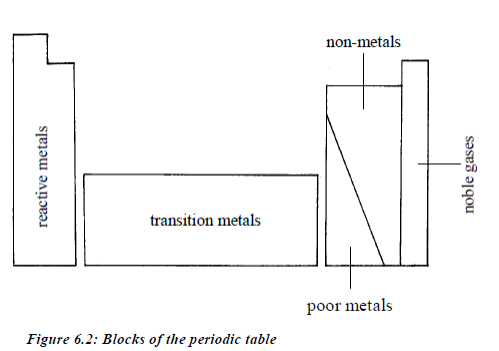
- There are 5 blocks of similar elements in the periodic table as shown in figure 6.2.
- The normal (non-transition) elements (groups 1-7) have their outermost shells incomplete, meaning that they can allow additional electrons to enter into their outermost orbital (valency shell). But each of their inner shells is complete.
- The transition metals have their outermost as well as their penultimate (second last) shells incomplete.
- Elements of group 0 (noble gases) have their shells complete. These elements show little reactivity. That is why they wereonce called „inert‟ gases because they are very unreactive; or „rare gases‟ because they were rarely found.
- Gaps left by Mendeleev for undiscovered elements (now occupied by the transition elements and the noble gases) have been filled by the respective elements following their discovery. Man-made elements have also found a place in the periodic table.
- Metals have been clearly separated from non-metals. Metalloids or semi metals (poor metals) have also been included. Metalloids are elements whose properties are intermediate between metals and non-metals. They include boron (B), silicon (Si), germanium (Ge), arsenic (As), antimony (Sb) and tellurium (Te). In some publications, germanium and antimony are usually classed as poor metals and the rest as non-metals.
Periodicity
The Concept of Periodicity
Explain the concept of periodicity
Consider the electronic configuration of the first twenty elements of the periodic table shown in the table below.
Table 6.4: Electronic configurations of the first 20 elements
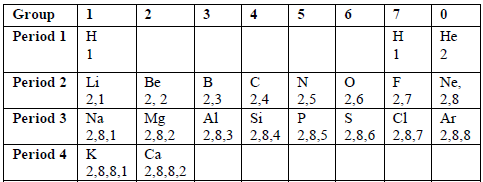
You will notice that elements in the same vertical columns (groups) have the same number of electrons in the outermost shells of their atoms. Because the outer electrons determine the chemical properties of an element, then the elements in each period tend to resemble each other closely in chemical behaviour. For instance, the noble gases, He, Ne and Ar show a chemical inertness which is characterised by the stable outer electron octet or duplet. Due to this reason, the compounds of the noble gases with other elements have not been found.
Attempts to classify elements by arranging them in order of increasing atomic weights shows that the properties of elements were periodic. This means elements with similar or comparable properties appear after a certain specific interval in a given arrangement. The occurrence of successive groups of elements showing strong chemical similarity in this way is called periodicity.
Therefore, periodicity is the repetition of similar chemical properties of elements after a certain specific interval in a given arrangement. The repetition in properties is due to repetition of similar electronic configuration of outermost shells of elements after certain intervals.
General Trends
This refers to change in some properties of elements across the periods and down the groups in the periodic table. These trends become more obvious if we leave aside the noble gases in Group 0. In this case, we shall concentrate our efforts on variations in the most important properties of the elements only. The following is a summary of the change in some properties of elements down the groups and across the periods.
The Change in Properties of Elements Across the Periods
Explain the change in properties of elements across the periods
Atomic and ionic size
The sizes of atoms and ions may be given in terms of atomic radius and ionic radius units respectively. The number of shells an atom or ion posses and the nuclear charge determines the size of an atom or ion. This is how the two properties vary along the period and down the group:
Atomic size
Down the group: Atomic sizes increase down the group. Along the period; Considering the normal elements only, the size of atoms decreases from left to right across the period. This is because as atomic number increases across the period, the nuclear charge (due to increasing protons) increases and electrons in shells are pulled closer to the nucleus.
Ionic size
- Positive ions (cations): Down the group: On descending the group, the nuclear charge increases and the number of shells increase by one at each step so, the ionic size also increases. A positive ion is smaller than the corresponding neutral atom because on forming the ion, the metal atom loses the valency electron(s). Valency electron(s) refer(s) to the electron(s) in the outer-most shell of an atom. Any further removal of electron(s) from the ion will decrease the ionic size further. Across the period: The ionic size does not change, i.e. remains the same, as you move across the period from either direction.
- Negative ions (anions): A negative ion is larger compared to the corresponding neutral atom because on forming an ion, one or more electrons are added to the atom. The added electron(s) is/are repelled by the electron(s) already present in the outermost shell, hence leading to an increase in the size of an atom, even though no new shell is formed. Down the group and along the period: Ionic size increases down the group, and along the period, i.e. from left to right.
Atomic radii (singular: radius)
Atomic radius is the distance from the centre of the nucleus to the outermost shell (valency shell). Down the group: Atomic radii of elements increase down the group with increase in atomic sizes. Along the period: In the period, atomic radii decrease from left to right with an increase in the atomic numbers
Electronegativity
Electronegativity is the tendency of an atom to attract the shared pair of electrons towards itself in a molecule. The electronegativity values of elements in group 0 (inert gases) is zero.
Down the group: Electronegativity decreases down the group. Along the period: Electronegativity increases across the period from left to right in the Periodic Table.
Metallic character (or electropositivity)
Electropositivity is the tendency of an element to lose the valency electron(s) and donate the same to other elements (usually non-metallic elements). This process occurs during the formation of new substances e.g. molecules and compounds. Literally, such reactions occur between metals and non-metals whereby metals donate electrons and non-metals receive these electrons. So, metals are electropositive elements while non- metals are electronegative elements.
Down the group: Metallic character (electropositivity) increases down the group. Along the period: Generally, the metallic character decreases along the period from left to right. The gradation in metallic properties across the period is as follows: Metals → poor metals → metalloids → non metals → noble gases
Chemical reactivity
Reactivity is the tendency of an element to lose or gain electrons in a chemical reaction. Down the group: In a group, the chemical reactivity for metals increases from the top to the bottom while it decreases for non metals
Along the period: For metals, the reactivity decreases from left to right in a period while it increases for non-metals.
Ionization Energy or Ionization Potential (I.E or I.P)
This refers to the minimum amount of energy required to remove the most loosely bound electron from an isolated atom or ion in its gaseous state. The smaller the value of ionization energy, the easier it is to remove the electron from the atom.M(g) →M+(g) + e-
Down the group: It decreases gradually down the group. Along the period: It increases along the period from left to right with the increase in atomic number. Why is there a decrease in I.E. as you go down the group? This is because electrons are held in their shells by their attraction to the positive nucleus, and as you go down the group, the size of the atom increases (increasing atomic radius). So, the outermost electron(s) of an atom gets further and further away from the attraction or pull of the positive nucleus, hence requiring little energy to remove from the atom
Electron affinity (Ea):
This is just opposite to I.E. It is defined as the amount of energy released when an extra electron is added to an isolated neutral atom in its gaseous state.

Down the group: The values of electron affinity decrease down the group. Along the period: The values increase along the period from left to right.
Density and melting point
The density of a substance is the ratio of its mass to its volume, while the melting point is the temperature at which a solid substance turns into liquid at standard atmospheric pressure.
- Density-Across the period:Down the group: Densities of elements increase down the group. Across the period: Densities decrease across the period from left to right.
- Meting point-Across the period: Down the group: Melting points of elements decrease down the group as the elements become less metallic in nature. Across the period: Melting points of elements decrease across the period from left to right
The Change in Properties of Elements Down the Groups
Explain the change in properties of elements down the group
Electronic Configuration to Locate the Positions of Elements in Periodic Table
Use electronic configuration to locate the positions of elements in periodic table
The modern periodic table is based on electronic configurations of the elements. Look at table 6.3 and study the electronic configurations of the first twenty elements and where they are placed in the periodic table.
Elements in the same Group have the same number of electrons in the outermost shells. Lithium, sodium, and potassium have one electron in the outer shell. These elements are in Group 1. Beryllium, magnesium, and calcium have two electrons in the outer shell. These elements are in Group 2
This pattern continues to Group 3, Group 4 and so on. The group number in the periodic table is the same as the number of electrons in the outermost shell. The halogens are the elements in Group 7. Bromine is one of the halogens. How many electrons does each bromine atom have in its outer shell?
As we move down each group, the number of shells increases by one at each step. Each atom of an element has one complete shell than the one above it.
Progressing from left to right across each period, the outer shell is being filled by one electron at each step. Certain electronic configurations are found to be more stable than others are. The noble gases at the end of each period have full outer shells. They have stable duplet (2 electrons) or octet (8 electrons) in their outermost shells. This makes them more difficult to break up, and this fits well with the fact that they are so unreactive
The outer electrons of an atom are mainly responsible for the chemical properties of an element. Therefore, elements in the same group will have similar chemical properties.
Chapter summary
The Periodic Table of elements is a tabular display of the chemical elements, which are arranged by atomic number, electron configuration, and recurring chemical properties
The Periodic Law state that “The properties of elements are a periodic function of their atomic masses”
The vertical columns in the Periodic Table are called Groups. Some of the groups have special names:
- Group I is often called the alkali metals.
- Group II, the alkaline earth metals.
- Group VII, the halogens.
- Group 0, the noble gases.
The horizontal rows are called Periods. The columns are called Groups. The transition metals (or elements) form a separate block in the middle of the Periodic Table between groups II and III.
Periodicity is the repetition of similar chemical properties of elements after a certain specific interval in a given arrangement.
General trends refer to changes in some properties of elements across the periods and down the groups in the Periodic Table.
The trends include variations in properties such as atomic and ionic sizes, atomic radii, electronegativity, electropositivity, chemical reactivity, ionization energy, electron affinity, density, and melting and boiling points
The Modern Periodic Table is based on electronic configurations of the elements. Elements in the same Group have the same number of electrons in the outermost shell.
Review questions
Question Time 1
A.1. The vertical columns in the Periodic Table are called______.
- rows
- groups
- periods
- tables
2. Group two elements are called______.
- the alkali metals
- the alkaline earth metals
- the halogens
- the noble gases
3. An element whose electronic configuration is 2:8:2 is most likely to be found in ______ of the Periodic Table.
- Group 2
- Group 8
- Period 2
- Period 4
4. The gaps in the Periodic Table that were left for the undiscovered elements by Mendeleev are now occupied by ________.
- the alkali metals and the alkaline earth metals
- the noble gases and the halogens
- the transition elements and the noble gases
- the halogens and the alkali metals
5. Which of the following arrangements of elements makes Dobereiner’s triads?
- Chlorine, Helium and Bromine
- Calcium, Sodium and Barium
- Chlorine, Bromine and Iodine
- Iron, Cobalt and Silver
6. State the following:
- The Law of Triads
- The Law of Octaves
- The Periodic Law
7. State the Modern Periodic Law.
8. Give the main features of the Modern Periodic Table
9. The diagram below represents part of the Periodic Table of elements, showing some blocks only. The letters used in the table are not the official symbols of the respective elements. For the purpose of this question, the letters in the table should be used as they are:

- Write the letter of the:
- most electronegative element.
- least electronegative element.
- element in group 8 which has three shells in its atoms.
- most reactive metal element in period 3.
- element in period 3 which is the halogen
- inert gas element which has the least atomic number
- most reactive alkali earth metal
- If the atomic numbers of the elements with the letters K and C are 8 and 11, respectively, write down the molecular formula of the compound formed between C and K.
10. The following table is part of the Periodic Table where the transition metals are not included. The numbers in the table are the atomic numbers of some of the elements.

- write down
- For each number, write the symbol of the corresponding element
- Considering the elements with atomic numbers 12 and 17, which is a metal and which is a non metal?
- Write the symbol of an inert gas element represented by the given atomic number.
11. Define electronegativity
12. Consider the following elements of group seven in the order in which they appear in their group in the Periodic Table: F, Cl, Br, and I.
- Which element is the most electronegative?
- Name the least electronegative element.
- Which element has the largest atom?
- Write the electronic configuration of the chlorine atom
13. Explain how the ideas of electronic configurations are used to locate the positions of elements in the Periodic Table
14.Study the part of the Periodic Table below and then answer the questions that follow. Note that the letters are not official symbols for the elements concerned. They have been used for the purpose of this question only

- Name and write the chemical symbols for the elements with letters U, V, W, X, Y, and Z
- Write down the electronic configurations for the elements V, X, and Z.
- Give the names of the three elements found in period 3.
15. The table below represents a part of the Periodic Table. The letters are not actual symbols for the elements concerned. They have been used for the purpose of this question only. Study the figure and answer the question that follows.

- How do ionic radii of P and R compare? Explain
16. Define periodicity
- What do you understand by the term ‘atomic radius’?
- How do the atomic radii of elements vary across the period and down the group in the Periodic Table?
- Differentiate between electronegativity and electron affinity.
- What is ionization energy (I.E.)? How does it vary along the period and down the group in the Periodic Table?
REFERENCES
- Arora, G. (2006). Chemistry Formulae. Readwell Publications. New Delhi.
- Gallagher, R. & Ingram, P. (2000). Complete Chemistry. Oxford University Press. London.
- Garg, V.C. (2006). Chemistry Formulae. Academic (India) Publishers. New Delhi.
- Holderness, A., Lambert, J. & Thompson, J.J. (1987). A New Certificate Chemistry (6th ed.). Clays Limited, St Ives Plc. London.
- Leeds, D., Payne, R., McDuell, B. (Editor). (2001). Chemistry for OCR A. Bath colour Books Limited.
- Tanzania Institute of Education (1995). Secondary School Chemistry, Book One. NPC (KIUTA). Dar es Salaam
Listening to this topic