Mathematics (New)
ALGEBRA
Reading settings
Text size
Line spacing
Colours
ALGEBRA
This topic covers Algebraic Expressions, Linear Equations in one unknown, Linear Equations intwo Unknowns (Simultaneous Equations) and Linear Inequalities with one unknown.
Upon completion of this chapter, you should demonstrate competencies in Algebra by:(i) Using mathematical symbols to form Algebraic Expressions correctly (ii) Simplifying the Algebraic Expressions (iii) Solving the equations in one unknown correctly (iv) Forming and solving an equation from word problems correctly (v) Solving Linear simultaneous equations by elimination or substitution methods (vi) Forming and solving linear Simultaneous Equations from practical situations correctly (vii) Solving linear inequalities in one unknown and (viii) Forming and solving linear inequalities from practical situations correctly.
These competencies should help you solve real-life problems such as currency conversions, calculating profit and loss, estimating budgets, solving age-related problems and many more.
Introduction
Algebra is a branch of mathematics that helps us to work with unknown numbers. In arithmetic, we solve problems using known numbers but in algebra letters like 𝑥 and 𝑦 are used to represent numbers that we do not yet know. This helps us solve many real-life problems, such as finding prices, ages, calculating distances, finding quantities of different items and many more.
Algebraic Expressions
In algebra we treat letters as numbers. Any letter may represent any number though in some cases there are letters we commonly use. For example, we use a letter l to represent length, r to represent radius, v for volume, A for area etc.
The letters are treated like numbers, and thus we can add, subtract, multiply or divide them by using the common operations signs, that is (+) for addition, (−) for subtraction, (×) for multiplication and (÷) for division. For example, 𝑥 + 𝑥 = 𝑥 × 2 = 2𝑥, 3𝑦 − 𝑦 + 𝑧 = 2𝑦 + 𝑧, 𝑚 + 𝑚 + 𝑚 = 𝑚 × 3 = 3𝑚 and so on.
The Basic Concepts of Algebraic Expressions
Algebraic Expressions and Like Terms
Algebra
algebra form 1
Algebra
Explore the Basic Concepts of Algebraic Expressions
The combinations of letters and numbers by using common mathematical operation symbols are called algebraic expressions. For example, 𝑥 + 2𝑦, 3𝑎 − 7𝑏 + 12, 𝑥 + 5𝑦 − 3𝑧 and 2𝑎 ÷ 5 are algebraic expressions.
In algebraic expressions, letters like x, y and z are called variables. Each expression can be grouped into what we call terms, for example the expression 𝑥 + 2𝑦 has two terms which are𝒙 𝑎𝑛𝑑 𝟐𝐲, while the terms of the expression 3𝑎 − 7𝑏 + 12 are 𝟑𝒂, −𝟕𝒃 𝑎𝑛𝑑 𝟏𝟐.
A term is made up of a variable or variables and a number called coefficient. Thus, the coefficient of the term 3a in the expression 3𝑎 − 7𝑏 + 12 is 3 and that of -7b is -7.Note that the term 12 (which has no variable) in the expression 3𝑎 − 7𝑏 + 12 is called a constant term as it remains unchanged.
Two or more terms of an expression are said to be similar or alike if they are made up of the same variable (or variables). For example, 3𝑥 + 4𝑦 + 10𝑥 − 3𝑧 in the expression, the terms 3𝑥 and 10𝑥 are similar since they all contain only the variable x.
Similarly, in the expression 4𝑎𝑏 + 3𝑏 + 2𝑎 − 5𝑎𝑏 + 𝑐 the terms 𝟒𝒂𝒃 and −𝟓𝒂𝒃 are similar since both contain the product ab.
Note: We write 2𝑥 as a short form for 2 times 𝑥, 3𝑚 for 3 times m or m times 3, but we avoid writing 𝑦3 to mean 3 times y, instead we write 3𝑦.
Simplify Algebraic Expressions
Expressions involving similar terms can be simplified as it is done for common numbers.
Addition and Subtraction of algebraic expressions;
Example 1
Simplify each of the following expressions:
(a) 5𝑥 + 8𝑥 (b) 𝑦 − 6𝑦 (c) 2𝑎 + 10𝑎 (d) 𝑥𝑦 + 6𝑥𝑦 (e) 18𝑎𝑏 − 5𝑎𝑏
Solution;
a) 5𝑥 + 8𝑥 = 13𝑥
(b) 𝑦 − 6𝑦 = −5𝑦
(c) 2𝑎 + 10𝑎 = 12𝑎
(d) 𝑥𝑦 + 6𝑥𝑦 = 7𝑥𝑦
(e) 18𝑎𝑏 − 5𝑎𝑏 = 13𝑎𝑏
Note that in all 5 cases, an operation has been performed by adding or subtracting the coefficients of the terms. Also note that we write 𝒚 instead of 𝟏𝒚.
Example 2
Simplify the expression;
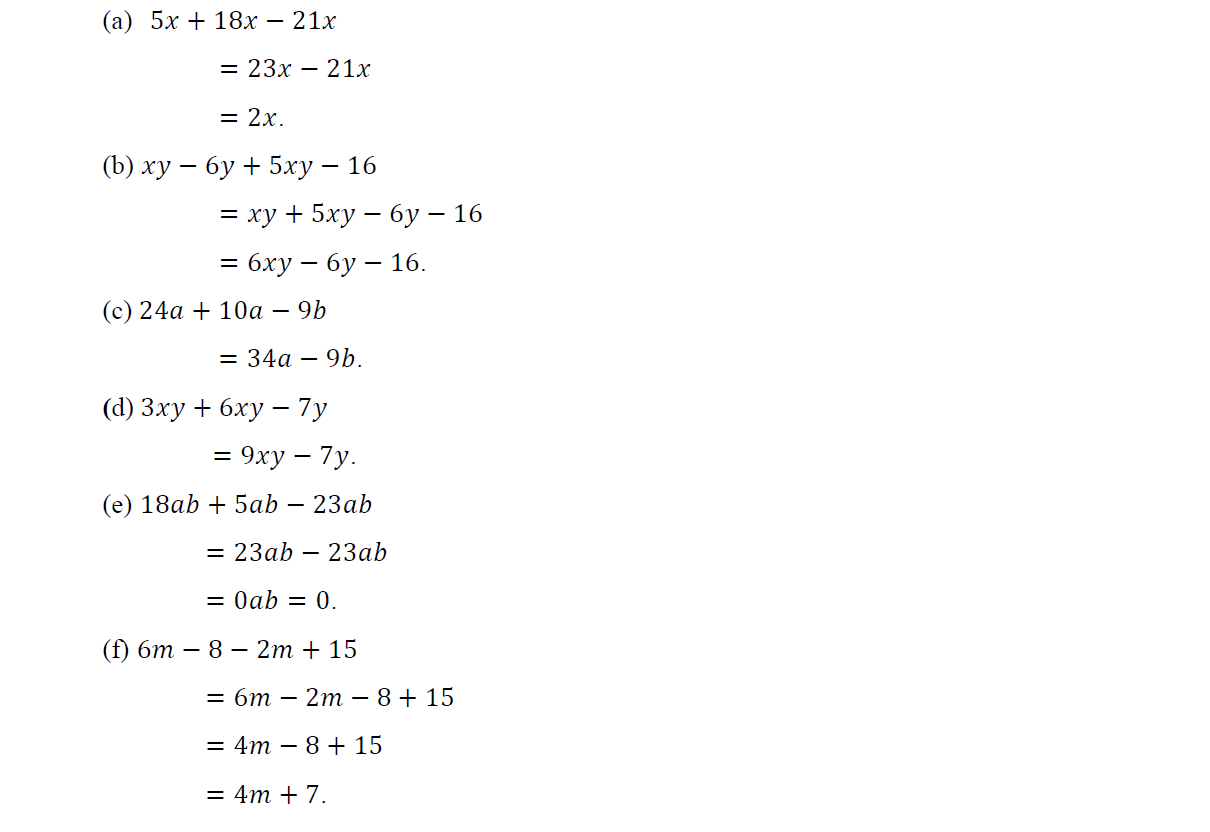
(a) 5𝑥 + 18𝑥 − 21𝑥 (b) 𝑥𝑦 − 6𝑦 + 5𝑥𝑦 − 16 (c) 24𝑎 + 10𝑎 − 9𝑏 (d) 3𝑥𝑦 + 6𝑥𝑦 − 7𝑦 (e) 18𝑎𝑏 + 5𝑎𝑏 − 23𝑎𝑏 (f) 6𝑚 − 8 − 2𝑚 + 15
Solution;
Example 3
Simplify 4𝑥 + 9𝑦 − 3𝑥 + 5𝑦 and;
(a) state the coefficient of x. (b) state the coefficient of y.
Solution;
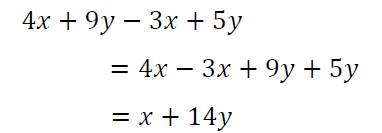
∴ 4𝑥 + 9𝑦 − 3𝑥 + 5𝑦 = 𝑥 + 14𝑦
(a) The coefficient of x is 1.
(b) The coefficient of y is 14.
Exercise 1
1.Simplify each of the following algebraic expression;
(a) 7𝑥 − 18𝑥 + 12𝑥
(b) 5𝑥𝑦 − 16𝑦 + 35𝑥𝑦 + 13
(c) 14𝑎 − 10𝑎 − 9𝑏
2. Write each of the following expressions in the simplest form, and in each simplified expression, state the number of terms.
(a) 25𝑎 + 𝑎 − 18𝑎 − 9
(b) 𝑥𝑦 − 16𝑦 − 5𝑥𝑦 − 14
(c) 24𝑦𝑧 + 10𝑦 − 9𝑦𝑧
(d) 9𝑥 + 6𝑥𝑦 − 7𝑦 − 𝑥 + 12𝑦
(e) 8𝑎 − 5𝑎 + 23𝑎
(f) 6𝑚 − 8 − 2𝑚 + 𝑛 + 28
3. Simplify each of the following expressions and then state the coefficient of each term;
(a) 2𝑝 + 𝑞 − 8𝑝 + 9𝑞
(b) 7𝑥𝑦 − 16𝑦 − 5𝑥𝑦 − 3𝑥 − 6
(c) 34𝑎𝑏 + 18𝑎 − 19𝑎𝑏 − 8
Multiplication and division of algebraic expressions
Just like 4 × 6 = 6 × 4 so is 𝑦 × 𝑧 = 𝑧 × 𝑦 = 𝑦𝑧 𝑜𝑟 𝑧𝑦.
Therefore, to multiply 4𝑥 by 10 is the same as multiplying 10 by 4𝑥, that is 4𝑥 × 10 = 10 × 4𝑥 = 40𝑥.
Similarly, the division of algebraic expression by a number is simply done by dividing the coefficient of the expression by the divisor. For example, since 12 ÷ 4 = 3, then 12𝑎 ÷ 4 = 3𝑎.
Note: For multiplication involving brackets, 𝑒. 𝑔 (𝑎 + 𝑏) × 𝑐 the brackets are opened by multiplying each term inside the bracket by the term outside the bracket.
For example (𝒂 + 𝒃) × 𝒄 = 𝒂 × 𝒄 + 𝒃 × 𝒄 = 𝒂𝒄 + 𝒃𝒄
For division involving brackets like (𝑎 + 𝑏) ÷ 𝑐, the brackets are opened by dividing each term inside the bracket by the number (divisor), that is (𝒂 + 𝒃) ÷ 𝒄 =𝒂/𝒄+𝒃/𝒄.
Example 4
Perform each the following Multiplications;
(a) 2𝑥 − 3y by 4 (b) 2𝑥 − 4𝑦 + 5 by 12 (c) 5𝑎 + 2𝑎𝑏 − 3𝑏 + 6 by 3
Solution;
(a) (2𝑥 − 3y) × 4 = 4(2𝑥 − 3𝑦)= 𝟖𝒙 − 𝟏𝟐𝒚
∴ (2𝑥 − 3y) × 4 = 𝟖𝒙 − 𝟏𝟐𝒚
(b) (2𝑥 − 4y + 5) × 12= 12(2𝑥 − 4y + 5)= 𝟐𝟒𝐱 − 𝟒𝟖𝐲 + 𝟔𝟎
∴ (2𝑥 − 4y + 5) × 12 = 𝟐𝟒𝐱 − 𝟒𝟖𝐲 + 𝟔𝟎
c) (5𝑎 + 2𝑎𝑏 − 3𝑏 + 6) × 3 = 3(5𝑎 + 2𝑎𝑏 − 3𝑏 + 6) = 𝟏𝟓𝐚 + 𝟔𝐚𝐛 − 𝟗𝐛 + 𝟏𝟖
∴ (5𝑎 + 2𝑎𝑏 − 3𝑏 + 6) × 3 = 𝟏𝟓𝐚 + 𝟔𝐚𝐛 − 𝟗𝐛 + 𝟏𝟖
Example 5
Perform the following divisions;
(a)15𝑛 ÷ 3
(b) 104𝑚𝑛 ÷13
Solution;
(a)15𝑛 ÷ 3 = 5𝑛
(b) 104𝑚𝑛 ÷ 13 = 8𝑚𝑛
Example 6
Simplify the following expressions;
(a) 2𝑥 × 4𝑦 (b) 5𝑎 × 2𝑏
Solution;
(b) 2𝑥 × 4𝑦 = 8𝑥𝑦
(c) 5𝑎 × 2𝑏 = 10𝑎𝑏
Example 7
Simplify the expressions below;
(a) 3 x 2𝑚 + 2 x 5𝑚 (b) 8𝑥 ÷ 2 + 6𝑥 ÷ 3 (c) 4𝑥𝑦 ÷ 𝑦 − 6𝑥 ÷ 2 (d) 12𝑚𝑛 ÷ 3 − 3𝑚𝑛
Solution;
(a) 3 × 2𝑚 + 2 × 5𝑚 = 6𝑚 + 10𝑚 = 16𝑚
(b) 8𝑥 ÷ 2 + 6𝑥 ÷ 3 = 4𝑥 + 2𝑥 = 6𝑥
(c) 4𝑥𝑦 ÷ 𝑦 − 6𝑥 ÷ 2 = 4𝑥 − 3𝑥 = 𝑥
(d) 12𝑚𝑛 ÷ 3 − 3𝑚𝑛 = 4𝑚𝑛 − 3𝑚𝑛 = 𝑚𝑛
Note that, when the values of the variables in the expression are given, we can write the expression as a numeral.
Example 8
Find the value of 𝑥 + 2 when 𝑥 = 1.
Solution;
If x=1 then 𝑥 + 2 = 1 + 2 = 3,
∴ 𝑊ℎ𝑒𝑛 𝑥 = 1, the value 𝑥 + 2 is 3.
Example 9
Find the value of 3𝑥 + 2𝑦 − 5𝑥𝑦 + 40 when 𝑥 = 1 and 𝑦 = 5.
Solution;
If 𝑥 = 1 and = 5 then we have 3𝑥 + 2𝑦 − 5𝑥𝑦 + 40 = 3 × 1 + 2 × 5 − 5 × 1 × 5 + 40 = 28
∴ 3𝑥 + 2𝑦 − 5𝑥𝑦 + 40 = 28
Exercise 2
1. Write the following expressions in the simplest form;
(a) 4𝑎 + 3𝑏 + 2𝑎 + 𝑏
(b) 6𝑛 + 3𝑚 − 2𝑛 − 2𝑚
(c) (1/2)s-t+3s-(1/4)t
2. Simplify these expressions;
(a) 4𝑥𝑦 ÷ 𝑦 + 6𝑥 ÷ 2
(b) 𝑥𝑦𝑧 − 3𝑥𝑦 + 4𝑧𝑥 − 𝑧𝑥𝑦
3. Simplify each of the following;
(a) 3(2𝑛 + 3) + 4(5𝑛 − 3)
(b) (2-k)/k +2(k-1)
4. Simplify the following expressions;
(a) 3(2ℎ + 3𝑘) + 4(3ℎ − 𝑘)
(b) 3𝑥 − 8𝑦 + 2𝑧 + 12𝑥 − 24
(c) 3(2𝑛 + 3) + 4(5𝑛 − 3)
(d) (4𝑚 + 6𝑛)/2
(e) (3𝑚𝑛 + 2𝑚𝑝) ÷ 𝑚
(f) (7𝑝𝑞 − 2𝑠𝑝) ÷ 𝑝
5. Simplify the following;
(a) (4𝑥 + 8𝑦) ÷ 2 + (9𝑥𝑤 + 4𝑤𝑦) ÷ 𝑤
(b) 𝑥(𝑦 − 5) + 𝑦(𝑥 + 2)
6. Perform each the following Multiplications;
(a)12𝑥 − 3y +7 by 4
(b) 2𝑥 + 3𝑦 − 15 by 12.
(c) 5𝑎 + 2𝑎𝑏 − 3𝑏 + 6 by 8.
Algebraic Equations
This subtopic is a continuation of algebraic expressions whereby two or more expressions are related or connected by using the equal sign. The equations to be discussed here are those with linearity property.
The Basic Concepts of Algebraic Equations
Explore the Basic Concepts of Algebraic Equations
An algebraic equation is a mathematical statement of equality.
It connects two expressions with an equal sign (=), for example: 2y = 12 is an equation in which 2y is related to 12 by using the symbol “=”. Thus, an equation has two equal sides.
An equation expresses a statement or a problem in a clear and short way, for example, to find a number which when multiplied by two gives twenty, is the same as to finding 𝑥 in the equation 2𝑥 = 20.
Forming linear equations
A linear equation is an equation whose unknown variables are raised to 1, they do not involve terms with products of two or more unknowns. For example, 3𝑥 + 6 = 15 and 5𝑥 − 𝑦 = 20 are linear equations, but 3𝑥2− 2 = 10 or 𝑥𝑦 + 𝑥 − 𝑦 = 1 are non-linear equations.
Procedures for Forming Linear equations
The following steps can be used in forming an equation from a statement:
Step 1: Identify (understand) what the question is asking for, that is identify the unknown.
Step 2: Let the unknown be represented by a letter (variable).
Step 3: Formulate the equation by connecting variable let in step 2 above with numbers by usingmathematical symbols (+, −,×,÷ and =) in accordance with the given conditions.
Example 10
The sum of two numbers is 20, if one of the numbers is 12, form the equation connecting them.
Solution;
Let the unknown number be 𝑥, then 𝑥 + 12 = 20.
∴ 𝑥 + 12 = 20 is the required equation.
Example 11
The difference between 56 and another number 21, form the equation.
Solution;
Let the unknown number be m, then 56 − 𝑚 = 21
Therefore, the required equation is 56 − 𝑚 = 21
Example 12
If the product of two numbers is 348 and one of the numbers is 29, form the equation.
Solution:
Let the unknown number be 𝑦, then 29𝑦 = 348
∴ 29𝑦 = 348 is the required equation.
Example 13
The product of 12 and another number is the same as two times the sum of 12 and the number,form the equation.
Solution;
Let the unknown number be 𝑧, then 12𝑧 = 2(12 + 𝑧).
∴ 12𝑧 = 2(12 + 𝑧) is the required equation.
Note that it is important to be able to relate different English words with the corresponding mathematical signs;
For example, (+) For addition, sum, plus or increased etc.
(−) For subtraction, minus, decrease, difference etc.
(×) For multiplication, multiply, product and so on.
(÷) For division, divide, divided etc.
(=) For equals, is, gives, result is etc.
Exercise 3
Formulate equations for each of the following:
1. Five times a number gives twenty.
2. The difference between 567 and another number is 150.
3.When a certain number is increased by 15, the result is 808.
4.The product of 12 and another number is the same as three times the difference of 12 and the number.
5. A number is such that when it is doubled and 45 added to it, the result is the same as multiplying the number by 3 and subtracting 26.
6. When 36 is added to a certain number, the result is the same as multiplying the number by 5.
7. If John is n years old and is 6 years older than James, write an expression of the sum of their ages.
Linear Algebraic Equations in One Unknown
Form Linear Algebraic Equations in One Unknown
An equation in one unknown is the one having a single unknown variable, for example 56 − 𝑚 = 21 or 𝑥 + 12 = 20 are equations in one unknown.
Solve Linear Equations in One Unknown
Solving Linear Equations
Linear Equations
To solve the equation means to find the value of unknown which satisfies the given equation.
Example 14
Solve the equation;
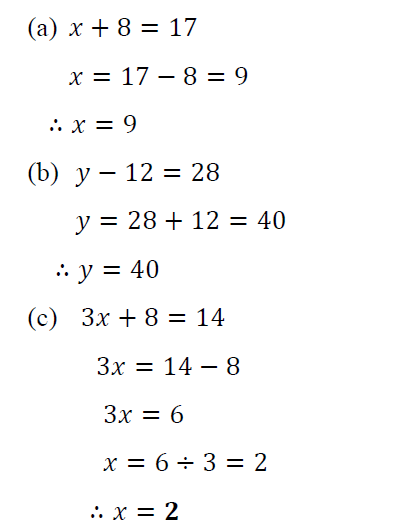
(a) 𝑥 + 8 = 17 (b) 𝑦 − 12 = 28 (c) 3𝑥 + 8 = 14
Solution;
Example 15
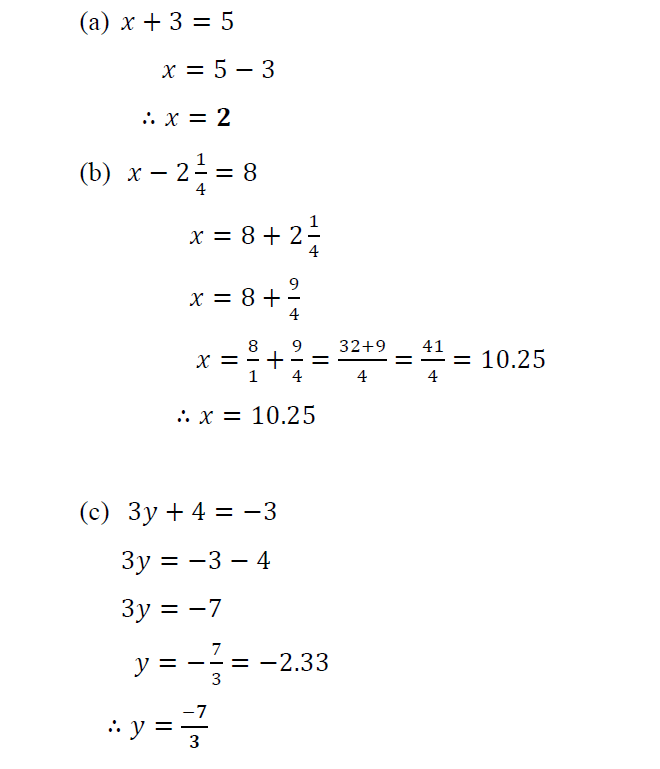
Solve the following equations;

Solution;
Example 16
Solve for unknown in each of the following equations;

Solution;
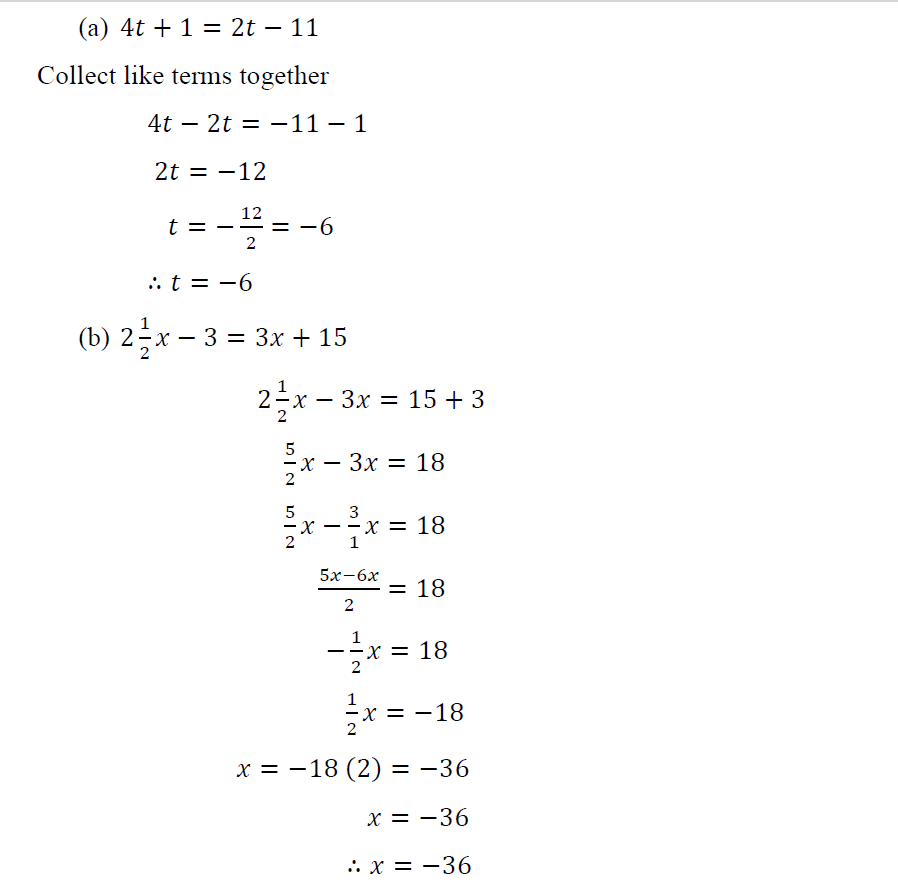
Note that in order to make the equation unaltered, whatever operation is done on one side of the equation, it must also be done on the other side.
Exercise 4
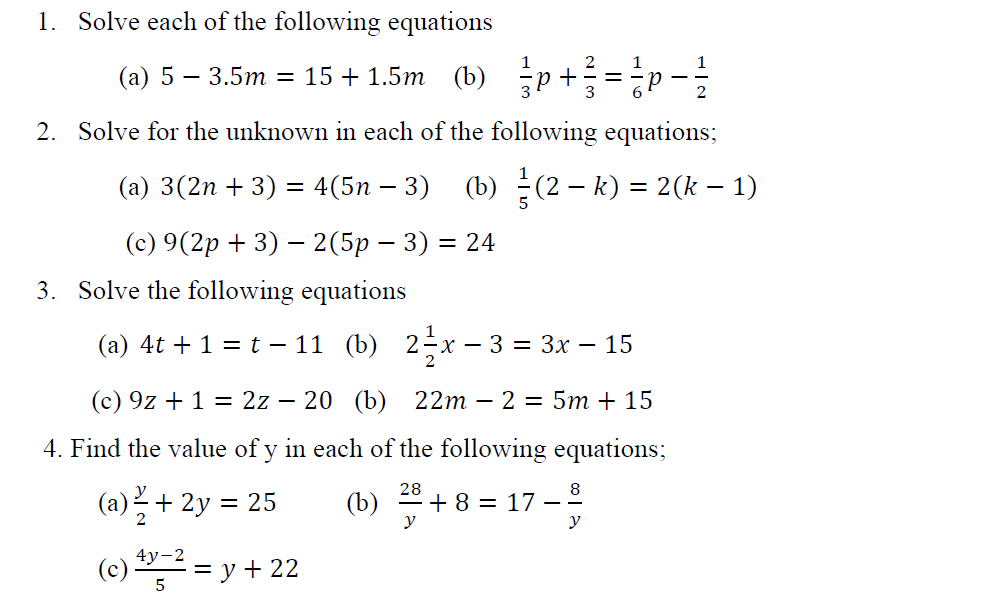
Workout for each of the following problems:
Formulate and Solve Linear Equations from Word Problems
In mathematics, solving a word problem requires you first to express the problem in mathematical form, that is formulating an equation corresponding to it. After the equation has been formulated, the normal procedures for solving the equations are used, followed by a conclusion.
Example 17
Naomi is 5 years young than Mariana. The total of their ages is 33 years. How old is Mariana?
Solution;
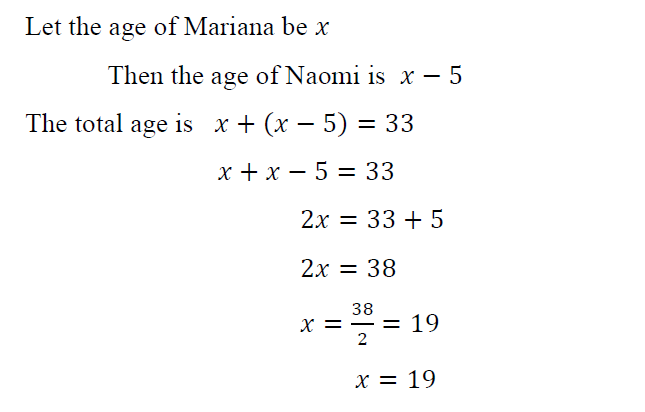
∴ Mariana is 19 years old.
Example 18
The sum of two consecutive odd numbers is120. What are the two numbers?
Solution;
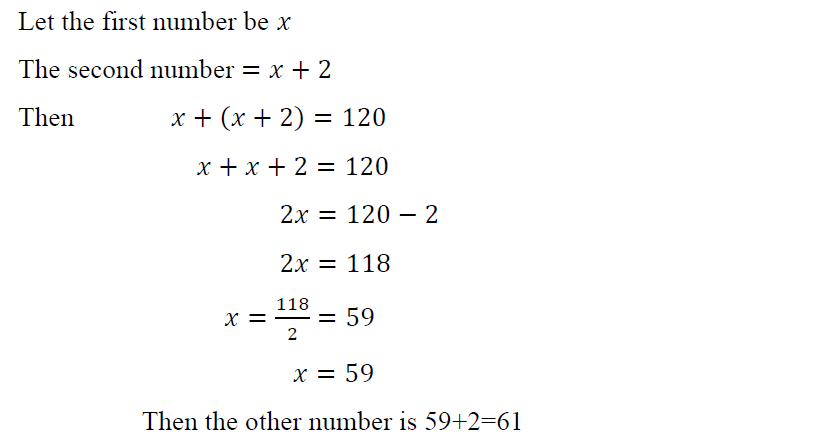
∴ The two consecutive odd numbers are 59 and 61.
Example 19
A rectangle is four times as long as it is wide. The perimeter of the rectangle is 200 𝑐𝑚. Find thearea of the rectangle.
Solution;
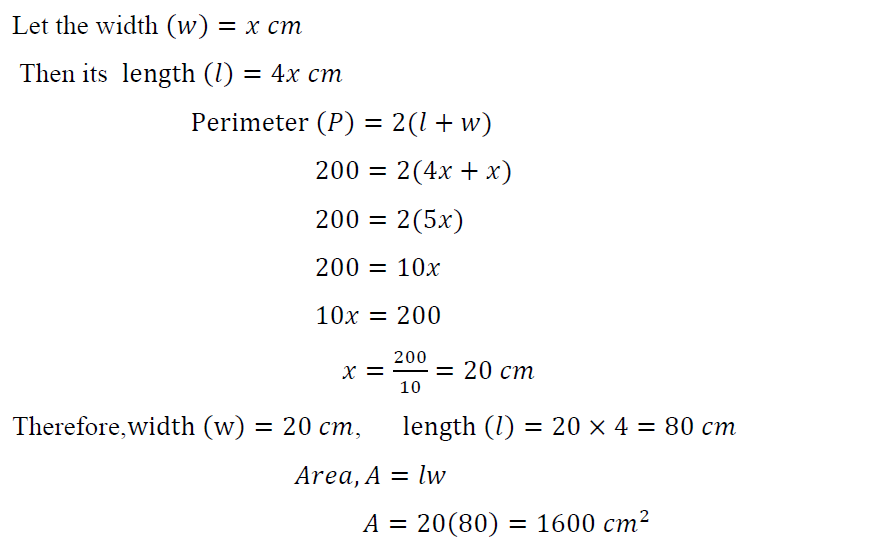
∴The area of the rectangle is 1600 𝑐𝑚2
Example 20
Rose was given Tsh. 5600 by her father to buy mangoes, how many mangoes did she get if each mango was sold at Tsh. 200?
Solution;
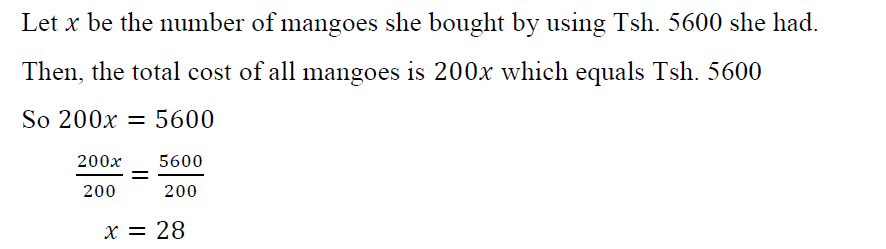
∴ She got 28 mangoes.
Example 21
A mother is 32 years older than her son. If after 4 years the mother’s age will be twice as that of her son, what is their present ages?
Solution;
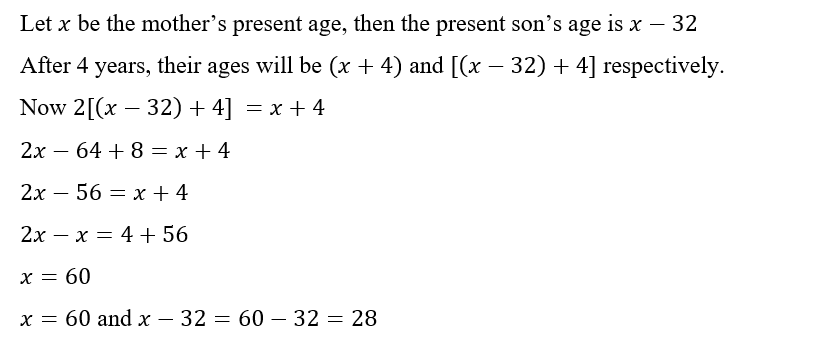
Therefore, the present mother’s age and her son’s age are 60 years and 28 years respectively.
Exercise 5
1.The sum of two consecutive numbers is 31, find the smaller number.
2. If John has two hundred shillings, how many oranges can he buy if each orange costs 50 shillings?
3. A girl has shillings and two other girls each has 40 shillings more than the first.If the three girls have a total of 980 shillings, find the value of x.
4. A boy bought y balls at 500 shillings each. This number of balls was 4 more than if the cost was 700 shillings each. Find y.
5. If the product of 2 and another number n is 25, find n.
6. The difference between 1048 and another number is 107. Find the number.
7.When the difference between 24 and m is multiplied by 5, the result is 20, find the value of m.
8. The product of half of a certain number and 6 is 48. Find the number.
9.In forty years to come, Salome will be four times as old as she was five years ago. How old is she now?
10. Two parcels have a combined weight of 46 𝑘𝑔. If one of them is 2/3 the weight of the other, what are the weights of the parcels?
Linear Simultaneous Equations
So far we have learned on how to form and solve linear equations in one unknown.However, in the real world many problems come in more than one unknowns. Therefore, in this section we discuss on how to formulate and solve linear equations in two unknowns from various real world scenarios.
The Basic Concepts of Equations in Two Unknowns (Simultaneous Equations).
Simultaneous Equations
Explore the Basic Concepts of Equations in Two Unknowns (Simultaneous Equations).
Simultaneous equations are groups of equations containing multiple variables, they are also referred to as systems of linear equations.

Solving simultaneous equations
The solution to the system of equations is a set of values of the variables involved in the equations satisfying all the equations. There are several approaches (methods) used to solve simultaneous equations but our discussion is limited to Elimination and Substitution Methods.
Linear Simultaneous Equations Using the Elimination Method
Solve Linear Simultaneous Equations Using the Elimination Method
Solving simultaneous equations by elimination method involves the following steps;
(1) Choose a variable to eliminate e. g 𝑥 or 𝑦
(2) Make sure that the letter (𝑖. 𝑒 variable) to be eliminated has the same coefficient in both equations and if not, multiply the equations with appropriate numbers that will enable the variable to be eliminated have the same coefficient in both equations.
For example,
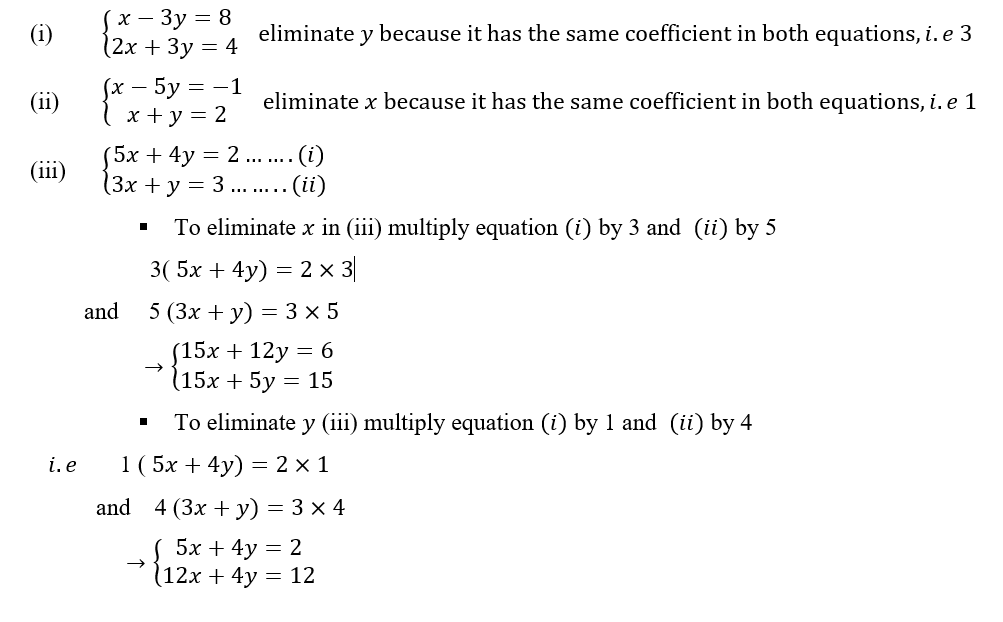
(3) If the signs of the letter (variable) to be eliminated are the same, subtract the equations.
(4) If the signs of the letter(variable) to be eliminated are different, add the equations.
Example 22
Solve the following simultaneous equations by elimination method;

Solution;
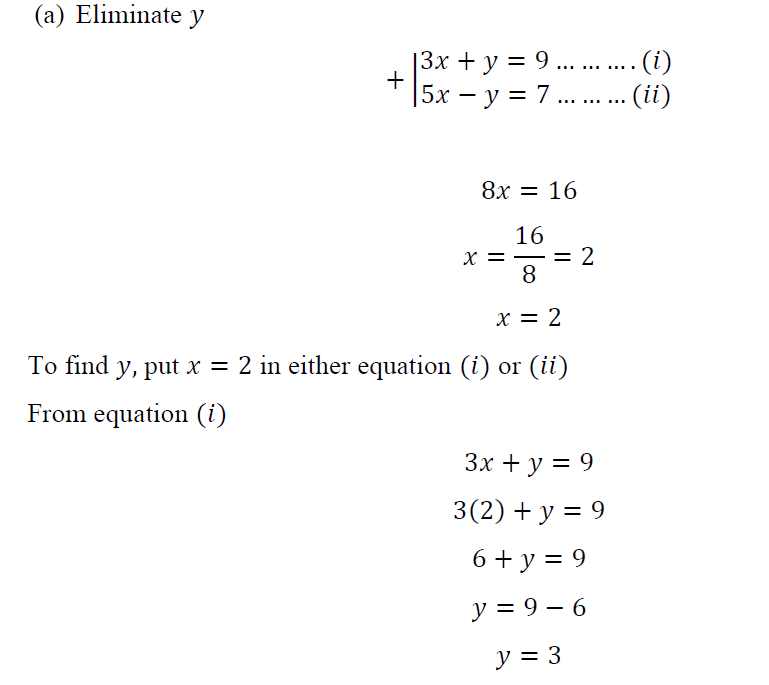
∴ 𝑥 = 2 𝑎𝑛𝑑 𝑦 = 3
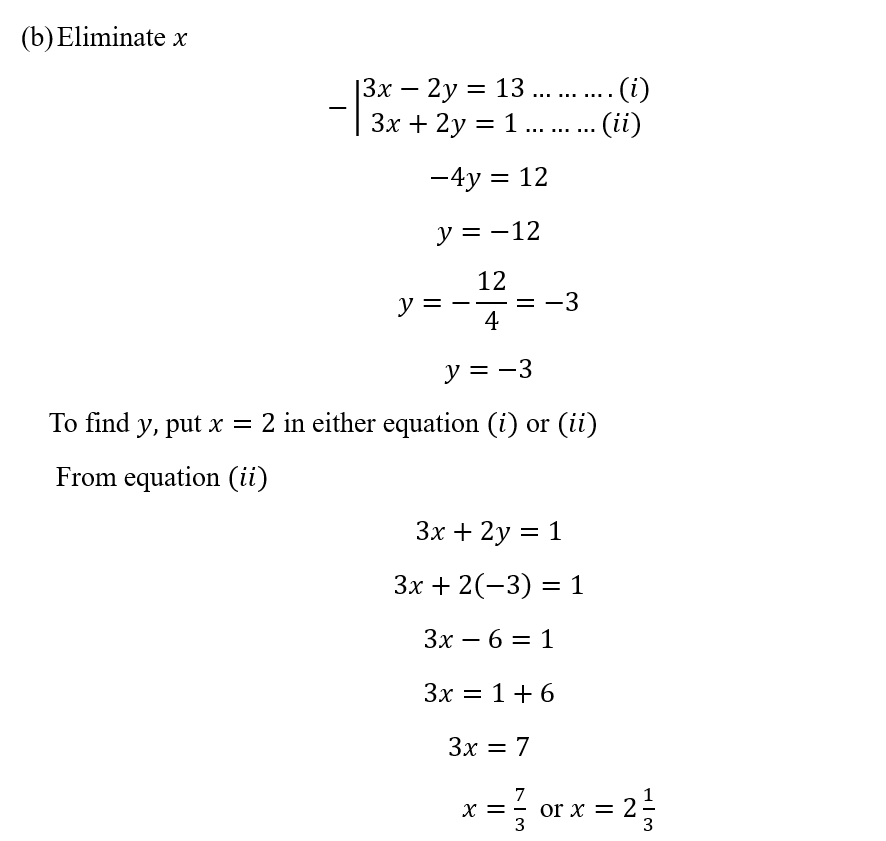
∴ 𝑥 = 7⁄3 𝑎𝑛𝑑 𝑦 = −3
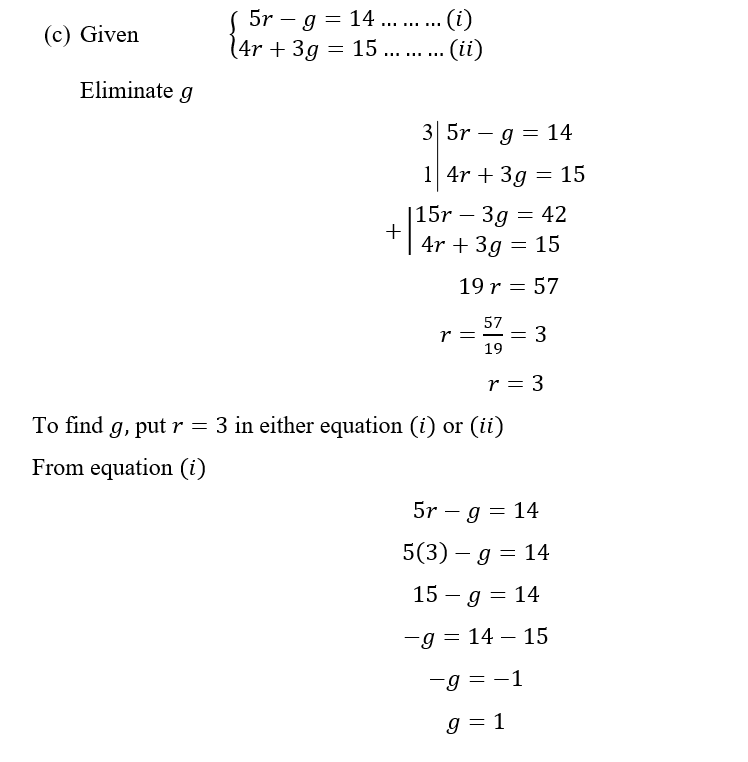
∴ 𝑟 = 3 𝑎𝑛𝑑 𝑔 = 1
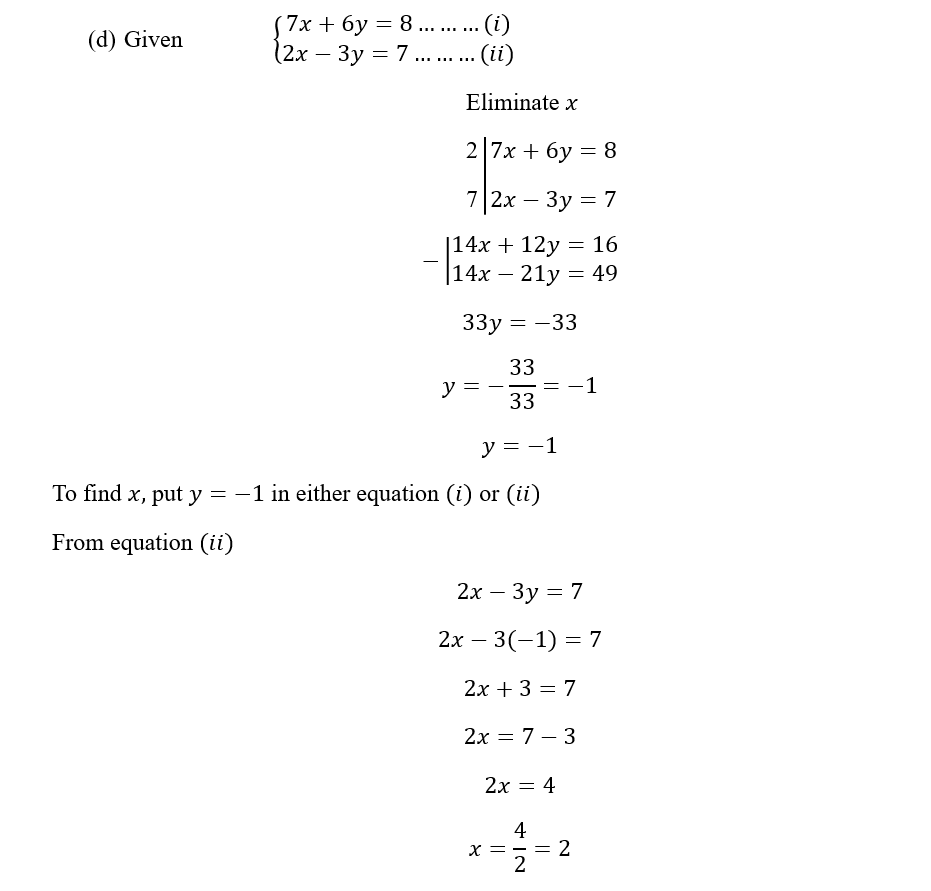
∴ 𝐱 = 𝟐 and 𝐲 = −𝟏
Linear Simultaneous Equations Using the Substitution Method
Solve Linear Simultaneous Equations Using the Substitution Method
In solving simultaneous equations by substitution method, the following steps are important:
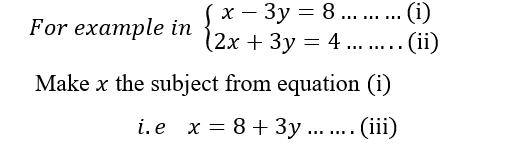
(1) Make the subject one letter from one of the two given simultaneous equations, this introduces a new equation.
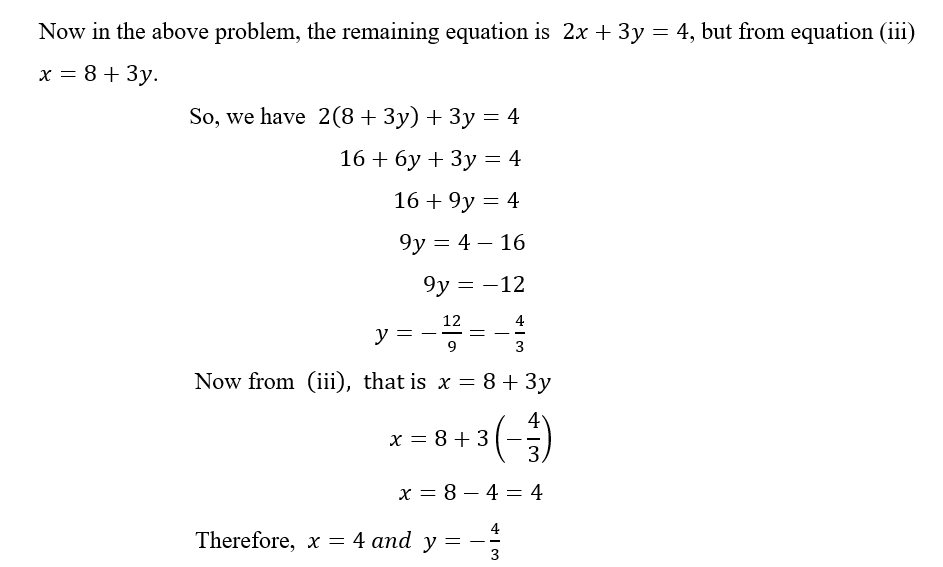
(2) Substitute (or replace) the letter in the remaining equation (that is equation (ii)) and then proceed as in the case of elimination method.
Example 23
Solve the following simultaneous equations by substitution method;

Solution;
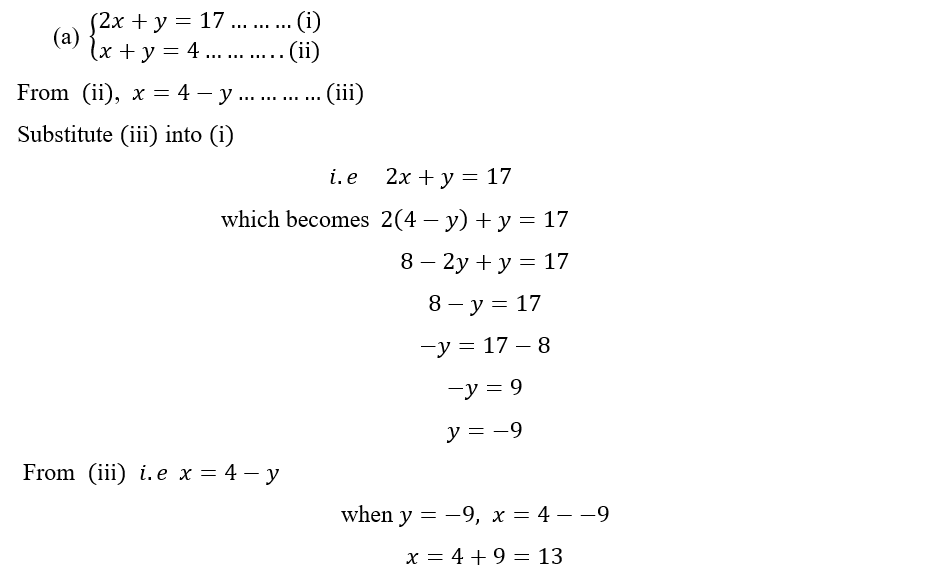
∴ 𝑥 =13 𝑎𝑛𝑑 𝑦 = −9
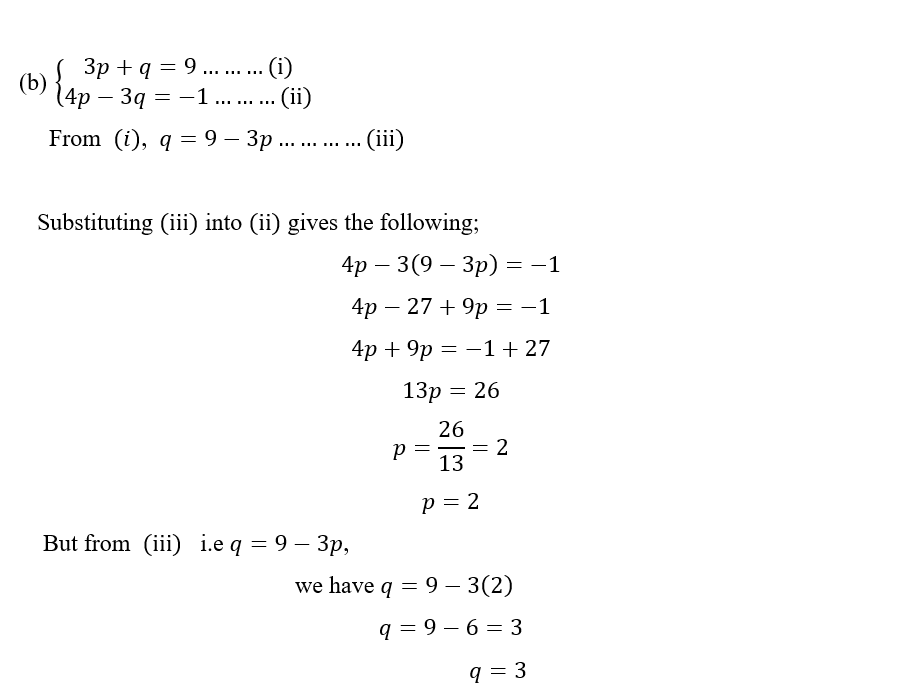
∴ 𝑝 = 2 and 𝑞 = 3
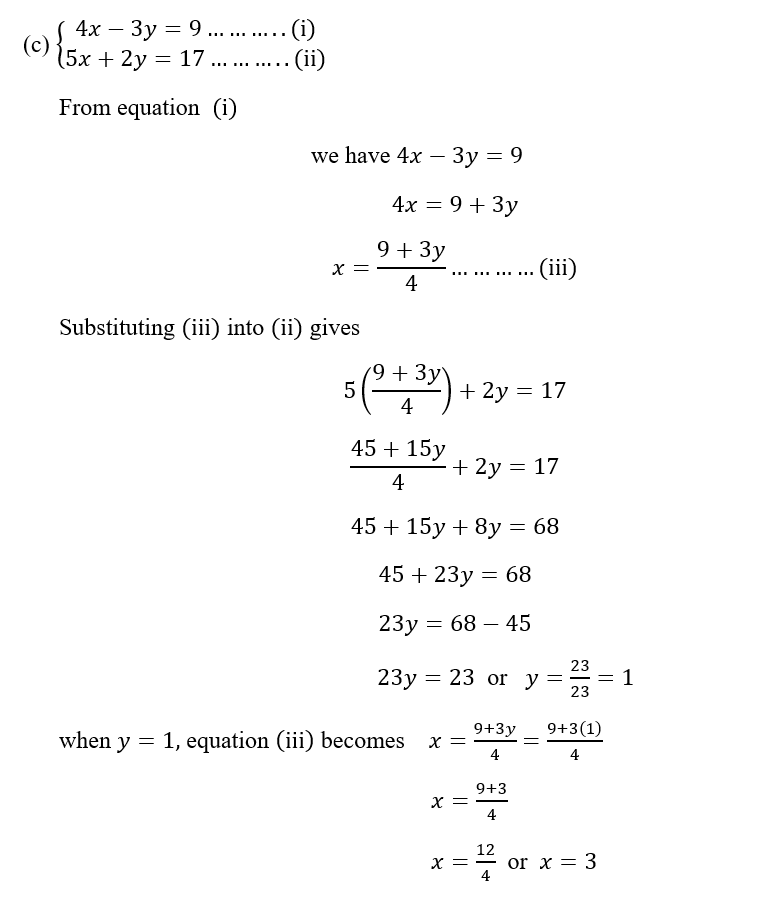
∴ 𝑥 = 3 𝑎𝑛𝑑 𝑦 = 1
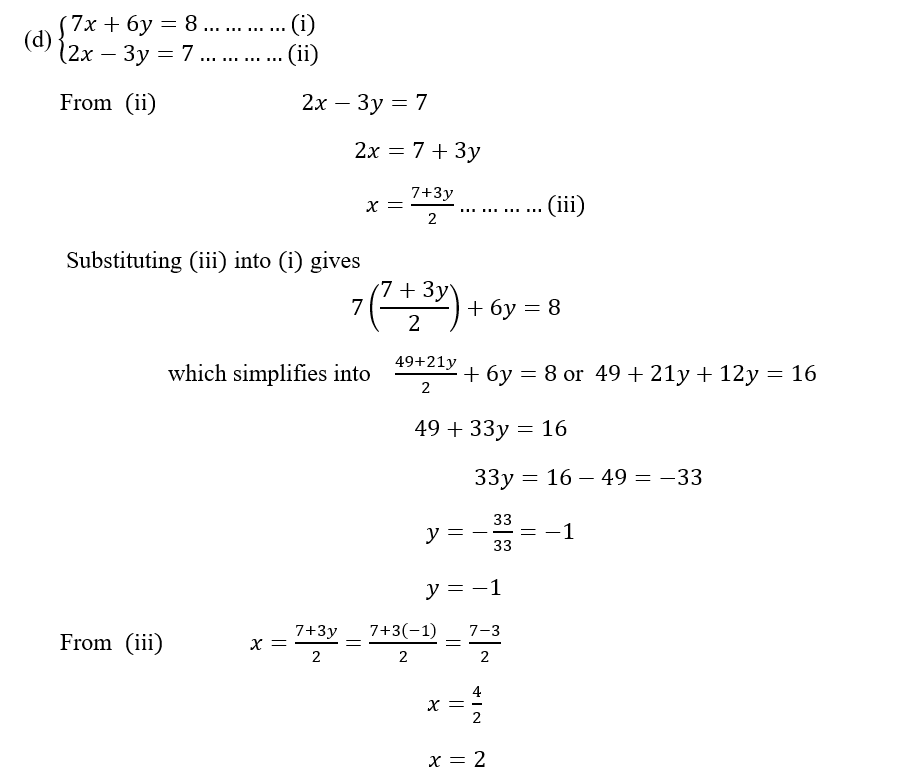
∴ 𝑥 = 2 𝑎𝑛𝑑 𝑦 = −1
Exercise 6
1.Solve the following systems of simultaneous equations by using elimination method.

2.Solve each of the following systems of simultaneous equations by using substitution method.

3. Solve the following systems of simultaneous equations by any method.

Word Problems Involving Linear Simultaneous Equations
Formulate and Solve Word Problems Involving Linear Simultaneous Equations
Word problems leading to simultaneous equations can easily be solved by first expressing or writing the problem in mathematical form as a system of two simultaneous equations. After writing the problem is in this form, you can use either elimination or substitution method to solve it, and then make your conclusion.
Example 24
If 3 Mathematics books and 4 English books weigh 9 kg , and 5 Mathematics books and 2 English books weigh 8kg, find the weight of one Mathematics book and one English book.
Solution;
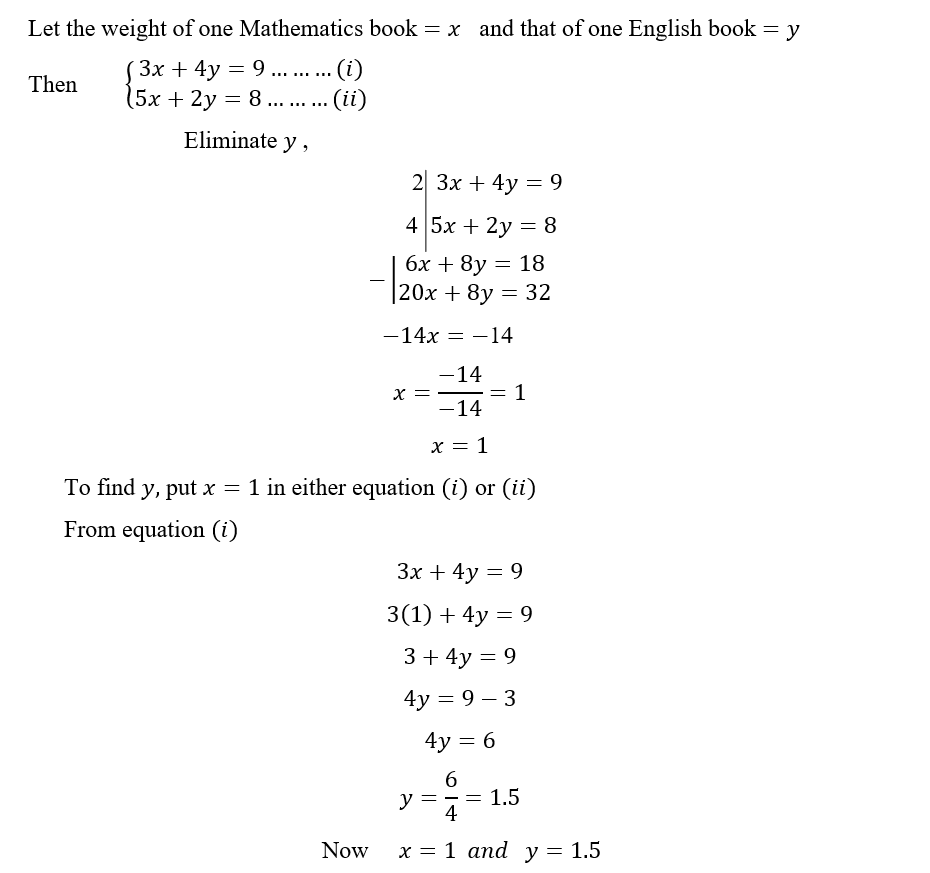
Therefore, one mathematics book weighs 1kg and one English book weighs 1.5 kg.
Example 25
The age of a father is 4 time that of his son. If the sum of there is 60 years, find the age of sonand that of his father.
Solution;
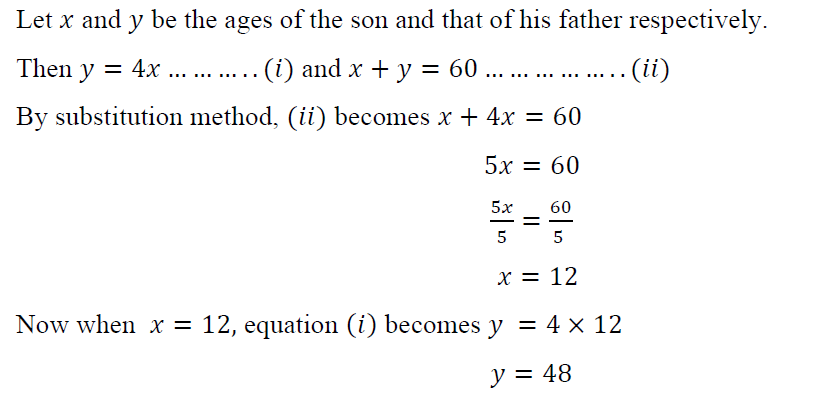
Therefore, the age of the son is 12 years and that of his father is 48 years.
Example 26
In a certain dispensary, three times the number of doctors plus the number of nurses is 9, and five times the number of doctors minus the number of nurses is 7. What is the total number of workers (doctors and nurses) are there in the dispensary?
Solution;
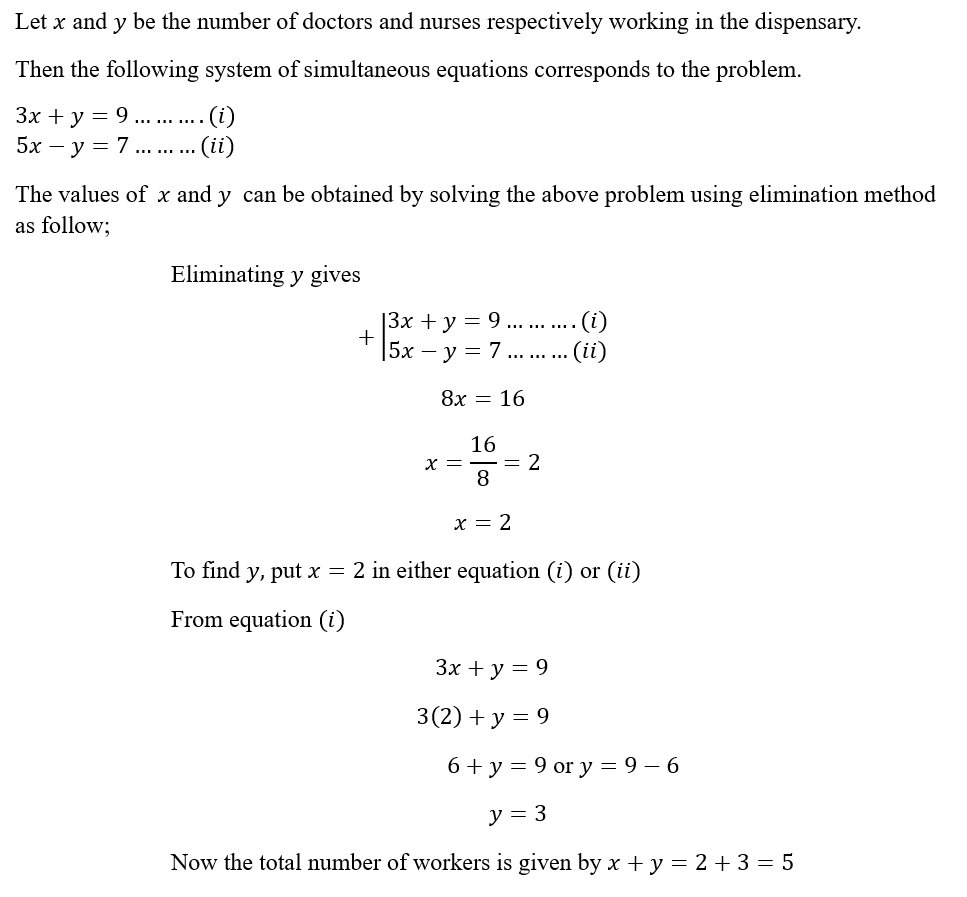
Therefore, the total number of workers (doctors and nurses) in the dispensary is 5.
Exercise 7
1.The sum of two numbers is 109 and the difference of the same numbers is 29. Find the numbers.
2.Two numbers are such that the first number plus three times the second number is 1 and the first minus three times the second is 1⁄7.Find the two numbers.
3. The sum of the number of boys and girls in a class is 36. If twice the number of girls exceeds the number of boys by 12, find the number of girls and that of boys in the class.
4. Twice the length of a rectangle exceeds three times the width of the rectangle by one centimeter and if one third of the difference of the length and the width is one centimeter, find the dimensions of the rectangle.
5. The cost of 4 pencils and five pens together is 1400 shillings while the cost of 6 pencils and 8 pens is 2200 shillings.Calculate the cost of one pencil and one pen.
6. Half of Paul's money plus one-fifth of John's money is 14,000 shillings. Three quarters of Paul's money plus two-third of John's money is 26,500 shillings. How much has each?
7. One-third the sum of two numbers is 50 and one-fifth of their difference is 2, find the numbers.
8. The current age of Juma is 5 time that of his son Yusuph. If three years ago their age sum was 78 years, what is their current age sum?
Solution of Inequalities with One Unknown
The Concept of Linear Inequalities in One Unknown
Explain the Concept of Linear Inequalities in One Unknown
In mathematics the signs =, <, >, ≤, ≥ and ≠ are used to compare the unknowns in the same way as when comparing numbers. A mathematical sentence having two or more expressions connected by " = " is called an equation 𝑒𝑔. 3𝑥 − 5 = 13
When two expressions are connected by <, >, ≤, ≥ or ≠, the resulting statement is called an inequality.
For example, 3𝑥 − 5 > 13 or 3𝑥 − 5 < 13 are inequalities.
Thus, an inequality is a mathematical statement containing two expressions which are not equal. One expression may be less or greater than the other.
In most cases the expressions are connected by the inequality symbols <, >, ≤ or ≥.
Where " < " 𝑚𝑒𝑎𝑛𝑠 less than, " > " 𝑚𝑒𝑎𝑛𝑠 greater than, " ≤ "𝑚𝑒𝑎𝑛𝑠 less or equal to, 𝑎𝑛𝑑 " ≥ 𝑚𝑒𝑎𝑛𝑠 greater or equal to.
Inequalities in One Unknown
Inequalities and the Sign-Flip Rule
Solve Inequalities in One Unknown
Solving Linear Inequalities in One Unknown;
When solving linear inequalities, the following hints (Rules) must be observed;
(i) Addition or subtraction of the same number or term from each side of the inequality does not change the inequality.
(ii) Multiplication and division of the same positive number on each side of the inequality does not change the inequality.
(iii) Multiplying or dividing each side by the same negative number changes the inequality sign.
Example 27
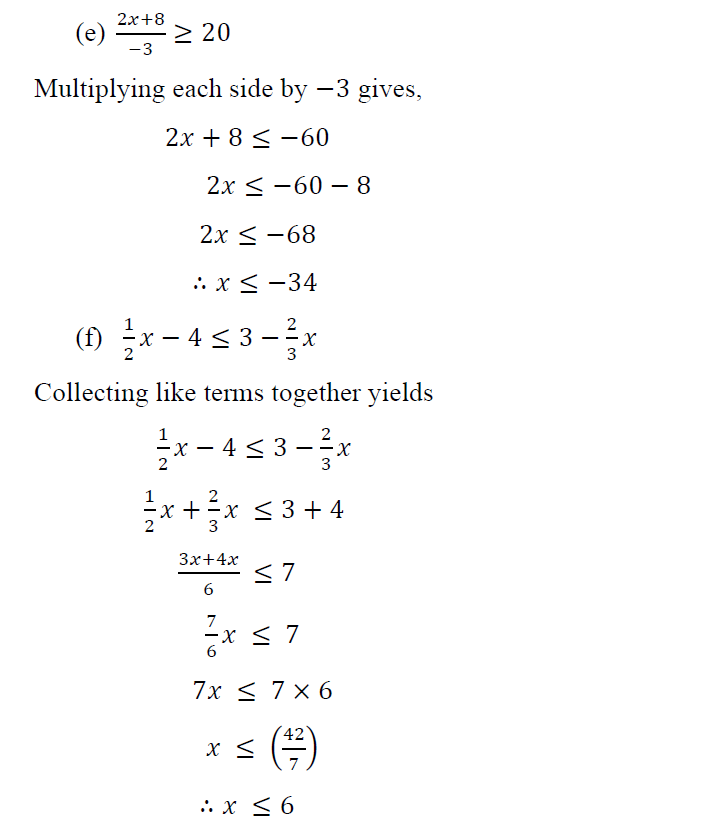
Solve the following inequalities:

Solution;
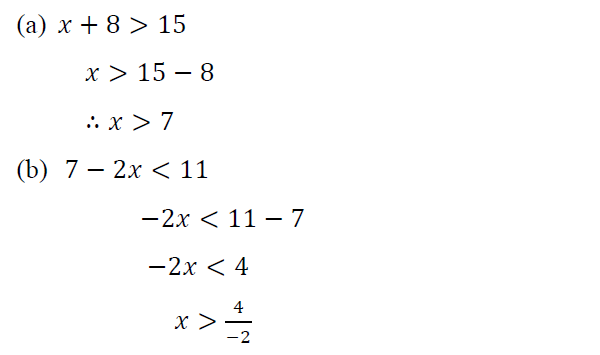
∴ 𝑥 > −2
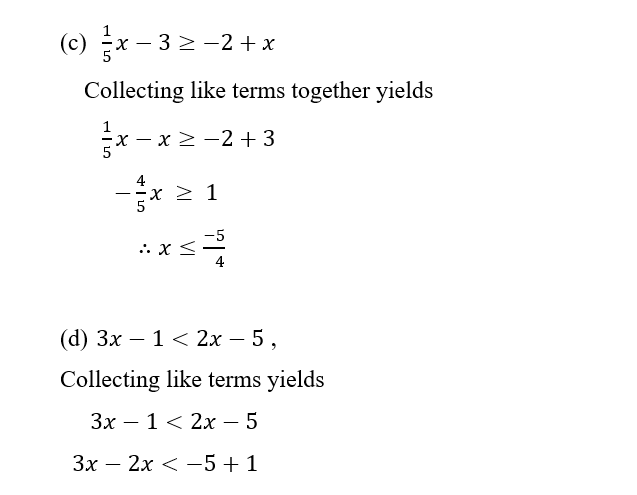
∴ 𝑥 < −4
Example 28
Find the largest integers that satisfy the following inequalities;

Solution;
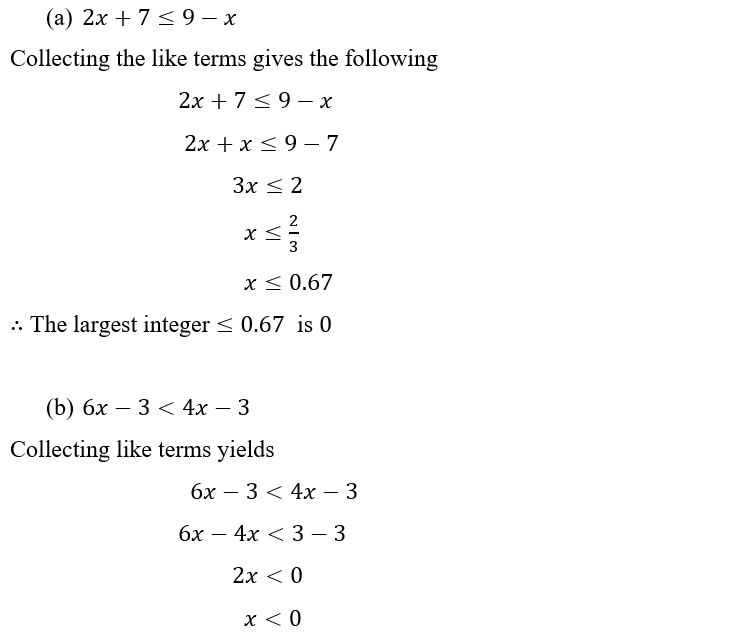
∴ The largest integer < 0 is −1
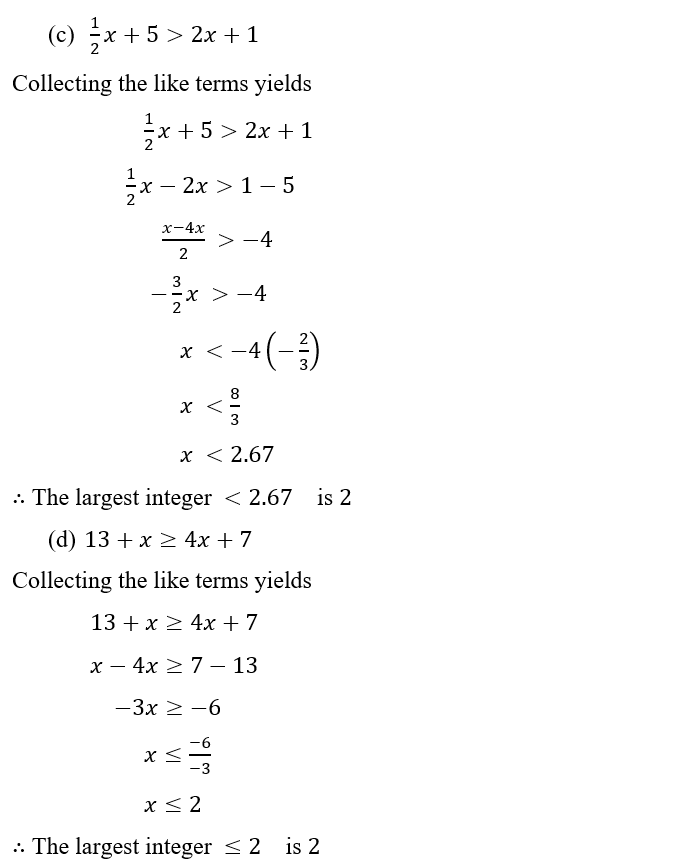
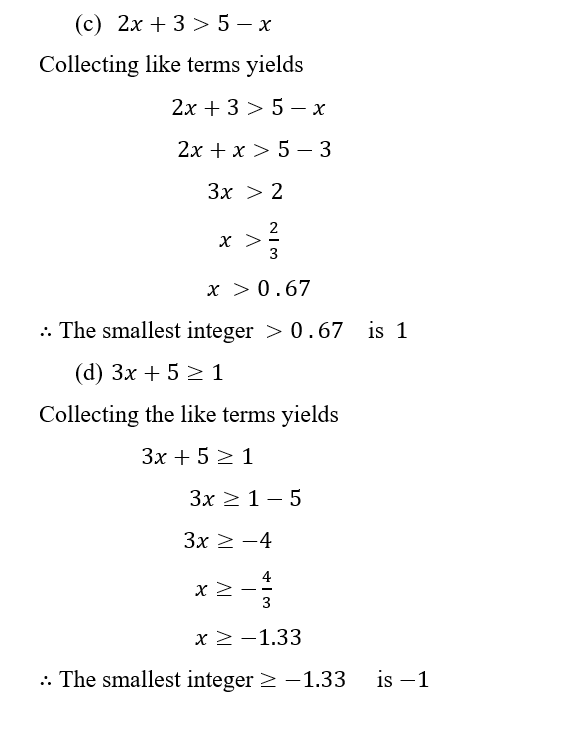
Example 29
Find the smallest integers that satisfy the following inequalities;

Solution;
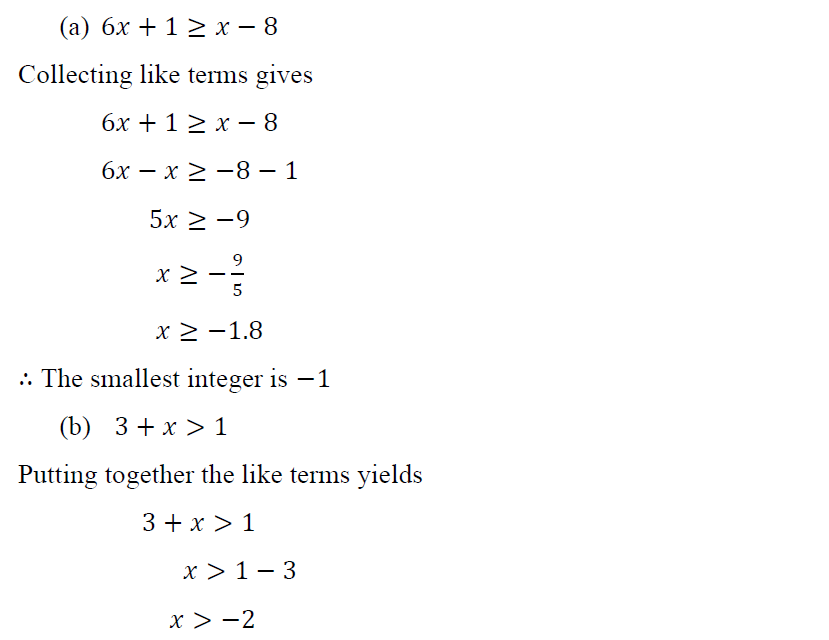
∴ The smallest integer > −2 is −1
Exercise 8
1. Solve for 𝑚 given that 𝑚 − 1 ≤ 3𝑚 − 7
2. Solve for 𝑥 in each of the following;
(a) 3(2𝑥 + 3) ≤ 4(5𝑥 − 3) (b) 2(2 − 𝑥) ≥ 2(𝑥 − 1)
3. Find the greatest integers that satisfy the following inequalities:
(a) 3 − 4𝑥 ≥ 12 (b) 4𝑥 + 3 ≤ 9
4. Find the least integers that satisfy each of the following inequalities;
(a) 1 − 2𝑥 < 5 (b) 2𝑥 − 1 ≥ 5
5. Find the solutions of the following inequalities and represent the solutions on the number line;
(a) 3𝑥 + 5 < 2𝑥 − 12 (b) −3 < 2𝑥 + 1 ≤ 5
Topic Summary
Algebra Recap: From Expressions to Inequalities
Algebra is a branch of mathematics that uses letters, symbols, and numbers to represent quantities and relationships. Letters called variables stand for unknown values, while numbers represent known values.
In algebra, we form algebraic expressions using variables, numbers, and operations such as addition, subtraction, multiplication, and division. When an expression is set equal to another expression or number, it forms an algebraic equation.
One important part in algebra is simultaneous equations. These are two or more equations involving the same unknowns, which must be solved together. The solution is the set of values that satisfies all equations at the same time. Common methods used to solve simultaneous equations include the substitution method, elimination method, and graphical method.
Algebraic Expressions
(i) In algebra, variables (letters) are treated like numbers.
(ii)When adding or subtracting the algebraic expressions, the operation is done by adding or subtracting the coefficients of the terms which are similar.
(iii) Multiplication and division of algebraic expressions can be done by multiplying or diving the coefficients of the terms.
Note: You can’t add or subtract the algebraic expressions which are not similar,also when performing any operation on algebraic expression, BODMAS must be observed.
Linear Equations
(i) A linear equation of one unknown has only one solution.
(ii) In order to solve linear equations in two unknowns, there must be exactly two equations so that one solution can be obtained.
Generally, you can solve linear simultaneous with 𝑛 unknowns if and only if youhave exactly 𝑛 equations and it is when you get a unique solution.
Common Methods for solving simultaneous Equations
Elimination method: The method involves balancing the equations such that on addition or subtraction, one variable (unknown) vanishes and one equation remains with one unknown and hence its value can easily be determined.
Substitution Method: The method involves choosing one equation from which you can choose one variable (unknown), and make it the subject, which is then substituted in the remaining equation making it the equation of one unknown.You then solve it and after getting the value of one unknown, the result is simply plugged in any of the two equations and then solve for the remaining unknown.
Solving Linear Inequalities
When solving linear inequalities, it is important to adhere to the following hints:
(i) Addition or subtraction of the same number or term from each side of the inequality does not change the inequality sign.
(ii) Multiplication and division of the same positive number on each side of theinequality does not change the inequality sign.
(iii) Multiplying or dividing each side by the same negative number changes the inequality sign.
Listening to this topic