Mathematics (New)
APPROXIMATIONS
Reading settings
Text size
Line spacing
Colours
APPROXIMATIONS
In this topic you will learn about Rounding off Numbers, Significant Figures and Approximations in Calculations.
Upon completion of this chapter, you should demonstrate competencies in Approximations by:
(i) Rounding off whole numbers to the given place values correctly (ii)Rounding off decimals to the given number of decimal places correctly (iii) Writing a number to a given number of significant figures and (iv) Performing approximations of all numbers in calculations.
These competencies should enable you to use approximations in real life situations such as preparing budgets, estimating the quantity of items, making quick calculations and judging the amounts without exact counting.
Meaning of Approximation
Introduction
In everyday life, we do not always need an exact answer. Sometimes, a number that is close to the exact value is enough. For example, we estimate the number of students in a class, or the distance between two places and the cost of items in a shop.
The process and methods of finding a value that is close to the exact value or answer is called approximation. It helps us to simplify calculations and make quick decisions. The symbol ′′≈′′ is used in approximations.
The Concept of Approximations (Rounding Off, Significant Figures, and Decimal Places)
Why We Estimate: Introducing Approximation
Explore the Concept of Approximations (Rounding Off, Significant Figures, and Decimal Places)
Rounding off numbers is the process of changing a number to a nearby and simpler number while keeping its value close to the original. It is done to make numbers easier to read, write, or use in calculations.
Rounding Off Numbers
Rounding off is the method or process of shortening a number by adjusting it according to its place value, decimal places, or significant figures. It is used to simplify calculations, improve clarity of results, and make numbers easier to handle.
The Concept of Rounding Off Numbers
Explain the Concept of Rounding Off Numbers
We already know that any number, it be a whole number, fraction or decimal is formed by choosing the digits from 0, 1, 2, 3, …………up to 9.
Therefore, rounding off numbers depends on the value of the digit from 0 to 9 immediately to the right of the place you are rounding to. This digit tells you whether to keep the digit the same or change it.
Round Off Numbers by Place Value
Rounding Off Whole Numbers by Place Value
To round off a number, check the digit to the right of the digit in the required place value and use the following rules:
Rule 1: If the digit to the right is 0, 1, 2, 3 or 4, then all the digits to the required place value are not changed.
For example, when you round off
(i) 35. 4 to ones, the number is 35
(ii) 274 to tens, the number is 270
(iii) 327 to hundreds, the number is 300
(iv) 856145 to thousands, the number is 856000.
Rule 2: If the digit to the right is 5, 6, 7, 8 or 9, then 1 is added to the digit in the required place value and all the digits to the right of it are replaced by zeros.
(i) 0. 267 to one decimal place, the number is 0. 3
(ii) 17. 82 to ones, the number is 18
(iii) 63504 to thousands, the number becomes 64000.
Example 1
A certain district has a population of 326143 people. Round off the number to thousands.
Solution;
6 is in the thousands place. The number to the right of 6 is 1. Then 326142 is 326000 rounded off to thousands.
Example 2
The population of Tanzania in a census of 2002 was 42,850,671. Round off this to the nearest:
(a) million (b) ten million
Solution;
(a) The million digit is 2, since the next digit to the right (𝑖.𝑒 8) is greater than 5, then we can increase 2 by 1 and put the remaining digits to the right of 2 zeros
(b) The ten million digit is 4, since the next digit to the right (𝑖.𝑒 2) is less than 5, then we do not change 4 but we put the remaining digits to the right of 4 zeros.
∴ 42,850,671 ≈ 𝟒𝟑,𝟎𝟎𝟎,𝟎𝟎𝟎
Example 3
Round off the numbers;
(a) 23, 429 to the nearest 100
(b) 483, 699 to the nearest 1000
(c) 1, 253, 388 to the nearest 10 000
Solution;
(a) In 23,429, the 100 digit is 4, since the next digit to the right (𝑖.𝑒 2) is less than 5, then we do not change 4 but we put the remaining digits to the right of 4 zeros
∴ 23,429 ≈ 𝟐𝟑,𝟒𝟎𝟎
(b) In 483,699, the 1000 digit is 3, since the next digit to the right (𝑖.𝑒 6) is greater than 5, then we can increase 3 by 1 and replace the remaining digits to the right of 3 by zeros
∴ 483,699 ≈ 𝟒𝟖𝟒,𝟎𝟎𝟎
(c) In 1,253,338, the 10 000 digit is 5, since the next digit to the right (𝑖.𝑒 3) is less than 5, then we do not change 5 but we put the remaining digits to the right of 4 zeros
∴ 1,253,338 ≈ 𝟏,𝟐𝟓𝟎,𝟎𝟎𝟎
Example 4
The population of a certain country in the 1967 census showed that there were 5838487 men and 6111189 women. Round off figures to:
(a) Millions (b) Thousands.
Solution;
(a) 5838487 men is 6,000,000 men rounded off to millions because a digit next to 5 is 8, so we add 1 to 5, while 6111189 women is 6,000,000 women rounded off to millions since the digit next to 6 is 1, so we add 0 to 6.
Therefore, there were approximately 6,000,000 men and 6,000,000 women in the country.
(b) 5838487 men is 5838000 men rounded off to thousands , while 6111189 women is 6111000 women rounded off to thousands.
Therefore, there were approximately 5838000 men and 6111000 women in the country.
Example 5
A certain drink producing company got a profit of Tsh 86,547,510 after selling its produced drinks last year. How much is this amount to the nearest thousands?
Solution;
The digit in a place value of thousands is 7, the next digit is 5, so we add 1 to 7 making it 8, and therefore the profit made is Tsh 86,548,000 to the nearest thousands.
Example 6
Round off the decimal 0.037 to hundredth.
Solution;
0.037 is 0.04 rounded off to hundredth.
Round Off Numbers by Decimal Places
Rounding Off Decimal Numbers
All positions occupied by digits to the right of the decimal point are the decimal places of a number. For example,
7. 2 has 1 decimal place, 6. 403 has 3 decimal places, 3. 01671 has 5 decimal places, 0. 0004 has 4 decimal places, 55. 24 has 2 decimal places, while 305 has 0 decimal place.
Rounding off decimal numbers is done through similar processes as of rounding numbers by place values.
When rounding off decimal numbers, the digits the right of the given decimal place are dropped instead of being replaced by zeros. Therefore, the following rules may be used:
Rule 1: If the digit after the rounding off digit is 0, 1, 2, 3 or 4, then the rounding off digit remains unchanged and all other digits to its right are dropped.
Rule 2: If the digit after the rounding off digit is greater or equal to 5( that is 5, 6, 7, 8 or 9), then add 1 to the rounding off digit and drop all the remaining digits that appear to the right of it.
Example 7
Determine the number of decimal places of the following numbers:
(a) 45.163 (b) 43.0431046
Solution;
(a) 45.163 has 3 decimal places
(b) 43.0431046 has 7 decimal places
Example 8
Write 125.469 correct to;
(a) 1 decimal place (b) 2 decimal places
Solution;
(a) 125. 469 is 125.5 (correct to 1 decimal place)
(b) 125.469 is 125.47 (correct to 2 decimal places)
Example 9
Write 0.0506049 correct to;
(a) 2 decimalplaces (b) 5 decimal places
Solution;
(a) 0.0506049 is 0.05 (correct to 2 decimal places)
(b) 0.0506049 is 0.05060 (correct to 5 decimal places)
Exercise 1
1. Round off to thousands each of the following numbers;
(a) 9127 (b) 34556 (c) 70600
(d) 137890 (e) 10001376 (f) 1234567
2. Round off to ones each of the following numbers;
(a) 91.27 (b) 5.56 (c) 767.74
(d) 1.378 (e) 10.176 (f) 123.4569
3. The total mass of cotton harvested in a certain district was 15816528kg. Round off this number to the nearest;
(a) millions (b) thousands.
4. In 1983 the number of primary school pupils in Kilimanjaro region was 237268. Round off this number of pupils to the nearest thousands.
5.Write each of the following correct to 2 decimal places;
(a) 0.0817 (b) 5. 0744 (c) 1.70007
(d) 0.7153 (e) 12.047 (f) 3.6149
6. Round off the following;
(a) 0.0003456 (correct to 6 decimal places)
(b) 23.67087 ( correct to 2 decimal places)
(c) 3.00876(correct to 4 decimal places)
(d) 56.678054(correct to 1 decimal place)
7. Write each of the following correct to three decimal places:
(a) 0.7526 (b) 8.4999 (c) 34.7007
(d) 5.5555 (e) 3.14159
Significant Figures
Significant figures are the digits in a number that indicate how precise it is. They consist of all the known digits and the first estimated (uncertain) digit in a given measurement.
The Concept of Significant Figures.
Significant Figures and Precision
Explain the Concept of Significant Figures
Any digit from 1 to 9 appearing in a number is a significant figure, also zero appearing between digits from 1 to 9 is a significant figure. For example, the 0 in 4602 is a significant figure.
When zeros are written to the right of the last non-zero digit of an exact number, the zeros are not significant. For example, 32,000 has only 2 significant figures.
In decimals any zero to the left of the first non-zero digit is not a significant figure. For example, the zeros in 0.025 are not significant figures.
When zero is written at the end of an approximate decimal or number, it is considered to be a significant figure.
For example, in (3.89 ≈ 𝟒.𝟎) which is approximated to the nearest ones, 0 in 4.0 is a significant figure.
Also in 37979 ≈ 𝟑𝟖𝟎𝟎𝟎 which is approximated to hundreds, 0 in the third place value is a significant figure.
Round Off Numbers Using Significant Figures
When rounding off a number to a certain significant figure, locate the digit of the required significant figure, then look at the next digit to the right;
if it is 5 or more, round off (i.e increase the digit of the required significant figure by 1) and if it is 4 or less, do not change it and replace all the remaining digits to the right of the required significant figure with the zeros.
It is important to note that in rounding off numbers according to a specific number of significant figures, similar rules as those for place value and decimal places apply.
Example 10
Write the number 845961 correct to;
(a) 1 significant figure (b) 2 significant figures (c) 5 significant figures
Solution;
(a) 845961 ≈ 800000 correct to 1 significant figure.
(b) 845961≈ 850000 correct to 2 significant figures.
(c) 845961 ≈ 845960 correct to 5 significant figures.
Example 11
Round off the number 146 400 to;
(a) 2 first significant figure.
(b) 4 significant figure
(c) 3 significant figure
Solution;
(a) 146 400 ≈ 150,000 (correct to 2 significant figures).
(b) 146 400 ≈ 146,400 (correct to 4 significant figures).
(c) 146 400 ≈ 146,000 (correct to 3 significant figures).
Example 12
Determine the number of significant figures in each of the following numbers;
(a) 2.3004 (b) 0.0603
(c) 0.000012 (d) 3001000
Solution;
(a) 2.3004 has 5 significant figures.
(b) 0.0603 has 3 significant figures.
(c) 0.000012 has 2 significant figures.
(d) 3001000 has 4 significant figures.
Exercise 2
1. Determine the number of significant figures in each of the following numbers:
(a) 26. 3004 (b) 0. 0904
(c) 0. 00002 (d) 6002000000
2. In 1983 the number of primary school pupils in Kilimanjaro region was 237268. Round off this number of pupils to 2 significant figures.
3. For each of the following, approximate the numbers correct to the required number of significant figures.
(a) 0.385173 (correct to 3 significant figures).
(b) 23092.7 (correct 4 significant figures).
(c) 12.007138 (correct to 3 significant figures).
(d) 64.474 (correct to 1 significant figure).
(e) 15.6986 (correct to 3 significant figures).
(f) 126.306 (correct to 2 significant figures).
Approximations in Calculations
In calculations, approximation is used as a technique or process of estimating a number or result (answer) rather than finding its exact value. It is commonly used when exact calculations are difficult, time-consuming, or unnecessary.
Approximations in Computations and Measurements of Quantities in Various Contexts
Approximation in Calculations
Use Approximations in Computations and Measurements of Quantities in Various Contexts
In calculations, it is helpful to find a rough estimate of the answer first. To carry out a quick check of all calculations, you must take suitable approximations by rounding off all the numbers involved.
Note that the symbol "≈" is used for approximation.
Example 13
Estimate the value of;
(a) 521×29 (b) 49×91
Solution;
(a) To make finding the product easy, round off 521 to hundreds and 29 to tens.
521×29 ≈ 500×30 =15000
∴ 521×29 ≈ 𝟏𝟓,𝟎𝟎𝟎
(b) 49×91 ≈ 50×90 = 4500
∴ 49×91 ≈ 𝟒𝟓𝟎𝟎
Note that the exact answers for part (a) and (b) are 15,109 and 4,459 respectively.
Example 14
Estimate the value of 3869÷198.
Solution;
3869÷198 ≈ 4000÷200 = 20
∴ 3869÷198 ≈ 𝟐𝟎
Example 15
Estimate the value of 4.1×0.082
Solution;
By rounding off 4.1 to ones and 0.082 to hundredths,
4.1×0.082 ≈ 4.0×0.08 = 0.32
∴4.1×0.082 ≈ 𝟎.𝟑𝟐
Example 16
A school tour which involved 32 people, every person was required to pay a transport fee of 𝑇𝑠ℎ 5800. What was the approximate total transport cost?
Solution;
Total transport is given by 32×5800 ≈ 30×6000 =180,000
∴ The approximate transport cost was 𝑻𝒔𝒉 𝟏𝟖𝟎,𝟎𝟎𝟎.
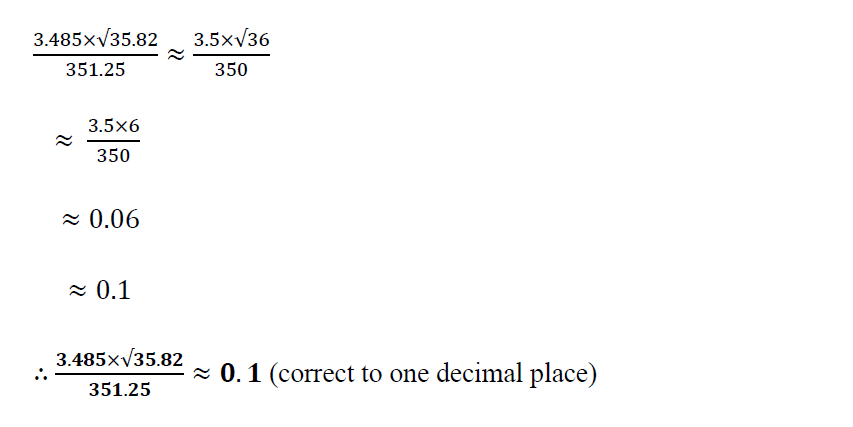
Example 17
Perform the following;

Solution;
Exercise 3
1. Estimate the value of;
(a) 2991×3.9
(b) 4.4×9.8
2.Find the estimate the value of ;
(a) 5869÷296
(b) 3.004÷0.489
3. Find the estimate value of 1367×4794.
Topic Summary
In Approximation we deal with finding values that are close to the exact value when an exact answer is not necessary or not possible. Approximation helps to make calculations simpler and quicker, especially in everyday situations.
The chapter introduces learners to the concept of rounding off numbers to the nearest place value such as tens, hundreds, decimal places, or significant figures.
Rounding off Numbers
In rounding off numbers, the following RULES are important:
(i) If the digit to the right is less than 5, the digit in the required place value remains unchanged, and all digits to the right of it are dropped (or replaced by zeros if necessary).
(ii) If the digit to the right is greater than or equal to 5, then one is added to the digit in the required place and all the digits to the right of it are replaced by zeros or dropped.
Note: In case one the number is reduced while in case two the number is increased.
Significant Figures
When dealing with significant figures, the following points are important:
(i) All non-zero digits in any whole number are significant figures.
(ii) Any zero between two non –zero digits are also significant figures.
(iii) All zeros appearing to the right of the last non-zero digit in any number are not significant figures.
(iv) In decimals, any zero to the left of the first non-zero digit is not a significant figure. For example, the zeros in 0.0001247 are not significant figures.
(v) When zero is written at the end of an approximate decimal or number it is a significant figure. For example, 5.673 is approximately 5.70 (to one decimal place), in this case, zero is a significant figure. Also, the number 5873 is approximately 6000, zero in the second place-value is a significant figure, but the remaining zeros are not.
Approximations in Calculations
When working with approximations in calculations, exact numbers are first replaced with approximate values to make calculations easier. The results obtained are therefore estimates, not exact answers.
Steps to work with approximations
1.Choose the required level of accuracy: Decide whether to round to a given place value, decimal places, or significant figures.
2. Approximate the numbers: Round each number according to the rounding rule. If the digit to the right of the required place value is 5 or more, round up but if it is less than 5, round down.
3.Perform the calculation: Carry out the required operation (addition, subtraction, multiplication, or division) using the approximated values.
4.State the answer correctly: Use the symbol ≈ (approximately equal to) to show that the answer is an approximation.
Listening to this topic