Mathematics (New)
NUMBERS
Reading settings
Text size
Line spacing
Colours
NUMBERS
This topic covers Concept of numbers, Rational numbers, Irrational numbers, Real numbers, Inequalities in real numbers and Absolute values of real numbers.
Upon completion of this chapter, you should demonstrate competencies in Numbers by: (i) Defining and Distinguishing between Rational, Irrational and Real Numbers correctly (ii) Identifying the place value of each digit in in a given number (iii) Performing basic operations on numbers correctly (iv) Converting Fractions into Decimal numbers correctly (v) Converting Repeating Decimals into Fractions correctly (vi) Representing a given Number on a number Line correctly (vi) Solving Inequalities in Real numbers and (vii) Finding the absolute value of Real numbers.
The competencies acquired from this topic should enable you to perform daily life activities like counting things, managing money, comparing items in terms of their quantities or values, distributing items and interpreting numbers.
Introduction
Numbers are mathematical objects used in counting, measurements, making comparisons and calculations.They are a fundamental part of mathematics and are used in everyday life, Science and Technology. Numbers help us in different ways, for example we use numbers when telling time, counting money and sharing of items. Therefore, learning numbers is an important step in understanding mathematics and solving day to day real problems.
Concept of Numbers
The Concept of Numbers
Explain the Concept of Numbers
The concept numbers is somewhat broad as the term include Whole numbers, Natural numbers, Fractions, Integers and Decimals. The other major categories of numbers are Rational numbers, Irrational numbers and Real numbers, which we are going to discuss in details.
Rational Numbers
Rational numbers are all those numbers which can be written as fractions without putting into consideration approximations. They also have a property that they can be represented on a number line without making approximations.
The Concept of Rational Numbers.
Rational Numbers and Recurring Decimals
Fraction
Explain the Concept of Rational Numbers.
Any number that can be written in the form of 𝑎⁄𝑏 where a and b are integers and b ≠ 0, is called a rational number. Note that in a rational number 𝑎⁄𝑏 , b ≠ 0 because the result of any number divided by zero is undefined.
Rational numbers can be zero, negative or positive. All integers are rational numbers with a denominator 1. Terminating and recurring decimals are also rational numbers because they can be expressed in the form of 𝑎/𝑏.
Therefore; fractions, integers, whole numbers, terminating and repeating(recurring) decimals together form a set of rational numbers.

The Rational Numbers on a Number Line
Represent Rational Numbers on a Number Line
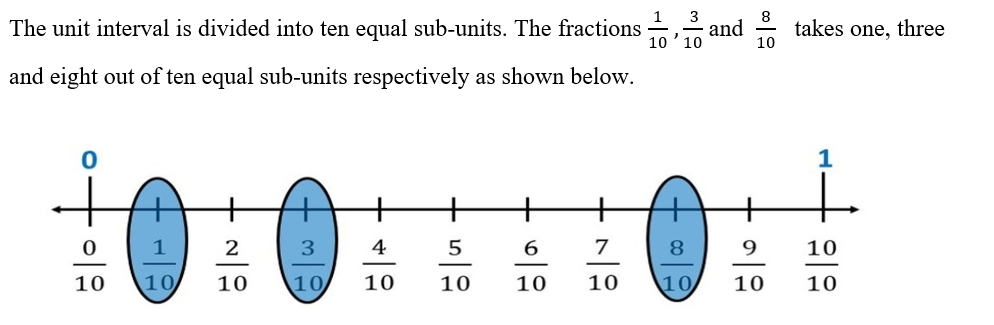
Rational numbers can be represented on a number line by dividing the given unit intervals of the number line into equal sub-units.
Example 1
Represent 1/10, 3/10 and 8/10 on a number line.
Solution;
Example 2
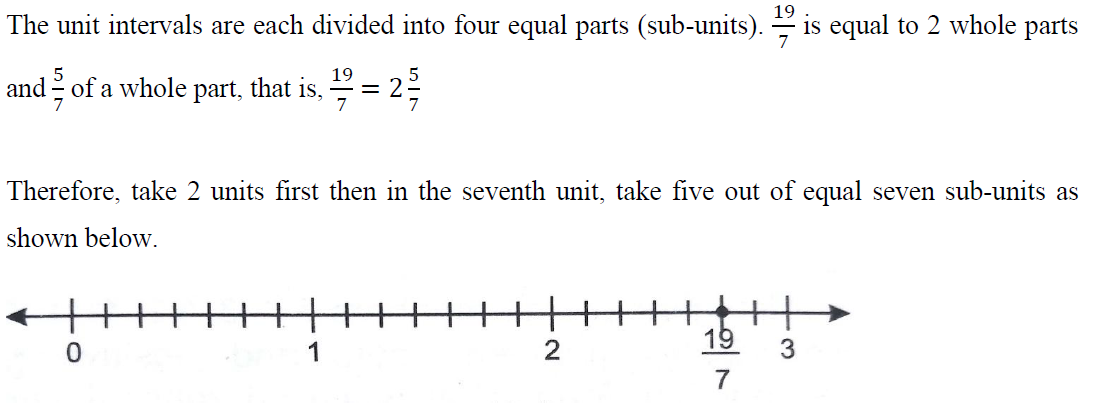
Represent 19/7 on a number line.
Solution;
Example 3
Represent −6/5 on a number line;
Solution;

Example 4
Represent −2.4 on a number line;
Solution;

Exercise 1
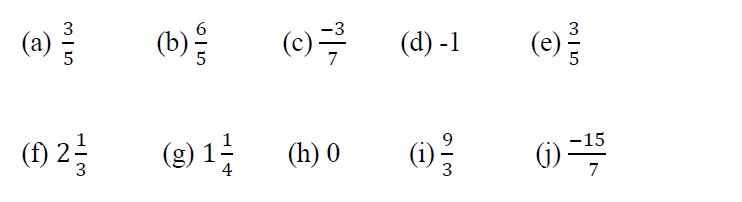
1. Show the position of each of the following rational numbers on a number line;
2. Write each of the following numbers in the form of 𝑎/𝑏 where a and b are integers and b ≠ 0.

3. Indicate the position of each of the following rational numbers on a number line.

Repeating/Recurring Decimals into Fractions and Vice Versa
Converting Decimals
Decimal
Convert Repeating/Recurring Decimals into Fractions and Vice Versa
Consider the following diagram, which shows one shaded part out of 10 equal sections of a rectangle ABCD.
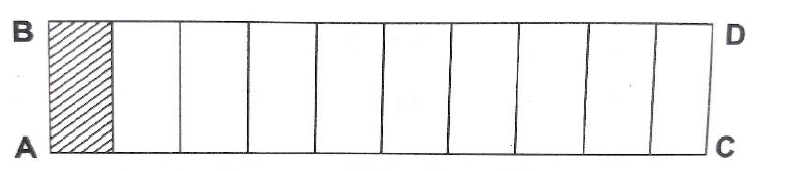
The shaded region in the diagram above can be written as 1/10 in fraction, it can also be written as 0.1 in decimal form, which is read as zero point one.
The rectangle can again be subdivided up into other 10 equal sections where each section can be written as 1/10÷10=1/100 or 0.01 in decimal form and each subsection can further be divided into other 10 equal parts, the division process can continue up to the desirable size of each section. Therefore, we can define a decimal as a fraction of tenth.
In a decimal number every digit has a unique place value, for example, in 7.543 the place value of each digit including those appearing after a decimal point can be determined as follows.

Considering the decimal number 8.152 , the place value of 1 is 𝐭𝐞𝐧𝐭𝐡𝐬 (i.e 1/10), that of 5 is 𝐡𝐮𝐧𝐝𝐫𝐞𝐝𝐭𝐡𝐬 (i.e 5/100), while the place value of 2 is 𝐭𝐡𝐨𝐮𝐬𝐚𝐧𝐝𝐭𝐡𝐬 (i.e 2/1000).

Note that decimal numbers such as 0.1, 0.001, 7.567, 5.6 and 8.152 have a countable number of digits after the decimal point, these are called terminating decimals.
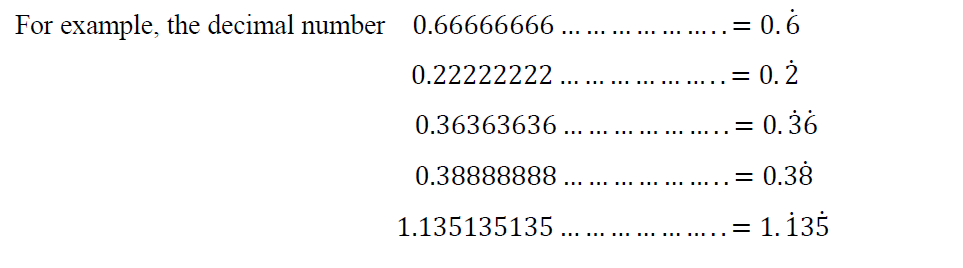
Decimal numbers such as 0.8333333…….., 0.12121212…. and 3.0234234234234……… are called recurring or repeating decimals, because they have digits that repeat endlessly after a decimal point. For example, in 0.8333333……………., the digit number (3) repeats itself with no end, in 0.121212……. two digits (12) repeat while in 3.0234234234…….. three digits (234) repeat.
Normally we indicate the recurring/repeating decimals by putting dots on the digits that repeat.
Converting Fractions into Recurring Decimals
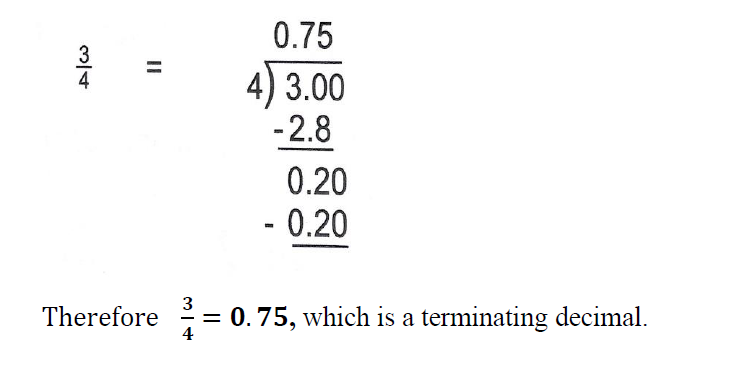
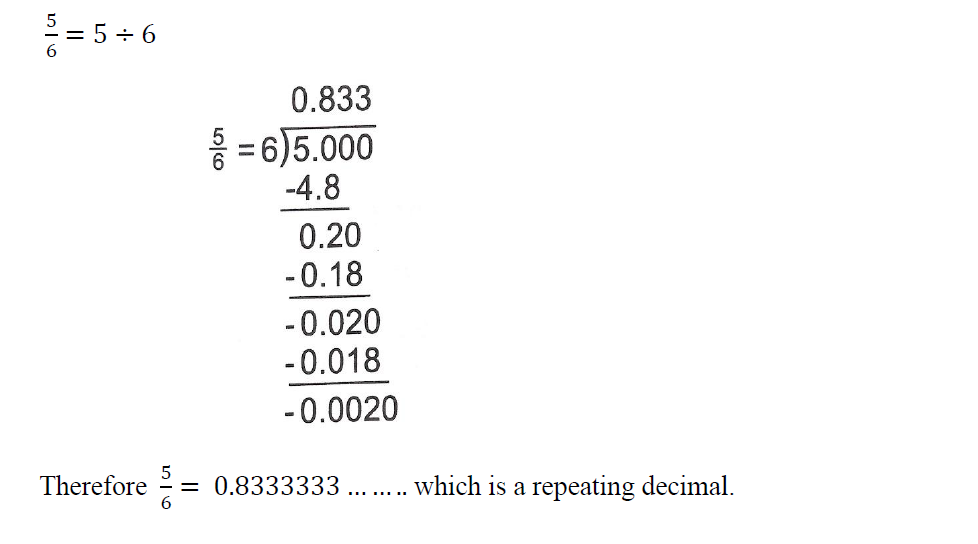
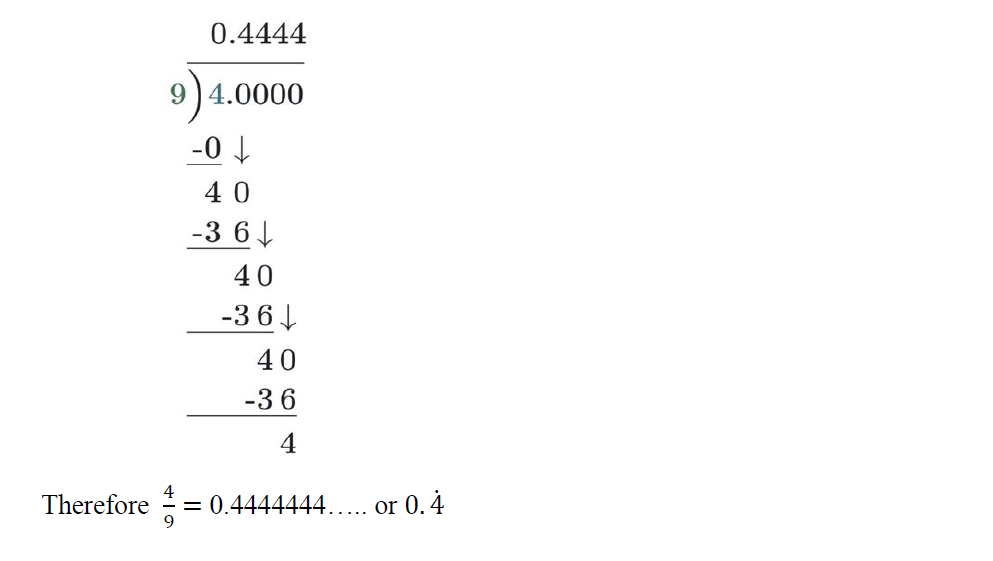
From a fraction, a decimal number is obtained by performing a long division between a Numerator (Dividend) and Denominator(Divisor). The process gives either terminating or recurring decimals.
Example 5
Convert 3/4 into a decimal.
Solution;
Example 6
Express 5/6 as a decimal.
Solution;
Example 7
Express 4/9 as a repeating decimal.
Solution;
Example 8
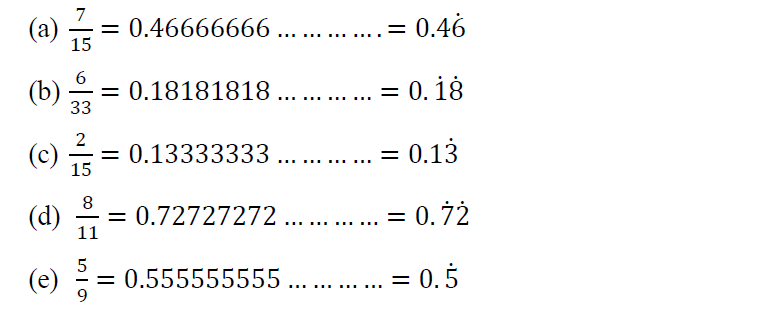
Convert each of the following fractions into decimals, write your answers as recurring decimals:

Solution;
Converting Recurring Decimals into Fractions
To convert recurring decimals into fractions it is important to identify the number of digits that are repeating in a given decimal number.
The following examples illustrate on how recurring decimals can be converted into fractions.
Example 9
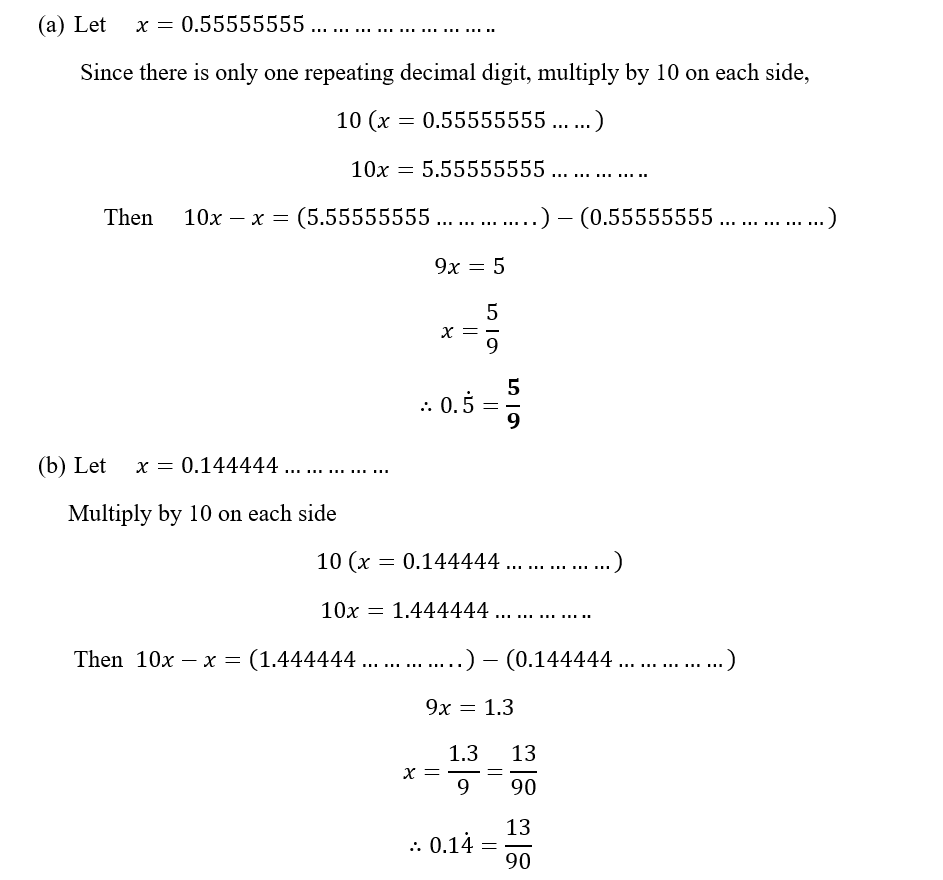
Convert each of the following decimals into fractions:

Solution;
Example 10
Convert each of the following recurring decimals into fractions;

Exercise 2
1. Convert the following fractions into decimals, writing the answers as recurring decimals;
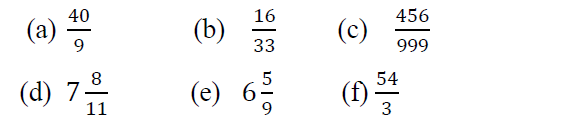
2. Convert each of the following decimals into fractions.

3. Express each of the following numbers in form of 𝒂/𝒃.

Irrational Numbers
The Concept of Irrational Numbers
Irrational and Real Numbers: Comparing Values
Explain the Concept of Irrational Numbers
So far, we have learnt that terminating and repeating (recurring) decimals are rational numbers, and can be written in form of 𝑎/𝑏 where 𝑏≠0. However, there are other numbers which cannot expressed in the form of 𝑎/𝑏.

Irrational Numbers on a Number Line
Represent Irrational Numbers on a Number Line
It is not possible to indicate the exact position of an irrational number on a number line, but we can only approximate its position. For example, on the number line, √2 lies between 1 and 2, and 𝜋 lies between 3 and 4.
Example 11
Represent 0.512783132…… on a number line correct to 2 decimal places.
Solution;
0.512783132 is approximately 0.51 correct to 2 decimal places, so on a number line, it appears as follows;

Example 12
Represent 𝜋 on a number line correct to 2 decimal places.
Solution;
The value of 𝜋 is approximately 3.14 correct to 2 decimal places, so on a number line, it appears as follows;

Exercise 3
1. State which of the following numbers are rational and which are irrational.

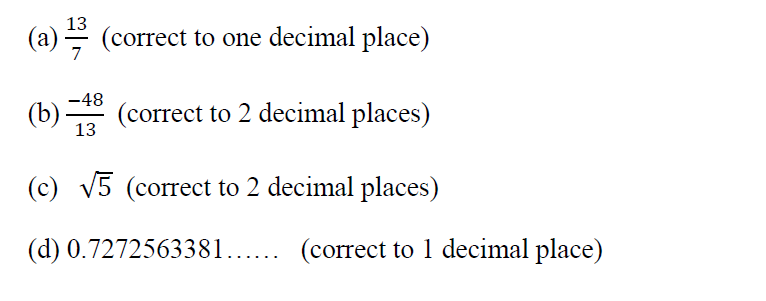
2. Locate the following irrational numbers on the number line;
Real Numbers
The Concept of Real Numbers
Explain the Concept of Real Numbers
Any number that can be indicated on a number line is called a real number. Therefore, both rational and irrational numbers form a set of real numbers as shown in figure 2.1
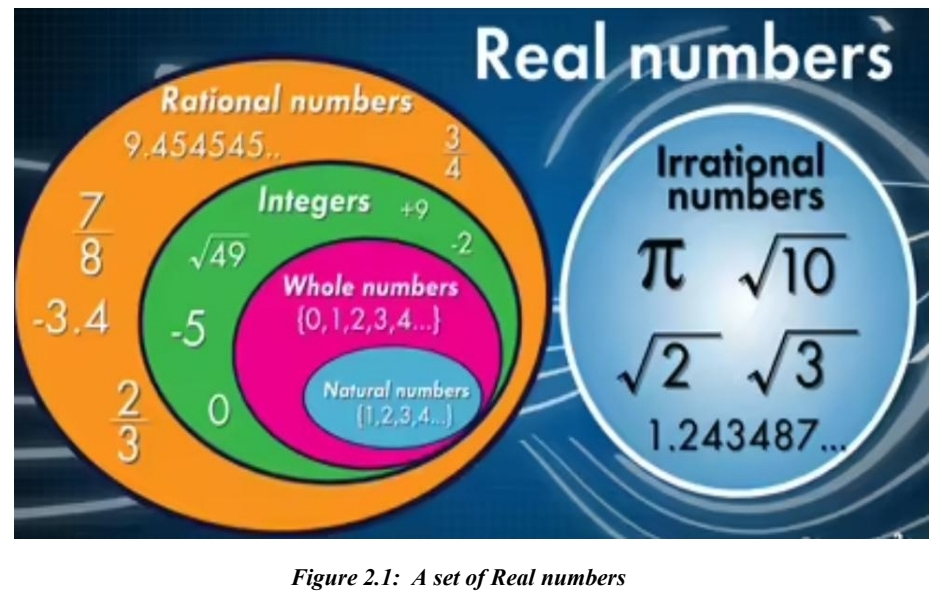
Examples of real numbers include the following;

Inequalities in Real Numbers
In our communities we always hear statements like Mr. Juma is older than his wife Asha, the cost of one type of a certain product is higher compared to the other, or she arrived late than her colleagues at the event. Such real life situations which involve comparisons in making decisions, give a rise to the so called inequalities.
The Concept of Linear Inequalities and Solve Related Problems
Explain the Concept of Linear Inequalities and Solve Related Problems
Generally, the term inequality stands for a mathematical statement which compares two values or expression in the same units.
The comparison is done by using the terms like Equal (=), Greater than (>), Less than (<), Less than or equal to (≤), Greater than or equal to (≥) and sometimes Not equal to (≠).
For example, we say 10 is greater than 3, or equivalently 3 is less than 10. Also, we may say the age of John is greater than that of his wife Anna to mean that John is older than his wife or equivalently Anna is younger than her husband John.
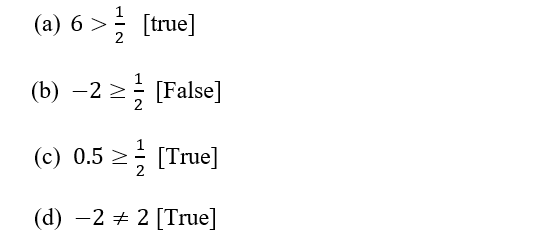
Example 13
Write true or false for each of the following mathematical statements:

Solution;
Example 14
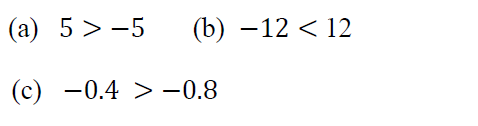
For each of the following, insert the mathematical symbol (=, <, or >) to make the statement true:
(a) 5( )−5
(b) −12 ( ) 12
(c) −0.4 ( )−0.8
Solution;
Real Numbers on a Number Line
Represent Real Numbers on a Number Line
It is not possible to list all the real numbers which lie between any two given integers. For example, between 0 and 1, there are uncountable real numbers.
However, the range of numbers between these two numbers can be represented using a number line, as shown by the following examples.
Example 15
Represent each of the following sets of real numbers on a number line.

Solution;
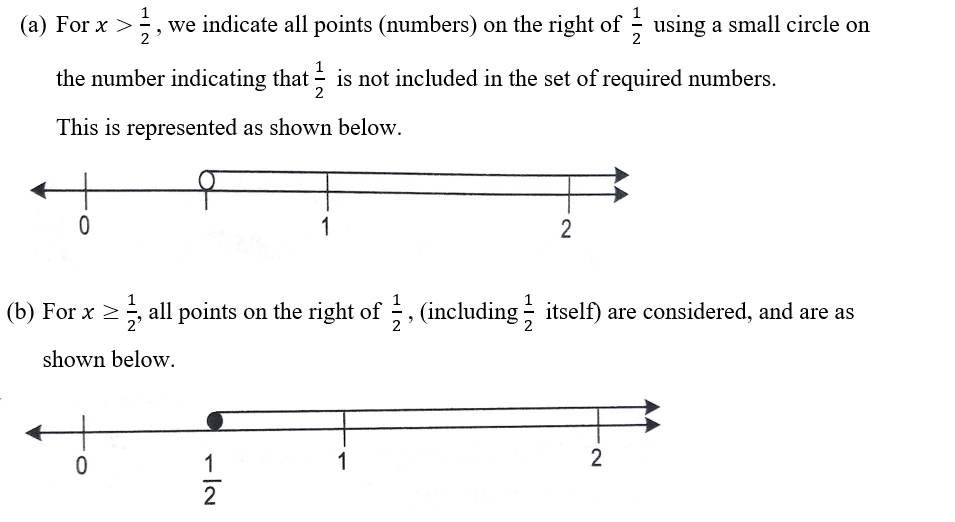
NB: A thick dot on a point is used to indicate that a particular point is included.
Example 16
Represent −3 < 𝑥 ≤ 6 on a number line.
Solution;
These are two real numbers 𝑥 ≤ 6 and 𝑥 >−3, and on the number line, they appear as shown below;

NB: In the interval −3 < 𝑥 ≤ 6, −3 is excluded while 6 is included in the set of the required numbers.
Example 17
Indicate all real numbers 𝑥 such that 𝑥 ≤ 3/2 on a number line.
Solution;

Example 18
Show on the number line all real numbers between −5/3 and 2 inclusively.
Solution;

Exercise 4
1. Locate the following real numbers on a number line.
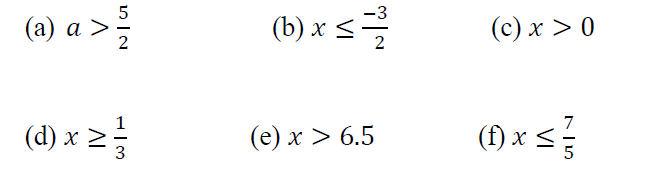
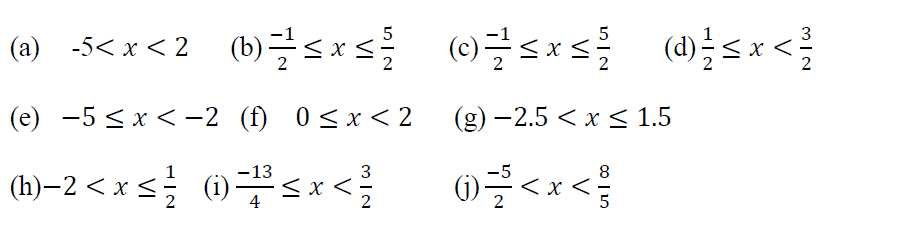
2. Represent the following mathematical statements on a number line:
3. Write the inequalities represented by each of the following number lines.
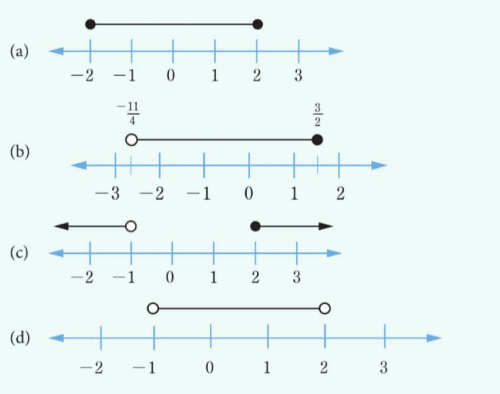
4. In question 3(a) and 3(b) above, how many integers are contained in the interval?
5. List all integers contained in the intervals represented by part (e) and (i) of question 2 above.
Comparisons of Real Numbers
Make Comparisons of Real Numbers
For any two real numbers 𝑎 and 𝑏, only one of the following is true.
Either 𝑎 = 𝑏, or 𝑎 < 𝑏 , or 𝑎 > 𝑏
For example, if 𝑎 = 6.350867… and 𝑏 = 6.350869….., then 𝑎 < 𝑏, the difference is at the sixth decimal place of the two numbers.
Likewise, if 𝑎 = 6.351867… and 𝑏 = 6.350867….., then 𝑎 > 𝑏, the difference is at the third decimal place of the two numbers.
Absolute Value of Real Numbers
The Concept of the Absolute Value of a Real Number and Solve Related Problems
Absolute Value: Distance from Zero
Explain the Concept of the Absolute Value of a Real Number and Solve Related Problems
The absolute value of a number is the magnitude of the number regardless its sign, it shows how far a number is from zero, for example both -2 and 2 have the same absolute value, that is 2 because they are all 2 units from zero but in opposite direction.
So, the absolute value of − 𝑥 𝑖𝑠 𝑥 , written as |𝑥|. The sign before 𝑥 is ignored. This is because the distance represented is the same whether in positive or negative direction.
For example, a girl walking 6 steps forward or 6 steps backwards will be considered to have moved the same distance from where she originally was, regardless of the direction. This can be represented on a number line as shown below:

The 6 steps forward (+6) and 6 steps backward (-6) have the same absolute value which is 6.
Therefore, |𝑥|= 𝑥 when 𝑥 is positive (𝑥 > 0) and |𝑥|=−𝑥 when 𝑥 is negative (𝑥 < 0). Note that the absolute value of 0 is 0.
For example, |3|=3 since 3 is positive and |−3|=−(−3) = 3 since the number is negative.
Example 19
Solve for 𝑥 𝑖𝑓,|𝑥|=5
Solution;
For any number 𝑥, |𝑥| = 5, there are two possible values.
∴ 𝑥 = 5 𝑜𝑟 𝑥 =−𝟓
Example 20
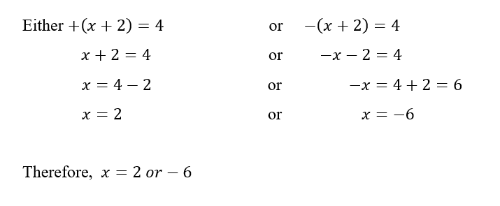
Solve for 𝑥, given that |𝑥+2|= 4
Solution;
Example 21
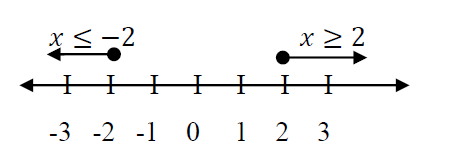
Solve for 𝑥 𝑖𝑛 |𝑥| ≥ 2 and illustrate the answer on a number line.
Solution;
Either 𝑥 ≥ 2 𝑜𝑟 −𝑥 ≥ 2; Equivalently, 𝑥 ≥ 2 or 𝑥 ≤ −2
∴ 𝑥 ≥ 2 or 𝑥 ≤ −2, and this can be represented on the number line as follows.
Example 22
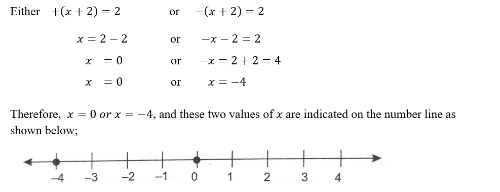
Find the solution of |𝑥+2|=2 and show it on the number line.
Solution;
Example 23
Indicate |𝑥| ≤ 2 on the number line.
Solution;
|𝑥| ≤ 2 means either 𝑥 ≤ 2 or −𝑥 ≤ 2
Now 𝑥 ≤ 2 or 𝑥 ≥−2, which can be combined to form −2 ≤ 𝑥 ≤ 2, since 𝑥 ≥−2 is equivalent to −2 ≤ 𝑥.
Therefore −2 ≤ 𝑥 ≤ 2 is shown on the number line below;

Exercise 5
1.Write the absolute value of each of the following:

2. Find the value of each of the following:

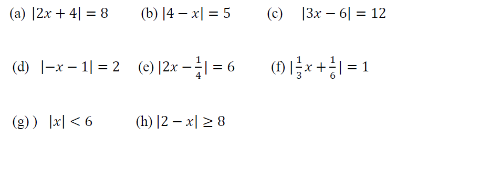
3. Solve each of the following equations and represent the results on a number line.
Topic Summary
Numbers is the chapter dealing with different types of numbers and how they are used in mathematics.
It begins with natural numbers, which are counting numbers, and whole numbers, which include zero. Integers include positive numbers, negative numbers, and zero.
In numbers, rational and irrational numbers are also discussed. However, the focus of this chapter has been on rational, irrational and real numbers.
Rational and Irrational Numbers
Any number that can be written or expressed in the form of a/b where both a and b are integers and b≠0 is a Rational number. Rational numbers include all integers, all fractions, terminating decimals and Repeating/Recurring Decimals.
All numbers that can’t be expressed in the form of a/b are called Irrational numbers. This group include numbers like √2, √7 and 𝜋.
Order of Real Numbers
For any two real numbers a and b, only one of the following is true;
i) a is greater than b (𝐚>b)
(ii) 𝐚 is less than b OR equivalently b is greater than a ( b>a).
(iii) a equals b (𝐚=𝐛)
Real Numbers
Any number that can be indicated on a number line is called a real number. Real numbers include both rational and irrational numbers.
Absolute Value of Real Numbers
The absolute value describes the distance of a number on the number line from zero without considering which direction from zero the number lies.
The absolute value of a number is never negative. For example, the absolute value of 5 is 5 and the absolute value of −5 is 5.
Listening to this topic