Chemistry
Air Combustion, Rusting And Fire Fighting
Reading settings
Text size
Line spacing
Colours
Chemistry is all around us. Did you know that everything is made out of chemicals? Any reaction taking place in body cells of all living and non living organisms correlates with chemistry. In chemistry we study materials that make up the earth and universe. Chemistry is sometimes called the central science because it bridges other natural sciences, including physics, geology and biology. Therefore, when talking about chemistry, we are referring to life on Earth.
Air Combustion, Rusting And Fire Fighting
Introduction
Air is the homogenous mixture of different gases. The gases that make up air are oxygen, nitrogen, carbon dioxide, and noble gases; air also contains water vapour and dust particles. In this chapter, you will learn about components of air, combustion, firefighting and rusting. By the end of the chapter, you should be able to demonstrate the presence of different gases in air and determine the percentage of oxygen in air experimentally. You should also be able demonstrate the combustion of different substances in air, and describe the applications of combustion in real life. Moreover, you are expected to be able to classify types of fires according to their causes, and identify different types of fire extinguishers used to extinguish different types of fires. Lastly, you should be able to demonstrate the conditions necessary for iron to rust, and describe different methods of preventing iron from rusting
Composition of air
CHEMISTRY FORM1 composition of air
Air is a mixture of different gases. The gases that make up the air include nitrogen, oxygen, carbon dioxide, noble gases (argon, helium, neon, krypton and xenon) and a little water vapour. Air may also contain traces of impurities such as carbon monoxide (CO), sulphur dioxide (SO2), hydrogen sulphide (H2S) and other gases. The presence of these gases in air results in air pollution. Table bellow shows the composition of air by volume. The proportion of water vapour and impurities in air is very variable.
The Gases Present in Air and their Proportions
Composition Of Air
Name the gases present in air and their proportions
The composition of air is not exactly the same everywhere. It changes slightly from day to day and from place to place. There is more water vapour in the air on a damp day and in air above water bodies such as oceans, seas, lakes, rivers, etc. Over busy cities and industrial areas there is more carbon dioxide. But the uneven heating of the earth's surface by the sun causes the air to move continually, resulting in winds. The resultant winds spread the pollutants around.
| Gas | Approximate percentage |
| Nitrogen | 78.00% |
| Oxygen | 21.00% |
| Noble (rare) gases mainly argon | 0.94% |
| Carbon dioxide | 0.03% |
| Water vapour | 0 – 4% |
The Presence of Different Gases in Air
Demonstrate the presence of different gases in air
The composition of air is not exactly the same everywhere. It changes slightly from day to day and from place to place. There is more water vapour in the air on a damp day and in the air above water bodies such as oceans, seas, lakes, and rivers. Over busy cities and industrial areas, there is more carbon dioxide. But the uneven heating of the Earth's surface by the sun causes the air to move continually, resulting in winds. The resultant winds spread the pollutants around
The presence of oxygen in air
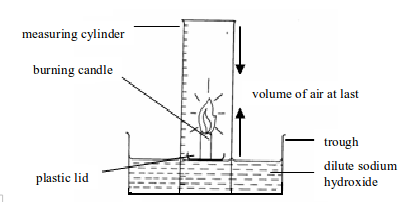
Oxygen is known as the active portion of the air because it supports combustion and combines with many other substances. Its presence and composition in air can be determined by using these properties. For example, if you light the candle and place the measuring cylinder over the top, as shown in Figure 6.1, the oxygen in air enclosed in the measuring cylinder will be used to burn the candle to produce carbon dioxide gas. The carbon dioxide so produced dissolves in sodium hydroxide solution. The dissolved carbon dioxide causes the level of sodium hydroxide solution to rise up. The oxygen gas used to burn the candle is practically equal to the amount of carbon dioxide produced. This fact is, therefore, used to calculate the percentage of oxygen in air
The Percentage of Oxygen in Air Experimentally
Determine the percentage of oxygen in air experimentally
1. Experiment. Determination of the presence and proportion of oxygen in air by combustion of a candle
Method
- Place a small candle on a plastic lid or any object that can float. Then set up the apparatus as shown in figure bellow. Sodium hydroxide is used in order to absorb the carbon dioxide gas produced by a burning candle.
- Light the candle and place the measuring cylinder over the top. Note the level of sodium hydroxide solution in the measuring cylinder at the start. A candle will stop burning (go off) once all the oxygen in the cylinder is used up.
- When the candle goes off, leave the apparatus to cool to room temperature. The purpose of cooling is to let the heated and expanded air to return to its normal condition. Then note the level of sodium hydroxide solution in the measuring cylinder.
.
Observation and findings
The oxygen in air enclosed in the measuring cylinder is used to burn the candle to produce carbon dioxide gas. The carbon dioxide so produced dissolves in sodium hydroxide solution. The dissolved carbon dioxide causes the level of sodium hydroxide solution to rise up. The oxygen gas used to burn the candle is practically equal to the amount of carbon dioxide produced. This fact is, therefore, used to calculate the percentage of oxygen in air.
Model results
In the experiment, the initial volume of air was found to be 70.5 cm3 and the final volume was 55 cm3. The percentage of oxygen in the air is calculated in two steps:
1. To find the volume of oxygen used up to burn the candle (which is practically equal to the volume of carbon dioxide produced and then absorbed by sodium hydroxide), we subtract the final volume of air from the initial volume
Volume or oxygen used = Initial volume of air – final volume of air
Therefore, the volume of oxygen used for combustion of the candle = 14.7 cm.

Alternatively, the volume of oxygen used up can be calculated by subtracting the initial volume of sodium hydroxide solution from the final volume. That is: Volume of oxygen used = final volume of sodium hydroxide – initial volume of sodium hydroxide = Volume of carbon dioxide dissolved in sodium hydroxide.
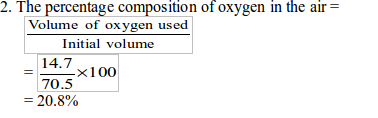
Therefore, the percentage of oxygen = 20.8%
In practice, it is difficult to get an accurate result with the above experiment.

This is due to a number of reasons such as:
- Not all the carbon dioxide is absorbed by the sodium hydroxide.
- The candle may go out (stop burning) before all the oxygen is used up due to accumulation of carbon dioxide in the cylinder.
- The heating of the air inside the measuring cylinder causes the gases to expand. This is why it is essential that the gases be allowed to cool to room temperature before reading the level.
The experiment in Activity 6.3 involves analysis of oxygen in air by reacting copper with oxygen to give copper(II) oxide. In this experiment;
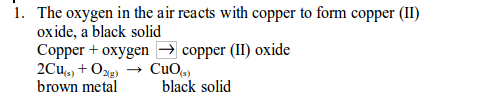
- The oxygen in the air reacts with copper to form copper(II) oxide, a black solid:

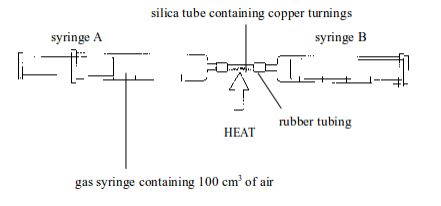
- The final volume of air in the syringe (shown in Figure 6.2), at the end of the experiment, is less than that of the original volume. This is because oxygen in the original air has combined with copper
2. Experiment . Determination of the presence and proportion of oxygen in air by the combustion of copper in air
Method
- Set up the apparatus as shown in figure bellow. Syringe A should contain 100 cm of air, syringe B should be empty.
- Heat the copper strongly and pass the air from syringe A back and forth (by pushing the piston of the syringe inward and outward) over the copper turnings a few times. Allow the air to cool and measure the volume of air in syringe A.
- Repeat the heating and cooling until the volume of air that remains in syringe A is constant. The copper is heated and cooled several times to ensure that it reacts with all oxygen in the sample of air.
`
Observations and findings
2. The final volume of air in the syringe, at the end of the experiment, is less than that of the original volume. This is because oxygen in the original air has combined with copper
Model of result
The volume of air in the syringe at different heating and cooling is as shown below:
Initial volume before heating = 100 cm3
Volume after first heating and cooling = 82 cm3
Volume after second heating and cooling = 79 cm3
Volume after third heating and cooling =79 cm3
The volume of oxygen used up = Initial volume of air before cooling - volume of air after the last heating and cooling
= 100 - 79
= 21%
The presence of carbon dioxide in air

Carbon dioxide is present in air to the extent of 0.03% by volume. The gas is formed during the combustion of all common fuels – wood, coal, coke, natural gas, petrol, diesel, paraffin oil, etc, all of which contain carbon.
It is breathed out as a waste product of respiration by all animals. All sorts of combustion and burning produce carbon dioxide. The gas produced by all these processes accumulates in air. However, the amount of carbon dioxide in air remains constant instead of the tremendous quantities released into the atmosphere. This is because plants take up carbon dioxide. They then convert it into complex starchy compounds during photosynthesis. The gas also dissolves in ocean water and other water bodies.
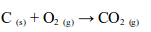
The presence of carbon dioxide in air can be shown by passing air through a test tube containing some limewater (figure 6.5). After a time, the limewater turns milky. This shows the presence of carbon dioxide.
Combustion
Air Combution 1
Chemistry F1 Air Combution
The Concept of Combustion
Explain the concept of combustion
Combustion refers to a reaction of a substance with oxygen which is accompanied by the release of energy in the form of heat and light. Combustion can take place in the open air such as the bonfire, or in a closed system, such as the combustion of fuel in a car engine. Oxygen in air supports the combustion. It is called a supporter of combustion. The gas surrounds any burning material. However, oxygen can sometimes combine chemically with the burning substance to produce a new substance. For example, when copper turnings are heated in air, the oxygen in air combines with copper to form copper(II) oxide.
The Combustion of Different Substances in Air and Analyse the Products
Demonstrate the combustion of different substances in air and analyse the products
Combustion in which a flame is produced is described as burning. Many substances can burn in air. During burning, energy is given out in the form of heat, light, and sound. Substances such as coal, wood, kerosene, and petrol burn in air. Any substance that burns is called a combustible material. Various combustible materials burn in air to give different products. For example, the kerosene in a tin lamp burns to produce light and dark smoke (carbon). Magnesium burns to produce whitish magnesium oxide. The items such as paper, piece of cloth, charcoal, wood, dry grass burn up to produce ash
Activity 1
Aim: Combustion of different substances in air.
Materials: tin lamp, kerosene, matchbox, funnel, paper, piece of cloth, charcoal, wood, dry grass, magnesium ribbon, and crucible
Procedure
- Use a funnel to add some kerosene in a tin lamp.
- Light the tin lamp with a matchbox and observe how it burns.
- Place each of the other items, one at a time, on a crucible.
- Light them up and observe how each substance burns.
Questions for discussion
Why does the kerosene in a tin lamp produce dark smoke as it burns?
The Application of Combustion in Real Life
Air Combustion Application
Describe the application of combustion in real life
1. The combustion of natural gas is an important source of energy for homes and industries. Natural gas is mainly methane. Complete combustion of methane produces carbon dioxide and water vapour. This reaction is accompanied by the production of heat
2. Burning fuel produces heat, which is used to heat homes, and cook food.
3. Combustion of fuels in automobile engines produces power (energy). The running of automobiles could be impossible without combustion of fuels that produce energy to make them work
4. Combustion of fuel in different burners produces heat and light used for different purposes in a chemistry laboratory
5. Smelting of metals: Smelting is a metallurgy technique to extract base metals from their ores with the use of heat and chemical reducing agents. Moderately reactive metals such as zinc, iron, and lead are roasted in a special furnace (kiln) to form oxides. The resulting oxides are then reduced with carbon to get pure metal. This process of extracting a metal from its ore by heating is called smelting
6. In the metallurgical industries, combustion is used during welding. Welding is the process of joining metals by melting the parts and then using a filler to form a joint. It can be done using different energy sources, including a gas flame
Fire fighting
Firefighting is the act of extinguishing destructive fires. A firefighter is a rescuer extensively trained in firefighting, primarily to extinguish hazardous fires that threaten life, property, and the environment. Firefighting is a highly technical profession that requires training and education in order to become skilled
Types of Fires According to their Causes
Classify types of fires according to their causes
Before starting to fight the fire, it is important to know the size and type of the fire that you are going to put off. The kind of firefighting material you are going to use will also depend on the type of fire in question. Fires are classified based on the type of burning materials.
1. Class A fires
These are the fires in which the burning materials are ordinary combustible materials such as paper, wood, cardboard, coal, rubber, clothing, furniture and most plastics. Water is the best extinguisher for these fires. However, any other type of extinguisher, except carbon dioxide, may be used.
2. Class B fires
These fires involve flammable liquids such as petrol, kerosene, oil, alcohol, ether, vanishes, etc. For small fires, a fire blanket or sand may be used. If the fire is large, use foam, dry powder or carbon dioxide extinguisher. Water should not be used on class B fires because the burning material, being lighter than water, will just float and spread the fire further.
3. Class C fires
The burning material involves flammable gases e.g. hydrogen, acetylene, coal gas, butane, methane, propane, etc. The best extinguishers to use in fighting against these fires are foam, dry powder or carbon dioxide extinguishers. It is important to turn off the gas supply, and spray water on the gas tank to cool it down.
4. Class D fires
The burning material is a metal. Alkali metals such as sodium or potassium may catch fire when they come in contact with water and oxygen. At high temperatures, many metals react with oxygen vigorously. Fires that involve burning metals should not be extinguished by water. This is because the burning metal can react with water to give hydrogen (another potential fuel). The appropriate extinguisher to use is foam or dry powder extinguisher.
5. Class F fires.
The burning material is cooking oil or fat. A cooking oil fire in the kitchen can be extinguished by covering the pan with a fire blanket or damp cloth. Foam, dry powder or carbon dioxide extinguishers also work by cutting off the air supply to the fire. For large fires, wet chemical extinguishers are recommended.
NOTE: Class E fires involve electrical equipment such as appliances, wiring, circuit breakers, and outlets. However, this class is nowadays not considered as among the classes of fire because electricity is not a fuel but rather a source of ignition. You may use carbon dioxide or dry powder extinguisher to put off these fires. Never use water as it can conduct electricity and give an electric shock. Also, remember to switch off power from the mains
Different Types of Fire Extinguishers used to Extinguish Different Types of Fire
Identify different types of fire extinguishers used to extinguish different types of fire
Before choosing the best fire extinguishers for fighting different types of fires it is crucial to identify the type of burning materials first, and hence the type of fire such as:
Class A: Solids such as paper, wood, clothing, rubber, etc
Class B: Flammable liquids such as paraffin, petrol, oil, spirit, alcohol, etc.
Class C: Flammable gases such as propane, butane, methane, hydrogen, etc
Class D: Metals such as aluminium, magnesium, titanium, etc
Class E: Fires involving electrical equipment such as appliances, circuit breakers and outlets, etc.
Types of fire extinguisher to use for each type of fire
Water extinguisher
This is the cheapest and most widely used fire extinguisher. It is used for class A fires. It is not suitable for class B (liquid) fires, or where electricity is involved.
Foam extinguisher
This is more expensive than water extinguisher, but more versatile. It is used for classes A and B fires. Foam spray extinguishers are not recommended for fires involving electricity, but are safer than water if mistakenly sprayed onto live electrical apparatus.
Dry powder extinguisher
This is often termed as “multi-purpose” extinguisher, as it can be used on classes A, B and C fires. It is the best for liquid fires (class B). It will also efficiently extinguish class C (gas) fires. However, take care because it can be dangerous to extinguish a gas fire without first isolating the gas supply. Special powders are available for class D fires.
When powder-type extinguishers are used indoors, the powder can obscure vision or damage goods and machinery. It is also very messy.
Carbon dioxide extinguisher
Carbon dioxide is ideal for fires involving electrical apparatus (class E). It will also extinguish class B (liquid) fires. However, the extinguisher has no post-fire security and the fire could re-ignite.
Wet chemical extinguisher
This is a special extinguisher for class F fires. The extinguisher contains potassium salts. The salts not only help to cool down the flames but also form a ‘saponification’ blanket that effectively smothers the flames with thick, soapy foam.
Specialist powder extinguisher
This is a specialist fire extinguisher for use on class D fires (fires on combustible metals such as sodium, potassium, magnesium, lithium, titanium, manganese and aluminium), especially in the form of powder or turnings.
The Components Needed to Start a Fire
State the components needed to start a fire
To extinguish fire, it is necessary to remove one or more of the three components of combustion. Any fire needs a fuel, oxygen (air) and heat to keep it going. Remove any one of them and the fire will go out. These components are as shown in the fire triangle below.
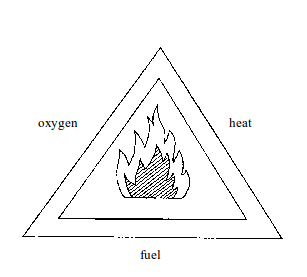
A fire will continue or start to burn if these components are present:
(i) Fuel: This refers to any combustible material be it solid, liquid or gaseous material provided it can catch fire and burn. You can stop fire by removing the combustible material from the path of fire.
(ii) Oxygen (air): Oxygen supports combustion. A fuel will only burn if there is sufficient supply of oxygen. You can extinguish fire by displacing, or taking away oxygen supply from the fire or by blocking the gas supply to the fire.
(iii) Heat: The temperature should be at the kindling point of that fuel or above it. Every fuel has its own kindling point. Below the kindling point, the fuel will not catch fire. You can put out fire by lowering the temperature below the kindling point of a particular fuel. Water may be used to cool down the fuel. The vapourization of water absorbs the heat; it cools the smoke, air, walls, objects etc, which could be used as further fuel.
Fire Extinguishers According to the Chemicals they Contain
Classify fire extinguishers according to the chemicals they contain
Fire extinguishers are classified according to the type of chemicals they contain
1. Liquid carbon dioxide extinguisher
This extinguisher contains liquid carbon dioxide. The liquid is contained in a metal container. When the safety pin is removed, carbon dioxide evaporates as solid "snow" (carbon dioxide sublimes). The snow settles on the fire and suffocates it.
2. Soda-acid extinguisher
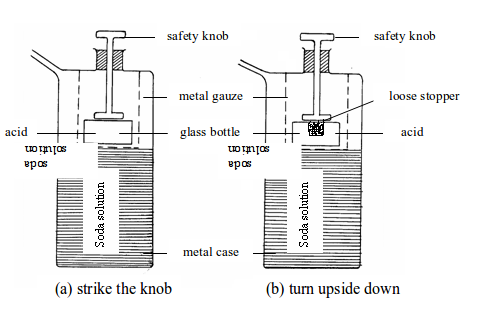
This extinguisher has a metal case containing soda (aqueous sodium carbonate or sodium hydrogen carbonate). In the metal case there is a glass bottle containing a concentrated acid (sulphuric or hydrochloric acid). There is a knob attached to the top of a metal case. Hitting this knob breaks the acid bottle thus bringing the acid and the soda into contact. The two react to give carbon dioxide, e.g.

The gas forms bubbles with the solution, thereby forming foam which is forced out of a jet of the case. The foam is directed to the fire where it covers the burning liquid, excluding all air from reaching the fire.
Some extinguishers are made in such a way that turning them upside down brings the soda and acid into contact and the reaction proceeds as stated above.
3. Foam extinguishers
This is different from the soda–acid type in that it contains sodium hydrogen carbonate in the metal case, but instead of the concentrated acid, it contains aluminium sulphate and saponium in the glass bottle. On mixing the three components, carbon dioxide gas is produced. The gas is ejected out as foam. The foam here lasts longer than the foam in the soda–acid extinguisher. The foam so produced also keeps air away from the burning material.
4. Dry chemical extinguisher
This extinguisher uses powdered sodium hydrogen carbonate and a nitrogen gas kept at high pressure. When the gas cartridge is broken using the top cap, the carbon dioxide under pressure propels the powder. The powder forms a layer over the burning material to keep air away.
Table bellow summarizes the types of fire extinguishers, indicating the chemicals they contain and the classes of fire they are suitable or unsuitable for.
| Type | Chemical composition of agent | Suitable for | Unsuitable for |
| APW (Air- pressurized water) | Ordinary tap water pressurized with air | Class A | Class B, C, D and E (will spread the flame and make the fire bigger!) |
| Dry chemical(DC) | Fine sodium bicarbonate powder pressurized with nitrogen | Class A, B, C and E | - Class D- Aircraft and electronics ( corrosive to metals such aluminium)Note: -Though it is safe to use indoors it can obscure vision |
| CO2 | Non-flammable carbon dioxide gas under extreme pressure | Class B, C and E | Class A (leaves a flammable substance on the extinguished material which canre-ignite later ) |
| Halon | Bromochloro-difluoro-methane | Class A and E | Class B and C (least suitable) |
| Foam | Proteins and fluoro-proteins | Class A and B | Class E |
| Wet chemical(WC) | Potassium acetate | Class F | Class E |
| ABC | Mono-ammonium phosphate with a nitrogen carrier | Class A, Class B and C | Electronic equipment (leaves a stick y residue that may be damaging to electrical appliances such as a computer) |
| Specialist powder (SP) | Powders of NaCl, Cu or graphite under extreme pressure | Class D | Class A, B, C, E and F |
Precautions on using fire extinguishers
The following are some safety precautions you have to keep in mind when using fire extinguishers:
- Keep a reasonable distance from the fire as it may suddenly change direction.
- Never use a portable extinguisher on people, instead use a fire blanket.
- Do not test a portable extinguisher to see if it works. It may leak and later fail to work during an emergency.
- Do not return a used portable extinguisher to the wall. Make sure it is recharged first.
- When a fire gets out of control, notify the nearest fire brigade.
Extinguishing Small Fires Using the Right Types of Fire Extinguishers
Extinguish small fires using the right types of fire extinguishers
Activity 2
Aim: To extinguish small fires using the correct fire extinguishers.
Materials: matchstick, different fire extinguishers like water, fire blanket, and a bucket filled with fine sand, and combustibles such as grass, wood, paper, plastic materials, kerosene, and oil
Procedure
- Set each of the combustibles on fire, one after another
- Use the correct fire extinguisher and procedure to put out the fire.
- Repeat the procedures 1–2 to put out fires caused by other combustibles not in the list above.
Questions for discussion
- Did you use the correct extinguisher to put out each type of fire?
- Why shouldn’t we use water to put out fires caused by flammable liquids?
Rusting
Air Combution Rusting
The Concept of Rusting
Explain the concept of rusting
Rusting is the name given to the oxidation of iron or steel in damp air. It is also called corrosion. Rust is hydrated iron (III) oxide. It is a soft, crumbly solid and hence weakens the structure of iron and steel. During rusting, iron reacts with oxygen to form brown iron (III) oxide
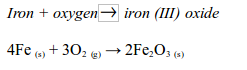
At the same time the iron (III) oxide reacts with water to form hydrated iron (III) oxide (or rust):

Note: The x in the equation indicates that the number of water molecules in the hydrated iron (III) oxide can vary. So, both oxygen and water are needed to cause rusting of iron.
Rusting is a serious economic problem. Large sums of money are spent each year to replace damaged iron and steel structures, or protecting structures from such damages. Rusting of bridges, corrugated iron sheets on house roofs, containers, articles, etc. require an expenditure of big sums of money as well as labour for replacement. Rust weakens structures such as car bodies, iron railings, and ships’ hulls, and shortens their useful life. Preventing it can cost a lot of money. All efforts must be made to stop iron or steel items from rusting. This can be achieved if we know the conditions necessary for iron to rust.
The Conditions Necessary for Iron to Rust
Demonstrate the conditions necessary for iron to rust
When iron is left in contact with both water and oxygen (or air), it reacts to form hydrated iron(III) oxide. Iron will not rust on exposure to dry air or air-free water (water that has been boiled to expel all dissolved air) only. However, iron will easily and readily rust in water containing dissolved air. Therefore, rusting only occurs in the presence of both water and oxygen. If one of the two conditions is excluded, in one way or another, rusting will not take place at all. Consider Figure 6.5; In tube 1, nails are in contact with both water and air (oxygen). Therefore, nails in tube 1 will rust. In tube 2, the water has been boiled to expel the dissolved air. In addition, any air above the water is prevented from dissolving in boiled water by a layer of oil. So, the nails are completely shielded away from air. Therefore, rusting is impossible. In tube 3, nails are in contact with air only. The moisture present in air is absorbed by anhydrous calcium chloride. Any moisture that might have been absorbed by the anhydrous calcium chloride is prevented from reaching the nails by a tuft of cotton wool. The cotton wool also absorbs some moisture directly from the air. Therefore, tube 3 will always carry dry air (moisture-free air). Hence, no rusting of iron nails occurs. This experiment demonstrates that for iron to rust, both water and air (oxygen) must be present. If one of these conditions is controlled, no rusting can take place.
Activity 3
Aim: To demonstrate the conditions necessary for iron to rust.
Materials: 3 boiling tubes, 6 nails, 3 stoppers, unboiled water, boiled water, anhydrous sodium chloride, cotton wool, and cooking oil
Procedure
- Set up the apparatus as shown in Figure 6.5.
- Leave the set up for four days.
- Take the nails out of the test tubes and observe.
Questions for discussion
- What was the function of oil added in test tube 2?
- Why was the water in test tube 2 boiled?
- What was the function of anhydrous calcium chloride in test tube 3?
Testing

The Different Methods of Preventing Iron from Rustin
Describe the different methods of preventing iron from rusting
We have learned that for iron to rust there must be direct contact between the iron and both water and oxygen from the air. Therefore, in order to stop rusting we must protect iron from either water (moisture) or oxygen (air) or both. The following are some of the methods used to prevent iron from rusting:
Painting
Painting the iron article creates a waterproof and airproof cover over the surface of the iron. This method is widespread for objects ranging in size from ships and bridges to garden gates. Paints that contain lead or zinc are mostly used. These paints are especially good for preventing rusting. For example, "red lead" paints contain an oxide of lead,.
As oxygen and water cannot reach the iron, it does not rust. However, if the paint layer is scratched off rusting may occur. So, regular repainting is necessary to keep this protection intact.
Oiling and greasing
The oiling and/or greasing of the moving parts of machinery forms a protective film, preventing rusting. Moving parts cannot be painted since the paint layer can be easily scratched off during movement. Again, the treatment must be repeated to continue the protection.
Plastic coating
Steel is coated with plastic for use in garden chairs, refrigerators, bicycle baskets, dish racks, etc. The plastic PVC (polyvinyl chloride), a trade name for polychloroethene, is often used for this purpose. Plastic is cheap and can be made to look attractive.
Electroplating
Electroplating is the coating of one metal with a layer of another metal by means of electrolysis, where the metal to be coated is the cathode and the coating metal the anode.
An iron or steel object can be electroplated with a layer of chromium or tin to protect against rusting. A ‘tin can’ is made of steel coated on both sides with a fine layer of tin. Tin is used because it is unreactive and non-toxic. However, if protective layer is broken, then the steel beneath will begin to rust. So, proper handling of tin-plated items is needed.
Galvanizing
An iron object may be covered with a layer of zinc. This is called galvanizing. Even if the zinc is scratched to expose the iron, the iron does not rust. This is because zinc is higher in the reactivity series than iron. So, zinc reacts with water and oxygen in preference to iron.
The zinc layer can be applied by several different methods. These include electroplating or dipping the object into molten zinc. When an iron or steel article is dipped into molten zinc and then removed, it becomes coated with a thin layer of zinc. The zinc forms a protective coat over the surface of iron. This process is used for dustbins, car bodies, barbed wires and motorway crash barriers.
Sacrificial protection
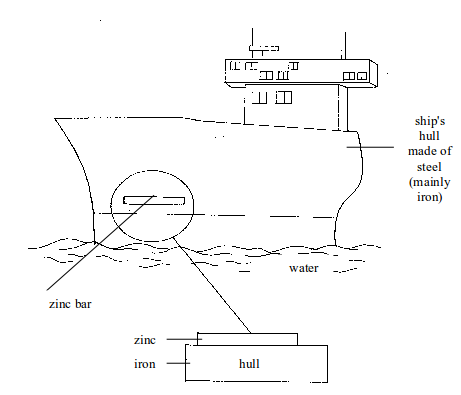
This is a method of rust protection in which blocks of a metal more reactive than iron are attached to the iron surface. Zinc and magnesium are more reactive than iron. When blocks of zinc or magnesium are attached to the hull of a steel ship or oil rig, it corrodes in preference to iron. This is called sacrificial protection because the zinc or magnesium is sacrificed to protect the iron. When the blocks are nearly eaten away, they can be replaced by fresh blocks. Underground gas and water pipes are connected by wire to blocks of magnesium to obtain the same protection.
It is not necessary to cover the whole surface of a steel article with the more reactive metal for sacrificial protection to work. A ship may have magnesium blocks riveted to its hull every few metres to prevent rusting of the whole hull.
Alloying
Alloys are mixtures of metals. For example, iron can be mixed with small quantities of much less reactive metals to form an alloy called stainless steel. Stainless steel contains iron mixed with chromium, nickel and manganese. Stainless steel does not rust. It also has a very attractive appearance. It is used to make cutlery and kitchen equipment.
Use of silica gel
Silica is a common name for silicon dioxide (SiO2). Silica gel is a granular, vitreous, highly porous form of silica made synthetically from sodium silicate. Despite its name, silica gel is a solid. It is used as a desiccant, which absorbs moisture to prevent rusting of iron items or articles. Most often, a small bag of silica gel is put inside bags or boxes used for storing or carrying iron items to absorb any moisture that may cause rusting.
Chapter summary
- Air is a mixture of different gases including nitrogen, oxygen, carbon dioxide, noble gases (argon, helium, neon, krypton and xenon), and a little water vapour.
- Combustion refers to a chemical reaction between a substance and an oxidant, usually oxygen, and accompanied by the release of energy in the form of heat and light.
- Applications of combustion in real life include generation of energy for homes and industries, fuel combustion in automobile engines, extraction of metals and welding.
- Fires are classified according to their causes as classes A, B, C, D, and F fires. Each type of fire is put out by a specific type of fire extinguisher.
- Components needed to start a fire are fuel, oxygen (air) and heat.
- Types of fire extinguishers based on the types of chemicals they contain are liquid carbon dioxide extinguisher, soda-acid extinguisher, foam extinguisher, and dry chemical extinguisher. The rusting of iron requires the presence of both water and oxygen (or air).
- Methods of preventing rusting include painting, oiling and greasing, plastic coating, electroplating, galvanizing, sacrificial protection, alloying, and use of silica gel.
Review questions
Question Time 1
1. Fill in the blanks
- The most abundant gas in the atmosphere is ______.
- The composition of _______in air is very variable.
- _____refers to the oxidation of iron or steel in damp air
- The presence of both____ and ____ are necessary for iron rusting to take place.
- The process of coating iron or steel with zinc is known as___________.
2. Oxygen occurs in air to an approximate extent of_____ by volume.
- 78%
- 21%
- 0.03%
- 12%
3. What is the other name for rusting?
- Erosion
- Corrosion
- Convection
- Combustion
4. Which of the following is not a process of preventing rusting?
- Use of silica gel
- Sacrificial protection
- Alloying
- Brushing
5. What type of fire is associated with cooking oil and fat?
- Class C fire
- Class E fire
- Class D fire
- Class F fire
6. Heat, fuel and ____ are the three components needed to start the fire
- fuel
- hydrogen
- oxygen
- nitrogen
8. briefly
- What do you understand by the term firefighting?
- Why is it necessary to use the correct type of fire extinguisher to fight a given type of fire?
- Classify fires according to the types of burning materials.
- Mention three types of fires in which water should not be used as an extinguisher. Give reasons for your answer
- Name the three components of fire.
- Classify the fire extinguishers based on the chemicals they contain
9.Define the term air
10. Name any five gases that make up air and indicate their proportions in air
11. Air is a mixture of different gases. By giving reasons, explain this statement
12. With the use of diagrams, explain how you can detect the presence of;
- carbon dioxide
- oxygen in the air experimentally
13. Define the term combustion
14. Give examples of substances that can burn in air
15. Indicate the application of combustion in real life
16. Define the following terms: (i) rust and (ii) rusting.
17. Explain how rusting takes place
18. State the conditions necessary for rusting to take place
19. What are the similarities and differences between burning and rusting?
REFERENCES
- Childs, A. (2000). Macmillan Secondary Chemistry (International ed.). Macmillan Publishers Limited. Malaysia.
- Holderness, A., Lambert, J. and Thompson, J. J. (1987). A New Certificate Chemistry (6th ed.). Clays Limited, St Ives Plc. London.
- Mazengo, R. (1992). Comprehensive ‘O’ Level Chemistry. Dar es Salaam University Press. Dar es Salaam
- SCSU, MoEVT-Zanzibar. (2008). Chemistry for Zanzibar Secondary Schools, Forms 1 & 2. Oxford University Press. Dar es Salaam.
- Tanzania Institute of Education (1995). Secondary School Chemistry, Book One. NPC (KIUTA). Dar es Salaam.
Listening to this topic