Chemistry
Heat Sources And Flames
Reading settings
Text size
Line spacing
Colours
Chemistry is all around us. Did you know that everything is made out of chemicals? Any reaction taking place in body cells of all living and non living organisms correlates with chemistry. In chemistry we study materials that make up the earth and universe. Chemistry is sometimes called the central science because it bridges other natural sciences, including physics, geology and biology. Therefore, when talking about chemistry, we are referring to life on Earth.
Heat Sources And Flames
Introduction
Most chemical reactions require heat to proceed. It is therefore important to have sources of heat in a laboratory for heating various reacting substances. In this chapter, you will learn about heat sources and types of flames. By the end of the chapter, you should be able to name various heat sources which can be used in a chemistry laboratory, and use different fuel burners to produce luminous and non-luminous flames. You are also expected to be able explain how the Bunsen burner functions
Heat sources
chemistry form 1 heat source
CHEMISTRY form1 Heat Source
Sources of heat in a chemistry laboratory include Bunsen burner, candle, spirit burner, kerosene burner (stove), tin lamp (kibatari), and charcoal burner.
Different Heat Sources which can be Used in a Chemistry Laboratory
Name different heat sources which can be used in a chemistry laboratory
The Bunsen burner is the best of all burners because it is convenient to handle. Another advantage of the Bunsen burner is that it produces a hot flame whose temperature is approximately 1000°C. The temperature can be adjusted easily to produce a non-luminous flame, which does not produce much soot.
Spirit burner
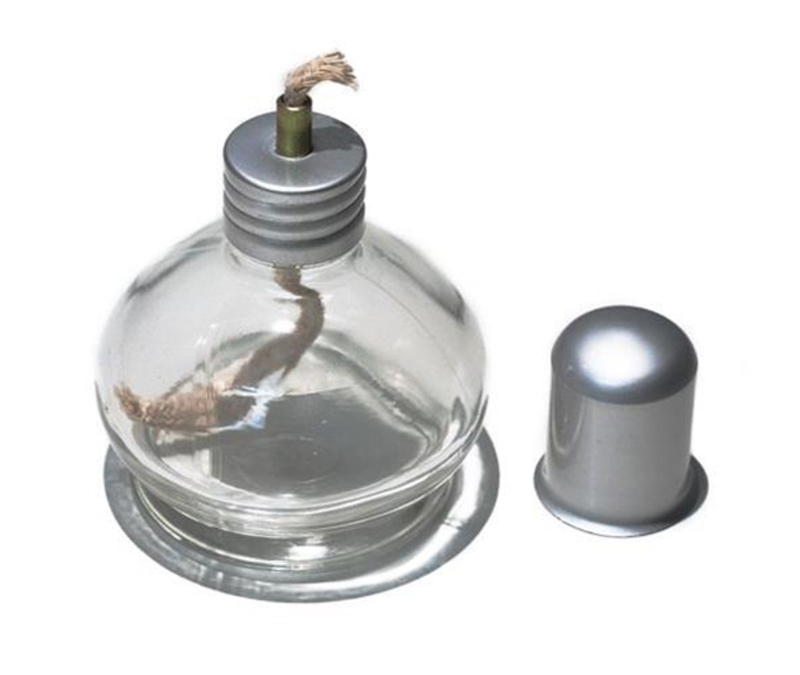
The spirit burner can also produce a soot-free flame. But the flame is not hot enough to effect (produce) some chemical reactions. Apart from that, the burner is filled with spirit, a substance that is highly flammable.
Spirit lamp
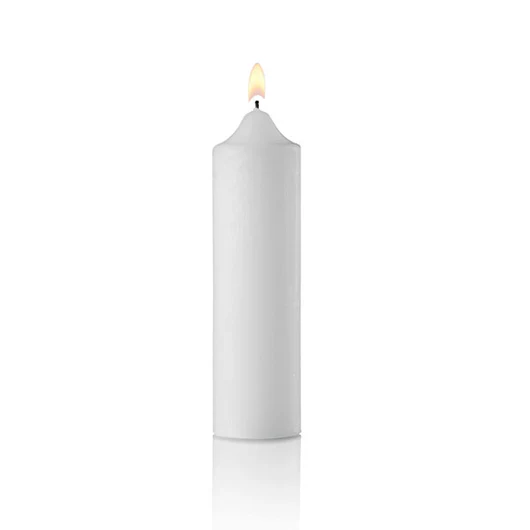
A candle
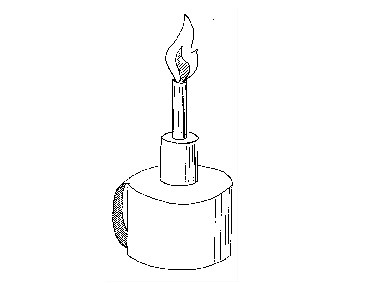
A candle (Figure 3.2) can only be used where a chemical reaction does not require strong heating. Its disadvantage is that it produces a lot of soot
The other burners, though not commonly used, are an electric heater and a gas burner. The electric heater uses electricity. The gas burner uses a liquefied gas. The disadvantage of an electric burner is that it cannot be used in areas where there is no electricity
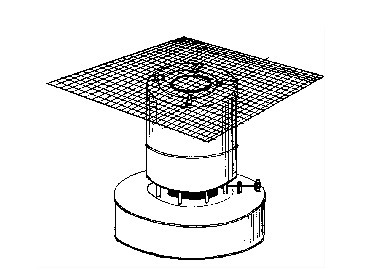
A kerosene burner
A kerosene burner (stove), also called jiko la mchina in Swahili, if well adjusted can produce a flame hot enough to heat many substances in the laboratory. It is fulled with kerosene, a fuel that is convenient to carry and store. This fuel does not catch fire easily as compared to spirit and it is affordable
It can conveniently be used by schools in the most remote areas where there is no electricity. If too much heating is required, wire gauze should be placed on top of the burner. This will enable reduce soot and increase the heating temperatures to about 1000°C or more.
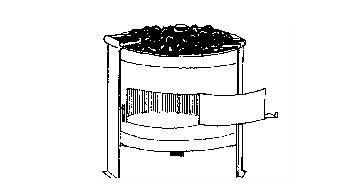
A charcoal burner
A charcoal burner can also be used in remove areas. In case the kerosene burner is not available, for one reason or another, a charcoal burner can be the best alternative.
The red-hot charcoal on the burner is almost soot-free. It can produce high temperature sufficient to carry out many reactions.
A tin lamp
A tin lamp (kibatari), though it produces a lot of soot, can also be used as a burner in a laboratory, especially in remote areas.
However, the heat it produces is not hot enough to initiate some reactions.
The Functioning of a Bunsen Burner
Explain the functioning of a bunsen burner
The Bunsen burner
Of all the burners we have discussed so far, a Bunsen burner is the mostly used. Therefore, we are going to discuss about the functioning of the Bunsen burner in more detail. As the name suggests, this burner was invented by a German scientist called Robert Bunsen, so it was named after his name as a Bunsen burner. The burner uses coal gas, which burns with a hot and non-luminous flame when the air holes are open. This is a kind of flame we normally use in the laboratory.
Functions of different parts of the Bunsen burner
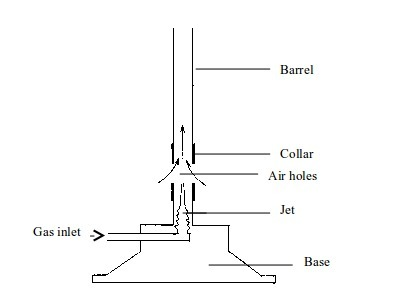
Base: Supports the burner. It makes the burner stable when placed on a bench because it is broad and heavy.
Gas inlet: Lets the gas in from the gas supply.
Jet: Directs the gas to the barrel
Collar: Regulates the amount of air entering the burner. It has air holes that can be turned open or closed depending on the kind of flame, and hence amount of heating required.
Air holes: These small holes on the collar allow air to enter in the burner.
Barrel: This is a part of the burner where air (from outside), and gas (from gas supply) mix up and burn.
How to light a Bunsen burner
After knowing the different parts of the Bunsen burner, it is important that you also learn how to light it. This is because careless use of the burner may lead to accident or wastage of the gas. The following is a correct sequence of steps on how to light the Bunsen burner:
- Connect the Bunsen burner by a rubber tube to the gas supply.
- Close the air holes.
- Turn the gas tap on to let in sufficient gas.
- Quickly bring a flame at the top of the barrel. You may use a matchstick, a lighter or wooden splint as a source of flame.
- Turn the collar to adjust the air holes until you get the type of flame you want. You may have the holes completely open.
- Adjust the gas tap until the gas supply is enough to produce a non-luminous flame.
To put off the flame of the burner after you finish heating a substance, turn the gas tap off in order to cut off the gas supply to the burner. Disconnect the burner from the gas mains by removing the rubber tube connecting the two. Then close the air holes. Pay attention not to touch the hot collar with your fingers or else wait until it is cool enough. Take the Bunsen burner and keep it at the appropriate place
Types of flame
Flame is the visible and gaseous part of the fire. It is the light energy released due to the combustion of fuel. For any solid or liquid to burn with a flame, it must first turn into inflammable vapours (gaseous state).
Luminous and Non-luminous Flames from Different Types of Flames
Produce luminous and non-luminous flames from different types of flames
A flame can be luminous or non-luminous. Flames of a candle and any oil are usually smoky and luminous. Flames of such kind are normally of little laboratory use. This is because they are not hot enough and would deposit soot on laboratory apparatus. Coal gas also burns with a smoky and luminous flame. With a Bunsen burner, one can produce two types of flames, namely the luminous flame and non-luminous flame
Luminous flame
This is a type of flame produced when the air holes of a Bunsen burner are closed. When the air holes are closed very little air enters the barrel of the burner. In this case, the flame will be large, unsteady and bright
The flame will have four main zones each having a distinct colour.
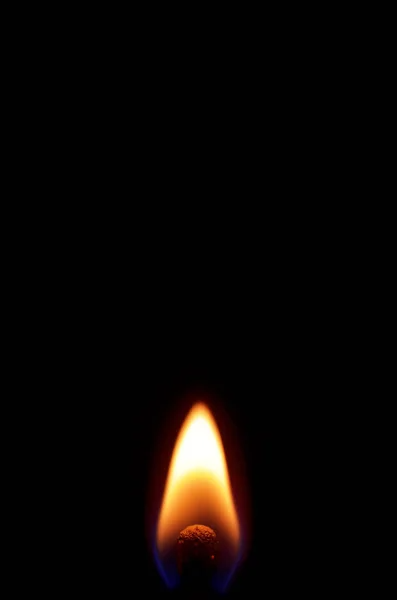
- The inner dark zone - This is dark, cool and contains unburnt gas
- Luminous yellow zone - The gas burns in this zone but because the air is not enough the burning is incomplete. This leads to formation of tiny carbon particles from the gas. When these particles are white-hot, they result in formation of light (the yellow colour we see). If a cold evaporating dish, porcelain crucible, or glass is placed in this zone, it will blacken due to deposition of carbon particles (soot) on it.
- Outer zone - This is a non-luminous zone where the burning of the gas is complete due to presence of enough air. Because of the absence of carbon particles, this zone does not give out light. Consequently, the zone cannot be seen easily.
- Blue zone – Due to rising convectional current, there is sufficient supply of air for complete burning at this zone.
Non-luminous flame
When air holes are fully opened, sufficient air enters the Bunsen burner barrel and mixes well with the coal gas. Hence, the burning of the gas is much quicker and complete. The flame is smaller and hotter.
Due to absence of white-hot carbon, no light appears. The flame is therefore non-luminous. The flame has three district zones each with a different colour.

- Cool inner zone – this is a zone of unburnt gas.
- Green/blue zone - part of the gas burns in this zone because there is not enough air to burn all the gas completely. However, no carbon is formed. The hottest part of the flame is at the tip of this zone.
- Outer purple zone – Burning of the gas in this zone is complete.
Major differences between luminous and non-luminous flames
| Non luminous flame | Luminous flame | |
| 1. | Formed when air holes are open | Formed when air holes are closed |
| 2. | Very noisy | Silent or calm |
| 3. | Comprises of three zones | Comprises of four zones |
| 4. | Forms no smoke or soot on apparatus | Forms a lot of smoke or soot on apparatus |
| 5. | Blue and almost invisible | Bright yellow and clearly visible |
| 6. | Very hot flame | Not a hot flame |
| 7. | Not bright | Very bright |
| 8. | Triangular flame | Wave-like flame |
Activity 1
Aim: To produce luminous and non-luminous flames from different burners.
Materials: A matchbox and different types of burners like Bunsen burner, kerosene stove, spirit burner, candle, tin lamp, and charcoal burner
Procedure
- Strike a matchbox and light up one burner after another.
- With a Bunsen burner, light up the burner when the air holes are closed. Then light it up when the air holes are opened.
- In each case, observe the type of flame produced (luminous or non-luminous) by the respective burner.
Observation
| Burner | Type of flame produced |
Uses of flames
Flames are used for different purposes. Some uses of the flames include the following:
- Production of heat for heating substances in the laboratory: In this case, a non-luminous flame, which produces much heat, is used. However, for reactions that require little heat, a luminous flame, which is not very hot, can be used.
- Flame tests for elements: In chemical analysis of some elements, a flame test is one of the preliminary tests normally used to identify an element. When some elements are strongly heated, they produce characteristic flame colours that distinguish them from one another. A non-luminous flame is often used.
- Production of light: Flames produce light that can be used to light a dark room. Therefore, an experiment that involves heating can even be conducted in the dark. The same flame is used to give heat as well as light. Here, a luminous flame is used. Examples of heat sources, which produce flames that may be used for lighting, are hurricane lamp, tin lamp, spirit lamp and candle.
- Cooking: Since it gives a hot flame and produces no soot, a non-luminous flame can be used for cooking food. Gas cookers, gas stoves and kerosene stoves usually produce such flames.
- Welding: A non-luminous flame is suitable for welding because it is very hot. In most welding operations, an oxyacetylene gas, a mixture of oxygen and ethyne, is used. When burned, the gas produces a flame hot enough to cut or melt the metal.
Chapter summary
Sources of heat in a chemistry laboratory include Bunsen burner, candle, spirit burner, kerosene burner (stove), tin lamp, and charcoal burner.
Of all the burners, a Bunsen burner is the best because it produces a very hot flame.
There are two types of flames, namely the luminous flame and non-luminous flame.
Flames are used for different purposes such as heating, lighting, welding, testing for elements and cooking.
Review questions
Question Time 1
A.1. Which of the following heat sources is not normally used in the laboratory?
- Bunsen burner
- Spirit lamp
- Kerosene stove
- Hurricane lamp
2. What is the disadvantage of using a candle as a heat source in the laboratory?
- Its smoke can cause blindness.
- It produces a blue flame
- It gives a luminous flame with much smoke and soot.
- It produces a smoky non-luminous flame
3.Consider the parts of the Bunsen burner flame in the figure below. Which is the hottest part of the flame?

- 3
- 1
- 2
- None of these
4. The most common source of heat used in laboratories is:
- Electric burner
- Gas burner
- Spirit lamp
- Bunsen burner
5.The following are some uses of flames, except;
- Heating
- Lighting
- Flame tests
- Ironing
B. Write TRUE for a correct statement or FALSE for an incorrect statement for each of the following statements:
- A luminous flame is hotter than a non-luminous flame.
- A Bunsen burner is the only burner used in laboratories.
- Wire gauze reduces the heating temperature.
- A luminous flame is used for lighting at home.
- A candle flame can be adjusted to produce a non-luminous flame.
C.1 .Outline the differences between luminous and non-luminous flame
2. Draw a well labelled diagram of a Bunsen burner showing all its parts
3. Briefly explain the function of each part you have labelled in (2)
4. Briefly explain how to light a Bunsen burner.
5. Describe the uses of any five different heat sources used in a chemistry laboratory
6. What are the limitations (disadvantages) of using the following burners as sources of heat in the laboratory?
- Spirit lamp
- Tin lamp
- Candle
- Charcoal burner
7. Draw and label all parts of the following two types of flames:
- A luminous flame;
- A non-luminous flame
8. Why is a Bunsen burner considered to be the best of all the burners used in school chemistry laboratories?
REFERENCES
- Holderness, A., Lambert, J. and Thompson, J. J. (1987). A New Certificate Chemistry. Clays Limited, St Ives Plc. London.
- Mazengo, R. (1992). Comprehensive ‘O’ Level Chemistry. Dar es Salaam University Press. Dar es Salaam
- SCSU, MoEVT-Zanzibar. (2008). Chemistry for Zanzibar Secondary Schools, Forms 1 & 2. Oxford University Press. Dar es Salaam.
- Tanzania Institute of Education (1995). Secondary School Chemistry, Book One. NPC (KIUTA). Dar es Salaam.
Listening to this topic