Chemistry
Matter
Reading settings
Text size
Line spacing
Colours
Chemistry is all around us. Did you know that everything is made out of chemicals? Any reaction taking place in body cells of all living and non living organisms correlates with chemistry. In chemistry we study materials that make up the earth and universe. Chemistry is sometimes called the central science because it bridges other natural sciences, including physics, geology and biology. Therefore, when talking about chemistry, we are referring to life on Earth.
Matter
Introduction
Matter is anything that has mass or weight and occupies space. In this chapter, you will learn about the concept of matter, states of matter, physical and chemical changes, elements and symbols, compounds and mixtures, and separation of mixtures. By the end of this chapter, you should be able to describe the three states of matter, and explain the importance of changing one state of matter to another. You are also expected to be able to demonstrate physical and chemical changes of matter experimentally. Moreover, you should be able to assign names and symbols to chemical elements, prepare a binary compound, and apply different methods to separate the components of different mixtures using different methods
Concept of matter
Concept of Matter
Matter
Matter P3 Edit
Matter
Explain concept of matter
Anything around us provided it has mass and can occupy space, is termed as matter. The word matter covers all the substances and materials from which the universe is composed of. These include materials around us such as water, soil, plants, animals, air, and clothes
States of matter
Substances exist in one of the three states of matter; solid, liquid and gaseous states. So, substances around us can be classified as a solid, a liquid, or gas. The state in which any matter exists depends on temperature and sometimes pressure conditions. One substance may exist as a solid in one condition and as a liquid or gas under a different condition. Water is an example of such substances. This change is called a change in the states of matter
The Three States of Matter
Describe the three states of matter
One State of Matter to Another
Change one state of matter to another
As previously highlighted, matter exists in three different states–solids, liquids and gases. We can use the kinetic theory of matter to explain how a substance changes from one state to another. Basically, changes from one state to another are caused by alterations in temperature and pressure. Normally molecules, ions or atoms of a substance move faster when the temperature is increased. For instance, an ice block is solid in nature and does not flow. After heating, the block melts to form liquid water. Heating the water strongly produces water vapour. The vapour condenses back to liquid when passed through the condenser
Melting and freezing
Melting is a change from solid to liquid state. When solids are heated, their constituent particles (atoms, molecules or ions) get energy and vibrate more violently. Vibrations of these particles overcome (exceed) their binding forces. The particles become mobile. The crystalline structure of solid is destroyed. A liquid state is reached and the particles are free to move. The temperature at which this happens is called melting point of the solid.
The melting point of a solid tells us something about the strength of forces holding its constituent particles together. Substances with high melting points have strong forces between their particles. Those with low melting points have weak forces between their particles.
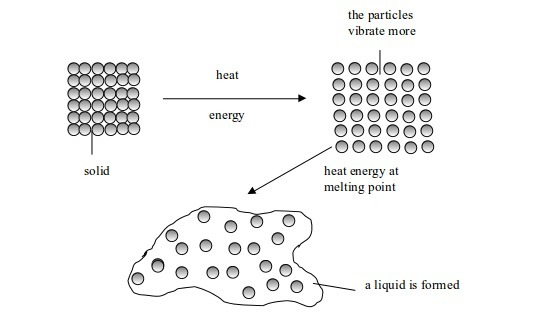
Freezing is a change from liquid to solid state. Freezing is the opposite of melting. The process is reversed at the same temperature if a liquid is cooled. The temperature at which a substance turns to a solid is called freezing point. The melting point and freezing point of any given substance are both the same. For example, the melting and freezing of pure water takes place at 0°C. Melting is not affected by any changes in atmospheric pressure.
Evaporation and boiling
Boiling is a change from liquid to vapour state at a particular temperature. Evaporation is the change from liquid to vapour state at any given temperature. If a liquid is exposed to open air, it evaporates. Splashes of water evaporate at room temperature. After rain, small pools of water dry up. When a liquid changes into a gas at any temperature, the process is called evaporation. Evaporation takes places from the surface of the liquid. The larger the surface area, the faster the liquid evaporates. The warmer the liquid is, the faster it evaporates. Thus, surface area and temperature affects the rate of evaporation of a liquid.
When a liquid is heated, its molecules get more energy and move faster. They knock into each other violently and bounce further apart. As the heating goes on, its molecules vibrate even faster. Bubbles of gas (due to air dissolved in water) appear inside the liquid. The whole process is called boiling. The temperature at which a liquid boils is called boiling point.
The molecules at the surface of the liquid gain enough energy to overcome the forces holding them together. They break away from the liquid and from a gas (vapour). As more of the liquid molecules escape to form a gas, a liquid is said to evaporate. This occurs at the boiling point of a liquid.
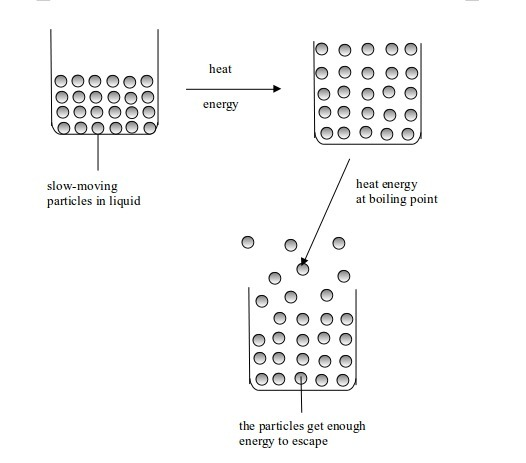
The temperature at which a liquid boils explains how strong the forces holding its particles (molecules) together are. Liquids with high boiling points have strong forces of attraction between their molecules than those liquids with low boiling points.
The boiling point of a liquid can change if the surrounding pressure changes. If the surrounding pressure falls, the boiling point also falls and vice versa. The boiling point of water at standard pressure (760 mmHg) is 100 °C. On a high mountain, where pressure is low, it is lower than 100 °C. The melting points and boiling points of some common chemical substances are shown in Table 5.2.
The melting and boiling points of some common chemical substances at standard temperature and pressure (s.t.p)
| Substance | Physical state at room temperature (20 °C) | Melting point (°C) | Boiling point (°C) |
| Oxygen | Gas | -218 | -183 |
| Nitrogen | Gas | -210 | -196 |
| Ethanol (alcohol) | Liquid | -114 | 78 |
| Water | Liquid | 0 | 100 |
| Sulphur | Solid | 113 | 445 |
| Common salt (Sodium chloride) | Solid | 801 | 1413 |
| Copper | Solid | 1084.6 | 2562 |
| Carbon dioxide | Gas | Sublimation point (°C) = -78.5 | |
From the above explanation, obvious differences between evaporation and boiling can be detected. See table bellow
| Evaporation | Boiling |
| 1.Occurs at all temperatures | Occurs at one particular temperature (boiling point) |
| 2.Occurs on the surface of the liquid | Occurs both inside and on the surface of the liquid |
| 3.Takes place slowly | Takes place faster |
| 4.Bubbles are not necessarily formed | Bubbles are formed |
Condensation and solidification
The reverse of evaporation is condensation. This is brought about by cooling. When a gas is cooled down, its particles lose energy. They move more and more slowly. When they knock into each other, they do not have enough energy to bounce away again. They stay close together and a liquid forms. This process is called condensation. When the liquid is cooled further, the movement of the particles slows down even more. Eventually, they stop moving and a solid forms. This is called solidification.
Condensation can be defined as a change in state of a substance from gas (vapour) to liquid. Solidification is a change from liquid to solid state of a substance. Solidification is the same as freezing.
Sublimation
A few solids do not melt when they are heated. Instead, they change directly from the solid to gaseous state without passing through the liquid state. This change in state is called sublimation. When a solid changes directly into gas, it is said to sublime. Iodine, solid carbon dioxide ("dry ice") and ammonium chloride are examples of solids that sublime. Like melting, sublimation also occurs at one particular temperature for each pure solid.
Activity 1
Aim: To show changes in states of matter
Materials: a source of heat, ice block, iodine, beaker, test tube, and condenser
Procedure
- Put a block of ice in a beaker and heat. Continue heating until vapour comes out of the beaker. Then pass the vapour through the condenser. Observe the changes that take place.
- Put some iodine in a test tube and heat strongly. Observe the changes that take place.
- What were the states of the ice blocks before and after heating?
- What happened to steam when passed through the condenser?
- What happened to the iodine when it was heated?
The Importance of Changing One State of Matter to Another
Explain the importance of changing one state of matter to another
The following points summarize the importance of change in state:
1. Separation of mixtures
Different mixtures can be separated through such processes as distillation, sublimation, evaporation and condensation. Let us have a look at an example of distillation. This process involves boiling, evaporation and condensation. Distillation as a process can be applied in separation of a mixture (solution) of two or more substances. A mixture of two or more substances with different boiling points e.g. water and alcohol can be separated by this means. In such a case, a container with the mixed-up liquids is heated. The liquid with a low boiling point evaporates and condenses first, leaving the one with a high boiling point in the container. The distillate (liquid with low boiling point) is collected, cooled down and transferred into another container.
2. Industrial manufacture of products
Industrially, the process of distillation is applied in the production of pure substances such as beer and other alcoholic drinks such as wine, vodka, konyagi, etc. The manufacturing process involves boiling, evaporating and condensation.
3. Refining of petroleum (crude oil)
Crude oil contains organic liquid components, each with a different boiling point. In the refinery, the components with lower boiling points evaporate first and get separated out, leaving those with higher boiling points behind. In this way, we get various types of oil components (fractions) such as petrol, diesel, kerosene, lubricating oil, etc.
4. Drying of crops and clothes
When you suspend your clothing on a cloth line to dry, the moisture in it is lost through evaporation. Likewise, farmers in the village often spread crops on the ground to dry. They do this in order to reduce moisture content and hence prevent decaying. The moisture contained in crops leave by evaporation. Therefore, you can notice how evaporation, as a change in state, is important in everyday lives.
5. Cooling of our bodies in hot weather
During hot weather, our bodies perspire a lot. When water evaporates from the body, it takes up the heat. This brings about the cooling effect, as heat is lost from the body surface. The cooling effect is more evident when the wind or air is blowing over the body. This is because wind increases the rate of evaporation. In this way, the body gets cooled down
6. Ice formation in refrigerators
Drinking water and beverages are usually cooled down in refrigerators. Alternatively, you can freeze water into ice and then use the resulting ice for cooling the drinking water, or beverage. Also, perishable products such as fish, meat, and milk are often packed in ice blocks to prevent them from spoiling. Selling ice blocks to beverage vendors is a source of income to some people
7. Melting metals to make alloys
In metallurgical industries, a need may arise to mix two or more metals (alloys) together. This is only possible where two or more metals are first melted at high temperatures into liquids. Then the resulting liquid metals are mixed in appropriate proportions. This is followed by cooling down the mixture to a solid alloy. Normally alloys have better qualities than individual metals. Examples of alloys include; amalgam (consists of mercury, silver, and copper), brass (consists of copper and zinc), and bronze (consists of copper and tin)
8. Testing the purity of substances
The presence of impurity may lower or raise the boiling point of the substance. A pure substance melts and boils at definite temperatures (Table 5.4). The values for the melting point and boiling point are precise and predictable. This means that we can use them to test the purity of a sample. They can also be used to check the identity of an unknown substance. For example, seawater is impure. It freezes at a temperature well below the freezing point of pure water (0 °C) and boils at a temperature above the boiling point of pure water (100 °C). Other substances behave in a similar manner. So, boiling as a change in state can be used to test for the purity of substances (Table 5.4). In addition, the impurity also reduces the exactness of the melting point or boiling point. An impure substance melts or boils over a range of temperatures, not at a particular point
| Substance | Melting point (°C) | Boiling point (°C) |
| Sodium | 98 | 883 |
| Iron | 1538 | 2861 |
| Diamond | 3547 | 4827 |
| Cobalt | 1495 | 2927 |
| Propane | -187 | - 42 |
| Ethanoic acid | 16 | 118 |
9. Formation of rain
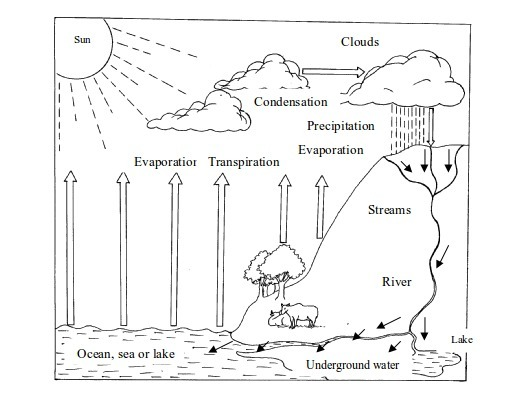
Perhaps the most important of all, as far as change in state is concerned, is the formation of rain. Rained is mainly formed through the process of evaporation and condensation. Water vapour, evaporating mostly from water bodies (oceans, seas, lakes, rivers, ponds, etc), land and plants rises up to the sky. As it rises, it cools down and condenses into tiny droplets
On further cooling as they rise up, these droplets form bigger water drops. Owing to gravitational force, these drops fall down as rainfall. Every one of you knows how important rain is to our life. Therefore, you have noticed how evaporation and condensation, as changes in state, contribute to rain formation.
Kinetic nature of matter
We already know that matter is composed of atoms, ions or molecules. We have not yet considered the reason why the same substance, say water, can exist in more than one form, for example as solid ice, liquid water, and gaseous steam. But does matter behave like that?
The kinetic theory of matter has been used to explain the way in which the arrangement of the particles of a substance can determine the properties of that substance, and particularly the state in which it is likely to be found under a given set of conditions. The idea is that all matter is made up of tiny moving particles. The main points of the theory are as follows:
- Matter is made up of particles that are constantly moving in random motion
- All particles have energy, but the amount of energy depends on whether the substance is a solid, liquid or gas.
- The temperature of a substance is a measure of the average kinetic energy of the particles
- A change in phase may occur when the energy of the particles is changed.
- There are spaces between the particles of matter
- There are attractive forces between particles and these become stronger as the particles move closer together
The solid state
In the solid state, the particles are so closely packed as indicated in Figure 5.1(a). The particles are held together by strong forces of attraction that act as a chemical glue. Free movements of particles cannot take place. They cannot move around freely in this arrangement. Instead, they vibrate about a fixed position. They are arranged in a fixed pattern which forms a cluster of vibrating masses. This makes a solid to have a fixed shape, which cannot be changed except by applying strong external forces
The liquid state
The particles of a liquid are also closely packed but the forces of attraction between them are weaker than of a solid. These forces of attraction tend to bind them together. The particles have more kinetic energy and they can move around each other. It is thought that the particles of a liquid are fairly randomly arranged but consist of "clusters" closely packed together as shown in Figure 5.1(b). This property makes a liquid to have a definite volume. However, since the particles are fairly free to move, a liquid does not have any characteristic shape. Thus, a liquid will always take the shape of its container
The gaseous state
The gaseous state is one in which the particles are moving independently of each other in all directions and at great speeds. The particles of a gas are relatively far apart as indicated in Figure 5.1(c). They exert no force of attraction on each other. They have more energy than the particles of solids and liquids. They move rapidly and randomly, colliding with each other and with the walls of the container. A typical speed for a molecule of hydrogen in air at ordinary temperature and pressure has been found to be approximately 500 ms–1. It is estimated that a nitrogen molecule makes 109 collisions each second. Thus, a gas will rapidly spread out to fill any container in which it is placed. A gas cannot have any shape of its own
Three states of matter

The different states of matter are due to the variations in the characteristics of their constituent particles. Solids, liquids and gases differ in the ways their atoms are arranged, and the intermolecular forces of attractions between their particles. The differences in physical properties between the three states of matter are summarized in Table 5.1.
| Property | Physical state | ||
| Solid | Liquid | Gas | |
| Shape | has a definite shape | no definite shape; takes the shape of the container | no definite shape, occupies the whole container |
| Volume | has a fixed volume | has a fixed volume | variable (depending on temperature and pressure) |
| Fluidity | does not flow | generally flows easily | flows easily |
| Expansion heating | low | medium | high |
| Compressibility | incompressible | almost incompressible | highly compressible |
| Motion of particles | slow | high | very high |
| Density | high | moderate to high | low |
| Tangibility | tangible | tangible | intangible |
| Visibility | visible | visible | Some gases are invisible |
Physical and chemical changes
Depending on the nature of change, all changes that matter undergoes can be classified as either physical or chemical.
The Characteristics of a Physical Change
Describe the characteristics of a physical change
Physical change
Physical change is any change that occurs without altering the chemical composition of a substance. Substances may undergo changes in their physical properties such as changes in colour, shapes (or forms), states, density, structures, and texture. If you take a stone and break it down into small particles, you will have only changed its form, but it will remain a stone. Likewise, melting ice to water or freezing water to ice do not change it, but it is still water in different forms. The same case happens when you dissolve salt in the water to get a solution of salt in water. You can still get back the original salt by evaporation, except that the crystals of the salt obtained will not look exactly the same as those of the original salt
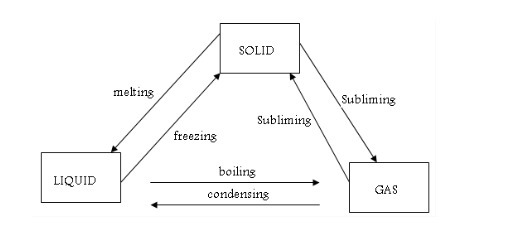
These changes of state are examples of physical changes. Physical changes such as melting and boiling do not result in new substances being formed
For example, ice and water still contain the same particles whether in solid (ice) liquid (water) or gaseous (vapour) state.
Characteristics
In the explanation above, we find that in a physical change it is only the physical form, and not the actual nature, of a substance that changes. The changes are brought about by a mere addition or removal of heat, as in the case with water or ice. Such a change is called a physical change. It can be distinguished by the following characteristics:
- There is no formation of a new substance. Consider an example given above. The ice, liquid water and steam are the solid, liquid and gaseous forms of the same substance (water).
- There is no change in weight of the substance undergoing the change. If you start with 50g of ice, you will still get the same mass of water and steam (vapour) upon melting and boiling respectively.
- The changes are readily reversible. You can easily change water back to ice and vapour to water by a mere subtraction of heat (cooling).
- It is not accompanied by a great heat change. Just a little heat is required to change ice to water, and water to steam.
Physical Changes of Matter Experimentally
Demonstrate physical changes of matter experimentally
Experiment
- Add some common salt (sodium chloride) to distilled water in a beaker. Stir the mixture until the salt disappears and forms a solution with water. Transfer the water into a porcelain dish. Heat the content until all the water has evaporated off. The salt reappears in its original white solid form.
- Grind some roll sulphur in a mortar to powder. Put the resultant powder in a test-tube and heat gently, shaking all the time. The sulphur melts to an amber-coloured liquid. On cooling, this liquid returns to its original condition as a yellow solid.
- Put a block of ice in a beaker. Heat gently until the whole block melts to form water. Pour the water formed in a cup and place it in a deep freezer overnight. The water will freeze back to ice.
You will have seen that all the above changes involve only changes in physical forms of the substances. The chemical nature of substances remained unchanged. Therefore, we can define a physical change as a change that does not involve formation of a new substance but involves a change in state or physical form of the substance and that such a form can be reversed.
The Characteristics of a Chemical Change
Describe the characteristics of a chemical change
Chemical change
A chemical change is a process in which one or more substances are altered into one or more new and different substances. Chemical changes usually involve changes in the chemical properties of substances. For example, when you burn a piece of wood in the fire, you get ash. The properties of wood and ash are very different. There is no way you can change ash back to wood. It is practically impossible. A permanent change in the chemical properties of a substance is called a chemical change. In a chemical change, a substance loses its physical and chemical properties. For example, when some roll sulphur is strongly heated on a deflagrating spoon, it burns to produce a new gaseous substance (sulphur dioxide). The magnesium ribbon burns on a Bunsen burner flame to produce a new substance, magnesium oxide. Likewise, iron nails kept in wet cotton will form rust after few days
Characteristics
Includes
- A chemical change results in the formation of new substance(s). The new substance has different chemical and physical properties as compared to the original substance.
- It is generally not reversible.
- There is a change in weight or mass of the substance undergoing the change
- The change is accompanied by a considerable heat change
Chemical Changes of Matter Experimentally
Demonstrate chemical changes of matter experimentally
Experiment
- Strongly heat some roll sulphur on a deflagrating spoon until it melts and begins to burn with a blue flame. If you continue heating, it gradually decreases in amount and finally the spoon will be left empty. The disappearance of sulphur is due to the formation of a new gaseous substance that is invisible. The presence and existence of a gas in air can be defected by its irritating smell. The gas can also be detected by burning the sulphur in a gas jar to which some blue litmus solution has been added. The gas formed, sulphur dioxide, will turn the blue litmus paper into a red one.
- With the aid of tongs, subject a piece of magnesium ribbon to a Bunsen burner flame. The ribbon burns to produce a new substance, white ash of magnesium oxide.
- Wrap a wet cotton wool around an iron nail. Keep it in a test tube for 3 days. By the 3rd day, some brown marks of rust will appear on the surface of the nail. Rust is hydrated iron (III) oxide. This is quite a new substance compared to iron nails.
Table
| Physical change | Chemical change |
| 1. Produces no new kind of matter | Always produces a new kind of matter |
| 2. There is no change is mass or weight of the substance | 2. There is a substantial change in the weight of the substance |
| 3. The change can be reversed | 3. The change cannot be reversed |
| 4. Little heat is absorbed or evolved | 4. Heat changes may be large |
| 5. The change involves only a change in physical properties of a substance | 5. Both physical and chemical properties are changed. |
Elements and symbols
The Concept of an Element
Explain the concept of an element
The universe is made up of vast amounts of different substances. These substances are made up of a number of small elements. An element can be defined as a substance that cannot, by any known chemical process, be split into two or more simpler substances. This means that elements cannot, by any chemical process, be made to yield substances simpler than themselves. In 1803, a scientist called John Dalton suggested that each element was made up of its own kind of particles. He called these particles the ‘atoms’. Therefore, an element is a substance that is made up of only one kind of atoms
There are about 118 different elements known. Most of these elements have been obtained from the Earth's crust and the atmosphere, and few have been artificially made by scientists. From these 118 elements, all other substances on Earth are made. Table 5.6 shows the approximate percentage compositions by mass of the elements in the Earth's crust, the oceans, and the atmosphere. Can you notice the abundance of oxygen? Analysis of the Earth's crust, the oceans, and the atmosphere, reveals that oxygen is the most abundant element on Earth, accounting for half the total mass
| Percentage by mass of elements in the Earth’s crust | Percentage by mass of elements in the oceans | Percentage by mass of elements in the atmosphere | |||
| Oxygen | 46.6 | Oxygen | 86 | Nitrogen | 78 |
| Silicon | 27.7 | Hydrogen | 10.9 | Oxygen | 21 |
| Aluminium | 8.1 | Chlorine | 1.8 | Argon & other elements | 1 |
| Iron | 5.0 | Sodium | 1.0 | ||
| Calcium | 3.6 | Magnesium | 1.0 | ||
| Sodium | 2.8 | Calcium | 0.05 | ||
| Potassium | 2.6 | Sulphur | 0.05 | ||
| Magnesium | 2.1 | Potassium | 0.04 | ||
| Titanium | 0.5 | Nitrogen | 0.02 | ||
| Hydrogen | 0.15 | Bromine | 0.01 | ||
| Carbon | 0.2 | Carbon | 0.01 | ||
| Others ( total) | 1.3 | Others (total) | 0.02 | ||
Names and Symbols of Elements
A chemical symbol is the way of representing an element using initial letter(s). There are many different elements as you have seen above. Every element has a name and a symbol to represent it. Some symbols are just a single capital letter, such as H. Others have two letters, the first of which is always a capital, such as Mg.
Rules for assigning chemical symbols to elements
Includes
- Each element is given a different symbol to represent it.
- Some elements are represented by two letters e.g. Ca (for calcium), Cl (for chlorine), etc.
- If two letters represent the element, the first letter is always a capital and the second letter is always a small letter e.g. argon (Ar) and helium (He).
- In order to avoid confusion, some elements have their chemical symbols derived from Latin names
All symbols are recognized and are used by all scientists all over the world. Some examples of elements and their symbols are given in the table below
| Element | Symbol | Element | Symbol |
| Aluminium | Al | Bromine | Br |
| Copper | Cu | Carbon | C |
| Iron | Fe | Chlorine | Cl |
| Lead | Pb | Hydrogen | H |
| Magnesium | Mg | Nitrogen | N |
| Mercury | Hg | Oxygen | O |
| Potassium | K | Phosphorus | P |
| Silver | Ag | Sulphur | S |
| Sodium | Na | Silicon | Si |
| Calcium | Ca | Iodine | I |
| Manganese | Mn | Fluorine | F |
| Tin | Sn | Gold | Au |
| Chromium | Cr | ||
| Zinc | Zn | ||
| Nickel | Ni |
Most symbols of elements are taken from their English names. For example, the symbol for aluminium is Al and for carbon is C. But for some elements, their symbols are taken from Latin names. For example, potassium has the symbol, K from its Latin name Kalium. Sodium has the symbol, Na from its Latin name Natrium. Table 5.8 shows examples of symbols of elements derived from Latin language
| English name | Latin name | Chemical symbol |
| Sodium | Natrium | Na |
| Gold | Aurum | Au |
| Potassium | Kalium | K |
| Mercury | Hydragyrum | Hg |
| Silver | Argentum | Ag |
| Antimony | Stibium | Sb |
| Lead | Plumbum | Pb |
| Tin | Stannum | Sn |
| Iron | Ferrum | Fe |
| Copper | Cuprum | Cu |
| Tungsten | Wolfram | W |
The reason for assigning some elements with Latin names was to avoid confusion among scientists when representing different elements. For example, the symbol for silicon is Si. It could be impossible to represent silicon by the symbol S and at the same time represent the element sulphur by the very symbol, S. Similarly, potassium could not be represented by the symbol P that was assigned to phosphorus. So in order to avoid such confusion, scientists decided to use Latin names to represent some elements. In so doing, the anticipated and unnecessary contradiction among scientists from different parts of the world was avoided.
Symbols are particularly useful when more than one atom is present in a substance. For example, hydrogen gas consists of pairs of hydrogen atoms joined together. So hydrogen gas is shown as H2. When more than one atom is joined together like this, we call the substance formed a molecule. Atoms making up gases such as hydrogen, oxygen, nitrogen, etc, always exist as molecules. Sulphur exists as a hexagonal ring of eight atoms. Phosphorus exists as a tetrahedron of four atoms. Table bellow shows some elements that exist as molecules.
| Element | Atomic symbol | Molecular symbol |
| Oxygen | O | |
| Nitrogen | N | |
| Hydrogen | H | |
| Sulphur | S | |
| Phosphorus | P | |
| Chlorine | Cl | |
| Fluorine | F | |
| Bromine | Br | |
| Iodine | I |
Classification of Elements
Elements can be classified as either metals or non-metals. Metals and non-metals have different physical and chemical properties. This is the criterion used for classification of these elements into metals on one hand and non-metals on the other hand. Table bellow summarizes the physical and chemical properties of some common elements.
| Element | Date of discovery | Metal or non-metal? | Solid, liquid or gas? | Melting point (°C) | Boiling point (°C) | Density ( g cm-3 ) |
| Oxygen | 1774 | Non-metal | Gas | -219 | -183 | 0.00132 |
| Nitrogen | 1772 | Non-metal | Gas | -210 | -196 | 0.00117 |
| Carbon | Ancient | Non-metal | Solid | 3500 | 4827 | 22 |
| Iron | 1735 | Metal | Solid | 1540 | 3000 | 7.9 |
| Copper | Ancient | Metal | Solid | 1080 | 2500 | 9.0 |
| Lead | Ancient | Metal | Solid | 327 | 1744 | 113 |
| Gold | Ancient | Metal | Solid | 1060 | 2700 | 193 |
| Silver | Ancient | Metal | Solid | 961 | 2200 | 10.5 |
| Hydrogen | 1766 | Non-metal | Gas | -259 | -253 | 0.00008 |
| Aluminium | 1825 | Metal | Solid | 660 | 2450 | 27 |
| Zinc | 1746 | Metal | Solid | 419 | 910 | 7.1 |
| Mercury | Ancient | Metal | Liquid | -39 | 357 | 13.6 |
| Iodine | 1811 | Non-metal | Gas | 114 | 183 | 4.9 |
| Chlorine | 1774 | Non-metal | Gas | -101 | -35 | 0.003 |
| Sodium | 1807 | Metal | Solid | 98 | 890 | 0.97 |
| Potassium | 1807 | Metal | Solid | 64 | 760 | 0.86 |
| Sulphur | Ancient | Non-metal | Solid | 119 | 444 | 2.1 |
| Phosphorus | 1669 | Non-metal | Solid | 44 | 280 | 1.8 |
Metals and non-metals
Many elements differ in their chemical and physical properties, but some elements are similar in their behaviours. For example, some elements are shiny, malleable, and good conductors of heat and electricity. These are called metals. On the other hand, elements that appear dull, poor conductors of heat and electricity are known as non-metals. Some elements conduct heat and electricity moderately well, and possess some properties of metals and some properties of non metals; these are called metalloids. The differences between metals and non metals are shown in Table 5.11.
| SNo | Metals | Non metals |
| Have high densities except for sodium and potassium | Have low densities | |
| Shine and can be polished | Are dull and cannot be polished | |
| Are malleable and ductile, that is, they can be hammered into sheets and drawn into wires | Are brittle | |
| Have high tensile strengths | Have low tensile strengths | |
| Have high melting points except for sodium, potassium and mercury (which is a liquid at room temperature) | Have low melting points and many of them are gases | |
| Are good conductors of heat and electricity | Are poor conductors of heat and electricity except for carbon, in the form of graphite, which conducts electricity | |
| They make a ringing sound when struck (they are sonorous). | They are not sonorous. |
Elements from Other Substances
Differentiate elements from other substances
There are over 105 different elements known. Of these, 90 have been obtained from the Earth's crust and the atmosphere, and 15 have been artificially made by scientists. From this small band of elements, all other substances on earth are made. Table 5.6 shows the approximate percentage composition by mass of the elements in the earth's crust, the oceans, and the atmosphere. Can you notice the abundance of oxygen? Analysis of the earth's crust, the oceans, and the atmosphere, reveals that oxygen is the most abundant element on earth, accounting for half the total mass.
| Percentage by mass of elements in the earth’s crust | Percentage by mass of elements in the oceans | Percentage by mass of elements in the atmosphere | |||
| Oxygen | 47 | Oxygen | 86 | Nitrogen | 75.5 |
| Silicon | 28 | Nitrogen | 10.9 | Oxygen | 23 |
| Aluminium | 7.8 | Chlorine | 1.8 | Argon | 1.4 |
| Iron | 4.5 | Sodium | 1.0 | Hydrogen | 0.02 |
| Calcium | 3.5 | Magnesium | 0.1 | Carbon | 0.01 |
| Sodium | 2.5 | Calcium | 0.05 | Others( total) | 0.07 |
| Potassium | 2.5 | Sulphur | 0.05 | ||
| Magnesium | 2.0 | Potassium | 0.04 | ||
| Titanium | 0.5 | Nitrogen | 0.02 | ||
| Hydrogen | 0.2 | Bromine | 0.01 | ||
| Carbon | 0.2 | Carbon | 0.01 | ||
| Others( total) | 1.3 | Others (total) | 0.02 | ||
Compounds and mixtures
Compounds and Mixtures
Concept of compounds and mixtures
A compound is a substance that contains two or more elements chemically combined together. A mixture is a substance that contains two or more elements not combined chemically. The differences between compounds and mixtures are identified in Table 5.12.
Differences between mixtures and compounds
| Mixtures | Compounds |
| 1. The components of a mixture can be separated by physical means, e.g. filtering, magnetic separation, decantation, etc | The components of a compound can be separated by chemical means only |
| 2. The composition of a mixture can vary widely, e.g. a mixture of 20g of sand with 1g of salt or vice versa. | Compounds are fixed in their compositions by mass of elements present, e.g. there are always 2 atoms of hydrogen to 1 atom of oxygen in a molecule of water |
| 3. Mixing is not usually accompanied by external effects such as explosion, evolution of heat, or volume change (for gases) | Chemical combination is usually accompanied by one or more of these effects |
| 4. Properties of a mixture are the sum of the properties of the individual constituents of the mixture. | The properties of a compound are quite different from those of its constituent elements. For example, water is a liquid whereas its constituent elements, hydrogen and oxygen, are both gases. |
| 5. No new substance is produced as the mixture forms | A new substance is always produced when a compound forms. |
A Binary Compound
Prepare a binary compound
A compound is a substance that contains two or more elements chemically combined together. This is a very important difference from mixtures. Mixtures can contain more than one element but the elements are not chemically combined. The number of chemical substances known is approximately four millions. All compounds on earth are made from about one hundred simple materials. Such compounds range from simplest substances, like water, which contains only two elements, to those complex materials of which our own bodily tissues are composed. The following is a short list of common compounds and the elements they are made of.
The Properties of a Compound with those of its Constituent Elements
Compare the properties of a compound with those of its constituent elements
Elemental composition of some compounds
| Compound | Constituent elements |
| Water | hydrogen and oxygen |
| Carbon dioxide | carbon and oxygen |
| Ethanol | carbon, hydrogen and oxygen |
| Sugar (sucrose) | oxygen, hydrogen and carbon |
| Sodium chloride(common salt) | sodium and chlorine |
| Marble (calcium carbonate) | calcium, carbon and oxygen |
| Sulphuric acid | hydrogen, sulphur and oxygen |
| Sand | silicon and oxygen |
| Clay | aluminium, oxygen and hydrogen |
Compounds have different properties from the elements that make them up. For example:
- Water (H2O) is a colourless liquid at room temperature but the elements that make it, hydrogen and oxygen are both gases.
- Sodium chloride is a white solid made of sodium and chlorine. Sodium is a solid, highly reactive metal, and chlorine is a greenish yellow gas with a chocking smell.
Preparation of a binary compound
A binary compound refers to a compound made up of two different elements. In a binary ionic compound, the total numbers of positive charges and negative charges must be equal. The following experiment demonstrates a typical preparation of a binary compound.
The Concept of a Mixture
Explain the concept of a mixture
A mixture is something that contains two or more substances not combined chemically. The substances may mix up completely or they may remain separate.
Our environment is a mixture of all forms of matter. For example, the earth's crust is a mixture of soils, rocks, minerals, and water. Sea, river, and lake waters contain dissolved gases, living organisms and, sometimes, salt. Air consists of gases, water vapour, and dust particles. The components of each of these mixtures could be elements such as oxygen, nitrogen, sulphur or gold. Alternatively, the mixture might consist of elements and compounds such as hydrocarbons (e.g. petroleum), water, metallic oxides or salts.
Other substances that can form mixtures when placed or mixed together include sand and sugar, maize and bean seeds, soil and table salt, water and mud, etc.
Mixtures into Solutions, Suspensions and Emulsions
Classify mixtures into solutions, suspensions and emulsions
Classification of mixtures
Mixtures can be classified as solutions, suspensions or emulsions. This classification is based on whether the mixed substances dissolve completely or not. It also depends on the nature of the mixtures that result upon mixing. Let us look at each category in detail.
Solutions
A solution is a uniform mixture of two or more substances. Such mixtures may be a solid in a liquid, a liquid in a liquid, a liquid in a gas and, very rarely, a gas in a gas. (See table bellow). We most often think of a solution as being made of a solid dissolved in a liquid. For example, solutions of sugar or salt in water are quite common. A solid that dissolves in a liquid is called a solute while the liquid in which that solid dissolves is called a solvent. For example, sugar and salt are solutes and water is a solvent.
However, other substances that are not normally solids can be found dissolved in a liquid. For example, the gases, carbon dioxide and oxygen, dissolved in water are important for life to continue in oceans, seas, lakes, rivers, etc.
Less obvious perhaps, but quite common, are solutions of one liquid in another. Alcohol mixes (dissolves) completely with water. Beer, wine and whisky do not separate into layers of alcohol and water (even when the alcohol content is quite high). Alcohol and water are completely miscible, that, is they make a solution.
Solutions of gases in gases are very uncommon. Technically, air could be described as a solution of several gases in nitrogen, though this could be unusual everyday use of the term. However, it is interesting to note that different gases always mix completely with each other.
| Solutes | ||||
| Solid | Liquid | Gas | ||
| Solvents | Gas | Naphthalene slowly sublimes in air to form a solution | Water vapour in air | Oxygen and other gases in the air |
| Liquid | Sucrose (sugar) in water and salt in water | Ethanol (alcohol) in water and various hydrocarbons in each other (petroleum) | Carbon dioxide in water (carbonated water) | |
| Solid | Steel and other metal alloys | Mercury in gold and hexane in paraffin wax | Hydrogen in metals | |
Suspensions
A suspension is a cloudy mixture of solid particles suspended in a liquid. A solid is said to be suspended in a liquid when small particles of it are contained in a liquid but are not dissolved in it. If the mixture is left undisturbed, the solid particles will slowly settle to the bottom of the containing vessel, leaving the pure liquid in a top layer. Muddy water is a typical suspension. The mud would settle after a time if left undisturbed leaving the residue on the bottom of the containing vessel and clear water in a top layer. The particles of mud would be retained by filtering whilst the water (and any solids in solution) would pass through. If you mix flour or chalk dust in the water, it forms a suspension. Their particles are simply dispersed (spread) throughout the water and would eventually settle down to the bottom of the vessel if left undisturbed for some time. Table 5.15 shows the differences between solutions and suspensions.
Differences between solutions and suspensions
| Solutions | Suspensions |
| Homogeneous | Heterogeneous |
| Transparent/clear | Opaque/not clear |
| Particles completely dissolved | Particles separate on standing |
| Components separated by evaporation | Components separated by filtration |
Emulsions
An emulsion is a cloudy mixture of tiny droplets of one liquid suspended in another liquid. Sometimes two immiscible liquids will not separate out into two layers when mixed together. One of the liquid may form droplets and spread throughout the other to form an emulsion. Cooking oil and water do not mix but they will form an emulsion when they are mixed and shaken. Droplets of oil will spread throughout the water. Unlike pure liquids, emulsions are cloudy (opaque). So you cannot see through them. The emulsion will not settle like a suspension. Which other liquids you know can form suspensions?
Formation of mixtures
Mixtures can be formed from different substances in two major ways.
The first type constitutes homogenous mixtures, where the substances are totally mixed together uniformly. Examples include solutions of salts and sugars in water.
The second type constitutes heterogeneous mixtures, where the substances remain separate and one substance is spread throughout the other as small particles, droplets, or bubbles. All emulsions and suspensions fall under this category. Examples include suspensions of insoluble solids or oil droplets in water.
Separation of mixtures
To make use of the materials around us, we need methods for physically separating the many and varied mixtures that we come across. One of the distinctive characteristics of a mixture of substances is that it is usually possible to separate the constituents by physical means. There are many different physical methods used to separate a wide variety of mixtures. The particular method employed to separate any given mixture depends upon the nature of its constituents. The following are some of the methods in wide use.
The Different Methods of Separating Mixtures
Describe the different methods of separating mixtures
1. Filtration
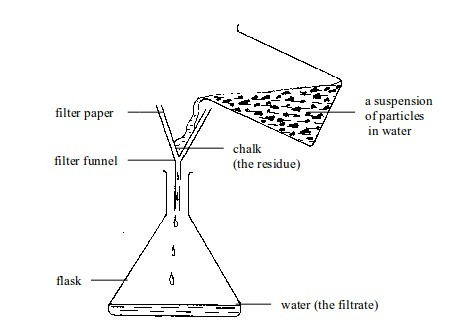
This method is best applicable in separation of components of mixtures called suspensions.
A mixture of chalk dust or flour with water can be separated by filtering the suspension. The suspended particles get trapped in the filter paper. The trapped particles are called the residue. The water is called the filtrate
2. Decantation
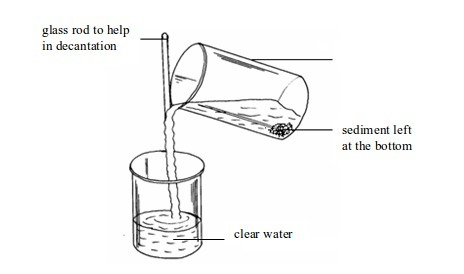
This is another method that can be used to separate mixtures called suspensions. However, in this case, separation will be successful if the suspended particles are large enough. Otherwise, the decantation exercise should be accompanied by filtration if you want to get a clear liquid.
Once the solid has settled to the bottom of the container (sedimented), the liquid can be carefully poured off. This is called decantation. Decantation can be applied to separate such components as mixtures of mud, sand or gravel in water and so on.
3. Evaporation
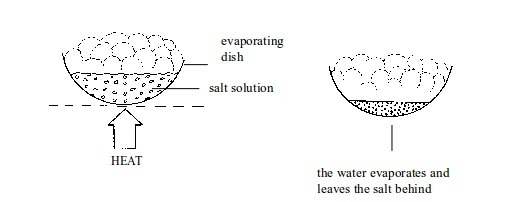
This method is used to separate substances that form a solution. In such a mixture, the solute is completely dissolved in a solvent to make a uniform solution. To separate these substances, the solution is heated so that the solvent evaporates, leaving the solid residue behind.
A mixture of salt or sugar in water can be separated by applying this method.
4. Simple distillation
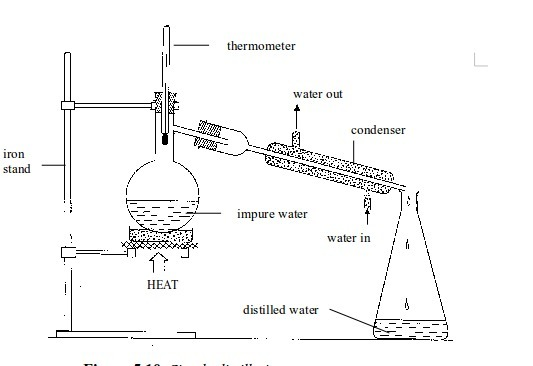
Separating a liquid from a solution can be carried out by distillation. The boiling point of a liquid is usually very much lower than that of the dissolved solid. The liquid can easily be evaporated off in a distillation flask. It is condensed by passing it down a water-cooled condenser and then collected as the distillate
This method can be used to obtain pure water from impure water or from water with dissolved impurities. The process may be used to separate a liquid from a solution or to separate two liquids whose boiling points differ by an appreciable temperature interval. This is a way of getting a pure solvent out of a solution.
5. Fractional distillation
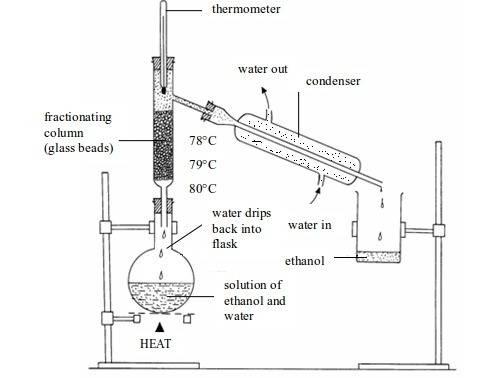
Separating the liquids from a mixture of two (or more) miscible liquids is again based on the fact that liquids will have different boiling points. However, the boiling points are closer together than for solid-in-liquid solutions. It is difficult to separate mixtures of liquids whose boiling points differ by only a few degrees. In this case, fractional distillation is used.
For example, ethanol boils at 78°C whereas water boils at 100°C. When a solution of ethanol and water is heated, ethanol and water vapours enters the fractionating column. Evaporation and condensation take place as the vapours rise up the column. Ethanol passes through the condenser first as the temperature of the column is raised above the boiling point. Water condenses in the column and flows back into the flask because the temperature of the column is below its boiling point of 100°C.
The temperature on the thermometer stays at 78°C until the ethanol has distilled over. Eventually, the thermometer reading rises above 78C°. This is a sign that all the ethanol has been separated, so heating can be stopped. By watching the temperature carefully, the two liquids (fractions) can be collected separately.
Various forms of fractionating column can be used. Their general purpose is to provide surfaces, e.g. flat discs, on which ascending vapour can condense. Glass beads in the column provide a large surface area for condensation.
6. Sublimation
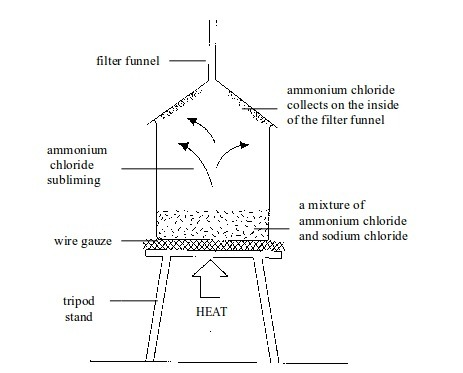
This is a technique used to separate a mixture of solids where one of the solids sublimes. Examples of solids which sublime are ammonium chloride, iodine, solid carbon dioxide and naphthalene. A mixture of any of these solids with another solid can be separated by sublimation.
Let us consider a mixture of iodine and sodium chloride. The mixture is placed in a beaker and covered with a filter funnel as shown in the diagram below. Then, as the mixture is heated, the ammonium chloride sublimes. The ammonium chloride vapour rises and condenses on the cooler walls of the filter funnel. The sodium chloride is left in the beaker.
7. Chromatography
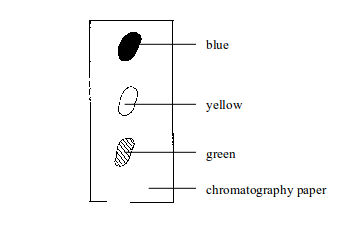
Chromatography is a method used to separate and identify the components of a mixture. The method works by allowing the molecules present in the mixture to distribute themselves between two phases; a stationary phase and a mobile phase. Thus, the separation is based on the differences in the rates at which components of the mixture move through a stationary phase (porous medium) under the influence moving phase (solvent, such as liquid or gas). During separation by chromatography, a mixture is placed on stationary phase; then, the mobile phase passes through the stationary phase and solubilizes the components. The mobile phase carries the individual components a certain distance through the stationary phase, depending on their attractions to both of the phases. Molecules of a component of the mixture that spend most of their time in the mobile phase are carried along faster. For instance, during separation of the components of black ink by paper chromatography, different colours of the ink are observed as shown in Figure 5.12. This pattern of colours is called a chromatogram. The blue ink has the fastest speed. This means it is the most soluble in the solvent and least absorbed by the paper. The green ink has travelled the least. This means, it is the least soluble in the solvent and most absorbed by the paper

Separating dyes in ink
Procedure
- Put a small spot of the water-soluble ink onto a strip of filter paper as shown in figure bellow
- Place the filter paper in a beaker of water. Make sure the level of the water is below the level of the ink spot.
- Leave the filter paper until the water has risen to the top of the paper.
- Remove the paper and allow it to dry.
- Note the colours the ink contains.
Observation
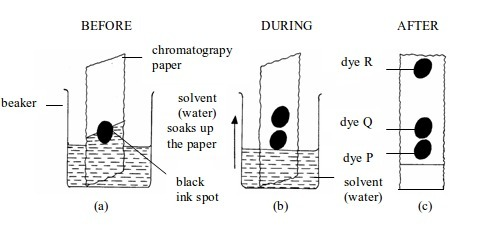
As the solvent (water) moves up the paper, the dyes are carried with it and begin to separate. They separate because they have different solubilities in water and are absorbed to different degrees by the filter (chromatography) paper. As they rise, they are gradually separated.
Findings
The different colours of the ink make a pattern of colours formed during the process of chromatography. This pattern of colours is called a chromatogram.
Figure aboveshows a chromatogram of black ink. The blue ink has the fastest speed. This means it is the most soluble in water and least absorbed by the paper. The green ink has travelled least. This means it is the least soluble in water and most absorbed by the paper.
Uses of Chromatography
Chromatography is used in many different ways. The following are some of the application of chromatography:
- It can be used to find out the components of a liquid or solid, or even to identify different substances.
- It can be used by security agents and medical personnel to analyse blood and urine samples.
- Causes of pollution in water and in animals that live in water can also be detected using chromatography.
- In chemistry, chromatography is used to test the purity of substances and in separation of mixtures.
8. Layer separation
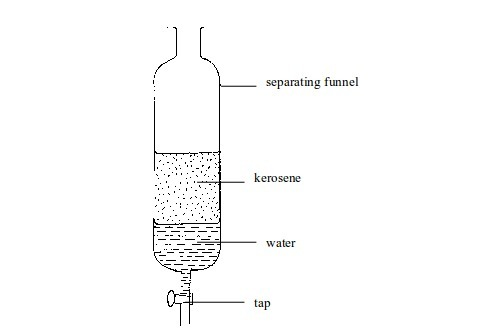
Mixtures of two immiscible liquids can be separated with a separating funnel. The mixture is placed in a separating funnel and allowed to stand. The liquids separate into two different layers. The lower denser layer is then "tapped" off at the bottom.
For example, when a mixture of kerosene and water is poured into the funnel, the kerosene floats to the top as shown in figure above. When the tap is opened, the water runs out. The tap is closed again when all water has gone, leaving the kerosene in the funnel.
9. Solvent extraction
Solvent extraction, also known as liquid-liquid extraction, refers to the separation of materials of different chemical types and solubilities by selective solvent extraction. That is, some materials are more soluble in one solvent than in another. The method is used to refine petroleum products, chemicals, vegetable oils, and vitamins.
This method is used is to separate a solid from a solution in which there is more than one solid dissolved. An example of this is a water solution of iodine and sodium chloride.
EXPERIMENT:Separating iodine from sodium chloride by solvent extraction.
Method
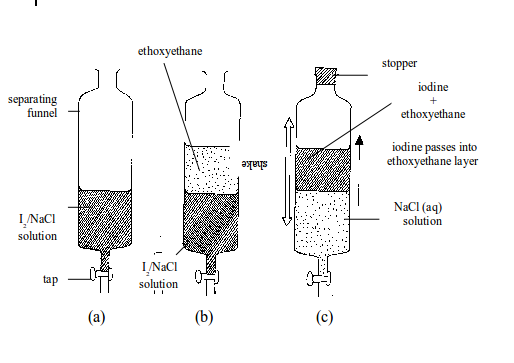
- Put the solution into a separating funnel as shown in figure (a).
- Add ethoxyethane. This forms a layer on top of the solution (b). The ethoxyethane is called the extracting solvent.
- Stopper the separating funnel and shake well figure (c). The iodine, which is more soluble in the ethoxyethane, passes into the ethoxyethane layer. The sodium chloride remains in the water layer.
- The water layer is run off into a beaker followed by the ethoxyethane layer into another beaker (Caution: Remove the stopper before opening the tap).
- The ethoxyethane is then evaporated off by simple distillation. Similarly, the water layer can be evaporated to yield sodium chloride.
The solvent extraction works on two principles:
- One solid in the solution must be more soluble in the extracting solvent than the other.
- The extracting solvent must not be miscible with the solvent in which the mixture of solids is dissolved. Neither should it react with it.
10. Centrifugation
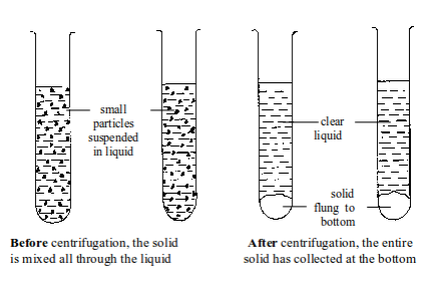
A centrifuge is used to separate small amounts of suspension. Centrifugation is used with insoluble solids where the particles are very small and spread throughout the liquid. In centrifugation, test tubes containing suspensions are spun round very fast. The solid gets thrown to the bottom. Here, it is no longer the force of gravity on the solid that causes settling.
Instead, there is a huge centrifugal force acting on the particles due to the high speed spinning of the samples. This causes the solid to be deposited at the bottom of the centrifuge tube.
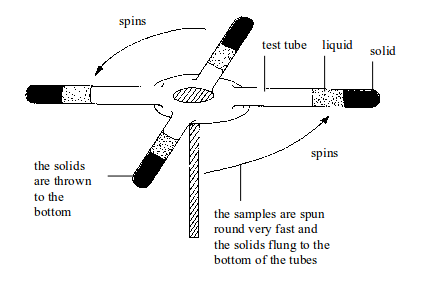
After centrifugation, the liquid can be decanted (poured out) from the test tube, or removed with a small pipette.
This makes the solid to be left behind.
11. Magnetic separation
If the solid mixture contains iron, the iron can be removed using a magnet. This method is used to separate scrap iron from other metals. Magnetic iron ore can be separated from other material in the crushed ore by using an electromagnet. In the process of recycling metals, iron objects can be picked out from other scrap metals using electromagnets.
12. Crystallization
This process involves evaporation but the speed of evaporation is much slower. In principle the salt solution can be left in the evaporating basin for a long period until all the water has evaporated but in practice this takes longer time. The process begins by evaporating away the liquid. However, because the crystals are needed, evaporation is stopped after the solution has been concentrated enough. The concentrated solution is allowed to cool slowly and crystallize. The crystals so formed can be filtered off and dried. A similar process is used to extract salt from the sea. Salty sea water is placed in wide basins and put in the sun. Water evaporates off, leaving the salt crystals in basins.
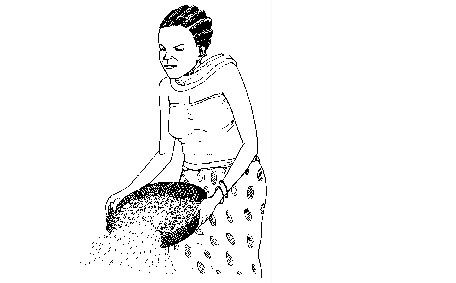
13. Winnowing or threshing
This is a method used to separate grains from husks or bran. The process makes use of the differences in density of the constituents in the mixture. When the winnower is shaken around, grains, being denser than husks or bran, sink to the bottom of the winnower
The less dense husks or bran moves to the top. They are then blown off the winnower by wind or breath, or sometimes picked by hand and separated from the grains.
The Significance of Separating Different Mixtures
Explain the significance of separating different mixtures
We separate mixtures in order to obtain the mixture constituents and put them into appropriate use. The world around us is made up of mixtures of different substances. These substances are often of little use when they are in the form of a mixture. For this reason, separation of the individual components of mixtures is deemed inevitable.
1. (i) Fractional distillation
Is used industrially to separate the various fractions of crude oil such as natural gas, petrol, kerosene, diesel, lubricating oils, waxes, asphalt and bitumen. All these fractions have a significant use in man’s industrial, domestic and commercial activities. The functions or use of all these fractions is well known to everyone of us. Can you mention the functions of each fraction? You will learn more about these products in organic chemistry section.
(ii) Fractional distillation of liquid air
Separates the air into its component gases. This is important because these components have many uses in our everyday life. Some of these fractions and their functions are summarized below:
| Component | Use |
| Nitrogen | Manufacture of fertilizer |
| Oxygen | Used in hospitals, steel making, diving and space travel |
| Argon | Filling light bulbs |
| Carbon dioxide | Fire extinguishing, used in carbonate drinks, etc. |
| Helium | Filling airships and water balloons |
| Krypton and Xenon | Used in photographic flash lamps |
2. Filtration and purification of drinking water make use of processes such as decantation, filtration and sometimes distillation. The bottled water we drink is prepared by some or a combination of these processes.
3. In mining, an electromagnet is used to separate magnetic iron ore from other materials in the crushed ore.
4. In the manufacture of ethanol by fermentation in breweries, distillation is used in the final stage to purify ethanol to its purest form (surgical spirit) in which the ethanol is usually sold. Likewise, distillation of fermented starch (8-12% ethanol), yields alcoholic drinks called sprits (whisky, gin, brandy, rum) which contain about 35-40% ethanol.
5. (i) Paper chromatography is very useful in analysis of substances present in a solution. For example, it can tell whether a substance has become contaminated or otherwise. This can be very important, because contamination of food or drinking water, for instance, may be dangerous to our health.
(ii) Chromatography has proved very useful in the analysis of biologically important molecules such as sugars, amino acids, and nucleotide bases. Molecules such as amino acids can be seen if the paper is viewed under ultra- violet light.
(iii) Paper chromatography is the test that can be used to check for the purity of a substance. If the sample is pure, it should only give one spot when run in several different solvents.
6. Other separation methods are also used to check whether purification has been successful. Samples obtained by distillation can be re-distilled. The purity of crystals can be improved by re-crystallisation. A water sample can be tested for amount of dissolved material by evaporating a certain amount of water to dryness. The solid waste can be weighed. This would give the amount of dissolved solid in the water.
The process of purification is of crucial importance in many areas of chemical industry. Medical drugs (pharmaceuticals) must be of highest possible degrees of purity. Any contaminating substances even in very small amounts may have harmful side effects.
7. (i) Separation of cream from whole milk is done by the process of centrifugation. As the milk is spun, the heavier contents are forced down and the lighter cream rises up. After centrifugation, the cream is poured off the top by decantation. This is the initial stage of milk constituent separation, after which other components such as milk proteins (cheese) are separated.
(ii) Centrifugation is applicable in blood analysis, where the solid part of blood is separated from the liquid part by centrifugation. Blood is a suspension containing microscopic blood cells (corpuscles) in a liquid called plasma. If blood is centrifuged in a test tube, the blood cells are flung to the bottom, leaving the liquid plasma on top.
8. Knowledge of separation of two immiscible liquids can be applied in the extraction of metals such as iron from their ores. For example, at the base of the blast furnace, the molten slug forms a separate layer on top of the liquid iron. The two can then be "tapped" off separately. The method is very useful in organic chemistry as part of the process called solvent extraction.
9. Evaporation process is used in the extraction of common salt from seawater whereby the sun evaporates water molecules from salty water, leaving crystals of the salt behind.
10. Layer separation technique is applied in the recovery of liquids from contaminants.
11. Solvent extraction process is applied in the extraction of certain edible oils from seeds, and in the extraction of some metals from sludge mixture.
The Components of Different Mixtures using Different Methods
Separate the components of different mixtures using different methods
Activity 2
Separate the components of different mixtures using different methods.
Chapter summary
Matter is anything that has mass and occupies space.
Matter exists in three states, namely gaseous, liquid and solid states. Changes in states from one state to another are caused by alterations in temperature and pressure
A physical change is a change that does not result in new substances being formed. A chemical change is a permanent change in the chemical properties of a substance.
An element can be defined as a substance that cannot, by any known chemical process, be split into two or more simpler substances
A chemical symbol is a way of representing an element using the letter(s)
Elements can be classified as either metals or non metals. Metals and non metals have different physical and chemical properties
A compound is a substance that contains two or more elements chemically combined together. A mixture is something that contains two or more substances not combined chemically. Mixtures can be classified as solutions, suspensions or emulsions. The different methods of separating mixtures include filtration, decantation, evaporation, simple distillation, fractional distillation, sublimation, chromatography, layer separation, solvent extraction, centrifugation, magnetic separation, crystallization and winnowing
Review questions
Question Time 1
A.1. What change occurs when ammonium chloride is heated at 340 °C?
- It expands.
- It sublimes
- It solidifies.
- It evaporates
2. What is the name of a process involved in the change of state from liquid to gas?
- Condensation
- Evaporation
- Sublimation
- Melting
3. The following are changes in the state of matter, except________.
- frying
- condensation
- evaporation
- freezing
4. A uniform mixture of sugar and water is called_____.
- glucose
- emulsion
- solution
- suspension
5. Chemical elements are classified as________.
- solutions, suspensions and emulsions
- compounds and mixtures
- solids, liquids and gases
- metals and non metals
6. Two immiscible liquids are easily separated using a______.
- condenser
- filter funnel
- fractionating column
- separating funnel
7. When two or more substances are mixed together chemically, ________ is formed
- a compound
- a mixture
- an element
- a solution
8. What method can easily be used to separate a mixture of wheat grains and bran?
- Winnowing
- Filter funnel
- Separating funnel
- Centrifugation
9. Fill in the gaps with correct words.
- Matter is anything which has________and occupies______.
- The three states of matter are_____, _____ and _______.
- An element can be defined as___________.
- A solution is a ____ of two or more substances.
- An emulsion is a ____ of tiny droplets of one liquid suspended in another liquid
10. Write TRUE for statements that are correct and FALSE for statements that are not correct.
- Matter exists in three states, namely solid, liquid, and gas.
- A liquid has no fixed volume.
- A change in state from gas to solid is called sublimation.
- In a physical change, a new substance is usually formed.
- Metals are shiny and can be polished.
- The components of a compound can be separated by physical means only.
- The liquid state is one in which the particles are moving freely in all directions.
- Condensation is the same as solidification.
- Boiling occurs at one particular temperature.
- Iodine sublimes when heated
11. Indicate, giving examples in each case, which of the following can be described as physical changes or chemical changes;
- The heating of a salt solution
- The action of heat on ice
- The burning of paper or wood in air
- The rusting of iron in air
- Fermentation of milk
- The melting of a metal
12. Give any six (6) methods available for the separation of mixtures.
13. Name the process that can be used to separate the following substances:
- Iodine and iron
- Salt and sugar
- Salt and sand
- Kerosene and water
- Iron and mud
- Water and flour
14. Define the term ‘matter’
15. Mention three states of matter and give typical examples of some substances that exist in each state
16. Define the following changes of states:
- Melting (thawing)
- Boiling
- Freezing (solidification)
- Condensation
- Evaporation
- Sublimation
17. In a tabular form, state the differences between a physical change and a chemical change
18. Differentiate between metals and non metals
19. Write down the differences between a compound and a mixture.
20. Compounds possess different properties from the elements that make them up. Explain this fact
21. Giving an example in each case, define the following terms:
- Solution
- Suspension
- Emulsion
22. Differentiate between a homogenous mixture and a heterogeneous mixture
REFERENCES
- Childs, A. (2000). MacMillan Secondary Chemistry. Macmillan Publishers Limited. Malaysia.
- Holderness, A., Lambert, J. and Thompson, J. J. (1987). A New Certificate Chemistry. Clays Limited, St Ives Plc. London
- SCSU, MoEVT-Zanzibar. (2008). Chemistry for Zanzibar Secondary Schools, Forms 1 & 2. Oxford University Press. Dar es Salaam
- Tanzania Institute of Education (1995). Secondary School Chemistry, Book One. NPC (KIUTA). Dar es Salaam
Listening to this topic