Chemistry
Laboratory Techniques And Safety
Reading settings
Text size
Line spacing
Colours
Chemistry is all around us. Did you know that everything is made out of chemicals? Any reaction taking place in body cells of all living and non living organisms correlates with chemistry. In chemistry we study materials that make up the earth and universe. Chemistry is sometimes called the central science because it bridges other natural sciences, including physics, geology and biology. Therefore, when talking about chemistry, we are referring to life on Earth.
Laboratory Techniques And Safety
Introduction
Laboratory is the special room/building where scientific experiments are conducted. Students in fact should learn science through doing experiments in the laboratories instead of simply learning it theoretically through textbooks in classrooms. Conducting experiments in the laboratory is usually associated with some risks. Thus, it is important to familiarize yourself and follow all the laboratory safety rules in order to avoid accidents. In this chapter, you will learn about the rules and safety precautions in a chemistry laboratory, First Aid and First Aid Kit, basic chemistry apparatus and their uses, and safety signs. By the end of this chapter, you should be able to state and follow laboratory rules, identify possible causes of accidents in a chemistry laboratory, and explain the basic chemical warning signs, and safety measures for a chemistry laboratory. You are also expected to be able use common chemistry laboratory apparatus and the items found in a First Aid Kit
Rules and safety precautions in a chemistry laboratory
laboratory Rules
State laboratory rules
Laboratory safety involves all the measures taken by the institution (such as school) and laboratory users (such as students, teachers, and technicians) to eliminate potential harm to human health and wellbeing. Laboratory users must understand that safety is the responsibility of everyone working in the laboratory
Laboratory safety rules are a major aspect of every chemistry laboratory. Students in the laboratory must follow specific safety rules and procedures so that they do not injure themselves or colleagues. The following are some important laboratory rules
- Do not enter the laboratory without permission from your teacher or laboratory technician.
- Put on closed shoes and long clothes. Sandals and shorts are strictly prohibited.
- Do not run or play in the laboratory.
- Do not drink, eat or taste anything in the laboratory.
- Do not carry out any experiment if you are not allowed by your teacher or laboratory technician.
- Always wash your hands after experiments.
- Never use your bare hands to transfer solids from one container to another. Use a spatula instead.
- Notify your teacher or technician immediately in case of an accident.
- Read the label carefully before taking anything from the reagent bottle.
- Do not use flammable chemicals such as alcohol, acetone, and carbon disulphide near fire flames.
- Always add acid to water; not water to acid.
- If chemicals accidentally splash onto your skin or eyes, flush immediately with a lot of water
- Never point a test tube or vessel that you are heating at yourself or your colleague.
- Never take away anything from the laboratory without your teacher’s or technician’s permission.
- (vii) If you have very long hair, tie it back in the laboratory.
- Do not pour chemicals and reagents down the sink. Dispose of these only in designated containers
- Do not discard solids down the sinks. They will clog up the sinks. Use specified containers for such wastes.
- Depending on the nature of the experiment, you should wear protective gears such as a laboratory coat, safety goggles, and gloves
The Safety Measures for a Chemistry Laboratory
Explain the safety measures for a chemistry laboratory
Laboratory safety measures are safety precautions which you should take when carrying out experiments in the laboratory. The following are some of these safety measures:
- Label and lock all storage areas, cupboards, drawers, storage cabinets, and refrigerators.
- Keep all chemicals in properly labelled containers.
- Know the safety measures to take when exposed to different hazardous materials.
- All chemicals that react with each other must be stored separately.
- Use fume hoods/cupboards/chambers whenever possible.
- Never store food in a laboratory refrigerator or freezer.
- Stored chemicals must be inspected regularly to ensure they have not expired.
- The laboratory must have emergency exits and wide windows.
- Keep the laboratory floor clean and dry at all the time.
- The laboratory must be equipped with portable fire extinguishers and other safety devices.
- Wear protective gears to minimize exposure to hazards.
- There should be a manual or instruction guides on how to treat spills of different chemical substances.
- Each laboratory should be equipped with adequate First Aid Kits.
NOTE: All the above rules and safety measures are applicable to all research, teaching and academic laboratories. However, your laboratory may require some more rules that apply to specific materials and equipment.
First aid and first aid kit
Conducting chemistry experiments involves the use of sources of heat and hazardous chemicals such as solvents and reagents which are potential causes of accidents. The apparatus and equipment may also cause damage and injuries in the laboratory in case they are mishandled. Thus, students must be familiar with the set of guidelines which they can use to mitigate or prevent the damage caused by exposure to chemicals or injury prior to professional medical help being available. These guidelines are called First Aid
FIRST AID
First Aid is a help given to someone who is injured or sick before the victim gets further medical assistance. First Aid helps to:
- relieve pain and bring hope to the victim.
- prevent permanent disability
- prevent the victim’s condition from getting worse
- reduce the possibility of death.
- shorten recovery time
Possible Causes of Accidents in a Chemistry Laboratory
Identify possible causes of accidents in a chemistry laboratory
Accidents may occur in a school laboratory if utmost care is not taken into account. Accidents in the laboratory are mainly cuts on parts of the body such as hands, fingers, legs or head. Others are burns from flames, scalds from boiling fluids, bruises and grazes due to accidental falling on a slippery floor.
There are many causes of accidents in the laboratory. Some possible causes include:
- Improper experimental procedures, for example, pouring water into an acid instead of pouring the acid into water.
- Neglecting some laboratories rules such as ignoring to wear protective gears, tasting the chemicals, eating or drinking while in the laboratory.
- Failure to adhere to proper conduct in the laboratory like running unnecessarily and conducting experiments without your teacher's or technician's permission and guidance.
- Improper use or handling of laboratory equipment and apparatus when conducting experiments. This can cause cuts, bruises, and grazes.
- A slippery laboratory floor which can cause fractures, cuts, bruises, and grazes.
- Accidental spillage of chemicals on body parts such as hands, face, and eyes.
- Poor ventilation may cause suffocation (due to inadequate oxygen supply) and poisoning (by inhaling poisonous gases produced while experimenting).
- Improper disposal of chemical wastes may result in explosions, burns or even fires.
- The leaking of gases from taps or cylinders may cause fires or even explosions.
- Use of wrong reagents due to incorrect labelling of chemicals or use of reagents or chemicals that have expired. This may cause burns, poisoning or damage to apparatus or equipment.
- Loose or improperly plugged electrical appliances. They may cause electric shock, especially when touched with wet hands and during fixing of sockets
In general, it can be concluded that most laboratory accidents are a result of negligence and carelessness of experimenters. It is also due to failure to follow the laboratory rules and general safety measures.
The Items Found in a First Aid Kit
Name the items found in a first aid kit
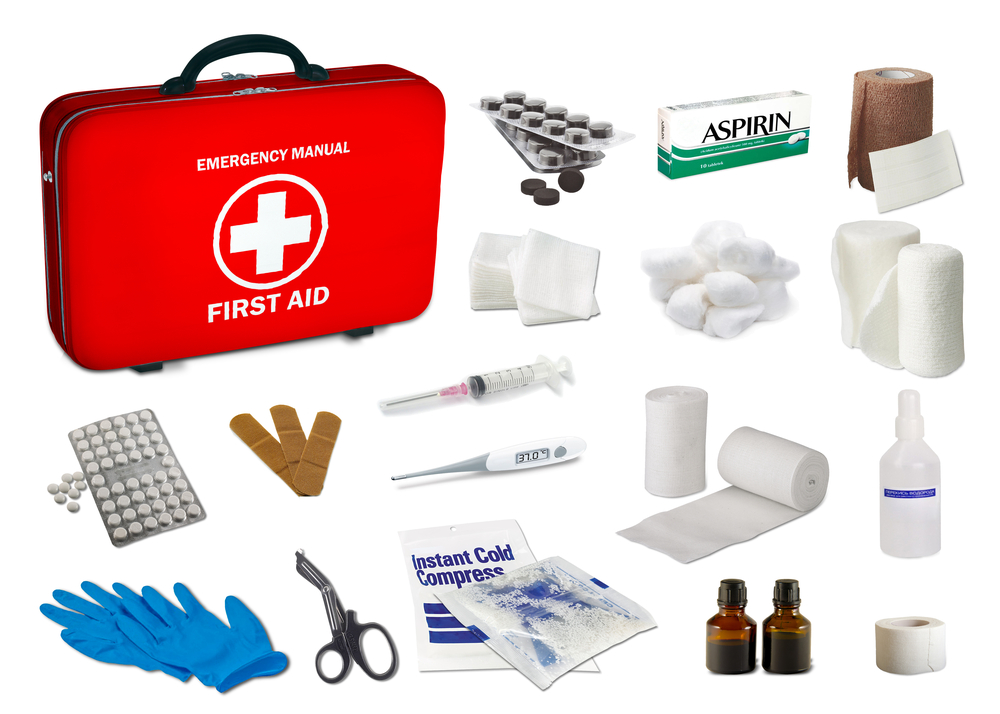
A First Aid Kit (Figure 2.1) is a collection of supplies and equipment that are used to give initial help to an injured or sick person before getting medical treatment. In the laboratory, the First Aid Kit is usually kept in a place where it can be reached easily in case of an accident, preferably on the wall. Each student must be familiar with the tools and chemicals kept in the kit and learn how to use them to provide First Aid to a victim
How Each First Aid Kit Item is Used
Demonstrate how each first aid kit item is used
Components of a First Aid Kit
The main items found in a First Aid Kit and their functions are listed in Table 2.1
| Tool/chemical/item | Function |
| First aid manual | Contains guidelines on how to use the items in the first aid kit |
| Sterile gloves | Worn on hands when attending bleeding cuts or wounds to avoid infecting wounds and to prevent direct contact with the victim’s body fluids |
| Sterile dressing | Stops bleeding |
| Antiseptic agent | Cleaning and disinfection of wounds, cuts, bruises, grazes or blisters |
| Soap | Washing hands, wounds and equipment |
| Antibiotic ointment | Prevents infection on cuts and bruises in or near the eye |
| Burn ointment | Applied on burns to prevent infection |
| Petroleum jelly | Soothing broken skin |
| Plaster or adhesive bandage | Covering small wounds or cuts |
| Sterile gauze | Covering wounds to protect them from dirt or germs |
| Eye wash solution | Flushing the eyes or as a general decontaminant |
| Thermometer | Recording body temperature |
| Antibiotic towelettes or cotton wool | Cleaning and drying cuts and wounds |
| Iodine tincture | Dressing fresh cuts and bruises |
| Pain relieving drugs such as aspirin, paracetamol, panadol, etc | Relieving mild pains |
| Liniment | Reducing muscle pain |
| Mild antibiotics | Treating mild bacterial infections on the skin, ear, nose and mouth |
| Gentian violet solution | Applied on minor wounds and treatment of serious heat wounds |
| Hydrogen peroxide solution | Cleaning wounds |
| Methylated spirit (70% alcohol) | Cleaning cuts and bruises |
| Bandages | Dressing wounds and cuts, and immobilizing injured limbs |
| Scissors or razor blade | Cutting dressing materials |
| Dental kit | Treatment of broken teeth, loss of crown or filling |
| Safety pins (small and big) | Splinter removal and securing triangular bandage slings |
| Tweezers | Splinter or stinger removal |
| Resealable oven bag | Container for contaminated articles |
| Moleskin | Applied to blisters or hot spots |
| Triangular bandage | Used as a sling, towel or tourniquet |
| Boiled, clean water | Washing hands and drinking |
| Nasal spray decongestant | Nasal congestion from colds or allergies |
| Torch | Source of light |
| Whistle | Blown to call for help |
The Items in a First Aid kit to Provide First Aid to an Accident Victim
Use the items in a first aid kit to provide first aid to an accident victim
Basic chemistry laboratory apparatus and their uses
Instruments used for carrying out different experiments in the laboratory are called laboratory apparatus. In most school chemistry laboratories, you will encounter the same basic apparatus
The Apparatus Used in a Chemistry Laboratory
List the apparatus used in a chemistry laboratory
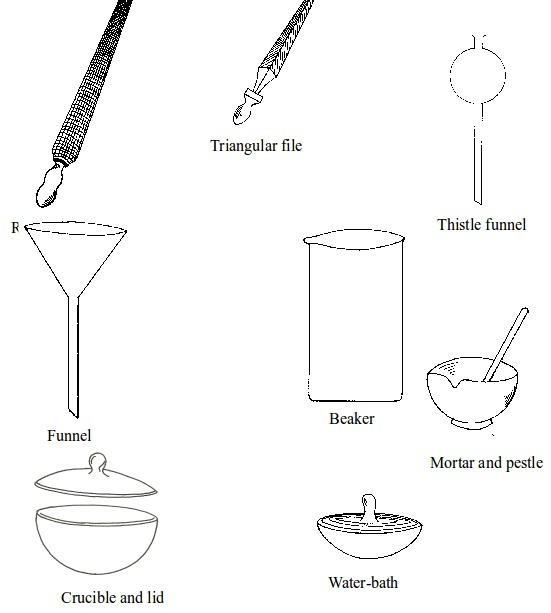
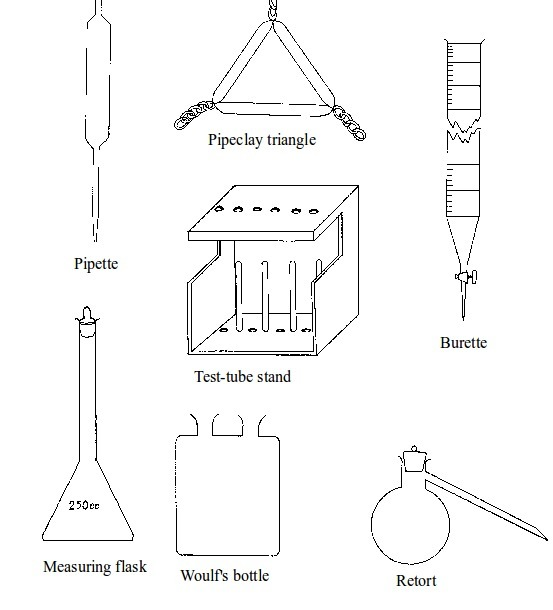
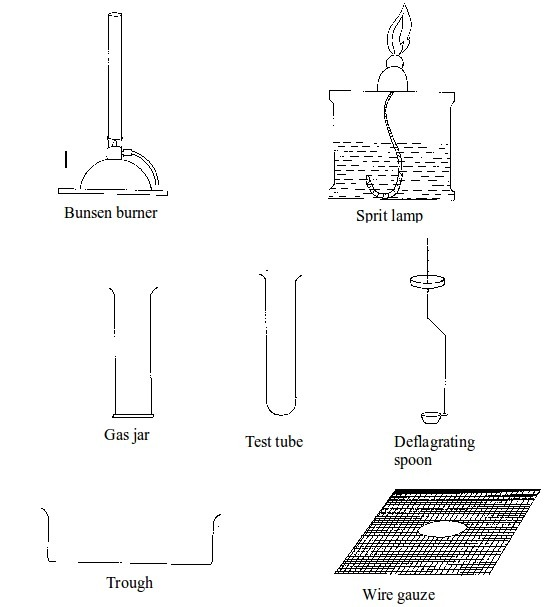
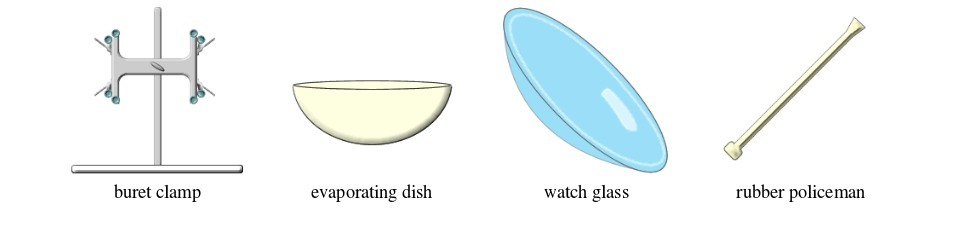
The most common apparatus used in chemistry laboratories include the following: pipette, measuring cylinder, thermometer, burette, balance, stopwatch, beaker, test tube, dropper, flasks, watch glass, gas jar, thistle funnel, boiling tube, tripod stand, wire gauze and crucible. Others are evaporating dish and deflagrating spoon, filter paper, filter funnel, mortar and pestle, test tube rack, test tube holder, tripod stand, tongs, reagent bottle, wash bottle, spatula, and safety goggles. The following figures (Figures 2.1–2.44) show some common chemistry laboratory apparatus:
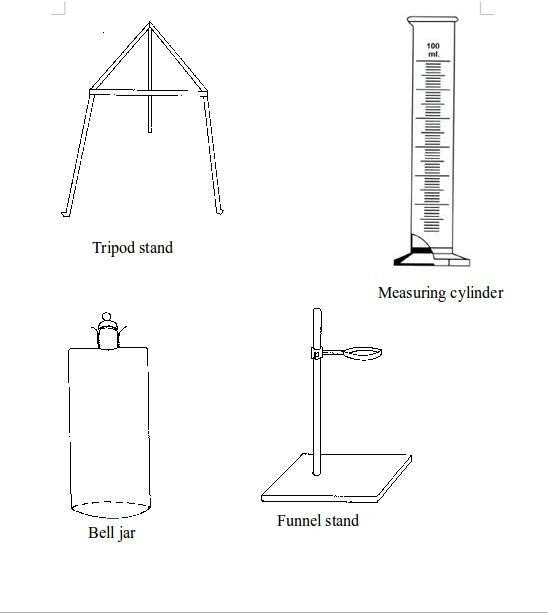
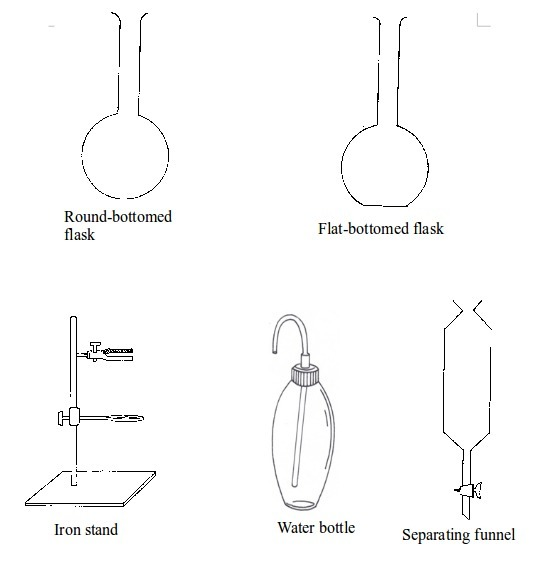
Chemistry Laboratory Apparatus According to their Uses
Categorize chemistry laboratory apparatus according to their uses
Chemistry laboratory apparatus can be classified according to their uses or according to the materials they are made of;
a. Laboratory apparatus classified according to their uses include the following:
- Apparatus for holding things, for example, test-tube holder, retort stand and clamp, test-tube rack, tongs, and tweezers;
- Apparatus for taking measurements, for example, thermometer, burette, pipette, measuring cylinder, measuring flask, beam balance, electronic balance, measuring syringe, beaker, and stopwatch;
- Apparatus for heating substances, for example, boiling tube, pipeclay triangle, crucible and lid, wire gauze, deflagrating (combustion) spoon, Bunsen burner, spirit lamp, tripod stand, evaporating dish, wire gauze and stove;
- Apparatus for doing chemical reactions (or testing), for example, beaker, test tube, dropper, flask, watch glass, gas jar, and thistle funnel;
- Apparatus for filtering, for example, filter funnel, filter paper, and cotton wool;
- Apparatus for grinding e.g. mortar and pestle;
- Apparatus for storage, for example, reagent bottles and wash bottle;
- Apparatus for scooping, for example, spatula, and scoopula; and
- Apparatus for safety, for example, goggles, and hand gloves.
b.The apparatus can also be classified based on the materials they are made of. The commonly used apparatus are made of glass, metals, plastics, or wood. Few apparatus are made of clay and asbestos. Table 2.2 summarizes some common laboratory apparatus, their compositions and uses
| Apparatus | Material | Uses |
| Test tube | Glass | Holding small amounts of liquids for mixing or heating. |
| Funnel | Glass or plastic | Pouring liquids into containers with small openings; also used to hold filter paper |
| Beaker | Glass or plastic | Holding and mixing liquids; the glass beaker is also used heating and mixing liquids |
| Flask | Glass | Holding and heating substances; also used for precise dilutions and preparing standard solutions |
| Retort stand | Metal | Holding apparatus during experiments |
| Tripod stand | Metal | Holding apparatus during heating |
| Gas jar | Glass | Collecting gases |
| Wash bottle | Plastic | Storing distilled water and for washing specific pieces of equipment with water or keep materials moist |
| Crucible | Ceramic, graphite | Heating chemicals |
| Test tube holder | Metal and wood | Holding test tubes while heating |
| Weighing balance | Metal and plastic | Measuring weight (or mass) |
| Spatula | Metal | Scooping small quantities of powder or crystalline chemicals |
| Condenser | Glass | Collecting vapours by condensing them into liquid |
| Pipette | Glass | Accurate measurements of specific volumes of liquids for titrations |
| Burette | Glass | Measuring volumes of reagents usually during titrations |
| Trough | Glass | Assists in gas collection |
| Tongs and forceps | Metal | Picking and holding hot substances and apparatus |
| Measuring jar | Glass | Measuring volumes of liquids |
| Thistle funnel | Glass | Leading liquids into containers and apparatus |
| Dropper | Glass rubber | Obtaining small amounts of liquids (not precise). Usually used for dropping indicators into reagents |
| Mortar and pestle | Clay | Crushing or grinding substances |
| Wire gauze | Metal | Used as a surface for a beaker or flask to rest when being heated by a Bunsen burner. It provides even distribution of heat during heating. |
| Spring balance | Metal | Measuring weight |
| Distillation flask | Glass | Separating mixtures of two liquids with different boiling points |
| Combustion spoon | Metal | Burning powder in jars |
| Thermometer | Glass | Measuring temperature |
| Delivery tube | Glass | Allowing gases to pass through from one container to another |
| Bunsen burner | Metal | Heating substances |
| Separating funnel | Glass | Separation of immiscible liquid mixtures |
| Measuring cylinder | Glass or plastic | Measuring volumes of liquids |
| Measuring syringe | Plastic, glass | Sucking in and measuring specific volumes of liquids |
| Stopwatch | Plastic or glass and metal | Accurate measurement of time |
| Watch glass | Glass | Used as a surface to evaporate some liquids, to hold substances being weighed or observed, or as a cover for a beaker |
| Boiling tube | Glass | Is a large test tube used to heat substances requiring strong heating, or when the sample is too large for a test tube |
| Evaporating dish | Ceramic, glass | Heating and evaporating liquids and solutions |
| Filter paper | Paper | Separating fine solid particles from liquids (filtration) |
| Test tube rack | Wood or plastic | Holding and transporting test tubes during experiments |
| Reagent bottle | Glass | Storing different chemicals |
| Safety goggles | Glass | Protecting eyes from chemical spills, strong light and harmful vapours |
| Bell jar | Glass | Keeping gases, moisture, air, or for creating vacuums |
Common Chemistry Laboratory Apparatus
Use common chemistry laboratory apparatus
Common laboratory apparatus
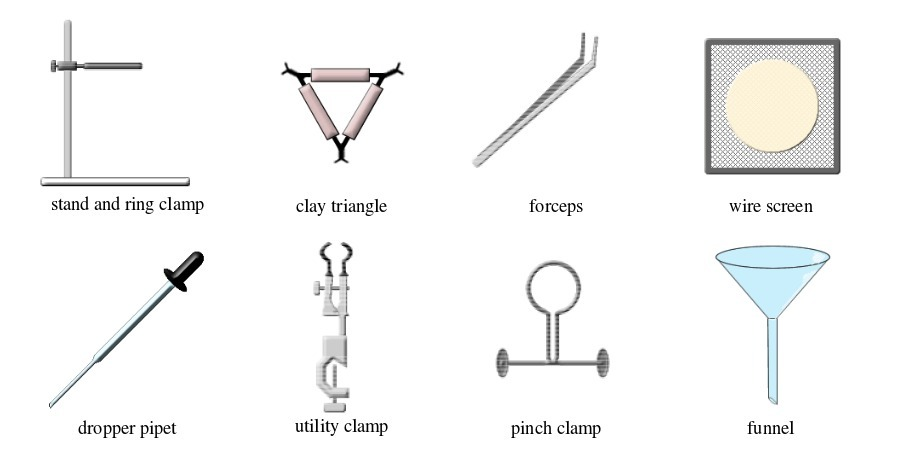
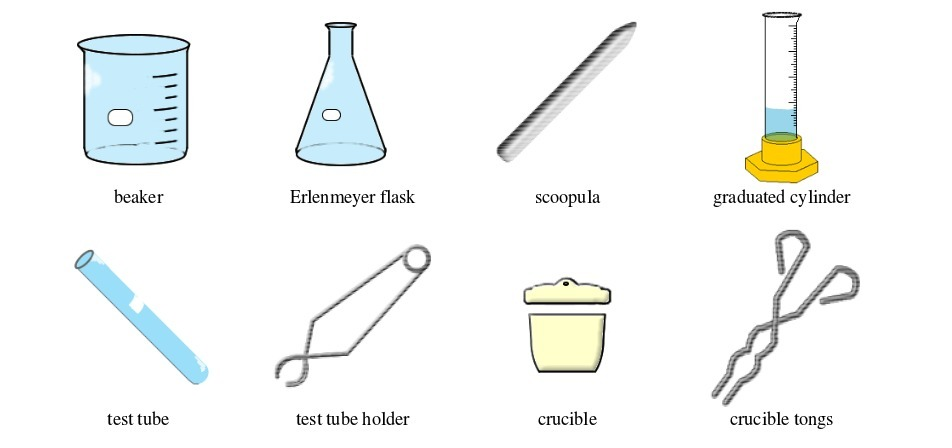
Activity 1
Aim: To measure volume of liquids using different apparatus
Materials: pipettes, burettes, measuring cylinders, water, beakers.
Procedure
- Carefully pour some coloured water into a graduated measuring cylinder with a capacity of 100 cm3. Add the water, up to a 25-cm3 mark.
- While adding water, position yourself at eye-level with the mark on the cylinder. This will enable you to obtain the most accurate measurement. To simplify the work of reading the level of the water, you may use coloured water.
- Pour the water into the 50-cm3 volumetric flask. Add the water carefully until it reaches the 50-cm3 mark.
- Position yourself at eye-level with the mark. You will obtain the most accurate reading when the mark appears straight rather than elliptical. To obtain this, put a flask on a flat table.
- Add water one drop at a time. Do so until the bottom of the curved surface of the water exactly matches the mark on the flask.
Activity 1.2
Aim: To measure the masses of solid substances
Materials: chemical, electronic or spring balance, watch glasses, various substances such as sand, sugar, salt, flour, stones, fruits.
Procedure
- Put an empty watch glass on the weighing balance. Note down its mass. Record this as mass M1.
- Place the various items you have on the watch glass, one item at a time. Note down the mass. Record this as M2.
Note: to obtain the mass of an object, we subtract the mass of an empty watch glass from the mass of the watch glass and the substance. That is, M2 - M1.
For example
i

Warning signs
Chemical safety signs
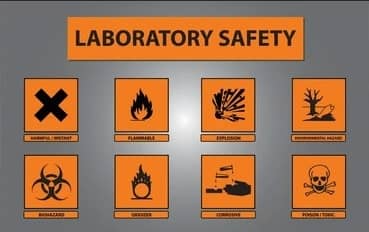
Chemical safety signs are safety symbols found on containers and places containing hazardous substances. The symbols are also found on tanks or containers that are used to carry, store or transport certain chemicals. Containers holding flammable fuels such as diesel, petrol, and natural gas, as well as those containing toxic chemicals must have safety symbols. These symbols indicate the dangers (hazards) likely to be caused by the chemicals they contain if they are handled carelessly. Thus, when performing experiments in the laboratory, it is important to read and follow the safety signs on chemical containers. This will minimize the chances of causing accidents in the laboratory
The Basic Chemical Warning Signs
Draw and label the basic chemical warning signs
There are many chemical safety signs, but the most common ones are shown in Figure 2.45.
The Concept of Warning Signs
Explain the concept of warning signs
Before conducting an experiment in the laboratory, you must be aware whether the substance you want to use is toxic, corrosive, flammable, oxidant, explosive, or harmful. This information will help you know how to handle the chemicals safely. Proper handling of chemicals enables you to avoid unnecessary accidents. Below is an explanation about the safety signs shown in Figure 2.45
Toxic
Toxic substances include those that can poison you or the other person working close to you in the laboratory. These substances can kill within a short time or after some few days. They should not be allowed to get into your body through body orifices (month, nose, eyes, ears, etc). Neither should they be allowed to contact your skin. They become even more dangerous when they get into the body. If it happens that these substances touch your skin accidentally, wash it immediately with ample water.
Corrosive
Corrosive substances refer to those chemicals that can burn or corrode (eat away) your skin. They can also corrode wood or metals. One can become blind if such substances accidentally get into his/her eyes. If they contact your skin, wash it immediately with a lot of water. Examples of corrosive substances commonly found in a school laboratory are concentrated mineral acids such as sulphuric acid, hydrochloric acid and nitric acid, and concentrated alkalis such as sodium hydroxide, potassium hydroxide and ammonia.
Flammable
These chemicals catch fire easily. For this case, they should be kept away from flames or fires. They can be set into fire by any kind of sparks, be it from welding or fire. When working with flammable chemicals in the laboratory all burners must be put off. These chemicals are usually very volatile. The containers used to carry them must be stoppered immediately after every use. Examples of flammable chemicals are methylated spirit, ether, acetone and methanol.
Explosive
Explosive chemicals are those that explode rapidly upon detonation (set into fire or ignited). Because the reaction is rapid, it results into throwing off particles at a high speed. For this reason, they should not be kept in glass containers. This is because during explosion the particles will disperse around and cause serious injuries to people. Those explosive chemicals that can react without external detonation are even more dangerous
Oxidizing agents
These chemicals can stimulate a burning substance to burn efficiently and faster. Therefore, they must be kept away from fires no matter how small that fire may be. An example of oxidizing agent is oxygen gas.
Harmful or irritant
Harmful substances are those that can impair your health or make you fall sick. They do not normally kill instantly but have detrimental effects following a long exposure to them. These chemicals do not kill immediately. However, care must be taken when handling or dealing with them. Irritating substances cause pains when in contact with the body. They are dangerous to health when in contact with the body surface for a long period of time.
Chapter summary
A laboratory is a room or building where scientific experiments are conducted. Laboratory rules is a set of guidelines that explain how well to behave and conduct experiments in the laboratory
Laboratory safety measures are safety precautions to be taken when carrying out experiments in the laboratory
First Aid is a help given to someone who is injured or sick before the victim gets further medical assistance
Causes of accidents in a chemistry laboratory include improper conducts and improper experimental procedures, a slippery laboratory floor, chemical spillage, poor ventilation, improper disposal of chemical wastes, leaking gases and loose or improperly plugged electrical appliances
A First Aid Kit is a collection of supplies and equipment that is used to give initial help to an injured or sick person
Laboratory apparatuses may be classified according to intended uses or materials they are made of.
Chemical safety signs are safety symbols found on containers and places mainly representing toxic, corrosive, flammable, explosive, oxidizing, and harmful (irritant) substances.
Review questions
Question Time 1
A.1. Define the following terms:
- Laboratory
- First Aid
- First Aid Kit
- Apparatus
2. Which of the following statements best describes the word laboratory?
- A room or building where scientific experiments are carried out
- A building where experimental animals are kept
- A room or building where chemicals are kept
- A building where students do their homework
3. Students saw a sign marked ‘Corrosive’ on a bottle. They made the following possible interpretations. Which is the most correct?
- The bottle contained distilled water
- The bottle had radioactive materials.
- The bottle contained ammonia solution.
- The bottle contained spirit used in lamps
4. Which of the following items is not likely to be found in a First Aid Kit?
- Bandage
- Whistle
- Thermometer
- Eraser
5. Which one of the following sets contains chemistry laboratory apparatus?
- Funnel, pen, flask, crucible, and fork
- Gas jar, beaker, pipette, spatula, and hammer
- Condenser, burette, thermometer, and tongs
- Test tube, trough, water bath, and trowel
6. Complete the following statements:
- A room where scientific experiments are conducted is called______.
- The chemical warning sign indicated as ‘Toxic’ means_______.
- Crucible and lid are made of ______.
7. Draw and describe the functions of the following apparatus:
- Separating funnel
- Mortar and pestle
- Measuring cylinder
- Test tube rack
- Wash bottle
8. Outline 10 laboratory rules
9. Why is it important that we must follow these rules? Give any 5 reasons
10. Each chemical stored in a chemistry laboratory must have a chemical safety warning sign label on it. Why do you think that every chemical container or bottle must bear such a label?
11. Explain the functions of any five tools that are most likely to be found in a First Aid Kit
12. Explain 10 major causes of accidents in the laboratory
REFERENCES
- Childs, A. (2000). Macmillan Secondary Chemistry (International Ed.). Macmillan Publishers Limited. Malaysia.
- Marandu, E. J. (2007). Fundamentals of Secondary School Chemistry, Book One. Kapsel Educational Publications. Dar es Salaam.
- Misra, R. S. (1986). Introduction to Experimental Chemistry for Schools. Press and Publicity Centre. Dar es Salaam
- SCSU, MoEVT-Zanzibar. (2008). Chemistry for Zanzibar Secondary Schools, Forms 1 & 2. Oxford University Press. Dar es Salaam.
- Tanzania Institute of Education (1995). Secondary School Chemistry, Book One. NPC (KIUTA). Dar es Salaam.
Listening to this topic