Mathematics
NUMBERS (Whole numbers)
Reading settings
Text size
Line spacing
Colours
NUMBERS (Whole numbers)
Whole numbers are the set of counting numbers together with zero. They begin at 0, 1, 2, 3, 4, 5, 6… and continue endlessly. We use them every day to count objects, measure quantities, and perform calculations.
Natural and Whole Numbers Explained.
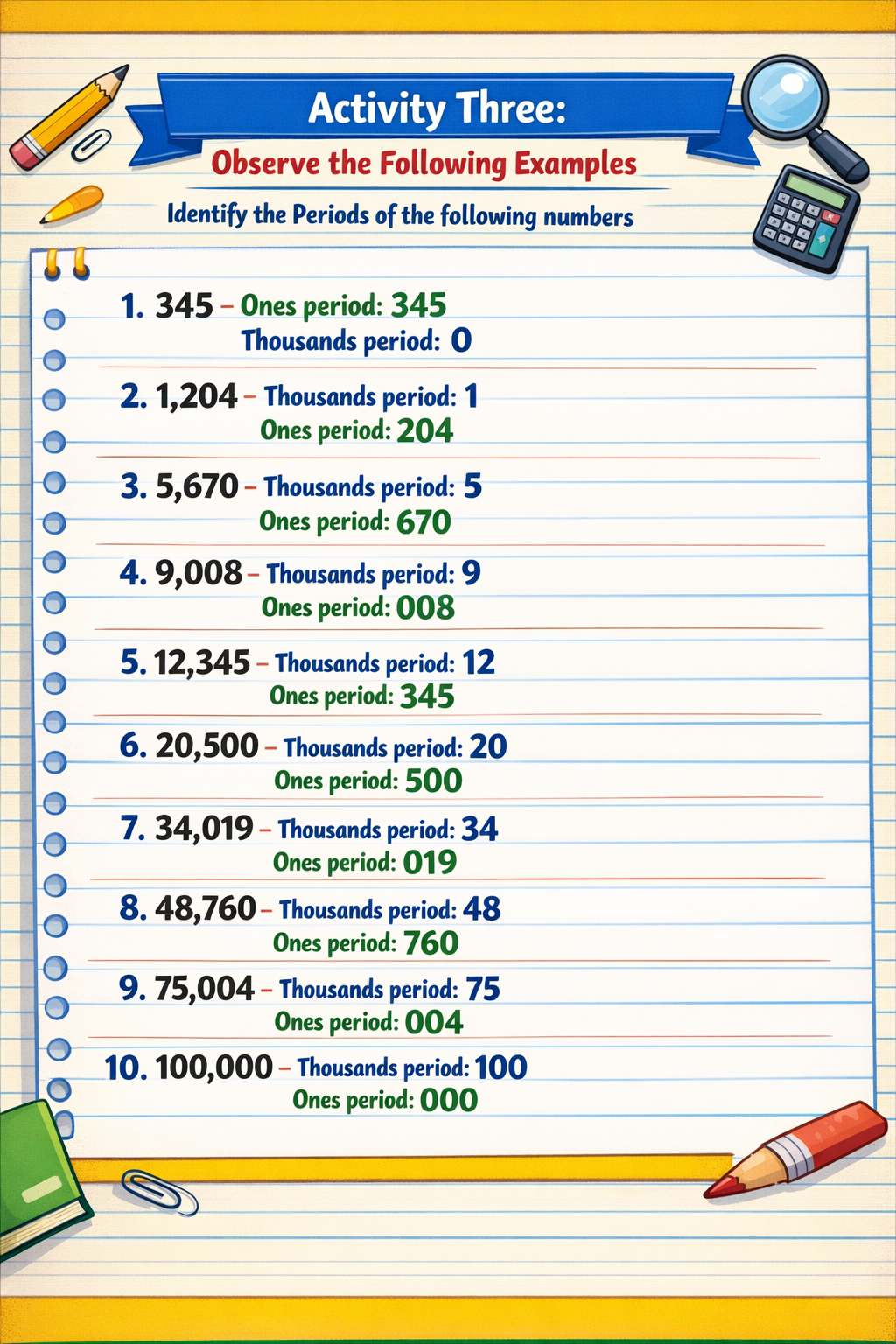
Identify the periods of numbers.
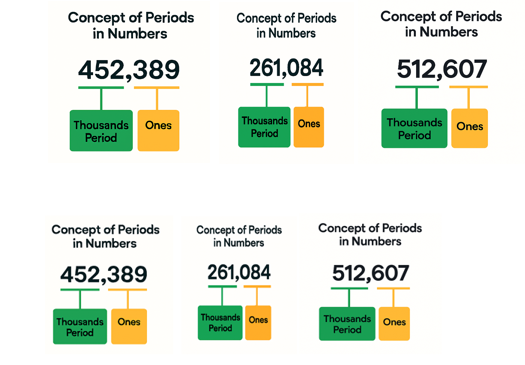
A period is a group of three digits in a number, separated by commas when writing large numbers. Starting from the right. The first period is the ones period (units, tens, hundreds). The second periods is the thousands period (thousands, ten-thousands, hundred-thousands).
Identify the periods of numbers.
Activity 1
Study the following charts which shows the period of numbers and their concerned place values
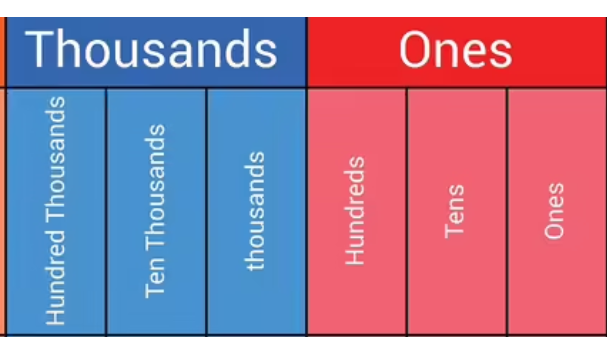
Example 1
Study the following examples
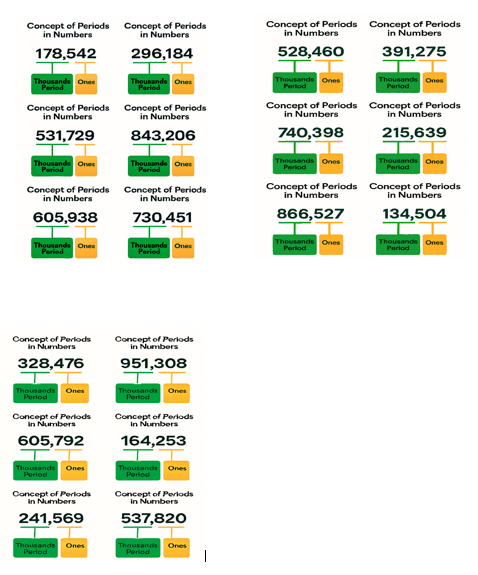
Activity 2
Study more examples
Simple Rule for Learners
- i) Count numbers in groups of three from the right.
- ii) Each group is called a period
Exercise 1
Identify the Periods of the following numbers
- 1. 456
- 2. 2,340
- 3. 7,018
- 4. 15,672
- 5. 40,009
- 6. 76,013
- 7. 45,324
- 8. 134
- 9. 10,002
- 10. 100,000
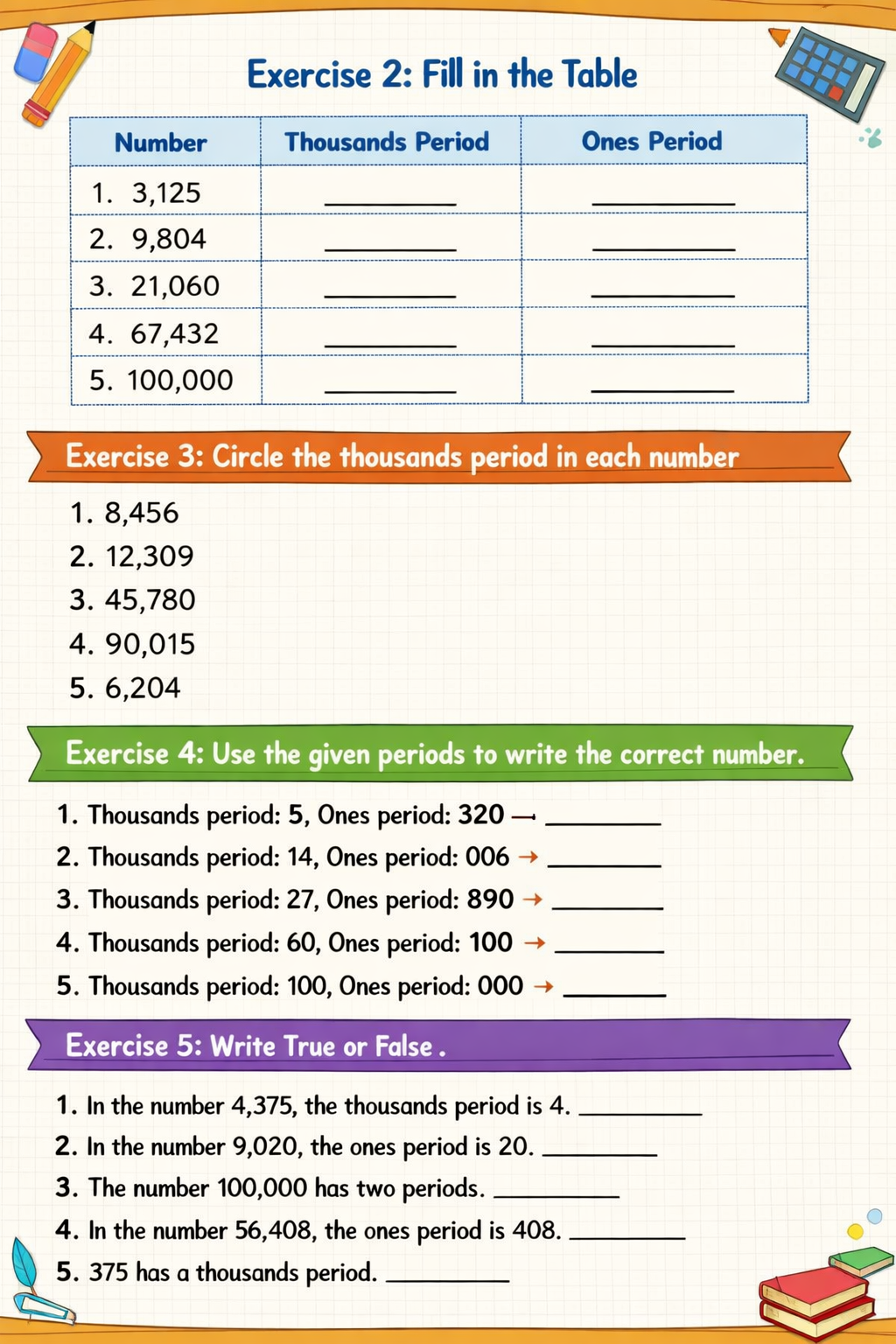
Exercise 2
Do the following exercises
Count numbers according to their place values.
Activity 3
Study the following explanation.Counting numbers according to their place values means breaking each digit down based on its position in the number. Each position has a value: ones, tens, hundreds, thousands, and so on.Place Value Basics
- Ones (units): The rightmost digit.
- Tens: The second digit from the right.
- Hundreds: The third digit from the right.
- Thousands: The fourth digit from the right.
- Ten-thousands,
- Hundred-thousands
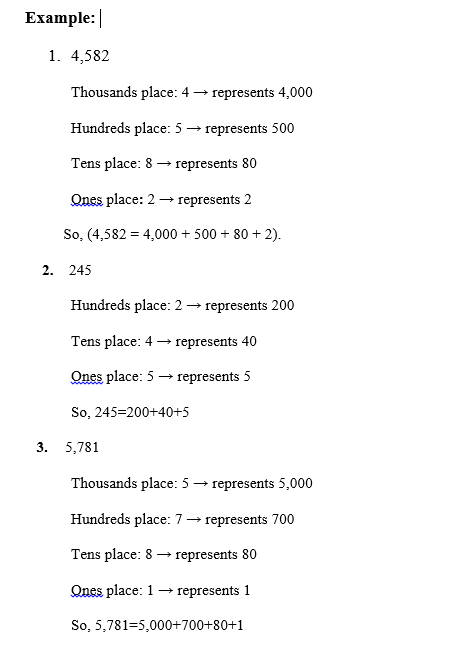
Example 2
Go through the following examples
Use numbers in counting.
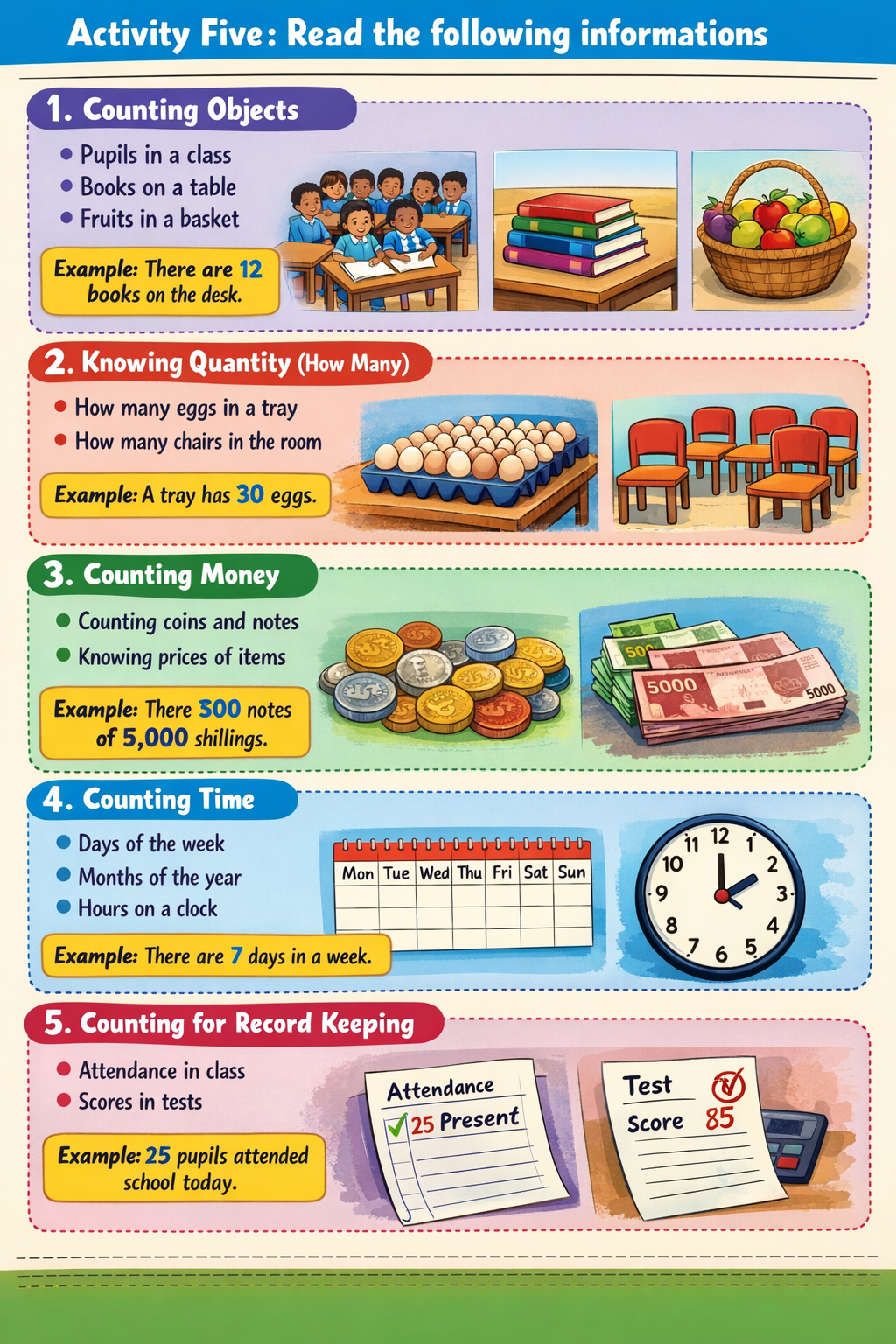
Activity 4
Read the following information Numbers are super important in everyday counting. We use them to know how many, how much, and the order of things. We use numbers in countingin the following areas
Reading numbers (1 to 100,000)
Read numbers according to their periods.
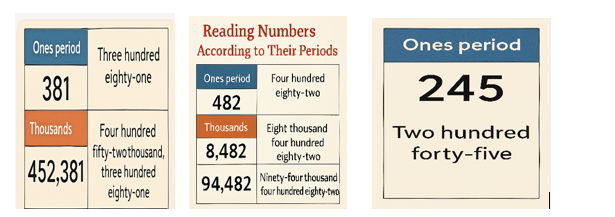
Activity 5
Observe the flashcards below, and then try yourself to read numbers according to their periods. When you are going to read numbers according to their periods, remember the following:
- 1. Group digits in threes
- 2. Read each group
- 3. Say the period name
- 4. Skip zero periods
- 5. Read left to right (highest period to lowest period)
Activity 6
Activity 7
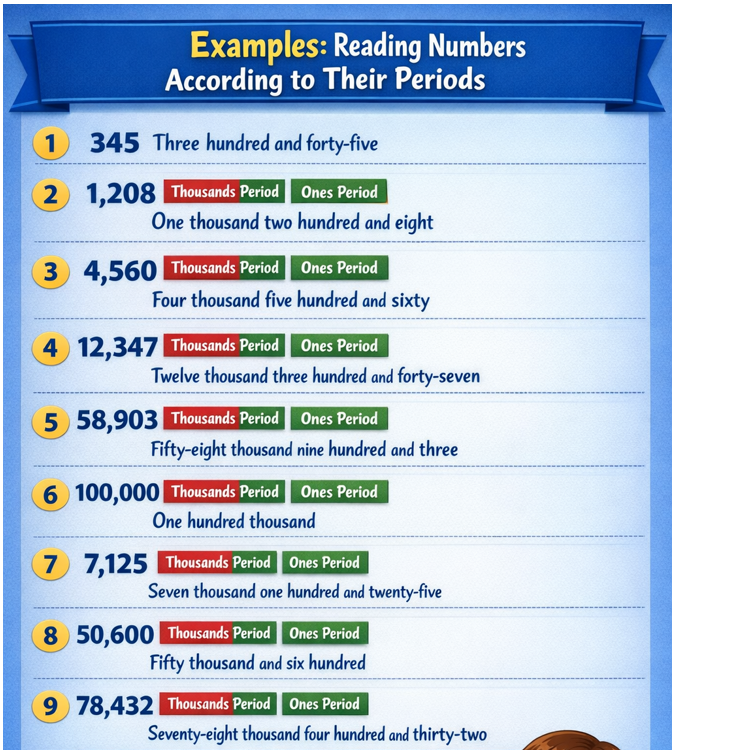
Study the following examples, and then try it yourself to do the exercise
Exercise 3
Read the following numbers according to their periods
- 245
- 1,306
- 4,580
- 12,904
- 38,217
- 67,896
- 26,980
- 89,763.
- 99,462
- 30,300
Read numbers in numerals.
Reading numbers in numerals means saying numbers correctly when they are written using digits
Activity 8
Study the following examples
- 1,000 One thousand
- 1,245 One thousand two hundred and forty-five
- 3,080 Three thousand and eighty
- 6,519 Six thousand five hundred and nineteen
- 10,000 Ten thousand
- 12,340 Twelve thousand three hundred and forty
- 25,006 Twenty-five thousand and six
- 48,920 Forty-eight thousand nine hundred and twenty
Activity 9
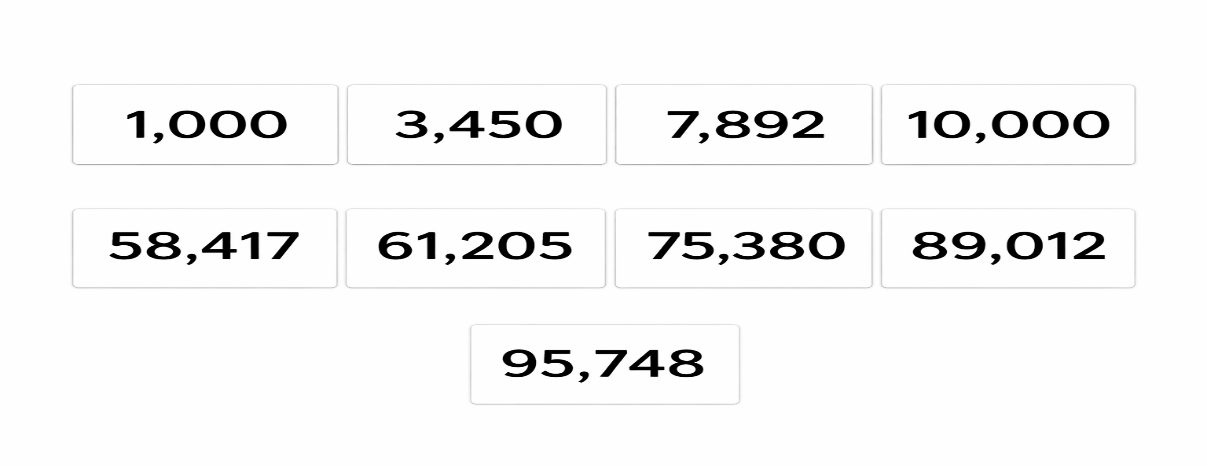
Observe the following examples
Activity 10
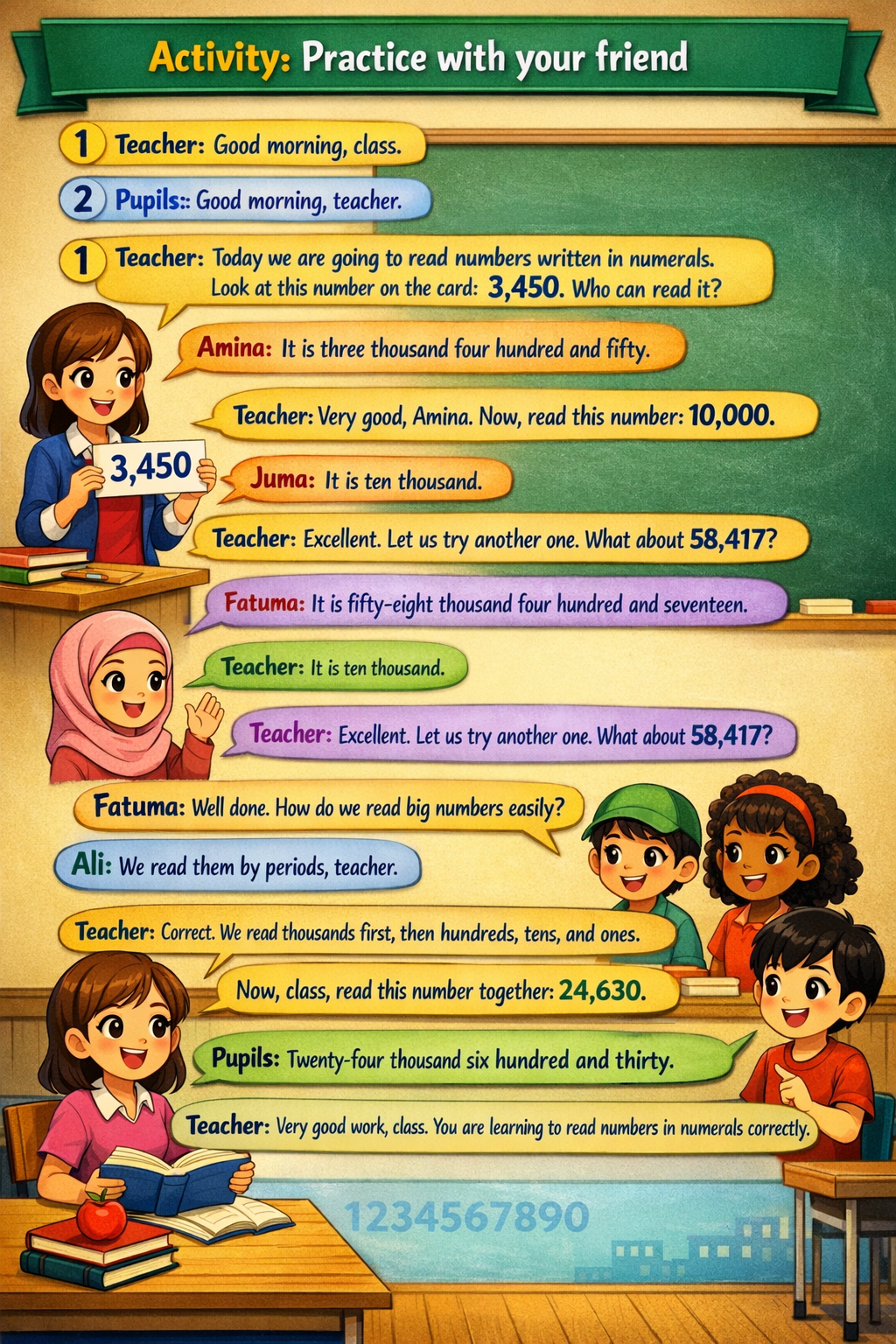
Practice with your friend the following
Exercise 4
Read these numbers loudly and clearly.
- 1,000
- 3,450
- 7,892
- 10,000
- 24,630
- 58,417
- 12,305
- 40,090
- 6,700
- 25,000
Read numbers in words.
Activity 11
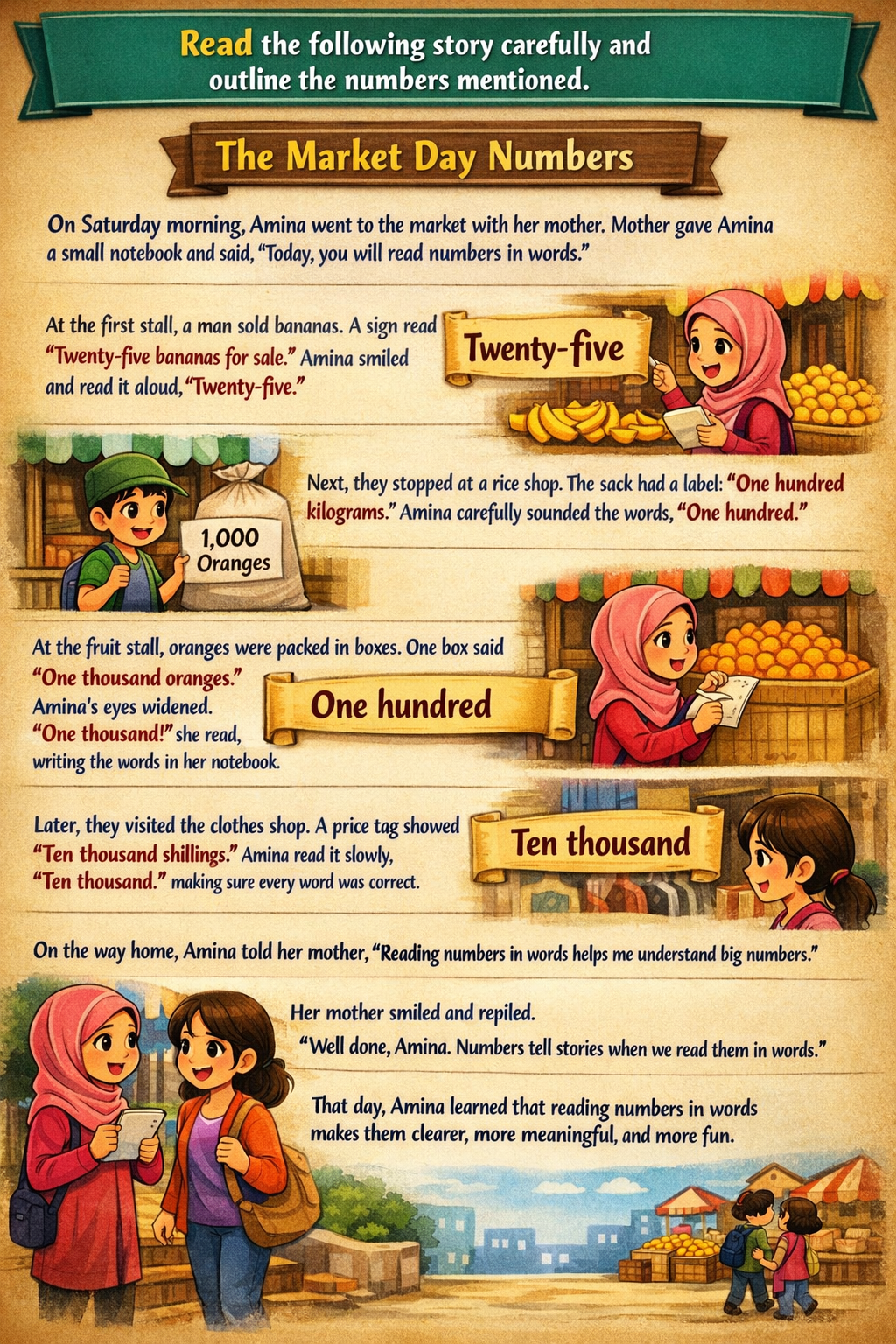
Read the following story carefully and outline the numbers mentioned.
Activity 12
Study the examples below carefully
- 5 - Five
- 12 - Twelve
- 28 - Twenty-eight
- 40 - Forty
- 100 - One hundred and six
- 354 - Three hundred and fifty-four
- 1000 - One thousand
- 2,410 - Two thousand four hundred and ten
- 10,000 - Ten thousand
- 58417 - Fifty-eight thousand four hundred and seventeen
- 6,720 - Six thousand seven hundred and twenty
- 12468 - Twelve thousand four hundred and sixty-eight
- 20,000 - Twenty thousand
- 34,0910 - Thirty-four thousand nine hundred and ten
- 45, 603Forty-five thousand six hundred and three
- 60, 850 - Sixty thousand eight hundred and fifty
- 99,999 Ninety-nine thousand nine hundred and ninety-nine
Exercise 5
Write the numbers in words
- 1,205
- 3,410
- 6,089
- 7,560
- 9,999
- 10,005
- 20,140
- 50,060
- 99,999
- 36,298
Writing numbers (1 to 100,000)
Write numbers in expanded form.
Activity 13
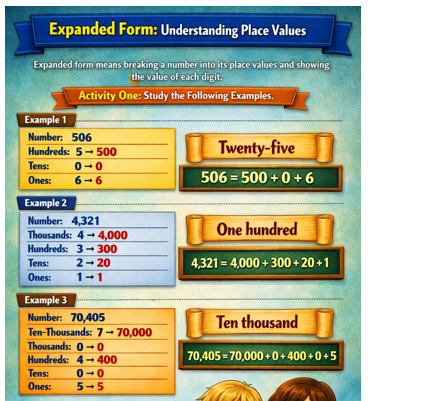
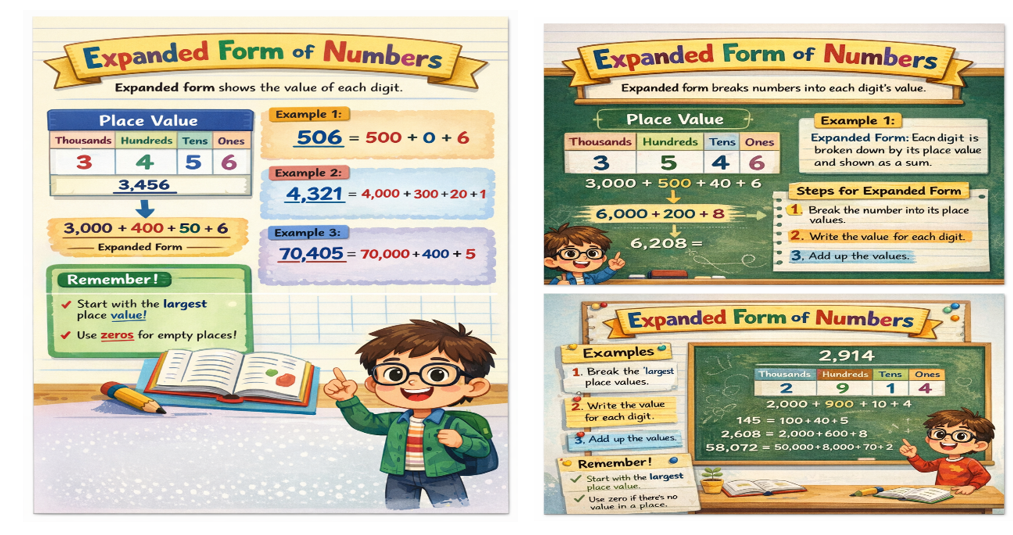
Expanded form means breaking a number into its place values and showing the value of each digit.Study the following examples
Example 3
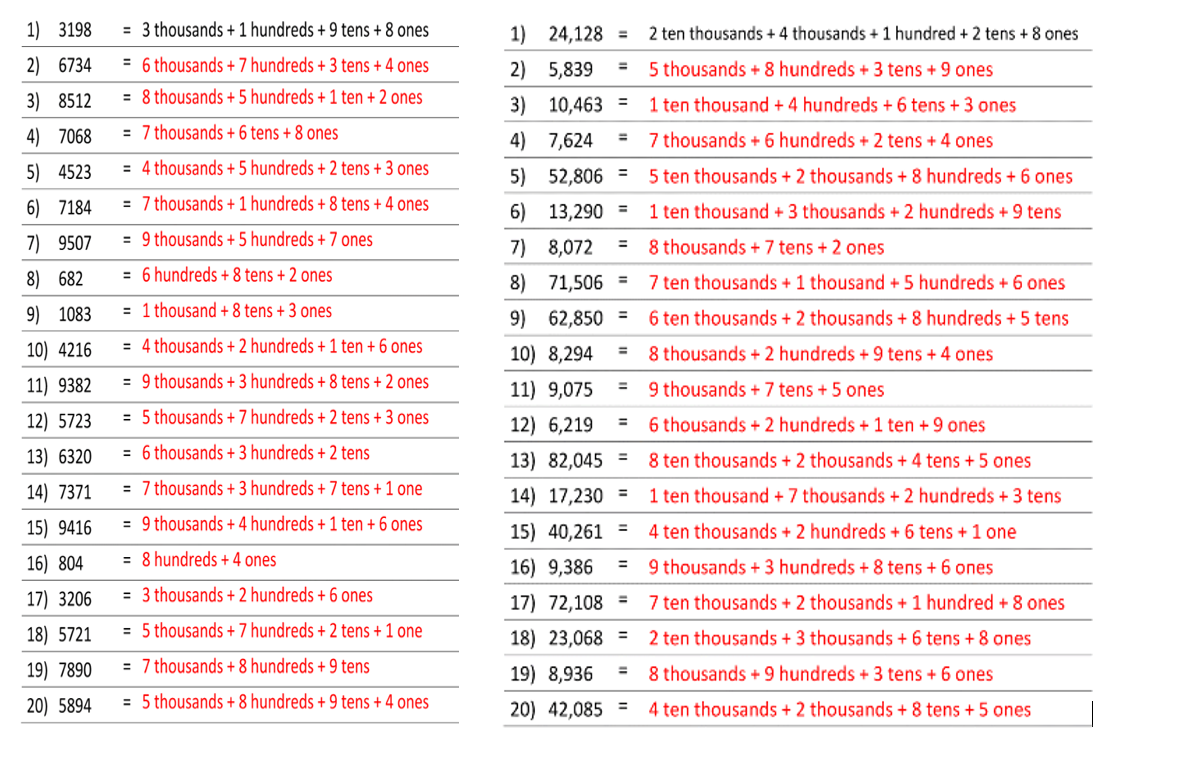
Study the following examples
Exercise 6
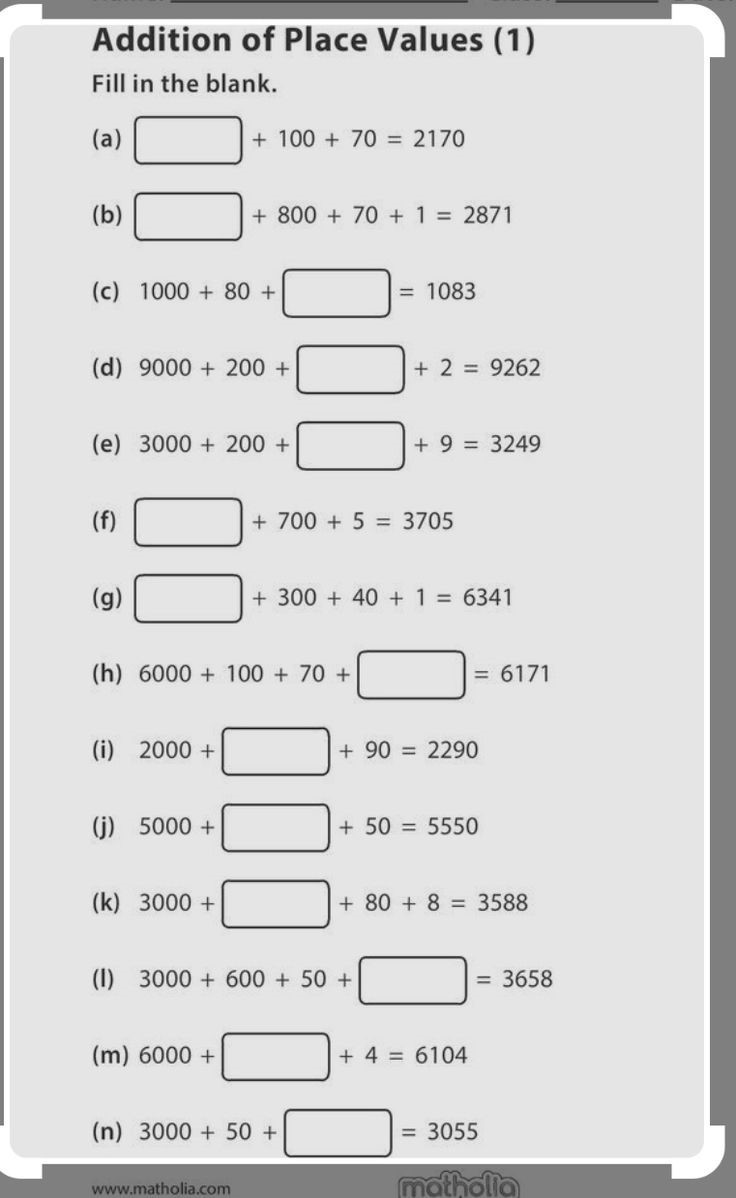
Do the following exercises
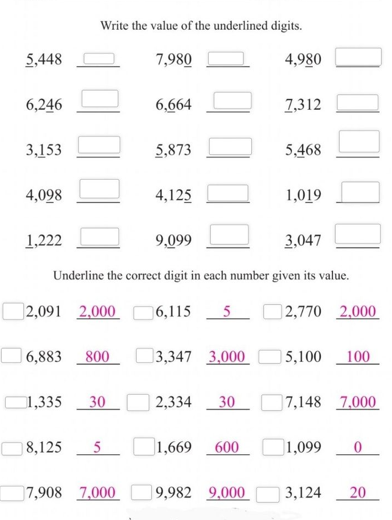
Write numbers in words.
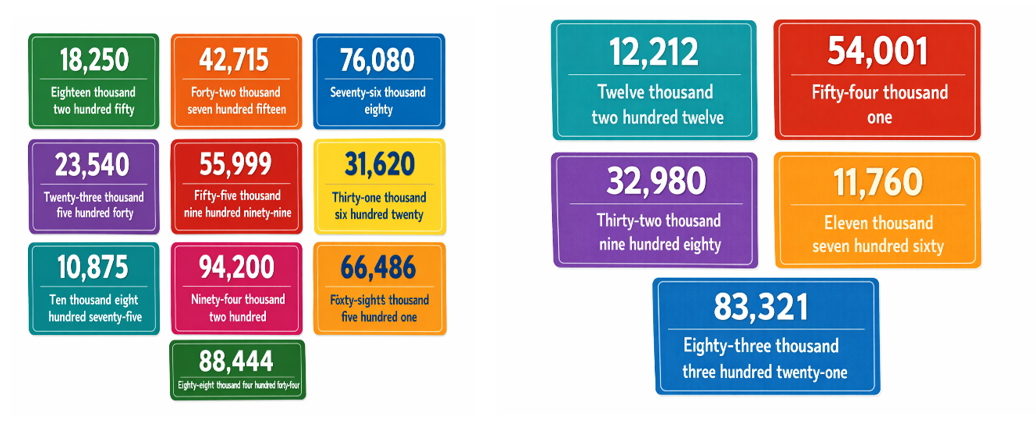
Writing numbers in words is a connection between numerical symbols with language. Each digit or group of digits corresponds to a word or phrase, and together they form the full expression of the number
Activity 14
Observe the following flashcards carefully.
Example 4
Carefully study the examples provided and then attempt the exercise.
- 12,345 Twelve thousand three hundred and forty-five
- 50,210 Fifty thousand two hundred and ten
- 7,806 Seven thousand eight hundred and six
- 99,999 Ninety-nine thousand nine hundred and ninety-nine
- 31,502 Thirty-one thousand five hundred and two
Exercise 7
Write the following numbers in words
- 12,345
- 23,456
- 45,678
- 67,890
- 98,765
Write numbers in numerals.
Writing numbers in numeralsmeans changing numbers written in words into number symbols (digits).
Activity 15
Study the examples below
- Twelve thousand three hundred and forty-five 12,345
- Twenty-five thousand six hundred and seventy-eight 25,678
- Forty-three thousand two hundred and ten 43,210
- Sixty-seven thousand eight hundred and ninety 67,890
- Eighty-eight thousand eight hundred and eighty-eight 88,888
- Ninety-nine thousand nine hundred and ninety-nine 99,999
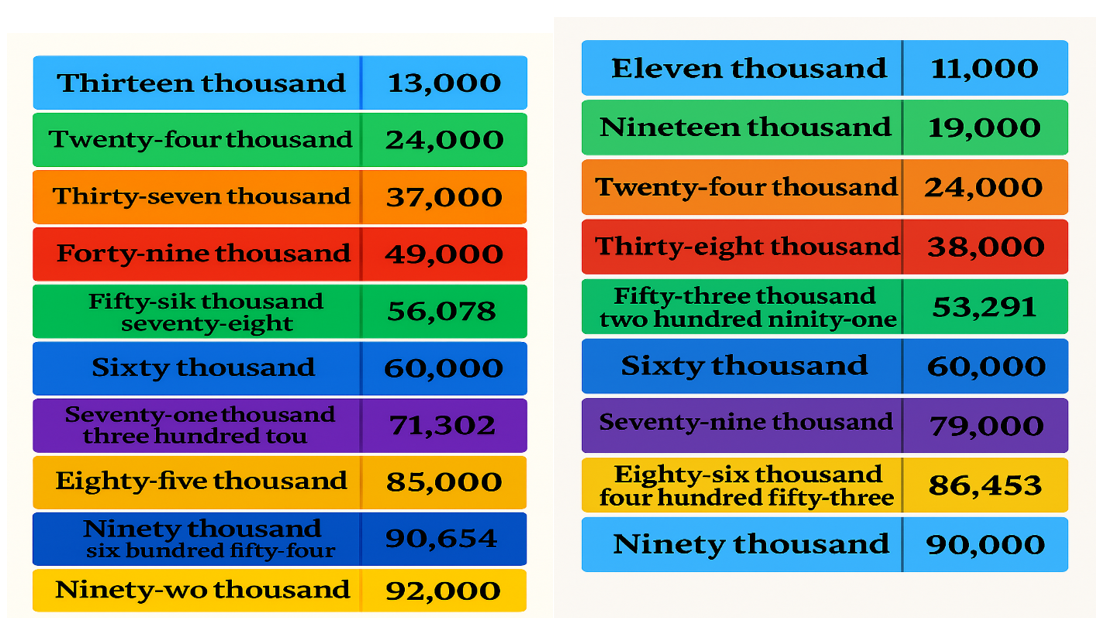
Example 5
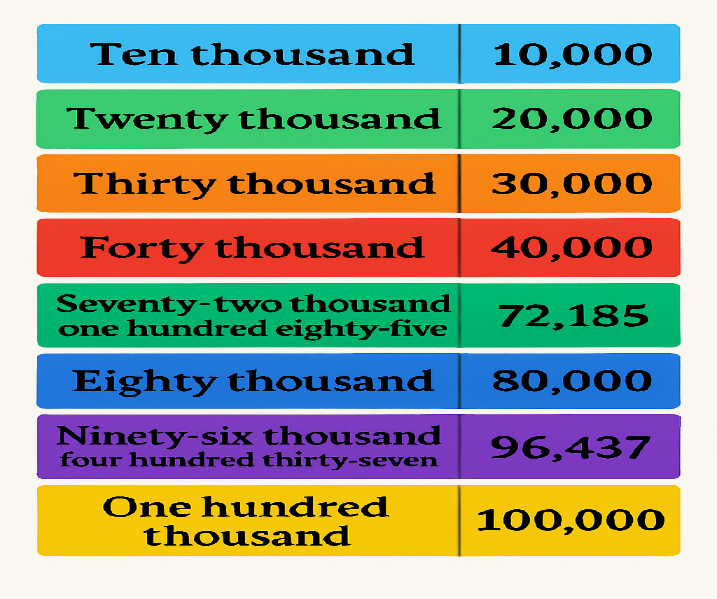
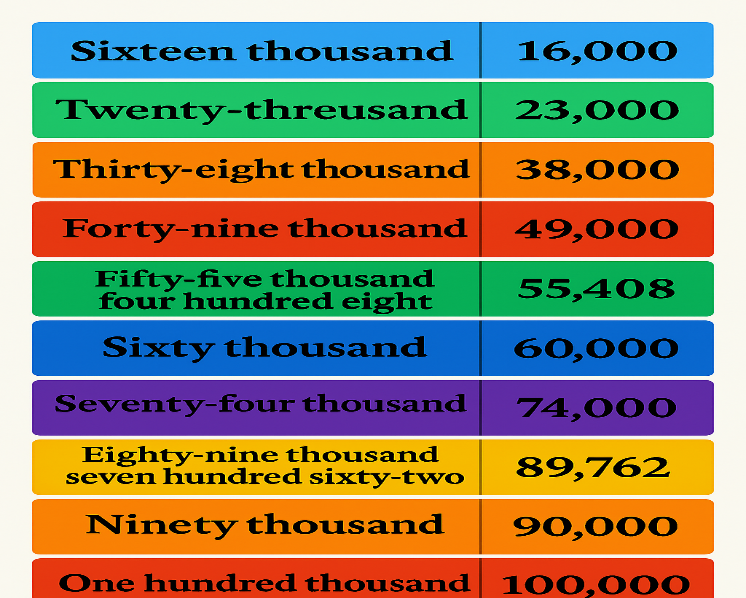
Observe the following flashcards, and then do the exercise by yourself
Example 6
Study more examples
Exercise 8
Write the following in numerals
- Sixteen thousand
- Twenty-one thousand two hundred and thirty-four
- Thirty-five thousand six hundred and seventy-eight
- Sixty thousand and one
- Eighty-four thousand
Exercise 9
Read and write the number mentioned in numerals.
- A school has one hundred and twenty pupils.
- A farmer collected two thousand eggs in one week.
- The book costs four thousand and five hundred shillings.
- The village planted three hundred and ninety trees.
- The school bought six hundred pencils.
- The company earned seven thousand eight hundred shillings last month.
- There are ninety-six students in the sports competition.
- A classroom has fifty-two chairs.
- The village planted two thousand five hundred trees this year.
- A library has one thousand two hundred books.
Listening to this topic